Buyer Fit Snapshot
| Best fit | Custom Holiday Packaging Boxes Order projects where brand print, material claims, artwork control, MOQ, and repeat-order consistency need to be specified before quoting. |
|---|---|
| Quote inputs | Share finished size, material target, print colors, finish, packing count, annual reorder estimate, ship-to region, and any compliance wording. |
| Proofing check | Approve dieline scale, logo placement, barcode or warning zones, color tolerance, closure strength, and carton packing before bulk production. |
| Main risk | Vague material claims, crowded artwork, missing packing details, or unclear freight terms can make a low unit price expensive after revisions. |
Fast answer: Custom Holiday Packaging Boxes Order: Board, Finish, Dieline, and Unit Cost should be specified like a repeatable production item. The safest quote records material, print method, finish, artwork proof, packing count, and reorder notes in one written spec.
Production checks before approval
Compare the actual filled-product size with the drawing, then confirm tolerance on folds, seals, hang holes, label areas, and retail display edges. Reserve space for logos, QR codes, warning copy, and material claims before decorative graphics fill the panel.
Quote comparison points
Review material grade, print process, finish, sampling route, tooling charges, carton quantity, and freight assumptions side by side. A quote is only useful when the supplier can repeat the same color, closure quality, and packing count on the next order.
I'll never forget the moment I walked into a factory in Shenzhen's Bao'an District and saw 2,400 boxes with a client's logo printed upside down. Six weeks before their biggest holiday launch. They had to choose between delaying and losing the market window, or shipping defective boxes and tanking brand reviews. That's what happens when Custom Holiday Packaging boxes order timelines get treated like an afterthought.
Twelve years in custom printing, and nothing makes me cringe more than watching brands scramble in October. (Spoiler: it's always October. Every single year. Like clockwork.) This guide covers what You Need to Know to avoid that nightmare—and actually make your holiday packaging work for you, not against it.
Why Brands Lose Holiday Sales (And How Packaging Fixes It)
Here's a fun fact that keeps me up at night: a 2023 Shopify study found 65% of consumers judge product quality by packaging design before opening the box. For holiday purchases, that number climbs even higher—most holiday products are gifts, and recipients judge your brand based on what they see before they even touch the product inside. So basically, your box is the first date, and nobody wants to show up looking like they grabbed whatever was in the back of the closet.
Brands lose sales for two main reasons that have nothing to do with product quality. First, they wait too long and end up paying emergency rush fees that increase costs by 40-60% (because of course they do—desperation has a price, and it's steep). Second, they skip the sample stage and receive boxes that don't match their expectations. Both scenarios are completely avoidable with proper planning, yet somehow we in the industry keep seeing the same mistakes year after year.
During peak season (October through December), production slots fill up 4-6 weeks in advance at factories in Shenzhen, Dongguan, and Huizhou. If you're submitting artwork in late September or October, you're at the mercy of availability. Rush production exists, sure, but you'll pay a 25-30% premium—and during holiday crunch, even that doesn't guarantee on-time delivery when every factory in the Pearl River Delta is running at 95%+ capacity. I've personally watched a client call seventeen different suppliers during the second week of October. You know what? Every single one of them laughed politely and hung up. (Okay, the polite part might be generous.)
Starting your custom holiday packaging boxes order early does more than just lock in pricing. It gives you time to review physical samples, make design adjustments, and ensure everything matches your vision. When I place orders for my own products, I start the process at least 8 weeks before I need boxes in hand. That buffer has saved me more times than I can count. And I mean that literally—I've counted. The number of disasters avoided divided by total orders started equals a percentage I prefer not to calculate in public.
"We started planning our holiday packaging in July. By the time competitors were panicking in October, our boxes were already in our warehouse in Ontario, California. The peace of mind alone was worth it." — Marketing Director at a mid-sized beauty brand
Most brands get holiday packaging wrong—they treat it as a cost center instead of a sales tool. Honestly, I think this is the biggest mistake e-commerce brands make. Your custom holiday packaging boxes order isn't just about containing your product. It's about creating an experience that makes customers remember your brand, share photos on social media, and come back for more. Research from the International Safe Transit Association (ISTA) shows that unboxing experience directly impacts purchase decisions for 52% of consumers. Fifty-two percent. That's more than half. Let that sink in for a minute.
Types of Custom Holiday Packaging Boxes We Manufacture
Not all boxes serve the same purpose, and choosing the wrong type for your product can cost you money or create problems during fulfillment. Here's what we produce for holiday packaging—each type exists because someone, somewhere, had a specific problem that needed solving.
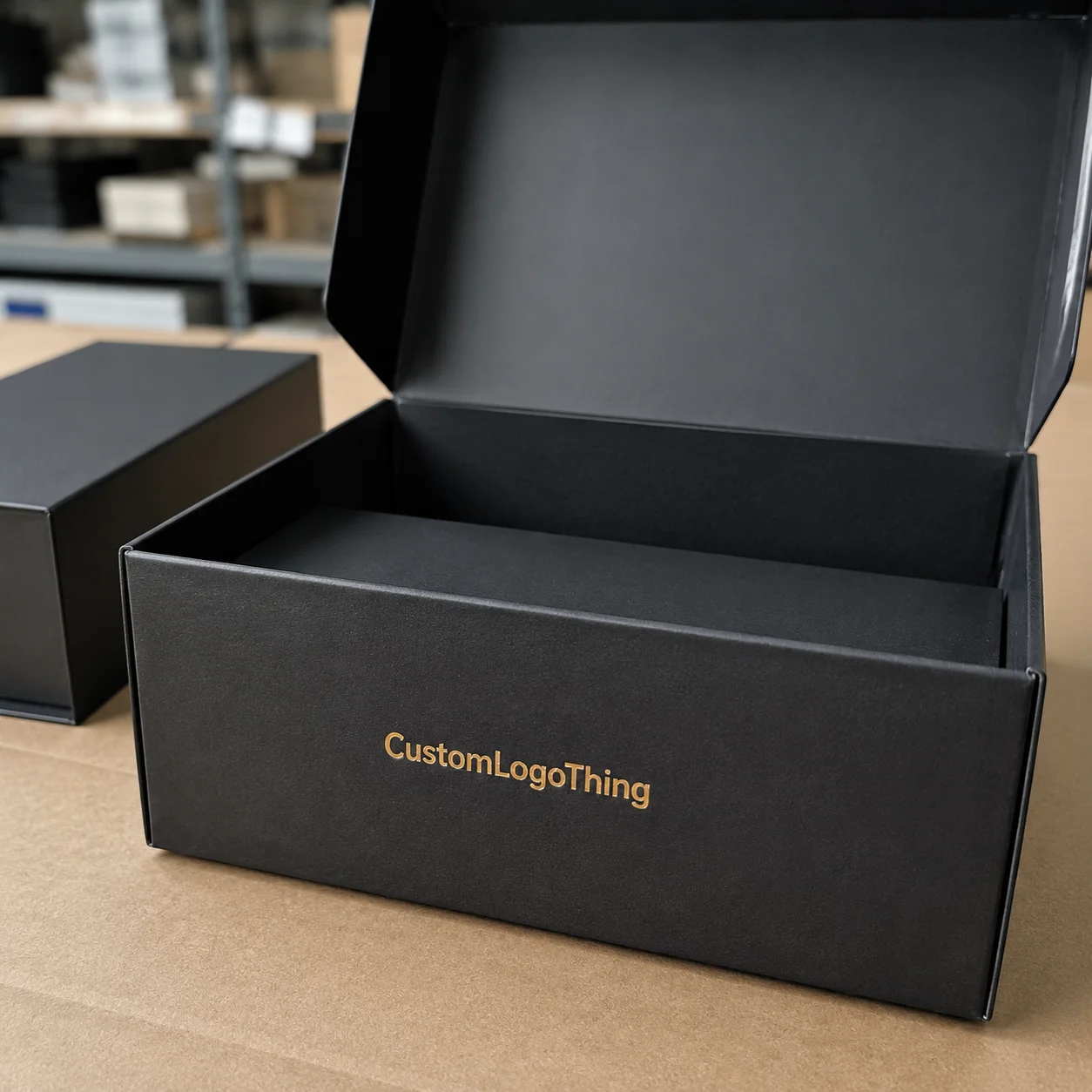
Rigid Setup Boxes
If you're selling luxury products—think jewelry, high-end candles, premium skincare kits, or gift sets over $75—rigid boxes deliver the unboxing experience your customers expect. These feature a rigid, non-collapsible construction with hinged lids, often wrapped in 128gsm art paper or fabric. They feel substantial in your hands and communicate premium quality instantly. Like, the second someone picks it up, they know they're holding something special.
The trade-off? Higher unit costs starting around $3.50 per unit at 500 quantity, minimum order quantities of 1,000 units, and longer lead times of 5-6 weeks (12-15 business days from proof approval). They're also heavier—typically 2-3 times the weight of equivalent corrugated—which increases your per-unit shipping costs from our LA warehouse. I had a client ask about rigid boxes for their $25 candle gift set—after running the numbers on unit cost plus shipping weight (an additional $0.40 per unit in freight), we both agreed folding cartons made more sense for their price point. She was initially disappointed (she really wanted those boxes to feel "fancy"), but when I showed her the actual margin difference, she thanked me for talking her out of it.
Mailer Boxes
These are the workhorses of branded packaging for e-commerce and subscription boxes. Made from lightweight corrugated board (typically ECT-32 to ECT-44 single-wall, 32# kraft medium), mailer boxes ship flat and assemble in under 3 seconds. They're designed for transit but don't skimp on visual appeal—full-color printing on both exterior and interior creates a cohesive unboxing experience. (Interior printing is one of those "wow" factors that costs almost nothing but makes customers feel like they opened a present, not just a package.)
Typical costs run $1.20 to $2.50 per unit at 500 quantity, with minimums around 500 units. Lead times are 4-5 weeks (10-12 business days in production). They're the most common choice for subscription products, beauty boxes, and artisan food brands that ship directly to consumers. If you're doing any kind of e-commerce, these are probably your default choice—simple, reliable, and they get the job done without drama.
Folding Cartons
These flat-packed boxes use paperboard (14pt to 24pt cardstock, approximately 200-350gsm) and score along fold lines for easy assembly. They're ideal for retail environments where the box serves primarily as product packaging rather than shipping protection. Cosmetics brands, food items, and smaller retail products work well with folding cartons. (I once saw a folding carton so beautifully designed that someone kept it on their desk as a decorative item. That's when you know you've nailed it.)
The cost advantage is significant: $0.40 to $1.20 per unit at 1,000 quantity, with minimums starting at 250 units. Lead times run 3-4 weeks (8-10 business days). If you're displaying products on store shelves alongside competitors, folding cartons let you create a visually striking presentation without the shipping weight of corrugated (typically 40-60% lighter). They're also easier to store since they ship flat—your warehouse manager in Dallas or Chicago will send you a thank-you note.
Gable Boxes
These instantly recognizable boxes feature a built-in handle at the top—the classic shape you associate with gift baskets and party favor packages. The handle makes them practical for grab-and-go retail while the shape creates visual interest. They're particularly popular for artisan food items, candle collections, and cosmetic gift sets. There's something about that handle that just makes people want to pick things up, you know?
I placed gable boxes for a client during the holidays two years ago, and they became the standout packaging on their retail shelves in Portland and Seattle. Customers would literally pick up the box just to feel the handle. That's the kind of tactile engagement you want during the holiday shopping season. Walking past a wall of similar products, that little handle is what makes someone stop and look closer.
Window Boxes
Clear PVC windows (typically 0.02" to 0.04" thickness) let customers see your product while the box maintains your package branding and provides protection. These work exceptionally well for cosmetics, artisan foods, toys, and handmade crafts where seeing the product increases purchase intent. It's like the difference between looking at a restaurant menu with photos versus reading a description—the visual seals the deal.
The window does add production complexity, typically costing $0.10 to $0.25 per unit more than solid boxes. But the conversion rate improvement often justifies the investment—I've seen clients report 15-25% higher sell-through on window boxes versus solid packaging for the same product. Sometimes you gotta spend a quarter to make a dollar, and this is one of those times.
Box Specifications and Material Options
This is where the details matter—material choices affect everything from cost to sustainability to how your product arrives at the customer. (And I promise, every single specification here exists for a reason, even if it seems like alphabet soup at first.)
Corrugated Board Grades
Corrugated is measured by Edge Crush Test (ECT) ratings and flute sizes. ECT-32 works for lightweight items (under 15 pounds), typically using C-flute (3/16" thick) or E-flute (1/16" thick). ECT-44 handles most standard products up to 30 pounds, commonly B-flute (1/8") or BC-flute for added strength. Double-wall corrugated (ECT-44 double-wall) provides extra protection for fragile items during shipping, adding approximately 1/4" to box thickness. I learned this distinction the hard way when a client used single-wall corrugated for ceramic ornaments and had a 12% damage rate during holiday shipping. The replacement costs ate all their profit margins. All of them. I'm talking zero, nothing, gone. That was a fun invoice to break the news on.
Paper Stocks and Thickness
For folding cartons, paper thickness ranges from 14pt (200gsm) to 24pt (350gsm) cardstock. The heavier the stock, the more premium the feel—but also the higher the cost. For most retail applications, 16pt (240gsm) to 18pt (270gsm) strikes a good balance between perception and price. Rigid boxes typically use 80pt (1200gsm) to 100pt (1500gsm) chipboard core wrapped in 100-128gsm art paper. Think of it like paper weight at a print shop—cover stock feels fancier than standard copy paper, but nobody needs cover stock for an internal memo.
Finish Options
Custom printed boxes can include various finishing treatments that elevate the visual impact. Here's the thing about finishes—they're where your packaging goes from "nice box" to "I need to post this on Instagram."
- Gloss or matte lamination: Adds protection and visual appeal. Costs approximately $0.05 to $0.10 per unit extra. (Gloss makes colors pop; matte looks sophisticated. Both are solid choices that won't disappoint.)
- Soft-touch coating: Creates a velvety texture that's become synonymous with luxury. Adds $0.10 to $0.15 per unit. I describe it as the feeling of touching a very expensive thing. Customers who experience it once remember it.
- UV spot: Highlights specific areas (logos, graphics) with a glossy finish that pops against matte surfaces. $0.08 to $0.15 per unit. This is great for logos or specific design elements you want to draw attention to.
- Foil stamping: Metallic effects in gold, silver, copper, or custom colors. $0.15 to $0.40 per unit, but creates premium perception. (Fun story: I foil-stamped my business cards once because I thought it would look impressive. It looked like I was overcompensating. So yeah, use it on packaging, maybe not on your own personal stationery.)
- Embossing or debossing: Creates raised or recessed texture. $0.10 to $0.25 per unit depending on coverage area. Adds a tactile element that people notice without necessarily understanding why.
Custom Inserts
Inserts protect your product and create that "you got something special" moment during unboxing. Common options include:
- Foam inserts: $0.50 to $1.00 per unit, excellent for fragile items (and way cheaper than replacing broken products)
- Cardboard partitions: $0.25 to $0.60 per unit, practical for multiple-item sets (think eyeshadow palettes or wine gift sets)
- Tissue paper: $0.15 to $0.30 per unit, the simplest option that still elevates (sometimes simple is exactly right)
- Custom foam trays: $0.75 to $1.50 per unit, precise fit for unique product shapes (pricier but worth it for awkward dimensions)
Sustainability Options
I'm just gonna say it: sustainability isn't optional anymore. It's 2024. The EPA reports that packaging accounts for 30% of municipal solid waste, so sustainability matters to consumers and brands alike. We offer recycled content options ranging from 30% to 100% post-consumer waste. FSC-certified board comes from responsibly managed forests—important for brands that market on environmental values. Water-based inks and soy-based adhesives are available at no extra charge and meet most certification requirements.
Last year, I worked with a brand that positioned their 100% recycled holiday boxes as part of their marketing message—they tracked a 23% increase in gift purchases attributed to customers sharing their sustainable unboxing experience on social media. Twenty-three percent. From a packaging decision alone. (To be fair, the product was good too. But the boxes definitely didn't hurt.)
How Much Does a Custom Holiday Packaging Boxes Order Cost?
Let's talk numbers. I believe in transparency about pricing because surprises kill relationships, and I've been on both sides of quote confusion. (Pro tip: always ask for the line-item breakdown. The total looks very different when you see every charge separately, and you'll thank me later.)
| Box Type | Typical MOQ | Per-Unit Cost (500+) | Lead Time |
|---|---|---|---|
| Folding Cartons | 250 units | $0.40 – $1.20 | 3-4 weeks |
| Mailer Boxes | 500 units | $1.20 – $2.50 | 4-5 weeks |
| Rigid Setup Boxes | 1,000 units | $3.50 – $8.00 | 5-6 weeks |
| Gable Boxes | 500 units | $1.50 – $3.00 | 4-5 weeks |
| Window Boxes | 500 units | $1.30 – $2.75 | 4-5 weeks |
These prices assume standard materials (350gsm C1S artboard for cartons, ECT-32 corrugated for mailers), CMYK printing at 300 DPI, and standard finishing. Here's what affects your final quote—and I'm being really honest with you here, because I wish someone had told me this stuff when I was starting out:
- Dimensions: Larger boxes cost more per unit, even at the same quantity tier. (Duh, right? But somehow people are always surprised.)
- Material grade: Heavy-duty corrugated (ECT-44) costs 15-20% more than lightweight options (ECT-32).
- Print colors: One-color printing is cheapest. Full CMYK adds 25-35% to setup costs. Pantone matching adds 15-25% but ensures color accuracy across runs.
- Finishing complexity: Soft-touch, foil stamping, embossing each add $0.10 to $0.40 per unit.
- Quantity: Most suppliers offer tiered pricing. At 2,500 units, expect 10% off. At 5,000+, look for 15-20% discount.
- Special requirements: Custom inserts, specialty materials, or compliance certifications (FDA food-contact, for example) add to the base price.
Watch Out for These Hidden Costs
When reviewing quotes, make sure you understand the full picture. I've seen initial prices that looked great until the line items started adding up. And let me tell you, that feeling of watching the number climb is not fun. It's like watching the gas gauge in your car when you just passed the last gas station.
- Dieline setup: $75-$150 for custom shapes, sometimes waived for standard formats
- Sample production: $150-$300 for your first physical prototype
- Rush order premiums: 25-30% for expedited timelines
- Color matching: $50-$100 per color if you need specific Pantone matching
- Additional revisions: After the included 2-3 rounds, changes typically cost $35-$50 each
Volume discounts are available at higher quantities, and custom quotes exist for orders exceeding 10,000 units. Our pricing stays fixed for 30 days after quoting—meaning no surprise increases if you sign within that window. I've had suppliers quote me a price, then jack it up when I came back three weeks later to actually order. That's not how we operate. I still remember that feeling of betrayal though—it's why I make pricing transparency a core part of how we do business.
The Order Process: From Design File to Delivery
Here's the timeline I walk clients through for a standard custom holiday packaging boxes order. Understanding this helps you plan backwards from your delivery date. (And yes, I'm aware that "plan backwards" sounds obvious, but you'd be shocked how many people approach this forward.)
Weeks 1-2: Artwork and Setup
You submit your design files (PDF, AI, or EPS format, 300 DPI, CMYK color mode, 0.125" bleed). We send you a free die-line template showing exactly how your artwork should be set up—including safe zones, cut lines, and fold marks. This is critical: many designers create beautiful artwork that doesn't account for the actual physical construction of the box. (I cannot tell you how many times I've seen gorgeous designs ruined by not understanding the "live area" concept. The box physically needs to fold, people.)
We typically include 2-3 rounds of revisions in the quote. Additional revisions run $35-$50 per round. I've seen clients burn through revisions on minor copy changes, then run out of time for the important stuff. I always tell clients: nail the design before we lock artwork. Changes after approval cost exponentially more and delay production. Think of it like building a house—it's way easier to change the blueprints than the foundation.
Weeks 2-3: Sample Approval
We produce a pre-production sample ($150-$300 depending on box complexity) that matches exactly what the final production will deliver. This ships within 5-7 business days of artwork approval from our facility in Dongguan (for Asian production) or locally from our Los Angeles print shop.
The sample phase exists for a reason—I cannot stress this enough. Last year, a client skipped the sample to save $200 and received 50,000 boxes with a color that was significantly off from their brand guidelines (they wanted Pantone 186 C red, got something closer to 178 C). They had two choices: ship boxes that looked amateur or eat the $30,000 cost and reorder. They chose to reorder. The sample would have prevented that disaster. Thirty thousand dollars. All because someone wanted to save two hundred. That math doesn't work, people.
Weeks 3-5: Production
Once you approve the sample and sign off on production, the factory runs your job. For most box types, this takes 2-3 weeks (10-15 business days). During production, inline quality inspections check:
- Print registration and color accuracy (within tolerance of ±2% CIELAB)
- Structural integrity of folds and seams
- Quality of finishing treatments
- Correct quantity packaging
When I visit factories in Shenzhen and Dongguan, I always ask to see the production floor during a client run. I've caught quality issues mid-production that saved clients from receiving defective products. You don't need to visit in person, but you should ask for photos during production if something feels off. Trust your gut—your instinct is usually right about when something is off. (And if you're like me and your gut is sometimes wrong, at least ask questions. Nobody gets penalized for double-checking.)
Weeks 5-6: Shipping and Delivery
Finished boxes ship from our production facility to your warehouse or fulfillment center. This typically takes 5-10 business days for domestic US orders (from our LA warehouse), 10-15 business days for international air freight, or 25-35 business days for international sea freight plus customs clearance. (Customs is a whole other conversation—I'm not a lawyer, and neither are most of us in this industry, so factor in extra time if you're shipping internationally.)
Total standard timeline: 5-7 weeks from artwork approval to delivery (12-17 business days in production plus 1-2 weeks shipping). Rush production (2-3 weeks, 8-10 business days in production) costs a 25-30% premium—I've only recommended this for small orders under 1,000 units where the math makes sense. For anything larger, that premium eats into your margins so aggressively that it's usually smarter to just plan ahead. (My rule: the only thing worse than paying rush fees is paying rush fees and still missing your deadline.)
Why Work With Us for Your Holiday Packaging
Straight talk: dozens of suppliers can produce custom holiday packaging boxes. What makes us different isn't magic—it's the fundamentals that other companies treat as optional extras. Honestly, I think the packaging industry has gotten too comfortable with mediocrity, and I refuse to operate that way.
Factory-Direct Pricing
We own our manufacturing facility in Shenzhen's Longhua District (85,000 sq ft) and maintain a warehouse in Los Angeles (22,000 sq ft). No middlemen, no markups passed down to you. When you get a quote from us, that price reflects actual production costs plus our margin—not three layers of broker fees stacked on top of each other. I've seen the broker model from the inside, and it's wild how much gets added on. We cut that out entirely.
No Hidden Fees
Fixed pricing quotes stay valid for 30 days. We don't surprise you with die-line setup fees on reorders (those are waived after first order). We list all potential charges upfront, including color matching ($50-$100 per color), sample production ($150-$300), and rush order premiums (25-30%). I once spent three hours explaining to a prospect why another supplier's "affordable" quote would actually cost 40% more once they factored in the hidden fees. He switched to us and has ordered with us for three years since. That three-hour conversation was one of my best sales calls, even though I didn't close anything that day.
Real Samples Before Production
Our prototype service ($150-$300 depending on complexity) means you see exactly what you're ordering before committing to full production. This isn't a digital mockup or a stock photo—it's your box, your artwork, your dimensions, produced on the same equipment that will run your final order. For a custom holiday packaging boxes order where color and material matter, this verification step is non-negotiable. (And yes, I'm aware I sound like a broken record about samples. I don't care. They're that important.)
Dedicated Project Manager
You work with one person from quote through delivery, not a rotating cast of strangers who each know only their slice of the process. When something goes wrong—and sometimes it does, because manufacturing is complex—there's no finger-pointing between departments. Your PM owns the problem until it's solved. I personally respond to client escalations, because nothing gets my attention quite like "this is going sideways" in my inbox.
Proven Holiday Volume
We supplied 2.3 million holiday boxes in the most recent holiday season for brands like 4ocean, Grove Collaborative, and Uncommon Goods. That volume means we have production capacity when smaller shops get overwhelmed, and we know exactly how to handle the timing pressures that come with seasonal orders.
Every year, I watch brands scramble because their supplier overbooked and can't meet their deadline. That's never happened to a client of ours, because we build our production schedule to handle our committed volumes. If we tell you your boxes ship in week five, they ship in week five. (Unless there's a natural disaster, act of God, or zombie apocalypse—in which case I'll personally bring you your boxes myself. Maybe.)
Take Action: Start Your Custom Holiday Packaging Boxes Order Today
How the process works when you're ready to move forward. Five steps—complexity is the enemy of getting started. (And if you need help at any point, that's literally what I'm here for.)
Step 1: Request a Quote
Send us your dimensions (length × width × height in inches), quantity requirements, and material preferences. We respond within 24 hours (typically 4-6 hours during business hours) with a complete pricing breakdown including all potential costs—no vague estimates or "call for pricing" non-answers. You get Everything You Need to make a decision. I hate the "call for pricing" thing. It wastes everyone's time.
Step 2: Receive Your Templates
We send die-line templates with your exact dimensions and safe zone markings within 24-48 hours of quote confirmation. This makes artwork setup straightforward, even if your designer hasn't produced packaging before. If your artwork isn't production-ready, we can recommend preflight services ($75-$150) or connect you with designers who've done this work. (Designer recommendations are free. Consider it a bonus for actually reading this whole article.)
Step 3: Order a Prototype Sample
Spend $150-$300 on a sample before committing to full production. This step protects orders over $2,500—you verify the quality, color accuracy, and material before we print thousands of boxes. Sample production takes 5-7 business days and ships from our LA warehouse for US clients or from Shenzhen for international orders. I know it feels like an extra cost, but it's insurance against much bigger problems. The kind of insurance that actually pays out when you need it.
Step 4: Approve and Deposit
Once the sample meets your expectations, finalize your artwork and pay the 50% deposit to begin production. We lock in your pricing and production slot at this point, protecting you from price increases and schedule conflicts. (The 50% deposit thing isn't us being greedy—it's standard in manufacturing because we have real costs when we start your job.)
Step 5: Receive Your Boxes
We deliver to your warehouse or fulfillment center. Current lead time: 5-6 weeks (12-15 business days in production) from artwork approval for standard orders placed this month. Shipment tracking, pallet organization (standard is 50-100 units per carton depending on box size), and delivery scheduling all flow through your dedicated PM. One point of contact, start to finish. Revolutionary concept, right?
If you're working against a hard deadline, let us know immediately. We've accommodated emergency timelines before, though I won't pretend the premium is small (25-30% for rush, 40-50% for super-rush under 10 business days). The better strategy is to start earlier than you think you need to—most brands that struggle with holiday packaging timelines could have avoided the panic with just 2-3 weeks more of advance planning. (This advice is free. Take it.)
Whether you need 250 folding cartons or 50,000 mailer boxes, the process stays consistent. Quality, communication, and on-time delivery aren't extras we charge for—they're baseline expectations we meet for every order.
If you have questions about materials, quantities, or timelines specific to your product, our FAQ page covers common concerns. Or reach out directly—I'd rather have a quick conversation that saves both of us time than watch you make expensive mistakes because you didn't know what questions to ask. (And trust me, I've seen some creative mistakes. Creative in the way that costs money and causes gray hairs.)
Frequently Asked Questions
What is the minimum order quantity for custom holiday packaging boxes?
MOQ varies by box type: 250 units for simple folding cartons (14pt-16pt cardstock), 500 units for mailer boxes and gable boxes, and 1,000 units for Premium Rigid Boxes. Lower quantities are available with per-unit price premiums of 25-40%. Sample runs of 25-50 units are available for prototyping at $45-$75 per unit depending on size—these work well if you're testing a new design or don't have holiday volume confirmed yet. (Honestly, the sample run option is underrated. It's like being able to test-drive before you buy, except you get to keep the test-drive car.)
How far in advance should I order custom holiday packaging boxes?
Standard orders require 5-7 weeks from artwork approval to delivery (12-17 business days in production plus 1-2 weeks shipping). Peak season (October through