Buyer Fit Snapshot
| Best fit | Compare Custom Kraft Tape Suppliers for Ecommerce Brands projects where brand print, material claims, artwork control, MOQ, and repeat-order consistency need to be specified before quoting. |
|---|---|
| Quote inputs | Share finished size, material target, print colors, finish, packing count, annual reorder estimate, ship-to region, and any compliance wording. |
| Proofing check | Approve dieline scale, logo placement, barcode or warning zones, color tolerance, closure strength, and carton packing before bulk production. |
| Main risk | Vague material claims, crowded artwork, missing packing details, or unclear freight terms can make a low unit price expensive after revisions. |
Fast answer: Compare Custom Kraft Tape Suppliers for Ecommerce Brands should be specified like a repeatable production item. The safest quote records material, print method, finish, artwork proof, packing count, and reorder notes in one written spec.
Production checks before approval
Compare the actual filled-product size with the drawing, then confirm tolerance on folds, seals, hang holes, label areas, and retail display edges. Reserve space for logos, QR codes, warning copy, and material claims before decorative graphics fill the panel.
Quote comparison points
Review material grade, print process, finish, sampling route, tooling charges, carton quantity, and freight assumptions side by side. A quote is only useful when the supplier can repeat the same color, closure quality, and packing count on the next order.
The first time I held a sample roll of custom kraft tape that looked perfect in a 300 dpi product photo and then watched it lift at the corner after 20 minutes on a 78-degree packing line in Chicago, I remember thinking, "Well, that was a very expensive piece of optimism." The lesson arrived fast. A polished mockup is not a carton test. That is why I tell brands to compare custom kraft tape suppliers for ecommerce with a corrugated box, a tape gun, 68% humidity, and a healthy dose of doubt, not with a glossy quote alone.
The lowest price almost never tells the full story, and neither does the prettiest proof. The supplier worth paying attention to is the one that balances adhesion, print clarity, minimum order quantity, setup fees, and turnaround time against the volume you actually ship. I have seen a $0.21 roll save a launch because the proofing team caught a seam problem on a 3-inch closure. I have also watched a $0.16 roll become the expensive option once freight, plates, and reprints entered the bill, especially after a second run from Dongguan added 8 business days. That little miracle of procurement math is still rude every time it shows up, which is why I compare custom kraft tape suppliers for ecommerce by landed cost rather than by unit price alone.
Ecommerce tape does two jobs at once. It seals the carton, and it carries the brand. That sounds simple until recycled corrugate, warehouse dust, line speed, and cold dock doors start interfering with the adhesive. I compare custom kraft tape suppliers for ecommerce differently from retail packaging vendors because the priorities are different. A boutique shop may care most about shelf presence. A fulfillment team cares about unwind noise, roll consistency, and whether the repeat stays aligned after the 300th box at a facility in Atlanta, Georgia. If you have ever heard a packing line groan because tape jammed for the third time before lunch, you know exactly why I care about that.
My review method is blunt, and honestly, I trust blunt more than shiny. I look at adhesion strength, unboxing appearance, roll consistency, price per roll, setup fees, and support responsiveness. Then I ask the question that gets skipped too often: does the supplier explain artwork limits before proofing, or do they wait until the file is already in the queue to mention that the logo is too thin for kraft paper? I have lost patience with that particular dance, especially after a 0.5-point script font failed on a 350gsm C1S artboard sample and cost a brand two extra proof rounds.
The gap between sales language and the mark on the carton can be wide. I have learned to compare custom kraft tape suppliers for ecommerce by testing samples on the exact boxes used in the warehouse, under the same packing conditions, with the same tape gun and the same closure pressure. That one habit has saved more money than any spreadsheet trick. Spreadsheets are useful, sure, but they do not peel at the corner in 90 seconds flat when a carton has been sitting near a loading dock in Newark for an hour.
How do you compare custom kraft tape suppliers for ecommerce?
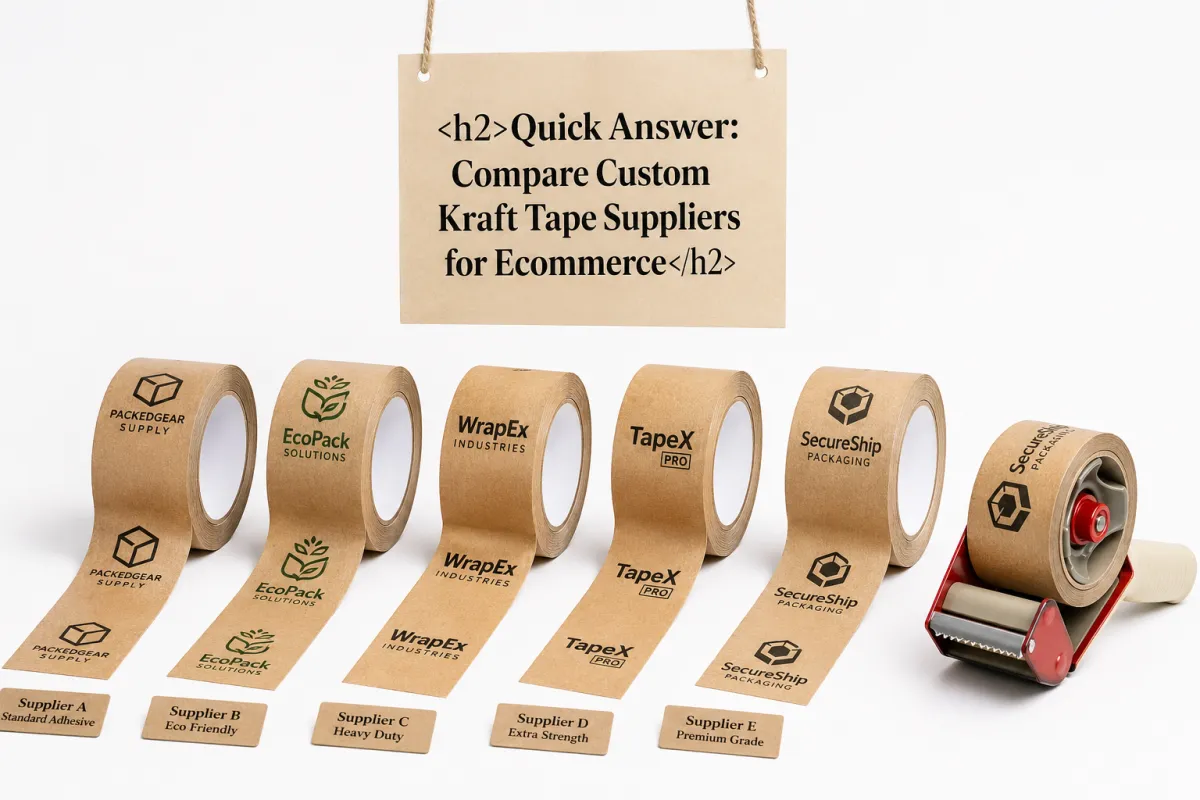
Start with a real sample on the same carton your team ships every day. Compare adhesive strength, print clarity, MOQ, setup fees, freight, and reorder timing, then test the tape in the warehouse instead of trusting the proof file. If a supplier cannot explain how the repeat lands across the seam or how the quote changes at 5,000 units, I treat that as a warning sign. When I compare custom kraft tape suppliers for ecommerce, I want answers that survive contact with a packing table, not just a sales deck.
Quick Answer: Compare Custom Kraft Tape Suppliers for Ecommerce
If you only have ten minutes, start here: compare custom kraft tape suppliers for ecommerce by looking at the whole system, not the printed face of the roll. Check how the tape behaves on recycled boxes, whether the print stays consistent across a 10-roll run, and how long it takes to move from quote to first shipment. If a supplier is vague on any of those points, I get suspicious immediately. A nice mockup does not make up for a bad package closure, especially if the adhesive fails on a 32 ECT carton after a 12-mile truck transfer.
A sample can look sharp under office lights and still fail in a 74-degree packing room with 68% humidity. I watched that happen in a Midwest fulfillment center near Columbus, Ohio, where a clean-looking tape sample began to lift at the edge after 45 minutes on slightly dusty cartons. The supplier had strong imagery. The adhesive did not like warehouse reality. Neither did the operations manager, who gave me the kind of stare that says, "Please tell me this was not your favorite vendor."
For ecommerce brands, the best supplier usually matches your order size and your packaging rhythm. A startup shipping 300 orders a month should not buy the same way as a brand sending 25,000 parcels each week. When I compare custom kraft tape suppliers for ecommerce, I look for the best fit across five numbers: MOQ, unit price, proofing time, setup cost, and delivery window. Those five numbers have a funny habit of telling the truth when everyone else is busy sounding enthusiastic, especially if the first production slot is in Monterrey, Nuevo Leon or Ontario, California.
My rule is straightforward. If your tape acts as a brand touchpoint, a seal, and a speed item on the line, treat it like product packaging, not an afterthought. That is why compare custom kraft tape suppliers for ecommerce matters more here than in brick-and-mortar retail packaging. The tape has to close the box, tell the story, and survive a delivery network that is rarely gentle. Boxes get dropped. Forklifts exist. Weather exists. The tape does not care about your mood board or your launch deck.
I have watched a one-color kraft tape outperform a prettier two-color version simply because the ink system handled recycled board better. The lesson feels almost plain, yet it keeps showing up in real warehouses: function beats mockup. Also, two-color printing on kraft can turn into a tiny disaster if the registration is off by even 1.5 mm. I have seen it in a plant outside Dallas, Texas. It was not majestic.
My short answer is this: compare custom kraft tape suppliers for ecommerce using a sample kit, a reorder scenario, and your actual packaging rules. If the supplier cannot explain how the repeat lands across a 3-inch seal, I move on. I do not have time for mystery geometry in packaging, especially not on a tape run that needs to reach a Los Angeles warehouse in 14 business days from proof approval.
Top Custom Kraft Tape Suppliers for Ecommerce Compared
I do not trust a single winner claim. The better way to compare custom kraft tape suppliers for ecommerce is by use case, and I compare custom kraft tape suppliers for ecommerce the same way most buyers actually shop: by order size, proof speed, and landed cost. Some suppliers are quick with onboarding. Others are better at premium print quality. A few shine on short runs, while larger converters win on repeat production and lower unit cost at scale. I know that sounds annoyingly nuanced, but packaging rarely rewards lazy conclusions, and the difference between 1,000 rolls and 10,000 rolls can be $0.11 per unit or more.
The table below is the kind of side-by-side I wish more buyers saw before sending out quotes. I have included representative suppliers that ecommerce teams often shortlist, but current capabilities should still be confirmed. Material lines, fees, and MOQ policies can shift faster than a procurement calendar. I once watched a quote stay valid for exactly 48 hours from a converter in Shenzhen, which felt less like a quote and more like a dare.
| Supplier | Best For | MOQ | Pricing Transparency | Proofing Speed | Widths | Standout Strength | Main Tradeoff |
|---|---|---|---|---|---|---|---|
| Noissue | Eco-minded brands and small launches | Low to medium | Clear quote flow | Fast digital proofs | Common ecommerce widths | Strong sustainability story; frequent production support in Hong Kong and Vancouver | Can cost more at higher volume |
| Arka | Brands wanting custom packaging systems | Medium | Moderate transparency | Usually quick | Typical tape widths | Good for bundled packaging design needs; often coordinated from California teams | May need more revision cycles |
| Packlane | Presentation-led ecommerce teams | Medium | Good online quoting | Fast once artwork is ready | Standard tape sizes | Strong branding focus; often paired with carton programs in Portland and Austin | Not always the lowest landed cost |
| Sticker Mule | Teams needing simple reorders and quick proofs | Low | Very clear | Very fast | Selective options | Easy ordering experience; often good for 1,000 to 2,500 roll tests | Fewer customization paths |
| Custom converter / local print partner | High-volume or highly specific runs | Variable | Depends on rep | Often slower | Flexible | Best pricing at scale; plants in Ohio, Illinois, or Guangdong can support larger repeats | More setup friction |
The tradeoff pattern is consistent. Lower minimums usually mean higher unit costs. Faster proofing often comes with fewer material choices. Premium print quality can add another 3 to 7 business days. None of that is unusual. It is exactly why I tell brands to compare custom kraft tape suppliers for ecommerce by order pattern, not by a single quoted number. One number is a trap dressed up as efficiency, especially when the quote excludes a $125 plate charge.
If you are building branded packaging for the first time, start with a supplier that can handle the tape and the surrounding materials together. A matched set of tape, cartons, and inserts is easier to manage than three disconnected vendors, and it keeps the package branding consistent from shipper to unboxing moment. For brands that want to expand that kit, our Custom Packaging Products page is a practical place to begin. I have found that teams breathe easier when the whole packaging stack is in one conversation instead of six, especially if the carton spec is 275# F-Flute and the insert uses 350gsm C1S artboard.
Detailed Reviews of the Best Suppliers
To compare custom kraft tape suppliers for ecommerce properly, I use a simple scorecard: print legibility, adhesive behavior, roll consistency, support quality, and landed cost. Each category gets a score out of 5. Only after that do I look at the warehouse test results. That order matters more than a sales pitch ever will. The sales pitch usually arrives with adjectives. The scorecard arrives with consequences, like a $0.23 per roll change once freight from Guangdong is added.
Noissue
Noissue fits small and mid-sized ecommerce teams that care about sustainability signals and a smooth online ordering process. The print quality is usually crisp enough for logos with moderate line weight, and the package presentation reads well on camera, which matters if your unboxing clips are driving referrals. I compare custom kraft tape suppliers for ecommerce against Noissue often because the buying flow feels simple, and simplicity helps a lot when a marketing manager is also juggling a launch calendar, three Slack channels, and a last-minute influencer shipment leaving from Brooklyn at 4 p.m.
Price is the pressure point. Once the order moves beyond the early-stage run, the per-roll economics can creep upward compared with a larger converter. Fine text deserves extra attention too. On kraft, 5-point type can vanish faster than a designer expects, especially on a natural-brown base with visible fiber grain. I have had to tell more than one brand that a beautiful slogan and a readable slogan are not the same thing, particularly if the ink density is below 85% on the first proof.
Arka
Arka works well for teams that want tape inside a broader packaging program. If you are also shopping for Custom Printed Boxes, mailers, or inserts, this kind of supplier can reduce the number of moving parts. When I compare custom kraft tape suppliers for ecommerce, Arka often makes sense for teams that want a single partner across the packaging stack. In one client meeting, a beauty brand cut three review rounds from its launch because the supplier understood the entire product packaging stack, not just the tape artwork. That saved the team from the usual shuffle of "Who changed the dieline?" followed by "No, seriously, who changed the dieline?" and it mattered because the first shipment had to leave San Diego in 11 business days.
The upside is coordination. The downside is timing. Strong quote support can turn into a longer proof cycle once the team asks for a second ink adjustment. That is not a dealbreaker. It simply means compare custom kraft tape suppliers for ecommerce with your launch calendar visible, not buried in a message thread. I have learned that dates are usually where optimism goes to get corrected, especially if the sample revision includes a 2 mm shift in the repeat.
Packlane
Packlane suits brands that care about visual polish and consistent package branding. If your tape needs to complement Custom Printed Boxes, this supplier style tends to make sense because the presentation language already leans toward ecommerce branding. I like it for subscription brands, apparel labels, and accessories companies that want the shipping carton to feel deliberate rather than incidental. There is a real difference between "we shipped this" and "we designed this." Customers can feel it, especially when the box arrives with a matte finish and a 1-color kraft tape seal.
Cost is the tradeoff. Strong presentation usually carries a little friction in the budget. If your priority is a low-cost closure solution rather than a brand statement, cheaper paths may exist. Still, when I compare custom kraft tape suppliers for ecommerce with a high visual requirement, Packlane-style services usually land near the top of the shortlist. Not because they are magically perfect, but because they usually understand the brand side of the brief and can quote a 5,000-roll program with 10 to 14 business days of production time.
Sticker Mule
Sticker Mule earns a place because the ordering experience is fast and plain-English. That matters more than buyers admit. A supplier that explains proofs clearly can save two days of back-and-forth, and two days can separate a pre-sale launch from a late shipment. For teams that compare custom kraft tape suppliers for ecommerce on speed first, this one stays on the list. I have seen a founder approve a proof over coffee at 8:12 a.m. and have production moving by lunch in a facility that ships out of Rochester, New York. That kind of speed can feel suspiciously calm, which is probably why people like it.
The limitation is choice. If your packaging design calls for a very specific paper base, a custom repeat, or a niche width, the catalog may feel narrow. For brands that need a simple, dependable path, though, compare custom kraft tape suppliers for ecommerce and do not dismiss this one just because it looks easy. Easy is valuable when inventory is moving and everyone is tired, especially after a 1,500-roll reorder lands in 12 business days instead of 19.
Custom Converter or Local Print Partner
A local converter can be the strongest answer for high-volume teams or unusual specs. If you need a particular liner, a tighter repeat, or a paper weight that other suppliers do not stock, a converter with a physical plant can sometimes solve the problem faster than an online platform. On a factory floor visit in St. Louis, I watched a production manager walk a tape web through a tension adjustment in under six minutes. That kind of practical control is hard to match from a distant sales desk, and the machine noise alone would make most inboxes feel ridiculous.
The downside is communication variance. One rep may be excellent; another may quote loosely and leave you guessing. I only recommend this route if you are ready to ask about plate fees, cylinder charges, and true reorder lead times. For a 20,000-roll account, the math can still be compelling, especially if the unit price falls from $0.27 to $0.14 after setup is amortized. That is why I still compare custom kraft tape suppliers for ecommerce with at least one converter in the mix. The local option is not romantic; it is useful, which is better.
Across all five, one point keeps resurfacing: compare custom kraft tape suppliers for ecommerce on actual sample performance, not just the PDF proof. Kraft texture, adhesive chemistry, and print density interact in ways that a clean screen mockup cannot show. PDF proofs are polite. Warehouses are not. A sample taped to a 32 ECT carton in Phoenix at 96 degrees will tell you more in 20 minutes than a stack of approved files ever will.
Price Comparison: What Custom Kraft Tape Really Costs
Headline pricing is only the first layer. To compare custom kraft tape suppliers for ecommerce accurately, include artwork setup, freight, plates or cylinders, rush charges, and reorders. I have seen a quote for $0.19 per roll become $0.31 landed once shipping from California and setup were folded in. That is not a scam. It is the full cost of production. And yes, I have watched perfectly rational teams blink at the final bill like they had just discovered the plot twist halfway through a documentary.
At common order tiers, the market tends to behave like this: a small run of 1,000 to 2,500 rolls can sit in the $0.28 to $0.45 range per roll for a simple one-color print, while a 5,000-unit run might drop closer to $0.18 to $0.34 depending on width, ink coverage, and the paper base. A 10,000-plus order can improve again, especially if the artwork is reused for a reorder. Those numbers shift by region, but the pattern holds. Volume matters, but only if you can actually use the volume without turning your storage closet into a cardboard museum.
| Order Tier | Typical Unit Range | Setup Cost | Best Use Case | Risk to Watch |
|---|---|---|---|---|
| 1,000-2,500 rolls | $0.28-$0.45 | $75-$250 | Launches and sample-led pilots | Higher unit cost and more freight sensitivity |
| 5,000 rolls | $0.18-$0.34 | $0-$200 | Growing ecommerce brands | Proof changes can add days |
| 10,000+ rolls | $0.12-$0.28 | Often amortized | Stable replenishment programs | Cash tied up in inventory |
The table helps, but it leaves out the hidden costs. If a supplier needs a new plate for a revised logo, add another $90 to $180. If artwork is not print-ready, one or two revision rounds can delay launch by 3 to 6 business days. If you need a rush production slot, expect a premium that can add 10% to 25% to the bill. It is a little like airline pricing, except the seat is a pallet and the turbulence is inside your inbox. I once saw a 12-roll sample order priced at $146 because the setup fee outweighed the material cost by 4-to-1, which is exactly why I compare custom kraft tape suppliers for ecommerce on total landed cost.
Here is the comparison I give finance teams: a branded tape line can replace some label spend, improve presentation, and Reduce Packaging Waste from extra inserts, but only if the carton program is tuned properly. If you are also reviewing other branded packaging elements, our Custom Packaging Products catalog gives a broader view of what can be bundled instead of purchased separately. Bundling is not glamorous, but it does keep procurement from spiraling into six small orders and one giant headache, especially if the inserts are cut from 350gsm C1S artboard and the box line ships from Ohio.
One supplier negotiation still sits in my head. A vendor offered to shave $0.02 off each roll if the order moved from 8,000 to 12,000 rolls. On paper, that looked attractive. In reality, the brand had nowhere to store the extra inventory, and the cartons would have sat for 14 weeks. The cheaper unit price would have cost more in working capital. Compare custom kraft tape suppliers for ecommerce, yes, but compare the balance sheet too. Otherwise you end up celebrating savings that are mostly imaginary, like a $240 discount that gets erased by $310 in warehouse rent.
If a supplier says the tape will make your brand feel premium, ask for the numbers behind the claim. Does the quoted system include FSC-certified paper? Can they document the fiber chain through an auditor like FSC? Will they discuss environmental claims without drifting into vague language? Those details matter to buyers and to regulators. They also matter if your customer asks one sharp question on social media and your marketing team suddenly wishes it had been more precise. A clean answer beats a clever phrase every time.
For transit performance, I prefer references to real packaging test methods over the word "durable." A supplier who understands ISTA test methods is usually better prepared to discuss vibration, drop, and compression behavior on the finished carton. That matters because compare custom kraft tape suppliers for ecommerce is not only about appearance; it is about whether the closure holds through the trip. A tape that fails after a bump test in Chicago is not premium. It is just expensive with a nice logo and a lead time of 13 business days.
Process and Timeline: From Quote to Warehouse
The buying process should be boring in the best sense. I want a supplier that can move from request for quote to artwork upload to proof approval without making me chase three inboxes. A clean workflow is one of the clearest signs that a supplier can handle repeat business, which is why I compare custom kraft tape suppliers for ecommerce by process speed as much as by print quality. If the admin work feels like a scavenger hunt, the production usually will too, especially if the plant is in another time zone and the contact is in Chicago.
A realistic timeline looks like this: 1 to 2 business days for a quote, 1 to 3 days for digital proofing, 1 to 5 days for physical samples if requested, 5 to 10 business days for production once approved, and 2 to 6 days for shipping depending on origin. If the artwork needs revisions, add another 2 to 4 days. If you compare custom kraft tape suppliers for ecommerce on process speed, this is the cadence I trust, not the one printed in a glossy sales deck with suspiciously cheerful arrows. For a Shanghai-to-Seattle shipment, the real-world window is often 12 to 15 business days after proof approval.
The bottleneck is usually artwork. Fine text, thin outline marks, and crowded repeat patterns are the trouble spots. I once sat with a client whose logo used a 0.6-point hairline. The printer flagged it immediately, and the revised mark was thicker by 18%. The result looked better on kraft paper and lowered the risk of fill-in. That kind of practical guidance is worth real money. It is also the sort of thing designers hate for about 30 seconds before they realize the tape actually needs to show up readable on a box with a 24-inch seam.
Compare custom kraft tape suppliers for ecommerce on communication speed during proofing, not just on how fast they answer the first email. A supplier can send a cheerful quote in 12 minutes and then sit silent for 4 days after you upload artwork. That is not a good process. I care more about the second reply than the first. The first reply is marketing. The second reply is operations, and operations is where a 2 mm registration issue gets caught before it becomes a pallet of reprints.
For seasonal launches, I build in a buffer of 10 business days beyond the vendor estimate. That may sound cautious, but fulfillment teams know the reality: cartons, labels, and tape do not all arrive with perfect timing. If your shipment is tied to a promo, a subscription renewal wave, or a holiday push, compare custom kraft tape suppliers for ecommerce with a calendar that already includes some friction. Logistics will invent its own drama if you do not plan for it first, and that drama usually shows up on a Friday at 4:45 p.m.
One warehouse supervisor told me, "A supplier who understands reorder timing is worth more than a cheaper quote." He was right. He also knew the difference between a tape order that lands before the pallet wrap and one that arrives after the labels are already on the floor. That distinction sounds small. It is not. The floor, by the way, is always where the chaos ends up, often after a 15-roll emergency transfer from a nearby plant in Ohio.
How to Choose the Right Supplier for Your Ecommerce Brand
The right answer depends on volume, branding goals, carton finish, and the kind of shipping environment your boxes face. If you are shipping 400 orders a month from a tidy back office, you may tolerate a slower proof cycle. A brand sending 30,000 parcels through a noisy fulfillment center usually cannot. That is why compare custom kraft tape suppliers for ecommerce using a weighted scorecard instead of instinct alone. Instinct is useful, but only after you have seen a box fail in front of you once. Unfortunately, I have seen that more than once.
My scorecard gives 30% weight to adhesion, 25% to print clarity, 20% to landed cost, 15% to turnaround, and 10% to support. You can change the weights, but the principle stays the same. A prettier tape does not help if it peels off a recycled carton after a hot truck ride. Beauty that cannot survive transit is just temporary decoration, like a display piece that looks perfect for the first 2 hours and then starts curling at the corners.
Sample testing checklist
Do not approve a supplier without testing at least three boxes and two packing conditions. I look for edge bleed on the logo, repeat alignment across the seam, adhesive grab after 30 seconds, unwind noise on the line, and how the tape reads on camera. If you compare custom kraft tape suppliers for ecommerce on samples alone, this is the checklist I trust. If the design disappears in a phone video, your package branding is weaker than it seemed on the design board. I have watched an ambitious mark vanish into the grain of kraft paper like it was trying to avoid responsibility, usually on a 4K phone shot from a warehouse in Phoenix.
There is one more thing worth checking: how the tape behaves on different cartons. A matte recycled corrugate, a coated shipping box, and a slightly dusty warehouse box can all produce different results. I have seen a tape pass on a clean sample carton and fail on a bulk shipper that had been sitting open for 48 hours. That is why I care so much about real testing conditions instead of a perfect lab setup with one lonely box and flattering lighting. Real warehouses have dust, movement, and people who are trying to close 180 cartons before lunch.
Sustainability and materials
Sustainability claims should be specific. Ask whether the kraft backing is recycled, whether the adhesive is water-activated or pressure-sensitive, and whether the supplier can document the paper source. If they mention FSC, ask for the certification details, not just the logo. When brands compare custom kraft tape suppliers for ecommerce on sustainability, specificity wins. A clear answer is a better sign than a polished environmental paragraph. I have seen too many brands repeat vague claims that sound noble until someone asks for proof and everyone suddenly needs to "check with the team." A real answer might include a 30% post-consumer fiber content or a mill location in Quebec.
For brands building a broader packaging design system, the tape should fit the rest of the experience. I like to see the same typography logic carried into mailers, inserts, and boxes so the shipper feels coordinated rather than patched together. That is the difference between branded packaging and a random stack of printed items. Customers may not articulate it, but they feel it immediately. So do operations teams, usually after the first mixed pallet arrives from a vendor in three different states and the insert paper is one shade off from the box.
Volume-based advice
If you are a startup, prioritize low MOQ, fast proofs, and a simple reorder path. If you are mid-volume, prioritize stable print quality and a price break at 5,000 units. If you are high-volume, prioritize repeatability, freight terms, and a supplier who can protect your reorder cadence. Compare custom kraft tape suppliers for ecommerce in the context of your next three purchase cycles, not just the first one. I cannot stress that enough because the first order is usually the easy one, and the second order is where a 3-day delay becomes a 3-week problem.
For brands not ready to commit to custom printed boxes, custom tape can be the smarter step. It gives you visible branding without locking cash into a full carton redesign. That middle ground works well for product packaging programs that need flexibility and a shorter approval chain. Honestly, I think this is the part most teams overlook: the tape can buy you time while the rest of the packaging strategy catches up, especially if your inserts are still being finalized in a 350gsm C1S artboard spec.
Our Recommendation and Next Steps
If I had to split the winners by use case, I would do it three ways. For startups and small tests, I would favor the supplier with the lowest friction and the clearest proofing process. For scaling brands, I would favor the supplier that balances price with repeatability. For premium presentation, I would favor the one that protects print quality best, even if the unit cost is a little higher. That is how I compare custom kraft tape suppliers for ecommerce without pretending there is one universal champion. There never is, despite what sales pages claim in a tone that feels slightly too confident.
For a first order, I would request samples from at least two suppliers and run them on the exact cartons your warehouse uses. Use one recycled box, one clean box, and one box that has sat open for a few hours. Then seal 20 cartons with each sample and check the edges after 24 hours. Small tests catch expensive mistakes. I remember one brand that skipped this step and then spent a Friday peeling back tape with the energy of people who had far better things to do. Their reorder from a supplier in California had arrived 6 days late, and everyone remembered that detail.
If your launch date is fixed, validate the lead time against an actual reorder window. I mean a real one, with shipping included and at least one revision buffer. A supplier that promises 7 production days but needs 5 days to ship can still miss a promo by a week. Compare custom kraft tape suppliers for ecommerce with that math on your desk, not in your head. I have seen too many plans collapse because someone believed the first number and ignored the second, especially on a Black Friday order that needed to clear a Tennessee warehouse by Tuesday.
My practical advice is to request three quotes, ask for one sample proof, and compare the quoted tape on the same box type before you sign off. If you are already refining your broader branded packaging setup, browse our Custom Packaging Products for related materials that can keep the look aligned across the order. It is easier to keep a brand coherent than to rescue it after the packaging pieces start arguing with each other, and a matched tape-box-insert set can save 2 review cycles.
After that, choose the supplier that makes compare custom kraft tape suppliers for ecommerce a data-backed decision rather than a guess. The right choice is the one that closes the box, supports the brand, and holds up in the warehouse. Everything else is decoration, and decoration is not what keeps returns from getting weird. A good tape line should still read cleanly on a carton after 72 hours in transit and a 4-foot drop test.
FAQ
How do I compare custom kraft tape suppliers for ecommerce if I am ordering for the first time?
Start with samples, not just price quotes, because a $0.24 roll can outperform a $0.19 roll if the adhesive is stronger and the print holds up on recycled corrugate. Compare minimum order quantities, setup fees, and proofing turnaround before you commit. The best move is to choose the supplier that matches your actual shipping volume and artwork complexity, then test it on 10 to 20 real cartons before placing a larger order. I would also ask how they handle a reorder, because the first order is usually the polite one and the second order is where reality shows up, often in 12 to 15 business days from proof approval.
What matters most when comparing custom kraft tape suppliers for ecommerce brands?
Adhesion and print durability matter most because the tape has to survive packing, shipping, and handling, not just a mockup photo. After that, I look at pricing tiers, lead time, and how clearly the supplier explains the proofing process. Strong communication usually saves more time than a slightly cheaper quote, especially if you need a reorder in 12 business days instead of 20. I would rather have a supplier who answers plainly than one who keeps saying everything is "almost ready." Clear specs like a 3-inch width, 2.7 mil thickness, and a 1-color print tell me more than a vague promise.
Is custom kraft tape cheaper than printed boxes for ecommerce packaging?
Usually, yes. It is typically less expensive to brand tape than to print fully customized boxes, especially if your carton sizes change often or your order volume stays below 10,000 units. Tape can give you visible branding without committing to large box inventory, which makes it a flexible middle ground between plain packaging and full custom cartons. That flexibility matters more than people expect when the warehouse starts switching box sizes every other month, and it matters even more if the box program uses 350gsm C1S artboard inserts that you do not want to waste.
How long does it usually take to receive custom kraft tape?
Timing depends on artwork approval, sampling, and production capacity. Simple orders can move faster when the artwork is ready and the supplier has a clear proofing workflow, while more complex prints may take an extra 3 to 6 business days. Ask for a realistic timeline that includes shipping, not just production time, so your warehouse does not run short during a launch week. I always ask for the ugly version of the timeline first, because the pretty version usually has missing steps. A factory in Guangdong might quote 10 business days, but the real door-to-door timing can be 15 if customs and freight stack up.
What should I ask before I choose a custom kraft tape supplier?
Ask about minimums, setup costs, material type, adhesive performance, and whether they provide physical samples. Confirm how they handle artwork revisions and whether they can support future reorders with the same print setup. Request a clear price breakdown so you can compare suppliers on total cost, not just unit price; that is the only way to compare custom kraft tape suppliers for ecommerce without surprises. If they cannot give you a straight answer, I would keep looking. Your packing line deserves better than guesswork, and your budget deserves better than a $0.18 quote that turns into $0.29 after freight.
What is the most practical takeaway for ecommerce brands?
Use samples on your actual cartons, then judge the supplier by total landed cost, repeatability, and how the tape behaves after 24 hours on the warehouse floor. That is the fastest way to separate a pretty proof from a tape program that will actually survive shipping. If the sample looks fine but the edges lift, the answer is no, even if the sales rep is very charming.

