Buyer Fit Snapshot
| Best fit | Custom Insert Trays for Boxes projects where brand print, material claims, artwork control, MOQ, and repeat-order consistency need to be specified before quoting. |
|---|---|
| Quote inputs | Share finished size, material target, print colors, finish, packing count, annual reorder estimate, ship-to region, and any compliance wording. |
| Proofing check | Approve dieline scale, logo placement, barcode or warning zones, color tolerance, closure strength, and carton packing before bulk production. |
| Main risk | Vague material claims, crowded artwork, missing packing details, or unclear freight terms can make a low unit price expensive after revisions. |
Fast answer: Custom Insert Trays for Boxes: Materials, Costs, Process should be specified like a repeatable production item. The safest quote records material, print method, finish, artwork proof, packing count, and reorder notes in one written spec.
Production checks before approval
Compare the actual filled-product size with the drawing, then confirm tolerance on folds, seals, hang holes, label areas, and retail display edges. Reserve space for logos, QR codes, warning copy, and material claims before decorative graphics fill the panel.
Quote comparison points
Review material grade, print process, finish, sampling route, tooling charges, carton quantity, and freight assumptions side by side. A quote is only useful when the supplier can repeat the same color, closure quality, and packing count on the next order.
Custom insert trays for boxes solve a problem that shows up every day on packing lines and in customer complaints: the product shifts, rubs, tilts, or collides inside the package long before the outer carton shows much damage at all. That internal movement is where a lot of breakage starts, and it is also where a lot of packaging misses the mark. A well-made tray does more than occupy empty space. It holds each item where it belongs, keeps the pack looking orderly the moment the lid opens, and supports the kind of package Branding That Makes the whole shipment feel thoughtful instead of hurried.
For buyers comparing Custom Packaging Products, the insert is often the difference between a box that merely contains a product and a box that actually protects and presents it well. In practice, custom insert trays for boxes are one of the fastest ways to reduce scuffing, improve packing consistency, and make retail packaging feel more intentional without changing the outer box size. They also help with bundled items, because they keep parts, accessories, and samples separated so the kit reads clearly in the hand and on the shelf. That sounds simple, but it changes a lot downstream.
That balance of structure and presentation is why custom insert trays for boxes show up in so many categories: subscription kits, cosmetics, electronics, beverage samplers, medical components, premium gift sets, and promotional mailers. The details shift from one project to the next, but the goal stays steady: stop movement, protect surfaces, and make the contents look like they were planned as a set instead of tossed into a carton at the last minute. When the tray does its job, the package feels calm, which is a lot harder to fake than people think.
There is also a useful distinction between a spacer, a die-cut insert, and a structured tray. A spacer mostly creates distance. A die-cut insert uses cutouts and folds to cradle the product. A structured tray goes further with defined pockets, support walls, or multiple levels that organize the contents and guide how they sit during shipping. Once that difference is clear, it becomes easier to see why custom insert trays for boxes depend on more than box dimensions alone. Fit, material, and production method all shape the final result, and if one of those is off, the whole thing can feel kinda off too.
What Custom Insert Trays for Boxes Actually Solve
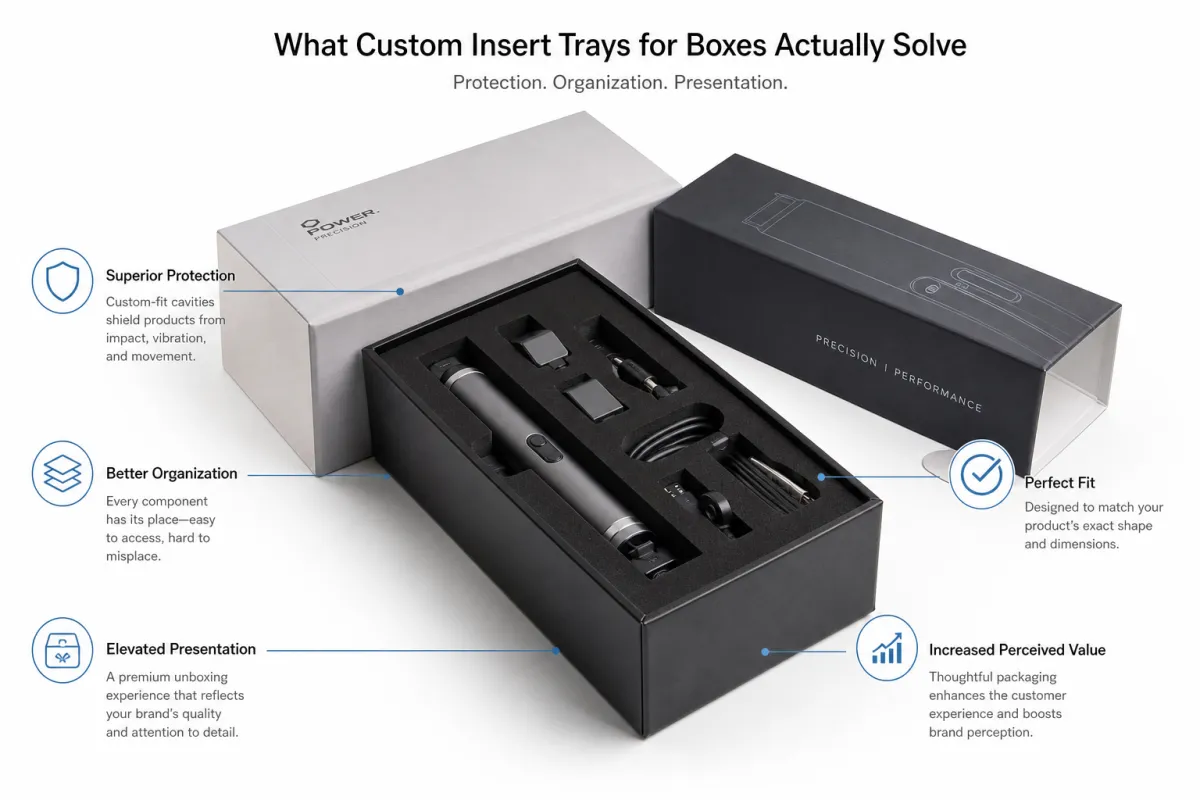
Many return claims do not start with a weak outer carton. They start with internal movement. A strong box can still allow a bottle to knock against a jar, a cosmetic compact to scuff a divider, or a small accessory to rattle enough that the package feels cheap. Custom insert trays for boxes solve that by controlling the empty space inside the pack, which is often where the real damage begins. The tray becomes the internal structure that keeps the product from drifting during vibration, compression, and repeated handling.
From a packaging buyer's point of view, that matters for both shipping and shelf appeal. A consumer opening the box wants a clean reveal, not a jumble of loose parts. A fulfillment team wants a tray that speeds packing instead of slowing it down. A brand wants the product to look deliberate. Custom insert trays for boxes can support all three goals at once, but only if the design matches the use case instead of borrowing a generic shape that happens to be close enough.
Common applications tell the story well. Subscription kits often use custom insert trays for boxes to keep several items separated so they do not arrive tangled or smeared. Cosmetics rely on tray geometry to protect polished surfaces and delicate caps. Beverage samplers need separation between glass or aluminum containers. Electronics often require a center cavity plus accessory pockets for cords, adapters, or manuals. Medical components may need strict orientation so parts remain stable and easy to inventory. Retail gift sets use trays to present each item cleanly and raise the perceived value of the bundle.
The practical advantage is not subtle. A tray can reduce abrasion, prevent corner crush, and stop the contents from settling into the lowest point of the carton where impact forces tend to gather. It can also support version control. If you have a family of SKUs that share the same outer carton, custom insert trays for boxes can often be adjusted internally to handle different accessories or count configurations without redesigning the whole package system. That kind of flexibility saves time later, even if the initial design takes a little more care.
In other words, the tray is not filler. It is part of the package structure. Thoughtful packaging design usually treats the outer box and the insert as one system rather than two separate jobs. If the tray is undersized, the product moves. If it is oversized, the product becomes hard to load or hard to remove. If the material is wrong, the tray may collapse, tear, or look too flimsy to support the price point. I have seen that happen more than once, and the fix is usually less dramatic than people expect: better measurement, better tolerances, better structure.
Here is a simple way to think about the decision:
- Spacer: fills space and limits movement, but offers basic structure only.
- Die-cut insert: shapes the interior with cutouts and folds for more precise fit.
- Structured tray: creates defined pockets, better stacking behavior, and stronger presentation.
That last category is where custom insert trays for boxes often earn their keep. They can make a pack feel premium without relying on heavy graphics or expensive finishes. In many cases, the tray does the brand's heavy lifting by keeping the product centered, clean, and easy to understand the moment the carton opens. That quiet clarity is part of the value, even if nobody talks about it much.
How Custom Insert Trays for Boxes Are Built
Good custom insert trays for boxes start with the product, not the box. That sounds obvious, yet it is one of the most common mistakes in packaging design. The tray cavity needs to match the actual dimensions of the item, including rounded corners, caps, seam lines, labels, and any protrusions that affect how the product sits. A drawing that looks perfect on screen can still fail if the real unit has a slightly larger shoulder, a softer edge, or a wider tolerance band than expected.
The design logic usually begins with a retention method. Friction fit is one of the simplest approaches, using just enough pressure to hold the item in place. Shoulder support works well for bottles, jars, and components that should rest on a ledge rather than a bottom pocket alone. Nesting pockets create shallow cradles for items that need orientation control. Die-cut cutouts can secure long or narrow products. Multi-level compartments separate primary products from accessories, samples, or instructions. Each method changes how custom insert trays for boxes behave during shipping and how easy they are to use on the packing line.
There is also a system-level benefit that buyers sometimes overlook. The tray and the outer box work together. The insert controls movement; the box provides compression strength and stackability. If the tray is designed well, the full pack resists vibration better, sits more evenly on pallets, and survives the knocks that happen during order fulfillment and last-mile delivery. In short, custom insert trays for boxes are not just about the opening moment. They are about the entire path from pack-out to unpacking.
Layouts vary a lot depending on the goal. Retail display trays often prioritize neat presentation and easy product removal. Shipping trays often prioritize retention and crush resistance. Subscription fulfillment trays need enough structure to support fast assembly without causing bottlenecks. Premium gift sets may use layered inserts so the customer discovers the contents in stages. The brand may stay the same, but the geometry can shift dramatically from one project to the next, and that is perfectly normal.
That is why the best custom insert trays for boxes are usually built from a short list of practical decisions:
- How much movement can the product tolerate?
- How easily must the product be removed?
- Does the tray need to look polished on display?
- Will the pack be shipped individually or in bulk cases?
- How fast does the packing team need to load it?
These questions sound simple, but they shape everything from cavity depth to fold direction. Once those decisions are clear, the tray can be engineered to fit the workflow instead of fighting it. That is where custom insert trays for boxes become genuinely useful rather than just decorative. A tray that supports the work behind the scenes usually ends up being the tray that customers trust out in the open.
For projects that need a broader range of packaging options, it helps to compare tray styles against the box format, the pack-out method, and the final retail packaging goal. Some jobs need a clean single-piece insert. Others need a layered structure. Others still need a tray that can be packed and closed in seconds. The geometry changes, but the principle stays the same: the insert must make the package easier to trust.
Material, Fit, and Performance Factors
Material choice is where many projects either stay elegant or drift into avoidable problems. Custom insert trays for boxes can be made from paperboard, corrugated board, molded pulp, foam, plastic, or specialty substrates, and each one performs differently under real shipping conditions. The best choice depends on weight, fragility, visual goals, and end-of-life expectations. A lightweight cosmetic set does not need the same structure as a glass sampler pack or an electronic accessory kit, and trying to force one material to do every job usually gets expensive fast.
Paperboard is often the cleanest option for lighter products and premium retail packaging. It prints well, folds cleanly, and supports crisp die-cut detail. Corrugated board adds more support and is better for heavier contents or deeper trays that must resist compression. Molded pulp offers a tactile, natural look that many brands like for sustainable branding and lower-material designs. Foam is strong at shock absorption and is still useful where the product is delicate or irregular, though it may not fit every recycling stream. Plastic inserts and specialty substrates can be excellent for durability or reuse, but they need a stronger reason to justify the extra material and disposal concerns. Nobody should pretend otherwise.
For a practical comparison, the table below is a useful starting point. The ranges are typical, not fixed, because print coverage, quantity, cavity count, and assembly labor all move the number around.
| Material | Best For | Relative Protection | Presentation | Typical Unit Range at Mid Volumes |
|---|---|---|---|---|
| Paperboard | Light retail packs, cosmetics, sample sets | Light to moderate | Very clean, print-friendly | $0.18-$0.45 |
| Corrugated | Heavier goods, shipping-focused kits, layered inserts | Moderate to high | Functional, less refined unless finished well | $0.25-$0.70 |
| Molded pulp | Sustainable presentations, separated components, durable trays | Moderate | Natural, textured, eco-forward | $0.22-$0.60 |
| Foam | Fragile products, shock-sensitive electronics, precision parts | High | Technical, less retail-friendly | $0.30-$0.90 |
| Plastic or specialty substrate | Reuse, moisture exposure, highly specific retention | Moderate to high | Durable, sometimes premium, sometimes industrial | Varies widely |
Fit is just as important as material, and sometimes more important. A tray that is technically correct on paper can still fail if the production lot varies by a few millimeters from the sample. Product tolerances, label buildup, coatings, and assembly variance all matter. I have seen custom insert trays for boxes work beautifully with one production batch and then feel too tight with the next batch because a cap changed, a label thickened, or a supplier adjusted a molded part. Tolerance planning belongs in the design stage, not after the first rejection. If the product has any seasonal or supplier-driven variation, build for that from the start.
Surface finish affects buyer perception even when the tray is not the star of the show. White paperboard can feel clean and modern. Black board can create a more dramatic reveal. Natural pulp can support a more environmentally minded look. Soft-touch lamination, aqueous coatings, and carefully chosen print coverage all influence how the insert feels in the hand. If the tray is visible during unboxing, those details become part of the package branding. If it is hidden most of the time, the material still shapes how the product feels when lifted, replaced, or inspected.
Sustainability goals should be addressed early. Many brands want recyclable or recycled-content materials, and that is a fair ask. The real-world answer depends on coatings, adhesives, mixed substrates, and how the end customer will dispose of the tray. A paper-based insert may be easier to recycle than a foam or plastic insert, though local collection systems vary. If certification matters, sourcing can be aligned with standards such as FSC for fiber content, and disposal expectations can be checked against guidance from the EPA at EPA recycling resources. For testing and handling guidance, many teams also look at ISTA test methods to benchmark shipping performance.
That mix of material, fit, and performance is why custom insert trays for boxes should be treated as an engineered component, not a generic insert. The right choice protects the product, supports the line, and leaves less guesswork for the customer. It also keeps the project honest, which matters when a package has to do real work in the field instead of just looking good in a mockup.
What Custom Insert Trays for Boxes Cost and Why
Pricing for custom insert trays for boxes is usually driven by the same handful of factors: material thickness, tray size, cavity complexity, quantity, finishing, and whether the design needs tooling or only a die-line adjustment. The more folds, folds-with-glue, nested cavities, or precise cutouts a tray has, the more labor and setup are involved. That is true whether the project is a simple paperboard insert or a more technical structure made for high-value product packaging.
Quantity has a big impact. Smaller runs almost always cost more per unit because setup is spread over fewer pieces. At 500 or 1,000 units, the economics can feel steep if the design is highly customized. At 5,000 units, the setup cost is shared more efficiently, and the unit price often drops in a noticeable way. For custom insert trays for boxes, that means the same geometry can land in very different price bands depending on run size and how much hand assembly is required. That is one reason two quotes can look close on paper and still behave very differently once production starts.
Assembly labor is easy to underestimate. A tray with a single score and one locking tab is quick. A tray with multiple folds, glue points, and accessory pockets can slow the packing line, especially if the team is loading the product by hand. Slower pack speed means higher total cost, even if the material itself is modest. That is why the best quote is not always the lowest number on the page. It is the quote that reflects the full job, including how the tray behaves in production and how much time it asks from the people building it.
To compare options fairly, ask what is included. Some quotes cover prototyping, one round of revisions, and production tooling. Others do not. Freight can be a meaningful line item for larger inserts. Setup charges may appear under another name. If you are comparing vendors, ask each one to quote the same assumptions so you can judge the actual value of the custom insert trays for boxes instead of a partial headline price. Otherwise, the cheapest number can turn into the most expensive path once the missing pieces show up.
Here is a practical view of how cost tends to move:
| Project Type | Material | Setup Complexity | Typical Cost Pressure | Best Use |
|---|---|---|---|---|
| Simple single-cavity tray | Paperboard | Low | Lowest | Light retail kits |
| Multi-pocket tray | Paperboard or corrugated | Moderate | Moderate | Gift sets, samples, accessory kits |
| Heavy-duty insert | Corrugated or molded pulp | Moderate to high | Moderate to high | Shipping protection |
| Precision retention tray | Foam or specialty substrate | High | Highest | Fragile or technical goods |
That table points to the real economics. The tray is not expensive because it exists. It is expensive because it has to do a job reliably at scale. For some brands, a tray that reduces breakage by even a small amount pays for itself quickly through fewer returns, less repack work, and fewer damaged first impressions. For others, the value shows up in cleaner kitting and a more polished reveal that supports a higher perceived product value. Both are legitimate returns, and both are worth measuring instead of guessing.
It is also worth comparing the insert against the overall packaging budget instead of treating it as a separate line that must always be minimized. If a tray improves protection and presentation at the same time, the return is bigger than its unit cost suggests. That is especially true for premium kits, subscription boxes, and retail launches where the first opening experience can influence repeat purchases. A few cents saved on the insert can disappear fast if the pack arrives damaged or feels forgettable.
Step-by-Step Process and Timeline
The cleanest path to custom insert trays for boxes starts with good data. Exact dimensions matter, but so do photos of the product from multiple angles, the total weight, the finish on the surfaces, and any accessories that must fit in the same pack. If the product has a charger, card, spoon, insert card, or safety leaflet, the tray needs to account for it from the beginning. The more complete the input, the fewer surprise revisions later. That part is not glamorous, but it saves a lot of friction.
Next, define the job clearly. Is the insert meant mainly for shipping protection? Is it a retail presentation piece? Is it a subscription fulfillment tray that must pack quickly? In many cases it needs to do two or three of those things at once. That decision drives everything else. A tray that is optimized only for display may not survive rough handling. A tray that is optimized only for protection may feel too utilitarian for retail packaging. Custom insert trays for boxes work best when the goal is stated up front, not guessed at later.
Once the purpose is clear, the material and structural style can be selected. At that point, the first sample or prototype should be built as early as possible. A physical sample tells you things drawings cannot. You can see whether the product sits too deep, whether it lifts out too easily, whether the tray resists bending, and whether the packaging team can load it without forcing parts into place. For custom insert trays for boxes, that first sample often reveals the real answer faster than a dozen email threads. Honestly, it is usually the moment the conversation gets real.
A practical workflow often looks like this:
- Collect exact product measurements, weight, photos, and accessory details.
- Confirm the job: shipping protection, retail display, kitting, or a mix of all three.
- Select material, wall thickness, and retention style.
- Create the first dieline or prototype.
- Test fit, removal force, and box closure.
- Review revisions and approve the final version.
- Move into production with the approved spec.
Testing should not stay theoretical. Put the sample through real handling: shake it, close it, open it, reload it, and if possible, run the type of drop or transit simulation that matches your shipping lane. Not every project requires a formal lab program, but the discipline helps. If the pack is important enough to matter financially, it is important enough to test. Some teams use ISTA-style methods as a guide, especially for fragile or higher-value shipments. I would rather see a rough prototype fail on a table than in front of a customer.
Timeline depends on complexity. A straightforward insert with complete data can move from concept to sample relatively quickly. More complex custom insert trays for boxes may need a few rounds of revision, especially if the product dimensions are tight or the pack includes multiple components. Sampling, approval, tooling, freight, and production all need room in the schedule. A realistic plan leaves space for adjustment instead of pretending the first prototype will always be perfect. That assumption usually backfires, and it is not a fun one to clean up.
For brands also ordering other packaging components, it often helps to coordinate the tray with Custom Packaging Products at the same time, especially if the outer box, insert, and printed sleeves all need to land together. That keeps the spec sheet cleaner and avoids mismatches between the box and the internal structure. It also makes procurement less chaotic, which is a nice bonus when timelines get tight.
Common Mistakes With Custom Insert Trays for Boxes
One of the biggest mistakes is measuring only the nominal product size and ignoring tolerances. Real products are not perfect rectangles. Labels add thickness. Caps vary. Seams protrude. Finishing processes can shift a dimension just enough to matter. If the tray is built only from idealized measurements, custom insert trays for boxes can come back too tight, too loose, or simply awkward to use. Those failures are annoying because they are preventable.
Another common error is choosing a material based on appearance alone. A tray may look beautiful in a sample photo, but if it cannot support the load, it will crush at the corners, bow in the middle, or tear at the fold lines after a few cycles of handling. That is especially risky in high-volume fulfillment, where a weak tray can slow assembly and raise damage rates at the same time. Good custom insert trays for boxes should look right and perform right. One without the other is usually not enough.
Geometry can become a trap as well. It is tempting to make every cavity unique and every edge decorative, but complexity raises tooling, slows the line, and creates more opportunities for the product to hang up during insertion. Sometimes the smarter move is a simpler pocket with one or two well-placed retention points. In packaging design, simpler is often faster and less expensive, and it can still feel premium if the proportions are right. Fancy is not the same thing as effective.
Fit problems work in both directions. Too tight, and the user has to wrestle the product out of the insert. Too loose, and the product rattles, shifts, or leans off-center. Neither outcome helps retail packaging. The goal is a controlled fit that secures the item without making removal feel like a struggle. That is the sweet spot for custom insert trays for boxes, and it usually comes only after at least one physical sample has been reviewed. I have rarely seen someone guess that sweet spot correctly on the first pass.
"If the product rattles in transit, the outer box is getting blamed for an internal design problem."
Skipping product testing is the final mistake that keeps showing up. Drawings can be accurate and still miss the way a tray behaves in the hand, in a carton, or under stacking pressure. Physical testing exposes the weak points fast. It also shows whether the insert slows down the pack line or makes the unboxing feel forced. That is why a sample matters so much for custom insert trays for boxes: it turns assumptions into visible behavior.
If a project starts with clear measurements, realistic tolerances, and an honest review of how the tray will be used, most of these problems can be avoided. The best projects feel boring in the best way. They fit, they protect, they pack cleanly, and they do not create noise for operations or customer service. That kind of predictability is a feature, not a flaw.
Expert Tips and Next Steps for Better Results
My strongest advice is simple: build the tray around the product first, then refine the presentation. That order keeps the work grounded. A tray that protects and organizes the product is far more useful than one that looks polished in a render but fails in the box. With custom insert trays for boxes, function and brand feel should support each other, not compete. If the structure is right, the appearance usually follows pretty naturally.
Ask for a sample early. A physical prototype tells you how much force is needed to remove the product, whether the cavity depth feels right, and whether the contents line up as expected when the lid opens. It also shows whether the tray needs a stronger fold, a different flute, a wider shoulder, or a smaller cutout. Those are the details that make the difference between average product packaging and packaging that feels deliberate.
When multiple SKUs share a box size, keep the design as modular as possible. Small structural changes can often support a wider product family without forcing a full redesign. That lowers setup burden and keeps future replenishment easier. For brands with changing assortments, that flexibility is often more valuable than squeezing every last decorative element into one version of the tray.
It also helps to prepare a clean spec sheet before you request pricing. Include exact dimensions, product weight, quantity, shipping method, print needs, and target timeline. If there are fragile points, mention them. If the tray must support retail display, say so. The clearer the brief, the cleaner the quote, and the better the first sample for custom insert trays for boxes will usually be. A good brief saves everybody a headache.
Here is a practical checklist that keeps projects moving:
- Measure the actual product, not just the drawing.
- Photograph the product in the intended pack position.
- Define the main goal: protection, presentation, or both.
- Compare material options against weight and disposal goals.
- Request a sample before approving production.
If you are comparing packaging partners, review the broader Custom Packaging Products range alongside the tray spec so the insert, outer carton, and any printed components all work together from the start. That coordination usually saves time later and makes the final pack feel cleaner on the shelf and in the hand.
When the details are handled well, custom insert trays for boxes do a lot of quiet work. They protect the product, reduce damage, sharpen presentation, and make the whole package feel more thoughtful. I would never treat custom insert trays for boxes as an afterthought. They are a core part of the package, and in the right build, they can raise both performance and perceived value at the same time.
Frequently Asked Questions
What are custom insert trays for boxes used for?
They hold products in place so items do not shift, scuff, or collide during shipping and handling. They also improve presentation by making the package look organized, premium, and easier to open. Custom insert trays for boxes are common in retail kits, gift sets, subscription boxes, electronics, and fragile product packaging.
Which material is best for custom insert trays for boxes?
The best material depends on product weight, fragility, shipping distance, and the look you want at unboxing. Paperboard suits lighter products, corrugated adds strength, molded pulp supports sustainability goals, and foam is often used for shock control. The right choice balances protection, printability, assembly speed, and end-of-life disposal.
How long does it take to make custom insert trays for boxes?
Timeline depends on whether the design is simple or requires multiple revisions, sampling, and tooling. A basic layout may move quickly, while more complex trays need prototype review and fit testing before production starts. The fastest path is to provide exact dimensions, product photos, quantity, and shipping requirements up front.
How are custom insert trays for boxes priced?
Pricing is usually driven by material choice, tray size, cavity complexity, quantity, finishing, and setup costs. Smaller runs tend to cost more per unit because setup is spread across fewer pieces. To compare quotes fairly, ask what is included for samples, tooling, freight, and revisions.
Can custom insert trays for boxes be recycled or reused?
Yes, many can be recycled or reused, but it depends on the material and any coatings, adhesives, or mixed components used. Paper-based inserts are often easier to recycle, while foam and plastic options may require different disposal streams. If sustainability matters, ask for the material breakdown before approving the design.
For most brands, the best outcome comes from balancing protection, presentation, and cost instead of chasing just one of those goals. The practical takeaway is straightforward: define the product, test the fit, choose the material with your shipping lane in mind, and approve the sample before production. That is the real job custom insert trays for boxes perform well: they make the package work harder without making it feel complicated.

