Buyer Fit Snapshot
| Best fit | Custom Inserts MOQ for Boxes projects where brand print, material claims, artwork control, MOQ, and repeat-order consistency need to be specified before quoting. |
|---|---|
| Quote inputs | Share finished size, material target, print colors, finish, packing count, annual reorder estimate, ship-to region, and any compliance wording. |
| Proofing check | Approve dieline scale, logo placement, barcode or warning zones, color tolerance, closure strength, and carton packing before bulk production. |
| Main risk | Vague material claims, crowded artwork, missing packing details, or unclear freight terms can make a low unit price expensive after revisions. |
Fast answer: Custom Inserts MOQ for Boxes: Pricing, Specs, and Lead Time should be specified like a repeatable production item. The safest quote records material, print method, finish, artwork proof, packing count, and reorder notes in one written spec.
Production checks before approval
Compare the actual filled-product size with the drawing, then confirm tolerance on folds, seals, hang holes, label areas, and retail display edges. Reserve space for logos, QR codes, warning copy, and material claims before decorative graphics fill the panel.
Quote comparison points
Review material grade, print process, finish, sampling route, tooling charges, carton quantity, and freight assumptions side by side. A quote is only useful when the supplier can repeat the same color, closure quality, and packing count on the next order.
Custom Inserts MOQ for Boxes: Pricing, Specs, and Lead Time
If a product shifts, rattles, or tilts inside the shipper, the box is doing only part of the job. That is why custom inserts MOQ for boxes is not just a sourcing question. It sits at the intersection of packaging design, damage prevention, and production reality. A fitted insert can reduce abrasion, speed pack-out, and make a package feel intentional instead of improvised.
The hidden cost is rarely the insert alone. It is the second shipment, the support email, the extra inspection, and the customer who opens a box to find a loose component instead of a finished product. A $0.20-$0.60 insert can cost less than a single reship once freight, labor, and service time are counted together. That comparison changes the purchasing conversation. Not insert versus no insert. Insert versus the full cost of avoidable waste.
Practical rule: if a product can move more than a few millimeters inside the package, that looseness is already affecting cost somewhere in the chain.
Custom inserts also shape how a program runs day to day. They control where each component sits, how much pressure it sees, how quickly a picker can assemble the order, and whether the outer carton needs extra void fill. For a packaging buyer, that makes the insert the hinge point between product protection, retail presentation, and package branding. It has to protect, present, and hold up under production demands. When those goals align, the box feels more expensive even if the structure stays inside budget.
Why Empty Space Is the Most Expensive Part of a Box
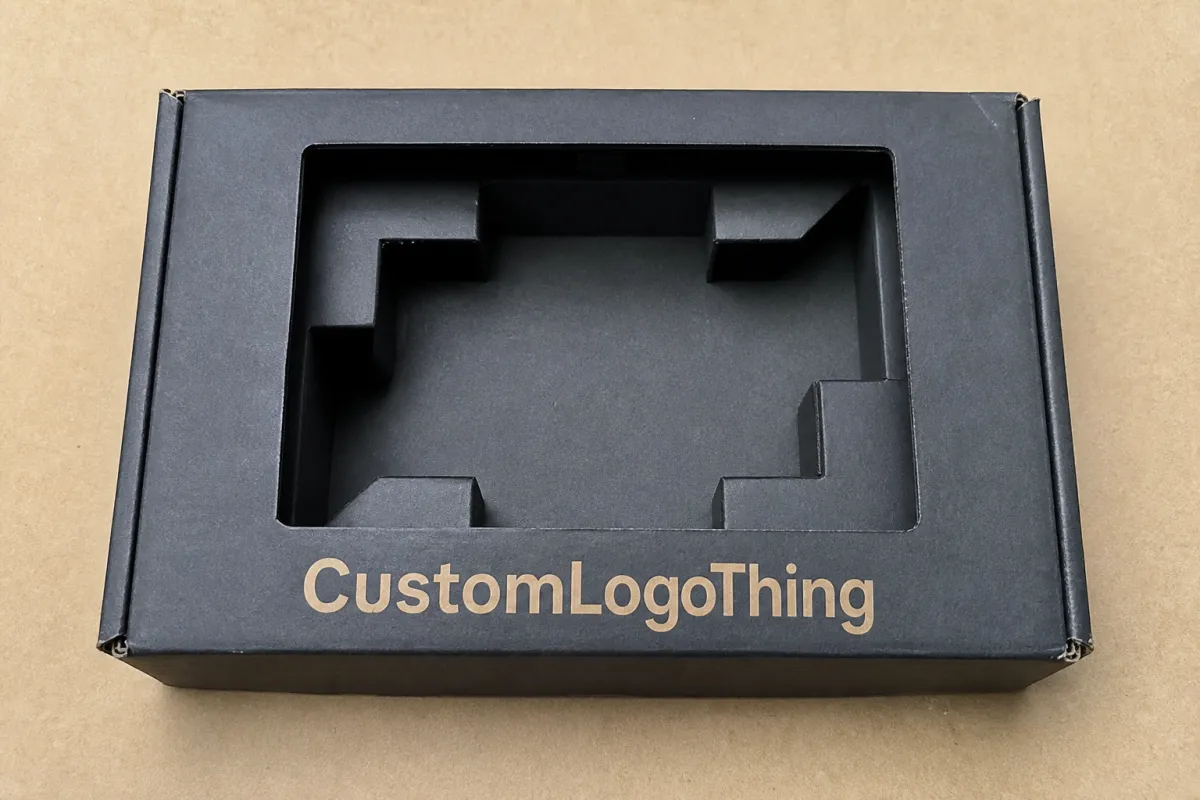
Empty space looks harmless on a packing table. In transit, it behaves like a multiplier. A product that moves inside a carton takes impact differently on every drop, vibration event, and corner strike. That movement can chip edges, scuff finishes, bend accessories, and shift lids. The carton may still arrive intact. The product experience may not.
Labor tells the same story in a quieter way. A loose product often needs more dunnage, more tape, more inspection, or a second pass at pack-out. Those minutes are easy to miss during a sample run and difficult to ignore once order volume grows. If a packer saves 8-12 seconds per unit by placing a product into a fitted cavity instead of building temporary fill, the gain compounds quickly across a 5,000-piece run. That is not a rounding error. It is a scheduling advantage.
Damage and inefficiency reinforce each other. A weak box creates returns, and returns create more freight, more handling, and more time spent explaining a failure that should have been prevented in the first place. This is why custom inserts should be treated as a control layer, not decoration. They can keep a fragrance bottle upright, stop a charger from sliding under a tray, or separate multiple SKUs so they do not rub in transit. The insert becomes the packaging engineer’s quiet safeguard.
Launch teams feel the effect most sharply when the product mix is more complex than a single item in a mailer. Subscription boxes, PR kits, cosmetics sets, electronics bundles, and gift packaging all benefit from a tighter pack-out. When each cavity matches the product footprint, the result is cleaner presentation, easier repeatability, and fewer surprises on the line. The box feels planned because it is planned.
The outer structure matters too. A rigid box with a shallow tray may need a different support strategy than a corrugated shipper with a tuck-in insert. A retail-ready package may need the insert to disappear visually, while a direct-to-consumer box may benefit from branding on the interior face. The best choice depends on the shipment profile, the product finish, and the buyer’s tolerance for risk.
What Custom Inserts Actually Include for Box Programs
Buyers often use “insert” as a catchall term, but the build options are not interchangeable. A paperboard insert behaves differently from a corrugated divider. Molded pulp absorbs shock in its own way. Foam cushions fragile items, but it changes the feel and often the sustainability story. The right structure depends on what needs to be held, protected, and shown.
Paperboard inserts are common for lightweight products, cosmetics, small electronics accessories, and gift sets where presentation matters as much as protection. They usually pair well with sharp graphics, crisp folds, and compact layouts. Corrugated inserts suit heavier contents or situations where the insert must lock into a larger shipper and resist deformation during transport. Stiffness is the point there.
Molded pulp is often selected for high-volume protective programs. It supports a sustainability story and performs well when the product shape can be matched closely. Foam inserts still make sense for fragile components, custom device cases, and high-value items that need controlled shock absorption. Hybrid structures are common too. A buyer may use a paperboard face for presentation and a protective inner layer for support.
From a packaging design standpoint, the insert has to answer more than “where does the product go?” It needs to manage cavity count, depth, tuck-in tabs, locking features, finger notches, and the relationship between the insert and the outer box wall. That sounds technical because it is. A two-cavity insert for a serum bottle and dropper can look simple until the neck height, cap clearance, and closure pressure are measured.
Good insert design also exposes inefficiency. A layout review can reveal that a single accessory is forcing a larger footprint than necessary, or that two components could share one die-cut zone instead of being packed separately. That matters because it can reduce board usage and improve unit cost without weakening protection. The insert is not only a fit solution. It also works as a diagnostic tool for the rest of the package.
A well-structured insert can improve fulfillment speed too. A packer who can place products into defined cavities without adjusting orientation on every order will usually work faster and make fewer mistakes. On a seasonal program or replenishment order, that consistency matters. The same insert should guide the product into place even when staffing changes or order volume spikes.
Materials, Fit, and Print Specifications That Affect Results
Before asking for pricing, gather exact product dimensions, unit weight, fragility level, outer box style, and the intended cavity layout. If there are multiple components, list each one separately. If one item is fragile and another is not, say so plainly. That level of detail cuts down on quote revisions and makes supplier comparisons more honest.
Fit is where many programs lose money. An insert that is too loose creates movement, while an insert that is too tight can scuff, crush, or slow assembly. In practical terms, a few millimeters can change the outcome completely. That is why sample photos, measured drawings, and an actual pack-out sequence matter more than generic specs. The production team needs to see how the item is really loaded, not just how it appears in CAD.
Material choice should follow function, not habit. Paperboard is often the most efficient option for lightweight products and clean branding. Corrugated adds structure and can protect heavier products without becoming too bulky. Molded pulp can reduce plastic use and work well for repeatable product shapes. Foam is often reserved for fragile or high-value items where impact resistance takes priority. The strongest procurement decision weighs protection, appearance, and unit economics together.
Print and finish matter as well. A plain uncoated insert may be the right call for an internal support layer. A coated or printed insert can support branded packaging and improve the unboxing experience. Spot color is often enough for interior marks or a small logo, while full-coverage print raises cost and may require tighter color control. Matte or gloss lamination changes both appearance and scuff resistance. If food contact, sustainability paperwork, or retailer compliance is part of the brief, ask for that up front instead of after sampling starts.
For buyers comparing suppliers, an accurate specification sheet is the fastest way to separate real quotes from rough guesses. A clear spec should include cavity count, product dimensions, board grade or material type, print coverage, expected pack-out order, and whether the insert will be visible to the end customer. That clarity makes the comparison more useful because it lowers the chance that two quotes were built on very different assumptions.
If recycled content or chain-of-custody documentation matters, ask whether the paperboard can be sourced with FSC certification. If transit testing is part of approval, many packaging teams refer to ISTA packaging test protocols to check how a structure behaves under drop, vibration, and compression conditions. Those references are not just paperwork. They help turn opinion into repeatable packaging decisions.
Custom Inserts MOQ for Boxes: Cost, Pricing, and Unit Economics
MOQ is driven by setup economics. Material cost matters, but it is rarely the only factor. Cutting tooling, die preparation, print setup, manual assembly, and sampling all affect the minimum quantity a supplier can quote responsibly. That is why two inserts with similar board weight can carry very different MOQ thresholds if one design requires several folds and the other is a simple flat layout.
For most buyers, the real question is not “What is the lowest MOQ?” It is “What quantity gives me an acceptable unit cost without forcing me to overbuy inventory?” That distinction matters. A low minimum may sound attractive, but if the unit price is too high, the total landed cost can end up worse than a slightly larger run. A larger run can also be the smarter choice if the product line is stable and the unit cost drops enough to justify the inventory.
Pricing usually breaks into four buckets:
- Setup and tooling: dielines, dies, cutting setups, and initial proofing.
- Production: material, cutting, folding, assembly, and print.
- Finishing: coatings, lamination, specialty surfaces, or branding work.
- Freight: packaging insert shipping can matter because the product is often bulky relative to its value.
That split helps because it shows where the cost pressure lives. If setup is the biggest issue, a slightly larger order may lower unit cost materially. If production is the bottleneck, simplifying the layout or reducing cavity complexity may produce the bigger savings. If freight is dominant, nesting, flat-shipping, or changing the material stack may matter more than shaving a few percent from print coverage.
Here is a practical comparison many procurement teams use when evaluating custom Inserts for Boxes:
| Material | Best Fit | Typical MOQ Pressure | Indicative Unit Cost Behavior | Notes |
|---|---|---|---|---|
| Paperboard | Lightweight products, retail packaging, presentation-first inserts | Often lower for simple die-cuts; more efficient at 1,000-5,000+ pieces | Usually the lowest entry cost; rises with print coverage and cavities | Good for branded packaging and compact layouts |
| Corrugated | Heavier items, shippers, stronger edge support | Moderate; can work for pilot runs and steady replenishment | Mid-range; depends on flute type, thickness, and assembly labor | Often chosen when stiffness matters more than a thin profile |
| Molded pulp | High-volume protective packaging, sustainability-led programs | Usually higher because tooling and mold economics matter | Can improve at scale, but startup cost is higher | Good for repeatable shapes and reduced plastic content |
| Foam | Fragile components, shock absorption, premium protection | Varies widely; custom cutting or molding can raise the minimum | Often higher due to density, cutting, or tooling needs | Protection is strong, but sustainability and feel should be checked |
For common paperboard and corrugated programs, quotes often become more competitive once the order moves beyond a few hundred units. A simple insert with limited print can work at a lower MOQ. A more complex structure with multiple cavities, locking tabs, or a printed presentation layer may need a larger first run before the numbers settle into a reasonable range. Molded pulp and foam usually change the pattern because tooling, mold preparation, or cutting complexity can push the minimum higher.
As a planning frame, a buyer may see paperboard inserts priced in a lower range for straightforward builds, while complex printed structures, molded pulp tooling, or premium foam inserts land much higher. That is normal. What matters is the quote shape. A supplier should be able to show how the unit cost changes at the lowest viable MOQ, at a mid-volume run, and at the planned replenishment quantity. That curve tells the truth faster than a single number does.
Ask for pricing using your real scenario. If the first order is 2,500 units, say that. If the likely refill is 10,000 units, ask for that too. A quote that shows both numbers is more useful because it reveals whether the insert should be optimized for the launch order, the replenishment order, or both. That is where smart purchasing happens. Not in the cheapest-looking line item, but in the shape of the cost curve over time.
It also helps to ask whether one size can be shared across multiple SKUs. Sometimes the answer is yes, especially if product dimensions are close and the aesthetic gap is acceptable. Other times, forcing one insert to fit too many products creates extra voids, higher damage risk, and a weaker presentation. A shared insert is only efficient if it still behaves like a purpose-built solution.
If you are comparing options, browse our Custom Packaging Products to see how insert structures fit into a broader carton program. A quote is easier to read when the outer box, insert, and print strategy are considered together.
Process and Timeline: From Dieline to Production
The cleanest projects follow a predictable route. First comes product review: dimensions, weights, fragility, and the pack-out sequence. Then comes structural recommendation. After that, the supplier issues a quote or concept proof, followed by dieline development or sampling, proof approval, production, and shipment. Each step sounds routine. The speed comes from how well the handoffs are handled.
Most delays start with missing information. A late dimension update can force a new sample. Unclear artwork can delay proof approval. A product that is heavier than expected may require a structural change after the first test sample is already made. Those revisions cost time, and time costs money because it affects freight booking, launch timing, and retailer commitments.
Timeline depends heavily on the material. Simple paperboard inserts can move faster than molded, foam, or multi-part builds. A basic die-cut insert may be completed quickly once dimensions are locked, while a custom molded solution may need tooling, first articles, and more than one approval step. Print complexity adds time too, especially if the insert carries brand graphics rather than serving only as an internal support piece.
For planning purposes, many buyers should assume that a straightforward sample-and-production cycle is measured in weeks, not days. If the project involves a new mold, complex assembly, specialty finish, or strict retail compliance, the timeline can stretch further. That is not poor execution. It is the cost of a structure that does more work.
Sampling pays for itself when the product is fragile, expensive, or visually exposed. A prototype confirms whether the cavity depth is right, whether the product rocks in place, and whether packing speed is acceptable. It also surfaces issues that are hard to see on screen. A tab may interfere with the lid. A shoulder may scrape a printed bottle. A closure may press too hard against a corner. Better to catch those problems early.
If the launch date is fixed, the safest move is to lock the pack-out dimensions early and leave room for review. Buffer time is not waste. It is insurance against rework. Teams that reserve extra time for sample adjustments usually save more than they spend because they avoid rush freight and emergency redesigns later.
When the shipment profile is sensitive, it is smart to test against recognized distribution standards. A packaging team may choose a protocol aligned with the product’s route to market, and ISTA is a useful reference point for that discussion. The goal is simple: make sure the insert behaves in the same conditions the customer will actually experience.
Why Buyers Choose Us for Custom Box Inserts
Buyers usually compare suppliers on three things: consistency, communication, and the ability to balance cost with performance. Those sound obvious until a run arrives with dimension drift, weak corners, or a structure that looks fine on paper but slows the packing line. In practice, operational credibility matters more than broad claims. The insert must fit the same way on the first box and the five-thousandth box.
A strong packaging partner should be able to explain tradeoffs plainly. If the requested structure is too expensive, the team should say why and suggest a more efficient alternative. If a paperboard insert can solve the job better than a more expensive structure, that should be made clear. If a product needs a different cavity depth or a stronger locking feature, the recommendation should be specific. That is the difference between selling packaging and solving packaging.
Communication quality is not a soft metric. It affects schedule, waste, and defect rate. Clear quote documentation reduces confusion. Fast feedback on dimensions keeps sampling on track. Practical recommendations prevent spec creep. When a supplier can identify where a design is overbuilt or underbuilt, the buyer gets a better unit cost without giving up protection. That is the kind of support that matters in real procurement work.
Scale readiness matters too. Many teams start with a pilot order, then move into seasonal or replenishment runs if the product performs well. The insert structure should support that path without a redesign every time the volume changes. A good partner can translate a pilot spec into a repeatable production spec and keep the packaging design stable across order cycles.
There is also a branding advantage that should not be overlooked. The inner pack is part of package branding, even if the logo is small or the print is minimal. A neat insert gives the product a more intentional presentation. That matters in DTC, retail packaging, and gift sets where the unboxing moment influences perceived value.
For broader support, our FAQ covers common packaging questions that come up during sourcing, sampling, and reorder planning. The right insert partner should make the process easier, not harder.
Next Steps: Build a Quote-Ready Insert Spec
Before asking for pricing, gather the pieces that make the quote accurate. You will get better answers if the supplier knows the exact product dimensions, unit weight, quantity by SKU, outer box size, shipping method, and whether the insert must be visible to the customer. A photo of the packed product helps too. So does a simple note on whether the insert is mainly for protection, presentation, or both.
A good sourcing sequence is straightforward:
- Define the protection requirement first.
- Choose the material that fits that requirement.
- Confirm the cavity layout and fit.
- Compare pricing at the MOQ and at the replenishment quantity.
That order keeps you from starting with price and ending with a structure that does not solve the problem. If the item is fragile, a low-cost structure that fails in transit is expensive. If the item is lightweight and presentation-driven, an overbuilt insert can raise unit cost for no benefit. The right answer sits between those extremes.
To speed up a quote, provide a pack-out sample, state whether the insert needs branding, and give the target launch date. If you already know the box style, include it. If there are multiple cavities or accessories, list each one. The more precise the brief, the less time the project spends in clarification loops.
Comparing scenarios is more useful than comparing one number. Ask for one quote at the lowest viable MOQ and another at the expected reorder quantity. Ask whether a different board grade or a slightly altered cavity layout changes the economics. Ask whether flat-shipping the insert can reduce freight. Those questions reveal the real cost curve, which is far more useful than the first price you see.
Actionable takeaway: if your team is evaluating custom inserts MOQ for boxes, build the spec before you request pricing. Gather dimensions, pack-out order, quantity targets, shipping method, and the material you are willing to test. Then ask for quotes at both launch volume and reorder volume. That gives you a clearer view of unit cost, lead time, and the tradeoffs that actually matter.
What is the MOQ for custom inserts for boxes?
MOQ depends on material, structure, and whether tooling or print setup is required. Simple paperboard inserts can often start lower than molded pulp or highly customized builds, but the real answer comes from your exact dimensions, cavity count, and quantity needs. A supplier should quote against your use case, not a generic minimum.
How do custom inserts for boxes affect unit cost?
Unit cost usually drops as quantity increases because setup costs are spread across more pieces. Complex cavities, special folds, extra print coverage, and premium finishes raise the price. A good quote should separate setup, production, finishing, and freight so the total landed cost is easy to compare.
Which material is best for custom inserts MOQ for boxes?
Paperboard works well for lightweight products and strong presentation. Corrugated is better when stiffness and protection matter more than a thin profile. Foam or molded pulp can suit fragile items, but those options often change MOQ and lead time. The best material is the one that matches the product’s weight, fragility, and branding needs.
How long does it take to produce custom inserts for boxes?
Timeline depends on the design, sample approval process, and production method. Straightforward insert builds can move faster than complex or multi-material projects. The fastest way to shorten lead time is to approve dimensions, artwork, and pack-out details early so the supplier does not have to restart sampling.
Can I order multiple box sizes under one insert MOQ?
Usually each size or dieline is treated as a separate production item. Combining sizes may be possible if the structures are very similar, but pricing still reflects setup differences. It is smart to ask for a quote that compares separate runs against a shared layout before deciding which path makes more sense.

