A practical guide to custom Instagram stickers for car windows, including materials, sizing, QR codes, pricing, production timelines, and proofing checks.
What custom Instagram stickers for car windows actually do
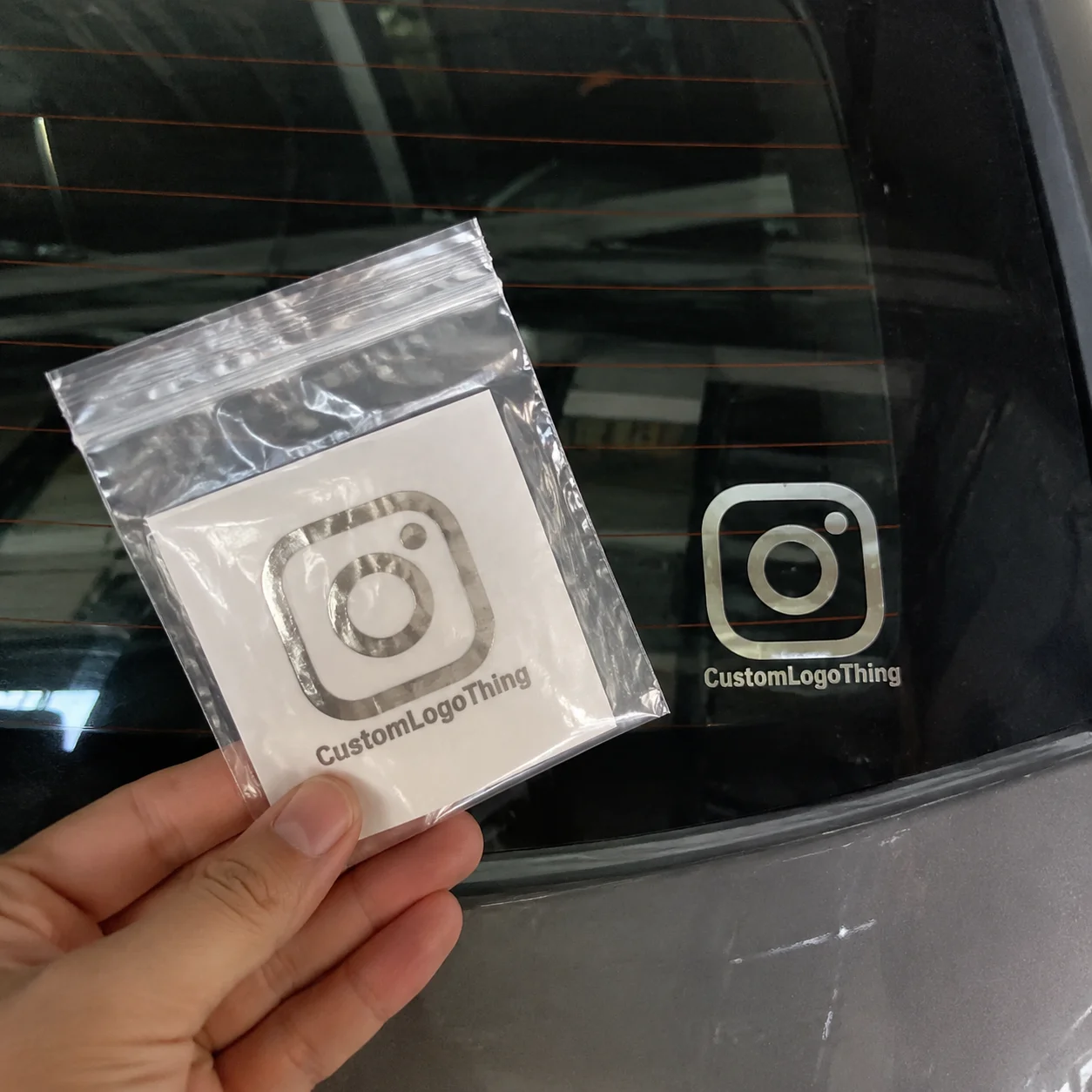
A parked car can create more local impressions in a week than a small social ad budget, especially if it sits in traffic, school pickup lines, gym lots, job sites, event venues, or outside a busy café. Custom Instagram stickers for car windows are outdoor decals that display an Instagram handle, QR code, hashtag, logo, campaign message, or short call to action on a vehicle surface.
Simple idea. More complicated execution.
A decorative car sticker says something about taste. A business decal identifies a company. A social handle sticker asks people to move from the physical street to an online profile. A promotional campaign sticker goes one step further: it may push a seasonal giveaway, menu launch, booking page, product drop, or event RSVP.
The best placements are usually the rear window, side window, bumper, fleet door, tailgate, food truck service panel, delivery car, or event vehicle. Glass gives a clean background. Painted metal gives more room. Bumpers can work, but they take more abuse from road spray, dirt, abrasion, and washing.
Instagram-specific vehicle decals fit salons, food brands, photographers, creators, gyms, car clubs, real estate agents, mobile detailers, pet groomers, and local service businesses because those categories live on proof. People want to see the haircut, cake, renovation, listing, class vibe, grooming result, or finished wrap before they message.
The sticker is not just vinyl. It is a small bridge between offline attention and online follow-through. Flashy graphics help less than many buyers assume. Readability, placement, contrast, and a clear reason to scan or follow usually do the harder work.
How vehicle social handle decals work in the real world
The decision path is short. Someone notices the car. They see the handle or QR code. They recognize the brand, offer, logo, or product category. Then they decide whether to search, scan, follow, save it mentally, or ignore it. That entire sequence may happen in 3 to 5 seconds.
A good vehicle Instagram sticker can include a handle, logo, short CTA, QR code, brand color, and sometimes the Instagram icon. Not all six belong on every design. A known local bakery may only need “@brandname” and a small cake mark. A new mobile mechanic may need “Scan for same-week booking” because the audience does not yet know why the profile matters.
Format changes performance. Cut vinyl lettering is clean, durable, and strong on tinted glass, especially in white. Printed vinyl decals handle full-color logos, gradients, QR codes, and campaign art. Clear stickers look subtle but can disappear on dark glass if the artwork lacks contrast. White-backed decals make color more reliable. Perforated window film supports larger glass graphics while preserving some inside visibility. Removable bumper stickers suit short campaigns, giveaways, and temporary event vehicles.
Visibility tradeoffs are brutally practical. White lettering often reads well on tinted glass. Black or navy graphics may vanish on shaded windows. A pale gray QR code on clear stock can look refined in a proof and fail on a real vehicle. The proof is not the street.
Durability depends on UV exposure, rain, road debris, adhesive quality, washing frequency, temperature swings, and whether lamination is used. Packaging teams often think in terms of handling and distribution standards such as ISTA test protocols. Vehicle decals are different products, but the mindset carries over: the real environment is harsher than a desk review.
Safety matters. Keep driver sightlines clear. Avoid blocking mirrors, backup visibility, license plates, lights, inspection stickers, or required registration areas. Local vehicle decal rules vary, especially for large rear-window graphics. A smaller readable sticker in a safe position beats a huge graphic that creates visibility problems.
Practical rule: If a stranger cannot read the handle from 10 to 20 feet away while walking past the vehicle, the design is probably too small, too thin, or too busy.
Material, adhesive, size, and finish choices that matter
Material choice is the quiet variable. It separates a decal that curls after three months from one that still looks sharp after repeated sun, rain, washing, and road grime. Indoor sticker stock, paper labels, and low-tack promo labels are not built for automotive exposure. For vehicle Instagram decals, outdoor vinyl is the safer baseline.
Common films include calendared vinyl for general use and cast vinyl for more demanding curves or longer campaigns. Many buyers do not need premium cast film for a flat rear window. It becomes more relevant for curved panels, complex surfaces, or fleet graphics where consistency matters across 10, 25, or 50 vehicles.
Adhesive matters as much as the face stock. Permanent adhesive suits long campaigns and company vehicles. Removable adhesive works for pop-ups, seasonal offers, political campaigns, and short runs where clean removal is part of the plan. Static cling is useful for temporary window use, although it is more sensitive to installation conditions and surface cleanliness.
Finishes change both appearance and function. Gloss makes color pop and often suits food, beauty, fitness, and creator brands. Matte reduces glare and can feel more restrained, though dirt may show differently. Clear materials create a subtle “printed on glass” look. Lamination adds cost, but it can improve scratch resistance, UV durability, and wash tolerance.
| Sticker Format | Best Use | Typical Strength | Watch-Out |
|---|---|---|---|
| Cut vinyl lettering | Handles, short URLs, fleet names | Clean look and strong contrast on tinted glass | Limited for complex logos or QR codes |
| Full-color printed vinyl | Logo plus handle, QR code, campaign art | Flexible design options | Often benefits from lamination outdoors |
| Clear decal | Subtle window branding | Minimal background edge | Low-contrast art can disappear |
| Perforated window film | Larger rear or side window graphics | High visibility from outside | May require closer legal and visibility checks |
| Removable bumper sticker | Events, short promotions, test campaigns | Easier changeout | More exposure to dirt and abrasion |
Size should follow viewing distance, not ego. A personal creator might use a 6 to 10 inch wide handle decal. A small business rear-window decal often lands in the 12 to 24 inch range. Fleet side-panel graphics can go larger, but the message still needs hierarchy. More space does not fix a crowded layout.
QR codes need physical size and quiet space. A 1 inch code may scan on packaging held in the hand. A car sticker often needs more room because the scanner is farther away, the surface may reflect light, and the vehicle is not always parked in perfect conditions. Many failed QR decals are not technically “bad prints.” They are simply too small, too glossy, or too low contrast for the setting.
For artwork, send vector files where possible: AI, EPS, PDF, or SVG. Raster logos should be at least 300 dpi at final print size. Outline fonts. Expect CMYK color conversion. Test contrast. The same discipline used in packaging design, retail packaging, and package branding applies here: the design must survive real lighting, distance, and handling, not just look attractive on a monitor.
Surface compatibility is another overlooked detail. Glass, painted metal, plastic trim, and textured bumpers behave differently. If you already use Custom Labels & Tags for product packaging, do not assume that same construction belongs on a vehicle. The adhesive system and film requirements are usually different.
Process and timeline: from artwork to applied car sticker
The ordering process usually follows a simple sequence: Request a Quote, share artwork or handle details, choose material and size, review a proof, approve production, print, cut, pack, ship, and apply. The slowdowns tend to happen before printing, not during printing.
Prepare the basics before asking for pricing. Confirm the exact Instagram handle spelling, including underscores, periods, and capitalization preferences. Decide where the QR code should lead: profile, booking page, menu, portfolio, giveaway page, or campaign landing page. Gather brand colors, logo files, vehicle placement photos, and target quantity.
The proofing stage deserves close attention. It catches typos. It checks QR scanability. It verifies scale. It confirms whether a white underbase, clear background, contour cut, or square cut is being used. A wrong handle on 500 decals is not a production issue; it is usually a proofing failure.
Typical timing depends on artwork readiness, proof approval speed, quantity, specialty finishes, lamination, die-cut complexity, packing needs, and shipping distance. A simple run with clean vector art may move quickly after proof approval. A laminated, contour-cut, multi-size fleet order with sorting by vehicle group will take longer.
Rush jobs are possible only when the decisions are already made. Clean artwork helps. So does choosing a standard outdoor vinyl, standard finish, and simple cut shape. If the file needs logo cleanup, QR rebuilding, color matching, or several proof rounds, rush timing gets fragile.
Application has its own clock. The surface should be clean, dry, and free of wax or heavy residue. Moderate temperature is better than freezing cold or extreme heat. Many vinyl products need curing time before washing, often at least 24 to 72 hours depending on adhesive and conditions. Build a buffer before events, pop-ups, car meets, grand openings, or fleet launches.
Quality control should be specific, not ceremonial. Check the printed handle against the live Instagram account. Scan the QR code before and after lamination if possible. Compare color against the approved proof, allowing for the normal difference between screen color and print. Inspect edges for clean cutting, especially around thin lettering. Count pieces before packing if the order is being split across several vehicles or teams.
Cost, pricing, MOQ, and unit cost drivers
Pricing is shaped by size, material, finish, quantity, cut complexity, lamination, artwork help, packaging, and shipping. Two Stickers That Look similar from six feet away can quote very differently if one is simple one-color vinyl and the other is full-color laminated vinyl with a scannable QR code and custom contour cut.
Unit cost drops as quantity rises because setup, proofing, material handling, file preparation, and production setup are spread across more pieces. That is basic manufacturing math. It is the same reason custom printed boxes and other Custom Packaging Products often show sharper price breaks once the order moves past the smallest efficient run.
MOQ is practical, not mysterious. Some custom sticker formats work at low quantities, especially simple decals for one vehicle. Specialty vinyl, laminated outdoor decals, multiple cuts, or fleet sorting may favor larger runs. A shop may still produce a small order, but the unit price can look high because the setup work does not shrink with quantity.
| Example Order Type | Likely Cost Driver | Typical Buyer Scenario | Budget Note |
|---|---|---|---|
| One-color handle decal | Vinyl color, cut size, weeding time | Creator or small local business vehicle | Often lowest cost per design |
| Full-color logo and handle | Print coverage, material, cutting | Salon, food brand, photographer | Costs more than plain lettering |
| QR code window decal | Print accuracy, contrast, proof testing | Menu, booking, giveaway, portfolio | Size may need to increase for scanning |
| Laminated outdoor decal | Lamination, added handling, durability | Vehicles parked outside daily | Higher upfront cost, fewer replacements |
| Fleet decal set | Quantity, sorting, consistency, packing | Delivery cars or service vans | Better unit cost at higher volume |
As a rough buyer expectation, simple small vinyl decals may fall into a low per-piece range at higher quantities, while laminated full-color outdoor decals with QR codes can cost several times more, especially at small runs. Exact pricing depends on dimensions and construction. A 4 inch decal is not priced like a 24 inch rear-window graphic.
For small orders, setup can dominate the quote. For larger orders, material yield, finishing speed, and packing requirements start to matter more. A batch of 250 identical rectangular decals is usually more efficient than 250 decals split across five sizes, three materials, and individual vehicle packs.
Hidden cost risks are real. Low-resolution art can trigger redesign fees or reprints. A misspelled handle can ruin the full batch. A QR code with poor contrast can look fine in the file and fail in use. Changing size after proof approval may restart layout and production prep.
Paying more makes sense when the sticker has to last outdoors, support a fleet, match existing brand assets, or represent a premium business. UV resistance, better adhesive, lamination, and consistent color are not glamorous line items. They are replacement-cost control.
Ask for two or three quantity tiers. For example: 50, 100, and 250 pieces. Or 10, 25, and 50 if it is a fleet test. Provide dimensions, quantity, surface type, indoor or outdoor use, finish preference, adhesive preference, and delivery deadline. Good quote inputs produce cleaner pricing.
Common mistakes that make car stickers hard to read
The core mistake is designing for a phone screen instead of a moving vehicle. On a screen, tiny details look controlled. On a car, viewers may have only a few seconds, glare may hit the glass, and the vehicle may be 15 feet away across a parking lane.
Tiny handles fail first. Thin fonts fail next. Low contrast follows. Overly detailed logos often collapse into visual noise. A script font that looks refined on a business card can become unreadable on tinted glass. If the handle is the point, make the handle the hero.
Placement can ruin otherwise good artwork. Avoid rear defroster lines where possible, windshield wiper paths, curved glass edges, heavy tint, and areas that collect dirt quickly. Bumpers pick up grime. Lower doors get road spray. A side window may be cleaner, but legal and visibility limits still apply.
QR code mistakes are common: too small, too crowded, too low contrast, printed on reflective material, or placed where people would need to scan from an unsafe position. The destination matters too. A slow, broken, or non-mobile page wastes the scan. A QR code on custom Instagram stickers for car campaigns should be tested at actual size before production, not after the order arrives.
Message crowding is another problem. Handle, slogan, phone number, website, service list, city, QR code, five icons, and a discount line cannot all be the main message. Choose one primary action: follow, scan, book, view menu, see portfolio, or join the giveaway.
Unlaminated printed stickers may fade faster outdoors, especially in high-sun regions or on vehicles parked outside daily. The EPA’s UV Index guidance is a useful reminder that sunlight is not a minor exposure variable. Packaging people understand this from shelf life and display conditions; vehicle graphics face an even less controlled environment.
Application errors create avoidable failures. Dirty surface. Wax residue. Air bubbles. Extreme cold. Extreme heat. Washing too soon. Installing across a surface seam. A careful 10-minute prep step can prevent months of irritation.
Field test before buying deep: Print the design at actual size, tape it to the intended vehicle area, step back 10 to 20 feet, and ask someone who did not design it to read it aloud.
Next steps before you request a sticker quote
Before requesting a quote, define the goal. Are you trying to gain followers, drive bookings, promote a menu, show a portfolio, push a giveaway, or support a launch? One sticker can do one job well. It rarely does six jobs well.
Choose the vehicle placement next. Rear window, side window, bumper, door, tailgate, and service panel all have different size limits and visibility patterns. Take a straight-on photo of the area with a tape measure in the frame if possible. That one photo can prevent a surprising amount of guesswork.
- Confirm the handle: Check every underscore, period, and spelling detail before proofing.
- Generate the QR code: Use a destination that works well on mobile and can handle real traffic.
- Pick the primary action: Follow, scan for menu, book appointment, view portfolio, join giveaway, or visit campaign page.
- Decide on size: Use viewing distance and vehicle placement rather than screen appearance.
- Collect artwork: Send vector logos, brand colors, font notes, and any existing branded packaging references.
- List production needs: Quantity, finish, adhesive type, surface, deadline, and whether design help is needed.
Testing is useful before a full run. Order a small batch if the campaign is new. Apply one sample. Check readability in daylight, at night, under parking lot lighting, and after the glass gets slightly dusty. Scan the QR code from realistic distances while the vehicle is parked. If the code only works under perfect lighting from 8 inches away, revise it.
For brands already investing in branded packaging, vehicle stickers should not feel disconnected. The color palette, logo spacing, and tone should match the product packaging, retail inserts, and social profile. Consistency builds recognition faster than a one-off decal style that looks unrelated to everything else the buyer sees.
Send quote details in a clean list rather than scattered across several messages. Include dimensions, quantity, finish, adhesive type, vehicle surface, delivery deadline, shipping location, and whether you need design setup. If you are unsure about material, say how long the decal needs to stay on the vehicle and how often the car is washed.
The best vehicle social decals are not the loudest. They are readable, correctly built for the surface, proofed carefully, and easy to act on. A stranger should understand the handle, know why it matters, and be able to follow or scan without solving a design puzzle.
FAQ
What size should custom Instagram car stickers be?
For rear or side windows, many buyers start with a width that makes the handle readable from 10 to 20 feet away. QR codes usually need more space than text because they require clean edges and quiet space to scan correctly. The best size depends on vehicle placement, glass tint, font style, and how much information appears on the sticker.
Are Instagram handle stickers for cars weatherproof?
They can be weather-resistant when printed on outdoor vinyl with the right adhesive and optional lamination. Basic paper stickers or indoor labels are not suitable for rain, UV exposure, car washes, and road grime. Ask for outdoor-rated vinyl if the sticker will stay on the vehicle for months.
Can I put a QR code on custom car Instagram decals?
Yes, but the QR code must be large enough, high contrast, and placed where people can scan it safely while the vehicle is parked. Test the code at actual print size before production to confirm it scans from realistic distances. Link the QR code to a mobile-friendly Instagram profile, booking page, menu, or campaign landing page.
How much do custom social media stickers for cars cost?
Cost depends on sticker size, vinyl type, quantity, finish, cut shape, lamination, artwork setup, and shipping. Simple one-color vinyl lettering usually costs less than full-color laminated decals with QR codes. Request multiple quantity tiers to see where unit cost drops instead of guessing from one quantity.
How long does it take to make custom Instagram stickers for vehicles?
Timeline depends on artwork readiness, proof approval, material choice, order size, finishing, and shipping method. Clean vector artwork and quick proof approval can shorten the process. Build in extra lead time before events, launches, pop-ups, or fleet rollouts.