Buyer Fit Snapshot
| Best fit | Custom Invoice Inserts with Logo projects where brand print, material claims, artwork control, MOQ, and repeat-order consistency need to be specified before quoting. |
|---|---|
| Quote inputs | Share finished size, material target, print colors, finish, packing count, annual reorder estimate, ship-to region, and any compliance wording. |
| Proofing check | Approve dieline scale, logo placement, barcode or warning zones, color tolerance, closure strength, and carton packing before bulk production. |
| Main risk | Vague material claims, crowded artwork, missing packing details, or unclear freight terms can make a low unit price expensive after revisions. |
Fast answer: Custom Invoice Inserts with Logo: Design, Cost, Timing should be specified like a repeatable production item. The safest quote records material, print method, finish, artwork proof, packing count, and reorder notes in one written spec.
Production checks before approval
Compare the actual filled-product size with the drawing, then confirm tolerance on folds, seals, hang holes, label areas, and retail display edges. Reserve space for logos, QR codes, warning copy, and material claims before decorative graphics fill the panel.
Quote comparison points
Review material grade, print process, finish, sampling route, tooling charges, carton quantity, and freight assumptions side by side. A quote is only useful when the supplier can repeat the same color, closure quality, and packing count on the next order.
A shipping box gets tossed. A useful insert often gets kept. That is the quiet advantage of custom invoice Inserts With Logo: they turn a routine receipt into a branded touchpoint that clarifies the order, answers questions, and gives the customer one more reason to remember the brand after the carton is gone. For teams that care about branded packaging, this is a small printed piece doing real work.
Most buyers do not want a random flyer drifting around in the mailer. They want the insert to feel like it belongs to the shipment, not like something grabbed from a desk drawer five minutes before packout. Thoughtfully made custom invoice inserts with logo sit between operations and marketing, which is usually where the smartest package branding decisions live.
There is a practical reason brands keep asking for custom invoice inserts with logo. Clear inserts reduce support friction. Order details, care notes, return steps, and a direct contact path can all live on the same sheet, which keeps the customer calmer and the support inbox quieter. That part matters more than the glossy pitch deck version of the idea, frankly.
What custom invoice inserts with logo actually do
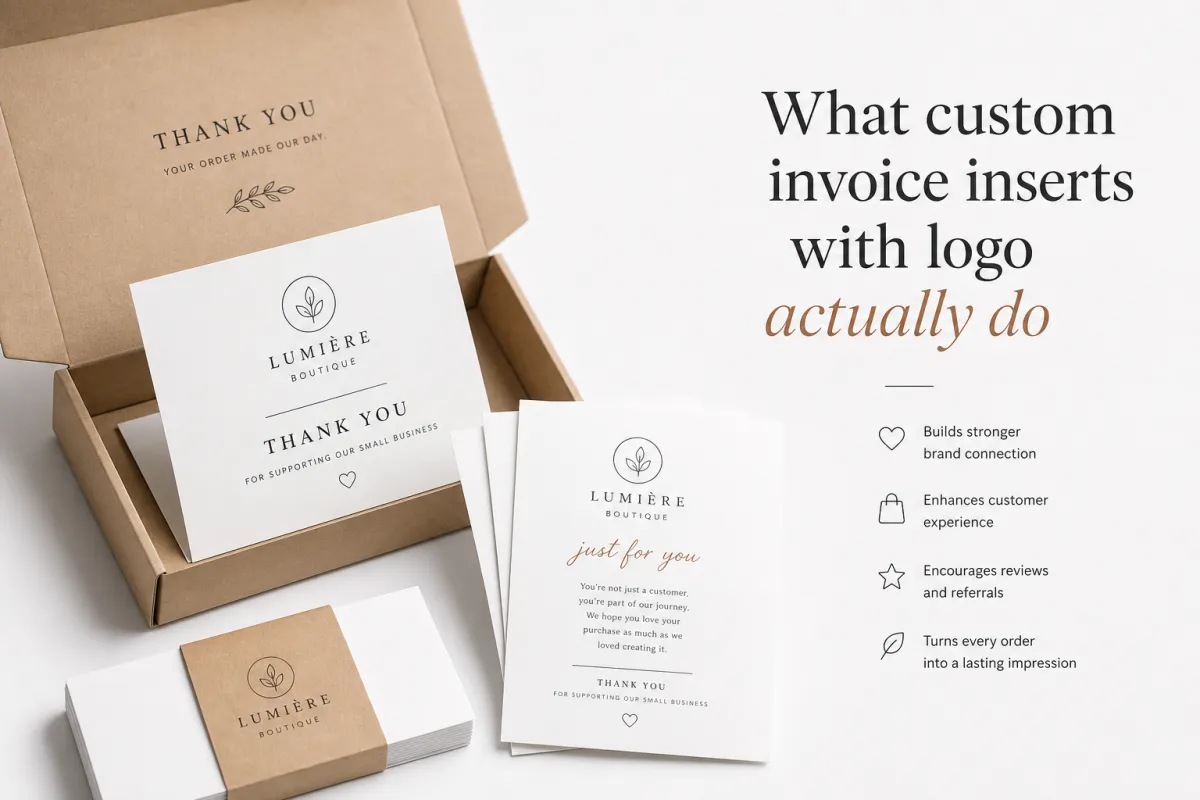
At the simplest level, custom invoice inserts with logo are printed sheets placed inside shipments to combine billing details, brand messaging, support information, or a short thank-you note. They are paper, yes, but in product packaging terms they are paper with a clear job description. A good insert gives the customer confidence in the order and leaves behind a cleaner memory of the brand once the unboxing moment is over.
The useful part is how long the insert can stay around. The carton gets recycled, the mailer gets flattened, and the insert may sit on a desk, a counter, or the refrigerator if it has something worth keeping. That is why custom invoice inserts with logo should be designed as reference pieces first and marketing pieces second. If the customer keeps it because it answers a question later, the piece has already earned its keep.
There are a few related pieces people mix up:
- Invoice insert: usually the customer-facing summary of the order, payment, or shipment details.
- Packing slip: mostly operational, built to help the warehouse verify items and quantities.
- Thank-you card: lighter on data, heavier on tone and brand personality.
- Marketing flyer: aimed at sales, promotions, or cross-sells, often less useful as a receipt companion.
That difference matters. A packing slip belongs to fulfillment. A thank-you card belongs to tone. A flyer belongs to acquisition or repeat-order goals. Custom invoice inserts with logo can borrow a little from all three, but they should not try to be all three at once. That is how layouts get crowded and messages lose their shape.
From a branding standpoint, these inserts help a routine transaction feel deliberate. They can make modest retail packaging feel more considered, and they can make higher-end custom printed boxes feel more complete. For smaller brands, that matters because the insert is often the least expensive visible brand asset in the entire order. Cheap, yes. Disposable, not necessarily.
I have seen more than one otherwise polished shipment lose credibility because the insert felt rushed. A low-resolution logo, a crooked QR code, or a return address tucked into a corner can make the whole package feel improvised. The fix is rarely expensive; it is usually just a matter of giving the piece the same attention you give the outer box.
"A good insert answers the next question before support has to."
That is the real value of custom invoice inserts with logo: clarity first, branding second, and a better chance of repeat business because the customer did not have to hunt around for the basics.
How custom invoice inserts with logo work in the order flow
The customer journey starts before the box opens. Checkout sets expectations, shipping builds anticipation, and the unboxing moment decides whether the order feels tidy or chaotic. Custom invoice inserts with logo fit into that chain as the first printed item the customer actually reads. That is a useful spot. A label on a carton gets glanced at. The insert gets handled.
In a typical fulfillment setup, the workflow stays straightforward: collect order data, merge it into a template, print the insert, and place it with the shipment or packing slip. Static runs use the same design in every box. Personalized custom invoice inserts with logo can change the order number, item list, or QR code from order to order. Personalization usually improves relevance, though it also adds setup time, file checks, and more chances for field mapping mistakes if the template is messy.
Good inserts can support operations as much as they support branding. They cut down the number of "How do I return this?" and "How do I wash this?" emails that clog up the inbox. They can point customers toward reorder links, service hours, or a care guide. If the product needs assembly or special handling, the insert can say so plainly instead of burying the note in a website footer nobody sees.
That is why the best custom invoice inserts with logo usually mix the essentials with one next step:
- order summary or item list
- brand logo and short brand line
- customer service contact details
- care, return, or setup instructions
- QR code to a support page, reorder page, or product guide
- one small upsell or cross-sell, if it truly fits the order
That last line deserves restraint. One. Not five. Once the insert starts pushing every offer at once, it stops feeling useful and starts looking like junk mail in nicer clothes. Nobody asked for that.
For brands building a broader system, Custom Packaging Products can keep the insert aligned with the rest of the shipment experience. A packaging team that thinks about the insert, the carton, and the mailer as one set usually gets cleaner results than a team that treats each item like a separate little project. If you are already investing in product packaging options, the insert should carry the same level of care.
Quality checks matter too. If inserts travel inside heavier kits or premium bundles, the team should think about how they ride along with the rest of the packout. Industry references from groups like ISTA help buyers think about distribution stresses, while paper sourcing standards from FSC matter when sustainability claims are part of the message. Not every insert needs formal testing, but a valuable shipment deserves more than a shrug. And if your insert carries tax language, compliance wording, or return terms, have finance or legal review it before print. Paper is cheap; corrections are not.
Design factors that make custom invoice inserts with logo worth keeping
Design is where custom invoice inserts with logo either earn their space or waste it. A clean layout can make a modest order feel polished. A crowded one can make a good product look cheap. The goal is not decoration. The goal is structure.
Size comes first. Common formats include 4 x 6 inches, 5 x 7 inches, A5, and standard letter. Smaller inserts cost less and fit more easily in mailers, but they only work if the message stays short and readable. Bigger inserts suit detailed care instructions, return policies, or multi-product orders. A page that needs a lot of information should not be forced onto a tiny panel just to save a fraction of a cent.
Stock choice matters more than many teams expect. A 70# uncoated text sheet works well for straightforward invoices and support notes. A 100# text or light cover stock feels sturdier and prints more crisply in full color. Some brands choose 14pt cover for a more premium impression, especially when the insert doubles as a thank-you card or branded note. Thickness is not always the right answer, though. If the insert needs to fold neatly into a slim mailer, extra bulk can create packout problems fast.
Hierarchy is the real design test. The customer should see the logo, the order identity, and the next action without searching for them. Put the support phone number or email where the eye lands quickly. Keep the return policy readable. If there is a QR code, make it large enough to scan with a phone in normal light. A code that needs careful squinting is decoration, not a tool.
Typography should match the brand, but it should not become a performance. If the product is simple and direct, the insert should feel simple and direct too. If the brand is premium, the spacing, contrast, and image treatment should reflect that. Package branding works best when the insert looks like it belongs with the shipment, not like it borrowed a different outfit from a different brand.
Useful content ideas for custom invoice inserts with logo include:
- care tips that prevent avoidable returns
- assembly or setup steps in 3 to 5 bullets
- a reorder URL or QR code
- customer service hours and response expectations
- a small loyalty offer that expires in a realistic window, such as 14 to 30 days
Contrast beats cleverness every time. Black type on warm white stock usually reads better than pale gray text on textured paper. If the customer has to tilt the page under a lamp to read it, the design missed the point. Good custom invoice inserts with logo should feel easy. Not flashy. Easy.
If the insert needs to fit into a larger branding system, think of it as a bridge between branded packaging and support operations. It can echo the same color palette used in retail packaging or the same illustration style used on custom printed boxes. That kind of consistency helps the full package feel deliberate instead of assembled from leftovers.
One more practical detail: make sure the artwork file is actually built for print. I have seen too many good ideas get flattened by low-resolution logos, missing bleed, or a QR code that was generated from a screenshot. It is a small thing until production starts, and then it becomes a very expensive small thing.
Custom invoice inserts with logo: process, timeline, and turnaround
The process for custom invoice inserts with logo should be boring in the best possible way. Brief the job, quote the job, proof the job, print the job, ship the job. Fewer surprises make a cleaner stack of paper and a calmer warehouse.
Here is the usual path:
- Brief: define size, quantity, stock, print sides, and the exact content.
- Quote: confirm pricing, setup costs, proofing, and freight.
- Artwork setup: build the layout or drop in variable data.
- Proofing: check spelling, barcode or QR accuracy, and page dimensions.
- Approval: sign off only after the layout matches the actual use case.
- Production: digital or offset printing, then any cutting, folding, or packing.
- Delivery: production time plus transit time, which are not the same thing.
Delays usually begin with vague input. A brand sends half-finished copy, missing logo files, or a string of "we'll know the offer next week" notes, and the project stalls while everyone waits. Custom invoice inserts with logo move faster when the buyer gives one clear source of truth from the start. Use vector logos when possible, send final copy in a text file, and state the exact size up front. That saves time. It also cuts out the back-and-forth that tends to stall a job for no good reason.
For simple digital runs, production often lands in the 3 to 7 business day range after proof approval, depending on the printer and finishing. Larger offset jobs may sit in the 7 to 15 business day range, especially if plates, drying, or folding are involved. Shipping time is separate. A three-day truck transit after a five-day print run is still an eight-day wait. Math remains stubborn.
If the insert is part of a broader packaging rollout, the timeline can stretch because the team may also be coordinating product packaging, corrugated mailers, or branded tissue. That is normal. It just means the schedule should be mapped honestly instead of dressed up with vague optimism.
Two things improve turnaround every time. First, provide a firm quantity and spec sheet before quoting. Second, lock the proof schedule early so no one sits on approvals for a week while the production slot disappears. A firm ship date beats a hopeful one. Ask for both the proof date and the production completion date in writing. That is not being difficult. That is avoiding disappointment.
When buyers ask for custom invoice inserts with logo, they are usually balancing speed, quality, and budget. If you want all three, the job has to be tidy. Clean files, clear dimensions, and realistic copy are the fastest path to a smooth run. Chaos costs money. It always has.
Custom invoice inserts with logo: cost, pricing, MOQ, and quote basics
Pricing for custom invoice inserts with logo depends on a few very predictable things: quantity, stock thickness, print method, color count, and any folding or finishing. The frustrating part is that the quote looks simple until one of those variables changes. Then the math changes too.
For small digital runs, the per-unit cost can be higher, but setup is often lighter. For larger offset runs, the unit price drops as quantity rises, but the printer may add plate or setup charges. MOQ, or minimum order quantity, matters a lot here. A brand buying its first insert run may care more about total spend and leftover inventory than the lowest possible unit price. That is the practical version of buying paper.
Here is a practical comparison of common options for custom invoice inserts with logo:
| Option | Typical Spec | Best Fit | Approx. Unit Price Range | Notes |
|---|---|---|---|---|
| Basic black-and-white insert | 70# uncoated text, 1 side | Simple invoices, support notes, packing documentation | $0.05-$0.12 at 5,000; $0.10-$0.20 at 1,000 | Fast, readable, and usually the cheapest starting point |
| Full-color branded insert | 100# text, 2 sides, 4-color print | Brand messaging, care tips, reorder prompts | $0.08-$0.18 at 5,000; $0.16-$0.30 at 1,000 | Better for package branding and visual consistency |
| Premium feel insert | 14pt cover, 2 sides, spot color or full color | High-end gifts, subscription kits, premium retail packaging | $0.12-$0.26 at 5,000; $0.22-$0.40 at 1,000 | Looks substantial, but may be overkill for plain invoices |
| Variable-data insert | Personalized fields, QR codes, order-specific details | Reorder links, custom instructions, segmented messaging | $0.10-$0.24 at 5,000; $0.18-$0.35 at 1,000 | More setup work, but better relevance and support value |
Those are working ranges, not guarantees. Paper market swings, shipping costs, and finishing steps can move a quote up or down. A die-cut fold, rounded corners, or specialty stock can add cost quickly. If a vendor quotes custom invoice inserts with logo, ask whether proofing, plates, setup, and freight are included. A low quote that excludes half the job is not a bargain. It is incomplete.
Ask for quantity breaks too. A quote for 1,000, 5,000, and 10,000 pieces can show where the price drop slows down. Sometimes the jump from 1,000 to 5,000 makes sense. Sometimes it just creates years of dusty inventory. For brands with slower turnover, storage risk matters as much as unit cost.
For sustainability-driven buyers, paper selection can be guided by FSC-certified stock options. If that matters to your brand story, make sure the supplier can document it instead of relying on broad claims about being "eco-friendly." If you want a traceable certification path, the FSC certification standard is a better place to start than marketing fluff. On the shipping side, some packaging programs also reference ISTA packaging test guidance when inserts travel inside larger kits or heavier custom printed boxes.
In practical buying terms, the smartest quote strategy stays simple: request two or three quantity breaks, compare the setup charges, and look at total landed cost rather than unit cost alone. That keeps custom invoice inserts with logo tied to the real economics of the business, not just a polished spreadsheet cell.
Common mistakes with custom invoice inserts with logo, plus expert fixes
The worst custom invoice inserts with logo are usually not ugly. They are busy. There is a difference. A busy insert tries to make the customer read too much, notice too much, and do too much. The result is cognitive fatigue, which is a polite way to say the page gets ignored.
One common mistake is overload. Teams try to add the receipt, the policy page, the thank-you note, the referral offer, the care guide, and the social pitch on one side of one sheet. That is not a strategy. That is a pileup. A better fix is to choose one primary goal and one secondary goal. If the insert exists to explain usage, then the main call to action should be support or care. If it exists to drive repeat sales, then the content should point to reorder or subscription sign-up. Pick the lane.
Another mistake is weak contrast. Gray text on off-white stock looks tasteful until somebody tries to read it in kitchen lighting. Tiny QR codes create the same problem. If the code cannot be scanned after a quick print, it is not doing its job. Test the exact size on the exact stock before approving the run. A proof on a bright monitor means very little once ink hits paper.
Brand mismatch can be just as damaging. A luxury-looking insert inside a budget shipment can feel false. A bargain-looking insert inside a premium kit can drag the whole experience down. The insert should match the tone of the rest of the package system, whether that system includes simple mailers, textured tissue, or more elaborate branded packaging. Consistency matters because customers notice tone faster than many teams expect.
Here are the fixes I recommend most often for custom invoice inserts with logo:
- keep the message to one main promise and one next step
- use larger type than you think you need, especially for support details
- test the QR code, phone number, and URL on a physical proof
- choose a stock that folds and packs cleanly in the mailer
- pilot the insert on a limited run before a full rollout
That last point saves money more often than people expect. A small pilot catches copy mistakes, layout issues, and fulfillment placement errors before they scale. If the insert will be packed by a warehouse team, ask whether it will be inserted by hand, machine, or as part of a printed pack slip bundle. The workflow changes the practical design. What looks tidy in a design file may become awkward once it has to move through a busy line.
And yes, some brands still undercount the importance of the boring details. Support contact placement. Margin. Fold line. Order of information. Those details decide whether custom invoice inserts with logo feel useful or accidental. Useful wins. Accidental gets recycled with the mailer.
One more fix that pays off fast: read the insert aloud before print approval. If the wording sounds stiff or self-important spoken out loud, it usually reads that way too. A plain sentence with a clear action will beat a fancy paragraph almost every time.
Next steps for custom invoice inserts with logo: test, measure, refine
The best way to handle custom invoice inserts with logo is to treat them like a small performance project, not a one-time design exercise. Start with an audit of the current insert. What is it supposed to do? Reduce support tickets? Improve repeat orders? Clarify shipping? If the answer is "all of the above," that is usually the first sign the page needs a sharper job description.
Then build a simple spec sheet before requesting quotes. Include the size, quantity, stock, print colors, file format, and exact copy that must stay on the page. If the insert needs personalization, define the variable fields early. The more complete the brief, the less room there is for expensive guessing. Buyers who send a clean spec for custom invoice inserts with logo usually get cleaner pricing and faster turnaround. That pattern is hard to miss once you see it a few times.
After that, run a pilot. Start with a small batch and track a few concrete signals: support ticket volume, reorder clicks, QR scans, return question frequency, and whether packout errors drop. There is no need to make measurement complicated. A basic before-and-after comparison is enough to show whether the insert is earning its keep. If the numbers move in the right direction, expand. If they do not, revise the message or the layout before printing more.
Placement in the fulfillment workflow matters as much as the design. The insert should reach the customer flat, clean, and in the right order every time. If it gets folded wrong, crushed, or omitted, the branding value disappears fast. A beautiful insert that never reaches the box is just a PDF with ambition. Not useful.
From a broader packaging perspective, the best brands keep the insert tied to the rest of the shipment experience. The same visual logic should show up in the box, the mailer, the paper stock, and the support note. That kind of consistency strengthens package branding and makes the whole order feel considered instead of patched together. If the rest of the system needs an upgrade too, the Custom Packaging Products page is a sensible place to review supporting materials.
My advice is simple: keep custom invoice inserts with logo focused on clarity first and branding second. Use the insert to answer the obvious questions, support the customer, and reinforce the brand without shouting. Then refine it from real order feedback. That is the part most teams skip, and it is also the part that makes the insert worth printing again.
If you want a clear starting point, pick one insert size, one paper stock, and one purpose. Print a small run, test it inside real shipments, and change only what the data or the packing team tells you to change. That keeps the project grounded and keeps the insert useful instead of merely decorative.
How are custom invoice inserts with logo different from a packing slip?
A packing slip is mostly operational: item list, quantities, and order verification. A custom invoice inserts with logo piece can do that plus branding, support details, care notes, or a reorder prompt. Many brands use both so the fulfillment team gets accuracy and the customer gets a better post-purchase touchpoint.
What size works best for custom invoice inserts with logo?
Simple inserts often work well at 4 x 6 inches or A5 because they fit easily in mailers and stay cheap to print. Use a larger size if you need detailed instructions, returns info, or multiple product references. Pick the smallest size that still keeps the main message readable without cramming the layout.
How much do custom invoice inserts with logo usually cost?
Pricing depends on quantity, paper stock, color count, and whether the insert needs folds or finishing. Higher volumes usually lower the unit cost, but setup and proofing can matter a lot on small runs. Ask for a quote that separates print cost, proof cost, and shipping so you can compare vendors properly.
What is the usual turnaround for custom invoice inserts with logo?
Turnaround depends on how fast artwork is approved and whether the job is digital or offset printed. Simple runs move faster when the file is final and the specs are locked before quoting. Always confirm production time and transit time separately, because those are not the same thing.
What should be on custom invoice inserts with logo?
Keep the essentials: logo, order or product info, support contact, and one clear next action. Add useful extras like care tips, reorder links, QR codes, or return instructions if they help the customer. Do not overload the page; one focused message usually performs better than a cluttered flyer.

