custom jam jar labels need to do more than look good. They have to help a buyer spot the flavor fast, carry the required copy, and hold up when the jar is chilled, handled, shipped, or opened in a damp kitchen. If the label fails on any of those points, the packaging looks unfinished no matter how strong the artwork is.
That is why this is a spec-driven purchase. Size, adhesive, stock, finish, and jar shape all affect whether the label stays flat, reads clearly, and survives real use. The right setup makes the product feel deliberate. The wrong one leads to lifting corners, wrinkling, or a label that looks tired before the jar is empty.
For jam brands, the practical questions are usually the most important: what fits the jar, what survives condensation, what quantity makes sense, and what will the final quote actually include. Those are the issues that decide whether the label program scales cleanly or turns into reprint work.
What custom jam jar labels have to do on shelf
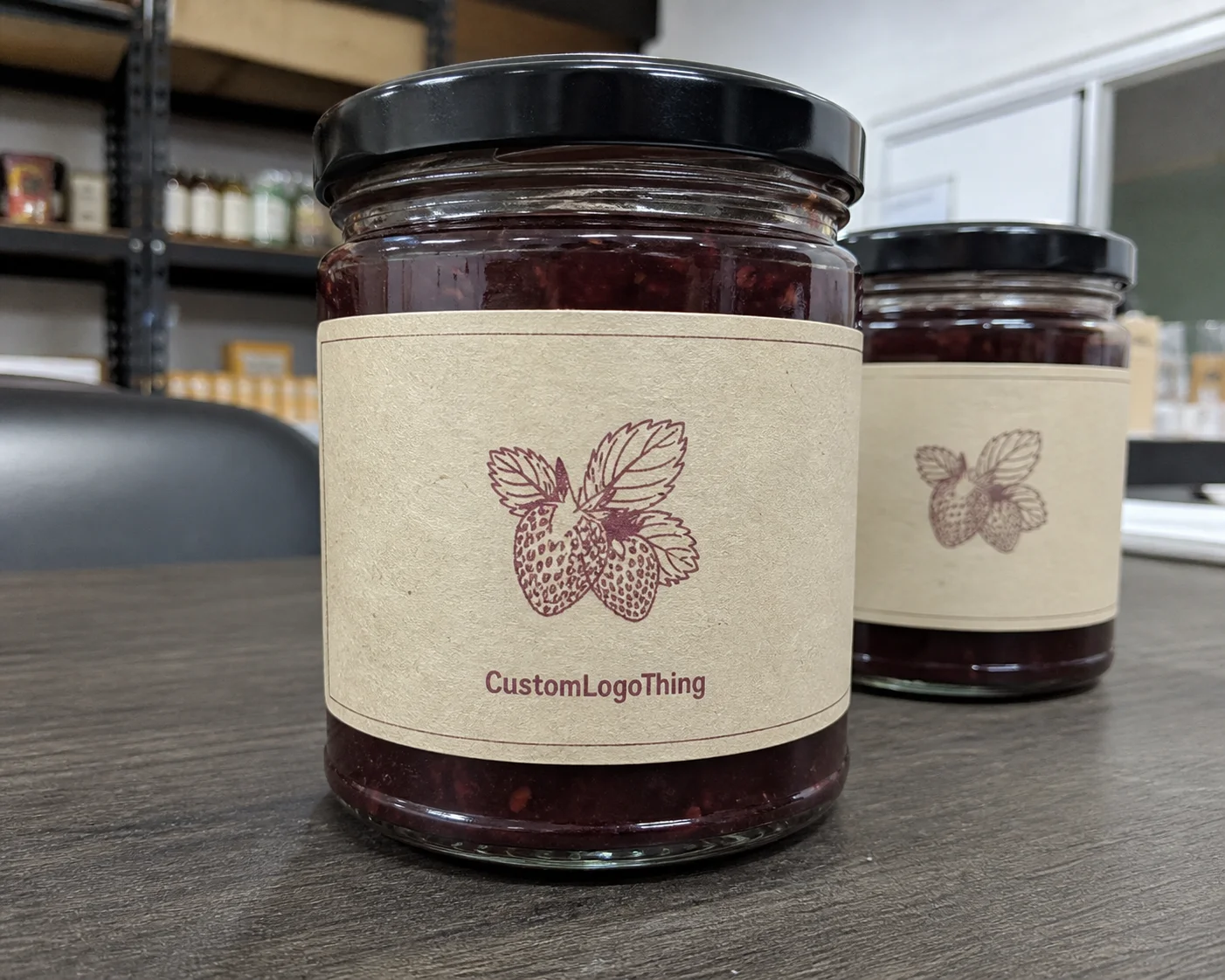
Jam buyers decide quickly. The label has to identify the flavor at a glance, support the brand, and make the jar look worth picking up. If the line includes several flavors, the system needs to stay consistent without making every jar look identical.
A front label usually carries the brand and flavor name. Depending on the pack, it may also need room for ingredients, net weight, barcode placement, and legal text. That is a lot to fit on a small surface, especially when the jar has a curve or a short flat panel.
The environment matters too. Jars get chilled, stacked, handled with damp hands, and moved through cold storage or retail displays. A paper label that looks fine on a screen can soften, wrinkle, or lift once condensation shows up. That is why label selection is part of packaging engineering, not just design.
Common formats include:
- Front label for branding and flavor identification
- Wraparound label when more copy space is needed
- Neck label for seasonal notes or premium detail
- Lid seal for a finished look or tamper support
- Tamper-evident strip for retail confidence
For a product line, the label system matters almost as much as the jar itself. The packaging should look planned across flavors, sizes, and channels so the brand reads as coherent in a shop, at a market stall, or in a gift set.
“Most label failures are not art problems. They are spec problems wearing a nice design.”
That is the right frame for buying labels. The art matters, but the specification decides whether the jar looks polished after the first week on shelf.
Process and turnaround: from proof to delivery
The workflow is usually straightforward: Request a Quote, send dimensions or artwork, review the proof, approve the file, and move into print and shipping. Delays tend to come from incomplete measurements, production-unready artwork, or slow proof approval rather than the print run itself.
Lead time depends on stock, finish, and shape. A repeat order on an existing size can be fast once the proof is approved. New die-cut shapes, specialty finishes, or white ink usually take longer. As a planning guide, simple runs often land around 7-12 business days after proof approval, while more complex jobs can run closer to 12-18 business days. Shipping sits outside that window.
If the order includes multiple jar sizes, specify each one separately. A 4 oz wide-mouth jar and an 8 oz round jar are not interchangeable, and the shoulder curve can reduce usable space more than a mockup suggests.
- Missing jar measurements
- Low-resolution logos or raster artwork
- No bleed on the file
- Late proof approval
- Unclear ingredient or barcode placement
- Last-minute artwork changes after proofing
It also helps to request production time and shipping time in the same quote. That keeps launch planning honest. If the packaging set includes boxes, inserts, or shipping cartons, track the full schedule together so the label order does not finish before the rest of the pack is ready.
For brands building a wider packaging system, the jar label should fit with the rest of the pack rather than feeling like a separate project. It does not need to mirror every carton or mailer exactly, but it should sit in the same visual family.
Materials, adhesives, and finishes that survive the fridge
Paper labels can work for dry pantry jars, but they are usually the wrong choice for chilled product. Condensation attacks paper fast. It gets under the edge, softens the face stock, and makes the label look older than it should.
For refrigerated or frequently handled jars, film-based stock is safer. The main options are:
- Paper labels - lower cost, better for dry storage, vulnerable to moisture
- BOPP / polypropylene film - better moisture resistance, common for refrigerated product
- Waterproof synthetic stock - useful for cold-chain or high-handling use
Adhesive selection matters just as much as the face stock. Permanent adhesive is the standard for retail jars because the label needs to stay put through transport, display, and handling. Removable adhesive can make sense for short test runs or temporary seasonal packs, but it is not the default choice for chilled product.
For refrigerated storage, ask for a chilled-friendly adhesive. Not every adhesive behaves well at lower temperatures, and a label that holds on the bench can still fail in a cooler.
| Option | Best Use | Typical Cost Impact | Practical Risk |
|---|---|---|---|
| Paper + standard adhesive | Dry pantry jars, low-moisture handling | Lowest | Can wrinkle or lift in condensation |
| BOPP film + permanent adhesive | Retail jam, refrigerated display, market handling | Moderate | Usually the safest general-purpose choice |
| Waterproof synthetic + chilled adhesive | Cold storage, wet hands, premium shelf life | Higher | Best performance, but costs more |
Finish changes both the look and the handling behavior. Matte usually feels more artisanal. Gloss pushes color harder and often handles moisture better. Soft-touch can look premium, but it is not always the best choice for wet handling because wear can show sooner than expected.
Special effects help only when they improve readability. Clear labels can work well when the jam itself is visually appealing. White ink can make text stand out on transparent or dark containers. Metallic accents can lift a premium line, but only if contrast stays strong.
Shape fit deserves attention. A label that looks fine on a flat mockup can fail once it wraps around glass. Shoulder curves, seams, and the true flat panel height all matter. For an important order, test the label on the actual filled jar before approving production.
Cost, pricing, and MOQ: what moves the quote
Pricing depends on more than quantity. Size, stock, adhesive, finish, and shape all affect the quote. A simple front label on paper stock costs very differently from a waterproof die-cut label with white ink and a matte laminate.
The main pricing drivers are:
- Label size
- Order quantity
- Stock material
- Adhesive type
- Finish: matte, gloss, soft-touch, or specialty
- Custom die-cut shape
- Number of flavors or versions
- Front-only or wraparound coverage
MOQ affects unit cost because setup is spread across the run. A quantity of 500 will usually carry a much higher per-label cost than 5,000, even if the materials are identical. Fixed labor in proofing, setup, and finishing has to be absorbed somewhere.
As a rough planning range:
- Small runs: about $0.25-$0.60 per label depending on size and finish
- Mid-volume runs: about $0.12-$0.28 per label
- Larger runs: often lower per unit, especially on repeat sizes
Cheap labels become expensive when they are the wrong size, wrong stock, or wrong adhesive for the product. Reprints cost more than choosing the right spec early.
Watch for extra charges that are easy to miss:
- Proof charges on complex jobs
- Tooling or die costs for new shapes
- Rush fees
- Freight
- Reprint costs after approval mistakes
For scaling brands, ask for pricing at several quantities so you can see where the unit cost starts to drop. That helps with inventory planning and makes seasonal or multi-flavor programs easier to manage.
How to order labels without a reprint
Start from the jar, not from the concept. Measure the actual container in hand. You need the diameter, usable panel height, shoulder curve, seam location, and the true flat area once the jar is filled. Catalog dimensions and memory are not enough.
Before requesting a quote, gather:
- Jar dimensions
- Label placement area
- Logo files
- Flavor names and version list
- Ingredients and net weight copy
- Barcode
- Required legal text
- Quantity by flavor
Build artwork for print. Use vector files for logos and icons. Include bleed. Keep text away from trim. Do not assume the printer will fix file problems later, especially when multiple versions or sizes are involved.
Review the proof on the dieline, not just on a mockup. A mockup shows the direction. It does not tell you whether the barcode fits cleanly or whether the type will fall into the jar curve.
Check every line before approval: spelling, ingredient order, barcode size, label dimensions, finish notes, and quantity. A good-looking proof can still be wrong in ways that cost time and money.
If the product will ship with gift sets, sample packs, or subscription boxes, make sure the label style still fits the rest of the packaging. Pairing Custom Labels & Tags with the right Custom Packaging Products helps keep the line aligned as it grows.
For new designs, test a label on the actual jar, with the actual fill, and after refrigeration. Look at the edges after several hours in the fridge and check readability under store lighting. That is the best way to confirm the label is production-ready.
Common mistakes that make jar labels fail
Sizing errors are the most common problem. A mockup on a flat artboard can hide the fact that the label will wrap too far, hit the shoulder, or land into the bottom curve. Jars are less forgiving than screens.
Moisture is the other repeated failure point. Standard paper labels can wrinkle, cloud, or lift when jars are chilled or handled with wet hands. If the product goes into a fridge, cooler, or cold display case, that has to be specified up front.
Typography can also sink the label. Tiny copy on a busy background disappears quickly, especially on dark fruit spreads where contrast is already limited. The flavor name should stay readable from normal shelf distance.
Other production mistakes include:
- No bleed
- Wrong cut orientation
- Inconsistent versioning across flavors
- Skipped proof checks
- Using one jar size to approve another
Hand-filled jars also vary slightly, so the layout needs a little tolerance. Leaving breathing room around the edge is safer than pushing artwork to the limit.
If the jars will sell through markets, specialty shops, or direct-to-consumer channels, the label has to hold up at different distances and under different lights. That is part of branded packaging, not a bonus.
Expert checks before you place the order
Before placing the order, run a real preflight. Check the jar dimensions, label placement, material, adhesive, finish, quantity, reorder threshold, and delivery date. If one of those is off, the quote can change or the print job can fail.
Ask for a mockup on the actual jar shape, not just a flat artwork proof. A flat proof confirms placement, but it does not tell you whether the label will curl once it meets condensation.
Decide whether the package needs one label or a full label system. Common components are:
- Front label for brand and flavor
- Neck label for message or premium detail
- Lid seal for finish and tamper indication
- Tamper-evident strip for retail confidence
Build inventory buffer into the plan. Seasonal flavors, holiday packs, and market runs can move fast. Running out usually costs more than carrying a small safety stock, especially if the labels must stay aligned with jars, cartons, and shipping materials.
The best order is the one that arrives cleanly the first time. Send measurements, artwork, quantities, and delivery needs together. Test the label on a chilled jar before final approval. That is the real benchmark for custom jam jar labels.
If the label reads clearly, holds up in cold storage, and fits the jar without fighting the curve, the specs were right. That is what keeps the packaging looking deliberate and keeps the reprint budget intact.
What size should custom jam jar labels be for a standard jar?
Measure the flat panel width and height on the actual jar. Leave a margin so the label does not overlap the shoulder, seam, or bottom curve. If the jar shape is unfamiliar, ask for a dieline based on the real container and test a sample first.
Are custom jam jar labels waterproof or just water-resistant?
Waterproof usually means film-based labels with the right adhesive and finish for condensation or refrigeration. Paper labels can work for dry pantry use, but they are a poor fit for chilled jars.
How long do custom jam jar labels take to produce?
Simple reorders on stock materials can move quickly once the proof is approved. Custom shapes, specialty finishes, and new artwork add time before production starts. In many jobs, proof approval is the main delay.
What affects custom jam jar labels pricing the most?
Quantity, size, material, finish, adhesive, and whether the shape needs a custom die all affect the quote. Multiple flavors or variable versions add setup work and can raise cost.
Do I need a front label, neck label, or tamper seal for jam jars?
A front label is the baseline because it carries the brand and flavor name. A neck label or lid seal can help with premium positioning, gifting, or tamper evidence. You do not need every format, but combining two labels can make a small jar feel more finished.