Buyer Fit Snapshot
| Best fit | Custom Kraft Archive Boxes Bulk for Sustainable Storage projects where brand print, material claims, artwork control, MOQ, and repeat-order consistency need to be specified before quoting. |
|---|---|
| Quote inputs | Share finished size, material target, print colors, finish, packing count, annual reorder estimate, ship-to region, and any compliance wording. |
| Proofing check | Approve dieline scale, logo placement, barcode or warning zones, color tolerance, closure strength, and carton packing before bulk production. |
| Main risk | Vague material claims, crowded artwork, missing packing details, or unclear freight terms can make a low unit price expensive after revisions. |
Fast answer: Custom Kraft Archive Boxes Bulk for Sustainable Storage should be specified like a repeatable production item. The safest quote records material, print method, finish, artwork proof, packing count, and reorder notes in one written spec.
Production checks before approval
Compare the actual filled-product size with the drawing, then confirm tolerance on folds, seals, hang holes, label areas, and retail display edges. Reserve space for logos, QR codes, warning copy, and material claims before decorative graphics fill the panel.
Quote comparison points
Review material grade, print process, finish, sampling route, tooling charges, carton quantity, and freight assumptions side by side. A quote is only useful when the supplier can repeat the same color, closure quality, and packing count on the next order.
Custom Kraft Archive Boxes Bulk for Sustainable Storage
Custom kraft archive boxes bulk orders usually solve a storage problem that has already started costing time, even if nobody has put a number on it yet. The documents may still be in good shape, but the system around them often is not: cartons buckle, lids separate, labels smear, and boxes stop lining up the way they should on a shelf. From a packaging buyer's perspective, that turns into wasted labor and repeated reordering. From an operations perspective, it creates inconsistency between teams that ought to be working from the same storage format.
That is where custom kraft archive boxes bulk make a real difference. They establish a repeatable standard for records, invoices, legal files, tax archives, samples, and reference material that has to stay organized for the long term. They also make budget planning easier, since larger runs often bring the unit cost down and reduce the scramble that comes with emergency purchases. If the goal is durable, tidy, and recyclable storage, the archive box is not a small detail. It is part of the structure that holds the whole system together.
A quieter benefit gets missed surprisingly often. Many businesses talk about sustainability in broad terms, then keep buying mixed cartons that fail early and end up discarded. Custom kraft archive boxes bulk reduce that cycle by replacing many one-off orders with a single defined spec. One SKU, one measurement set, one labeling format. That is easier on warehouse teams, easier on finance, and easier on the recycling stream.
I've seen records rooms where half the problem was not the paper at all, just the packaging around it. One department used oversized cartons, another used thin retail-style boxes, and the result was a kind of slow-motion mess that made every retrieval feel harder than it should have been. A standard archive box fixes that kind of drift in a way people notice pretty quickly.
"The best archive packaging does three jobs at once: protects records, speeds retrieval, and keeps the storage footprint predictable."
Why Custom Kraft Archive Boxes Bulk Beat Short-Term Storage
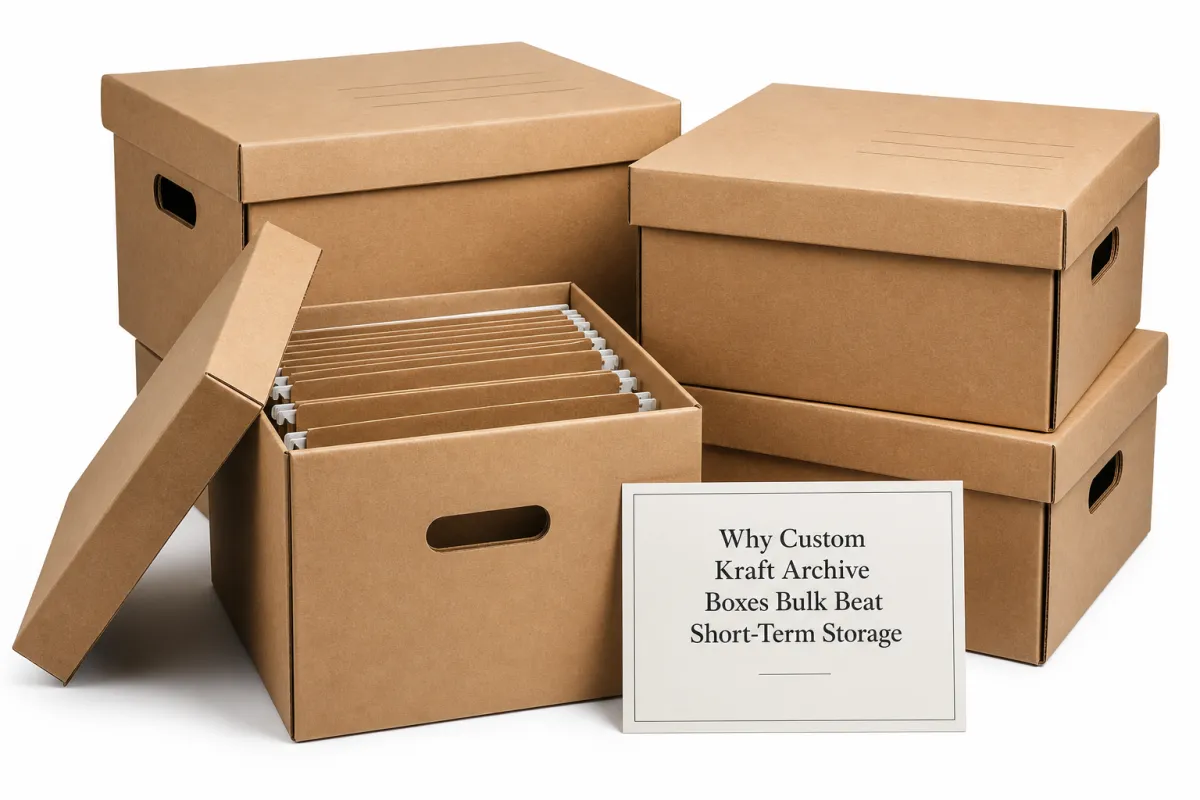
Short-term cartons are built for movement, not endurance. They work for a few weeks, sometimes a few months, then the corners soften, the lid loses its shape, and the label area stops looking dependable. Custom kraft archive boxes bulk are made for a different job. They are meant to sit on shelves, survive repeated handling, and preserve order over time. That difference matters more than many people admit, especially once records stop being temporary and start becoming part of daily operations.
A lot of archive problems begin quietly. A box caves in under weight. A lid loosens during a move. A handwritten label fades under office lighting. Once a single box fails, the rest of the row starts to look untidy, and retrieval time stretches from a quick check into a frustrating search. Custom kraft archive boxes bulk avoid that drift by giving every department the same wall thickness, the same stack height, and the same closure method. The outcome is practical rather than flashy, and practical is what buyers still appreciate months later.
Consistency matters even more when records move between locations. A head office, a regional branch, and an outside storage contractor all benefit from the same box format. If the dimensions shift from one order to the next, shelf planning becomes guesswork. If the print layout changes, barcodes and file notes become harder to read at a glance. Custom kraft archive boxes bulk keep the storage language stable across the organization, which is especially useful during audits, relocations, and department consolidations.
The sustainability case is stronger when it is framed around operations instead of slogans. Recyclable kraft board, fewer replacements, and less scrap from ill-fitting cartons all add up. The EPA's recycling guidance still favors source reduction first, because avoiding waste is usually cheaper than dealing with it later. In archive storage, source reduction means choosing a box that lasts longer and actually fits the job instead of ordering whatever carton happens to be available that week. If your team also manages branded packaging or custom printed boxes elsewhere, the logic is the same: standardize the format, then repeat it consistently.
For buyers comparing options, the business case is fairly direct. Custom kraft archive boxes bulk usually reduce the per-unit price, cut down on reorder cycles, and save time that would otherwise be spent fixing storage problems after the fact. That is not a theory exercise. It is what happens when procurement starts treating archive storage like a working asset rather than a disposable carton purchase.
One more advantage deserves attention. Bulk orders make it easier to keep branding and document labeling aligned across the company. A restrained logo, a strong write-on panel, and a visible index area can do more for internal organization than many teams expect. Small details like that tend to matter most when the archive grows and people need to find the right file fast.
Custom Kraft Archive Boxes Bulk: Product Details That Matter
The structure of a good archive box looks straightforward on paper and becomes much easier to miss in production. Custom kraft archive boxes bulk should use rigid walls, reinforced edges, and a closure style that stays shut under pressure. If the box sits on a shelf, the sides need to resist bowing. If it rides on a pallet, the base has to hold its shape under load. If it is handled often, the hand holes should be reinforced rather than punched into a weak panel.
Most buyers focus first on five things: stackability, label visibility, box height, access, and print clarity. Hand holes make the box easier to move. Lid styles matter because some teams want a lift-off cover while others prefer tuck-in or tab-lock construction. Write-on panels are essential for archive tracking, and barcode areas should stay clean enough to scan quickly. When those details are decided early, custom kraft archive boxes bulk become much easier to deploy across different departments.
There is a meaningful difference between plain utility packaging and archive boxes that carry a clear internal identity. Plain cartons can hold files, but they do not usually support a thoughtful records system. Branded packaging helps users identify contents at a glance, and it reinforces package branding standards that larger organizations often want to keep consistent. That does not call for loud graphics. In archive storage, a restrained logo, a clear title field, and a consistent tone on the kraft surface usually work better than heavy artwork.
What can be customized without driving the cost too high? In many cases, the print area, logo placement, internal divider count, and the visual treatment of the kraft board are all reasonable places to start. The natural kraft look can stay intact while still carrying useful code fields or a simple mark. If your team also buys product packaging for other departments, the archive line should not feel disconnected from the rest of the operation. It should follow the same practical logic.
In real use, the best custom kraft archive boxes bulk balance three pressures: durability, readability, and cost discipline. A box that is too light fails early. A box that is too elaborate inflates the budget with features no one actually uses. A box that is too plain misses the chance to improve the archive workflow. The right answer usually sits somewhere in the middle.
- Rigid walls: help boxes resist crush during stacking and handling.
- Reinforced edges: reduce damage at the corners, where failure usually starts.
- Clear labeling zones: make retrieval and audit checks faster.
- Simple branding: supports internal standardization without overprinting.
- File-friendly geometry: keeps folders and binders upright, not bent.
Specifications for Custom Kraft Archive Boxes Bulk
Before anyone asks for pricing, the specification needs to be clear. Custom kraft archive boxes bulk should be defined by dimensions, board grade, wall construction, closure type, and load capacity. If those five items are vague, the quote will be vague too, which usually leads to revision cycles that eat time and sometimes push the final price higher than expected.
The material choice matters more than many buyers first assume. Natural kraft has a clean, recognizable appearance and pairs well with a recyclable brand story. Recycled kraft can be a better fit for internal records where appearance matters less than environmental reporting. Liners and board strength influence how the box behaves under compression, and moisture resistance becomes more relevant if the boxes will sit near loading docks, basements, or storage rooms with changing humidity. For more general packaging design work, the same rule applies: the material should match the job rather than the mood board.
Size selection should follow the contents, not the other way around. Legal files need different internal dimensions than letter files. Invoices and folders are often thinner, but mixed document sets can create bulk unexpectedly. Sample kits may require extra clearance because inserts and dividers take up space. For custom kraft archive boxes bulk, a modest amount of clearance helps. Too much clearance wastes storage volume and makes stacking sloppy. Too little causes bent corners and deformed files.
Buyers should also ask for the operational details in writing. Exact tolerances, carton count per bundle, pallet configuration, and storage conditions all matter. If the cartons will be packed in a specific orientation, say so. If the warehouse needs a certain pallet height, confirm that early. A clear spec sheet saves more time than a long thread of emails ever will.
These are the details I would want on a proper quotation:
- Finished internal and external dimensions.
- Board grade or flute type.
- Closure style and handle type.
- Print method, ink coverage, and logo placement.
- Packing format, including bundles and pallet count.
- Any performance target tied to compression or handling.
For performance reference, many buyers look at compression and transit guidance from standards bodies. The International Safe Transit Association publishes packaging test protocols, and ASTM methods such as compression testing are useful when archive boxes must hold heavy loads or travel between facilities. If the archive is sensitive, a sample run should be judged against the actual use case, not only the artwork proof. You can review test guidance at ISTA and material certification expectations at FSC.
That is the practical value of custom kraft Archive Boxes Bulk: the box should be specified like a working storage tool, not a generic carton. Once the spec is right, every reorder becomes easier to manage.
Quick sizing rule: measure the tallest folder stack, add a modest clearance for easy insertion, then check shelf depth before approving the dieline. That one habit prevents most fit issues.
Custom Kraft Archive Boxes Bulk Pricing, MOQ, and Unit Cost
Pricing for custom kraft archive boxes bulk depends on more variables than most buyers expect. Size is the first driver. Board thickness comes next. Print coverage, insert complexity, and closure style can all move the price. Order volume matters too, because setup costs get spread across more cartons as the run gets larger. That is why a quote for 1,000 units and a quote for 5,000 units can look very different, even when the box seems almost identical from a distance.
MOQ is not a fixed industry number. Plain kraft archive runs are usually easier to scale, while custom dimensions and printed features can raise the minimum order quantity. The practical way to handle it is to ask for the MOQ separately from the unit price, then compare the options by volume instead of by guesswork. That gives a buyer a clearer sense of whether a lower MOQ is worth a higher per-unit cost.
Here is a simple comparison many procurement teams use when evaluating custom kraft archive boxes bulk versus other options:
| Option | Typical MOQ | Indicative Unit Cost | Best Fit | Notes |
|---|---|---|---|---|
| Plain kraft archive box | 500-1,000 units | $0.65-$1.20 | Internal records, simple storage, lower branding needs | Fastest to approve and usually easiest to reorder |
| Printed archive box | 1,000-3,000 units | $0.90-$1.60 | Branded packaging, department labeling, audit visibility | Better for company-wide standards and package branding |
| Heavy-duty custom box with inserts | 2,000-5,000 units | $1.40-$2.80 | Long-term records, heavier files, multi-part archives | Higher protection, more tooling detail, more setup time |
Those ranges are useful reference points rather than promises. The exact number depends on board grade, print coverage, and whether the structure needs special tooling. Freight can shift the total cost more than many buyers expect, especially on larger shipments. Palletization, proofing charges, plate or die costs, and delivery location all matter. A buyer who looks only at the unit price can miss the larger picture entirely.
There is also a volume effect that is easy to overlook. A setup fee of a few hundred dollars feels heavy on a small order and barely noticeable on a larger one. That is why custom kraft archive boxes bulk often look expensive at low quantities but become more attractive as the run size grows. Fixed costs get spread out, and the order starts to look more efficient.
For teams that need broader packaging support, it can help to place the archive project inside a wider sourcing plan. Our Custom Packaging Products page is a good starting point if archive boxes are one piece of a larger packaging program. For procurement teams buying repeat quantities, our Wholesale Programs can help standardize reorders and reduce specification drift over time.
If the goal is to cut cost without weakening performance, the usual levers are straightforward: trim unnecessary print, keep the structure clean, and avoid oversized dimensions. That is often enough to bring custom kraft archive boxes bulk into a more manageable range without sacrificing the box's function.
Process, Timeline, and Lead Time for Custom Kraft Archive Boxes Bulk
The production process for custom kraft archive boxes bulk should be predictable. It usually begins with quoting, then dieline confirmation, then artwork review, proof approval, material sourcing, production, and dispatch. Each step moves smoothly when the brief is complete. Each step can also turn into a delay if the measurements are unclear or the artwork is not ready when it needs to be.
Lead time depends on how standard the order is. Simple runs using existing tooling move faster than highly customized archive boxes with special sizes or multiple print areas. If the order is plain kraft with minimal branding, the schedule is usually shorter. If it includes dividers, special handles, or a custom lock style, the project needs more time. The buyer's biggest advantage is clarity early on. The sooner the spec is locked, the easier it is to keep the schedule under control.
Delays usually come from three places. The first is unclear measurements. The second is late artwork approval. The third is a structural change requested after proofing. That last one is expensive because it can affect the dieline, board usage, and carton count. Custom kraft archive boxes bulk are not difficult to produce, but they do reward disciplined planning.
It helps to build extra buffer time when archive storage is tied to relocation, audit season, or office consolidation. Those are the moments when buyers feel pressure to receive everything quickly. The irony is that those same periods are often when approval cycles slow down. A cushion of a few business days can prevent a much bigger problem later.
Typical timing, in practical terms, often looks like this:
- Quoting and spec review: 1-2 business days if measurements are ready.
- Artwork and proofing: 2-4 business days, depending on revision count.
- Production for standard runs: often 10-15 business days after approval.
- Production for custom structures: often 15-20 business days or more.
- Freight and receiving: depends on destination and pallet requirements.
Those timelines are typical, not guaranteed. Material availability can change them. Seasonal capacity can affect them too, especially when the order is large or the board spec is specific. The safest approach is to approve the proof quickly and keep the internal decision chain short. Every extra day spent waiting on sign-off is a day the schedule slips.
For archive programs, documentation matters as much as physical production. Ask for a final spec sheet, approved artwork file, and packing note before dispatch. That way the next reorder of custom kraft archive boxes bulk can be matched exactly. Repeatability is the real value here. Once the file is set, future orders become simpler and less expensive to manage.
One practical detail often gets overlooked: receiving space. A bulk order may arrive on multiple pallets, and the receiving team needs room to inspect, count, and store it. If the warehouse is already crowded, build that into the timeline. It sounds basic because it is basic, yet basic planning prevents very expensive re-handling later.
Why Choose Us for Custom Kraft Archive Boxes Bulk
Buyers do not need a sales pitch here. They need a supplier that understands how storage packaging behaves in the real world. Custom kraft archive boxes bulk should be produced with consistent material sourcing, clear proofing, and repeatable results across reorders. That matters more than flashy language or a long list of features nobody uses.
The best partner for this kind of work helps you Choose the Right board grade, dimensions, and print scope for the actual storage environment. That sounds simple, yet it is where many projects go off track. A box that looks fine on a mockup can still fail if the compression strength is too low or the dimensions do not match shelf depth. A practical supplier keeps the conversation grounded in use, not hype.
Sustainable packaging expertise matters because archive boxes sit right at the point where durability meets recyclability. If the box is weak, the archive system becomes wasteful. If the box is overbuilt, the cost climbs without a real gain. The goal is a balanced spec that supports responsible sourcing, sensible cost control, and a long service life.
Service quality matters just as much. Responsive quoting keeps the project moving. Clear specifications prevent guesswork. Samples reduce risk before full production. Production transparency helps procurement plan the receiving window. Those are not luxury extras. They are the basics that make custom kraft archive boxes bulk worth ordering in the first place.
There is another benefit that procurement teams usually notice quickly: repeat ordering becomes easier when the supplier keeps records cleanly. Once the spec is stored correctly, reorders can be matched against the original structure. That reduces specification drift and preserves consistency across departments. For larger organizations, that consistency is a form of cost control.
If your archive program needs to sit inside a larger sourcing framework, it helps to work with a packaging partner that can handle both custom printed boxes and standardized utility packaging. That range makes it easier to align archive storage with the rest of the brand and operations system.
The value is simple, honestly. A reliable supplier makes custom kraft archive boxes bulk easier to approve, easier to receive, and easier to reorder. That is what buyers are paying for.
Next Steps for Custom Kraft Archive Boxes Bulk Orders
Start with the contents. Measure file height, shelf depth, folder width, and the number of boxes needed per department or site. That sounds obvious, but poor measurement remains one of the most common reasons archive packaging falls short. If the box is too tall, shelves waste space. If it is too short, the files slouch. Custom kraft archive boxes bulk work best when the archive dimensions are known before the quote begins.
Then gather three inputs before requesting pricing: dimensions, quantity, and print requirements. That gives the supplier enough information to quote the correct structure and avoid avoidable revisions. If the archive will carry heavier files or be accessed often, ask for a sample or prototype. A sample is especially useful for long-term records, because it shows how the box behaves under real handling rather than only on paper.
It also helps to decide who signs off internally before the order is placed. Procurement, records management, and operations should not all be waiting to review the same proof at the last minute. A short approval chain keeps the timeline tight and reduces rework. The same rule applies whether you are buying archive storage or any other form of product packaging: fewer decision points usually mean fewer delays.
Before confirming the bulk order, make sure these items are clear:
- Final dimensions and board grade.
- Closure style and handle placement.
- Print area, logo size, and labeling zones.
- Pallet count, carton count, and receiving requirements.
- Delivery dates that match internal storage capacity.
Then align the delivery plan with the real receiving window. If boxes are arriving during an audit, a move, or a site cleanup, leave room for inspection and staging. That buffer is usually cheaper than paying for rushed handling later. In a bulk archive project, logistics are not separate from the packaging choice. They are part of the same decision.
Custom kraft archive boxes bulk are at their best when they are treated as a system purchase rather than a one-off carton order. Confirm the spec, approve the artwork, align the delivery date, and place the order with enough time for internal receiving. That is the cleanest path to a stable archive program and predictable cost control.
Practical takeaway: if you want the order to go right the first time, lock the measurements, ask for a sample against real shelf space, and keep the spec sheet unchanged for every reorder. That one habit saves the most money over the life of the archive.
Frequently Asked Questions
How do I choose the right size for custom kraft archive boxes bulk?
Measure the file stack, folder width, and shelf space before choosing a carton size. Allow a small clearance so documents fit without bending, but avoid oversizing that creates wasted storage volume. Match the dimensions to how the boxes will be stored: on shelves, stacked on pallets, or moved between sites. For many buyers, the best approach is to test one sample before committing to the full custom kraft archive boxes bulk order.
What is the usual MOQ for custom kraft archive boxes bulk orders?
MOQ depends on box size, print complexity, and whether the order uses standard or custom tooling. Plain kraft archive runs often start lower than fully printed or structurally customized versions. Ask for a quote that shows MOQ separately from unit price so you can compare options clearly. That makes it easier to see whether custom kraft archive boxes bulk fit your budget and timing.
Are custom kraft archive boxes bulk orders recyclable?
Kraft board is commonly recyclable when it is uncoated or uses recycling-friendly finishes. Inks, adhesives, and laminations can affect recyclability, so confirm the exact material build before production. If sustainability is a priority, request a material spec that supports your local recycling stream. That is one reason many teams prefer custom kraft archive boxes bulk over mixed-material storage options.
What affects pricing most for custom kraft archive boxes bulk?
Board grade, box dimensions, print coverage, and order quantity are the biggest drivers. Freight and pallet configuration can change the total cost more than buyers expect, especially on larger shipments. Reducing unnecessary print or simplifying the structure can lower unit cost without hurting performance. In many cases, the smartest savings in custom kraft archive boxes bulk come from clean specification, not from cutting corners.
How long does production usually take for custom kraft archive boxes bulk?
Timeline depends on proof approval, material availability, and whether the order needs special printing or custom sizing. Simple orders move faster than highly customized archive boxes with added features. The fastest way to keep lead time on track is to approve measurements and artwork quickly. For most procurement teams, the biggest schedule risk in custom kraft archive boxes bulk is not the factory - it is the approval chain.

