Buyer Fit Snapshot
| Best fit | Custom Archive Boxes Bulk projects where brand print, material claims, artwork control, MOQ, and repeat-order consistency need to be specified before quoting. |
|---|---|
| Quote inputs | Share finished size, material target, print colors, finish, packing count, annual reorder estimate, ship-to region, and any compliance wording. |
| Proofing check | Approve dieline scale, logo placement, barcode or warning zones, color tolerance, closure strength, and carton packing before bulk production. |
| Main risk | Vague material claims, crowded artwork, missing packing details, or unclear freight terms can make a low unit price expensive after revisions. |
Fast answer: Custom Archive Boxes Bulk: Pricing, Specs, and Lead Times should be specified like a repeatable production item. The safest quote records material, print method, finish, artwork proof, packing count, and reorder notes in one written spec.
Production checks before approval
Compare the actual filled-product size with the drawing, then confirm tolerance on folds, seals, hang holes, label areas, and retail display edges. Reserve space for logos, QR codes, warning copy, and material claims before decorative graphics fill the panel.
Quote comparison points
Review material grade, print process, finish, sampling route, tooling charges, carton quantity, and freight assumptions side by side. A quote is only useful when the supplier can repeat the same color, closure quality, and packing count on the next order.
Custom Archive Boxes Bulk: Pricing, Specs, and Lead Times
The cheapest archive box is often the costliest one to live with. In custom Archive Boxes Bulk orders, the real savings show up in labor, shelf space, and fewer damaged files, not only in the invoice total. A records team can waste more hours fixing weak cartons than the cartons were ever worth, and that gets kinda expensive fast.
Custom archive boxes bulk is a procurement decision, not a casual stationery buy. The right build keeps departments aligned, makes storage rooms easier to audit, and stops the steady stream of mismatched cartons that collapse, sink on shelves, or refuse to fit the filing system already in place.
After enough warehouse walks and records-room checks, I have learned that storage problems usually start with a small spec mistake. A box that is half an inch off, a lid that bows under weight, or a print panel that leaves no room for indexing can turn into a daily nuisance. Nobody notices the good carton right away, but everybody notices the bad one by week two.
Why custom archive boxes bulk beats piecemeal ordering
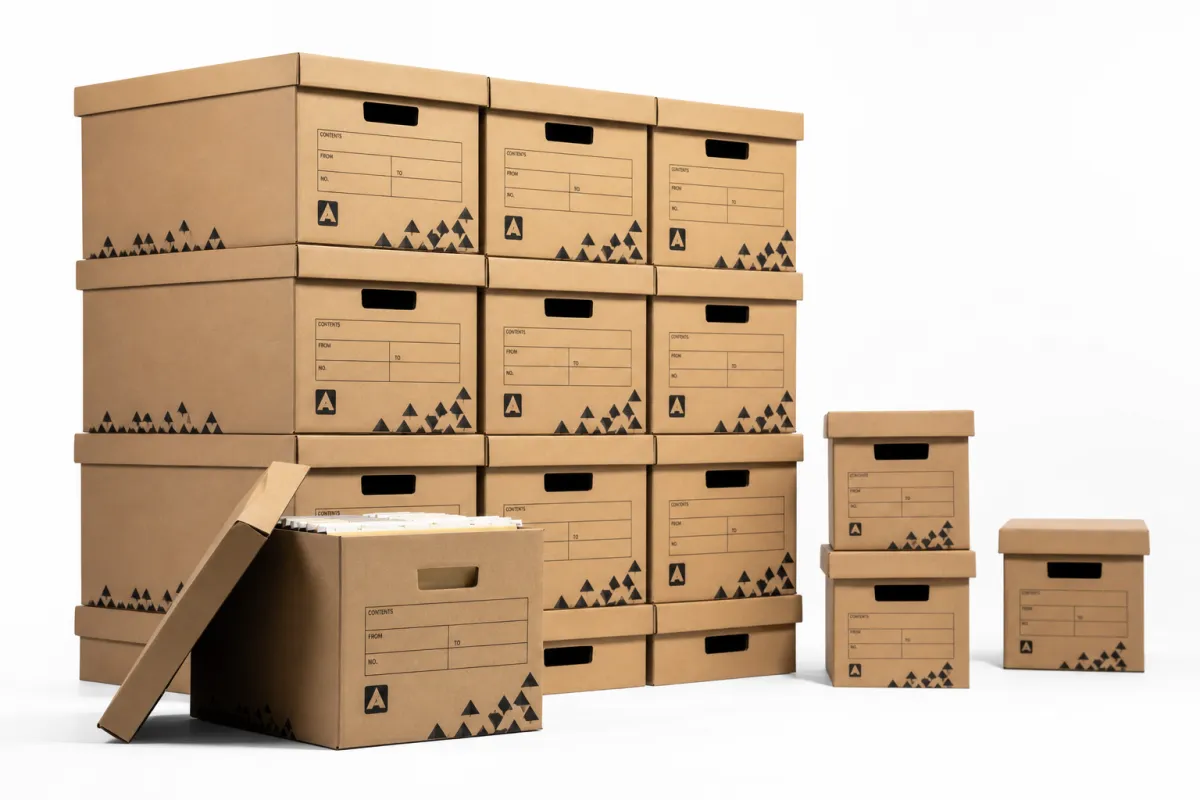
Fewer moving parts usually means fewer problems. One size, one print format, one stacking profile, one labeling system. That sounds plain until it is compared with piecemeal buying, where every department chooses a slightly different carton and then expects records staff to make the whole room behave. The box that looks cheapest on paper often turns into the most expensive one after label delays, mixed dimensions, and the time spent correcting storage mistakes.
Bulk ordering lowers the unit cost in a way small, separate orders rarely can. A one-off reorder may seem harmless, yet it often brings a higher per-unit price, separate freight charges, and another round of proofing. With custom archive boxes bulk, the savings come from scale and consistency. Procurement handles fewer purchase cycles, records teams hold predictable inventory, and the archive room stops looking like it was stocked by five different people with five different ideas.
The operational benefit matters just as much as the pricing. Custom archive boxes bulk helps standardize shelf depth, file height, and labeling across branches or departments. Retrieval gets faster, stacking gets cleaner, and corner crushes happen less often because the boxes actually match the available space. A box that fits correctly also protects documents better. Mixed formats are where files get bent, buried, or filed somewhere nobody can find without a small miracle and a long lunch break.
Bad storage creates bad habits. Weak boxes get overfilled. Loose lids get taped shut. Wrong sizes turn the archive room into a puzzle nobody wants to maintain. Custom archive boxes bulk cuts that chaos down before it starts. Buy smarter, not just more, and the boxes pay for themselves in fewer replacements and fewer complaints.
Custom archive boxes bulk: materials, styles, and use cases
Material choice sets the tone for the whole order. For custom archive boxes bulk, common options include corrugated board, rigid board, and archival-safe board. Single-wall corrugated works for lighter files and short moves. Heavier records, bound reports, and binder storage usually call for stronger board, often in the 32 ECT to 44 ECT range, with double-wall construction when the load is serious. If long-term preservation matters, ask for acid-free or document-safe materials instead of assuming all cardboard performs the same. It does not.
Style matters just as much. Lift-off lid archive boxes are popular because they open easily and stack well. Hinged boxes are useful when staff need quicker access without losing lids. File storage boxes with a front panel can suit active records better, while reinforced cartons are a better fit for heavy loads that travel between rooms or sites. Custom archive boxes bulk should follow the way the documents are handled, not force the team to change its workflow because a catalog photo looks tidy.
Use cases vary more than many buyers expect. Law offices want consistent labeling and tamper-resistant storage. Hospitals need clear department coding and fast retrieval. Schools often need seasonal moves and short-term holding for enrollment records, testing files, and HR paperwork. Accounting firms care about audit trails and easy indexing. Warehouses and corporate records rooms usually want stacking strength, pallet stability, and a size that works with existing shelves. I am not gonna pretend every archive room is built the same; the spec has to reflect the actual job, or the boxes just sit there looking organized while failing in practice.
Functional details make the box easier to use every day. Hand holes help with lifting. Thumb cuts help with access. Reinforced edges keep lids from fraying. Printed title panels, barcode space, and department fields turn a plain carton into custom printed boxes that are easier to sort and audit. Even in internal storage, the discipline used in product packaging and retail packaging still applies: clear structure, readable identification, and enough consistency that people do not have to guess. If recycled sourcing matters, ask for certified fiber and check the chain-of-custody options at fsc.org.
Specifications that matter for archive storage boxes
Start with the dull specs, because that is where the success lives. For custom archive boxes bulk, lock down internal dimensions, board thickness, load capacity, lid fit, and stacking strength before anyone starts talking about print. If the box needs to hold letter files, legal files, or binders, measure the contents with real clearance for removal. A carton that is 1/4 inch too tight becomes a daily annoyance. A carton that is 1/2 inch too large wastes shelf space and lets documents move around.
Shelf depth and file height matter more than artwork, even if nobody likes admitting it. A nice logo does not help if the lid catches on the shelf lip or the box blocks a whole run of drawers. For custom archive boxes bulk, I usually tell buyers to measure the worst-case shelf, not the nicest one. Old shelving is rarely perfectly square. If the boxes are for active records, leave room for indexing tabs and retrieval fingers. If they are for long-term storage, maximize the usable interior without forcing staff to cram the files in like they are packing for a late flight.
Print and labeling specs should work first and look good second. One-color logos keep costs down and still make the boxes look organized. Blank write-on panels matter more than fancy graphics. Barcode space helps with audits. Color-coded side panels let different departments sort faster without inventing a new system every quarter. Good packaging design does not need to shout. It needs to work. Good package branding on archive storage is just clear identification repeated consistently across every carton in the stack.
Durability details deserve attention too. Ask about moisture resistance if the archive room sits in a basement or near a loading area. Ask about crush protection if the boxes will be stacked high. Ask about corner performance if they will move on carts, pallets, or in and out of trucks. For transport testing, the standards world is not glamorous, but it is useful; ista.org explains test profiles that help buyers understand how cartons hold up in transit. In some cases, ASTM compression testing is the right conversation as well. For custom archive boxes bulk, those details are what separate a storage box from a future complaint.
- Measure the contents first: folder width, binder spine, and required clearance.
- Check the shelf: depth, height, and any lip or rail that steals space.
- Define the load: light files, mixed paper, binders, or dense records.
- Decide the label system: manual write-on, barcode, color code, or department print.
- Set the durability target: storage only, frequent handling, or site-to-site transport.
Custom archive boxes bulk pricing, MOQ, and quote factors
Pricing is not mysterious once the drivers are clear. With custom archive boxes bulk, the biggest cost factors are box size, board grade, print coverage, coatings, reinforcement, and quantity. A larger box uses more material. A stronger board adds cost. More print colors, inside print, or special coatings push the price up further. The quote also changes if the box has hand holes, reinforced edges, or an unusual closure. Buyers who send vague requests get vague pricing. Buyers who send real specs get useful numbers.
MOQ follows the build. Plain standard archive boxes often allow lower minimums than fully printed or highly customized versions. Once custom dimensions, color printing, special finishes, or structural reinforcement enter the picture, the production run usually has to get bigger to make the setup worthwhile. That is normal. For custom archive boxes bulk, a lower MOQ can help with a pilot run, but the real savings usually start once the order reaches a true bulk quantity. Small orders are for testing. Bulk orders are for repeat use and budget control.
| Build | Typical MOQ | Unit Price Range | Best For | Main Tradeoff |
|---|---|---|---|---|
| Plain corrugated archive box | 500-1,000 units | $0.48-$0.95 | Basic records storage and internal moves | Lowest cost, least customization |
| Printed archive box with one-color branding | 1,000-3,000 units | $0.68-$1.35 | Department labeling and cleaner organization | Better identification, slightly higher setup cost |
| Reinforced archival box | 1,000-5,000 units | $1.20-$2.75 | Heavy files, long-term storage, and frequent handling | Stronger build, higher material cost |
| Archival-safe custom build | 2,000+ units | $1.45-$3.25 | Document-sensitive storage and higher-end records programs | Best protection, but not the cheapest route |
Those numbers are practical ranges, not promises carved into stone. A smaller box with light print may come in lower. A large box with heavy coverage, special board, or a complex lid can land higher. Freight also changes the math. Palletizing, destination, liftgate service, and rush handling can all add cost. For custom archive boxes bulk, the quote should always include the unit price, setup charges, freight estimate, and whether the sample or proof is included in the order. If a supplier leaves those items out, the “cheap” price usually gets less charming after the invoice arrives.
If a quote only shows the box price and hides freight, proof changes, and pallet charges, it is not a full quote. It is a teaser.
A useful quote request should include dimensions, quantity, print details, material preference, shipping address, and target timing. It also helps to note whether the boxes are for active storage, long-term archival use, or moving between locations. Those three jobs are not the same. A records room box can be lighter than a relocation box, and a relocation box can be less refined than a permanently indexed archive carton. With custom archive boxes bulk, precision at the quoting stage saves real money later.
Production process and lead time for bulk orders
The production flow is straightforward when the brief is clean. For custom archive boxes bulk, the process usually starts with a quote review and artwork check, then moves to proof approval, manufacturing, packing, and dispatch. If the size is standard and the print is simple, the schedule moves faster. If the design keeps changing, the lead time stretches. Every revision adds a handoff, and every handoff adds room for error. That is not dramatic. That is production.
Simple approved orders can move in a fairly predictable window. In many runs, production takes about 12-18 business days after proof approval for common specifications, with heavier customization pushing that longer. Rush jobs are possible, but they usually cost more and reduce flexibility in scheduling. Overseas freight can add several weeks depending on routing and port conditions. Domestic pallet freight is faster, but the pallet still has to move through the carrier network. For custom archive boxes bulk, the box itself may be quick; the delivery is what often tests everyone’s patience.
Samples are worth the time. A pre-production proof or physical sample lets the buyer check fit, print placement, lid closure, and stack behavior before committing to the whole run. That matters when the boxes need to match shelving or existing filing systems. A one-inch mistake in the sample stage is a small problem. A one-inch mistake in 5,000 cartons is a budget item and a headache. I have seen buyers skip the proof to save a week and then lose a month fixing the order. Smart people do not do that twice.
Final delivery timing also depends on quantity, seasonal demand, and how the cartons are packed for shipment. Pallet wrap, corner protection, and proper stacking inside the truck matter more than buyers think. If boxes are loaded badly, they arrive distorted and everybody pretends not to notice while filing a damage claim. Custom archive boxes bulk should leave the plant ready for use, not ready for a repair project.
The sample is the cheap part of the lesson. The full run is where the lesson gets expensive.
Why choose us for custom archive boxes bulk orders
Consistency is the main reason buyers choose a specialist. A generic supplier can sell you a carton, sure, but that does not mean every carton in the run will match the sample or hold up in real storage. With custom archive boxes bulk, the value is in repeatable sizing, repeatable print, and repeatable quality. That matters when a records room needs boxes from different departments to stack cleanly, scan cleanly, and stay readable after years of handling.
Practical support matters too. Good suppliers should help with size selection, board recommendations, print setup, and honest feedback when a request is overbuilt. Not every archive box needs premium board. Not every box needs full-coverage print. Sometimes the better answer is a smaller spec with cleaner indexing. That is the kind of advice that earns trust, because it saves the buyer from paying for features that do nothing. If you need a broader packaging mix, our Custom Packaging Products page is a useful starting point, and buyers with repeat schedules can compare options through our Wholesale Programs.
Quality control across bulk runs is non-negotiable. The first box and the last box should behave the same way. If a carton drifts halfway through production, the whole order becomes a shelf-fit problem. For custom archive boxes bulk, that means checking dimensions, print registration, board consistency, and closure performance before the shipment leaves. Direct factory pricing helps too, because it gives procurement teams a clearer number to work with instead of a mysterious margin stacked on top of a carton that may or may not fit the job.
There is also a business case that gets missed when everyone is focused on unit price. Better archive boxes reduce complaints, reduce replacement orders, and reduce damaged records. That is real savings. It also improves package branding inside the company, because the storage system looks intentional instead of improvised. Custom printed boxes do not need to be flashy to do the job. They need to be clear, durable, and standard. For custom archive boxes bulk, that is the part most buyers care about after the first painful reorder.
Next steps for ordering custom archive boxes bulk
Before asking for pricing, count the storage volume and measure what actually needs to fit. Do not guess. For custom archive boxes bulk, the fastest quote comes from exact numbers: folder width, binder depth, shelf limitations, and whether the boxes will sit upright, stack flat, or move by pallet. If different departments use different file types, note that now. A good spec today prevents an awkward rework later.
Put the essentials in one place. That means dimensions, quantity, print needs, label system, shipping destination, and target delivery window. If the budget is tight, request two or three quote options instead of one vague request. A plain build, a printed build, and a reinforced build are often enough to show the real tradeoff. That is especially useful for custom archive boxes bulk, because the buyer can see exactly how much better the stronger version is before signing off on a larger spend.
Approval should happen after the sample, the artwork, and the quantity split by site or department are checked. If one branch needs 2,000 cartons and another needs 1,000, the shipping plan should reflect that from the start. It is far easier to sort the order before production than to repack it afterward. If you want a smoother process, send the exact spec instead of a rough idea of the spec. Production teams are good, not psychic.
The cleanest orders are the ones with fewer surprises. Custom archive boxes bulk works best when the buyer knows the storage job, the shelf size, the print need, and the timing. Measure the contents, confirm the shelf clearance, choose the right board, and ask for a plain, printed, and reinforced quote side by side. That simple sequence gives you a box that fits the files, fits the room, and stays within budget without turning the project into a small administrative disaster.
What is the usual MOQ for custom archive boxes bulk?
MOQ depends on box size, board type, and whether the boxes are printed or plain. Unprinted standard builds usually allow lower minimums than fully customized archive cartons, especially when the size is common and the structure is simple. Ask for tiered pricing if you want to compare a smaller test run against a true bulk order, because custom archive boxes bulk pricing often drops sharply once setup costs are spread over more units.
How do I choose the right size for custom archive boxes bulk?
Measure the folders, documents, or binders that must fit inside, then add enough room for easy removal. Check shelf depth and aisle clearance so the box fits the storage system instead of fighting it. If multiple departments will use the boxes, standardize on one or two sizes to reduce confusion. That keeps custom archive boxes bulk practical instead of creating a new labeling problem.
Can custom archive boxes bulk include labels or branding?
Yes, most buyers add logo printing, department names, date fields, or barcode space. Keep the design functional first, because archive boxes need clear identification more than flashy graphics. One-color or limited-color printing usually keeps costs lower while still improving organization, and it often fits better with the clean look people expect from branded packaging and custom printed boxes.
How long does production take for bulk archive box orders?
Lead time depends on quantity, customization level, proof approval, and shipping method. Simple orders move faster; revised artwork, special materials, or rush timing extend the schedule. Build in extra time if the boxes must arrive before a move, audit, or records purge. With custom archive boxes bulk, the calendar is usually decided by approvals and freight, not just the factory schedule.
Are custom archive boxes bulk suitable for long-term document storage?
Yes, as long as the board and construction are appropriate for the storage environment and document sensitivity. Look for sturdy corners, stable stacking, and materials that help protect against dust, crushing, and handling damage. For true archival use, ask about document-safe or acid-free construction before placing a large order. Custom archive boxes bulk can be a solid long-term solution if the spec is chosen with the actual storage conditions in mind.
Send the exact dimensions, quantity, and storage use, and the custom archive boxes bulk quote gets much more accurate. Measure once, choose the right construction, and compare the plain, printed, and reinforced options Before You Order. That is the shortest route to a box that fits the files, fits the shelves, and does not waste money on features nobody asked for.

