Buyer Fit Snapshot
| Best fit | Custom Kraft Boxes with Inserts projects where brand print, material claims, artwork control, MOQ, and repeat-order consistency need to be specified before quoting. |
|---|---|
| Quote inputs | Share finished size, material target, print colors, finish, packing count, annual reorder estimate, ship-to region, and any compliance wording. |
| Proofing check | Approve dieline scale, logo placement, barcode or warning zones, color tolerance, closure strength, and carton packing before bulk production. |
| Main risk | Vague material claims, crowded artwork, missing packing details, or unclear freight terms can make a low unit price expensive after revisions. |
Fast answer: Custom Kraft Boxes with Inserts: Board, Finish, Dieline, and Unit Cost should be specified like a repeatable production item. The safest quote records material, print method, finish, artwork proof, packing count, and reorder notes in one written spec.
Production checks before approval
Compare the actual filled-product size with the drawing, then confirm tolerance on folds, seals, hang holes, label areas, and retail display edges. Reserve space for logos, QR codes, warning copy, and material claims before decorative graphics fill the panel.
Quote comparison points
Review material grade, print process, finish, sampling route, tooling charges, carton quantity, and freight assumptions side by side. A quote is only useful when the supplier can repeat the same color, closure quality, and packing count on the next order.
Custom Kraft Boxes With Inserts solve a packaging problem that shows up fast once product starts moving through real production, real freight, and real hands. A carton can look beautiful on a render or in a sample photo, then arrive shifted, rubbed, or rattling because nothing inside keeps the product where it belongs. For a buyer, that is not just a cosmetic miss. It affects damages, repack labor, customer confidence, and the quiet pressure that shows up when a launch needs to stay on schedule.
That is the practical value of Custom Kraft Boxes with inserts. The kraft outer box carries structure and branding, while the insert holds the product in place, limits movement, and gives the pack a repeatable feel on the line. Once the cavity is built around the actual product dimensions, packing gets calmer, shipping gets more predictable, and the finished box reads as intentional rather than improvised.
I have seen plenty of packaging programs where the outer carton looked right but the inside behaved like a loose shipping box. That mismatch is expensive, and it is often sneaky because the first issue is not a dramatic break. It is the tiny scuff, the shifted cap, the corner wear, the customer who notices the product is not centered. A well-planned insert prevents a lot of that before it starts.
The cheapest box on paper can become the most expensive once damaged goods, replacement shipments, and handling labor are counted together. In practice, custom kraft boxes with inserts often earn their keep by reducing waste and keeping the line moving without a bunch of little corrections piling up.
Custom Kraft Boxes with Inserts: What They Actually Solve
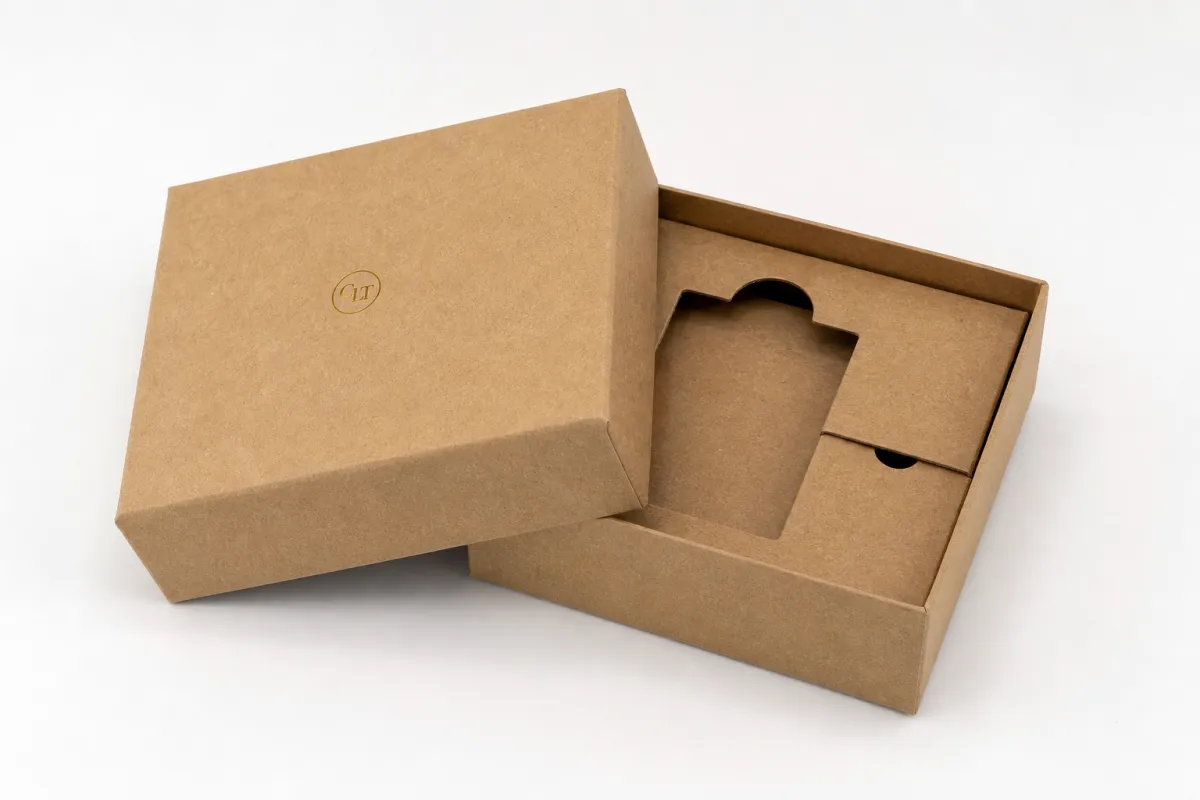
From a packaging buyer's point of view, custom kraft boxes with inserts usually do three jobs at once: they protect the product, improve presentation, and make pack-out more repeatable. A candle, glass bottle, charging accessory, or skincare kit can sit centered in the carton instead of sliding into a corner and rubbing against print or structural edges.
Damage rarely comes from one dramatic hit. More often, it starts with small movement repeated over and over: a carton vibrating in transit, a bottle tapping the cavity wall, a lid flexing slightly, a corner wearing down one trip at a time. custom kraft boxes with inserts reduce that motion by giving the product a defined home inside the pack.
There is also a cost side that gets missed if you only look at the unit price. A carton might look inexpensive until repacking labor, damaged-goods write-offs, customer service time, and replacement shipments are added in. Once those pieces are included, a better-structured pack can be the cheaper option even if the quote is a little higher. That is usually the part people wish they had caught earlier, honestly.
Common uses include cosmetics, candles, electronics accessories, beverage sets, tea or coffee samplers, sample kits, and small retail gift packs. Anywhere a brand wants a cleaner reveal and less movement, custom kraft boxes with inserts make the package feel more controlled and easier to repeat across a run.
"A box that looks premium on a table but fails in transit is not premium packaging."
That idea sounds simple, but it tends to get ignored when teams focus too hard on the outside artwork. The better approach is to treat the outer carton and the insert as one packaging system. If the product shifts inside, the package is not really finished, no matter how nice the print looks.
How Custom Kraft Boxes with Inserts Work in Real Packaging Lines
The outer kraft box gives the structure, stacking strength, and print area; the insert does the quiet work. It creates cavities sized to the product dimensions, which is why custom kraft boxes with inserts feel much more controlled than generic folding cartons stuffed with tissue, paper, or loose void fill.
Different insert styles behave differently on the line and in transit. Die-cut paperboard is crisp and economical for lighter items. Corrugated inserts add stiffness for heavier SKUs. Molded pulp brings a more natural, recyclable feel. Foam can protect sensitive products very well, although many brands avoid it for sustainability reasons. Kraft dividers work well for sets and multi-compartment layouts where the goal is separation more than shock absorption.
| Insert material | Best fit | Typical cost impact | Notes |
|---|---|---|---|
| Die-cut paperboard | Light cosmetic and accessory items | Lowest; often adds about $0.02-$0.06 per unit at mid-volume runs | Fast to assemble, sharp presentation, limited shock absorption |
| Corrugated | Heavier bottles, kits, and shipped retail sets | Moderate; roughly $0.04-$0.10 per unit depending on cavities | Better rigidity and stack strength |
| Molded pulp | Fragile items with sustainability goals | Moderate to higher; often $0.05-$0.12 per unit | Good protection, less crisp print appearance |
| Foam | High-value electronics or delicate components | Varies widely; often highest at low volume | Excellent protection, weaker recycling story |
| Kraft dividers | Multi-item kits and beverage sets | Usually low to moderate | Good for separation, not ideal for impact protection alone |
The table above is directional, not fixed. A 3,000-unit order can price differently from a 10,000-unit order because cutting setup, sheet yield, and assembly efficiency do not scale in a straight line. That is why buyers comparing custom kraft boxes with inserts should ask for a quote that clearly separates material, tooling, and assembly instead of accepting a single blended number.
During fulfillment, a snug insert does more than protect the product. It speeds up packing because the operator knows exactly where each piece goes, and that predictability matters more than people think. If a line packs 2,000 units a day, even five extra seconds per unit starts adding hours to a week. Those hours get real fast once labor is already stretched.
Display-focused inserts leave more of the product visible and can support shelf presentation or an unboxing video. Protection-focused inserts hide more of the item within the cavity, but they usually do a better job of reducing scuffing and corner damage. The right version depends on product weight, fragility, and whether the pack-out is hand-filled or supported by semi-automated equipment. For some brands, custom kraft boxes with inserts also become part of the retail experience because the reveal happens in stages and signals care before the product is even touched.
Even inside the same SKU family, the insert can change. A glass bottle may need stronger side-wall support than a metal tube. A two-piece kit may need a divider to keep components from colliding. That is why custom kraft boxes with inserts are less about generic support and more about motion control that matches the actual product path from packing bench to customer door.
Custom Kraft Boxes with Inserts: Cost, Pricing, and MOQ Factors
Pricing on custom kraft boxes with inserts usually starts with four drivers: board grade, insert complexity, print coverage, and finishing. A plain kraft exterior with a single-cavity paperboard insert can stay fairly lean. Add foil, spot UV, multi-color inside printing, or a nested multi-piece insert, and the cost structure changes quickly.
Small runs often surprise buyers because setup cost has a bigger impact than they expect. Custom dies, cutting rules, and insert tooling spread across only a few hundred boxes can make the unit price look high at first glance. That does not automatically mean the order is wrong. If the packaging supports a launch, subscription kit, or seasonal retail set, custom kraft boxes with inserts may still be the better choice because the alternative could be damage, repacking, or a box that simply does not present well.
MOQ is not just a number a supplier tosses out to sound strict. It is tied to die-cutting economics, press setup, board yield, and how efficiently insert sheets fit on a parent sheet. When the design uses multiple cavities or a multipart build, the supplier may raise the MOQ because assembly and scrap become harder to manage cleanly.
For a realistic budget, compare more than the ex-factory quote. Freight can move materially based on carton size and pallet count. Warehousing matters if the cartons arrive flat but the inserts ship separately. Hand insertion labor can add a few cents per unit, and for complex kits it can add more than people expect. Replacement costs from damage claims often exceed all of that, which is why a low headline price can be kinda misleading if the pack is underbuilt.
At a mid-volume order, a simple custom kraft box with insert may land around $0.18-$0.28 per unit, while a more complex build can move toward $0.35-$0.70 or higher depending on print coverage and materials. Those ranges only help if the buyer also knows what is included. Ask whether tooling is separate, whether freight is included, and whether the quote assumes flat-packed delivery or pre-assembled shipment.
For buyers comparing quotes, the clearest breakdown is usually tooling, unit price, minimum quantity, freight, and lead time. Without that split, custom kraft boxes with inserts can look similar on paper while hiding very different landed costs.
If the project is still broad and you are comparing packaging structures, browsing Custom Packaging Products can help narrow the board, print, and insert combinations before you request samples.
Production Steps and Timeline for Custom Kraft Boxes with Inserts
Production begins with exact product measurements, not estimates pulled from a spec sheet. A bottle labeled 42 mm wide can behave very differently once a pump, shrink band, or cap is attached. That is why custom kraft boxes with inserts should be dimensioned from the packed form, not the bare item, whenever the product ships as a set.
The next step is the dieline. That file defines the carton geometry, tuck depth, fold lines, and insert cavities. If the supplier is creating new tooling, the lead time grows by design review, sample cutting, and one or more proof rounds. For many jobs, the full cycle runs 12-15 business days after proof approval, but complex builds can stretch longer, especially with printed inserts or tighter cavity tolerances.
Lead times usually stretch in three places: incomplete specs, late artwork, and change requests after sampling. A simple color correction can be manageable. Changing box depth after the die is cut is not. In practice, custom kraft boxes with inserts reward buyers who lock dimensions early and keep artwork moving while the sample is being reviewed.
A standard flow often looks like this:
- Collect product dimensions, weight, and fragility notes.
- Build or review the dieline and insert layout.
- Produce a structural sample or white sample.
- Approve graphics and finish.
- Manufacture, inspect, pack, and ship.
That sequence looks basic, yet it is usually where the delays hide. If a supplier has to wait for photos, revised measurements, or a new pack-out video, the calendar slips. When launch timing matters, custom kraft boxes with inserts should be approved before the shelf reset or e-commerce drop, not after inventory is already booked.
For brands that care about shipping performance, ask whether the sample plan includes a drop-test reference. Sites such as ISTA can help frame expectations, and many teams also reference FSC when paper sourcing matters. The point is not paperwork for its own sake; it is making sure custom kraft boxes with inserts survive the route they are meant to survive.
Some packaging teams also compare results against ASTM D5276-style drop checks or internal shipping simulations. That does not mean every carton needs the same test battery. It does mean the package should be validated against the actual handling conditions it will see, not against a polished ideal that ignores vibration, stacking, and the occasional rough transfer.
Common Mistakes When Ordering Custom Kraft Boxes with Inserts
One of the biggest mistakes is measuring the product without measuring the pack-out. Clearance changes once you add protective wrap, a closure mechanism, or a hand-packed accessory. A fragrance bottle that measures 60 mm tall can need a 64 mm or 66 mm cavity if the cap, neck ring, or tissue wrap is part of the presentation. That difference is small on paper and huge on the line.
Another error is choosing the insert because it looks tidy in renderings. A clean cavity pattern is not enough. Weight distribution matters. So does center of gravity. A tall item standing upright in a shallow insert can tip even if the cavity fits perfectly. custom kraft boxes with inserts should be designed around how the product behaves after the packer closes the lid, not just how the CAD drawing looks.
Assembly time is another silent cost. An insert that folds into a clever structure but takes 20 seconds to set up can erase any material savings. If the line handles 5,000 units a week, those extra seconds compound into overtime, temp labor, or missed ship windows. That is especially true for multi-piece retail packaging or subscription kits where the pack sequence has to stay smooth.
Overdesign is just as risky. Some buyers ask for heavier printing, extra coatings, and complex structural layers for products that simply need a sturdy carton and fast fulfillment. There is nothing wrong with premium finishes, but they should earn their place. If the packaging lives mostly inside a shipper, a simpler build may make more sense for custom kraft boxes with inserts.
Skipping pre-production samples is the mistake that keeps showing up. Without a sample, buyers discover weak corners, loose cavities, or oversized panels only after the order lands. Rework at that point is expensive because it hits freight, time, and sometimes the launch date itself. The sample is where bad assumptions usually surface first.
If the product is fragile or high-value, ask for structural testing rather than a photo-only proof. A pack can look right and still fail a drop, compression, or vibration check. That is why experienced buyers treat custom kraft boxes with inserts like part of the product, not just the outer shell.
Expert Tips for Better Custom Kraft Boxes with Inserts
Start with the packing workflow, not the artwork. That sounds backwards, but it saves money. If the operator can load the product in one motion and close the box in one motion, custom kraft boxes with inserts become easier to repeat at scale. Graphics can be refined after the fit is solved.
Use the lightest insert that still protects the product. Excess board thickness adds cost, but it also slows insertion and can crowd the cavity so tightly that the operator fights the pack instead of working with it. For many SKUs, a well-cut paperboard insert is enough. For glass or heavier kits, corrugated or molded pulp may be the better balance.
Ask for structural samples, not only visual proofs. If the item has any fragility, request a drop-test criterion up front. Many teams reference ISTA-style validation or an internal standard aligned with product value and shipping lane. The exact test plan depends on weight and distribution path, but the main point is simple: custom kraft boxes with inserts should be proven under use conditions, not only admired on a desk.
Modular layouts are underrated. If a brand sells one bottle now and a two-bottle set later, a family of related insert sizes can reduce future tooling and keep custom kraft boxes with inserts consistent across SKUs. The same logic applies to seasonal gift sets. One tooling family, multiple pack-outs. That is easier on procurement and easier on inventory planning.
Flat-packed cartons often save storage and inbound freight because they ship efficiently and take less space on pallets. Pre-assembled options can make sense for premium gifting, speed on the line, or smaller programs where labor is scarce. The best choice for custom kraft boxes with inserts is not the fanciest one; it is the one that fits the warehouse, the pack line, and the margin target.
There is also a sustainability angle that buyers cannot ignore. FSC-certified paperboard can support an environmental claim path if the supply chain documentation is in place, and a thoughtful insert can reduce void fill or secondary corrugated. For brands under pressure to improve product packaging without drifting into vague green claims, the paper trail matters as much as the material choice.
One final practical test: ask whether the insert can be packed by a new hire after a five-minute explanation. If not, the design may be too clever. custom kraft boxes with inserts work best when the operation is simple enough to stay consistent during a rush.
Next Steps Before You Order Custom Kraft Boxes with Inserts
Before you request quotes, gather exact product dimensions, weight, fragility notes, branding goals, and pack-out requirements. If the item ships with inserts, caps, cables, cards, or tissue, include all of it. That one detail often decides whether custom kraft boxes with inserts fit cleanly or arrive too tight.
Then compare at least two or three sample constructions side by side. A buyer learns more from an actual packed sample than from a spreadsheet full of part numbers. One sample may assemble faster. Another may protect better. A third may present better on shelf. The right answer is usually the one that balances all three without forcing the line to slow down.
When you ask for a quote, insist on a split line for tooling, unit cost, MOQ, freight, and lead time. That separates the one-time cost from the repeat cost. It also makes tradeoffs visible. A lower unit price with a much higher tooling charge can be the wrong deal for a small launch, while a slightly higher unit price may be better if the tooling is reusable across SKUs.
A simple launch plan helps keep custom kraft boxes with inserts on track:
- Approve dimensions from packed product samples.
- Lock the insert material and cavity layout.
- Review the structural sample and print proof.
- Confirm inbound timing against inventory needs.
- Test the first packed units before full rollout.
That sequence sounds cautious, but caution is cheaper than rework. A box order that misses fit by 2 mm can cost far more to fix than it would have cost to sample properly. In retail packaging, that is the kind of math that matters.
The most useful habit is also the least glamorous: validate the design against product weight, packing speed, and budget before launch. If custom kraft boxes with inserts pass those three tests, the rest usually falls into place more easily.
For a brand that wants cleaner presentation, fewer damaged goods, and a more controlled unboxing experience, custom kraft boxes with inserts can be the right answer. Just do not judge them by the drawing alone. Judge them by the packed sample, the packing rate, and the landed cost. If those three line up, you are probably looking at a package that will hold up in real use instead of only on a screen.
What are custom kraft boxes with inserts used for?
They hold products securely inside a kraft outer box, reducing shifting, scuffing, and breakage during shipping and retail handling. Custom kraft boxes with inserts are common for candles, cosmetics, glass items, electronics accessories, and curated kits that need both protection and presentation. They also help brands create a more organized unboxing experience, especially when one box contains multiple components.
How much do custom kraft boxes with inserts cost?
Cost depends on board thickness, insert complexity, print coverage, finishing, tooling, and the order quantity you choose. Smaller runs usually carry a higher unit cost because setup and tooling are spread across fewer boxes. To compare quotes fairly, ask for tooling, unit cost, and freight separately so you can see the real budget impact for custom kraft boxes with inserts.
Which insert material is best for fragile products?
Die-cut paperboard or corrugated inserts often work well for lightweight fragile items because they are precise, affordable, and easy to scale. Foam or molded pulp may be better when the item needs extra shock absorption, heavier support, or a more premium protective fit. The best choice depends on product weight, drop risk, and how much manual packing time your fulfillment process can handle.
How long does production take for custom kraft boxes with inserts?
Production time depends on sample approval, tooling needs, print complexity, and whether the insert requires special cutting or assembly. Lead time often stretches when artwork changes late or when the product dimensions were not finalized before quoting. If launch timing matters, approve samples early and ask the supplier to map the full production steps before you commit.
Do custom kraft boxes with inserts reduce damage and returns?
Yes, when the insert is matched correctly to the product, it can cut shifting and reduce the most common in-transit damage issues. They are especially effective for fragile or multi-item sets where loose movement causes scratches, cracks, or broken components. The return reduction comes from better fit, better support, and fewer packaging mistakes during fulfillment.

