Buyer Fit Snapshot
| Best fit | Custom kraft paper bags projects where brand print, material claims, artwork control, MOQ, and repeat-order consistency need to be specified before quoting. |
|---|---|
| Quote inputs | Share finished size, material target, print colors, finish, packing count, annual reorder estimate, ship-to region, and any compliance wording. |
| Proofing check | Approve dieline scale, logo placement, barcode or warning zones, color tolerance, closure strength, and carton packing before bulk production. |
| Main risk | Vague material claims, crowded artwork, missing packing details, or unclear freight terms can make a low unit price expensive after revisions. |
Fast answer: Custom kraft paper bags: costs, process, and impact should be specified like a repeatable production item. The safest quote records material, print method, finish, artwork proof, packing count, and reorder notes in one written spec.
Production checks before approval
Compare the actual filled-product size with the drawing, then confirm tolerance on folds, seals, hang holes, label areas, and retail display edges. Reserve space for logos, QR codes, warning copy, and material claims before decorative graphics fill the panel.
Quote comparison points
Review material grade, print process, finish, sampling route, tooling charges, carton quantity, and freight assumptions side by side. A quote is only useful when the supplier can repeat the same color, closure quality, and packing count on the next order.
Custom Kraft Paper Bags: What Actually Matters Before You Print
Custom Kraft Paper bags look simple on a shelf, but in production they are the result of many small decisions tied together. The right choice is not just a graphic exercise; it is a mechanical one. Paper choice, weight, closures, print chemistry, and finishing all determine whether the bag feels premium, holds its load, and survives a real customer journey from shelf to throw-away.
This article focuses on practical sourcing and specification for Custom Kraft Paper Bags, especially where teams struggle: matching stock to real payload, balancing visual branding with durability, and staying compliant with realistic sustainability expectations. If you are evaluating this format for food, retail, hospitality, gifting, or events, the goal is not to pick the most expensive option. The goal is to choose the option that performs under use, not just in photos.
When you begin, it helps to think of these as systems, not single products. A bag with a great print can still fail if the handle tears, if the closure opens with a light pull, or if the surface cannot hold the color contrast your brand needs. If you define your requirements like an engineer and validate with proofing, Custom Kraft Paper Bags can become both cost-efficient and recognizable.
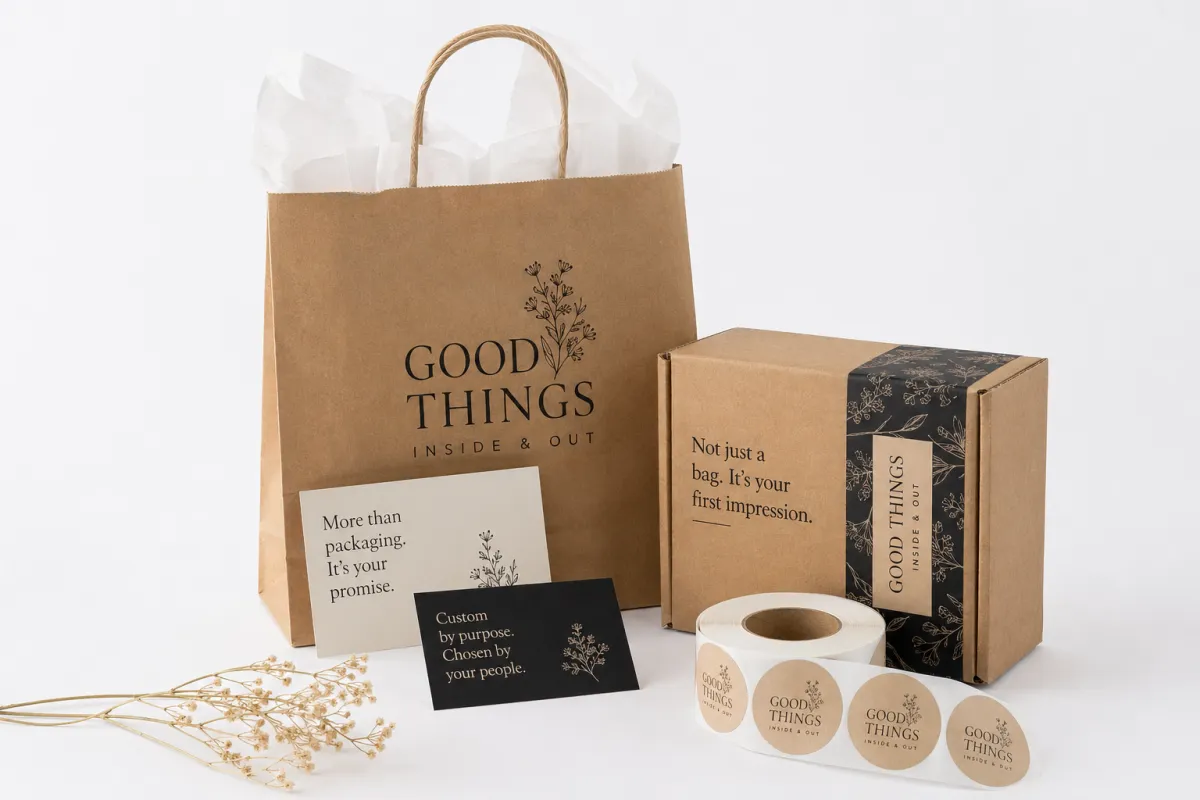
What makes custom kraft paper bags worth choosing?
Custom Kraft Paper Bags are attractive because they sit in a practical middle ground. Compared with lightweight plastic sleeves, they often carry more confidence for consumer-facing goods. Compared with rigid rigidized alternatives, they usually lower tooling complexity and unit cost. Compared with heavily coated paper stock, they typically keep the feel of genuine fiber and are easier to position as simple, reusable-looking packaging.
In most print and packaging projects, the performance target is a mix of durability and brand signal. For kraft, durability is strongly linked to fiber quality and basis weight. A common starting range for many food or retail SKUs is 80 to 120 gsm for very light goods. For heavier carry loads, teams often move to 120 to 170 gsm or switch to paperboard-like layers in the front panel and base area. This is not a fixed law; it is a typical band used in planning when exact stresses are not yet known.
Kraft’s long-fiber construction is often perceived as naturally premium and can support restrained graphics better than it sounds. Because uncoated brown stock absorbs some ink and visually softens very fine detail, simple and high-contrast visuals usually perform better than ultra-complex photo-heavy layouts. This is often the reason kraft works so well for brands with a calm, honest look.
If you browse your own current packaging, your first comparison should be with the product use profile, not mood boards. A single-bag bagel shop solution, a dry cosmetics pouch, and a premium tea retail carry all place different demands on the paper wall and seam structure. The successful option usually comes from matching these demands, not from choosing the most fashionable finish.
In this same planning stage, the internal architecture is often overlooked. A kraft bag with a clear visual identity but weak base fold can fold under its own load before reaching checkout. The material and conversion choices are inseparable; treat them as one decision.
How to spec custom kraft paper bags without getting burned
The first functional question is size. Under-sized bags are a major cause of customer complaints, while oversize bags shift the product during handoff and create a sloppy feel. A practical method is to measure three key dimensions for your product set: width, depth, and the highest expected weight including accessories, inserts, or bundled items. Add handling margin at both opening and shoulder points.
A common approach is to select width and depth based on the widest and tallest item, then set bag height at 1.2 to 1.4 times package height for carry stability. This extra height is not style decoration; it reduces toppling and lets customers fold the mouth once loaded. For heavy or irregular items, teams often increase depth first before changing height, especially for items that shift while walking.
For planning at scale, most teams compare these practical ranges:
- Very light and compact goods: 70-100 gsm, minimal gusset, smaller closure allowance.
- Standard retail carry items: 90-130 gsm with a moderate gusset and reinforced bottom seam.
- Mid-weight grocery or pantry items: 120-170 gsm or paperboard inserts in base area, with stronger stitch or reinforced handle anchors.
- High-load hospitality or reusable customer-use bags: often 150 gsm+ with denser handle reinforcement and tested heat or adhesive seams.
The handle is the next high-impact choice. Twisted-paper handles are common for light-medium payloads because they are fast to produce and generally reliable. Flat paper handles feel elegant and often improve ergonomics, but they are sensitive to edge splitting if the weave is weak. Die-cut loop handles may look precise, yet they are often the first place where cracking appears if load distribution is not tuned. Many buyers overestimate handle softness and underestimate required anchoring width.
Handle sizing is often done by scenario:
- Short carry distances with < 3 kg: narrower strap or corded twisted handle is often sufficient.
- Frequent in-store handling and shoulder carry: wider or double-anchored handles often perform better.
- Gift or premium repeat use: some teams add stitched or extra-laminate reinforcement for visual and functional consistency.
For closure method, common options include fold-over locking tabs, adhesive closures, and stitched seams. Some operations prioritize no-fuss sealing, while some prioritize reusability. The right answer depends on speed at packline, opening behavior, and whether the bag travels by hand, basket, or transport crate.
Material and construction basics that actually move quality
Paper grade and conversion style are not interchangeable variables. Custom Kraft Paper bags usually begin with kraft substrate, but the practical profile changes significantly between uncoated kraft, light-coated kraft, and kraft with food-barrier structures. Uncoated stock often gives the strongest “paper-first” impression and works well for light to moderate handling. Light coated stock can improve color holding but may slightly reduce breathability and alter recyclability in some systems.
For dry goods, uncoated or mild finish stock is often enough. For products that are greasy, moist, or dust-heavy, producers often add a grease-resistant layer. In those cases, the team should confirm both print compatibility and waste-stream acceptance for the final composite. A barrier that improves shelf handling can conflict with recycling claims if the receiving system does not support that material mix.
You should also decide early whether to ask for single-face printing or double-side artwork. Double-side printing often feels balanced for window-like premium products, but it adds complexity in color matching and drying tolerance. In many short and medium runs, single-side printing is chosen to reduce register variation and keep lead times tighter. If the brand has a high visual hierarchy on both sides, that complexity may still be worth it.
Paper edges, seams, and bottom construction matter as much as face stock. Common seam methods include side seam, top seal seam, and side-gusset conversion with bottom heat or fold-lock structures. In practical terms, side seams are simpler to produce and often stable, while bottom folds absorb more stress but require more process control. A Custom Kraft Paper bag used for heavier grocery fills often needs reinforced corners and a strong fold line at stress points. If you can, request a sample that has already been filled with a simulated load and shaken with a standard handling test.
Printing choices and artwork strategy
Print method should follow order profile. For frequent design updates, smaller batches, and test launches, digital printing is often practical because setup is lighter and turn times are shorter. For long, stable campaigns with tight color standards, flexographic and sometimes traditional offset methods may still be preferred, especially when graphics are less frequent and volume is higher.
For realistic planning, teams often evaluate this way:
- 100 to 500 units per design change: digital-first, short lead time, more flexible approvals.
- 500 to 2,000 units with repeated design: either optimized digital or flexo depending on color complexity.
- 2,000+ and recurring campaigns: flexo or high-efficiency offset is commonly considered for consistency and lower per-unit cost.
Because kraft stock is often absorbent, artwork with very fine halftones can lose definition. A practical fix is not always “more ink.” Often it is contrast tuning: darker line edges, slightly bolder typography, fewer very light tints, and simpler gradients. In many projects, reducing artwork complexity improves print consistency more than adding special effects.
If your brand guidelines require a specific PMS color, confirm ink standards and color tolerance early. Many teams discover this only after the first full run: a very dark blue that looks perfect on coated proofing board appears dull on kraft. Also check registration tolerance if registration marks and fine grid elements are essential. Brown stock can make minor misalignment noticeable in the corners, so tolerance should be specified in the file brief.
File prep for Custom Kraft Paper bags should usually include transparent backgrounds tested at full scale, bleed allowance, and a separate print proof that simulates the uncoated substrate. A practical art file setup often includes:
- A vector logo path with correct minimum line thickness.
- Safe and bleed margins that avoid edge clipping.
- Proof colors and overprint settings checked with representative ink set.
- Clear notes for where no print should touch corners that may fold into creases.
Closures, handles, and finishing details
Finishing decisions become critical when the customer’s hand is your last quality checkpoint. A beautiful front panel does little if a bag tears at the carry point. Choose finishing with the same seriousness as branding: matte coating, varnish, embossing, foil, spot UV, and other enhancements should be justified by both tactile and usage goals.
For practical projects, many teams start with “needed” first and “nice-to-have” second. Typical finish categories include:
- Plain natural with minimal treatment: highest perceived authenticity, often lowest environmental complexity.
- Water-based functional varnish: improves stain resistance and surface durability but changes hand-feel.
- Dry embossing or foil accents: premium impression with added process risk, usually used selectively.
- Reinforced edges and stitched seams: added durability for repeated handling.
Foil and heavy effects can create memorable aesthetics, but if bag lifecycle is short and usage includes frequent fold cycles, they may not remain coherent after transport. This is where realistic expectations matter. A premium finish should support a performance profile, not just a launch photo. For food service, too much finish can trap moisture or complicate microwave/garbage disposal pathways depending on material stack-up.
Closure style also interacts with compliance and reusability. If the bag is intended for returnable use, a simple robust mechanical closure often performs better than a decorative adhesive fold. If the use case is one-time carry, a simpler closure can lower both rework and assembly errors at packing lines.
One practical field rule is to test handle pull and mouth opening after the closure is applied. At least one sample should be tested with the real product type and weight profile. It is not unusual to find a perfect printed sample fail under real grip friction.
The recycling story is useful, but it is not simple
There is a strong consumer preference for kraft-like materials, and that preference can be justified when the material remains simple and transparent to sorting systems. But “recyclable” is not guaranteed simply because it says kraft. Uncoated sheets with minimal composite layers are usually easier to sort and process than multi-layered or heavy barrier versions.
Waste stream rules vary a lot by region, retailer policy, and municipal process. A bag with an added synthetic barrier for grease control may be accepted in one network and rejected in another. For this reason, practical teams request disposal and local collection guidance before approving final spec. A small mismatch here can affect brand claims and reverse logistics costs.
Recycled content is typically positive for environmental storytelling, but recycled content can alter brightness and texture. Typical trade-off patterns include slightly lower opacity, less uniform whiteness, and more variation in paper tone. Virgin fiber can deliver cleaner print and stronger rigidity for some graphics, while post-consumer blends can better align with sustainability messaging. Neither option dominates every project. The right choice depends on product exposure, expected handling, and the audience’s trust expectations.
For food-related use, the barrier and ink stack also intersects with contact safety expectations. In many markets, teams check whether adhesives, inks, and coatings are compliant for intended food-contact use and provide declaration documents. If this sounds overly strict, that is because it usually is; one overlooked compliance note can delay launch more than any visual tweak.
If your brand strategy includes a “paper-first” narrative, be precise in wording. Terms such as recyclable, compostable, and sustainable should reflect material structure, not only visual impression. A transparent statement based on tested stack-up is usually safer and more credible than broad claims.
Production scenarios, timing, and cost patterns
Production planning for custom kraft paper bags is often where quality intentions become practical numbers. Teams should estimate not only unit count, but also artwork revisions, sample rounds, and lead times for tooling. Typical ordering behavior differs by budget and launch urgency, but a common pattern is:
- Proofing phase: 1 design brief, 1 physical sample, 1 revision loop.
- Pilot phase: 150 to 500 units across one or two variations to validate handling.
- Launch phase: production run scaled to forecast with full packaging checks.
Batch size strongly affects cost structure. Small custom runs usually carry higher unit cost because setup and setup-related waste are spread over fewer parts. Larger consistent batches usually improve per-unit stability, but only if artwork, materials, and process settings are locked. Frequent late changes can cancel out any scale advantage.
When budgeting, many buyers compare only one number: unit cost. In practice, add four cost buckets:
- Paper grade and grammage.
- Print method and color coverage.
- Finishing features and additional handling materials.
- Sample, approval, freight, and potential remake costs.
Production timing is affected by drying curves and line speed. Glossy or dense coatings can add drying overhead. Large-format logos with heavy coverage may increase drying time and reject risk until ink balance is tuned. For time-sensitive campaigns, this is where digital workflows reduce risk but not necessarily long-run economics.
Scenario planning helps avoid surprises. In one typical case, a team using two seasonal designs with one small monthly refresh often chooses digital for each month to avoid warehousing mixed runs. In another case, a stable yearly campaign with predictable graphics chooses larger flexo runs because the cumulative production cost and repeatability are better over 12 months.
If your sourcing flow depends on short promotional windows, ask explicitly about changeover windows and reserved plate or print slot availability. A practical estimate often includes an internal review buffer because design and proofing delays are still the most common source of schedule slippage.
Most suppliers can also advise whether your order should be delivered in bulk pack or split by SKU. For high-mix retail, split packaging often reduces confusion in warehouses, but can increase changeover handling cost. For simple single-SKU launches, bulk runs are usually straightforward.
Quality checks that prevent expensive reorders
The cheapest place to catch quality failures is before full production. Physical sampling is essential because digital mockups cannot reveal crease cracking, seam behavior, or edge delamination under load. A practical review usually includes at least one sample from actual production material, not just a lab mockup.
Quality control checks commonly include:
- Edge strength and pull testing at handle anchor points.
- Load test with typical and max load to simulate one shopping cycle.
- Color block consistency and registration checks across runs.
- Opening and resealing simulation if closure reuse is part of use case.
- Print smudge resistance and oil/finger impression checks for food touchpoints.
For high-volume programs, teams often add a sample cadence: initial lot acceptance, then a mid-run sampling checkpoint. This is useful because paper fibers, humidity, and ink behavior can drift across production windows. If bags are used in hot or humid regions, moisture changes can make a stable sample feel different in the field. A standard internal rule is to avoid approving final lots without confirming a middle-batch look and feel.
Another important quality dimension is stackability and storage fit. A bag that looks excellent flat may block on racks if fold memory is too soft or if seam stiffness is low. Ask about cartonized shipment behavior and whether compression loads in transport are compatible with your carton size. If boxes are stacked high, choose profiles with stronger side seams and controlled corner strength.
In operations teams, acceptance criteria can be written as measurable items instead of vague preferences:
- “Handle pull withstands at least one firm tug equivalent to typical customer handling.”
- “Logo remains legible at the minimum expected distance in shelf conditions.”
- “Bottom seam does not split with standard filled test load.”
Documenting these conditions makes communication easier between design, purchasing, and production teams, and usually lowers the chance of last-minute returns.
Storage, handling, and operations
Even a well-chosen bag structure can fail in distribution if operations are not designed for it. Kraft paper is generally moisture-sensitive, so storage conditions are a practical factor in performance. If incoming paper sits in humid conditions for long periods, stiffness changes and color can shift. For stable output, teams commonly store finished goods in dry, ventilated areas and avoid direct contact with wet floors, open weather, and strong odors.
During shipping, packaging count by batch and orientation matters. Many teams place orientation marks or simple labels so staff do not rotate cartons randomly. If a run includes several panel styles, clear coding prevents wrong-size use at fulfillment points. This is especially important when the visual style is close across SKUs.
At fulfillment, workflow details matter more than expected. If operators open packs quickly, folded seams can catch and tear. If staff hand-fill heavy items and close by fold, closure geometry must support high repetition. If bags are pre-staged at kiosks, opening width and mouth reinforcement should be tuned for repeated opening. It is surprisingly common to spec a beautiful bag that is impossible to “run” efficiently at high throughput.
Consider the after-use path too. Many brands include a recycling instruction or clear brand message on the inside or rear. If messaging is part of strategy, keep it short and location-consistent so customers can find it quickly. If instructions are too dense, they get ignored and lose meaning.
What buyers usually miss
Most first-time buyers focus on logo style and cost per unit. Both are real, but they are not enough. Bag performance usually fails through combinations of small oversights: an under-rated gram basis for a specific weight class, an incompatible handle style, too much light-color art on brown stock, or a finish choice that conflicts with local recycling paths.
Common misses include assuming all kraft is equally easy to print, underestimating turnaround time for multiple design changes, and deciding final specs after artwork is locked. A few practical reminders:
- For heavy items, prioritize stock strength and seam integrity before decorative effects.
- For food service, verify food-surface contact suitability and wipe resistance as part of the sample stage.
- For premium retail, keep graphics clear and avoid excessive CMYK noise on absorbent areas.
- For sustainability messaging, confirm fiber source, coating type, and local disposal treatment before publishing claims.
If the project involves multiple channels, specify a variation policy. A single design can look different at a market booth, a grocery aisle, and an e-commerce insert. Different channels often deserve different grammage and handle priorities. The fastest way to reduce returns is to set the channel strategy before placing the first order.
Teams also benefit from comparing three reference options from an internal catalog of practical styles. If your brief is still evolving, you can request side-by-side physical references from Custom Packaging Products and align on where performance matters most before full commitment. A practical reference session often reveals the best compromise in less time than three internal meetings.
Starter checklist before placing your first order
Before approval, confirm the following in one document:
Product and payload
- Item dimensions with handling clearance included.
- Average and maximum weight scenarios, not just nominal fill weight.
- Expected movement and friction during transit.
- Any heat, moisture, or oil exposure.
Material definition
- GSM or basis-weight band and reason for that range.
- Need for coating or barrier layer and disposal impact.
- Handle style and anchoring method.
- Closure type and expected reuse behavior.
Visual and process controls
- Color palette with contrast adjustments for kraft stock.
- Print method aligned to quantity and revision velocity.
- Proof type (digital and physical), and acceptance criteria.
- Quality gates and sample acceptance sequence.
If you want technical alignment before you commit to a full launch, request a manufacturing-ready consultation, and ask for a direct review path for test runs. Our support teams often use these exact checkpoints to reduce rework and improve launch confidence.
You can also begin with sample planning by reaching out through Packaging Support and sharing your expected load profiles. A direct intake usually helps standardize specs faster than ad hoc notes.
Custom kraft paper bags: decision table
| Decision area | Best fit | What to verify | Risk if skipped |
|---|---|---|---|
| Film or paper thickness | Apparel, accessories, lightweight goods, and subscription boxes | Micron/GSM, seal strength, opacity, and puncture resistance | Thin material wrinkles, tears, or makes the brand feel low value |
| Closure and format | Self-seal mailers, gusset bags, zipper pouches, or drawstring bags | Opening size, resealability, hanging hole, and packing sequence | Wrong format creates returns, repacking, or poor display |
| Print area | Logo visibility and required compliance copy | Ink holdout, color contrast, barcode space, and proof approval | Artwork looks fine flat but disappears once the bag is filled |
FAQ
- Can custom kraft paper bags be used for hot or greasy food?
- Usually, but not by default. Kraft can work for food carry systems when a suitable barrier layer and food-contact-safe process are specified. Always test for grease resistance and local compliance requirements in your target markets.
- How do I choose between 100 gsm and 150 gsm stock?
- Start with your real payload and handling method. Light retail goods often work with lower ranges, while repeated carrying, heavier products, and transport motion often require higher basis-weight or reinforced structures. If uncertain, a pilot run at both bands with load simulation gives clearer data than a paper-only guess.
- Is digital printing enough for branded launches?
- For short runs and frequent updates, digital is often the most practical path. For highly repetitive campaigns with strict color and repeatability needs, flexo or other high-volume methods may be more stable over time.
- Can I use the same bag across grocery and retail use?
- Sometimes, but rarely without trade-offs. Grocery use often needs extra durability and spill tolerance; retail displays may prioritize shelf aesthetics. A shared outer style can work, while internal structure and material choices may still need to differ.
- Are kraft paper bags truly recyclable if I add printing varnish?
- Often the answer depends on varnish type and local collection systems. Uncoated or low-complexity finishes are usually easier to sort. Synthetic barriers or heavy films can change how a stream handles the material. Confirm local disposal pathways before finalizing the claim language.
- How do I avoid receiving a different color than the digital proof?
- Use a physical proof on the exact substrate and ask for process-adjusted color target values. Brown stock influences contrast and light tones, so proofs made on bright coated card often overestimate light color performance.
- Should I order sample sizes?
- Yes. At least one physical pre-production sample is strongly recommended, and for larger launches many teams request two: one for visual review and one for load-testing in real use conditions.
- Do custom kraft paper bags require special handling in storage?
- Usually, yes under humidity and dust control. Store in dry, stable conditions and avoid long exposure to high moisture because paper can lose stiffness and edge resilience.
Custom kraft paper bags work best when the details are boring on purpose
Great custom kraft paper bags are rarely chaotic. They are usually quiet, specific, and built around clear constraints: how much it carries, how it is opened, where it travels, and how the brand should feel when someone lifts it. Once these constraints are set, the choice of grain, gsm, handle, print method, and finish becomes much more repeatable.
Strong projects succeed because they avoid guessing. They define product-to-bag mapping, choose matching print and finishing methods, test physically, and align claims with actual material composition. That process may look less exciting than chasing a novel finish, but it usually creates fewer returns, better shelf performance, and Packaging That Feels right at the exact moment someone touches it.
If you approach custom kraft paper bags as a use-case system instead of a styling exercise, the results are predictable. You get packaging that is realistic to produce, realistic to recycle, and realistic to use.

