Buyer Fit Snapshot
| Best fit | custom kraft sleeves for boxes branding for packaging buyers comparing material specs, print proof, MOQ, unit cost, freight, and repeat-order risk where brand print, material, artwork control, and repeat-order consistency matter. |
|---|---|
| Quote inputs | Share finished size, material target, print colors, finish, packing count, annual reorder estimate, and delivery region. |
| Proofing check | Approve dieline scale, logo placement, barcode or warning zones, color tolerance, and any recyclable or compostable wording before bulk production. |
| Main risk | Vague material claims, crowded artwork, or missing packing details can create delays even when the unit price looks attractive. |
Fast answer: Custom Kraft Sleeves for Boxes Branding: Dieline, Finish, Proof, and Buyer Review should be specified like a repeatable production item. The safest quote includes material, print method, finish, artwork proof, carton packing, and reorder notes in one written spec.
What to confirm before approving the packaging proof
Check the product dimensions against the actual filled item, not only the sales mockup. Ask for tolerance on folds, seals, hang holes, label areas, and retail display edges. If the package carries a logo, QR code, warning copy, or legal claim, reserve that space before decorative graphics fill the panel.
How to compare quotes without losing quality
Compare board or film grade, print process, finish, sampling route, tooling charges, carton quantity, and freight assumptions side by side. A lower quote is only useful if the supplier can repeat the same color, closure quality, and packing count on the next order.
Custom Kraft Sleeves for Boxes: Branding That Sells
Custom Kraft Sleeves for boxes do one job very well: they turn a plain stock carton into packaging that looks planned instead of improvised. That sounds basic. It is basic. And it matters more than most teams admit. A box can protect a product and still look anonymous. Add a sleeve, and suddenly the pack has branding, shelf presence, and room for copy without paying for fully printed cartons. For brands trying to keep packaging costs under control, custom kraft sleeves for boxes are one of the smartest places to spend a little extra money.
What Custom Kraft Sleeves for Boxes Actually Do
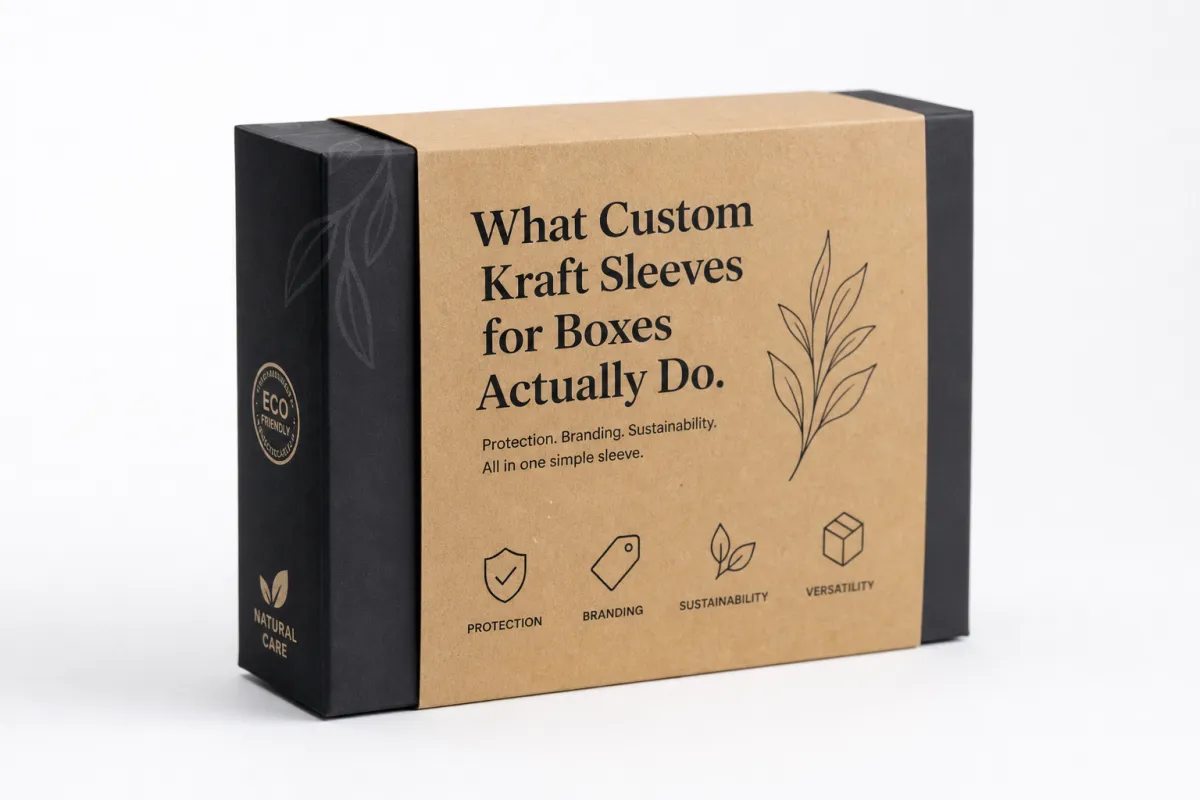
Custom kraft sleeves for boxes are not the structural shell. They are the outer layer that slides over a stock carton and carries the branding, product name, claims, and whatever else needs to be seen first. The carton protects the product. The sleeve sells it. That split is the whole point. You get better package branding without rebuilding the entire packaging system from scratch.
A plain box can do its job and still feel forgettable. That is the problem. Kraft sleeves change the tone fast. The package can read natural, earthy, handmade, premium, or eco-conscious depending on the layout and print treatment. Kraft has a texture people recognize immediately. It communicates before the copy does. That is why custom kraft sleeves for boxes work so well in retail packaging, gift sets, subscription kits, and product launches that need a strong first impression without a huge buildout.
Brands use custom kraft sleeves for boxes for a few practical reasons. Seasonal campaigns. Short-run launches. Bundle kits. SKUs that change often. If your scent name, flavor, or messaging shifts every few months, sleeves let you update the visible layer without changing the entire carton spec. Less waste. Less retooling. Less packaging chaos, which is rare and kind of beautiful.
A sleeve is not there to carry the box. It is there to sell it.
That also comes with limits. Sleeves add value, but they do not replace the protective role of the carton. If the box needs stacking strength, compression resistance, or better transit performance, the base structure still has to earn its keep. Custom kraft sleeves for boxes are a branding tool first. They are not armor, and pretending otherwise is how packaging gets blamed for shipping damage it never caused.
Picture a candle brand using a standard white folding carton for protection, then wrapping custom kraft sleeves for boxes around it with a single-color logo, scent notes, and a die-cut window. The result feels more premium than a plain stock box, but the budget stays sane. The same approach works for cosmetics, coffee gift boxes, soap bundles, and food packaging that wants a natural look without the cost of fully printed cartons.
That is the real value. The sleeve puts money where customers can see it. It gives you brand clarity, layout flexibility, and a cleaner way to launch products that change often. It also avoids overbuilding the carton just to improve the front panel. Custom kraft sleeves for boxes are a practical answer to a very common problem. Refreshing, really.
How Custom Kraft Sleeves for Boxes Work in Production
Production starts flat. Not wrapped. The printer lays the artwork onto kraft paper or kraft-style board, then the sheet gets cut, scored, and formed into a sleeve. Depending on the design, the sleeve may use a seam, tuck tab, glue point, or lock feature to hold its shape around the box. Custom kraft sleeves for boxes need these details built in early. Guessing on the dieline is how seams end up in the wrong place and everybody pretends the result is fine.
There is a real difference between a sleeve, a belly band, and a full outer wrap. A belly band is narrow and covers only part of the carton. A sleeve wraps farther around the box and usually behaves like a branded jacket. A full outer wrap goes further still and covers most visible sides. Pick the wrong format and you either spend too much on material or end up with a wrapper that sits awkwardly. Custom kraft sleeves for boxes work best when the format matches the packaging goal instead of the mood board.
Size matters more than people want to admit. The sleeve has to account for the exact box dimensions, board thickness, folding tolerance, and any windows or cutouts. A few millimeters can change the outcome. Too tight, and the sleeve buckles or tears at the seam. Too loose, and it shifts during packing or looks sloppy on shelf. A serious supplier builds the dieline from the actual carton sample, not from a pretty mockup with optimistic measurements. That is not overcautious. That is avoiding a mess.
Kraft paper prints differently from coated white stock. It is not a blank canvas, and treating it like one usually ends badly. The brown tone changes color perception. Some shades get richer. Others fade into the background. White ink can help with contrast, but it can also look muddy if the stock is too rough or the print process is wrong. Custom kraft sleeves for boxes usually look strongest with bold typography, limited colors, and enough negative space to let the material do part of the work.
Print method changes the result too. Digital print is common for short runs because it handles variable artwork and lower quantities efficiently. Offset or flexographic printing may make sense at higher volumes if the setup cost pays off. Each method changes color consistency, edge sharpness, and price. A deep black logo on rough kraft can look crisp in one process and muddy in another. Ask for a proof on the actual substrate. A random swatch from a sample book is not proof of anything except that somebody owns a sample book.
Application matters just as much as print. Some sleeves are hand-applied, usually on smaller runs or in fulfillment. Others move through semi-automatic or fully automatic lines. Hand assembly costs more labor, but it can make sense for lower volumes or unusual carton shapes. Line application is faster, but it needs a sleeve that feeds consistently and closes the same way every time. If growth is on the horizon, build the sleeve around the likely packing method now. Future you will be less annoyed.
For broader standards around test methods, transit durability, and material choices, the Packaging Coalition at packaging.org is a solid reference. If the project includes fiber sourcing claims, check the chain-of-custody rules at FSC before artwork gets signed off. Sustainability claims are not decoration. If the paperwork is shaky, so is the claim.
One detail gets ignored far too often: custom kraft sleeves for boxes should be engineered around the carton in the warehouse, not the concept render in the design file. Real boxes vary a little by supplier. Glue flaps, board thickness, and shipping compression can shift the outside dimensions enough to affect fit. If the sleeve is drawn around a perfect digital model, it will fight the real box every single time. Packaging buyers usually learn that lesson once. That tends to be enough.
Key Design and Material Factors That Change the Result
Material choice drives most of the feel. Lightweight kraft wrap stock costs less and works fine for simple applications, but it can feel flimsy if the sleeve is wide or the box gets handled a lot. Heavier kraft paper or paperboard folds more sharply, sits flatter around the carton, and usually looks better on shelf. For custom kraft sleeves for boxes, I think in practical ranges: lighter wraps for short bands, midweight stock for standard retail packaging, and heavier material when the sleeve needs a crisp edge or a more substantial hand feel.
Recycled content and fiber color shift the tone quickly. A warmer brown kraft reads more rustic. A lighter, cleaner kraft feels more contemporary. Darker fiber content can mute print contrast, while a brighter kraft surface gives logos more lift. If the brand leans into natural cues, that texture helps. If the brand wants precise, luxury-looking graphics, kraft can still work, but the typography and layout have to carry more weight. Custom kraft sleeves for boxes are not magic. They are a choice with consequences.
Artwork density also changes cost and appearance. Heavy full-bleed graphics use more ink, demand tighter setup control, and often fight the whole reason for using kraft in the first place. A stripped-back layout usually performs better. Strong logo placement, one or two supporting colors, clean type, and purposeful space around the mark often look better than a busy panel crammed with claims. That is true in branded packaging, and even more true on kraft, where the substrate already has visual texture.
Typography can make or break custom kraft sleeves for boxes. Thin serif fonts, pale gray text, and tiny legal copy can disappear into the paper texture. If the type is too delicate, the sleeve looks underdone. Better choices are medium-weight sans serif or a sturdy serif with enough stroke width to survive print on textured stock. I usually push buyers to build the hierarchy around three levels: a strong product name, a supporting descriptor, and only the essentials below that. More copy is not automatically better. Sometimes it just makes the sleeve read like a shipping label with ambition.
Finishes need restraint. Soft-touch lamination, gloss varnish, spot UV, foil, and embossing all have a place, but they can easily overpower the natural feel of kraft. A light matte varnish may help with rub resistance. Heavy gloss usually defeats the point. Foil can work on premium lines, but too much and the sleeve loses its identity. If the brand story is natural, handmade, or low-impact, the finish should support that story instead of arguing with it.
Structural details matter too. Glue tabs help the sleeve hold shape. Lock features can improve assembly speed. Tear strips help with opening, which is useful for gift packaging or retail packaging that customers should open without wrecking the carton. Window cutouts show color, texture, or the actual product. Every added feature means more tooling, tighter cutting, or extra labor. Custom kraft sleeves for boxes work best when the structure matches the use case, not when the design team piles on features because they can.
- Lightweight kraft: lower cost, good for simple wraps, less stiffness.
- Midweight kraft: better fold quality, better shelf presence, a common sweet spot.
- Heavier kraft board: sharper edges, better premium feel, usually higher material cost.
- Coated kraft: more print control, but less raw texture.
- Uncoated kraft: strongest natural look, though print contrast can be trickier.
If the project has transit demands, do not treat packaging design like a purely visual exercise. Ask whether the finished box with sleeve needs drop testing or compression testing that aligns with ISTA procedures. That does not mean every sleeve has to go through a lab. It means the packaging should not come apart the second a distribution center gets involved. Customer experience starts long before the box gets opened.
Custom Kraft Sleeves for Boxes: Cost, Pricing, and MOQ
Cost comes down to five things: paper grade, print coverage, die complexity, finishing, and quantity. Custom kraft sleeves for boxes are often cheaper than fully printed cartons because the base box can stay stock while only the outer layer gets customized. That split is especially helpful at lower and mid volumes. Instead of printing every wall of the carton, you spend the budget on the part customers see first.
Cheap is relative, though. A simple belly band at volume can cost very little. A wider wrap with a complex die, white ink, a window cutout, and specialty finishing will not be bargain-basement just because it is called a sleeve. Unit price moves with the job. Comparing quotes without checking specs is how buyers end up comparing apples to forklifts. One quote is for plain wrap stock with one-color print. Another is for a sculpted sleeve with a die-cut opening and hand-applied adhesive. Those are not cousins. They are strangers.
Here is a practical range to use as a starting point, assuming standard retail packaging dimensions and nothing weird on the finish side:
| Format | Best Use | Approx. Cost at 1,000 Units | Approx. Cost at 5,000 Units | Main Tradeoff |
|---|---|---|---|---|
| Simple kraft sleeve | Basic branding, promos, stock cartons | $0.28-$0.70 | $0.12-$0.28 | Less complex, but limited finishing |
| Belly band | Light branding, seasonal wrap, bundles | $0.18-$0.45 | $0.08-$0.20 | Lower material use, less coverage |
| Full outer sleeve | Retail presentation, wider message space | $0.40-$0.95 | $0.16-$0.38 | More material and more assembly time |
| Full printed carton | High-impact custom printed boxes | $0.55-$1.40 | $0.25-$0.70 | Best visual coverage, highest tooling burden |
Those ranges are not a promise. They are a working reference. Size, ink coverage, paper choice, and production country will shift them. The pattern still holds: custom kraft sleeves for boxes can save money, especially when the base box stays stock. The savings shrink if the sleeve gets fussy or labor-heavy. Assembly costs can eat the benefit if the design is too complicated for the packing line.
MOQ depends on print method and the supplier’s sheet size. Digital jobs often start lower because they skip plates. Offset and flexo usually want higher numbers to justify setup. Under a few hundred units, unit cost can jump fast. Over 5,000 pieces, the price often drops enough to make a sleeve much more attractive than a fully custom carton. For custom kraft sleeves for boxes, volume is usually the biggest lever.
Hidden costs are where people get blindsided. Sample rounds cost money. Dielines may be included, or they may not. Cutting dies and plates can be separate charges. Freight matters, especially for bulky but light packaging. Assembly labor is easy to forget and hard to ignore once the product is actually being packed. If the sleeve needs hand application, ask for a separate labor assumption. A quote without labor is not a quote. It is a teaser with stationery.
For quote comparison, ask suppliers to break out material, print, cutting, finishing, and assembly. Ask what happens if the size changes by 2 to 3 mm after proofing. That question exposes who is building carefully and who is guessing. Custom kraft sleeves for boxes deserve the same quote discipline as any other piece of product packaging.
Custom Kraft Sleeves for Boxes: Process and Timeline
A clean process usually follows the same path: brief, quote, dieline, artwork, proof, sample, production, and delivery. It sounds ordinary because it should be ordinary. Good packaging work is boring in the best way. Fewer surprises. Fewer reprints. Fewer emergency calls because somebody misplaced the seam location.
The brief should include the exact box size, target quantity, material preference, print method if known, and any finishing requests. If the carton is not finalized yet, say so. That matters. Custom kraft sleeves for boxes should be designed around the actual carton, not a placeholder size that looks close enough in a spreadsheet. If the packaging supplier needs the box sample, send it. A photo helps a little. A sample helps a lot more.
Timeline depends on how many moving parts are in the job. Straightforward digital print jobs with approved artwork can move quickly. Add Custom Die Cutting, specialty finishes, sample approval, or unclear box dimensions, and the schedule stretches. In practice, simple runs may land in the 7 to 12 business day range after proof approval, while more complex jobs often fall into the 12 to 20 business day range or longer. That is normal. The problem is not the timing. The problem is pretending it will not move.
Late changes are the biggest schedule killer. New logo placement, revised copy, changed QR code, adjusted Pantone targets, swapped box dimensions, new seam direction, and suddenly the job is back at proof stage. If the goal is to ship on time, lock the box size, artwork, and sleeve orientation before the supplier starts cutting. Custom kraft sleeves for boxes reward discipline. They punish indecision.
Artwork handoff should be treated like any serious packaging design job. Send files in the requested format, usually vector PDF or editable source files if the supplier asks for them. Build in bleed, keep text inside the safe area, and confirm barcode placement if the sleeve will be scanned in retail. Black should be rich but not overcooked. White objects should stay clear of folds. If the job includes claims or regulated copy, proof it carefully. No one wants a pallet of boxes carrying a typo that could have been caught in 30 seconds.
Before approval, I like a simple checklist:
- Confirmed outside box dimensions and tolerance.
- Final dieline with seam location marked.
- Material spec with paper weight and finish.
- Artwork proof checked for folds, bleed, and legibility.
- Assembly method confirmed, hand or line.
- Delivery date aligned with launch or restock plan.
That checklist sounds basic because it is basic. Basic is good. It is also where custom kraft sleeves for boxes either stay on track or burn time and money. If you also need mailers, cartons, or inserts, the Custom Packaging Products page is a useful place to compare compatible packaging options before you commit to a single structure.
Common Mistakes That Make Sleeves Look Cheap
The first mistake is designing the sleeve like a poster. A sleeve wraps around corners, crosses folds, and often gets seen at an angle. Flat-panel thinking does not survive contact with real packaging. If the graphics depend on perfect centered alignment and giant text blocks, the assembled piece can feel awkward. Custom kraft sleeves for boxes need layouts that respect the wrap, the seam, and the opening direction.
The second mistake is weak contrast. Thin type, pale ink, and low-contrast layouts can disappear on kraft stock. I see this a lot: a brand wants a natural paper look, then chooses a font weight that cannot survive print. The sleeve arrives and the message is technically there, but nobody can read it without leaning in. That is not branding. That is decorative frustration.
Another common miss is ignoring the actual box dimensions. A sleeve that is too tight can buckle at the seam, and a sleeve that is too loose can slide off or sit crooked on shelf. The problem gets worse if the box has a glossy finish or if the packer is moving fast. Even good-looking custom kraft sleeves for boxes can feel cheap if they do not sit properly on the carton.
Over-finishing is another trap. Foil on a kraft sleeve can look elegant if used carefully. Too much gloss or too much metallic treatment, and the raw paper story falls apart. The package starts looking confused, like a committee fought in a conference room and nobody won. Kraft already has character. It does not need fireworks.
Skipping a physical proof is a classic mistake. A flat mockup can lie. Scale changes. Texture changes. Fold lines behave differently. Color on kraft paper is not the same as color on a screen. That is why a sample or printed proof matters before full production. Custom kraft sleeves for boxes are not the place to gamble on assumptions.
Inconsistent branding is the last big one. If the paper says earthy, the typography says luxury, and the colors say neon energy drink, the package confuses people before they even touch it. Strong packaging design has a point of view. It does not need to shout, but it does need to know what it is. Good package branding feels aligned. Bad package branding feels like three different briefs got stapled together.
- Use type that survives texture and folds.
- Design for the seam, not against it.
- Check the fit on the real carton.
- Keep finishes aligned with the paper story.
- Approve a physical proof before the full run.
Expert Tips and Next Steps for Custom Kraft Sleeves for Boxes
Start with one hero SKU. That is the cleanest way to test custom kraft sleeves for boxes without spreading your budget across five sizes and three artwork versions. If the sleeve works on the main product, the design system can expand later. If it does not, you only learn the lesson once. That is cheaper than learning it everywhere.
Ask for a sample sleeve or flat proof on the exact paper you plan to use. Not similar paper. The exact paper. Kraft stock varies more than people expect, and a small shift in shade or stiffness changes the result. A sample lets you check contrast, seam behavior, and fold quality before the full order starts. For product packaging, that is money well spent.
If you are stuck between two stock choices, compare them side by side. One heavier sheet may give you a cleaner fold and a more substantial feel, while a lighter sheet may reduce cost and improve wrap flexibility. There is no universal winner. The better option depends on box size, artwork density, and how the package gets handled in real life. Custom kraft sleeves for boxes work best when the spec is chosen on evidence, not hope.
Pay attention to seam placement and opening direction. Customers notice these things, even if they do not have the vocabulary for it. A sleeve that opens in a way that makes sense feels intentional. A sleeve that fights the unboxing motion feels awkward. That is a small detail with a big effect on retail packaging and gift packaging alike.
Build a simple spec sheet before you talk to a supplier. Include the box dimensions, quantity, target finish, paper weight, print colors, seam position, and required date. If you know the carton supplier, mention that too. The more exact the brief, the less time everyone wastes. Custom kraft sleeves for boxes are not difficult to order when the inputs are clear. They get messy when people treat them like an afterthought.
If you want a practical next step, do this in order: measure the box, choose the paper weight, request a dieline, compare quotes that show material and labor separately, and then place a small first run of custom kraft sleeves for boxes. That gives you real data instead of a fantasy spec sheet. It also gives you a stronger base for future custom printed boxes, inserts, or related branded packaging pieces.
Used well, custom kraft sleeves for boxes are one of the cleanest ways to improve shelf appeal without turning the packaging budget into a joke. They are flexible, quick to update, and easy to scale once the format is set. If you want packaging that says the product matters, custom kraft sleeves for boxes are still one of the most practical tools in the kit.
Actionable takeaway: pick one stock carton, measure it properly, and prototype a sleeve on the exact kraft stock you plan to buy. If the fit, contrast, and opening direction work on that first unit, you have a packaging system worth scaling. If they do not, fix the dieline before you print a single full run. That is the boring answer. It is also the right one.
FAQ
What paper weight is best for custom kraft sleeves for boxes?
Most projects land well in a midweight range that holds shape without feeling bulky. Lighter stock can work for short wraps, while heavier stock is better if you need sharper folds or a more premium hand feel. The real answer depends on box size, seam design, and how the sleeve will be applied. Test it on the actual carton before you commit to custom kraft sleeves for boxes at scale.
Are custom kraft sleeves for boxes cheaper than printed boxes?
Usually yes, especially if you can use a stock box and print only the outer layer. The savings are strongest at low to mid volumes because you avoid fully customizing the entire carton. The tradeoff is assembly. If the sleeve is complicated or hand-applied, labor can reduce the advantage. That is why custom kraft sleeves for boxes should be priced with material and labor separated.
How long do custom kraft sleeves for boxes take to produce?
Simple digital orders can move quickly once artwork is approved. Jobs with dies, special finishes, or sample rounds take longer because each step adds review time. A practical planning window is often about 7 to 12 business days for simpler work and 12 to 20 business days or more for more involved custom kraft sleeves for boxes. Confirm with the supplier before you lock a launch date.
Do custom kraft sleeves for boxes need a dieline?
Yes. A dieline is the cleanest way to avoid seam mistakes, cutoff logos, and bad folds. If you do not have one, ask the supplier to build it from the exact box dimensions. Designing from a mockup alone is how expensive surprises happen. For custom kraft sleeves for boxes, the dieline is not optional. It is the map.
Can custom kraft sleeves for boxes work for small orders?
Yes, but unit cost is usually higher on small runs because setup and cutting get spread over fewer pieces. Digital print is often the best fit for short runs or frequent design changes. If you expect repeat orders, ask for pricing at multiple quantities before you decide. That gives you a better sense of where custom kraft sleeves for boxes start to make financial sense for your product packaging.

