Buyer Fit Snapshot
| Best fit | custom kraft stickers for boxes branding sticks for packaging buyers comparing material specs, print proof, MOQ, unit cost, freight, and repeat-order risk where brand print, material, artwork control, and repeat-order consistency matter. |
|---|---|
| Quote inputs | Share finished size, material target, print colors, finish, packing count, annual reorder estimate, and delivery region. |
| Proofing check | Approve dieline scale, logo placement, barcode or warning zones, color tolerance, and any recyclable or compostable wording before bulk production. |
| Main risk | Vague material claims, crowded artwork, or missing packing details can create delays even when the unit price looks attractive. |
Fast answer: Custom Kraft Stickers for Boxes Branding Sticks: Dieline, Finish, Proof, and Buyer Review should be specified like a repeatable production item. The safest quote includes material, print method, finish, artwork proof, carton packing, and reorder notes in one written spec.
What to confirm before approving the packaging proof
Check the product dimensions against the actual filled item, not only the sales mockup. Ask for tolerance on folds, seals, hang holes, label areas, and retail display edges. If the package carries a logo, QR code, warning copy, or legal claim, reserve that space before decorative graphics fill the panel.
How to compare quotes without losing quality
Compare board or film grade, print process, finish, sampling route, tooling charges, carton quantity, and freight assumptions side by side. A lower quote is only useful if the supplier can repeat the same color, closure quality, and packing count on the next order.
Custom Kraft Stickers for Boxes do more than people usually credit them for. One good sticker can make a plain brown mailer feel deliberate, finished, and worth opening. One bad one can make the whole package look like it was assembled five minutes before a pickup.
That is the appeal of custom kraft Stickers for Boxes: they are affordable, quick to produce, and capable of changing the feel of packaging without forcing a full carton redesign. Brands using custom printed boxes, recycled cartons, or plain mailers often use stickers because they want the box to feel branded without locking themselves into a huge print run. That matters. Customers can tell the difference between packaging that was planned and packaging that just happened.
Custom Logo Things works with buyers who want packaging that looks clean, practical, and not absurdly expensive. Sensible instinct. The real job is picking the right material, size, adhesive, and print method so custom kraft stickers for boxes improve the box instead of fighting it. I have seen otherwise solid brands lose the whole effect because the sticker was too pale, too small, or just glued onto the wrong surface.
What Custom Kraft Stickers for Boxes Actually Are
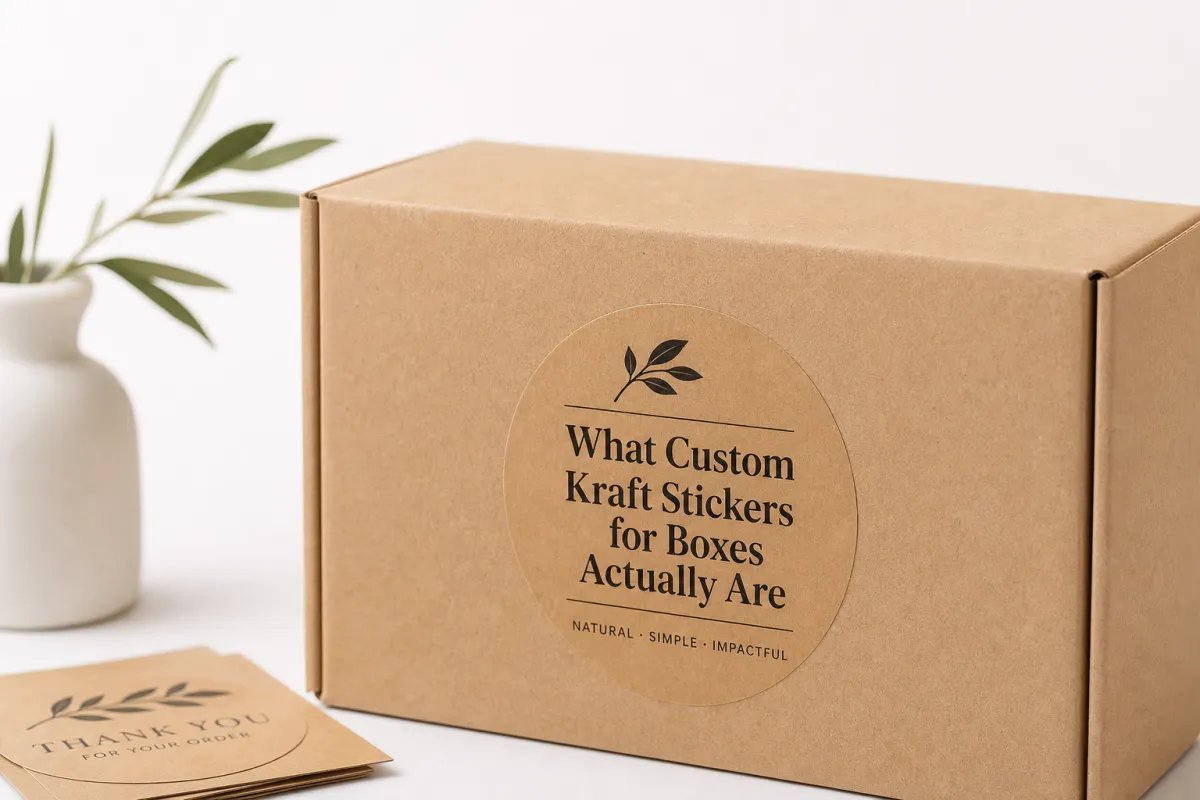
Custom kraft stickers for boxes are labels or seals designed to sit on brown kraft surfaces and look like they belong there. Paper stocks are the most common choice. Film versions show up too, usually on boxes that need a little more durability. Brands use them for logos, shipping seals, product notes, thank-you messages, ingredient labels, seasonal badges, and all the small details that tell customers someone was paying attention.
They are not just decoration. They are a packaging tool. A bakery might use them to close a pastry box. A subscription brand might place one across the flap of a mailer. A candle company might put one on the front of a carton so the package reads as retail packaging instead of generic shipping stock. Same basic idea. Different job.
There is a reason brands keep coming back to them. They are cheaper than a fully printed carton program, easier to update for seasonal drops, and flexible for short runs. If you only need 300 or 500 pieces, custom kraft stickers for boxes usually make a lot more sense than ordering custom printed boxes that will sit in storage for half a year. Inventory has a way of punishing optimism. Cardboard is not exempt.
The finish changes the mood faster than most buyers expect. Natural uncoated paper gives a rustic, handmade look. Matte coated stocks feel cleaner and a little more polished. Gloss can make a logo stand out, though on kraft it can drift toward looking less organic if the design is already busy. Clear film works when the goal is minimal visible coverage, and colored stock can add contrast where brown kraft would swallow the design. For branded packaging, the right finish usually depends on how formal the product feels and how busy the box already is.
Use cases are broad because the format is forgiving. Custom kraft stickers for boxes show up on:
- Shipping boxes and mailers
- Subscription packaging
- Bakery and food cartons
- Handmade product packaging
- Retail cartons and gift boxes
- Sample packs and promo kits
They are especially useful when the box itself is plain kraft but the brand still wants the package to feel intentional. That is the point. Not fancy for the sake of it. Just finished.
How Custom Kraft Stickers for Boxes Are Printed and Applied
The workflow for custom kraft stickers for boxes is straightforward: prep the artwork, choose the material and adhesive, proof the file, print, finish, cut, and apply. The process sounds simple because it mostly is. The trouble usually starts in the parts people rush through. Wrong dimensions. Weak contrast. A sticker that looks sharp on screen and flat on a textured box. That gap is where the mistakes live.
Digital printing is the usual choice for shorter runs because it handles variable artwork well and avoids the setup overhead of longer production jobs. Flexographic printing makes more sense at higher quantities and can improve unit pricing once setup costs are spread out. That choice affects more than the invoice. It changes lead time, minimum order expectations, and how much room there is for color complexity. If you are printing a few hundred labels for a launch, digital is usually the sane route. If you are ordering thousands for ongoing fulfillment, flexo can start to make a lot more sense.
Adhesion matters more than buyers expect. Kraft surfaces can be porous, dusty, or rough, depending on the carton grade. A standard label adhesive usually works on corrugated boxes and folding cartons, but recycled finishes with loose fiber or surface dust can weaken the bond. That is why custom kraft stickers for boxes should match the actual substrate, not just the nicest-looking mockup. Pretty render. Real carton. Different story.
Finishing choices shape the final feel. A matte laminate makes the sticker look more refined and helps protect against scuffs. UV coating adds shine and a bit of surface protection. Foil can work if the design stays simple and the brand wants a premium cue, but too much foil on kraft gets busy fast. No coating at all keeps the paper-forward look, which suits handmade lines and a lot of eco-positioned brands. If the sticker needs to feel like part of the box rather than a separate object, a lighter finish usually wins.
Placement matters because packaging is seen in motion, not in a perfect studio shot. Top flaps, front panels, and seal points are the usual spots. On a stacked box, the sticker often has only a second to earn its keep. For custom kraft stickers for boxes, that means the brand mark has to read from a distance and still hold together up close.
If you are comparing sticker choices with other packaging pieces, it helps to see how they fit into the larger packaging stack. A label, a tag, and a fully printed carton each solve a different problem. You can browse related formats through Custom Labels & Tags or pair sticker choices with other Custom Packaging Products if the box program needs more than one branded element.
Shipping stress deserves attention too. If your boxes are moving through rough handling, vibration, or stacked freight, testing guidance from groups like ISTA can help. Not every sticker needs transit-level testing, obviously, but a box that is living through parcel networks is not the place to gamble on weak adhesive. I have watched perfectly nice labels curl at the corners after one damp delivery route. It was not pretty.
What Custom Kraft Stickers for Boxes Cost and What Changes the Price
Pricing for custom kraft stickers for boxes depends on the same dull things that always decide print costs: size, quantity, material, adhesive type, print method, finish, and shape. Dull is good here. Dull means predictable. Predictable means fewer quotes that make you wonder whether someone added a yacht surcharge.
Small runs usually carry a higher per-sticker price because setup gets spread across fewer pieces. Larger orders tend to bring the unit cost down once press and finishing costs are covered. The pattern is simple enough. A low quantity often looks expensive, then things get much friendlier once the order moves into the thousands. Exact pricing depends on artwork and specs, but the shape of the curve stays the same.
Here is a practical way to think about cost:
| Option | Typical Use | Relative Cost | Best For |
|---|---|---|---|
| Standard paper sticker | Logo seal, light branding | Lowest | Short runs, simple box programs |
| Matte or coated paper sticker | Cleaner branding, better scuff resistance | Moderate | Retail packaging, premium mailers |
| Film sticker | Moisture exposure, handling, longer wear | Higher | Shipping-heavy programs, damp environments |
| Custom die-cut shape | Special logo outline or seal shape | Moderate to higher | Distinct package branding |
| Foil or specialty finish | Premium accent, visual punch | Higher | Gift boxes, luxury product packaging |
Where do buyers overspend? Usually in the same places. They choose oversized stickers that cover more box than they need. They add finishes that look great in a proof but do nothing for the real package. They order too many pieces before checking whether the size works on the actual panel. Or they pay for a custom shape when a clean rectangle would have done the job with less waste. That last one happens more than it should.
For custom kraft stickers for boxes, the right budget depends on the sticker's job. If it is only marking a shipping seal, basic paper is often enough. If the box is going on a retail shelf, getting handled repeatedly, or facing moisture, spending more makes sense. Function first. Polish second. Nobody needs to pay premium pricing for a sticker that lives quietly under a shipping label.
EPA guidance on packaging waste and materials can also help brand owners think more clearly about material choice, especially if they are balancing appearance with recyclability goals. The Environmental Protection Agency has useful reference material at EPA recycling resources. That does not pick the spec for you. It does keep the conversation tied to actual material behavior instead of vague eco talk.
A decent rule: spend extra only when the sticker has to survive rough handling, support premium positioning, or create a noticeable unboxing moment. If it is just saying “thanks” inside a mailer, you probably do not need the deluxe treatment. Pretty waste is still waste.
Key Design and Material Choices for Kraft Box Stickers
Designing custom kraft stickers for boxes is less about being clever and more about being readable. Kraft brown lowers contrast, which means pale colors, thin lines, and delicate type can disappear quickly. Dark ink, bold logo shapes, and a simple layout usually work better. If the logo depends on hairline strokes, the proof is probably going to disappoint you.
Size should follow the box panel, not the designer's mood board. A sticker that is too small looks forgotten. A sticker that is too large can crowd folds, seams, and edges until the box feels awkward. Most brands do better when the sticker sits in a clear visual zone with enough margin to breathe. That applies to retail packaging and shipping-first formats alike. I usually tell teams to mock the sticker on an actual carton before they get attached to a number on a screen. Screens lie. Cardboard does not.
Shape Choices That Actually Matter
Shape changes the feel more than most people expect. Circles feel friendly and seal-like. Squares and rectangles feel direct and practical. Custom die-cuts can echo the logo shape or make the sticker feel more bespoke, but they also add complexity. If the packing team cares about speed, standard shapes usually apply faster and waste less liner space.
For custom kraft stickers for boxes, shape should follow the job. A bakery seal does not need the same format as a front-facing logo sticker on a subscription carton. Functional branding beats decorative noise. Every time.
Material and Adhesive Tradeoffs
Paper gives the most natural look. It blends with kraft and supports the handmade, recycled, or artisan impression that many brands want. Film is stronger against moisture and abrasion, which makes sense for shipping-heavy programs or refrigerated conditions. Neither is universally better. They solve different problems.
Adhesive is not glamorous, but it decides whether the sticker stays put. Permanent adhesive is the right default for shipping seals and standard fulfillment. Removable adhesive works for retail reuse, sample boxes, or short campaign runs. If the sticker needs to peel off without tearing the box face, say that early. Otherwise, you may end up with the packaging version of buyer's remorse.
“A kraft sticker should look like part of the box, not like an apology stuck to the front of it.”
That is the test I use mentally. If custom kraft stickers for boxes feel tacked on, the design probably needs stronger contrast, a simpler composition, or a better size. Good package branding should look deliberate from across the room and still hold up when someone picks it up.
Some brands assume recycled packaging has to look raw or unfinished to feel honest. Not really. A clear brand mark on a kraft surface can feel more premium than a messy, low-contrast one, even if both claim to be natural. Sustainability messaging only works if the graphics stay legible. Otherwise the package just looks underdesigned.
One more practical point: if the box already has print, embossing, or a heavy texture, the sticker has to work harder. On plain kraft, the sticker can carry more of the visual identity. On busy surfaces, keep it simpler. Custom kraft stickers for boxes work best when they are designed for the surface they will actually live on.
Custom Kraft Stickers for Boxes: Process and Timeline From Proof to Delivery
The process starts with the brief. What is the sticker for? Seal, logo, ingredient label, seasonal promo, thank-you note, or some combination of those? Once the purpose is clear, the next step is artwork prep and file upload. Then comes proofing, approval, print production, finishing, cutting, packing, and shipment. Nothing magical. Just a chain of decisions, and each one can slow the order if someone gets vague.
Simple digital sticker jobs can move quickly after approval. Custom shapes, specialty coatings, or larger volume runs add production time. A realistic expectation is often several business days for proofing and a longer window for printing and finishing, especially if a custom die is involved. If someone promises impossible speed without checking files, they are usually selling optimism, not production. I would trust a vendor who asks a few annoying questions over one who nods at everything and then misses the ship date.
Here is what slows custom kraft stickers for boxes down most often:
- Low-resolution artwork
- Missing bleed or trim information
- Unclear sticker dimensions
- Color correction after proofing
- Last-minute design changes
The first two are avoidable. The last two are expensive. If the box program has a launch date, the safest move is to have final artwork ready before requesting quotes. That gives the vendor a chance to check the file against the intended material and shape instead of guessing what you meant. Guessing is not a packaging strategy.
To speed production, give the printer exactly what they need: final vector artwork when possible, exact dimensions, requested finish, adhesive preference, and a realistic quantity. Standard shapes also move faster than complex die-cuts. A square sticker sounds boring until it saves three rounds of revision and a week of delay.
Delivery planning matters because the sticker is only one piece of the job. The boxes still need to arrive, the packing line still needs to test placement, and the launch still has to survive freight timing. Build enough buffer for approval, production, shipping, and internal handling. Custom kraft stickers for boxes are usually not the thing that breaks a launch. Poor planning around them is.
If your packaging program includes other pieces, this is the point to check how the sticker fits with inserts, tissue, tape, and outer cartons. Consistency across package branding is what makes the whole setup feel finished. A good sticker on a messy box system still feels messy.
Common Mistakes That Make Kraft Box Stickers Look Cheap
The biggest mistake is tiny, thin artwork. Custom kraft stickers for boxes need enough contrast to survive on brown stock, and thin lines disappear fast on textured cardboard. Small type can work for ingredient labels or legal copy, but not as the main brand statement. If the logo needs a magnifying glass, the sticker is too small or the artwork is too delicate.
Color choice is the second problem. Light neutrals, washed-out pastels, and weak contrast against kraft brown often disappear. That does not mean every sticker has to be dark or heavy. It means the design has to respect the substrate. Brown is not white. Treating it like white is how you end up with packaging that feels cheap instead of intentional.
Overdesign hurts too. Too many colors. Too much copy. Too many competing elements. The sticker turns into clutter instead of branding. For custom kraft stickers for boxes, cleaner layouts usually win because the box itself already brings texture and warmth. Let the material do some work. It is already carrying a lot of the visual mood.
Size mistakes are common. A sticker that is too small to anchor the box looks accidental. A sticker that is too large can cross seams or folds and distort the logo. A centered logo can still fail if it sits too close to a flap crease. The box panel should guide the sticker size, not the other way around.
Production mistakes are the real headache. Skipping a proof is risky. Using the wrong adhesive creates peeling corners or torn liners. Picking a finish because it looked nice in a digital mockup is a classic move, and not a smart one. The real box has texture, dust, friction, and pressure. The mockup has none of that. Custom kraft stickers for boxes need to be judged in real conditions, not in a polished render.
Ordering the wrong quantity causes trouble too. Buyers often assume the sticker will stay in use forever, then the box size changes, the logo gets refined, or fulfillment shifts. That leaves a pile of outdated material. Testing a smaller batch first makes more sense if the packaging program is still changing.
One useful check is to compare the sticker against the rest of the product packaging. If the label looks sharper than the box, or the box looks better than the sticker, something is off. The goal is a coherent package, not one element floating around like it wandered in from a different brand.
Expert Tips and the Next Moves to Make Before You Order
Before ordering custom kraft stickers for boxes, start with a plain checklist. Measure the box panel. Decide what the sticker actually needs to do. Choose paper or film based on handling conditions. Confirm whether the box will face moisture, abrasion, or just dry shelf display. If the team cannot answer those questions, the quote will probably be more guesswork than strategy.
Testing two or three versions is often smarter than trying to solve everything in one shot. Try different sizes, shapes, or placements on actual kraft boxes. What looks balanced on a screen may look tiny in the hand. What looks bold in a proof may feel oversized once it sits next to tape, folds, and shipping marks. Small test runs save expensive lessons.
For launch packaging, premium gift boxes, or high-volume fulfillment, a short proof run is worth it. It lets you check color, adhesion, cut accuracy, and how the sticker behaves after a few hours on the box. That costs far less than finding out something failed after 2,000 units are already packed. Packaging buyers learn this the hard way because cardboard is apparently a fantastic place to store regret.
Brand consistency matters more than people think. Keep the logo placement steady, the type weight consistent, and the seal position familiar across products. That steadiness builds recognition across different custom printed boxes and mailers. Small choices. Big effect.
For teams balancing sustainability, appearance, and cost, custom kraft stickers for boxes usually work best as part of a wider packaging system rather than as a lone hero piece. They pair well with recycled cartons, simple inserts, tissue, and other controlled branding elements. If you need a broader packaging refresh, it is worth comparing sticker-only branding to a mix of stickers, tags, and cartons from Custom Packaging Products.
If your products already use labels or secondary tags, keep those choices aligned with the box sticker. Otherwise the package can feel like three different brands arguing in a cardboard alley. The cleaner path is matching font weight, finish, and visual tone across the system.
One more practical angle: if your packaging is going into a retail or resale environment, check whether the sticker finish is durable enough for handling. Brands often choose custom kraft stickers for boxes because they want warmth and simplicity, but the sticker still has to survive real use. That is where material choice, adhesive strength, and placement all matter together.
The next move is simple. Gather the box measurements, decide the sticker purpose, estimate monthly volume, and compare a basic paper option against a more durable version before requesting quotes. That gives you a sane starting point for custom kraft stickers for boxes and keeps the conversation focused on function instead of wishful thinking. A good sticker should make the box look finished, not like it was trying too hard.
FAQs
Are custom kraft stickers for boxes waterproof?
Not always. Standard paper custom kraft stickers for boxes are usually fine for dry shipping and normal handling, but they can fail with moisture, condensation, or repeated abrasion. If the boxes may face humidity or cold-chain conditions, choose a coated paper or film stock with stronger adhesive. For light indoor branding, waterproof performance is often unnecessary and just adds cost.
What size works best for custom kraft stickers for boxes?
The best size depends on the box panel, but most brands do better with a sticker that fills the visual space without crowding seams or edges. A good rule is to leave enough margin so the sticker looks deliberate, not squeezed onto the box. Measure the actual box face first, then mock up two or three sizes before ordering.
How much do custom kraft stickers for boxes usually cost?
Pricing depends on size, quantity, print method, finishing, and whether the shape is standard or custom die-cut. Small runs usually cost much more per sticker, while larger runs bring the unit price down fast. If the quote feels high, check whether you are paying for extras you do not need, like premium coatings or specialty shapes.
How long does it take to produce custom kraft stickers for boxes?
Simple digital orders can move quickly after proof approval, while custom shapes or premium finishes take longer. Artwork issues are usually the biggest timeline killer, not the printing itself. Build in buffer time for approval, production, and shipping so your boxes do not sit ready with nowhere to go.
Can custom kraft stickers for boxes be used on recycled packaging?
Yes, and that is one of their biggest strengths, because they pair naturally with recycled and eco-positioned packaging. Just make sure the adhesive and finish match the box surface, especially if the cardboard is dusty, rough, or heavily textured. A recycled look only works if the sticker still reads clearly and stays attached.
If you want custom kraft stickers for boxes that actually help the package instead of pretending to, focus on the basics: size, contrast, adhesive, and placement. That is where most strong results come from. Not from fancy ideas that fall apart when they meet a real carton.
Strong custom kraft stickers for boxes can make even plain kraft packaging feel finished, useful, and on-brand. Done well, they improve package branding without blowing up the budget. Done badly, they become expensive brown circles with regret attached.

