Buyer Fit Snapshot
| Best fit | Custom Label Roll Printing for Better Packaging projects where brand print, material claims, artwork control, MOQ, and repeat-order consistency need to be specified before quoting. |
|---|---|
| Quote inputs | Share finished size, material target, print colors, finish, packing count, annual reorder estimate, ship-to region, and any compliance wording. |
| Proofing check | Approve dieline scale, logo placement, barcode or warning zones, color tolerance, closure strength, and carton packing before bulk production. |
| Main risk | Vague material claims, crowded artwork, missing packing details, or unclear freight terms can make a low unit price expensive after revisions. |
Fast answer: Custom Label Roll Printing for Better Packaging: Material, Adhesive, Artwork, and MOQ should be specified like a repeatable production item. The safest quote records material, print method, finish, artwork proof, packing count, and reorder notes in one written spec.
Production checks before approval
Compare the actual filled-product size with the drawing, then confirm tolerance on folds, seals, hang holes, label areas, and retail display edges. Reserve space for logos, QR codes, warning copy, and material claims before decorative graphics fill the panel.
Quote comparison points
Review material grade, print process, finish, sampling route, tooling charges, carton quantity, and freight assumptions side by side. A quote is only useful when the supplier can repeat the same color, closure quality, and packing count on the next order.
Custom Label Roll Printing Guide for Better Packaging
The same artwork can behave like two different products once it leaves a monitor and lands on a real production line, and that is exactly why a custom label roll printing guide matters more than most buyers realize. I learned that the hard way on a chilled sauce line near Milwaukee, where a label that looked perfect on proofs started lifting at the corners the moment it hit a 38-degree warehouse floor and a high-speed applicator running 60 units a minute. The design team was annoyed, the operator was irritated, and I was standing there doing that awkward little nod that says, yes, the label is lying to all of us.
Most of the jobs I see are pressure-sensitive labels built around a release liner, face stock, and adhesive that have to function as one unit. That is why the label stock choice matters just as much as the artwork; a clean die-cut label can still feed poorly if the liner, adhesive, and roll tension are not matched to the dispenser or applicator.
At Custom Logo Things, I have seen roll labels save time, reduce waste, and make retail packaging look more polished, but only when the material, adhesive, finish, and roll build are matched to the product, the container, and the machine. If you are trying to improve branded packaging without creating line headaches, this custom label roll printing guide walks through the decisions that actually matter on the factory floor. For a 5,000-piece run of 2 x 3-inch labels, that can mean the difference between a quote around $0.15 per unit and a line that chews through rework at three times that cost. Honestly, I think that is the only way to talk about labels that makes sense: not as pretty little stickers, but as working parts of a production system.
What Is a Custom Label Roll Printing Guide and Why Does It Matter?
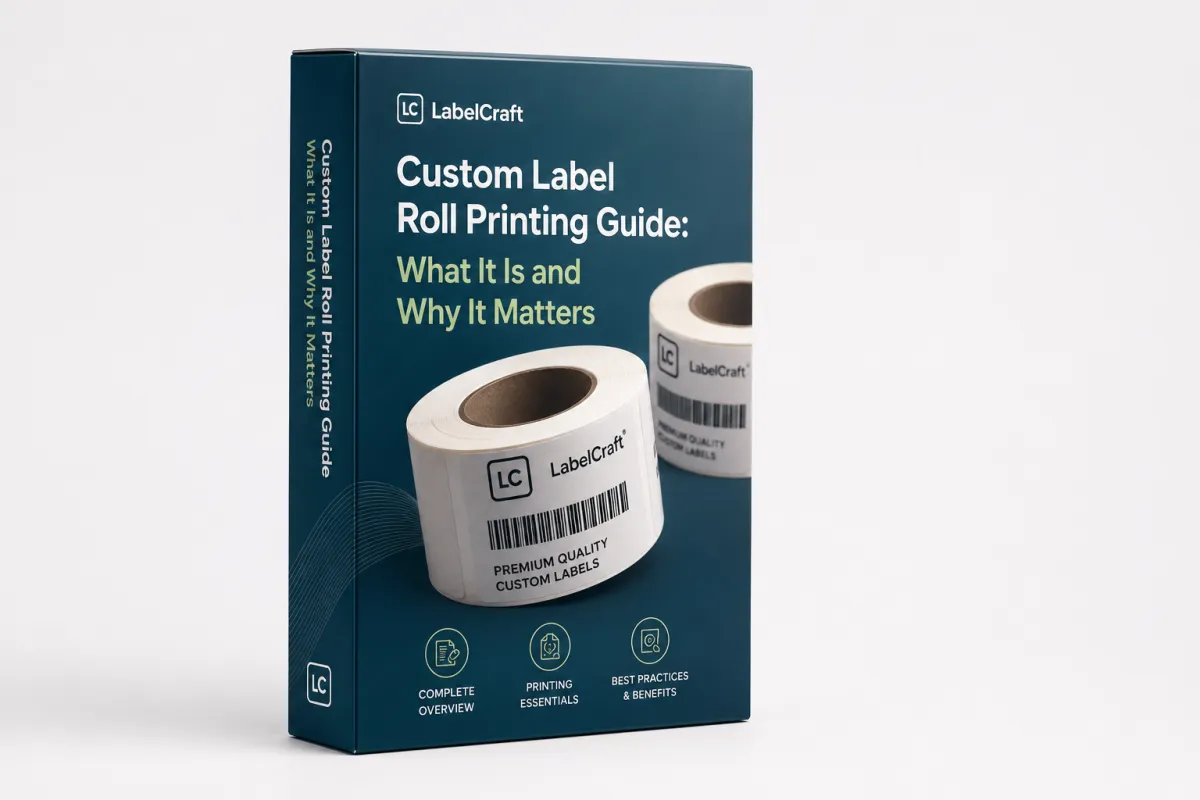
A custom label roll printing guide starts with a simple idea: roll labels are printed, die-cut, and rewound onto a core so they can be applied by hand or by machine in a steady flow. The label stock stays on a liner, usually a silicone-coated paper liner or a clear PET liner, and the labels are arranged in a repeatable format with a consistent gap so each one feeds cleanly through a dispenser. That sounds basic, yet the behavior changes fast once the label meets a curved jar, a cold bottle, a dusty carton, or an applicator head moving at 60 units a minute. Labels are funny that way; they look calm on a desk and become dramatic the minute a conveyor belt gets involved.
I have watched the same artwork perform beautifully on a sheet label and then struggle on a roll because the application environment was harsher than the design team expected. A cosmetics client in New Jersey once came to me after a lavender body oil label started wrinkling on a 2.5-inch diameter bottle during a humid summer run; the art was fine, but the stock choice and adhesive strength were not matched to the condensation in their filling room. That is the kind of lesson a solid custom label roll printing guide can save you from, and frankly it is cheaper to learn it from someone else's headache than from your own pallet of rework.
Roll labels show up everywhere: beverage bottles, supplement jars, frozen food tubs, candle jars, cleaning products, pouches, shipping sleeves, and industrial cartons that need consistent package branding. They are especially useful on lines where the label has to be applied quickly and cleanly, because a roll format fits handheld dispensers, semi-automatic labelers, and fully automated systems much better than a stack of sheets. If you also use Custom Labels & Tags across retail SKUs, the roll format gives you a cleaner path for repeat orders and line consistency. I have seen teams cut an entire minute off a packing cycle just by switching from loose labels to a proper roll build, which sounds small until you multiply it by ten thousand units.
The practical advantages become obvious once you spend time on a production floor. Hand application moves faster because the operator can peel and place without sorting loose sheets; automated application holds steadier because the web feeds in a controlled direction; storage stays simpler because rolls stack neatly on pallets or shelves; and interruptions fall away because the labels arrive ready for the line instead of needing extra handling. That is why this custom label roll printing guide keeps coming back to fit, not just appearance. A label that prints beautifully but fights the machine is not a good label. It is just an expensive problem with nice color.
Here is the blunt truth I tell buyers: if the label is part of a product launch, a co-packer handoff, or a retail reset, the roll spec matters as much as the art. A beautiful design can still fail if the unwind direction is wrong, the core size is off by half an inch, or the finish cannot survive oil, moisture, or abrasion. Smart packaging teams treat labels the same way they treat custom printed boxes and other product packaging pieces, as working parts of the system rather than decorative extras. I know that sounds less glamorous, but packaging rarely cares about our feelings, and a 350gsm C1S artboard folding carton that arrives in Dallas, Texas while the labels are spec'd for a different line will expose the mismatch immediately.
"The label looked fine on the mockup, but the first cold pallet in a 38-degree dock told the truth." That was a line a dairy buyer said to me after we swapped a paper stock for a freezer-grade film, and it still sums up why this custom label roll printing guide exists.
How Custom Label Roll Printing Works from File to Finished Roll
The production path is more orderly than most first-time buyers expect, but it has enough checkpoints to punish sloppy planning. A proper custom label roll printing guide starts with artwork setup, then moves into press-ready file checks, color management, printing, die cutting, slitting, rewinding, inspection, and packing. At each stage, one small technical detail can affect the whole run, especially if the label is going onto a curved PET bottle or a textured HDPE surface. I have seen a tiny typo survive three review rounds and then get caught only when somebody physically unwrapped the finished roll, usually after a 14-hour shift and a very long coffee.
Most roll labels are printed in continuous web form, which means the material moves through the press as a long strip rather than as separate pieces. After printing, the labels are die-cut to shape but remain attached to the liner, so they can be wound into a finished roll. That structure makes the format work well for digital printing on shorter runs of 500 to 5,000 labels and for flexographic printing or hybrid production on larger, more repeatable jobs such as 25,000-piece retail programs. The press choice changes the economics, but the roll build still has to match the way the label will be applied. If the line is automated, the roll spec matters just as much as the ink on the face stock.
Finishing carries more weight than many buyers expect. A matte varnish can cut glare on premium retail packaging, while a gloss laminate can protect against scuffing on shipping lanes or warehouse handling. Foil accents, tactile effects, and spot details can make a simple design feel more deliberate, especially for cosmetics or specialty food. I have stood at a press in our Shenzhen, Guangdong facility while a brand team debated whether a soft-touch finish justified the added cost, and the answer depended on how much shelf presence they wanted compared with how hard the package would be handled. My honest opinion? Soft-touch is lovely, but if the container gets banged around in transit, beauty needs backup, and a clear overlaminate can add that extra layer for only $0.03 to $0.07 per label on a 10,000-piece run.
Roll construction adds another layer of compatibility. Core size is often 1 inch, 3 inches, or 3.5 inches; roll diameter can determine whether a dispenser loads the roll without jams; unwind direction tells the machine which edge should feed first; and label spacing affects sensor timing on automated applicators. If those settings are wrong, a production line can stop even when the print looks flawless. That is why a careful custom label roll printing guide always includes roll direction, roll diameter, and core size as core decision points, not footnotes. I have watched a perfectly printed roll sit useless on a cart because the unwind was backward. The operator just stared at it like it had personally insulted his family.
Color approval is another point where buyer expectations and factory reality can drift apart. A neon brand color may look energetic on a backlit monitor, but on a coated film label under warehouse lighting it can lean dull unless the printer has a clean proofing process and a solid color target like Pantone 186 C or Pantone 3425 C. I prefer press checks or production samples whenever the label plays a major role in package branding, because a few minutes spent matching the right target can save a reprint later. For teams that want outside standards to back up transit and handling assumptions, I often point them to the ISTA testing standards and, for paper sourcing questions, the FSC certification program. Those references do not fix bad planning, of course, but they do give the conversation a more disciplined frame, especially when the launch is tied to a 12,000-unit distribution drop in the Midwest.
Custom Label Roll Printing Guide to Cost, Materials, and Pricing
Cost is usually the first question, and a useful custom label roll printing guide should answer it with real structure instead of vague promises. The main drivers are substrate choice, adhesive type, print coverage, finish, die complexity, quantity, number of SKUs, and any special handling such as variable data or individual bagging. A label that is simple to print and rewind can cost a lot less than one with a tight contour, a metallic finish, and three versions that all need to ship together. I have had buyers call asking for "just a label," and then the spec sheet turns out to include enough options to make a small gift box blush.
Material choice is where many projects are won or lost. Paper is the most economical option for dry, indoor use and short shelf life; BOPP is a common film choice for moisture resistance and better durability; vinyl is useful for tougher environments or curved surfaces; and specialty films can handle more demanding conditions, including chill rooms and heavy abrasion. For example, a 60-micron white BOPP with a 50# glassine liner and a permanent acrylic adhesive is a common spec for beverage bottles, while a 1.5-mil vinyl with a high-tack adhesive can be a better fit for textured tubs in a freezer room. I have seen teams save money by Choosing the Right material instead of the fanciest one, which is one of the quieter lessons in any strong custom label roll printing guide. The cheapest option on the quote is not always the cheapest option on the production floor, and that is a lesson some brands seem determined to learn twice.
| Material | Best Fit | Example Unit Cost at 5,000 | Example Unit Cost at 25,000 | Notes |
|---|---|---|---|---|
| Paper | Dry goods, short runs, indoor retail packaging | $0.15 to $0.24 | $0.08 to $0.14 | Lowest upfront cost, but weaker against moisture and abrasion |
| BOPP | Beverages, supplements, cosmetics, refrigerated products | $0.21 to $0.31 | $0.11 to $0.17 | Good moisture resistance and a common choice for branded packaging |
| Vinyl | Curved containers, tougher handling, industrial use | $0.28 to $0.39 | $0.14 to $0.23 | Flexible, durable, and often better for harsh environments |
| Specialty film | Freezer, oil, chemical, or premium shelf presentation | $0.33 to $0.51 | $0.17 to $0.29 | More expensive, but worth it for difficult conditions or premium product packaging |
Those figures are practical examples, not universal quotes, and a real custom label roll printing guide should always remind you that print coverage, finish, and quantity will move the numbers. A 5,000-piece job at $0.15 per label can be a fair starting point for simple paper stock, while a 25,000-piece 60-micron BOPP run can bring the unit cost down sharply if the artwork stays stable and the die does not change. I have sat across from buyers who expected a low price on a 2.5-inch by 4-inch label with metallic ink, soft-touch lamination, and a complex contour, and the final number only made sense once we separated material cost from finishing cost. Their faces usually change right around the word "lamination," especially when the extra finish adds $125 to a $1,500 order.
Shape changes pricing more than most people expect. A square or rectangle is usually cheaper because it nests efficiently and keeps waste low. A custom contour with narrow corners, tiny cutouts, or an oversized peel edge can increase die cost and setup time, sometimes by $85 to $150 for the tooling alone on a short run. If your brand is working on a broader packaging design system across labels, cartons, and pouches, it can be smart to keep the label shape simple and let the rest of the product packaging carry the visual complexity. I know designers sometimes want to do Olympic-level acrobatics with a cut line, but the machine does not care about bravery.
The cleanest quotes separate each component. Ask for the price of material, print method, finishing, die cutting, roll build, packing, and shipping as separate lines. That lets you compare vendors apples to apples, which matters more than chasing the lowest headline number. If you are also sourcing other items, the same thinking applies to Custom Packaging Products and the way they are bundled with labels in a larger rollout. A disciplined custom label roll printing guide should teach you to read quotes like a production manager, not a shopper in a hurry, and it should make freight from Shenzhen to Los Angeles, or from Houston to Reno, part of the real comparison.
Custom Label Roll Printing Guide for Process and Timeline Planning
Lead time is where good intentions get tested, so a practical custom label roll printing guide has to talk about scheduling in plain terms. A typical path runs from concept and file prep to proof approval, production, finishing, inspection, and shipping, and each step depends on the one before it. If the artwork is final, the quote is clear, and the material is in stock, the job moves far faster than if three people are still debating barcode placement or a finish change. I have lost count of how many "quick label jobs" turned into small civil wars because the final file was nowhere near final, even after the second round of emails.
Delays usually show up in a few predictable places: artwork revisions, missing dielines, low-resolution images, unconfirmed color targets, and late calls on adhesive strength or laminate choice. I once watched a supplement brand lose four business days because its legal team changed a compliance line after proof approval, which forced a recheck of the layout and barcode placement. That kind of delay is common, and any honest custom label roll printing guide should say so directly. If you have ever tried to coordinate marketing, operations, and legal on one label, you already know why there is a little edge in my voice here.
Timeline also depends on the print method and the number of SKUs. A single design in a stable size can move quickly, especially in digital printing, while a multi-SKU retail program with multiple roll widths, finish variations, or variable data needs more inspection time. If the job includes special coating or a premium finish, add buffer. If the labels have to arrive before a filling run in Atlanta, a trade show in Las Vegas, or a retail reset in Minneapolis, back up the schedule from the hard deadline rather than hoping the vendor can compress the process later. Hope is not a schedule, no matter how many people on the call say "we should be fine."
For planning, I like a simple breakdown that buyers can actually use. A straightforward custom label roll printing guide often looks like this:
- 2 to 4 business days for artwork cleanup, dieline confirmation, and proof setup.
- 1 to 2 business days for proof review if the team is ready and decision makers are available.
- 5 to 10 business days for production, depending on quantity, finish, and machine schedule.
- 1 to 3 business days for finishing, inspection, and packing.
- Shipping time based on location, freight method, and pallet count.
I would rather tell a buyer to plan for 12 to 15 business days from proof approval than promise a tighter window and create a mess on the back end. That is not because every job needs that much time, but because the variable parts of roll production deserve breathing room. A solid custom label roll printing guide respects the fact that packaging operations are connected; if the label misses the filling date, the whole launch can stall. And once a filling line sits idle, nobody is feeling philosophical about timelines anymore, especially on a 9,000-unit run packed for a Friday truck out of Ohio.
Step-by-Step Custom Label Roll Printing Guide for First-Time Buyers
If you are new to roll labels, the easiest way to avoid mistakes is to move in order. A first-time buyer should treat this custom label roll printing guide like a checklist, not a pile of creative options. Start with the package itself, then move to artwork, then to materials, and only after that to the finishing details that make the label look polished. That order sounds obvious once you say it out loud, but I have watched teams do the reverse with great confidence and very little useful result, usually while trying to hold a launch date in the same week.
Start with the product and container
Gather the container material, diameter, shape, surface texture, storage temperature, and application method before you ask for a quote. A smooth glass bottle behaves differently from a matte plastic jar, and a label that works on cardboard may fail on chilled poly. I have watched a line in a Chicago co-packing plant stop because someone ordered a label for a 3-inch jar without checking the slight ridge near the shoulder, which caused a wrinkle every fourth unit. That is exactly the kind of issue a strong custom label roll printing guide should prevent. The container decides more than people want to admit, especially when the product sits at 42 degrees in a refrigerated display case.
Build the artwork for the roll format
Use the correct dieline, include 1/8-inch bleed, keep text inside the safe area, and make sure barcodes are set up with enough quiet space around them. A label that looks crisp on a screen can still misbehave once it is cut to shape and wound onto a 3-inch core. If the design is part of a larger package branding system, check that the typography and color palette align with the rest of the line, whether the product is paired with pouches, cartons, or custom printed boxes. That consistency is part of the brand story, and the custom label roll printing guide should support it. I am a little strict about this because mismatched packaging always feels like someone left the band on stage without the drummer.
Choose stock, adhesive, and finish based on use
Do not pick paper simply because it looks economical on the quote. If the product will see moisture, oil, refrigeration, or rough handling, the label needs a material that can survive the real environment. Permanent acrylic adhesive is the most common choice for retail packaging, removable adhesive fits temporary use, and a freezer-grade adhesive can be the right answer for cold or textured surfaces. The most useful custom label roll printing guide advice I can give is this: test the substrate on the actual container, not just on a sample board. A pretty sample board has exactly zero chance of going through a freezer door in Cleveland or a wet bottle line in Tampa.
Ask for proofing and sample checks
For anything that matters to brand launch, compliance, or automated application, request a proof and, if possible, a physical sample or press-approved proof. In my experience, that extra step catches the majority of issues before they become waste. A buyer can often feel whether the finish is right, whether the laminate is too glossy, or whether the label release feels too tight for the applicator. The custom label roll printing guide is not just about buying labels; it is about reducing surprises, and surprise is usually just another word for a production delay with a nicer face. If the first approved proof is a PDF at 300 dpi and the second is a live sample from a 6,000-piece pilot run, you are asking the right questions.
Confirm the roll build
Check unwind direction, core size, outside diameter, label count per roll, and packing requirements before production starts. If the labels will run on a machine, ask for the applicator model and confirm the roll spec against it. A few minutes spent here can save a half-day stoppage later, which is why this custom label roll printing guide keeps circling back to machine compatibility. A clean roll is one that arrives ready to load, not one that forces the operator to improvise. Operators can improvise a lot of things; they should not have to improvise label geometry on a 3-inch core with a 10-inch outer diameter limit.
Common Mistakes in Custom Label Roll Printing Guide Projects
The most expensive mistakes are usually the quiet ones. A buyer chooses a paper label for a product that lives in a refrigerator, and a week later the corners start lifting. Another buyer orders the right print but the wrong unwind direction, and the applicator spends its first shift rejecting rolls. A practical custom label roll printing guide should point out these traps before they cost time and scrap. The worst part is that most of them feel small during approval and huge during production, especially once the pallet has already landed on the dock at 38 degrees.
One frequent issue is ignoring moisture, condensation, or freezer exposure. Paper can be fine for dry environments, but once the product hits a cold room or wet handling area, the wrong substrate can wrinkle, smear, or peel. I have seen this happen on beverage multipacks and on bath products that looked harmless in a showroom but got handled with wet hands on the retail floor. Good branded packaging should look intentional on day one and still hold up after a delivery cycle. If it starts curling at the corners after 24 hours at 42 degrees Fahrenheit, the brand starts looking nervous too.
Another common error is overlooking applicator requirements. The label may print perfectly, but if the roll diameter is too large for the machine tray, or the core size is off by even a small margin, the whole job can be rejected. That is why a dependable custom label roll printing guide should ask for equipment details before any quote is finalized. The label has to serve the line, not just the design file. I have seen perfectly good rolls get set aside because somebody assumed "standard" meant standard for that machine, which is not how the machine saw it, especially on a Label-Aire or Herma setup with a fixed spindle.
Low-resolution art and poor contrast cause trouble too. Thin type on a busy background can look stylish in a presentation deck and unreadable at three feet on a shelf. Barcodes with weak quiet zones can fail scanning. If the packaging design team wants a premium look, they still need enough contrast for real-world use. I tell clients to think like a warehouse picker, a store associate, and a customer all at once, because that is how the label will be judged in the wild. Design review is nice; warehouse reality is harsher and much less impressed, particularly when the scan gun is a Zebra DS2208 and the line is moving at 45 cases a minute.
Skipping material tests on the actual package is another habit that burns money later. A label can look fine on flat stock and still wrinkle on a curved jar or peel from a textured bottle wall. I remember a supplier negotiation where a brand insisted on saving five cents a unit by staying on a lighter film, and by the time the second production run arrived they had spent far more in labor and rework than they ever saved. That is the kind of caution a real custom label roll printing guide needs to pass along. Saving pennies on the spec and then paying dollars in labor is a very expensive hobby.
Finally, ordering too few labels can be costly in a different way. Small runs feel safer, but if the product sells faster than expected, you may be forced into a rushed reorder with limited material options or higher freight. The best buyers treat volume as part of the spec. A strong custom label roll printing guide looks beyond the immediate invoice and asks what happens if the product takes off. That is not pessimism. It is just what happens when packaging people have been burned one too many times and have the scars to prove it, usually after a 4,000-piece pilot order grows into 40,000 units in six weeks.
Expert Tips and Next Steps for Custom Label Roll Printing
The best results usually come from a little structure before production begins. If I were advising a buyer from the factory floor, I would say this: build a tiny sample matrix first. Test one or two materials, one adhesive strength, and one finish on the actual container in the actual storage condition. A freezer label should be tested cold at 34 to 38 degrees Fahrenheit, a cosmetic label should be tested after a few hours of handling, and a shipping label should be tested for scuffing. That practical mindset is what makes a custom label roll printing guide worth reading in the first place. Theories are nice, but labels care about temperature, pressure, and friction, not opinions.
Ask for a production checklist before anything goes to press. It should confirm file format, bleed, barcode specs, PMS targets, roll core size, unwind direction, outer diameter, and packing method. I like checklists because they turn a fuzzy conversation into a repeatable process, and repeatability is the foundation of good manufacturing. If your team buys labels regularly, keep that spec sheet with the rest of the packaging design records so future orders stay consistent. Future-you will be grateful, even if current-you thinks the file naming convention is annoying, especially when the job includes a 25,000-piece reorder from a plant in Dongguan, Guangdong.
That consistency matters across the whole branded packaging program. A label that matches the carton, the mailer, and the secondary pack creates a cleaner shelf story, whether the line is built around liquid detergent, a protein supplement, or a skincare set. If you are coordinating labels with other items, such as cartons or inserts from Manufacturing Capabilities, the technical notes should travel together so no one is guessing at the next reorder. A good custom label roll printing guide protects that continuity, and continuity is usually what keeps a brand from feeling pieced together. When a 350gsm C1S artboard carton, a 60-micron BOPP label, and a 24pt insert all share the same Pantone 7706 C, the line looks intentional instead of improvised.
My purchasing advice is simple. Lock down the critical choices first: container, environment, adhesive, roll spec, and application method. After that, use the finish to fine-tune shelf appeal. A gloss laminate can sharpen color, a matte finish can make a label feel calmer, and a tactile effect can turn a plain bottle into something that feels more premium in the hand. Those are finishing decisions, not survival decisions. The survival decisions belong to substrate and adhesive, and any honest custom label roll printing guide should say that out loud. If a label survives the line but does not win a beauty contest, that is still a win. Shelf drama is optional, and a $0.04 overlaminate is often cheaper than a reprint on 8,000 units.
There is also a practical way to keep costs in check without cheapening the result. Simplify the die shape, avoid extra finishes that do not serve the product, and order enough volume to get production efficiency without tying up cash in the wrong spec. If you are planning a broader packaging program, that same discipline helps with product packaging across labels, cartons, and inserts. A smart custom label roll printing guide does not chase the lowest price in isolation; it looks for the best match between performance and budget. That balance is usually where the real savings live, whether the order runs through a shop in Charlotte, North Carolina or a finishing line in Osaka.
Here is the short version of the next steps I recommend: gather your container specs, confirm the dieline, test a sample on the package, define the roll direction and core size, and request a quote that separates material, printing, finishing, and shipping. If you do that, the custom label roll printing guide becomes more than advice on a page; it becomes the path to a clean first order that prints well, runs well, and looks right on the shelf. That is the point of the custom label roll printing guide, and honestly, it is the point of good packaging work too, especially when proof approval starts the clock and the target is 12 to 15 business days later.
FAQ
What should I prepare before requesting a custom label roll printing quote?
Have the container dimensions, label size, quantity, material preference, adhesive needs, and any applicator requirements ready before you ask for pricing. Include the artwork file, barcode needs, and any special finish requests so the quote reflects the real production scope. If possible, share photos of the product and where the label will live so the printer can recommend a better substrate or adhesive. For example, a 2 x 3-inch label on a 12-ounce bottle, 5,000 pieces total, and a 3-inch core spec gives the factory enough detail to price it accurately without guessing. That extra context often saves a back-and-forth email chain that nobody enjoys.
How do I choose the right adhesive in a custom label roll printing project?
Match the adhesive to the surface and environment: permanent for most retail packaging, removable for temporary labeling, and specialty adhesives for cold, oily, or textured surfaces. Test the label on the actual package when the product will face refrigeration, condensation, or frequent handling. Ask whether the adhesive needs to perform immediately or after a dwell time, because that changes the spec. I have seen labels pass a desk test and fail a warehouse test at 38 degrees Fahrenheit, which is one of those infuriating little surprises that make everyone older.
What affects the turnaround time for custom label roll printing?
Timeline depends on artwork readiness, proof approvals, material availability, finishing steps, and how many SKUs are included in the order. Complex shapes, specialty finishes, and variable data usually add setup and inspection time. Fast approvals and complete specs are the easiest ways to keep the order moving. In practical terms, 12 to 15 business days from proof approval is a safer planning window than hoping for a rush turn, especially when the job ships to a plant in Texas or a co-packer in Indiana. If the decision makers are all traveling, expect the calendar to behave like a stubborn machine, because it will.
Can custom label roll printing work for automated label applicators?
Yes, as long as the roll is built to the applicator's requirements for core size, roll diameter, unwind direction, and spacing. The label material and adhesive must also be stable enough to feed cleanly at machine speed without curling or lifting. Always confirm the machine model before ordering if the labels will run on a production line. A 1-inch core may work on one machine, while another needs 3 inches or 3.5 inches and an 8-inch outside diameter limit, so the machine is not being difficult; it is just very literal, which is usually how equipment stays alive.
How can I keep costs down without hurting label quality?
Simplify the die shape, avoid unnecessary finishing extras, and Choose the Right material for the job rather than the most expensive one. Order enough quantity to benefit from production efficiency, but not so much that you lock in the wrong spec. Use a single spec sheet for repeat orders so you do not pay extra for avoidable revisions. In my experience, the quiet savings come from consistency, not from squeezing the last cent out of one line item. A 25,000-piece reorder on the same 60-micron BOPP, permanent acrylic adhesive, and 3-inch core usually costs less per unit than three separate 5,000-piece rush jobs.

