Custom label solutions are easy to underestimate because the part you notice first is usually the least useful part. A label can look sharp in a mockup and still fail in the real world: edges fray, print fades, stitching puckers, or the tag scratches skin after one wash cycle. That gap between the artwork and the finished garment is where most buying mistakes happen. It is also where quality becomes visible in a way customers can feel immediately.
For apparel brands, Private Label Buyers, and packaging teams that handle product presentation end to end, labels are not separate from the rest of the package. They sit inside the same system as hang tags, fold methods, carton inserts, and retail packaging. A Label That Fits the garment, survives laundering, and matches the product tier does more for brand perception than a louder logo ever will. The reverse is just as true: a weak label can make a well-made garment feel unfinished.
What matters most is not novelty. It is fit. The right substrate, finish, and attachment method depend on the fabric, the wash environment, the clothing category, and the amount of information the label must carry. A premium knit, a children's sleepwear item, and a technical running top all need different specs. Treat them the same and the results usually show it.
Custom label solutions for clothing: what actually changes the result
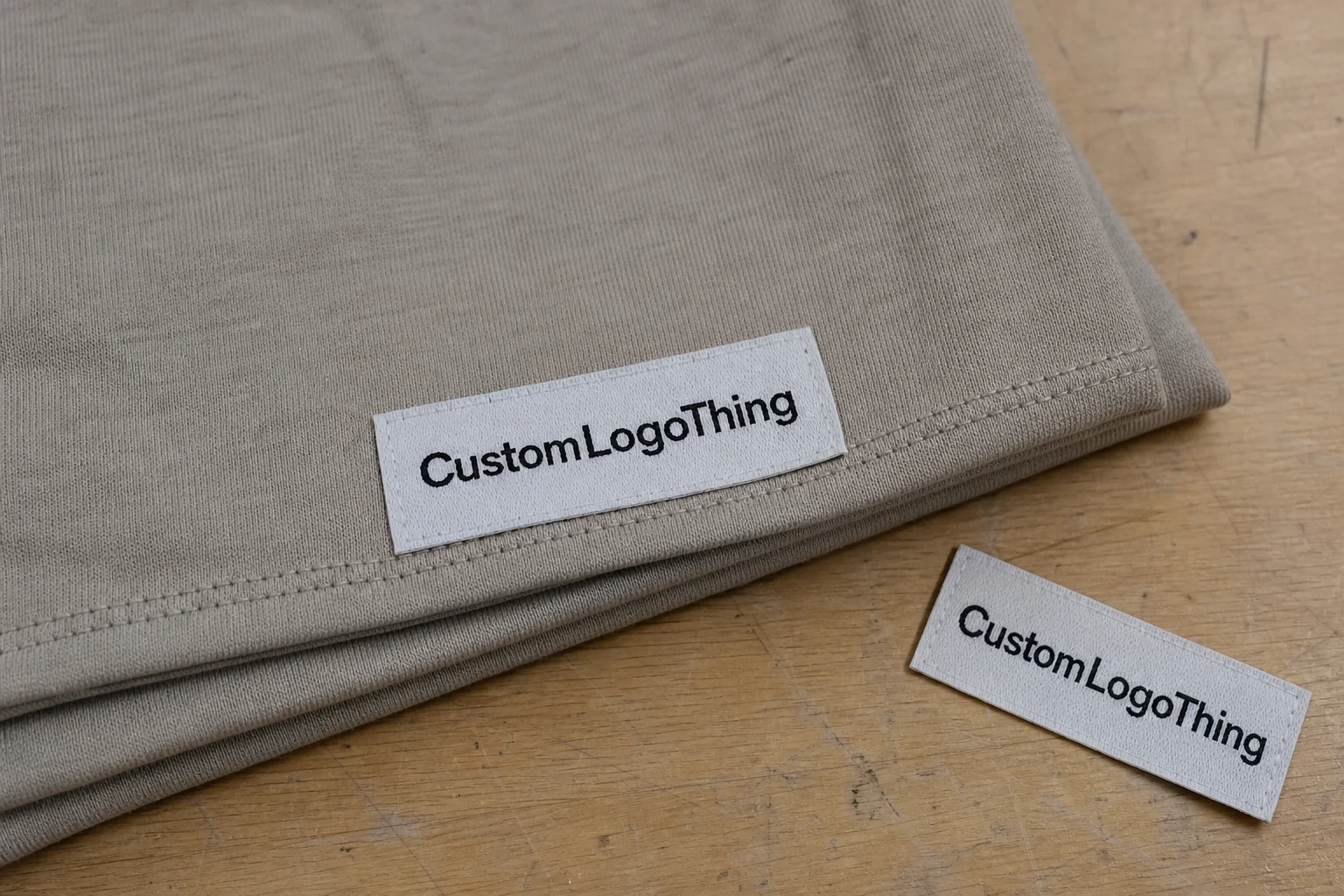
Custom label solutions include the full range of brand and information labels used on apparel: woven brand labels, printed care labels, satin neck labels, cotton labels, size tabs, and heat transfer labels. They are built for different jobs. Some are meant to survive repeated washing. Others exist mainly to support compliance text. A few are designed to disappear into the garment so the wearer notices comfort instead of construction.
The difference is practical, not cosmetic. Woven damask labels are often chosen for premium branding because the logo is built into the structure of the fabric. That gives them good wash durability and a clean edge, but there is a limit to how much detail they can hold. Printed labels can carry smaller text and more complex copy. Heat transfer labels remove the fabric tag altogether, which is why they are common in babywear, athleisure, and lightweight tees. Satin and cotton occupy the middle ground, each with its own tradeoff between softness, texture, and visual style.
Small details change how the garment is perceived before it is even worn. A scratchy neck label can make a solid tee feel lower grade. A care label that fades after a few washes raises questions about the rest of the product. A neatly finished label, on the other hand, creates the same impression as a well-formed box corner or a clean print register on a carton: someone checked the work.
A label has to do three things at once: identify the brand, survive real use, and remain comfortable enough that the buyer forgets it is there.
That is why the strongest spec is not the prettiest one on screen. It is the one aligned with the garment’s role. A hoodie that will be worn and washed often may need a woven label with a separate care label. A baby bodysuit may need a softer, tagless method. Outerwear often tolerates a more visible, more durable label because the garment is not sitting directly against skin. Those distinctions sound obvious in theory. In production, they are the difference between a clean launch and a stack of avoidable complaints.
- Woven labels fit premium branding and repeated washing.
- Printed labels suit detailed instructions and softer interiors.
- Satin labels offer a smoother hand-feel for fashion basics.
- Cotton labels support a natural, heritage-style look.
- Heat transfer labels remove bulk and work well for next-to-skin comfort.
For buyers managing custom printed boxes, hang tags, and retail presentation together, the label should be part of the same spec conversation. If the box says one thing and the interior trim says another, the product feels less disciplined. Packaging and labeling are separate line items in procurement. Customers experience them as one impression.
How the label production process works
On paper, the workflow is simple: quote, artwork review, proof, sample, production, finishing, shipping. In practice, the hidden cost is usually in the first two steps. Artwork that looks clean on a computer monitor can run into problems once it is translated into weave counts, print resolution, fold allowances, or heat-transfer constraints. Thin type, small legal copy, and low-contrast color combinations are the usual troublemakers.
Good suppliers do more than confirm size. They check whether the artwork can survive the chosen production method. A woven label with tiny lettering may need simplification so the text stays readable. A printed care label with dense copy may need a wider format or a layout that prioritizes line spacing. A sample is not just a miniature version of the final piece. It is a test of whether the spec is actually manufacturable.
The production sequence usually looks like this:
- Artwork prep: confirm vector files, dimensions, Pantone references, fold style, and copy accuracy.
- Proofing: check spacing, legibility, color translation, and orientation before the run begins.
- Sampling: verify hand-feel, edge finish, and logo clarity on the actual substrate.
- Production: run the approved design through weaving, printing, cutting, or heat transfer.
- Finishing: add folds, cuts, bundling, or pre-attachment packaging.
- Shipping: confirm counts, carton labeling, and transit protection.
Artwork approval is where speed is won or lost. A responsive buyer can save days by approving clean proofs quickly. A slow approval cycle can add a week or more, especially if the first proof reveals that the copy needs to be resized or the layout needs to be reworked. Rush orders do exist, but they compress the margin for error. Faster schedules often reduce the number of review rounds, which sounds efficient until a small mistake is multiplied across thousands of labels.
That matters even more if labels are only one piece of a larger launch. Brands that also manage Custom Packaging Products need the label calendar to align with carton printing, kitting, and distribution. If the garment is ready and the boxes are not, or the labels arrive after the first packing window, the whole launch absorbs the delay. The cheapest label quote can become expensive if it breaks the schedule.
There is another layer here that buyers overlook: compliance and testing discipline. For paper components in the same packaging program, FSC-certified stock may support responsible sourcing claims. For retail-ready shipping, ISTA test methods help simulate how products move through distribution. Those standards do not make a label better by themselves, but they expose weak assumptions before the customer does. See the ISTA distribution testing standards and FSC certification basics for reference points.
Material, finish, and attachment choices that affect performance
Material choice changes the outcome more than most buyers expect. It affects hand-feel, color clarity, wash life, and unit cost. A woven damask label is built into the fabric, so it usually feels more premium and holds up well to repeated laundering. The tradeoff is detail limitation. Fine type, tiny icons, and complex gradients are not its strength. Printed satin is smoother and usually easier to specify at smaller runs. Cotton gives a more natural, tactile look, although it tends to show wear sooner than many polyester-based options. Heat transfer labels remove the physical tag entirely, which is a major comfort advantage for close-to-skin garments.
Material first, finish second
Finish influences tone more than buyers often realize. Matte feels understated and modern. A slight sheen can make the same mark read more fashion-forward. Edge treatment matters too. Heat-cut edges reduce fraying on many synthetic labels, while woven folds such as center fold, end fold, or mitre fold affect where the label sits and how much bulk the seam picks up. If the fold is wrong, the label may twist under stitching or create a bump in an otherwise smooth seam. That is the kind of flaw that is invisible on a flat proof and obvious on a finished shirt.
Attachment method carries its own constraints. Sew-in labels remain the standard because they are durable and widely compatible. Iron-on labels can work for certain applications, but they depend on the fabric tolerating heat and pressure. Peel-and-stick is typically for temporary identification, sorting, or handling, not long-term wear. Heat press applications are excellent for tagless branding, though the garment construction has to tolerate the temperature and pressure used during transfer.
Match the garment to the label
- T-shirts: printed or heat transfer labels often win on comfort.
- Children’s wear: soft, tagless solutions reduce irritation.
- Premium basics: woven or satin labels support a polished interior finish.
- Activewear: stretch-friendly, low-bulk labels help with movement and sweat.
- Outerwear: abrasion resistance matters more than absolute softness.
A useful rule holds up across categories: the closer the label sits to skin, the more softness matters. The more the label functions as a visible brand marker, the more edge quality and visual sharpness matter. That distinction shapes both the material and the attachment method. Buyers who ignore it often over-specify one attribute and under-specify the one that actually matters.
The comparison with packaging is straightforward. A luxury knit and a promotional tee do not ask for the same interior label, just as a rigid carton and a mailer box do not ask for the same board stock. The brand can be identical and the construction still needs to change.
Cost, pricing, and MOQ: what buyers really pay for
Pricing for custom label solutions is shaped by quantity, size, color count, material, finish, and attachment method. Packaging format can add cost as well. If labels need to be packed by size, separated by SKU, or supplied in retail-ready bundles, labor increases and so does the invoice. A buyer comparing quotes only by unit price misses the real total.
For small runs, setup and proofing have outsized impact. For larger runs, the unit cost usually drops because the pre-production work is spread across more pieces. A 500-piece order might land around $0.22-$0.45 per unit depending on material and complexity, while a 5,000-piece run may fall closer to $0.06-$0.18 per unit. Those numbers move with the spec, but the pattern is reliable: volume rewards standardization, and complexity costs money.
| Label option | Typical MOQ | Relative unit cost | Best use case |
|---|---|---|---|
| Woven damask | Low to mid | Medium | Premium branding, long wash life, crisp logo identity |
| Printed satin | Low | Low to medium | Soft interior labels, care info, fashion basics |
| Cotton label | Low to mid | Medium | Natural look, heritage styling, textured presentation |
| Heat transfer | Mid | Medium to high | Tagless comfort, athletic wear, babywear, close-to-skin items |
| Peel-and-stick / temporary | Varies | Low | Handling, sorting, temporary identification |
MOQ is not a quality metric. A lower minimum order quantity improves flexibility, but it often raises the unit cost and can limit consistency across replenishments. A higher MOQ can be more economical if the design is stable and the sell-through is predictable. The risk on the other side is overbuying. If the brand changes care copy, size structure, or logo placement later, old stock becomes a sunk cost rather than a savings.
For that reason, buyers should ask for the landed price, not just the quoted production price. Shipping, sample charges, revision fees, and packing or kitting costs all belong in the comparison. A quote that looks cheaper on paper can become more expensive once handling is added. That is true for apparel labels, custom printed boxes, and most other branded packaging components. The headline number rarely tells the whole story.
Turnaround, lead time, and production steps to plan around
Most label orders follow the same sequence, but the timing depends on approval speed, sample needs, and production load. A straightforward order can move from quote to proof in a day or two, then into production once the proof is approved. Standard woven or printed labels often take 12-15 business days to produce, though simpler jobs may finish sooner and more complex programs may take longer. Transit time sits on top of that. If the labels feed a seasonal launch, a 3- to 5-day buffer is not excessive. It is a basic risk control.
Rush production is possible, but it changes the tradeoff. The schedule gets tighter, revision options shrink, and the margin for layout or color mistakes gets smaller. Some suppliers can move faster by reducing proof rounds or prioritizing a job in the queue. That can be the right decision for a launch in trouble. It is a weaker plan for a project that was never scheduled with enough lead time.
Three timing problems show up again and again:
- Artwork revisions: even minor copy changes can restart proofing.
- Material shortages: specific satin, damask, or transfer bases may not be available in the required window.
- Late approval: one delayed sign-off can hold the entire order.
The better planning habit is to lock the spec early and treat the proof as a control document, not a conversation starter. If the labels are part of a broader packaging launch, line them up with carton printing, hang tags, and receiving dates. A label that arrives on time but sits in storage because the boxes are late still counts as a delay.
For operations teams, the practical deadline is not the official launch date. It is the first date the product must be packed, checked, and ready to ship. Planning against that earlier milestone gives room for correction if the first run fails an inspection point or the sample reveals a readability problem.
Common mistakes that weaken clothing label performance
Most label failures are predictable. The first is choosing a material that conflicts with the garment. A rigid label on a soft tee feels abrasive. A thin printed label on a piece that gets heavy wash wear may fade too quickly. The second is trying to pack too much detail into too little space. Tiny type, hairline rules, and low-contrast artwork often disappear once the label is produced at scale.
Another common issue is ignoring attachment compatibility. Some fabrics accept heat and pressure well; others distort, glaze, or curl. If the label method does not fit the garment construction, the result can be peeling, seam puckering, or stiffness where the fabric should move naturally. That risk rises on delicate fabrics and performance apparel, where the construction is already engineered to do a specific job.
Late ordering creates a separate set of problems. Rush timelines reduce the room for correction. If a supplier has to choose between speed and careful verification, mistakes become more likely. A delayed shipment is inconvenient. A full reprint because the wrong care copy was approved is expensive.
Here is the short list of errors that are easiest to avoid:
- Ordering before the garment fabric and attachment method are finalized.
- Using tiny text that cannot hold up in production.
- Skipping sample review and going directly to bulk.
- Assuming monitor color equals physical color.
- Forgetting to budget time for shipping and receiving.
The brands that handle this well tend to think like print buyers. They check dimensions, ask for proof details, and compare the spec against the use case instead of the mockup. That habit is not glamorous, but it prevents most of the expensive mistakes. Good labeling is usually the result of disciplined decisions, not lucky ones.
Next steps for choosing the right label spec
Start with the garment, not the logo. Define who will wear it, how often it will be washed, and what matters most: softness, durability, cost, or premium presentation. Once those priorities are clear, the label choice gets much easier. A simple spec sheet is often enough to eliminate the back-and-forth that slows most orders.
At minimum, the spec should include the label type, size, artwork format, color count, attachment method, quantity, and target delivery date. If the design includes tiny type or brand-critical color matching, ask for a proof or sample before bulk production. That step costs time, but it usually saves money because it catches weak assumptions early.
Compare quotes only when the specs are identical. A woven label and a printed label are not interchangeable even if the logo is the same. Shipping terms, packaging format, and revision policy matter too. A lower quote with stricter revision limits may be less useful than a slightly higher quote with clearer approval support.
The most reliable programs keep labels aligned with the rest of the product line. The garment, the packaging, and the timeline should all point in the same direction. That is where custom label solutions prove their value. The customer notices the finished experience, not the friction behind it.
Use a final checklist: match the label to the fabric, confirm the attachment method, verify the proof, compare landed cost, and leave enough lead time for corrections. If those boxes are checked, the label is more likely to strengthen the product than to undermine it.
Frequently asked questions
What are the best custom label solutions for soft clothing items?
Printed, woven, or heat-transfer labels designed for low bulk are usually the safest choice. For tees, babywear, and athleisure, softness and wash durability matter more than texture-heavy finishes. A label that disappears in wear often performs better than one that looks impressive on a flat sample.
How do custom label solutions affect clothing branding?
Labels shape the perception of quality every time a customer touches the garment. A consistent label spec supports recognition across sizes, colors, and product lines. A messy one introduces doubt, even if the garment itself is well made.
What affects the cost of custom clothing labels most?
Quantity, material, color count, finish, and attachment method are the main drivers. Rush timing, packaging requirements, and kitting can raise the total cost as well. Unit price alone rarely reflects the full spend.
How long do custom label solutions usually take to produce?
Standard orders often take about 12-15 business days after proof approval, but that varies by complexity and supplier load. Samples, revisions, and shipping all add time. Faster schedules usually mean less room for correction.
How do I choose the right label type for my garment?
Match the label to the fabric and to how the garment will be worn. If it sits against skin, comfort matters more. If it is outerwear or a visible brand marker, durability and edge quality become more important. The best custom label solutions balance those demands instead of chasing one feature at the expense of the others.