Buyer Fit Snapshot
| Best fit | custom labels for small business branding for packaging buyers comparing material specs, print proof, MOQ, unit cost, freight, and repeat-order risk where brand print, material, artwork control, and repeat-order consistency matter. |
|---|---|
| Quote inputs | Share finished size, material target, print colors, finish, packing count, annual reorder estimate, and delivery region. |
| Proofing check | Approve dieline scale, logo placement, barcode or warning zones, color tolerance, and any recyclable or compostable wording before bulk production. |
| Main risk | Vague material claims, crowded artwork, or missing packing details can create delays even when the unit price looks attractive. |
Fast answer: Custom Labels for Small Business Branding: Dieline, Finish, Proof, and Buyer Review should be specified like a repeatable production item. The safest quote includes material, print method, finish, artwork proof, carton packing, and reorder notes in one written spec.
What to confirm before approving the packaging proof
Check the product dimensions against the actual filled item, not only the sales mockup. Ask for tolerance on folds, seals, hang holes, label areas, and retail display edges. If the package carries a logo, QR code, warning copy, or legal claim, reserve that space before decorative graphics fill the panel.
How to compare quotes without losing quality
Compare board or film grade, print process, finish, sampling route, tooling charges, carton quantity, and freight assumptions side by side. A lower quote is only useful if the supplier can repeat the same color, closure quality, and packing count on the next order.
Custom Labels for Small Business: Branding That Sells Without Pretending to Be Magic
Custom labels for small business can decide how a product is judged in under 3 seconds. I have watched a plain 8 oz glass jar move from “$2 farmers market” to “$18 shelf item” with nothing changed except a 2.5 mil BOPP stock, a matte varnish, and a 3.25 x 2 inch trim size. No branding sorcery. Just packaging design doing measurable work while everyone else talks about “elevating the experience,” which usually means very little until a buyer actually picks up the product. The same is true for Custom Sticker Labels on tiny batches, where one sharp decision can make a brand feel far more established than it is.
I remember one afternoon in Shenzhen, standing on a converter floor with a manufacturer who held up two sauce jars under the same fluorescent light. Same fill weight. Same lid. Same recipe. The first used a thin paper label that curled at the corners after 48 hours in an 85% humidity test. The second used a 2.5 mil BOPP label with permanent acrylic adhesive and a matte varnish that stayed flat after 72 hours in the same chamber. The contrast was almost funny. One jar looked like a prototype that had been left outside overnight. The other looked like a brand that had already survived a reorder, a warehouse transfer, and a few customer complaints in Dongguan.
That is the real job of custom labels for small business. They carry the logo, yes, but they also tell buyers whether the product is trustworthy, readable, and worth buying again. Labels show up on 4 oz jars, 12 oz bottles, shipping mailers, candle tins, sample packs, and inserts printed on 350gsm C1S artboard. They sit inside branded packaging, product packaging, retail packaging, and package branding all at once. A small company does not need an oversized budget. It needs a label that looks deliberate and survives the kind of handling that happens when nobody is looking. In practical terms, that usually means better label printing choices, not bigger spending.
I will keep this practical with concrete details: 0.125 inch bleed, 300 dpi artwork, 12 to 15 business days from proof approval for flexo work, and labels that do not peel when a bottle leaves a 38°F refrigerator and lands in a 72°F shipping dock. If you are buying custom labels for small business, you need to understand how they are made, which materials hold up, why quotes vary so wildly, and how to avoid the mistakes that quietly drain cash. I have sat across from founders with $800 label budgets and $8,000 label problems. The expensive ones usually began with one bad assumption: “It is just a sticker.” That sentence has caused more headaches than a slow printer and a missing shipment combined.
Custom labels for small business: why the first sticker matters
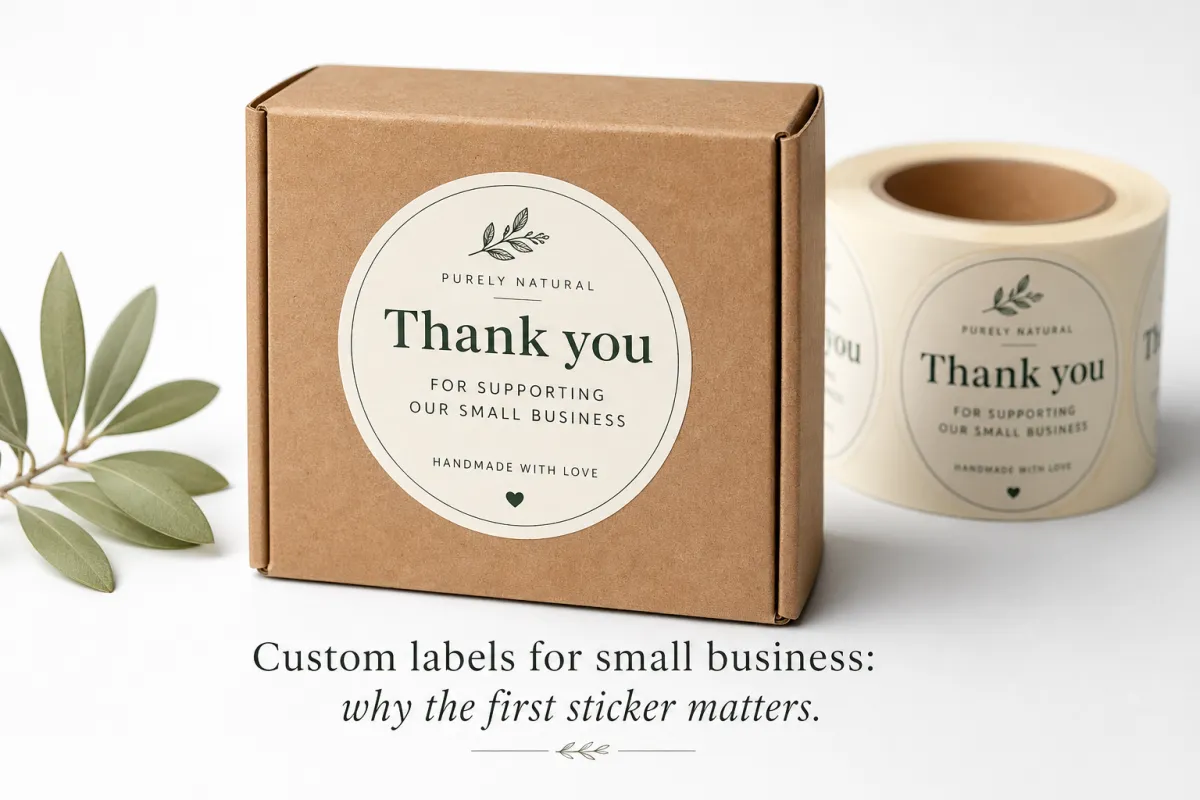
The first sticker is often the first salesperson. Before anyone opens the jar or reads the ingredient list, the label has already made a promise. Clean typography tells the buyer the brand is organized. A matte finish can signal craft and restraint. A gloss finish can push the piece toward a brighter, more retail-ready look. On a shelf with 40 competing products, that tiny rectangle has to do serious work from 4 feet away. It has to be seen, understood, and trusted before the shopper even touches the package.
I learned that during a client meeting with a honey brand in Austin that wanted black text on uncoated paper for 8 oz jars. On a monitor, it looked elegant. On the actual jars under 2,000 lux store lighting, the label disappeared and the text went dull after 7 days in a warm warehouse. We moved to a brighter white BOPP stock, tightened the hierarchy, and gave the logo 2 mm more breathing room. Same formula. Better label. Stronger sales. That is why custom labels for small business matter before the product is even tasted.
Labels also build trust in boring places. A shipping label that scans cleanly, a supplement label with readable 7-point dosage text, or a soap label that does not smear when it meets condensation tells the buyer the brand knows what it is doing. I have seen repeat purchase rates improve by 9% across a 12-unit display simply because the packaging looked consistent on the shelf in Chicago and on a reorder 6 months later. Customers may never say, “the label persuaded me.” They just notice the product feels reliable. Buyers are like that. They are not always poetic, but they are excellent at spotting disorder.
Small brands do not need fancy packaging for the sake of it. They need labels that fit the product, survive handling, and look like they belong there. That line between random and deliberate matters. If you are pairing labels with cartons or mailers, browse Custom Packaging Products so the label and the outer pack stop arguing with each other. If the label is the only piece you need right now, Custom Labels & Tags is the cleaner place to start, especially for 1,000 to 5,000 unit runs.
Here is the blunt version: custom labels for small business are not decoration. They are a conversion tool, a quality signal, and a repeat-purchase trigger. That is a lot of value for a part that may cost $0.15 per unit on a 5,000-piece order. I have seen brands spend $1,200 on a photoshoot prop and $430 on the entire label run. That should tell you something about where the actual leverage lives.
How are custom labels for small business made?
The label process is not magic. It is a chain of decisions, and each one changes the next. The usual sequence starts with artwork prep, then material selection, then print method, then finishing, then cutting or rewinding, then delivery. If any step is sloppy, the final roll shows it. I have seen beautiful designs undermined by a missing 0.125 inch bleed and a barcode set too close to the trim edge. The printer did not fail. The file did. And yes, the pain of seeing a 2,000-label run ruined by a 1.5 mm layout mistake is real enough to make anyone mutter at a laptop.
For custom labels for small business, the most common print methods are digital and flexographic. Digital printing works well for 250-piece test runs, short reorders, and multiple SKUs with different text. Straightforward digital jobs can move from proof approval to production in 5 to 7 business days. Flexographic printing usually makes more sense at 2,500 pieces, 5,000 pieces, and above because plates spread the setup cost across more labels. That is why a 10,000-label run can be far cheaper per unit than a 500-label test order. The tradeoff is setup time, which is usually longer, and the paperwork can feel like it was designed by someone who hated convenience.
Proofing matters more than most people think. A digital proof tells you layout, copy, and barcode placement. A press proof or material sample tells you how the ink behaves on the actual stock. On one cosmetics job in Xiamen, the brand wanted a warm taupe on a clear PET label. On screen it looked rich. On the bottle, it vanished unless we added white ink under the key text. That introduced one more step and about $120 in extra setup, then solved the legibility problem completely. I would rather have the uncomfortable conversation early than discover the problem after 5,000 labels are sitting in a box pretending to be useful.
Here is the basic workflow I use when I want a clean label order:
- Confirm container dimensions and label placement.
- Build the dieline with bleed and safe zones.
- Choose the material and adhesive based on storage conditions.
- Approve a digital proof and, if needed, a physical sample.
- Print, finish, inspect, and ship.
Rush orders compress that schedule, but they do not erase the steps. If someone promises custom labels for small business in 24 hours, read the fine print twice. I have paid rush fees on behalf of anxious founders, and the extra 15% to 30% premium usually buys speed, not forgiveness. Bad artwork still prints badly. A missing barcode still scans badly. A rushed timeline just delivers the mistakes sooner, which is a very expensive way to discover you were not actually ready.
Choosing materials, adhesives, and finishes that actually work
Material choice is where most small brands either save money or quietly waste it. Paper, BOPP, vinyl, clear film, and textured specialty stocks all have a place. The job is matching the label to the product, the surface, and the storage conditions. A candle jar on a boutique shelf has different needs from a refrigerated salsa bottle or a mailer that rides in a truck in July. The weather, the surface, and the customer’s hands all get a vote, whether we like it or not.
Paper still works for dry goods, short runs, and lower budgets. It feels familiar, and with the right coating it can look excellent on gift boxes and jars. For paperboard cartons and inserts, 350gsm C1S artboard is common in plants around Foshan and Guangzhou because it folds cleanly and prints sharply. If you want a paper sourcing angle, check the FSC certification resources at FSC. BOPP is the workhorse for moisture, oils, and handling. It resists smudging and holds color well. Vinyl is tougher and more flexible, which helps on curved or irregular surfaces. Clear film can look premium when the design uses transparent space on purpose, not by accident. I think clear film is one of the easiest places for a brand to look smart, but also one of the easiest places to make text disappear into the product like a tiny act of self-sabotage. That is why custom labels for small business need to be judged on real containers, not mockups alone.
Adhesive choice matters just as much. Permanent acrylic adhesive is the default for most retail packaging because it sticks well to glass, plastic, and coated cartons. Removable adhesive is better for temporary promotions or reusable containers. Freezer-grade adhesive matters for cold-chain products that sit at -20 degrees C, while extra tack can help on textured surfaces or kraft paper mailers. I once saw a client use a high-tack adhesive on a hand-poured soap line in Toronto. The labels gripped so hard that the first product test tore the paper fibers on removal after 12 minutes. That was not a win. That was a cleanup project. We spent longer fixing the mess than it would have taken to Choose the Right stock in the first place.
Finishes change how the brand reads. Matte looks calm and premium. Gloss looks brighter and more energetic. Soft-touch feels expensive, but it can pick up scuffs if the product is handled constantly. UV varnish protects against condensation, shipping abrasion, and oil splashes better than an uncoated surface, and a 1.5 mil lamination can rescue a label that spends 18 hours in a cooler or 3 days in a delivery van. For sauces, supplements, cosmetics, handmade food packaging, and shipping labels, I think first about abuse resistance and second about aesthetics. Cheap labels that peel or fade are not cheap. They are a second production run waiting to happen, and that second run always seems to show up right when cash flow is already having a bad week.
Here is a quick comparison I give to founders who need custom labels for small business without guessing through a supplier quote:
| Material | Typical Use | Sample 5,000-Piece Quote | Best For |
|---|---|---|---|
| Paper | Dry goods, bakery boxes, gift items | $430 total / $0.086 per unit | Lower budgets, short shelf life |
| BOPP | Jars, bottles, cosmetics, supplements | $750 total / $0.15 per unit | Moisture, oils, handling |
| Vinyl | Durable labels, curved containers | $1,090 total / $0.218 per unit | Flexibility, long wear |
| Clear film | Premium cosmetic and beverage packs | $980 total / $0.196 per unit | Minimal, modern packaging design |
| Textured specialty stock | Craft candles, artisan foods, boutique retail | $1,650 total / $0.33 per unit | High-touch branded packaging |
That table is not a promise. It is a field estimate for a 3 x 2 inch label with one print side and standard finishing. Final pricing changes with size, quantity, finishing, and whether the order needs special die cutting, white ink, or a second SKU on the same roll. Still, it is a better starting point than crossing your fingers and hoping the quote feels friendly. I have seen too many teams do the latter and act surprised when the invoice lands like a brick.
For custom labels for small business, I usually tell clients to think in terms of use conditions first. Will the product sit in refrigeration? Touch oil? Ship across the country? Sit on a shelf for 6 months? Answer those questions before falling in love with a pretty texture. Pretty and wrong is still wrong.
Custom labels for small business: pricing, minimums, and hidden costs
Pricing is usually built from six pieces: material, size, quantity, print method, finishing, and shipping. A tiny 1.5-inch circle label will not cost the same as a 4 x 6-inch wraparound label with foil and a specialty die. That sounds obvious, yet I still hear people ask why one quote is $180 and another is $1,400. Because they are not buying the same thing. One supplier may be quoting paper on a standard roll. Another may be quoting BOPP with a custom die, matte varnish, and split shipment. If the specs are different, the number is different. The math is being rude, not mysterious.
Minimum order quantities matter a lot for custom labels for small business. A startup may only need 300 labels for a test batch of candles or 500 labels for a seasonal hot sauce. Digital print can support those small runs, but the unit price will be higher. Once the order moves to 2,500 or 5,000 pieces, the unit cost usually drops fast. I have seen labels fall from $0.42 each on a 300-piece test to $0.11 each at 10,000 pieces. That is real money. It is also why ordering “just enough” can become false economy if you know the design will stay the same for 6 months.
Hidden costs are where budgets get bruised. Plate charges can hit flexo orders at $120 to $250 per color. Proof revisions can add fees if the file is not clean. Specialty dies cost extra. Rush work costs extra. Split shipments cost extra. If the supplier has to hold part of the run in a warehouse in Suzhou and send the rest later, somebody pays for that storage and second freight line. The number on the first quote is often the beginning, not the full story. I have had founders stare at a quote like it had personally insulted them. Fair reaction, frankly, but the fix is usually understanding what is actually included.
One negotiation I remember well involved a bakery brand in Portland that wanted 1,000 labels in three versions for three flavors. The supplier quoted three separate setup fees, which pushed the project over budget by $240. I asked them to keep the same 3-inch square format, change only the copy panel, and print all three SKUs on one press run. That Cut Waste and dropped the total by roughly 17%. Nothing mystical. Just less complexity and fewer setups. Suppliers usually have room to move if you know what to ask. The trick is asking with specifics, not vibes.
Use this simple framework when comparing custom labels for small business quotes:
- Match size exactly so you are comparing the same label footprint.
- Check stock type because paper, BOPP, and clear film do not price the same.
- Confirm finish since matte, gloss, and soft-touch change cost and performance.
- Ask about setup fees for plates, dies, and file corrections.
- Verify shipping terms so freight does not erase the “cheap” quote.
Good pricing is not about chasing the lowest number. It is about knowing what you actually need. A label that peels in cold storage or scratches off in transit can turn a $0.12 bargain into a $1.20 headache. I have seen that movie. It is not a good sequel.
Step-by-step ordering timeline for custom labels
A realistic ordering timeline keeps the whole project from wobbling. Here is the path I recommend for custom labels for small business: confirm the product specs, prep the artwork, approve the proof, print the labels, inspect the roll, and ship the order. Simple on paper. Less simple in practice if the founder is still changing the ingredient panel or deciding whether the logo should be 8% larger. That 8% has caused more drama than it deserves.
File prep is where a lot of delays hide. I want artwork in vector format whenever possible, with all fonts outlined, images at 300 dpi, a bleed of at least 0.125 inch, and a safe zone that keeps text away from the trim edge by at least 0.0625 inch. Barcodes need a quiet zone around them so scanners do not get grumpy. If you are using metallic inks, spot colors, or a complex dieline, tell the supplier early. Surprises belong on birthday cakes, not on production files. Production files should be boring in the best possible way.
Standard timelines vary by method. A straightforward digital label order can move in 5 to 7 business days after approval if the file is clean and the quantity is under 3,000 labels. Flexographic production typically takes 12 to 15 business days from proof approval because plate making and setup take time. Specialty finishes like foil, embossing, or layered varnish can push the schedule to 18 or 20 business days. If the product launch date is fixed, tell the supplier the real deadline upfront. “ASAP” is not a date. It is a mood, and not a very helpful one.
I like to ask five questions before I submit an order for custom labels for small business:
- What are the exact container dimensions?
- Will the labels face moisture, heat, refrigeration, or oil?
- Is the design final, including barcode and ingredient copy?
- What print method fits the quantity and finish?
- What is the true delivery date after proof approval?
If the labels will ship with the product, test the pack as a unit. The International Safe Transit Association explains packaging test methods such as ISTA 3A at ISTA. For print adhesion, I also like to hear a supplier mention ASTM D3330 peel testing, because it tells me they are not just guessing about how the adhesive will behave during a 900-mile truck ride from Shenzhen to Los Angeles.
Here is a simple decision path:
- Need labels fast: choose digital print, standard finishes, one SKU if possible, and a clean file.
- Can plan ahead: consider flexo for higher quantities, request a sample roll, and build a small buffer for revisions.
- Launching multiple flavors: keep the base structure identical and change copy or color accents only.
Planning ahead usually saves money and stress. That is especially true if the label must coordinate with Custom Printed Boxes, inserts, or a full retail packaging set. The more pieces you align before ordering, the less you pay later to correct the mismatch. I have watched brands spend $600 fixing a label that could have been right the first time for an extra $80 in planning. Painful. Very avoidable. And somehow the one person who said, “We can sort it later,” is never the one stuck doing the sorting.
Common mistakes with custom labels for small business
The most common mistake is choosing a label that looks great online and fails on the actual product. A bright white paper label on a bakery box can look lovely in a mockup, then stain the first time it touches butter or condensation. A clear film label can feel modern, then disappear on a dark bottle because the design never accounted for transparency. The screen is forgiving. Reality is rude. Reality also has fingerprints, wet hands, and an inconvenient relationship with gravity.
Another mistake is weak hierarchy. I see this often in custom labels for small business: the logo is tiny, the product name is buried, and the legal text fights for attention with the flavor notes. If a buyer cannot tell what the item is from 4 feet away, the label is underperforming. Use size, weight, and contrast intentionally. A 10-point ingredient line is not the place to show off. Neither is a 6-point contact panel that nobody can read without squinting like they forgot their glasses on purpose.
Mismatched branding is another silent problem. A brand might have one look on jars, another on boxes, and another on mailers. That makes the whole product line feel improvised. When package branding is consistent across labels, custom printed boxes, and shipping materials, the customer sees a real system. That matters in retail packaging because buyers instinctively trust what feels organized. I have seen a tidy visual system make a small product line look twice as established, which is a ridiculous return on a little design discipline.
Application conditions get ignored more than they should. Labels for cold storage need different adhesives than labels for shelf-stable products. Labels for oily surfaces need different stock than labels for dry cartons. Curved containers need better conformability. Skip those details and you may end up with lifted corners, bubbles, or ink rub. I once saw a client lose an entire weekend market because the label stock curled on chilled bottles overnight at 38 degrees F. They blamed the printer. The printer blamed the file. The real problem was that nobody asked whether the adhesive would hold after a 12-hour cold cycle.
Then there is the budget trap. Founders often order too few labels, then place a rush order 3 weeks later. That rush run usually costs 20% more per unit and has fewer options. It is a classic cash-flow mistake. If you know the product is likely to sell, printing a slightly larger run of custom labels for small business is often cheaper than living in panic. I am not saying over-order everything and fill your garage with boxes. I am saying stop pretending a tiny emergency run is a budget strategy.
“We stopped treating labels like decoration and started treating them like inventory,” said one supplement founder in Austin after a 14-SKU launch nearly collapsed her reorder calendar by 6 weeks.
That mindset shift matters. Labels are not a one-off creative expense. They are part of the product system. If the system is sloppy, the label will not rescue it. If the system is tight, the label can make the whole brand feel more expensive without adding much cost. That is one of those rare business wins that actually feels elegant instead of exhausting.
Expert tips and next steps for buying smarter labels
If I were buying custom labels for small business today, I would start with samples, not guesses. Ask for a sample roll or a material swatch and test it on the actual container. A label that looks great on a flat sheet can behave very differently on a curved 12 oz jar or a textured kraft pouch. I have stood on factory floors in Dongguan and Xiamen where a client said “that stock feels perfect” and then watched it fail because the adhesive never fully bonded to a matte-coated bottle after 24 hours. Real-world testing saves embarrassment, returns, and a truly annoying amount of email.
Compare life-cycle cost, not just unit cost. A label that costs $0.03 less but peels in transit is not cheaper. It is a return rate. It is rework. It is customer service time. That is why I care about shelf exposure, shipping abrasion, refrigeration, and moisture all at once. The true cost of custom labels for small business includes the cost of being wrong. And the cost of being wrong tends to show up late, which is the worst time for anything to show up.
One smart move is building a label system that covers multiple SKUs. Keep the size, shape, and brand architecture consistent, then change the flavor name, color band, or a small copy panel. That approach keeps the line cohesive and makes reorders easier. It also works better with branded packaging because the labels, boxes, and inserts can all share the same visual grid. You do not need to reinvent the wheel every time you launch a lavender scent or a new salsa heat level. Honestly, half the battle is just not making every new product look like it escaped from a different company.
Here is the order of operations I give to founders who want fewer mistakes and better pricing:
- Measure the container and write down the exact label area.
- Define storage conditions: dry, refrigerated, frozen, oily, or outdoor.
- Choose 2 to 3 candidate materials and request samples.
- Collect artwork, barcode files, and brand rules in one folder.
- Ask for a quote with quantity tiers so you can compare breakpoints.
- Approve the proof only after checking the actual container fit.
I also recommend thinking about the rest of the pack at the same time. If the label is fighting a box, a mailer, or a wrap sleeve, the brand feels disjointed. If you need the broader system, the right starting point is usually a mix of labels, cartons, and inserts from Custom Packaging Products, then a tighter label spec that matches the whole kit. That is how a small line starts looking like a proper shelf program instead of a random assembly of parts.
My final advice is simple. Test early. Ask direct questions. Get samples on the final packaging. Treat the label like a working part of the sale, not a decorative afterthought. If you do that, custom labels for small business will support sales, speed, and consistency instead of creating extra work. That is the point. Not prettier clutter. Better product packaging that helps the customer say yes.
Frequently Asked Questions
How much do custom labels for small business usually cost?
Pricing depends on size, stock, finish, quantity, and print method. A 300-piece test run can land around $0.42 per label, a 5,000-piece BOPP order can land near $0.15 per label, and a 10,000-piece reorder may drop closer to $0.09 per label. If you need rush production, specialty dies, or multiple proof revisions, expect the total to rise by 10% to 30%. I wish that number were prettier, but the supply chain in Suzhou and Shenzhen does not care about our feelings.
What is the best material for custom labels for small business products?
Paper works well for dry goods, gift packaging, and lower-budget runs. BOPP or vinyl is usually better for moisture, oils, frequent handling, or cold storage at 38 degrees F or below. The right choice depends on the container surface, the product environment, and how long the label needs to stay clean and attached. If you are unsure, test a sample on the actual bottle, jar, box, or pouch before you commit, especially if the pack uses matte glass, coated kraft, or a 2.5 inch curved shoulder.
How long do custom labels for small business take to produce?
Simple digital jobs can move in 5 to 7 business days after approval. Flexographic runs usually take 12 to 15 business days from proof approval, and specialty finishes can extend that to 18 or 20 business days because of plate work, white ink, foil, or added lamination. If the artwork is not final or the files need cleanup, the timeline stretches fast. That is the part people tend to underestimate, right up until they are staring at an email that says “one more revision needed.”
Can I order custom labels for small business in small quantities?
Yes. Many suppliers support short runs for startups, seasonal items, and test batches of 100, 250, or 500 units. The unit price is usually higher at low quantities, but that tradeoff can be worth it if you are still validating the product or managing cash flow carefully. Small runs are also useful when you are trying a new flavor, new scent, or limited-edition launch and do not want a mountain of leftover labels haunting you later.
What should I prepare before getting quotes for custom labels for small business?
Have container dimensions, label placement, quantity, and product conditions ready before you ask for pricing. Bring artwork files if you have them, plus barcode needs, finish preferences, and any brand rules. The clearer the spec, the faster the quote and the fewer surprises later. A supplier can work with a rough idea, but a precise brief saves everyone from the usual back-and-forth that steals half a workday and turns a Tuesday into a lost cause.
Practical takeaway: measure the container, choose the stock for the actual environment, and test a sample on the real product before you place the full order. That one habit catches most label mistakes before they become expensive, and it keeps custom labels for small business doing the job they were hired to do: make the product look ready to buy, ship, and reorder.


