Buyer Fit Snapshot
| Best fit | Personalized Vitamin Bottle Labels Waterproof projects where brand print, material claims, artwork control, MOQ, and repeat-order consistency need to be specified before quoting. |
|---|---|
| Quote inputs | Share finished size, material target, print colors, finish, packing count, annual reorder estimate, ship-to region, and any compliance wording. |
| Proofing check | Approve dieline scale, logo placement, barcode or warning zones, color tolerance, closure strength, and carton packing before bulk production. |
| Main risk | Vague material claims, crowded artwork, missing packing details, or unclear freight terms can make a low unit price expensive after revisions. |
Fast answer: Personalized Vitamin Bottle Labels Waterproof: What Works should be specified like a repeatable production item. The safest quote records material, print method, finish, artwork proof, packing count, and reorder notes in one written spec.
Production checks before approval
Compare the actual filled-product size with the drawing, then confirm tolerance on folds, seals, hang holes, label areas, and retail display edges. Reserve space for logos, QR codes, warning copy, and material claims before decorative graphics fill the panel.
Quote comparison points
Review material grade, print process, finish, sampling route, tooling charges, carton quantity, and freight assumptions side by side. A quote is only useful when the supplier can repeat the same color, closure quality, and packing count on the next order.
Personalized Vitamin Bottle Labels Waterproof: What Works
Personalized vitamin bottle labels waterproof usually fail in places most brands never bother to test: steam-heavy bathrooms at 95% humidity, lotion on fingertips, and the steady friction of a bottle sliding in and out of a gym bag. I remember one batch that looked pristine on a desk, then turned cloudy after two days beside a shower in Austin, Texas, where the bathroom sat near 78 F and the fan barely moved air. That is why these labels deserve more scrutiny than a quick splash test. A bottle that lives near a sink, inside a travel kit, or above a kettle in a warm cabinet faces a lot more than a stray droplet. The real question is whether the label still reads clearly after a week of condensation, handling, and abrasion.
That difference matters because a vitamin bottle is not a pantry jar. It may move from a refrigerated back room at 38 F to a bathroom shelf in less than 24 hours, then get opened twice a day for 60 days straight. I have watched brands lose trust over a label that curled at one corner on day three, even while the bottle itself held up perfectly. It is a tiny failure, but tiny failures have a nasty habit of multiplying. When a customer pays $24.99 for a premium supplement, a smeared dosage panel or lifted edge signals a rushed product. Waterproof labels protect more than ink; they protect confidence, shelf presence, and repeat purchases.
In my experience, the labels that hold up are the ones designed backward from the use case. Start with the bottle surface, then the humidity level, then the print method, then the finish. That order sounds plain enough, yet many buyers begin with color or logo size and only later ask about the bottle itself. I think that is backward. If you want Custom Bottle Labels to perform on HDPE, PET, or glass, the construction has to match the container and the environment, not just the artwork. The right build can keep ingredient text crisp for 6 to 12 months; the wrong one can begin failing in 72 hours.
Waterproof claims get misunderstood all the time. Waterproof does not mean invincible in every condition; it usually means the construction resists moisture, smear, and edge failure far better than standard paper stock. Water-resistant labels can survive a few droplets. Moisture-tolerant labels can handle some humidity. These labels are the version you choose when the bottle will face repeated exposure, not a one-time spill. That distinction gets expensive if you discover it after 10,000 units are already printed in Shenzhen or Dongguan. I have seen that movie, and I do not recommend the sequel.
What Personalized Vitamin Bottle Labels Waterproof Really Mean
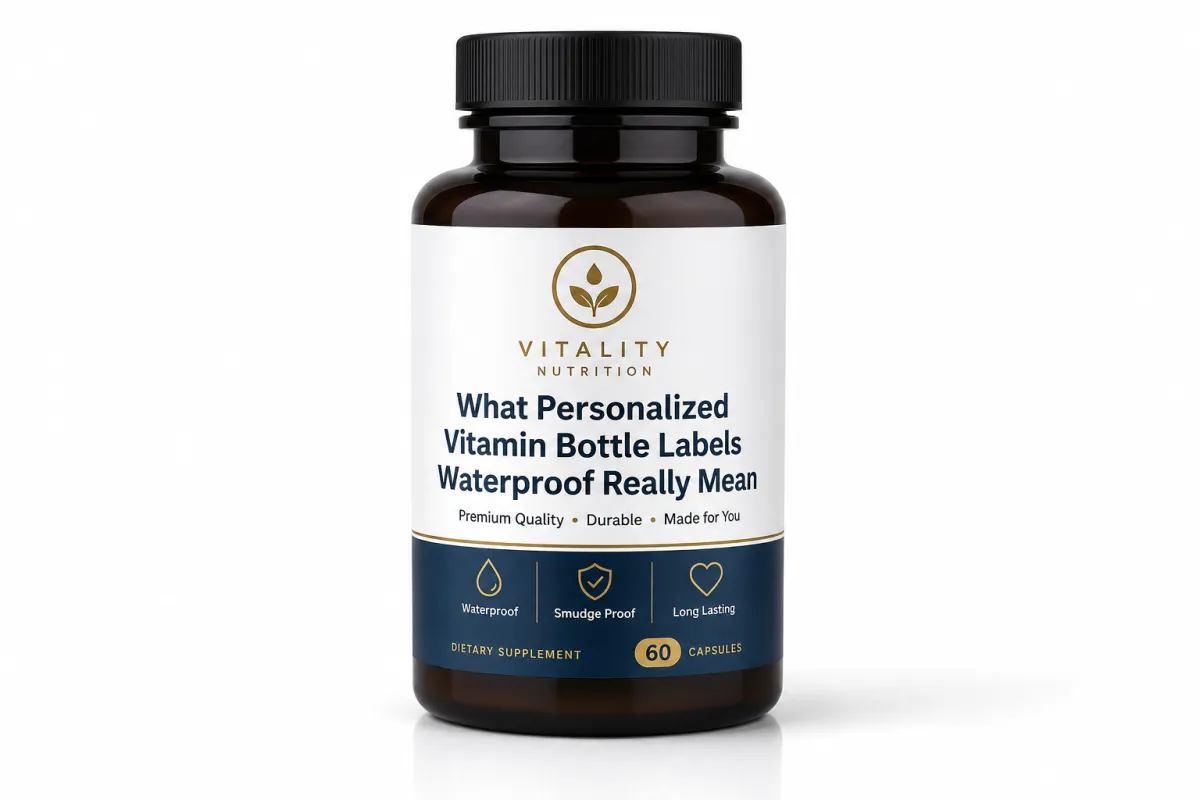
When I talk with buyers, I ask them to describe the label's worst day, not its best one. Will the bottle sit next to a sink for 8 minutes while someone washes their hands? Will it ride in a carry-on for 14 hours through temperature swings from 55 F airport air to 86 F tarmac heat? Will it get wiped with a damp cloth every night? Those questions show why these labels need a tougher standard than labels for dry pantry goods. A jar sitting at 40% humidity is not the same as a supplement bottle living in a 6-by-8-foot bathroom with steam, lotion, and constant handling.
The words matter because buyers often compare a print sample in a showroom to real life. A label can look flawless on a flat mockup and still fail on a curved 60 mm bottle after 3 days. I have sat in client meetings in Los Angeles where the sample looked sharp under 5,000K lights, then the same stock started lifting once it met a cold bottle pulled from a refrigerator at 38 F. That is why spec sheets should name the conditions: moisture level, contact frequency, storage temperature, and whether the bottle will be handled with oily hands or dry hands. Those four details change the material choice faster than design preferences do.
There is a branding side to this that gets missed. A label that stays flat and legible makes the brand feel deliberate; a label that wrinkles at one corner makes the whole product look cheaper than it is. I once watched a small supplement company switch from a basic paper label to a matte synthetic face stock from a plant in Suzhou, and the shelf presence improved immediately because the dosage panel stayed readable after 2 weeks in a humid gym environment. The formula did not change. The packaging did the heavy lifting. That is the part a lot of teams underestimate, and then wonder why a great product gets treated like a bargain-bin bottle.
"We stopped treating the label like decoration and started treating it like part of the product. The first reorder proved the point."
If you want a working definition, this is the one I use on the shop floor: a strong waterproof vitamin label is built with a moisture-resistant face stock, a matching adhesive, a print system that will not smear under light abrasion, and a protective layer that helps the surface survive condensation or cleaning. That is not marketing language. It is a four-part structure. Miss one part and the label may look fine on day one, then fail after the bottle has been opened 30 times. On a line in Foshan, I have seen the same build last 120 days on a bathroom shelf and fail in 9 days when the adhesive was swapped without warning.
For brands comparing options, I often point them to our Custom Labels & Tags page as a starting point, then narrow the spec from there. The label family matters less than the exact build. These labels can be made for small batches of 250 units or production runs of 50,000, but the material and adhesive should be selected for the real storage conditions, not a generic assumption pulled from a catalog. A guess is not a specification, and labels tend to punish guesses. If the project will ship from Miami or sit in a warehouse in New Jersey for 30 days, that detail belongs in the brief.
One more thing: if the product is regulated, review the current labeling rules before final approval. Packaging advice does not replace regulatory review, and a beautiful waterproof label is still the wrong label if the required information is missing or unreadable.
How They Are Made
The structure is simple on paper and more demanding in practice. A durable label usually has five parts: face stock, adhesive, ink, coating, and liner. The face stock is the visible layer. The adhesive binds it to the bottle. The ink creates the artwork and text. The coating or laminate protects the print. The liner supports the label before application. For waterproof vitamin bottle labels, each layer has to do its own job cleanly, because one weak layer can compromise the entire piece. One bad layer can undo a very expensive stack of good choices, especially on a 25,000-piece run headed for Atlanta distribution.
Synthetic face stocks tend to outperform paper in humid settings. Polypropylene, polyethylene, and polyester are common choices, and each one behaves differently. A 2- to 4-mil polypropylene film is often enough for short-run supplements, while a 48- to 50-micron polyester can handle higher scuff exposure and stronger chemical contact. Paper can work if it gets a strong protective coating, but paper-only constructions are rarely my first recommendation for bottles that will sit in a bathroom or a refrigerator door. Paper is charming until moisture gets involved, and moisture is not sentimental.
The print method matters too. Digital toner, UV inkjet, and flexographic printing each bring different strengths. UV inks usually resist moisture better than standard water-based systems, and they can stay legible on curved bottles where abrasion is a concern. I have seen one client in Chicago save a few cents per unit by switching to paper, only to spend nearly $1,200 on reprints when the ink started to scuff on the back panel after a 48-hour humidity test. That was one of those moments where everyone stared at the reprint invoice like it had personally insulted them. That is why these labels should be priced as a full system, not as face stock alone.
Adhesive selection is where many projects succeed or fail. On smooth PET, a permanent acrylic adhesive often performs well. On HDPE, especially if the bottle has a low-surface-energy finish, the adhesive may need to be tuned for stronger grab. If bottles are filled cold and then boxed immediately, condensation can interfere with initial bond strength. I have asked for peel data under ASTM D3330 more than once, because a good supplier should be able to show how the label behaves after 24 hours, not just at the moment of application. That level of proof is what makes the build dependable. Pretty graphics are nice; a label that actually stays put is nicer.
For buyers who want a simple comparison, I use a table like this before I request samples. The numbers below are planning figures from recent short-run and medium-run quotes from factories in Guangdong and Jiangsu, not a guarantee, but they are useful when deciding whether to push for a premium build or a simpler one.
| Label Build | Typical Spec | 1,000 Units | 5,000 Units | Best Fit |
|---|---|---|---|---|
| Paper + aqueous coating | 80 lb paper, coated face | $0.18/unit | $0.09/unit | Dry storage only |
| Polypropylene film + gloss laminate | 2.0 mil BOPP, permanent acrylic adhesive | $0.27/unit | $0.11/unit | General supplement bottles |
| Polyester film + protective topcoat | 48 micron PET, high-tack adhesive | $0.34/unit | $0.16/unit | High moisture, heavy handling |
| Premium film + specialty finish | Soft-touch laminate, variable data | $0.41/unit | $0.19/unit | Retail-focused brands |
Those figures show why a better build is sometimes cheaper than the damage it prevents. If a $0.11 label keeps a $24 bottle from looking damaged on shelf, the value is obvious. I have seen brands spend more on an emergency reorder than they would have spent upgrading the first run. The cheapest label is often the one you never need to replace. Frustrating, yes. Also true. One 5,000-unit reorder in Anaheim cost a client $2,800 in avoided markdowns because the first run survived 90 days in a bright retail cooler.
How Do They Hold Up in Real Conditions?
Durability is not one thing. It is a chain of small decisions, and each one affects how the labels behave in the real world. Moisture exposure is the obvious variable, but handling frequency can be just as damaging. A bottle picked up 6 times a day will wear faster than one opened weekly. Add in lotion residue, bathroom steam, and friction from a zip pouch, and even a strong label can begin to fray at the edge if the construction is weak in the wrong place. A 30-second handwashing routine can do more damage than a light drizzle.
Bottle shape is another major factor. On narrow supplement bottles, the label may need to wrap around a tight radius near the shoulder or taper slightly near the base. That geometry matters because an edge that sits on a curve is more likely to lift after 10 or 15 temperature cycles. I learned this on a client line in Dallas where a 50 ml bottle looked easy on a flat proof, but the actual bottle had a sharper radius than expected. The result was edge lift within 72 hours. Waterproof label builds solve that problem only if the dieline matches the bottle, down to the millimeter. The bottle does not care about your spreadsheet; it only cares about physics.
Finish choices change both performance and perception. Gloss tends to resist scuffing well and gives color more punch. Matte can look more clinical and upscale, but some matte coatings mark more easily if they are not matched to the ink system. Soft-touch finishes feel premium, yet they can cost $0.03 to $0.08 more per unit depending on size and run length. I usually tell brands that label construction should not choose finish by trend alone. Choose it by how the bottle will be touched, cleaned, and stored for the next 30 to 90 days. Trends do not scrub off fingerprints; coatings do.
Legibility is part of performance, not a separate concern. Supplement facts panels, ingredients, lot codes, and expiration dates all need to stay readable after handling. If the code fades or the panel smears, the label has failed even if it has not peeled off. For regulated products, I also pay attention to contrast ratios, type size, and whitespace. Tiny 5 pt text on a crowded curved label is a headache waiting to happen. The best builds preserve readability after rubbing, condensation, and 2 or 3 cleaning cycles, not just at delivery. A batch printed in Guangzhou with a strong black key line can still fail if the varnish is too soft.
Testing should match the actual environment. If the product will ship in cartons and then sit in a bathroom, test for 48 hours in a warm, humid room. If the bottle will be refrigerated, test the adhesive on a cold surface at 38 F. If the consumer will keep it in a gym bag, add abrasion testing with a fabric sleeve or a soft vinyl pouch. I often reference transit methods from ISTA when I build a sample plan, because the labels can pass a simple water test and still fail once pressure, vibration, and rubbing are added. Real life is annoyingly complicated, which is exactly why sample testing exists.
Another detail that matters more than buyers expect is label size. Larger labels have more surface area to collect condensation, but smaller labels can place too much stress on curved edges if the artwork is crowded. I have seen a 1.5-inch-wide label outperform a 2-inch-wide label simply because the narrower version sat more cleanly on a 30 mm bottle. That is not always the case, but it happens often enough that I check it on every new project. These labels work best when size, shape, and container geometry are planned together. A 65 mm by 38 mm label on a rounded PET bottle can outperform a 70 mm by 50 mm version if the seam stays out of the squeeze zone.
If the project includes paper-based stock for cost reasons, I ask whether the brand wants recycled-content paper or FSC-certified sources. For some clients, that sustainability signal matters as much as moisture resistance. You can verify sourcing options through FSC, then decide whether the final build should be paper with coating or a fully synthetic film. Either way, the label has to be evaluated as both a branding tool and a functional component. A label can be environmentally thoughtful and still fail if it cannot survive condensation. For cartons or secondary packaging, a 350gsm C1S artboard insert can carry the same visual language, but it is still not a substitute for a label that bonds to PET or HDPE.
Cost and Pricing for Waterproof Labels
Price is usually the first question, and it should be. For waterproof vitamin labels, the main cost drivers are material, size, print complexity, adhesive grade, finish, and order quantity. A 2-inch x 3-inch label with simple one-color artwork costs less than a full-color label with foil, spot gloss, and a special die cut. The more variables you add, the more the unit price moves. On small runs, setup can matter more than print time; on larger runs, material efficiency starts to dominate. Economics has a way of ignoring wishful thinking, especially on a 1,000-piece order.
I often break cost into two buckets: fixed and variable. Fixed costs include proofing, plate or setup fees, and die cutting. Variable costs include face stock, ink, laminate, and application labor. That means a 500-unit order may land at $0.42 per label because the setup fee is spread over fewer pieces, while a 5,000-unit order might drop to $0.11 or $0.14 per label depending on finish. For these labels, that math is why short runs feel expensive but long runs reward planning. The bill looks friendlier once volume does its thing. A supplier in Xiamen may quote a $65 setup fee, which looks small until you divide it across 250 pieces.
Here is the practical question I ask clients: do you want to save $0.04 per bottle now, or avoid a $2,500 reprint later? I have seen a buyer negotiate a cheaper paper option in a meeting, then return 3 weeks later after humidity caused the corners to curl. The replacement run cost more because it had to be rushed, and shipping alone added $180. With a waterproof label spec, the lowest bid is not always the lowest total cost. Sometimes it is the most expensive decision wearing a discount label. A rushed air shipment from Shenzhen to Chicago can erase any paper-stock savings in one invoice.
There are still ways to save money without losing performance. Standardizing bottle sizes can reduce die cutting complexity. Keeping artwork within a standard 1-color or 4-color setup can reduce press changes. Choosing a gloss laminate instead of a specialty soft-touch finish may save $0.03 to $0.05 per unit. If the bottle will live in a dry cabinet rather than a steamy bathroom, a strong coated film may be enough. These choices keep the project practical instead of over-specified. A 28 mm bottle and a 38 mm bottle do not need the same architecture if one sits in a closet and the other in a shower stall.
One client meeting stands out to me because the brand owner was convinced every bottle needed a premium soft-touch finish. We printed a 200-piece test on both soft-touch and gloss, then left them in a warm room near a kettle for 5 days. The gloss sample held up better, and it cost $0.06 less per unit. That sort of test is worth more than a sales pitch. It proved that the product can look premium without always needing the most expensive finish. I love it when the data politely disagrees with the mood board, especially when the room temperature sits at 82 F.
Below is a simple pricing framework I use when helping teams decide if the upgrade is justified.
- Low volume: 250 to 1,000 labels, usually $0.18 to $0.41 per unit depending on stock and finish.
- Mid volume: 2,500 to 10,000 labels, usually $0.09 to $0.19 per unit.
- High volume: 25,000+ labels, where unit price can drop further if artwork and size stay consistent.
- Premium needs: UV resistance, soft-touch lamination, or variable data can add $0.02 to $0.08 per unit.
Those numbers are not a quote, but they are close enough to help with planning. If your label is a key part of retail perception, premium waterproof labels often pay for themselves by reducing rework and improving shelf appeal. If the product is strictly internal or back-of-house, a simpler construction may be the smarter move. I prefer that honesty over selling a luxury spec that the product does not need. Not every bottle needs a runway outfit, and not every launch needs foil stamped on a Tuesday in November.
For brands ready to compare options, I usually suggest checking a few versions of the same label style through our label and tag options before locking the specification. Seeing the price difference between a 2 mil BOPP, a 48 micron PET, and a coated paper sample can settle the debate in 10 minutes. The quote lands better when it is tied to an actual bottle sample rather than a spreadsheet alone. A quote from Dongguan on Monday and a sample in hand by Thursday changes the conversation fast.
Step-by-Step Process and Timeline for Ordering
The ordering process should feel orderly, not mysterious. For a custom label project, I like a simple sequence: gather specs, review artwork, build a sample, test it on the actual bottle, approve the final proof, then schedule production. That order saves time because it catches mistakes before the press run. If a label is 2 mm too tall or the adhesive is wrong for a cold bottle, a sample reveals it. A 10,000-unit run does not. Printing is not magic. It is just expensive if you skip the sensible steps.
To start well, a supplier needs six specifics: bottle dimensions, surface material, quantity, artwork files, application method, and required durability level. If the bottle is 28 mm in diameter, say so. If the bottle is matte HDPE, say that too. If the labels will be applied by hand at 120 bottles per hour, that detail matters because some adhesives bond better with pressure and dwell time. These labels work best when the request is precise from day one. Vague requests create vague labels, and vague labels are usually the ones that peel. I also ask for a side-view photo with a ruler in the frame, which saves a surprising amount of email back-and-forth.
A realistic timeline for short-run custom work is often 3 to 5 business days for proofing, 2 to 4 business days for sample production, 12 to 15 business days for full production after proof approval, and 3 to 7 days for shipping depending on location. If there is foil stamping, specialty lamination, or variable data, add several more days. I have seen teams lose a week because they changed the ingredient panel after the proof. The schedule is rarely the printing itself; it is the revision cycle. The press is not usually the problem; human indecision is. A plant in Jiangsu can often run the labels in 2 shifts, but it still cannot print a moving target.
There is one step I never skip: application testing. I ask for 25 labels, 3 bottles, and 72 hours. On day one, the label should look clean. After 24 hours, check adhesion. After 48 hours, inspect the corners. After 72 hours, wipe the surface with a damp cloth and inspect the ink. That small test has saved more projects than I can count. It is the easiest way to verify that the final build really matches the use case. A 25-label test on a Friday can prevent a 25,000-label disappointment on a Monday.
"If a sample cannot survive three days of real handling, a full run will not fix the weakness."
One supplier negotiation I remember clearly involved a supplement client who wanted a 2-day turnaround on a custom label with variable lot numbers. The supplier said no, then explained why: the adhesive had to cure, the artwork had to be checked for panel alignment, and the bottle material was slicker than normal. The client waited 13 business days instead and got a label that held through condensation and shipping vibration. That is the kind of tradeoff that keeps the project dependable instead of merely fast. The final shipment left Ningbo on a Friday and arrived in Phoenix the following Tuesday, which beat the client’s launch window by just enough to matter.
If you are planning a reorder system, document the approved spec sheet with the exact face stock, adhesive, finish, and approved bottle photo. I recommend saving the file name, the test date, and the target bottle SKU in one folder. A 6-month reorder should not rely on memory. The more precise the record, the more consistent the next batch will be. A good spec file is cheaper than a second round of proofing, and a second round of proofing is cheaper than a pallet of mismatched labels.
Common Mistakes to Avoid With Waterproof Vitamin Labels
The first mistake is assuming every waterproof claim means the same thing. It does not. A label that resists a few droplets is not the same as one that survives daily humidity and friction. I have seen a so-called waterproof label crack at the fold line after 4 days in a bathroom cabinet because the coating could handle splash but not heat plus moisture. That is why the build needs to be tested against the actual environment, not a generic claim on a sales sheet. A label spec should behave like a test result, not a slogan.
The second mistake is using tiny type on crowded panels. Supplement labels already carry a lot: product name, serving size, dosage, warnings, lot code, expiration date, and sometimes storage instructions. If you squeeze all of that into 4 pt text on a 1.5-inch-wide label, no protective coating will save the reader. I prefer clear contrast, at least 6 pt for dense content, and enough white space so the eye can move. Good waterproof vitamin bottle labels should protect readability, not hide it. If people need a magnifier, the design failed before the moisture even showed up.
The third mistake is ignoring the bottle substrate. A label that bonds beautifully to glass may struggle on textured HDPE or a cold PET bottle with condensation. I still remember a project where the client changed bottle suppliers after approval and never said a word. The new bottle had a different surface energy, and the label failed within 36 hours. The design was fine. The adhesive was not. These labels are only as good as the surface they are applied to. Same artwork, different bottle, totally different result. That part surprises people more than it should, especially when the bottle comes from a different factory in Jiangsu.
The fourth mistake is skipping sample testing because the deadline feels tight. That decision can cost more time later. A 2-day sample round is usually cheaper than scrapping 5,000 bad labels. I tell buyers to test for three things at minimum: edge lift, abrasion, and moisture resistance. If the label will be chilled, add a cold-bond test. If it will be handled often, rub the surface 20 times with a dry cloth and 10 times with a damp cloth. Those simple checks tell you whether the label is ready for production. A 3-day test is not a delay; it is insurance priced in hours instead of dollars.
The fifth mistake is changing artwork after approval without recalculating the dieline. Even a 1 mm change in barcode placement can create a problem if the label wraps around a curve or overlaps a seam. I have watched a late-night artwork update trigger a 2-day delay because the revised file pushed the expiration date too close to the edge. For waterproof labels, consistency matters as much as creativity. The best-looking version is useless if it cannot be applied cleanly at scale. A file saved at 11:42 p.m. in Chicago can still cost a Monday morning in Shenzhen.
The sixth mistake is assuming batch-to-batch consistency happens automatically. It does not. Ink density shifts, adhesive lots vary, and film suppliers sometimes make subtle changes. That is why I recommend keeping the approved supplier, approved stock code, and approved finish locked in the spec sheet. If the project is critical, ask for a retained sample from the first run. That habit keeps the labels from drifting over time. Small drifts are exactly where surprises hide, and surprises are not a production strategy. A 0.2 mm trim variance can be the difference between a clean edge and a lifted corner.
Expert Tips and Next Steps for Better Label Results
If you want better results, ask for substrate samples before you approve the final build. I like to send 3 variants: a coated paper, a polypropylene film, and a polyester film, all printed with the same 2-inch artwork. Then I have the client apply each one to the real bottle for 48 to 72 hours. That exercise shows the difference instantly. The product becomes much easier to judge once it is on the actual container, not a flat proof. A print sample can flatter itself. A bottle cannot. A sample carton printed on 350gsm C1S artboard can help with brand presentation, but it will never replace a bottle test.
I also recommend a mini test plan. Keep it simple: 1 bottle in a warm bathroom for 72 hours, 1 bottle in a refrigerator for 24 hours, 1 bottle in a gym bag for a day, and 1 bottle wiped 15 times with a damp cloth. That gives you four stress points without requiring a lab. If the label survives those tests, you have a much stronger case for full production. That is the kind of practical check that separates good labels from merely decent ones. It is not glamorous, but it is cheaper than reprinting a warehouse mistake. The whole test can be done in 4 days, which is a small price for certainty.
Document the approved spec sheet and save the printer's proof PDF, the bottle photo, and the measured label dimensions in the same folder. Include the exact adhesive name, the face stock thickness, and the finish type. I know that sounds fussy, but a reorder six months later is easier when you can say, "Use the 50 micron PET with the high-tack acrylic adhesive and matte laminate." That level of detail keeps the labels consistent across product cycles. Precision is boring in the moment and delightful later. It also helps when the manufacturing shifts from Suzhou to Dongguan and you still need the same result.
My final advice is to treat the label like part of the formula. If the bottle is worth $18 to $35 on shelf, a few cents more for the right label is not wasteful. It is risk control. If you are still choosing between a paper option and a synthetic option, test both on your actual bottle, in your actual storage conditions, before you commit. The right choice often shows itself in 3 days, not 3 meetings. I wish more purchasing decisions were that honest, frankly. In Guangzhou, I once saw a brand save $0.07 per unit by changing stock, then lose $1,400 to a rework bill. The math was not subtle.
For brands at Custom Logo Things, the next step is straightforward: shortlist two constructions, request a quote, order a small sample set, and verify that the labels match your exact use case. If the label passes condensation, abrasion, and adhesion testing, you can move forward with confidence. If it fails, you have learned that at the sample stage, where a correction costs hours instead of thousands of dollars. That is the difference between a label that looks waterproof and a label That Actually Works. A 12-day production window is far easier to manage than a 12,000-unit mistake.
Are personalized vitamin bottle labels waterproof or just water-resistant?
They can be either, depending on the build. A true waterproof construction is designed to handle condensation, direct moisture, and light cleaning without quick failure, while a water-resistant label may only survive a few splashes before it wrinkles or lifts. For personalized vitamin bottle labels waterproof, the adhesive and protective layer matter as much as the face stock. If one piece is weak, the whole label starts acting like a liar. A label that holds up for 30 days in a bathroom is doing something very different from one that only survives a sink splash.
What material works best for waterproof vitamin bottle labels in humid bathrooms?
Synthetic films usually perform best. Polypropylene and polyester are strong choices because they resist moisture better than plain paper, especially around sinks and showers where humidity can stay high for 6 to 8 hours. A moisture-resistant adhesive and a protective topcoat are essential for humid environments. Paper can work in a dry cabinet, but bathrooms are paper's natural enemy. If the label needs to survive 85% humidity for 48 hours, film beats paper most of the time.
How long do waterproof vitamin bottle labels usually last?
That depends on handling, storage temperature, and how often the bottle is wiped or moved. A well-matched label can last through the full product cycle, which might be 30 to 180 days for supplements. Poorly matched labels can fail much sooner, especially if the bottle is chilled or handled with oily hands. Longevity is less about luck than about matching materials to the real environment. A 90-day shelf life is easy to say and hard to earn unless the label construction is right.
Can I print lot numbers and expiration dates on waterproof vitamin labels?
Yes, and you should if the product requires traceability. The key is using an ink or coding system that stays legible after rubbing, moisture, and normal handling. The variable data should be checked on the final substrate before the full run starts. A date code that disappears is not a date code; it is a future headache. I usually ask for a 24-hour rub test on the finished lot code before approving the whole batch.
What should I test before ordering a large run of waterproof vitamin bottle labels?
Test adhesion, condensation resistance, rub resistance, and readability on the exact bottle you plan to use. A 24-hour, 48-hour, and 72-hour sample check is usually enough to reveal edge lift, smudging, or peeling. That small test set can prevent a large production mistake. I would rather be fussy for three days than disappointed for three months. If the label survives 20 rubs with a damp cloth and a night in a refrigerator at 38 F, you are on solid ground.
Actionable takeaway: shortlist two label constructions, print 25 samples of each, and test them on the actual bottle for 72 hours in the same conditions where the product will live; approve only the version that stays flat, readable, and bonded after condensation, rubbing, and a cold start.


