Buyer Fit Snapshot
| Best fit | Custom Labels Premium Quality projects where brand print, material claims, artwork control, MOQ, and repeat-order consistency need to be specified before quoting. |
|---|---|
| Quote inputs | Share finished size, material target, print colors, finish, packing count, annual reorder estimate, ship-to region, and any compliance wording. |
| Proofing check | Approve dieline scale, logo placement, barcode or warning zones, color tolerance, closure strength, and carton packing before bulk production. |
| Main risk | Vague material claims, crowded artwork, missing packing details, or unclear freight terms can make a low unit price expensive after revisions. |
Fast answer: Custom Labels Premium Quality: What Actually Matters should be specified like a repeatable production item. The safest quote records material, print method, finish, artwork proof, packing count, and reorder notes in one written spec.
Production checks before approval
Compare the actual filled-product size with the drawing, then confirm tolerance on folds, seals, hang holes, label areas, and retail display edges. Reserve space for logos, QR codes, warning copy, and material claims before decorative graphics fill the panel.
Quote comparison points
Review material grade, print process, finish, sampling route, tooling charges, carton quantity, and freight assumptions side by side. A quote is only useful when the supplier can repeat the same color, closure quality, and packing count on the next order.
Custom Labels Premium Quality: What Actually Matters
A label can look polished on day one and still fail in cold storage, during shipping, or after a single wipe with a damp cloth. That is the part most buyers learn the hard way. custom labels premium quality is not just a nice-looking sticker with a fancy price tag; it is a working part of the package.
If a label belongs on product packaging, it has to do more than decorate the surface. It has to hold ink, hold adhesive, hold color, and hold up under the real conditions the product will face. That is the practical meaning behind custom labels premium quality, and it is a lot less vague than marketing copy would like.
For a brand, the label is often the first tactile proof of quality. It sits at the front line of packaging design, retail packaging, and package branding. A good one can make a glass jar feel expensive, a mailer feel considered, or a simple bottle look like it belongs beside products that cost twice as much. If you also need broader packaging support, Custom Packaging Products can connect the label to the rest of the system rather than leaving it as a surface treatment alone.
That broader system matters more than many teams expect. A label does not live in a vacuum. It has to coexist with the container, the shipping path, the shelf environment, and the customer’s hands. That is why custom labels premium quality is best measured as a combination of appearance, adhesion, and durability rather than a single visual trick.
What Custom Labels Premium Quality Really Means
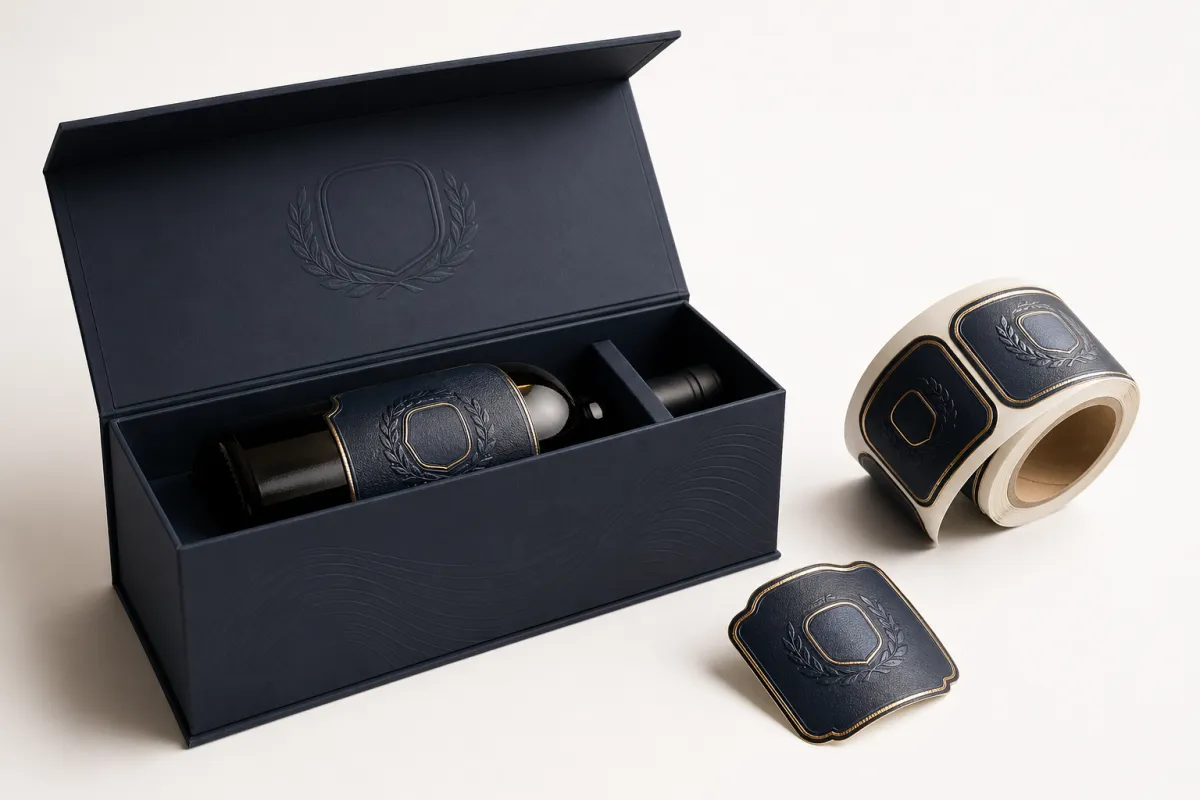
Here is the clean version: custom labels premium quality means the label performs the way it looks. A label that feels expensive but peels in transit is not premium. A label that prints sharply but looks cheap under retail lighting is not premium either. The best labels do both jobs at once.
Premium quality shows up in five places. The print is crisp enough that small type stays legible. The adhesive bonds cleanly without bubbles or edge lift. The die-cut lands accurately, so every label sits square on the container. Color stays consistent across the run, so one carton does not look like it came from another decade. The finish also matches the product environment, which matters more than many buyers expect.
Looks expensive and performs expensive are not the same thing. A textured paper label on a dry, shelf-stable candle can feel luxurious. Put that same stock on a refrigerated drink bottle and the result is a soggy mess. A glossy BOPP label may look less artisanal on screen, yet it can be the better choice for a shampoo bottle, supplement jar, or cleaning product because it resists moisture and abrasion. That is why custom labels premium quality should always be judged against the actual use case, not a mood board.
“A premium label is not the one with the most effects. It is the one that still looks intentional after handling, shipping, condensation, and a customer who actually opens the product.”
Branding teams care because labels carry more than ingredients or barcodes. They carry trust. Packaging buyers care because a label failure creates returns, repacks, and a lot of tedious emails. Small brands care because the label often does the visual heavy lifting before they can afford a custom carton or a full package overhaul. In that sense, custom labels premium quality is not a luxury line item. It is a brand protection tool.
Compared with Custom Printed Boxes, the difference is straightforward: boxes create the frame, while labels often create the first close-up impression. That is why many brands treat label quality as part of the same packaging system. When the label matches the bottle, jar, pouch, or mailer, the whole package feels more deliberate. When it does not, the whole thing reads cheaper than it really is.
The short version is simple. custom labels premium quality comes from materials, print discipline, finishing, and application performance. None of those pieces can carry the whole job alone.
What Should You Expect From Custom Labels Premium Quality?
You should expect a label that survives the job it was built for. That means clean adhesion, accurate color, readable copy, and a finish that matches the product environment. custom labels premium quality is not a decorative label with a larger margin. It is packaging performance with visual discipline.
For a buyer, that usually means asking a different set of questions. Will the label handle refrigeration? Will it resist scuffs in transit? Does the stock match the brand story without failing on contact with moisture? Those questions sound technical, but they are the real difference between a premium result and a costly rerun. If a supplier cannot answer them clearly, the quote is incomplete.
Think of premium labels the way engineers think about load-bearing parts. They are small, but they cannot be cosmetic. A custom label can carry a barcode, ingredients, regulatory copy, and brand identity at the same time. That is a lot of responsibility for a thin layer of stock, adhesive, and ink.
And yes, the label has to survive real humans, not just a shelf photo. If a product is going through fulfillment, being stacked in a truck, then sitting in a bathroom with condensation on the bottle, you are kinda asking for trouble if the material choice is wrong.
How Custom Labels Premium Quality Are Made
Good labels do not happen by accident. custom labels premium quality usually comes from a controlled production chain, and every step matters. The file setup affects the print. The print affects the finish. The finish affects the cut. The cut affects application. Miss one step and the label still ships, which is exactly the problem.
The process usually starts with artwork prep and dieline review. A clean file should include exact dimensions, safe zones, bleed, barcode placement, and font sizes that can survive production. Tiny text below 5.5 pt is where a lot of supposed premium labels get exposed. If the printer has to repair half the file, the odds of a polished result drop fast. That is not a moral judgment; it is just production reality.
Next comes proofing. For custom labels premium quality, a proof should verify size, color intent, crop placement, and material choice before anything goes to press. On a simple run, digital proofs may be enough. For more exact brand color work, printed proofs or press matching may be worth the extra step. If the brand color is a deep navy, a warm black, or a rich red, the gap between “close enough” and “right” will show immediately on shelf.
Then there is the substrate. Paper labels feel familiar and cost-effective. BOPP brings moisture resistance and a cleaner, smoother look. Vinyl handles more abuse and holds up well in tougher environments. Textured stocks create a more tactile, crafted feeling on dry products. Specialty films can add visual punch or better durability, depending on the project. The substrate is not just a base layer. It shapes how the label wears, how the print sits on the surface, and how much premium feel the finished piece actually has.
Finishing is where many buyers try to buy the whole premium experience at once. Lamination can protect the print and change the tactile feel. Varnish can add sheen without the full cost of lamination. Foil can create contrast and emphasis if used with restraint. Embossing and debossing add depth, though they also add setup considerations. Spot embellishments can make a label feel high-end fast, but only if the design has room for them. Stack too many effects together and the result is visual noise, not luxury.
Printing method matters too. Digital printing is often the best fit for short runs, variable data, and faster turnaround. Flexographic printing makes sense when volumes rise and color consistency matters across larger production. For custom labels premium quality, the method should fit the order size, the artwork complexity, and the finish requirements. The “best” method is the one that delivers the result you need without paying for capabilities you will never use.
There is also the unglamorous part: inspection. This is the stage where a good printer checks for scuffs, registration issues, adhesive performance, and cut accuracy. It sounds basic because it is basic. Yet a surprising number of labels lose quality here because someone rushed the final review or ignored a small alignment drift. custom labels premium quality depends on discipline, not just machinery.
For shipments that will face vibration, stacking, or transit stress, transport testing deserves attention too. The ISTA framework is a useful reference when packaging has to survive distribution, not just look nice on a mockup. That matters especially when the label is part of a larger retail packaging system or attached to corrugated shipper packs.
At this stage, custom labels premium quality is less about one flashy finish and more about process control. Good labels are built by people who know where the weak points are and plan around them before they become expensive mistakes.
Key Factors Behind Custom Labels Premium Quality
Five things usually decide whether custom labels premium quality feels truly premium or just expensive on paper: material, adhesive, ink and color control, finish, and artwork accuracy. If any one of those is wrong, the whole label can lose credibility quickly.
Material Selection
Material choice should follow environment first and aesthetic second. That is not glamorous, but it is the truth. A moisture-heavy environment calls for BOPP or vinyl more often than paper. A dry, shelf-stable candle or soap can work beautifully on textured paper if the container and handling conditions are friendly. If the label is going on a recycled paperboard carton, an FSC-certified stock may support the brand story without forcing a compromise on look or printability. For custom labels premium quality, the material should reinforce the product, not fight it.
Material selection also affects how a label behaves in the hand. Some stocks feel dense and expensive right away. Others feel lighter but may still perform better under stress. That difference is why packaging labels cannot be chosen from a photo alone. A sample set tells you more than a spec sheet does, especially when the product will live in a humid bathroom, a freezer, or a delivery truck in summer.
Adhesive Performance
Adhesive choice is where a lot of premium-looking labels quietly fail. Permanent adhesive is the default for most packaging, but not every permanent adhesive behaves the same. Removable adhesive makes sense for short-term promotions, sample packs, and products where label removal matters. Freezer-safe adhesive is needed when condensation and temperature swings are part of the reality. High-tack adhesive can help on rougher or lower-energy surfaces, but it should be tested on the exact container. If the label lifts at the corner, the premium effect collapses right away.
From a buyer's point of view, the right adhesive saves money twice. It reduces rework during application and reduces complaints after shipment. That is why custom labels premium quality is never just a print decision. It is a performance decision.
Ink and Color Control
Color is where people notice inconsistency faster than almost anything else. A label with rich blacks, crisp whites, and clean line work looks intentional. A label with muddy grays or off-brand reds looks cheap immediately, even if the paper stock is nice. Spot colors, CMYK builds, and metallic accents all need careful management. If the print house is using a target like ASTM D3330 peel testing for adhesion and checking shear with ASTM D3654, that tells you they understand the difference between a label that looks fine and one that survives real handling. Quality control is not a bonus. It is the job.
Finish Quality
Matte finishes create a softer, more understated look. Gloss finishes add punch and can make colors feel more saturated. Soft-touch finishes bring a velvety feel that many buyers associate with premium cosmetics and specialty goods. Metallic foils are strong when they are used as accents, not as a substitute for design. The finish should match the product category and the brand personality. A minimalist wellness brand and a loud energy drink are not asking for the same label treatment, even if both want custom labels premium quality.
A useful comparison helps here. A matte paper label on a candle may look elegant because the category rewards restraint. The same finish on a shampoo bottle can read flat unless the typography and layout carry more visual weight. Finish does not create taste by itself. It only supports the decision the rest of the label has already made.
Artwork and Dieline Accuracy
A label can be produced with great materials and still look sloppy if the artwork is wrong. Misaligned type, uneven margins, barcode placement too close to the edge, or a dieline that does not match the container are all instant warning signs. A premium label has visual discipline. There is enough whitespace. The typography is readable at the real size. Decorative elements do not crowd the core information. This is where many brands overdesign. They add foil, texture, patterns, and multiple fonts, then wonder why the piece feels busy instead of refined.
If you want a simple rule, use this: custom labels premium quality usually looks better when the design is a little calmer than the first draft. Not bare. Calmer. That small difference matters.
Custom Labels Premium Quality Pricing
Pricing for custom labels premium quality depends on more variables than most quote requests capture. Material type, shape, size, quantity, print method, color count, finish, and application format all affect the final number. That is why two labels that look similar on a mood board can land at very different price points once production details are locked in.
At a practical level, short runs cost more per unit because setup work is spread across fewer pieces. A run of 500 labels will never price like a run of 10,000 labels. That is normal. If a supplier gives you a suspiciously low quote on a tiny premium job, ask what got removed. It is usually either durability, finishing, or color control. Sometimes all three.
Here is a useful way to think about custom labels premium quality pricing at roughly 5,000 pieces, assuming a standard sheet or roll format and no wild special effects:
| Label Type | Typical Feel | Common Use | Rough Unit Range | Notes |
|---|---|---|---|---|
| Paper label with basic varnish | Clean, simple, affordable | Dry products, retail inserts, jars | $0.08-$0.16 | Good for shelf appeal when moisture is not a concern |
| BOPP label with matte or gloss finish | Smoother, more durable | Beverages, personal care, supplements | $0.12-$0.24 | Often the best balance of durability and cost |
| Textured premium paper | Tactile, crafted, upscale | Wine, candles, artisan foods | $0.14-$0.28 | Best when the product stays dry and handling is moderate |
| Foil, emboss, or soft-touch finish | Luxury-forward and more dramatic | Beauty, gifting, premium specialty goods | $0.20-$0.45 | Setup and finishing usually drive the higher cost |
These are not universal prices. They are working ranges, which is the only honest way to discuss custom labels premium quality. A larger run can push those numbers down. A small, shape-heavy, foil-rich order can push them up fast. If the label is a special die-cut, the tooling fee may also appear as a separate line item. That part catches people off guard because the label itself does not look like tooling. The invoice knows better.
Other costs can hide in the project too. Proof changes add time and sometimes expense. Rush production usually carries a premium. Special rolls, narrow wind directions, or custom core sizes can alter packaging and freight costs. If labels ship in large roll format for automated application, the setup can be different from sheet-fed labels intended for hand application. If you are comparing options, ask whether the quote includes finishing, slit widths, inspection, and shipping. Otherwise the numbers are not really comparable.
For custom labels premium quality, the smartest budget move is often not choosing the cheapest stock. It is choosing the right level of finish for the actual product. That may mean spending a little more on a moisture-resistant film and a simpler design, instead of piling on decorative effects that do not survive contact with the shelf.
Step-by-Step Process and Timeline for Custom Labels Premium Quality
Buyers usually want to know how long custom labels premium quality takes. Fair question. The answer usually sits somewhere between fast and slower than you hoped, depending on artwork readiness, proofing speed, and whether specialty finishing is part of the brief. A simple run can move quickly once the file is approved. A complex one can slow down in a way that makes everyone discover their patience in real time.
Here is a realistic project flow:
- Discovery and quote - You share size, quantity, material preference, adhesive needs, finish, and the application method.
- Artwork review - The printer checks dielines, bleed, fonts, barcodes, and color expectations.
- Proof approval - You confirm layout, spelling, dimensions, and finish before production starts.
- Print production - Digital or flexographic printing runs based on the order size and spec.
- Finishing and cutting - Laminating, varnishing, foiling, die-cutting, slitting, or sheeting happens here.
- Inspection and packing - Labels are checked, packed, and prepared for shipment.
- Delivery and application - You receive the labels and apply them to the actual containers.
A basic timeline for custom labels premium quality often looks like this: 1-2 business days for quoting and artwork review, 1-3 days for proofing if the file is already clean, 5-10 business days for standard production, and a bit longer for specialty finishes or complex die-cuts. A common total lands around 12-15 business days from proof approval. If you need foil, embossing, custom shapes, or a fast turnaround tied to a launch date, plan extra buffer. That buffer is cheap. Missing a launch is not.
The fastest projects are the ones where the buyer sends complete information on day one. That means final artwork, exact dimensions, quantity, substrate preference, adhesive type, finish expectations, and whether the label will be hand-applied or machine-applied. When a supplier has to guess how the label will be used, the back-and-forth slows everything down. custom labels premium quality benefits from clarity up front.
Here is a short prep checklist that saves time:
- Final vector artwork or print-ready PDF
- Exact finished size or container measurements
- Quantity per SKU
- Material preference, if you already know it
- Surface type and application conditions
- Any moisture, refrigeration, or freezer exposure
- Target launch date and shipping deadline
Reorders can be easier than first runs, but only if the spec was recorded properly the first time. Good printers keep a label spec sheet for exactly this reason. That sheet should include size, material, adhesive, finish, print method, and application notes. It saves time and prevents the classic “we thought this was the same as last time” conversation. It rarely is.
If your labels are part of a larger rollout involving branded packaging or seasonal retail packaging, give yourself more room than you think you need. Labels are often the last part to be approved, which means they are also the part most likely to be rushed. That is where custom labels premium quality can slip if the timeline is too tight.
Common Mistakes That Undercut Custom Labels Premium Quality
Most label problems are not mysterious. They are predictable. The same mistakes show up again and again, usually because someone prioritized appearance or price without checking how the label would behave in the real world. custom labels premium quality is easy to damage if you treat it like a generic commodity.
First mistake: choosing the wrong material. A beautiful paper stock can fail fast on cold bottles, frozen containers, or products with regular condensation. A sleek matte label can scratch too easily if it moves through a distribution chain with heavy handling. Always match the stock to the environment, not just the brand mood.
Second mistake: overdesigning the label. Premium does not mean crowded. Too many fonts, too many colors, too many effects, and too much copy make the label look frantic. That is true even when the printing is expensive. The eye needs a place to rest. A cleaner layout often reads more upscale than a label trying to prove it spent money.
Third mistake: skipping proof review. This one is brutal because it is so avoidable. A typo, a misregistered color, or a barcode that prints too small can turn custom labels premium quality into a reprint job. Screen previews are not the same as a real proof. The label needs to be checked at actual size, with actual contrast, in actual lighting.
Fourth mistake: focusing only on price per thousand. A low per-unit number can hide waste. If labels peel, jam on application equipment, or trigger rework, the cheap quote becomes the expensive label. Add returns, delayed launches, and frustrated customers, and the math gets ugly very quickly.
Fifth mistake: using the wrong adhesive or finish. This is the classic premium label failure. The design is strong, the stock is good, and the finish is attractive, but the adhesive cannot grip the container or the finish scuffs in transit. The label then looks tired before it reaches the customer. That is not premium. That is an expensive apology.
There is also a quieter mistake: ignoring the product story. For example, a botanical skincare brand may want a natural paper label, but if the bottle lives in wet bathrooms and gets handled with damp hands, a moisture-resistant film may be the smarter choice. The right answer is not always the prettiest sample. Sometimes it is the one that protects the brand better. That is the grown-up version of packaging design.
For many buyers, custom labels premium quality should be checked with a simple question: what will this look like after 30 days of use, not 30 minutes after unboxing? That question saves a lot of regret.
Expert Tips for Custom Labels Premium Quality and Next Steps
If you want custom labels premium quality without wasting money, test the label on the actual container with the actual product. Not a sample bottle from a shelf. The real container. The real fill level. The real environment. Adhesion changes with surface energy, temperature, condensation, and handling. A label that passes on paper can still fail on the line.
Ask for samples and compare them side by side under retail lighting. Screens lie. Print does not care about your monitor calibration. A matte label may feel sophisticated in the hand but wash out under bright store lights. A gloss label may look too shiny online and perfectly crisp in person. You do not know until you hold it next to the actual packaging. That is why custom labels premium quality needs physical comparison, not just approval by email.
Build a label spec sheet for every SKU. It should include finished size, material, adhesive type, finish, print method, application method, and any environment notes such as refrigeration or UV exposure. It sounds dull because it is dull. It is also the easiest way to keep reorders consistent and avoid production drift. The best packaging teams keep these records because memory is not a system.
Working efficiently with a printer is simple: send final artwork, realistic quantities, target timeline, and any known constraints in one shot. If the project involves Custom Labels & Tags, the more exact your brief, the fewer round trips you will need. That means faster quoting, cleaner proofing, and fewer surprises when the labels reach production.
One more practical habit: compare finishes in person before you commit. Soft-touch, matte, gloss, foil, and textured paper all change the feel of custom labels premium quality in different ways. A finish that looks luxurious on one product can look pretentious on another. That is not a design failure. It is a context failure.
For brands building a full visual system, keep the label aligned with the rest of the packaging stack. The label should not fight the carton, the bottle, or the mailer. It should reinforce the whole package branding story. Whether you are coordinating with custom printed boxes or a simpler bottle program, consistency across the system matters more than any single flourish.
If you are at the buying stage, the next steps are straightforward: audit the current label, define the performance requirements, request samples, and then get quotes from a supplier that can meet both quality and timeline. That is how custom labels premium quality becomes a repeatable standard instead of a one-time lucky run. Being picky here is sensible. Labels are small. Their impact is not.
In the end, custom labels premium quality comes down to whether the label still looks right after it has been handled, shipped, stored, and opened by a real customer. If it can do that, you have a premium label. If it cannot, you bought decoration.
How do I know if custom labels premium quality is worth the extra cost?
Judge it by product environment, brand visibility, and replacement risk rather than unit price alone. If the label has to survive moisture, handling, shipping, or retail scrutiny, custom labels premium quality usually pays for itself because it reduces failures and protects the product presentation.
What materials are best for custom labels premium quality?
BOPP and vinyl are strong choices for durability, moisture resistance, and a cleaner premium feel. Textured papers work well when the goal is tactile luxury on dry-packaged products, but the best material always depends on the container, the environment, and how the label will be applied.
How long does the custom labels premium quality process usually take?
Simple runs can move quickly once artwork is approved, while specialty finishes or custom shapes take longer. Proofing, revisions, and finishing are usually the real time sinks, so build in extra time if the labels are tied to a product launch or a seasonal shipment.
What drives custom labels premium quality pricing the most?
Material choice, finish complexity, quantity, and print method have the biggest impact. Specialty details like foil, embossing, or custom tooling increase setup costs, and rush production or repeated proof changes can quietly push the final price up.
How can I make sure my custom labels premium quality looks expensive, not busy?
Use stronger hierarchy, fewer fonts, and more whitespace so the design has room to breathe. Choose one or two premium finishes instead of stacking every effect at once, and test the label at actual size because what looks elegant on screen can look cluttered on the package.
If you are ordering custom labels premium quality for a real launch, start with the product conditions, then choose the stock and finish that can survive them. That is the difference between a label that merely looks nice and custom labels premium quality that actually earns the name.


