Buyer Fit Snapshot
| Best fit | Custom Lip Gloss Packaging Boxes projects where brand print, material claims, artwork control, MOQ, and repeat-order consistency need to be specified before quoting. |
|---|---|
| Quote inputs | Share finished size, material target, print colors, finish, packing count, annual reorder estimate, ship-to region, and any compliance wording. |
| Proofing check | Approve dieline scale, logo placement, barcode or warning zones, color tolerance, closure strength, and carton packing before bulk production. |
| Main risk | Vague material claims, crowded artwork, missing packing details, or unclear freight terms can make a low unit price expensive after revisions. |
Fast answer: Custom Lip Gloss Packaging Boxes: Design, Cost, and Fit should be specified like a repeatable production item. The safest quote records material, print method, finish, artwork proof, packing count, and reorder notes in one written spec.
Production checks before approval
Compare the actual filled-product size with the drawing, then confirm tolerance on folds, seals, hang holes, label areas, and retail display edges. Reserve space for logos, QR codes, warning copy, and material claims before decorative graphics fill the panel.
Quote comparison points
Review material grade, print process, finish, sampling route, tooling charges, carton quantity, and freight assumptions side by side. A quote is only useful when the supplier can repeat the same color, closure quality, and packing count on the next order.
Custom Lip Gloss Packaging boxes carry more weight than their size suggests. I have seen a beautiful formula get treated like an afterthought because the carton bent in transit, the cap rattled inside, or the print made the whole thing look cheaper than it was. Beauty buyers notice that. Retail buyers do too. A box is not just a wrapper; it is the first piece of evidence that the brand understands its own product.
That is why custom lip gloss packaging boxes deserve attention before the first proof lands on the table. A well-made carton protects a slim tube, keeps the cap from knocking against the sides, and frames the product with enough precision to make the purchase feel intentional. Some brands need a clean retail carton. Others need a sleeve, a presentation box, or a mailer-ready build that can survive the long ride from warehouse to doorstep. The box is part of the product experience, not a side note.
Packaging also changes how people judge value. A gloss in a stock carton may still sell, but it often blends into the shelf with all the personality of a placeholder. A custom build does something different. It can signal luxury without shouting, playfulness without looking careless, or a clean-beauty position without leaning on tired cliches. For a wider view of how structure, print, and finish can be matched to different item types, see Custom Packaging Products.
What Do Custom Lip Gloss Packaging Boxes Actually Do?
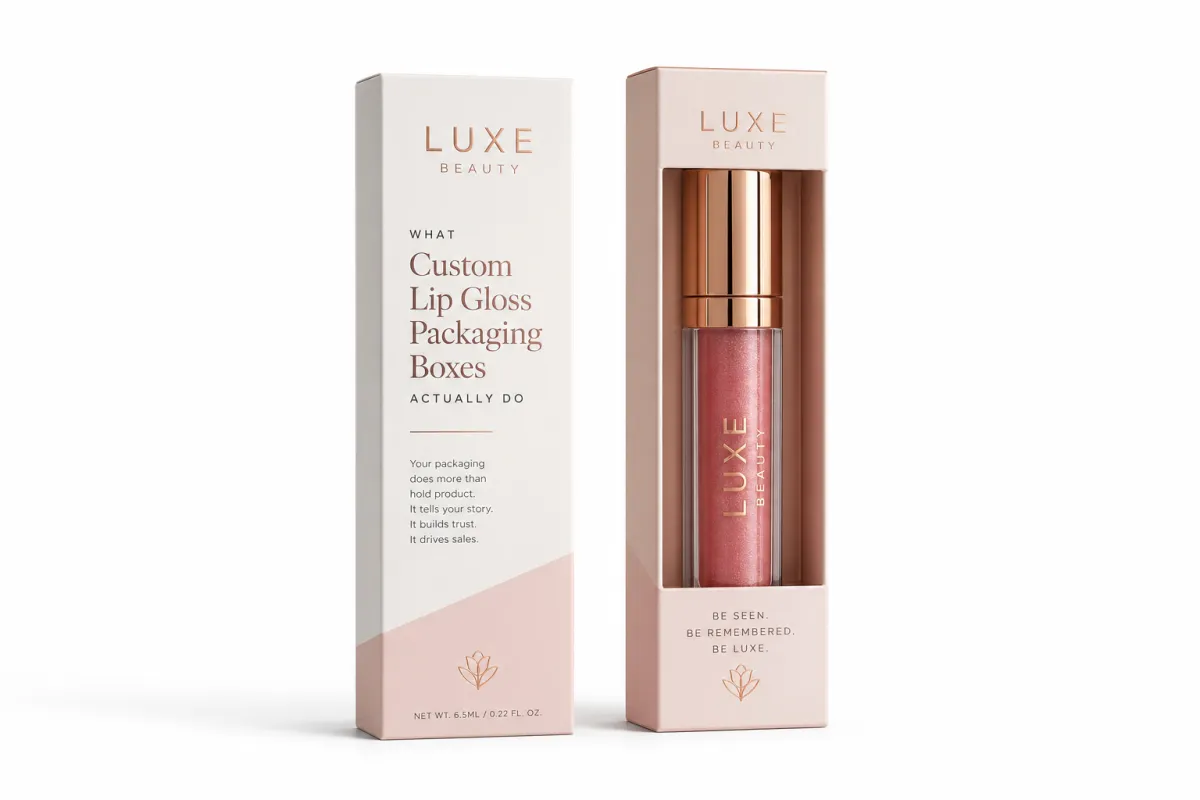
Damage complaints rarely begin with the formula. They usually begin with the carton. Loose fit, weak folds, bent corners, and tape that gives up too early all create the same impression: the brand cut corners. Custom lip gloss packaging boxes solve that by holding the tube steady, protecting the cap and wand area, and making the first touch feel deliberate rather than improvised. In retail packaging, that kind of control matters because the customer is already forming an opinion before they twist the applicator open.
A purpose-built carton works on three levels. It shields the gloss during handling, storage, and shipping. It gives the brand a surface for logos, shade names, ingredient copy, barcodes, and claims. It also helps the buyer understand what they are holding. That matters for single glosses, duo sets, and influencer bundles, where the outer carton does much of the talking. Strong custom lip gloss packaging boxes also keep branding packaging consistent across a line, which matters when a collection includes multiple shades or seasonal drops.
The divide between stock and custom is bigger than many buyers expect. A stock carton may be close in dimensions, yet the tube can still rattle, the tuck flap can feel flimsy, and the layout may leave too little room for the brand message. Custom cartons are built around the tube height, the closure style, the board weight, and the way the product will be sold. A boutique shelf box may need a strong front panel. An e-commerce box may need more crush resistance. A holiday set may need a window or insert so the color story shows through without exposing the product itself.
Fit is where money is saved or lost. A tighter carton reduces movement, and less movement means fewer dents, fewer open seams, and fewer customer complaints about a gloss that arrived looking tired. It also changes the feel in hand. A board with the right thickness, clean score lines, and a finish that suits the brand feels like Custom Printed Boxes made for a real product, not a temporary fix the team plans to outgrow. The same logic applies across custom lip gloss packaging boxes: precision in the structure usually creates confidence in the brand.
"A loose box teaches the customer to expect a loose product."
That sounds blunt because it is. A carton that stands upright, holds its shape, and survives ordinary handling supports stronger package branding and usually cuts down on avoidable rework. Premium lines need structure That Feels Premium. Youth-focused lines can be louder visually, but the box still has to hold the tube in place. In practice, good custom lip gloss packaging boxes make the product look complete before the customer has even opened it.
I once watched a buyer set two samples side by side and pick the heavier-feeling carton in under ten seconds. Same gloss shade, same ingredients, same retail price. The only difference was that one box flexed when pinched at the top. That tiny movement changed the whole read of the product. Packaging does that all the time, kinda unfairly, but it does.
For brands building a larger cosmetics range, the carton also has to sit comfortably beside mascara, lip balm, and other small beauty items without feeling like an orphan from a different family. Packaging design shapes that impression. Board weight, print method, spacing, and finish all matter, yet proportion may matter most of all. A compact box with disciplined dimensions often looks more expensive than a larger box with awkward margins. Buyers may not name that difference, but they absolutely register it. This is one reason custom lip gloss packaging boxes are often treated as a strategic piece of cosmetic packaging rather than a simple outer shell.
How Custom Lip Gloss Packaging Boxes Are Made
The production path for custom lip gloss packaging boxes starts with measurement, not artwork. A supplier needs tube diameter, cap height, wand length, and the amount of internal clearance needed for inserts or display orientation before the first quote makes sense. A lip gloss tube may look simple on a vanity, yet a few millimeters decide whether the carton feels precise or irritating. Set packaging raises the stakes again because multiple items must sit evenly and avoid knocking into each other.
Once the dimensions are known, the supplier builds or adjusts the dieline. That file controls fold lines, glue areas, panel edges, and closure behavior. It is technical, yes, but it also shapes the final look. Good packaging design at this stage prevents a long list of problems later, because the artwork can be placed around the structure instead of being squeezed into it. Safe zones, bleed, barcode placement, and cosmetic copy all need to be mapped before approval. At that point, custom lip gloss packaging boxes become a production job rather than a concept board.
Sampling changes everything. A digital proof can look flawless and still hide fit problems, color drift, or text sitting too close to a fold. A physical sample shows how the carton opens, whether the tube moves, and whether the finish matches the brand's target mood. That becomes especially useful for slim tubes, tall tubes, or gloss sets paired with another cosmetic item. Adjusting a sample is cheap. Correcting a full run of custom lip gloss packaging boxes after the fact is not.
After proof approval, the supplier moves into printing, finishing, die-cutting, folding, and packing. The order can vary by factory, but the main sequence usually looks like this:
- Confirm final artwork and dieline.
- Approve a digital proof or physical sample.
- Print the board sheet.
- Add any finish such as matte, gloss, foil, embossing, or spot UV.
- Die-cut the sheets into carton blanks.
- Fold, glue, or flat-pack the boxes as specified.
- Pack and prepare for shipment.
Lead time depends on what gets added to the order and where the project stalls. Simple custom lip gloss packaging boxes with basic print and one board choice often move faster than cartons with window cutouts, specialty coatings, or hand-assembled inserts. Artwork that is still changing can freeze the schedule. Out-of-stock paperboard can stretch it. Manual assembly can chew through days that looked safe on a spreadsheet. In many projects, the slowest part is not the press; it is waiting for approvals.
For direct-to-consumer brands, transit performance matters as much as shelf appeal. Many teams ask for testing based on ISTA test methods so the finished carton can survive stacking pressure, package shifting, and courier handling. Not every order needs that level of verification, though it becomes sensible once the boxes are traveling long distances or packed with other products.
Another practical wrinkle is coordination. Printing, finishing, and gluing do not move at the same pace. Some jobs overlap. Others wait for coating to dry or for the die-cut sheets to cure. A production timeline that looks short on paper can widen quickly once specialty finishes or complex die cutting enters the picture. For most custom lip gloss packaging boxes, accuracy still outruns speed.
Materials and Structure Choices for Lip Gloss Boxes
Material choice sets the tone before the customer reads a single word. For custom lip gloss packaging boxes, the most common boards are SBS, C1S paperboard, and kraft. SBS delivers crisp print quality and a clean cosmetic finish, which explains why it appears so often in premium beauty packaging. C1S works well when one side carries the graphics and the other stays plain. Kraft creates a natural or minimal look, though it changes how color behaves and can mute certain inks. All three can work. The brand story should decide.
Thickness matters just as much as surface. Thin board can print beautifully and still feel soft in the hand, especially for tall tubes or cartons that will travel through fulfillment before reaching a shelf. Heavier board helps the box keep its shape, resist corner crush, and support inserts or windows without sagging. Many beauty cartons land somewhere between 14pt and 24pt, roughly 250gsm to 400gsm depending on construction. For custom lip gloss packaging boxes, that range usually balances cost, print quality, and protection.
Structure changes behavior in practical ways. Tuck-end cartons are common because they are efficient and easy to run. Auto-lock bottoms add strength. Sleeves raise presentation value and work well for gift sets. Window cutouts show a color family without opening the box, though they add a die-cut step and demand a cleaner design strategy. Inserts, whether paperboard or molded, hold the tube in place and make the packaging feel more intentional. If the product ships direct to consumers, a tighter structure usually beats a flashy one. The same goes for custom lip gloss packaging boxes that must handle repeat storage and re-stocking on retail shelves.
Here is a practical comparison buyers can use before asking for a quote:
| Material / Structure | Best Use | Strength | Print / Finish Notes | Typical Cost Impact |
|---|---|---|---|---|
| SBS paperboard tuck-end | Retail singles and clean shelf presentation | Moderate | Excellent for crisp color and fine typography | Lowest to moderate |
| C1S carton with insert | Single glosses that need extra retention | Moderate to good | Good for a printed front with simple interior use | Moderate |
| Kraft sleeve or carton | Natural, eco-leaning brand positioning | Moderate | Best with restrained graphics and darker inks | Moderate |
| Auto-lock bottom carton | E-commerce and heavier set packaging | Good | Useful when the box must stand up through handling | Moderate to higher |
| Sleeve with inner tray | Gift kits and high-value presentation | Good | Works well with foil, embossing, and spot UV | Higher |
Finishes tempt brands to spend more than the design needs. Matte lamination gives a soft, modern surface. Gloss coating pushes color forward. Soft-touch lamination feels premium, though fingerprints can show if the box gets handled a lot. Foil, embossing, and spot UV add texture and contrast, but each one adds setup and production complexity. If the product is mass-market, a simple print on strong board may be enough. If the gloss is positioned as a gift item or prestige shade, decorative finish may earn its cost.
For buyers who care about sourcing, it makes sense to ask whether the board comes from an FSC-certified supply chain. That does not make the packaging environmentally perfect, but it does create a clearer paper sourcing story. Brands with responsible procurement goals often pair that with recycled content, lower ink coverage, or reduced lamination. Those choices can shape package branding in a way that feels grounded rather than performative.
There is no universal "best" build for custom lip gloss packaging boxes. The right choice depends on whether the product will sit on retail pegs, in drawer displays, inside subscription boxes, in influencer kits, or inside direct mailers. A carton can look elegant on a studio table and still fail in shipping if the fit is loose or the board is too light. Material, structure, and channel should be decided together. That is especially true for cosmetics packaging, where presentation and protection have to share the same space.
Custom Lip Gloss Packaging Boxes Pricing Factors
Pricing for custom lip gloss packaging boxes usually comes down to five variables: quantity, board choice, box size, print complexity, and finish complexity. A quote that looks unusually low usually means one of those pieces has been simplified. A slight change in size can change board usage. Switching from one-color print to full artwork changes press time. Adding foil or a window can introduce tooling or extra finishing steps. In packaging, the visible surface is only part of the bill; setup and handling can matter just as much.
Small runs cost more per unit because setup gets divided across fewer boxes. That is not a penalty; it is arithmetic. A die line still has to be reviewed, the press still has to be prepared, and the finishing steps still have to happen whether the order is 500 units or 5,000. As the run grows, the unit cost drops, while the total spend rises. For many brands, the smartest order is not the cheapest unit price. It is the volume that fits launch risk, storage, and cash flow without leaving boxes stranded in a warehouse.
Artwork complexity matters too. A disciplined design with a restrained palette and strong typography is usually easier to produce than a layered layout packed with metallic effects, tiny legal text, and multiple spot treatments. That does not mean premium design should be avoided. It means the more pieces a design includes, the more likely it is that custom lip gloss packaging boxes will need extra attention on press or during finishing.
Here is a simple pricing view buyers can use as a comparison starting point:
| Order Size | Common Print / Finish Level | Indicative Unit Range | What Usually Drives the Price |
|---|---|---|---|
| 500 units | Simple print, basic tuck-end | $0.55-$1.20 | Setup costs spread across a small run |
| 1,000 units | Printed carton with matte or gloss finish | $0.28-$0.70 | Board choice and finish selection |
| 5,000 units | Full-color carton with one premium effect | $0.16-$0.38 | Print coverage, die cutting, and finishing |
| 10,000+ units | Scaled production with streamlined setup | $0.12-$0.30 | Material efficiency and repeat production |
These figures are directional only. Exact dimensions, board thickness, finish selection, and whether inserts or windows are involved will push the final number up or down. Freight can change the real landed cost in a major way, especially when cartons are bulky and the route is long. Storage counts too. Custom lip gloss packaging boxes occupy space, and a low unit price stops looking attractive once the order sits untouched for months.
Keeping pricing under control often means simplifying where the customer will not notice the difference. Standardizing one or two sizes helps. Keeping the layout disciplined helps. Limiting finish combinations helps. If the gloss already has strong color and shape, the box may only need clean branding and one premium accent. That usually gives a better cost-to-impact ratio than piling on every available effect.
It also helps to ask for a quote that separates material, printing, finishing, inserts, and freight. That way the buyer can see whether the price is moving because of the board, the labor, or the shipping plan. A good supplier should be able to explain why custom lip gloss packaging boxes cost what they cost without hiding the real drivers behind a single all-in number.
Step-by-Step Order Process for Custom Lip Gloss Packaging Boxes
The cleanest ordering process starts with product facts. Before requesting custom lip gloss packaging boxes, gather the tube dimensions, cap height, desired carton style, and whether the product ships as a single, a duo, or a set. If there are branding rules, shade naming conventions, barcode requirements, or cosmetic copy rules, collect those too. The more exact the inputs, the fewer revisions later. A strong dieline request leaves little room for guesswork.
Artwork review comes next. Safe areas, bleed, fold lines, and barcode placement all need careful checking. With cosmetic product packaging, text contrast matters because label copy has to stay readable after folding and finishing. Tiny type should not sit close to a seam. A barcode should sit where scanners can read it easily and where ink coverage will not interfere with clarity. If the carton includes regulatory information, that needs the same care as the front panel design.
Proofing follows. A physical sample is ideal. Even a solid digital proof is better than approving from memory alone. Color can shift. A shade name can drift too close to a fold. A box that looked balanced on screen can feel cramped once folded. This is especially true for custom lip gloss packaging boxes with specialty finishes, because foil, embossing, and lamination all affect how the final carton reads under light. If a real gloss tube can be tested before production, use it.
Before production begins, confirm the details in writing:
- Final dimensions and box style
- Board type and thickness
- Print colors and finish options
- Quantity and acceptable variance
- Shipping address and delivery window
- Any insert or window requirements
That written confirmation saves time if questions surface later. It also helps when comparing suppliers or planning repeat orders. Custom lip gloss packaging boxes are easier to reorder when the original spec is precise, because the supplier can reproduce the same structure instead of rebuilding it from scratch.
After delivery, inspect the cartons before storing or using them. Check corner quality, registration, adhesive bond, and finish consistency. If the boxes are flat-packed, keep them dry and avoid placing heavy items on top. Printed surfaces scuff easily when handled carelessly. High-gloss cartons and soft-touch finishes deserve even more caution. Good handling protects the work that went into the custom lip gloss packaging boxes long before a customer opens one.
One practical habit pays off later: keep a sample box from the approved run. That one reference piece becomes useful for reorders, color checks, and team training. When someone asks how the gloss carton should look or feel, the physical sample answers faster than any spec sheet.
Common Mistakes With Lip Gloss Packaging Boxes
The first mistake is sizing. A box that is too loose lets the tube shift. A box that is too tight can bulge, crease, or make the gloss awkward to remove. Both problems make custom lip gloss packaging boxes feel less polished than they should. The right fit secures the product without forcing it. In a retail setting, even a small amount of movement can make the carton sound cheap when shaken, and sound affects perception more than most buyers admit.
The second mistake is overdesigning the surface. Premium finishes can look excellent, but too many of them muddy the message. A carton with foil, spot UV, embossing, and a busy color palette may look impressive in a render and feel crowded in hand. Good packaging design uses effects where they strengthen the story, not everywhere the budget allows. Sometimes the strongest custom lip gloss packaging boxes are the simplest ones, because shape, color, and typography are doing the selling.
Artwork errors create a different kind of trouble. Low-resolution images, weak contrast, crowded typography, and text sitting too close to folds all cause production headaches. The press can only reproduce what is supplied. Soft files print soft. Overlong copy gets smaller or gets cut. That is the point where custom printed boxes stop behaving like a creative asset and start acting like a technical file, which is a less forgiving category.
Compliance issues deserve real attention. Cosmetic packaging often needs ingredient space, batch coding, barcode placement, and claims that match the product label. If the box says one thing and the tube says another, the brand creates confusion it does not need. That does not mean every carton needs dense legal copy. It does mean the packaging should match the product documentation from the start. Good product packaging is attractive, but it is also consistent.
Skipping the sample is probably the costliest mistake. A screen can hide color shifts, gloss glare, and fit issues. A production run will not forgive them. One proof can prevent days of rework and a stack of unusable cartons. The brands that respect sampling usually end up with better custom lip gloss packaging boxes because they catch practical issues before those issues become expensive.
Freight mistakes show up just as often. Buyers compare unit price without comparing landed cost. A cheap box that requires expensive air freight, extra storage, or a second production pass is not cheap at all. The total picture matters, especially when the packaging is part of a recurring line of custom lip gloss packaging boxes that will be reordered again and again.
Expert Tips and Next Steps for Your Order
If you are narrowing down options for custom lip gloss packaging boxes, compare at least two structural choices before deciding. One box may look better in a render, while another performs better in the hand. That difference matters. A sleeve can feel elegant, but a tuck-end carton may ship more cleanly. A window can help on shelf, while a solid panel may protect the product better in transit. The best box is usually the one that fits the channel, not the one with the most decoration.
Ask for a quote that breaks out the key components. Material, print, finishing, inserts, freight, and one-time setup fees should be listed separately. That makes comparison easier and keeps the discussion honest. It also helps when multiple SKUs are being planned, because you can see whether each shade or size should be grouped into one run or handled separately. For custom lip gloss packaging boxes, clarity in the quote usually leads to clarity in the final result.
Before contacting a supplier, prepare the tube measurements, target quantity, artwork files, and launch date. If the box is for retail, gifting, or e-commerce, say so. That context changes the recommendation. A carton meant for boutique display may prioritize shelf presence. A carton meant for direct shipment may need a stronger board and a tighter insert fit. If you already know whether you want matte, gloss, soft-touch, foil, or embossing, share that early so the supplier can quote the real build rather than an imagined one.
Do not stop at a dimension drawing. Test the box with a real gloss sample. A drawing can show size, but it cannot show how the carton opens, whether the cap clears the top panel, or whether the tube sits too high in the cavity. That physical check is worth more than a polished mockup because it confirms presentation and fit at the same time. For custom lip gloss packaging boxes, that is where the final choice usually becomes obvious.
If you are still deciding, shortlist the structure, request a sample, compare lead times, and compare the quote structure side by side. Then move forward with the option that gives the best balance of fit, price, and brand presentation. That is often the strongest path for custom lip gloss packaging boxes, because it keeps the decision grounded in how the product will actually be sold and shipped.
For brands expanding beyond a single carton style, it can also help to review broader custom packaging products and see how the same visual language can carry across different items. When packaging design stays consistent, the line feels more deliberate, and that consistency strengthens retail packaging and package branding.
From a manufacturing standpoint, the next step is straightforward: choose the structure that protects the tube, supports the brand story, and fits the sales channel, then request a sample and a line-item quote. That is the fastest route to custom lip gloss packaging boxes that look right, ship right, and hold up in the customer’s hands.
FAQs
What should custom lip gloss packaging boxes include?
They should fit the tube securely, protect the cap and wand area, and present the brand clearly on the shelf. Good boxes usually include accurate dimensions, print-ready artwork space, and a finish that matches the product position. If the gloss ships direct to consumers, the structure should also hold up to packing, handling, and transit.
How much do custom lip gloss packaging boxes cost?
Pricing depends on size, material, quantity, print colors, finishes, and whether inserts or windows are added. Small runs usually have a higher unit price because setup costs are spread over fewer boxes. The best way to compare cost is to request a line-item quote that separates materials, print, finishing, and freight.
How long does it take to make custom lip gloss packaging boxes?
Timing usually depends on artwork approval, sampling, production complexity, and shipping distance. Simple cartons move faster than boxes with specialty coatings, foil, embossing, or custom inserts. To avoid delays, approve the dieline and artwork early and keep the product dimensions final before production begins.
What material is best for lip gloss packaging boxes?
Paperboard and SBS are common for clean print quality and lightweight cosmetic presentation. Kraft works well when the brand wants a natural, minimal look, but it may need design adjustments for color accuracy. The best material depends on whether the box needs premium shelf appeal, shipping strength, or a more eco-focused presentation.
Can custom lip gloss packaging boxes hold more than one gloss?
Yes, the structure can be sized for single units, duos, or gift sets if the internal layout is planned correctly. Multi-product boxes often need inserts or tighter compartment spacing to keep the items from shifting. The key is to design around the exact product set before choosing the die line and finishing details.
Strong custom lip gloss packaging boxes are built from fit, structure, print, and channel strategy working together. If those pieces line up, the carton does more than protect a tube; it helps sell the gloss, strengthens brand recognition, and reduces friction in production and fulfillment. The practical takeaway is simple: lock the dimensions first, test with a real sample, and choose finishes only after the structure proves itself. That is how custom lip gloss packaging boxes stop behaving like a cost and start doing real work for the product.