Buyer Fit Snapshot
| Best fit | Custom Laser Cut Window Boxes Wholesale for Brands projects where brand print, material claims, artwork control, MOQ, and repeat-order consistency need to be specified before quoting. |
|---|---|
| Quote inputs | Share finished size, material target, print colors, finish, packing count, annual reorder estimate, ship-to region, and any compliance wording. |
| Proofing check | Approve dieline scale, logo placement, barcode or warning zones, color tolerance, closure strength, and carton packing before bulk production. |
| Main risk | Vague material claims, crowded artwork, missing packing details, or unclear freight terms can make a low unit price expensive after revisions. |
Fast answer: Custom Laser Cut Window Boxes Wholesale for Brands should be specified like a repeatable production item. The safest quote records material, print method, finish, artwork proof, packing count, and reorder notes in one written spec.
Production checks before approval
Compare the actual filled-product size with the drawing, then confirm tolerance on folds, seals, hang holes, label areas, and retail display edges. Reserve space for logos, QR codes, warning copy, and material claims before decorative graphics fill the panel.
Quote comparison points
Review material grade, print process, finish, sampling route, tooling charges, carton quantity, and freight assumptions side by side. A quote is only useful when the supplier can repeat the same color, closure quality, and packing count on the next order.
Custom Laser Cut window boxes wholesale can change a buying decision in one glance, and I have watched it happen on warehouse floors in Los Angeles, Chicago, and Shenzhen. I remember standing beside a retail buyer in an aisle of corrugated pallets while she picked up two nearly identical cartons, tilted them under a 4,000K fluorescent light, and decided in under 3 seconds. The plain box got a polite nod. The windowed one got a second look, then a question about unit margin. That is not magic; it is human behavior doing what it always does when visibility replaces uncertainty.
On one candle project, a 14 oz amber jar that looked ordinary in an opaque carton suddenly sold itself once we cut a clean 92 mm x 54 mm window and switched to 350 gsm C1S artboard with a 0.25 mm PET patch. The client reordered 6,000 units within 19 days of launch from a distribution center in Dongguan, which still makes me smile because the original forecast had been so cautious it almost felt shy. The first quote had been $0.27 per unit at 5,000 pieces, and the reorder came in with a tighter dieline and a better pack count. Packaging people get dramatic about this stuff, but the numbers usually do the talking.
That is why I treat Custom Laser Cut Window Boxes wholesale as a commercial instrument, not a decorative extra. A window lowers uncertainty, shows color and texture before the customer reads a single line of copy, and gives a brand a quicker route to retail Packaging That Feels honest, controlled, and worth shelf space. I have seen that effect in a pharmacy endcap in Toronto, in a bakery display in Portland, and in a supplier meeting in Guangzhou where a buyer compared two cartons side by side and chose the visible product every time. Humans are consistent about one thing: if they can see what they are buying, they relax.
For brands selling cosmetics, candles, bakery items, or gift sets, the box is not just product packaging. It is package branding, price signaling, and protection in one structure. If the item has a finish that matters, a color that sells, or a texture customers want to inspect, custom laser cut window boxes wholesale often outperforms a fully opaque box before the sales team ever touches the pitch deck. I have a firm opinion on this: if the product is visually interesting, hiding it is a missed opportunity, and sometimes a very expensive one when the shelf competitor is using a 30 mm x 80 mm display window and winning the first reach.
Why custom laser cut window boxes wholesale lifts shelf conversion
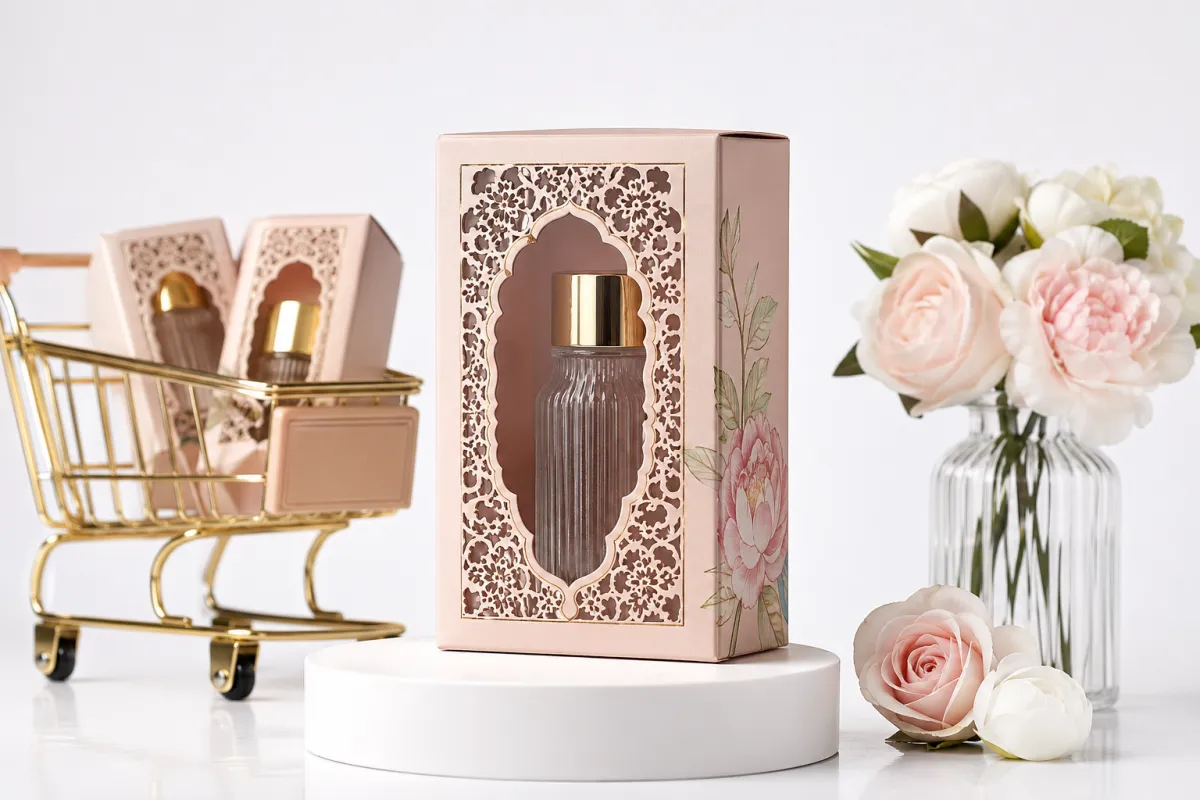
Custom laser cut window boxes wholesale lifts shelf conversion because it removes guesswork. Buyers do not want a promise; they want evidence. I have seen a skincare founder bring in two cartons to a review in Brooklyn, one sealed and one with a neat oval window, and the windowed version made the cream look denser, cleaner, and more expensive even though both held the same 120 ml jar. It was almost unfair, but retail is not graded on sentiment. The carton's visual proof mattered more than the paragraph on the back.
There is another reason these boxes work: they compress the decision path. Shoppers scan, compare, and move. If the front panel gives them the product, the format, and a hint of quality all at once, the box earns a few more seconds of attention. A few seconds is a long time on a shelf. It can be the difference between a hand reaching out and a cart moving on.
I have also seen the opposite happen. A beautiful printed box with no window can look polished in a meeting and invisible in store lighting. Under mixed retail illumination, dark inks swallow detail, matte coatings can flatten the product story, and the buyer is left guessing whether the item inside is as premium as the pitch deck said it was. The window fixes that. Not always, not for every category, but often enough that it deserves a hard look.
One caution: a window is not automatically better. If the product surface scratches easily, if the contents shift during transit, or if the visible portion does not actually sell the item, a cutout can work against you. I have seen a tea set look a little cheap once the inner tray showed through. That is the kind of mistake that feels small in the studio and expensive on a shelf. So yes, windows help conversion, but only when the visible area is deliberate.
Custom laser cut window boxes wholesale: formats, materials, and use cases
The phrase custom laser cut window boxes wholesale covers more than one structure. In practice, buyers usually mean folding cartons, rigid boxes, or specialty sleeves with precision-cut openings that reveal part of the product and keep the rest protected. The word “laser” matters here, but so does the box style. A clean window on a tuck-end carton behaves very differently from a window on a rigid two-piece gift box.
For many jobs, the window itself is not the product face; it is the proof. Think of it as a controlled peek. That peek might show the embossing on a soap bar, the wax color in a candle, the sheen of a lipstick tube, or the texture of a pastry sealed in a food-safe tray. A good window does not show everything. It shows just enough.
Here are the most common formats I see:
Folding cartons are the workhorse. They are affordable, easy to print, and familiar to retail buyers. They suit cosmetics, small accessories, candles, and low-to-mid weight products.
Rigid gift boxes add structure and a more premium feel. They are common for luxury sets, seasonal packaging, and higher-ticket items. The window is often paired with a wrapped lid or sleeve, which gives the box a little theater without becoming fussy.
Sleeves and cartons with inserts work well when the product needs to stay centered behind the opening. They are a smart choice for bottles, jars, and electronics, especially if movement in transit is a concern.
Material choice matters as much as the cut. SBS and C1S/C2S paperboard are common for printed folding cartons because they hold color well and crease predictably. Kraft stock can work nicely if the brand wants an earthier look, but dark kraft and laser cutting can produce slight edge browning if the beam settings are not tuned. That is not a dealbreaker, just a detail that should be discussed before production starts. For shipping cartons or heavier items, corrugated E-flute or F-flute can give the structure more backbone.
Window film is another place where people get casual and then regret it. PET is common because it is clear, stable, and economical. Acetate can look crisp, though it is not always the best fit for every production line. PVC exists too, but many buyers prefer to avoid it for environmental or brand-positioning reasons. If the box will contact food, the film and adhesive need to be checked for food-safety suitability. No guessing there. That is the sort of detail that turns into a headache if somebody waves it off.
The best use cases are the ones where visual proof actually sells the item. Cosmetics and skincare are obvious. Candles are another strong fit because color and vessel shape matter. Bakery and confectionery packaging can benefit too, though moisture, grease, and shelf life need more care than a lot of first-time buyers expect. Gift sets do well because the window can expose a coordinated arrangement, which signals value faster than a block of text ever will. It sounds simple because it is simple.
Specifications for custom laser cut window boxes wholesale orders
If there is one place where wholesale packaging gets quietly expensive, it is the spec sheet. A beautiful design with vague specifications is basically an invitation for variation, and variation is where margins go to die. For custom laser cut window boxes wholesale, I want the buyer to know five things before a quote is signed: substrate, size, window shape, film, and finishing.
Start with the substrate. Board thickness affects rigidity, crease quality, and how crisp the window edge looks after cutting. A 300 gsm carton may be fine for a small cosmetic box, while a 400 gsm board may be needed for a heavier product or a presentation piece that must hold its shape on shelf. The wrong board can make even a good design look a little tired. It is kind of annoying, but true.
Then define the window. A tiny circular opening and a large irregular cutout have different production implications. Curved shapes often need more precise tooling, and intricate details can slow the line or increase waste. If the box is actually laser cut, ask about kerf width, scorch risk, and whether the supplier uses laser cutting for samples only or for the final run. Many factories use laser for prototyping and steel-rule dies for volume production because it is faster and more economical at scale. The phrase “laser cut” gets used loosely in the market, so the buyer should confirm the actual process. That one question saves a lot of confusion later.
Window film specs matter too. Thickness affects clarity and feel. A 0.2 mm PET window is usually enough for small cartons, but larger openings may benefit from a stiffer film. Adhesive choice matters as well. Water-based glue can be cost-effective, while hot-melt can help with speed, depending on the line. If a supplier cannot tell you how the film is attached, I would keep asking.
Print and finish need just as much discipline. CMYK works for most brands, but spot colors can matter if the packaging has strict brand tones. Soft-touch laminate can make a box feel premium, though it can also lower recyclability in some supply chains. Matte aqueous coating is a practical middle ground for many wholesale orders. Foil, embossing, and spot UV can help, but they should support the design rather than compete with the product behind the window.
Here is the list I usually check before approving a sample:
- Exact product dimensions and unit weight
- Board grade and caliper
- Window size, shape, and placement
- Film material and thickness
- Glue type and assembly method
- Print colors, coating, and special finishes
- Pack-out quantity, master carton spec, and pallet height
That list looks boring because it is boring. Boring is good here. Boring specs produce fewer surprises, and fewer surprises make better wholesale packaging.
Pricing and MOQ for custom laser cut window boxes wholesale
Pricing for custom laser cut window boxes wholesale depends on the usual suspects: size, stock, print complexity, film, finishing, and quantity. The catch is that people often focus on unit price and ignore setup cost, shipping mode, and waste allowance. That is a mistake I see all the time. A quote that looks cheap on paper can turn out to be the expensive one once freight and packing are added.
For a simple folding carton with a PET window, four-color print, and a basic matte finish, a mid-volume order can land in a range that looks very different from one supplier to another. In the markets I work with, smaller runs may carry a unit cost that feels uncomfortably high, while larger runs can drop sharply once the tooling is amortized. As a rough reference, a straightforward carton at 3,000 to 5,000 pieces might sit somewhere around $0.18 to $0.42 per unit ex-works, but that range can move fast if the box is oversized, rigid, heavily finished, or assembled by hand. Treat that as a planning band, not a promise.
The window itself usually adds cost in two places. First, there is the cutting or tooling step. Second, there is the film application and the labor that goes with it. Intricate cutouts cost more because they slow production and raise the risk of waste. In a few cases, a laser-cut prototype can be more expensive than a die-cut production version by 8% to 20%, especially if the design has delicate edges or a lot of internal detail. That is one reason I push buyers to compare a fancy opening with a simpler one before they commit. Pretty is not always profitable.
MOQ is another topic where honesty matters. Some suppliers quote 1,000 pieces, others 3,000 or 5,000, and custom structures can push that higher. Lower quantities are possible, but the unit price usually climbs because setup costs have to be spread across fewer boxes. If a brand is testing a new SKU, a smaller run can make sense. If the item already has repeat demand, a larger run usually gives better economics and more consistent color across the batch.
My practical advice is this: compare quotes on the same spec, not just the same shape. A 350 gsm board with PET film and matte lamination is not the same thing as a 300 gsm board with no coating and an acetate patch. People get tripped up here, then blame the supplier for doing exactly what was requested. That is not a supplier problem; that is a spec problem.
Production process and timeline for custom laser cut window boxes wholesale
The best packaging projects move quickly because the brief is clear. The worst ones keep circling because nobody wants to make a call on the window size. I have seen both. For custom laser cut window boxes wholesale, the production process is usually predictable if the design is locked before the first sample is made.
It usually starts with a dieline or structure drawing. This is where the box lives or dies, honestly. Once the flat layout is correct, the supplier produces a prototype or digital proof so the buyer can check product fit, window alignment, and panel proportions. If the opening is laser cut, the sample may be produced by laser even if the final production run will use a die. That is normal. The point is to verify the look and the fit, not to pretend the sample is the final production method.
After approval, prepress checks color, bleed, and resolution. Then the line moves into printing, cutting, window insertion, folding, and glue application. Quality control should check the obvious things first: scuffed film, misaligned windows, crushed corners, weak glue lines, and print shifts. The less obvious checks matter too. A window that is technically centered but visually off by 2 mm can still look wrong on shelf. The eye is annoyingly precise.
As for timing, simple sample development can take about 5 to 10 working days, depending on how many revisions are needed. Mass production often runs 12 to 25 working days after sample approval, but specialty finishes, holiday demand, or hand assembly can push that longer. If freight is ocean-based, the calendar expands again. That is why experienced buyers build a buffer. Not because they are pessimists. Because they have shipped boxes before and know how schedules behave.
One more real-world detail: packaging sometimes arrives perfect in the top layer and slightly tired in the lower layers if compression testing was not considered. Master cartons, pallet stacking, and moisture exposure all matter. I once saw a beautiful run of window boxes arrive with a few flattened corners simply because the outer cartons were overpacked for the route. The product inside was fine. The presentation was not. Small difference, big cost.
Why choose us for custom laser cut window boxes wholesale
When buyers ask why a supplier should be trusted with custom laser cut window boxes wholesale, I look for the boring proof first. Can they make a sample that matches the final board? Can they explain the cutting method without hand-waving? Can they tell you what will happen if the window sits too close to a score line? If the answer to those questions is vague, the rest of the conversation usually is too.
A reliable packaging partner should be comfortable talking about structure, not just graphics. They should know how a window affects carton strength, how coating changes fold quality, and how humidity in transit can alter board behavior. I have worked with suppliers who understood the print side but missed the structural side, and the result was always the same: pretty art, awkward box. Pretty art does not save a bad tuck flap.
Trust also comes from transparency. Honest lead times matter. So do realistic tolerances. A supplier who promises perfection on every dimension is usually selling reassurance, not manufacturing. Better to hear, “This cut can hold within a small tolerance, but we need to keep the window away from the glue seam,” than to hear a grand promise and find out later that the design was never production-friendly.
Another good sign is whether the team asks questions back. A serious supplier will want to know how the box travels, where it sits in the store, whether it faces moisture or direct light, and whether the product inside can move. Those questions are not delays. They are the difference between packaging that looks nice in a render and packaging that survives a real sales cycle.
I am also a fan of suppliers who document the sample approval trail. A dated sample, an approved dieline, and a clear revision log reduce disputes later. It sounds administrative. It is. And it saves money. That is why the best wholesale packaging relationships feel less like guesswork and more like a disciplined handoff from design to production.
How do you order custom laser cut window boxes wholesale?
The easiest way to order custom laser cut window boxes wholesale is to move in a sequence and resist the urge to redesign halfway through. Every extra round of changes costs time, and sometimes money, in a very literal way.
- Send the product dimensions, product weight, and photos from a few angles.
- Share the target box style, such as tuck-end, rigid lid, sleeve, or drawer.
- Mark the window area you want visible and explain what should stay hidden.
- Choose board, film, print finish, and any special effects.
- Approve the dieline and sample, then lock the spec before production begins.
If the box will travel internationally, include the shipping method and destination climate. A carton that looks great in a dry showroom can behave differently in humid storage or on a long ocean route. That is not an academic concern. It shows up in folding performance, glue consistency, and edge wear. Packaging people learn this the hard way, then they stop skipping the boring checklist.
It also helps to tell the supplier what success looks like. Are you trying to boost conversion on a retail shelf? Reduce returns? Improve the unboxing moment? Cut down on breakage? Each goal changes the design slightly. A box built for shelf appeal is not always the same box you would build for e-commerce or subscription fulfillment. The window can support all three, but the structure has to be chosen with the real use case in mind.
Comparison table for custom laser cut window boxes wholesale for brands
| Option | Best use case | Confirm before ordering | Buyer risk |
|---|---|---|---|
| Paper-based packaging | Retail, gifting, cosmetics, ecommerce, and lightweight products | Board grade, coating, print method, sample approval, and carton packing | Weak structure or finish mismatch can damage the unboxing experience |
| Flexible bags or mailers | Apparel, accessories, subscription boxes, and high-volume shipping | Film thickness, seal strength, logo position, barcode area, and MOQ | Low-grade film can tear, wrinkle, or make the brand look cheap |
| Custom inserts and labels | Brand storytelling, SKU control, retail display, and repeat-purchase prompts | Die line, adhesive, color proof, copy approval, and packing sequence | Small errors multiply quickly across thousands of units |
Decision checklist before ordering
- Measure the real product and confirm how it will be packed, displayed, stored, and shipped.
- Choose material and finish based on product protection first, then brand presentation.
- Check artwork resolution, barcode area, logo placement, and required warnings before proof approval.
- Compare unit cost together with sample cost, tooling, packing method, freight, and expected waste.
- Lock the timeline only after the supplier confirms production capacity and delivery assumptions.
FAQs
Are custom laser cut window boxes wholesale always more expensive than standard cartons?
Usually, yes, but not by as much as people expect if the run is large enough. The window adds tooling and assembly work, yet better sell-through can offset that. I have seen a slightly pricier carton win because it moved faster and needed fewer markdowns.
Can laser cutting be used for full production runs?
Sometimes, but many factories switch to steel-rule dies for larger volumes because they are faster and cheaper at scale. Laser is excellent for samples, complex shapes, and small runs. If a supplier says everything is laser cut, ask how they handle volume. That question is fair.
What is the best material for the window film?
PET is the most common choice because it is clear and stable. Acetate is also used in some projects. If your product is food, skincare, or something with strict compliance needs, ask for the exact spec and test documents. Do not assume a clear film is automatically suitable.
Can I use these boxes for food?
Yes, but the materials, coatings, and adhesives need to be selected for food contact or indirect food packaging. Grease resistance, moisture exposure, and shelf life all matter. Bakery packaging has a way of exposing weak specs fast.
What should I ask for before approving a sample?
Check fit, window placement, fold quality, print fidelity, glue strength, and how the product looks under the same lighting it will face in store. If possible, put the sample next to the competitor boxes. That comparison tends to tell the truth quickly.
How much lead time should I build in?
For most wholesale orders, a few weeks is a realistic planning baseline once the sample is approved. Specialty finishes, holidays, and shipping can extend that. If your launch date is tight, build buffer into the calendar rather than hoping the factory will somehow slow time.
The practical takeaway is simple: choose custom laser cut window boxes wholesale only after you have tested the window against the product, the lighting, and the route to market. If the cut helps the item sell faster, keeps the carton strong, and survives the packing line without drama, it is doing its job. If it only looks clever on a mockup, trim it back, simplify the structure, and keep the visible area focused on the part of the product that actually earns the sale.