Custom Leather Toiletry Bag: How to Order the Right One
A custom leather toiletry bag is one of those products that looks simple until it has to work. It gets squeezed into carry-ons, opened with wet hands, exposed to leaks, and judged in a few seconds by how it feels in the hand and how it holds up after repeated trips. That combination makes it less like a basic pouch and more like a compact utility product with branding attached.
For buyers, the real decision is not whether the bag looks premium in a photo. It is whether the material, lining, zipper, and construction support the use case. A bag for executive gifting can lean into leather grain and presentation. A travel version needs wipe-clean performance and a shape that does not waste space. A hospitality program usually cares more about consistency and unit cost than about decorative detail.
That is why the best projects start with function, then move to appearance. If the brief is vague, the sample can still look impressive and the final product can still miss the mark. If the brief is tight, the supplier can make practical tradeoffs without guessing.
What a Custom Leather Toiletry Bag Is For
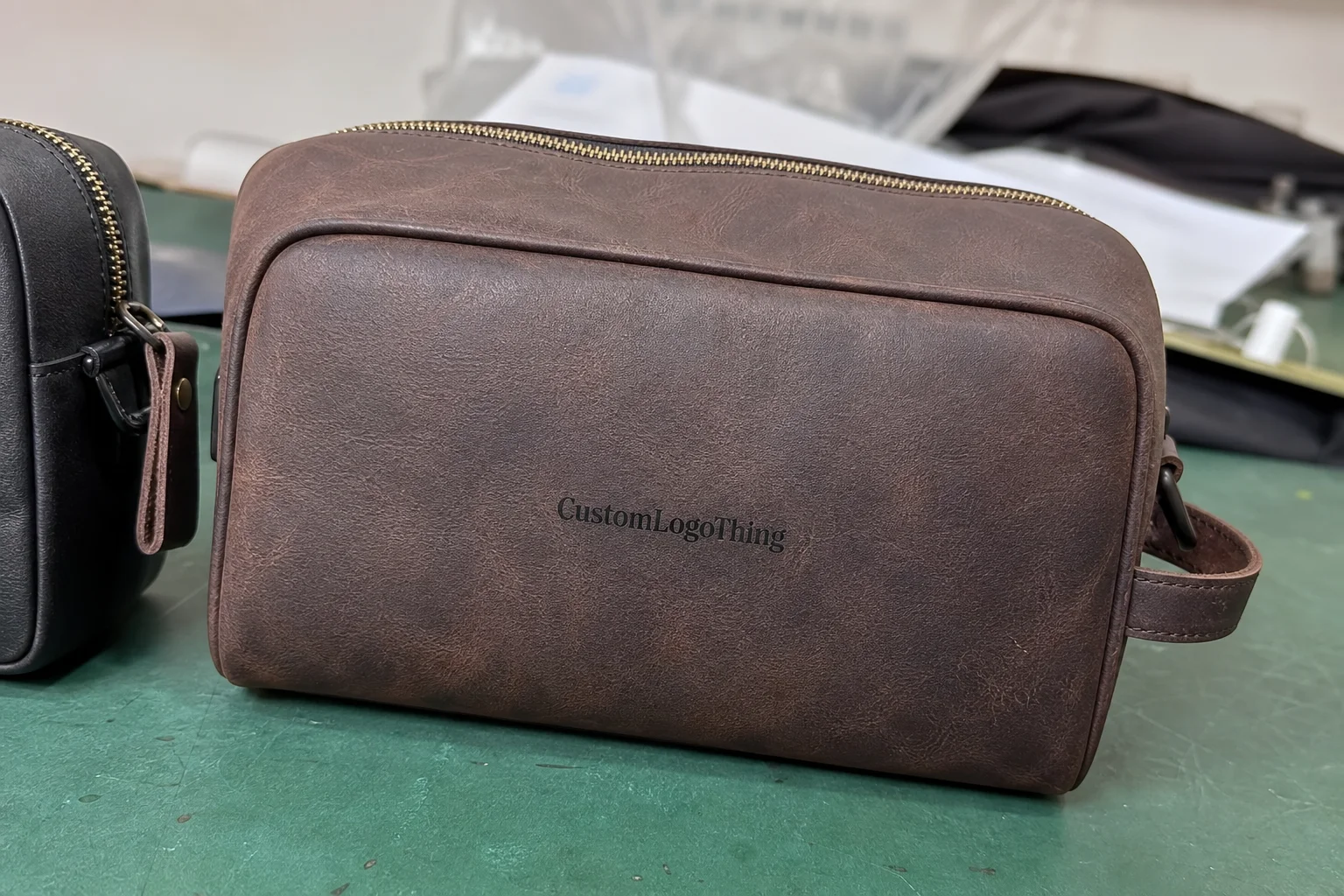
A leather toiletry bag is usually a soft-sided or semi-structured pouch used for grooming items, travel essentials, cosmetics, or small accessories. The label sounds modest. The requirements are not. It needs to open and close smoothly, resist staining, keep its shape well enough to protect contents, and still pack easily inside a suitcase or weekender bag.
The best version depends on where it will live. A retail bag on a shelf can afford a slightly more structured profile because presentation matters. A travel bag has to tolerate more abuse and still be easy to wipe clean. A gift-set component has to coordinate with outer packaging so the whole presentation feels intentional rather than assembled from unrelated pieces.
Leather raises perceived value immediately. It also increases cost, adds weight, and narrows the margin for sloppy construction. Compared with nylon or polyester, leather changes the entire buying equation: touch, smell, surface character, and the way the product ages all matter. A good bag looks better after use. A poor one starts to show wear the first time it gets stuffed too hard.
For that reason, the category is often chosen for premium merchandise, corporate gifts, hospitality amenity kits, and travel retail. In those contexts, the bag is not just storage. It is part of the brand impression. If it is paired with a carton, sleeve, or insert, the packaging should be planned at the same time as the bag, not after.
A useful way to define the project is to answer four questions clearly:
- What items must fit inside?
- How often will the bag be used?
- Does it need to travel in checked luggage, carry-on luggage, or both?
- Is the main goal utility, presentation, or a mix of the two?
Materials, Lining, and Construction
Leather grade is the first spec buyers notice, but it should not be the only one that matters. Full-grain leather usually offers the strongest character and the longest useful life. It keeps the natural surface and tends to age well. Top-grain leather is more uniform and easier to control visually, which can be useful for branding programs that need a cleaner look across a large run. Genuine leather is a broad commercial term, so quality varies widely. Bonded leather is the cheapest route, but it is rarely the best choice for a travel item that gets opened, compressed, and handled often.
The lining is where a lot of projects quietly succeed or fail. A good outer shell can still produce a disappointing bag if the inside traps moisture or stains easily. For travel use, buyers often choose a wipe-clean polyester, PU-coated fabric, or a microfiber-style lining. Those surfaces are easier to maintain when a bottle leaks or a cap comes loose in transit. Dark linings hide wear better. Light linings can feel more premium at first glance, but they show staining faster.
Zippers deserve more attention than they usually get. A weak zipper can make a well-made bag feel cheap. For medium formats, a #5 coil zipper is common. Larger bags often need a #8 or #10 zipper to reduce snagging and maintain smooth movement under load. The pull should feel comfortable in the hand, and the zipper path should not bind at the corners. If the zipper catches during sampling, it will probably keep catching in bulk production unless the pattern is corrected.
Stitch quality matters just as much. Around 8 to 10 stitches per inch on stress seams is a practical benchmark for a clean, durable finish. Corner reinforcement, edge paint, and gusset construction all affect how well the bag handles pressure when packed tight. A soft-sided bag is usually lighter and easier to store. A structured bag holds its shape better and often photographs more elegantly. Neither is automatically better. The right answer depends on whether the bag needs to serve as a functional travel item, a display piece, or both.
Branding method should be matched to the leather surface rather than chosen by habit. Debossing and embossing tend to work best on top-grain and full-grain leather with enough surface stability to hold the impression. Foil stamping can look strong, but it needs the right heat response. Heavily coated or overly soft leather can distort the logo. That is why sample approval should always include actual logo depth, placement, and legibility under normal lighting, not only in a studio-style photo.
For broader material and presentation references, the Institute of Packaging Professionals at packaging.org is a useful source for packaging-related standards and terminology. For transit questions, ISTA guidance can help frame shipping and distribution testing expectations when the bag is boxed with inserts or other presentation components.
How the Production Process Runs
Most custom bag projects follow the same path: inquiry, quotation, sampling, approval, production, inspection, and shipment. The sequence sounds routine, but the quality of the final result depends heavily on how much is defined before sampling begins. A vague spec turns the sample into a guessing exercise. A clear spec turns it into a real test.
The best starting point is a proper specification sheet. At minimum, the supplier needs dimensions, intended use, leather grade, lining choice, color reference, closure style, logo files, and packaging requirements. Vector artwork is the cleanest format for branding. If the logo will be embossed, debossed, or foil stamped, the supplier also needs to know whether the mark is meant to be subtle or highly visible. If the bag will ship in a gift set, the carton, insert, dust bag, and any printed outer packaging should be included from the start because they affect both cost and presentation.
A workable production sequence usually looks like this:
- Define the use case and target unit price.
- Lock the dimensions and expected contents.
- Choose the leather grade, lining, zipper, and closure.
- Approve a technical sketch or pattern draft.
- Request a physical sample with the exact logo method.
- Check zipper travel, seam alignment, and pocket function.
- Approve the pre-production sample before the bulk run.
- Review inspection photos or third-party inspection results if needed.
The sample stage is the point where hidden problems show up. A zipper can bind near a corner. A lining can wrinkle more than expected. A logo can sit too close to the edge and look off-center. Stitch lines can drift at the gusset. These are small issues individually. Together, they determine whether the bag feels premium or merely expensive.
Quality control should be grounded in practical checks rather than abstract promises. Inspect seam consistency, logo accuracy, zipper function, smell, edge finishing, and whether the interior wipes clean without leaving residue. If the bag is being sold through travel retail or bundled with other custom packaging products, the presentation standard should be checked as part of the same review. One weak component can drag down the whole set.
The leather may be excellent, but if the zipper feels rough or the lining stains on contact, the bag reads as lower quality immediately. Buyers notice that faster than they notice the grain.
If the program involves shipping across long distances, ask early whether the pack-out should be built around ISTA-style transit testing or similar distribution standards. That becomes more relevant when the item includes rigid packaging, inserts, or other presentation materials that can shift in transit.
Cost and What Drives It
Pricing is shaped by a short list of variables, but those variables stack quickly. Leather grade, bag size, construction complexity, lining choice, zipper quality, and branding method all affect unit cost. Minimum order quantity is the other major lever. Lower quantities usually raise the per-unit price because pattern setup, cutting, sampling, and finishing labor are spread across fewer pieces.
Buyers often compare quotes that are not actually comparable. A top-grain bag with a smooth lining and debossed logo is not equivalent to a bonded-leather bag with a printed patch and a basic zipper. If the pricing spread looks large, spec drift is often the reason. The only useful comparison is a like-for-like one.
| Option | Typical Use | Approx. Unit Price at 300-500 pcs | Branding Fit | Notes |
|---|---|---|---|---|
| Bonded leather pouch | Budget promotions, short-use gifting | $6.50-$9.00 | Simple deboss or patch | Lowest material cost, but weakest long-term durability |
| Genuine leather bag | Mid-tier corporate gifts, travel sets | $9.00-$16.00 | Deboss, emboss, foil, limited hardware branding | Quality varies by supplier, so sample review matters |
| Top-grain leather bag | Premium gifting, retail, executive sets | $14.00-$24.00 | Deboss and emboss usually work well | Better surface consistency and a cleaner premium finish |
| Full-grain leather bag | High-end retail, luxury gifting | $20.00-$38.00+ | Best for restrained, high-value branding | Highest perceived value, but also the most expensive to source |
Hidden costs usually create the biggest surprises. Ask up front about sampling fees, mold or plate charges, packaging upgrades, revisions, and freight. If the quote covers only the bag body and not the presentation box, the landed cost will be higher than it first appears. That matters in retail packaging and in branded packaging programs where the unboxing moment is part of the product value.
A practical way to budget is to treat the bag, the finish, and the packaging as one system if the item is meant to feel premium. If the program is utility-driven, spend more on leather durability, lining performance, and zipper quality. The packaging should support the product’s purpose, not compete with it.
Lead Time and Planning
Lead time is usually a combination of sampling time, approval time, production time, and transit time. Buyers often hear one number and assume it covers everything. It usually does not. A factory might quote 12 to 18 business days for production after approval, but that does not include the sample round or shipping. If the project needs a custom logo plate, a special zipper pull, or a leather color match, the schedule can stretch further.
The cleaner way to plan is to ask for milestone dates, not a single promised ship date. Request the artwork confirmation date, sample ship date, approval deadline, production start date, inspection window, and estimated dispatch date. That makes delays visible early. A slipped sample date is manageable. A missed launch date usually is not.
Common delay points are predictable:
- Waiting on leather color approval.
- Changing logo size after the sample arrives.
- Custom hardware that needs extra setup.
- Peak-season factory loading.
- Late changes to inserts or outer packaging.
Transit should be separated from production in the planning sheet. Air freight is faster, but it can be expensive for leather goods, especially at higher volume. Sea freight is more economical for larger orders, but it adds calendar time and more coordination. If the bags are tied to a seasonal launch, retail drop, or event date, build buffer time. Leather is not a category where you want to be making last-minute tradeoffs.
Packaging and distribution deserve equal attention. If the toiletry bag will ship in a rigid box with printed collateral, the shipper carton should be evaluated too. A product can arrive in perfect condition and still feel damaged if the outer packaging collapses or the inserts shift. That is where transit testing standards and reasonable pack-out design become part of the buying decision rather than an afterthought.
Common Buying Mistakes
The first mistake is choosing leather by appearance alone. A bag can look rich in a close-up image and still perform poorly if the surface scratches too easily or is hard to clean. For travel and grooming use, moisture resistance and lining quality deserve as much attention as color and grain.
The second mistake is under-sizing the bag. Buyers often approve dimensions that look elegant on paper, then discover the bag cannot fit a razor, bottle, charger, and comb without bulging. That is not a manufacturing issue after the fact. It is a planning issue before sampling. If the bag is meant to hold specific items, give the supplier actual item dimensions.
The third mistake is vague branding instructions. “Make the logo visible” is not a specification. The buyer should define placement, width, depth, and finish. A logo set too close to the zipper or too low on the panel can make the whole bag feel off-center. If package branding is part of the sale, consistency matters even more.
The fourth mistake is approving samples too quickly. A sample should be handled, zipped, packed, wiped, and reopened several times. Check whether the pull is comfortable. Check whether the stitching is tight at the corners. Check whether the lining wipes clean without staining. That small effort is far cheaper than correcting a large run later.
The fifth mistake is ignoring landed cost. The bag price is only one line. Freight, packaging upgrades, inserts, customs, and revision fees can move the total materially. Comparing quotes without those items is how projects get approved on paper and then pushed over budget later.
If a quote looks unusually low, the missing cost is usually hiding in packaging, shipping, or a spec that is thinner than the sample photo suggests.
Spec Checklist and Practical Tips
Start with the use case, not the finish. A travel retail buyer, a corporate gifting team, and a hospitality operator may all want a custom leather toiletry bag, but they do not want the same product. Travel retail usually rewards a clean silhouette and stable pricing. Executive gifting benefits from richer leather and restrained branding. Hospitality typically needs wipeability and repeatable build quality above all else.
If you want quotes that are actually useful, ask suppliers for two versions of the same design: one premium and one value-engineered. Keep the dimensions, logo, and overall layout the same. Then compare unit cost, weight, closure, and presentation. That comparison usually reveals the right tradeoff faster than open-ended revisions.
Request a sample with the exact zipper, lining, and decoration method you intend to buy in bulk. A generic sample can mislead. A debossed sample does not help if the final order will be foil stamped. A light lining sample is not a good proxy for a dark production lining. Precision in sampling saves time later.
Before contacting suppliers, build a short checklist:
- Target dimensions and expected contents.
- Leather type and preferred color.
- Lining material and wipe-clean requirement.
- Branding method and logo file format.
- Quantity, budget range, and deadline.
- Packaging needs, including dust bag, insert, or custom printed boxes.
If the bag is part of a larger merchandise or gift program, review the packaging system as a whole. A coordinated carton, sleeve, or insert can do as much for perceived value as a higher-cost leather grade. That is where Custom Packaging Products can sit naturally alongside the item itself, especially when product packaging and presentation influence the purchase decision.
The most reliable approach is also the least glamorous: define the use case, compare two spec levels, and insist on a physical sample before bulk approval. That keeps the project from turning into an expensive guess. If the brief is clear, the quote is comparable, and the sample proves the details, the final bag usually lands where it should.
What should I ask before ordering a custom leather toiletry bag?
Ask about leather grade, lining material, zipper quality, MOQ, logo method, and whether the supplier can provide a pre-production sample. Confirm whether the quote includes setup, packaging, freight, and revision costs. Request a clear timeline from sample approval to final shipment so delays are visible early.
How much does a custom leather toiletry bag usually cost?
Cost depends on leather type, construction complexity, decoration method, and order quantity. Lower-volume orders usually push the unit price up because setup costs are spread across fewer pieces. At medium volume, bonded-leather options can sit in the single digits, while full-grain leather can move well above $20 per unit depending on size and finish.
What is the best leather type for a travel toiletry bag?
Top-grain or full-grain leather is often preferred for durability and a premium look. If the bag will face frequent moisture exposure, the lining matters just as much as the outer leather. A wipe-clean interior can matter more than a richer surface finish in everyday use.
How long does production usually take?
Lead time varies by sampling, approval cycles, order quantity, and leather availability. A straightforward run may take a few weeks after approval, but the real schedule also includes artwork review, sample revision, and shipping. Build extra time if the bags are tied to a launch, event, or retail drop.
Can I order a small quantity without paying a huge unit cost?
Small runs are possible, but setup and labor get spread across fewer pieces. Simpler designs usually help keep the price more manageable. Ask for two quote levels so you can see how the cost curve changes at a higher volume before you commit.