The patch usually gets noticed before the cap silhouette. That matters more than most buyers expect. For Custom Logo Patches for hats wholesale, the patch is not just decoration. It is the repeatable brand mark that has to work across trucker hats, dad caps, snapbacks, beanies, bucket hats, and performance styles without falling apart when the order gets bigger.
That changes the buying logic. A hat program rarely stays a hat program for long. It ends up inside event kits, employee packs, retail shelves, influencer boxes, uniform rollouts, or warehouse cartons that need to move fast and arrive counted correctly. If the patch is off, the whole run feels off. One bad placement on a 20-piece sample is annoying. One bad placement on 2,000 hats is a budget problem.
Buyers usually want three things at once: a patch that looks clean, a hat that fits the use case, and a production path that does not create chaos on the back end. That sounds simple until the logo is tiny, the cap colors are all dark, and the deadline is not negotiable. Then every small choice starts costing money.
Why Wholesale Hat Patches Beat Plain Embroidery
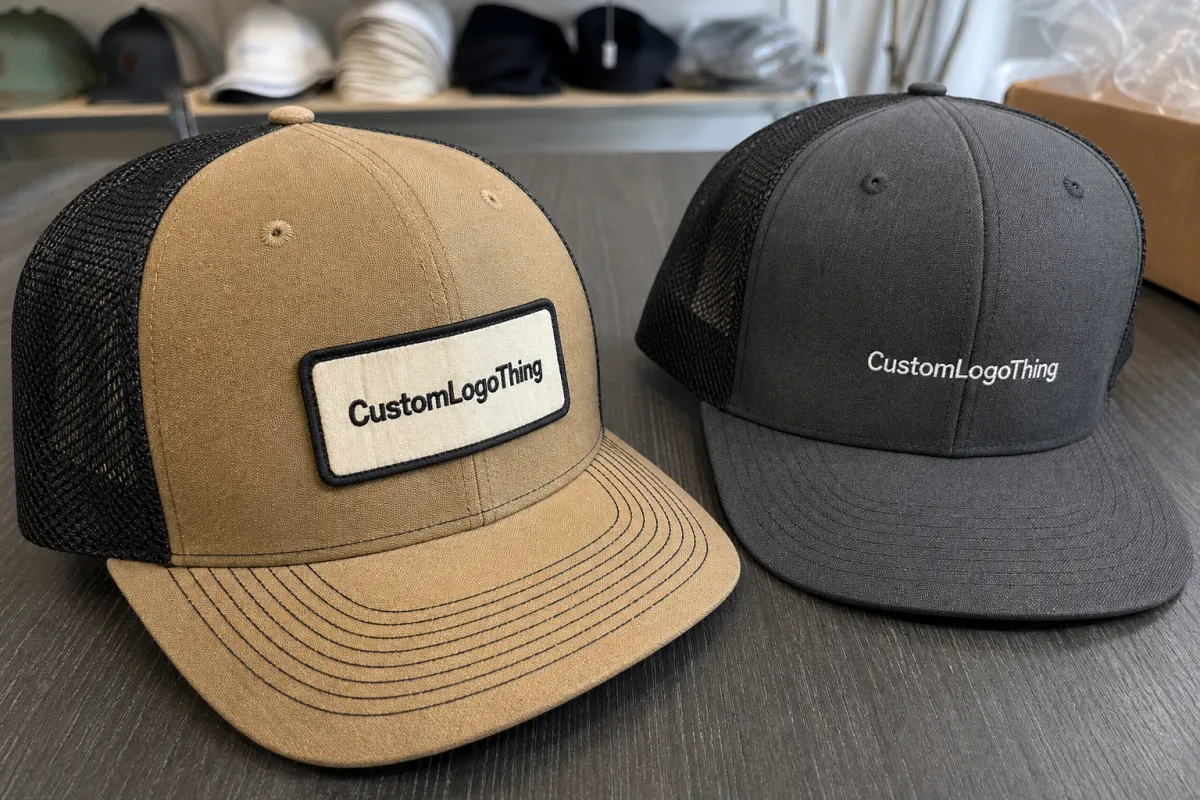
Plain embroidery still works for simple logos. It is durable, familiar, and easy to explain. The problem is flexibility. Direct embroidery locks the mark into one decoration style and one cap setup. A patch gives buyers more room to move. The same logo can go on a structured snapback, a foam trucker, a canvas five-panel, or a cuffed beanie without rebuilding the stitch file every time.
That flexibility is the real reason wholesale patch programs keep winning. A purchasing team can standardize the branding piece and still change the hat blank, the color mix, or the campaign theme. If the order is for a brewery drop, a contractor uniform set, or a franchise rollout, consistency matters more than novelty. Fewer variables means fewer mistakes. That is usually where the savings hide.
Patches also open up material choices that embroidery cannot match cleanly. Buyers can compare embroidered twill, woven labels, leatherette, PVC, rubber, chenille, and sublimated patches before committing to a final cap. Each option changes the feel, weight, edge definition, and perceived value. Some are better for a rugged workwear look. Others are better for retail presentation. A few are built mostly to survive weather and abrasion.
Direct embroidery sits inside the fabric. A patch sits on top of it. That difference sounds minor until the logo needs sharper contrast or more detail than thread can hold. Tiny lettering, thin outlines, and dense icon work often read better on woven or sublimated patches. On the other hand, a bold mark with heavy shapes may look stronger in embroidered twill or chenille. The logo decides. Not the mood board.
Practical buying rule: confirm patch type, attachment method, hat style, quantity, deadline, and packaging needs before asking for pricing. A loose request produces a loose quote. That is not a mystery.
For Custom Logo Things, decoration is only part of the job. A hat may ship loose in cartons, polybagged for retail, paired with custom printed boxes, or grouped into a larger merchandise kit. Decoration, packing, and distribution should be priced together when the order has a hard deadline or a presentation requirement.
Patch Types, Hat Styles, and Branding Use Cases That Actually Fit
Patch choice should follow the use case, not the sample photo on a screen. Embroidered patches fit bold logos, classic club marks, and outdoor service brands. Woven patches are better for small type, tight borders, coordinates, and logos with a lot of interior detail. Leatherette creates a premium, understated look without asking thread to do too much. PVC and rubber handle moisture, abrasion, and outdoor wear. Chenille brings a varsity texture. Sublimation handles gradients and photographic detail that would look muddy in embroidery.
The hat blank matters just as much. A tall shield patch may look strong on a structured trucker cap and awkward on a low-profile dad hat. A long horizontal patch can work well on a five-panel because the panel shape supports it. Beanies usually need smaller patches, often around 1.75 to 2.5 inches wide, because the cuff is shallow and the knit flexes. Performance caps can need special heat settings or sewing choices so the fabric does not mark or pucker.
Here is the part people skip: a flat mockup does not tell the whole story. Hats are curved. Seams interrupt placement. Foam fronts behave differently from cotton twill. Crown height changes the visual center. A patch that looks balanced in art files can sit too high or too wide once it is on a real cap. That is why the same logo often needs a different size or shape across styles.
| Patch Type | Best Fit | Typical Buyer Use | Watch Point |
|---|---|---|---|
| Embroidered twill | Snapbacks, truckers, dad caps | Crews, clubs, breweries, uniforms | Tiny text can fill in |
| Woven | Five-panel caps, retail hats, beanies | Detailed logos, small lettering | Less raised texture than embroidery |
| Leatherette | Outdoor, hospitality, lifestyle caps | Retail merchandise, resort programs | Color behaves differently than thread |
| PVC or rubber | Performance caps, workwear, outdoor gear | Weather-exposed or athletic use | Mold cost may affect small orders |
| Chenille | Structured caps, varsity-style drops | School, club, fashion runs | Bulkier profile |
Use cases tell the truth quickly. Landscaping crews need durability. Tournament giveaways need deadline control. Dealership uniforms need reorder consistency. Gym member drops need something that photographs cleanly. Corporate retreats may care more about polished presentation and individual bagging. Retail capsule collections need a patch that feels intentional, not like decoration pasted onto the nearest blank cap.
Color contrast is a bigger issue than buyers expect. A dark patch on a navy, black, charcoal, or forest cap can disappear fast if the border and background are too close. For mixed programs with several cap colors, ask for contrast guidance before approval. A logo that reads well on white may need a border, raised edge, or lighter backing to stay visible on black.
Logo File, Size, Color, and Attachment Specifications to Confirm
A solid quote starts with complete information. Send the logo artwork, patch type, patch shape, width and height, cap style, cap color, total quantity, deadline, shipping destination, and any packing rules. If the hats need individual polybags, size labels, carton labels, or kit assembly, say so early. Those details affect labor and freight more than most first-time buyers realize.
Vector artwork is the cleanest starting point. AI, EPS, and production-ready PDF files usually reduce cleanup time. A high-resolution PNG can still be reviewed, but complex logos often need adjustment before production. Thin outlines, distressed effects, and small type are the usual trouble spots. The cleaner the source file, the less room there is for surprise.
Most front hat patches sit somewhere between 2 and 3.5 inches wide. That range is not a rule. It depends on crown height, patch shape, and cap structure. A 3.25-inch oval may look balanced on a foam trucker. The same width on an unstructured dad cap can bend awkwardly across the front panel. Height matters too. A 2.75-inch shield needs more vertical space than a narrow 1.25-inch rectangle.
Color control has limits. Pantone references reduce drift, but thread, rubber, PVC, sublimation ink, and leatherette surfaces all behave differently. Matte black PVC on a black performance cap may vanish unless the shape, border, or raised detail creates visible contrast. Black thread on black twill can still work because texture creates separation. That is not magic. It is just how surfaces catch light.
Attachment Options Buyers Should Compare
- Heat press: efficient for many patch styles, but pressure, temperature, and cap fabric compatibility must be checked.
- Sewing: strong durability for workwear, retail hats, and long-term use; common for embroidered and woven patches.
- Adhesive backing: useful for certain applications, but not always the best choice for long wear or laundering.
- Hook-and-loop: suitable for tactical, team, or removable patch programs where interchangeability matters.
Each attachment method has a tradeoff. Heat application is fast, but the cap fabric has to tolerate it. Sewing is reliable, but the stitch path adds time and can affect the look if the patch is oversized or the cap front is too soft. Adhesive backing is convenient for short-term or specialty use, yet it is not the first choice for high-wear orders. Hook-and-loop makes sense for swap-out programs, but it adds bulk and can look out of place on fashion-driven retail caps.
Common production risks are predictable. Tiny type fills in. Thin borders lose strength. Low-contrast logos turn muddy. Oversized patches curve badly on soft hats. A pre-production proof catches those issues before the full run begins, which is cheaper than finding them in finished cartons.
If sustainability claims matter, ask for documentation instead of broad language. For paper-based packaging around the caps, FSC certification may be relevant; the Forest Stewardship Council explains chain-of-custody principles that buyers can use when specifying certified product packaging.
Pricing, MOQ, and Unit Cost Variables for Bulk Hat Patch Orders
Pricing comes from two linked products: the patch and the hat. Then labor, setup, proofing, packing, and freight join the calculation. A quote for 144 hats is not a small version of a quote for 2,500 hats. Setup time, digitizing, mold creation, color matching, and handling are spread across fewer units, so lower quantities usually carry a higher unit cost.
The main variables are quantity, patch material, patch size, number of colors, shape complexity, attachment method, cap blank selection, number of hat colors, and whether individual bagging or labeling is required. Freight can swing the final landed cost sharply if cartons are bulky or the order ships to multiple addresses. Buyers sometimes focus on the decoration line item and ignore the shipping math. That is how budgets get wrecked.
| Order Scenario | Common Quantity Range | Typical Cost Pressure | Buyer Strategy |
|---|---|---|---|
| Pilot merchandise run | 72-144 hats | Setup spread across fewer units | Keep patch size and cap colors simple |
| Event or crew order | 250-750 hats | Deadline and packing requirements | Approve proof quickly and avoid late art changes |
| Retail or franchise rollout | 1,000-5,000 hats | Batch consistency and freight planning | Request pre-production approval and tiered pricing |
| Recurring reorder program | Varies by release | Inventory timing and repeat accuracy | Lock patch specs, placement, colors, and packaging format |
Woven and embroidered patches are often efficient for many logo programs. PVC or rubber patches may require mold costs, but the mold becomes useful for repeat orders because the core shape is already defined. Leatherette can look premium without pushing logo complexity too far, which is why it fits outdoor brands, hospitality groups, and lifestyle retail so often.
Ask for tiered pricing at several quantities: pilot run, event quantity, and replenishment quantity. The best number is not always the lowest one. It is the point where the unit cost changes enough to justify buying more. Moving from 250 to 500 hats may reduce the price enough to support inventory. Moving from 500 to 750 might barely move the needle.
Share the target landed budget per hat. If the target is $12, the production recommendation may shift toward a simpler blank, a smaller patch, fewer cap colors, or easier packing. If the target is $24 for retail, the better answer may be a structured cap, a woven or leatherette patch, hangtagging, and carton packing that supports shelf presentation.
Packaging changes cost too. Buyers using Wholesale Programs often need more than decoration: branded packaging, carton labels, kit counts, or warehouse-ready master cartons. Shipping standards from groups such as ISTA can also influence how larger orders are packed for transit testing and damage reduction.
Production Steps, Timeline, and Lead Time From Artwork to Delivery
A typical order moves through inquiry, artwork review, quote, digital proof, sample or pre-production approval if needed, patch production, hat decoration, quality control, packing, and shipment. The timeline depends on approval speed as much as production capacity. Delayed art files and proof revisions can add days before the clock really starts.
For many bulk cap programs, a realistic standard timeline may run 12-20 business days after proof approval, depending on patch type, blank availability, quantity, and packing. That is not a guarantee. PVC molds, custom-dyed materials, imported blanks, split shipments, or special packaging can extend the schedule. Fast orders are possible, but the design has to be easy and the blanks have to be in stock.
The proofing stage deserves real attention. Check logo spelling, patch size, border thickness, thread or material colors, placement, cap style, and quantity breakdowns by color. A 500-piece order with four cap colors and two patch colors has more failure points than a single-style run. The more variables in the order, the more expensive a mistake becomes.
Physical samples are useful for retail launches, influencer kits, franchise rollouts, and any program where brand consistency matters more than speed. I would rather see a buyer spend a little extra time approving one clean sample than receive cartons full of hats that are technically correct and still disappointing in person. That kind of disappointment is expensive because it is hard to fix after the fact.
Rush orders can happen. Clean artwork helps. Standard patch styles help. Available blank hats help even more. Buyer response time is the part no one likes to talk about, but it matters. A proof that sits untouched for two days can wipe out the benefit of rush scheduling.
Work backward from the in-hands date, not the event date. Leave buffer for receiving, internal distribution, photography, retail merchandising, or kit assembly. If the hats are part of a broader Custom Packaging Products program, align the cap schedule with custom printed boxes, inserts, labels, or other packaging components so one delayed item does not stall the whole release.
Quality Checks That Prevent Bulk Hat Patch Mistakes
Quality control is a financial safeguard. One placement error multiplied across 800 hats becomes expensive very quickly. The same is true for a patch edge that lifts, a color that drifts, or a logo detail that turns muddy under thread.
Inspection should cover patch size, logo orientation, centered placement, attachment strength, thread trimming, color consistency, cap panel alignment, crown shape, and packaging count accuracy. For mixed assortments, inspect each cap color and style, not just one sample pulled from the top of the carton.
Curved crowns create distortion. A patch that looks centered on a flat mockup may need slight adjustment on a real cap because seams, foam thickness, and panel tension shift the visual center. That is one reason production photos before shipment can be useful for larger Custom Logo Patches for hats wholesale programs.
Durability checks vary by attachment method. Sewn patches should be checked for secure stitching, clean thread ends, and no puckering around the edge. Heat-applied patches should be assessed for edge lift, pressure marks, adhesive bleed, and fabric compatibility. PVC and rubber patches need attention around molded edges and fine raised details, especially where the design uses thin borders or small lettering.
Ask a blunt question before shipment: what happens if a defect is found? The answer should cover replacement handling, photo review, remake thresholds, and whether cartons are held until approval. Buyers can forgive a simple cap. Crooked patches, peeling edges, and unreadable logos make the whole brand feel careless.
How Custom Logo Things Supports Wholesale Hat Programs
Custom Logo Things is built for Buyers Who Need branded hats to be quoted, approved, produced, packed, and reordered without guesswork. The value is not hype. It is specification control. A clean production process is worth more than a flashy promise, especially when the order includes multiple cap colors, mixed pack counts, or retail-ready presentation.
The team can help match patch material, cap blank, patch size, and attachment method to the actual use case. A contractor buying 600 work hats should not receive the same recommendation as a boutique brand planning a 150-piece retail drop. Moisture exposure, shelf presentation, reorder frequency, and budget all change the right answer.
Manufacturing alignment matters because bulk hat programs often need more than decoration. Buyers may need individual bagging, labeling, kitting, event distribution, retail cartons, or warehouse-ready master cartons. That is where packaging knowledge becomes useful. A hat program that arrives miscounted, unlabeled, or hard to distribute creates labor on the buyer's side, and that labor was never part of the original budget.
For recurring buyers, approved specifications become an asset. Patch dimensions, placement, colors, cap style, packing method, and carton labels can be documented for future runs. That helps agencies, franchises, clubs, outdoor companies, event planners, contractors, breweries, and corporate merchandise teams keep each reorder aligned with the original approval.
Early sharing improves the quote. Send logo files, target quantity, cap preferences, in-hands date, shipping details, and budget range. Custom logo patches for hats wholesale are easier to price accurately when the production route is defined before the estimate is built.
Next Steps Before You Request a Bulk Hat Patch Quote
Before requesting pricing, gather the basics: logo file, preferred patch type, estimated quantity, hat style, cap colors, delivery location, and in-hands date. If you have reference photos for patch shape, border style, leather tone, embroidery texture, or cap silhouette, send them. Visual references cut down on interpretation errors fast.
Decide what matters most before quoting. Lowest unit cost, premium retail finish, weather resistance, fastest turnaround, exact color match, and easy reorder consistency are not the same path. A procurement team buying uniforms may prioritize durability and reorder control. A retail brand may choose a richer patch, cleaner packaging, and a higher landed cost because presentation affects perceived value.
Ask for tiered pricing and one recommended alternative. That gives you the requested build and a possible efficiency option. For example, a woven patch may preserve small lettering better than embroidery, while a leatherette patch may create a premium look with fewer variables than a multi-color thread design. The best quote is not the one that simply says yes to everything. It is the one that explains what each choice does to cost, timing, and appearance.
Review the proof carefully before approval. Spelling, placement, patch scale, border thickness, and color decisions become expensive to change after production starts. Good bulk orders are not rushed guesses. They are specified products with documented details and enough margin for the real world to behave like the real world.
To Request a Quote, send the artwork, quantity, deadline, cap preference, shipping details, and any packaging requirements so the team can build a specific estimate instead of a generic one.
FAQ
What is the usual MOQ for custom hat patches wholesale orders?
MOQ depends on patch type, cap blank, decoration method, and artwork complexity. Higher quantities usually lower unit cost because setup, proofing, and production handling are spread across more hats. Ask for tiered pricing if you are comparing a small launch order against a larger reorder program.
Which patch type is best for custom logo hats in bulk?
Embroidered patches work well for classic logos with bold shapes. Woven patches are better for small text and fine detail. PVC or rubber patches suit outdoor, athletic, or weather-exposed uses. Leatherette patches create a premium retail look for lifestyle, outdoor, and hospitality brands.
How long does production take for wholesale custom logo hat patches?
Lead time depends on artwork readiness, proof approval, patch type, cap availability, order quantity, and shipping destination. The clock usually starts after artwork and proof approval, not when the first inquiry is sent. Rush options may be possible when the design is simple and blank hats are available.
Can I use the same custom patch design on different hat styles?
Yes, but the patch must be checked against each hat's crown height, panel shape, and structure. A patch that fits a structured snapback may look too large on a low-profile dad hat. For mixed hat programs, approve placement and scale for each cap style before production.
What files do I need to order custom logo patches for caps wholesale?
Vector files such as AI, EPS, or PDF are preferred for clean production. High-resolution PNG files can be reviewed, but complex logos may need artwork cleanup. Include brand colors, patch size preferences, quantity, cap style, deadline, and shipping address for a more accurate quote.


