Plan Custom Beanies for Winter Merch People Actually Keep
A beanie is small. Harmless-looking, even. Then it lands in a winter merch kit and suddenly it has to do real work: feel good against skin, hold shape, look warm, frame the face, and carry a logo without screaming “conference leftover.”
That is why custom beanies for winter merch deserve more planning than most buyers expect. People judge them fast. Stretch, softness, cuff height, warmth, and logo placement all register before anyone reads the insert card or notices the clever box copy.
The practical surprise is how many details affect the final piece. Yarn, knit gauge, cuff depth, decoration method, logo scale, packaging, and delivery timing all matter. A scratchy hat with a stiff badge gets abandoned. A comfortable one ends up in a car, backpack, locker, jobsite bin, or coat pocket. That is the difference between ordered and used.
Why Custom Beanies for Winter Merch Need More Planning Than Most Giveaways
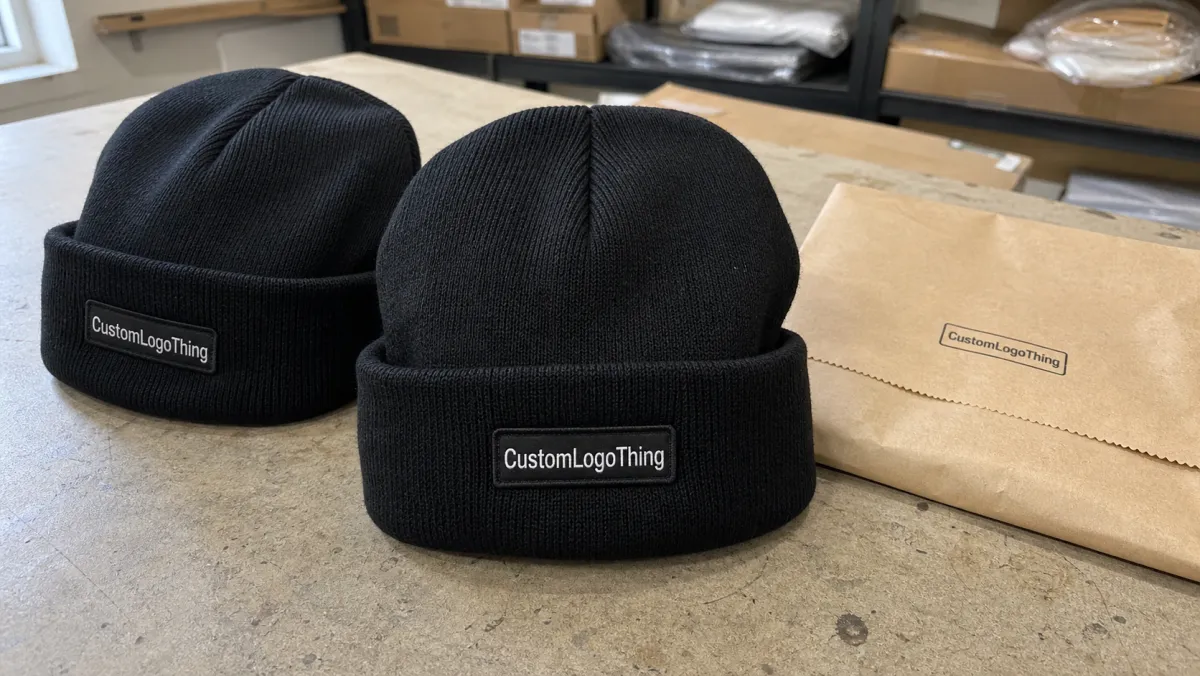
Winter merch covers more than holiday gifts. It can mean employee appreciation kits, retail add-ons, outdoor event giveaways, campus bookstore gear, loyalty rewards, ski trip pieces, volunteer packages, or cold-weather mailers. In all of those cases, warmth and perceived value matter. A cheap pen can be forgettable and still function. A beanie cannot hide. People feel it immediately.
The best orders start with the wearer. The knit needs enough body to hold its shape. The cuff has to sit correctly. The decoration has to survive stretch without looking warped. A bold embroidered mark may work beautifully on a 3-inch cuff. A detailed crest usually needs a woven patch unless you enjoy watching tiny text turn into fuzz.
Packaging changes the decision too. If the hat goes into a mailer with custom printed boxes, tissue, socks, cocoa, or a welcome card, the folded size and logo position affect the unboxing. A patch that looks centered on a flat product photo may face the wrong way in a kit. Basic package branding, yes. Still missed all the time.
Practical rule: choose the beanie, decoration, and packaging as one unit. If each piece is quoted separately without a shared spec, surprises usually show up in proofing, packing, or freight.
A tight plan covers construction, logo method, unit cost, proofing, delivery date, and how the finished item will be handed out or shipped. That is how custom beanies for winter merch move from “cheap giveaway” to something people keep.
How Beanie Construction, Yarn, and Fit Affect the Final Merch Piece
Start with structure. Common options include Cuffed Knit Beanies, uncuffed slouch styles, rib-knit watch caps, pom beanies, and fleece-lined styles for colder outdoor use. A cuffed beanie is usually the safest promotional choice because the folded band gives a stable decoration area, often around 2.5 to 3.5 inches high. Slouch styles feel more casual, but logo placement can shift as the wearer pulls the hat back.
Acrylic yarn is common for a reason. It is durable, color-consistent, washable, and cost-effective. It also handles embroidery and patches well. Wool blends feel warmer and more natural, but they cost more and may need clearer care instructions. Recycled yarns appeal to sustainability-minded programs, though color availability can be narrower. Cotton blends feel soft but typically provide less cold-weather insulation than acrylic or wool blends.
Gauge matters more than the spec sheet makes it sound. Two beanies can both say “100% acrylic” and feel completely different. A tighter knit blocks wind better, holds shape longer, and supports decoration with less distortion. A looser knit may feel soft at first touch, then stretch out after a few wears. For retail packaging or premium employee kits, stretch recovery is one of the first things to check. Pull the hat gently by hand and see if it rebounds. Very scientific? No. Useful? Absolutely.
Fit details need plain language. Adult standard, youth, oversized slouch, shallow cuff, deep cuff, fleece-lined, and pom style are not interchangeable. If the logo must stay visible while worn, confirm the cuff depth after folding and make sure decoration sits centered on the finished cuff, not on the flat unrolled panel.
Warmth has tradeoffs. Fleece lining feels substantial and works well for outdoor crews or cold-weather events, but it adds bulk and can make mailing more expensive. A lighter rib-knit beanie packs flatter and fits more head sizes, though it may not feel premium enough for a high-end kit. There is no universal best choice. There is only the right choice for the audience, climate, budget, and distribution method.
Color is not just branding. Navy, charcoal, black, forest, and heather gray hide wear. Heather yarns soften a logo-heavy design. High-contrast thread or patches pop, but they also expose every small registration issue. For coordinated branded packaging, check beanie yarns against the box, belly band, hang tag, or insert card before final approval. Screens lie. Physical materials are rude but honest.
Logo Decoration Methods That Work Best on Knit Beanies
Decoration is where many beanie projects either gain a retail feel or slide into leftover promo stock territory. The main choices are direct embroidery, woven patches, embroidered patches, leather or faux-leather patches, rubber PVC patches, and Custom Woven Labels. Each has a different cost, texture, and tolerance for detail.
Direct embroidery works best for bold marks, short lettering, and simple shapes. The catch is that stitches sit on a stretchy, ribbed surface. Small type, thin outlines, tight counters, and delicate gradients can disappear into the knit. Good digitizing helps by setting stitch direction, density, underlay, and pull compensation, but embroidery cannot save artwork that was never built for thread.
Patches solve many of those problems. A woven patch can hold finer detail because the artwork is produced on a controlled surface before being applied to the beanie. Embroidered patches feel thicker and more classic. Faux-leather patches give a warm, outdoor retail look, especially with debossed artwork. PVC patches work for brands that want a molded, weather-resistant badge, though they can feel heavy on shallow cuffs if oversized.
Woven labels are quieter. They are useful for side tags, lower-profile corporate merchandise, or programs where the hat should feel wearable rather than heavily branded. A small folded label on the cuff seam can look more like retail apparel than a giveaway. It will not impress someone from across a room. That is the point.
| Decoration Method | Best For | Typical Considerations |
|---|---|---|
| Direct embroidery | Simple logos, bold initials, short wordmarks | Often economical at medium quantities; small text under about 0.25 inch can lose clarity |
| Woven patch | Detailed logos, crests, thin lines | Cleaner edges; patch setup and application add cost and time |
| Faux-leather patch | Outdoor, brewery, campus, lifestyle, and retail-style merch | Debossed art should be simplified; patch color must suit the yarn |
| Woven label | Subtle branding and side-tag looks | Low-profile; not ideal if the logo must be visible from across a room |
Logo size should follow the hat, not the other way around. A 2 x 2.5 inch patch may look balanced on a deep cuff, while the same patch can overwhelm a shallow watch cap. Test contrast against the yarn, simplify registration lines, and avoid asking one decoration method to do everything. For custom beanies for winter merch, cleaner usually beats bigger.
Quality control should include more than “does the logo exist?” Check stitch density, loose threads, patch edges, heat-press adhesion if applicable, label alignment, and whether the decoration sits straight after the cuff is folded. A beanie can pass a flat-table inspection and still look crooked on a head. Annoying, but true.
Pricing, MOQ, and Unit Cost Factors Buyers Should Understand
Beanie pricing is shaped by the blank style, yarn type, decoration method, stitch count or patch complexity, number of logo locations, quantity, packaging, and shipping timeline. Standard decorated acrylic beanies usually sit in a practical promotional range. Fleece-lined, wool-blend, specialty patch, or private-label options climb quickly. Exact pricing depends on the supplier and project details, but a simple embroidered standard blank will almost always cost less than a custom knit jacquard program with hang tags and individual bags.
MOQ, or minimum order quantity, is really about setup. Lower quantities are often possible with standard blanks and one logo location. Fully custom knit patterns, custom yarn colors, private-label labels, or specialty trims usually require higher minimums because the mill, patch maker, decorator, and packing team all have setup time to cover.
Quantity helps unit cost because setup, digitizing, patch production, and handling get spread across more pieces. That does not mean every program needs 5,000 units. It means a quote for 72 pieces and a quote for 500 pieces may look very different, even if the logo is identical.
Hidden cost drivers are common. Oversized logos can increase stitch count. Metallic thread may require slower running speeds. Specialty patches may need tooling or minimum patch runs. Individual polybags, hang tags, size stickers, belly bands, multi-color splits, rush freight, and pre-production samples all add cost. None are automatically bad choices. They just need to be named before quoting, not discovered after approval.
As a rough planning lens, standard decorated acrylic beanies are often the most budget-friendly route. A patch can add cost but improve the finish, especially for detailed artwork. Fleece lining, specialty yarn, custom labels, and kit packing push the project into a more premium bracket. If the beanie is part of a broader winter merch kit, compare the added hat cost against the perceived value of the full presentation. A modest hang tag or belly band may do more for the finished kit than upgrading to a difficult yarn color that delays production.
Before asking for pricing, gather the target quantity, in-hands date, logo file, preferred decoration, color choices, and packaging expectations. If boxes or kit components are involved, review Custom Packaging Products early so the folded beanie, insert, and mailer size can work together instead of fighting each other during fulfillment.
Process and Timeline From Artwork to Finished Winter Beanies
The usual path is straightforward: select the beanie style, confirm blank or yarn color, choose decoration, review artwork, approve a digital proof, produce a sample if needed, run bulk production, inspect, pack, and ship. Simple on paper. The slow spots are almost always artwork approval, patch production, and freight.
Artwork preparation comes first. Embroidery needs digitizing, which converts the logo into stitch instructions. Woven patches need clean vector art with color breaks. Leather patches need artwork that debosses or prints clearly without delicate lines. A badge logo that looks sharp on a website may need serious simplification before it works on ribbed knit.
Proofing protects the project. A digital proof should show placement, size, thread or patch color, and general orientation. A physical pre-production sample is better when the logo has fine detail, the brand color is sensitive, or the finish is premium. Not every order needs a sample, but high-visibility retail drops, executive gifts, and employee kits with custom printed boxes often deserve one.
Lead times vary. Standard decorated beanies are generally faster than fully custom knit programs. Patch production, imported materials, peak winter demand, and multi-location shipping can add days or weeks. For firm event dates, share the in-hands date before quoting, not after proof approval. That one detail changes the options immediately.
Shipping and fulfillment can take longer than decoration. A carton of folded beanies is simple. A kit with belly bands, cards, socks, cocoa, mailers, and address-level distribution is a different operation. If sustainability claims or fiber sourcing matter, ask for documentation. For paper-based packaging claims, resources such as the Forest Stewardship Council can help buyers understand certification language. For shipped kits, ISTA offers package testing guidance worth reviewing before fragile inserts meet winter freight.
Approval delays are real delays. If a proof sits for four business days, the production calendar does not pause politely in the background. Quick decisions on color substitutions, logo scale, packaging, and ship-to details keep winter beanie orders on schedule.
Step-by-Step Guide to Spec a Beanie Order Before Requesting a Quote
A good quote starts with a good spec. You do not need every detail solved before contacting a supplier, but the project should be clear enough that the first estimate is close to reality.
- Define the use case. Is this a staff gift, retail merch piece, campus bookstore item, ski trip giveaway, outdoor fundraiser, or cold-weather event kit? A retail piece needs different finish standards than a one-day giveaway.
- Choose the silhouette and warmth level. Pick cuffed, slouch, pom, watch cap, or fleece-lined based on where the beanie will be worn. A fleece-lined style may be right for outdoor crews, while a soft cuffed acrylic beanie may be better for mailing.
- Narrow the color palette. Two or three yarn colors are usually easier to manage than six. Choose colors that support the logo, photograph well, and coordinate with apparel or package branding.
- Set the branding level. Decide whether the logo should be prominent, retail-subtle, or secondary. That choice points toward embroidery, patches, labels, or side tags.
- Prepare usable artwork. Vector art is best for patches and labels. Embroidery can start from clean high-resolution files, but it still needs digitizing. Remove tiny details that will not reproduce cleanly.
- Confirm logistics. Quantity, color splits, target budget, in-hands date, shipping destinations, and individual packaging all affect cost and schedule.
- Review proofs carefully. Check logo scale, cuff placement, thread contrast, patch orientation, spelling, trademark marks, and whether the finished look suits the audience.
For kits, keep the beanie spec beside the packaging spec. A folded 12-inch knit hat, a rigid mailer, and an insert card all interact. If you are building a wider launch kit, Custom Packaging Products can help frame the packaging design questions before the beanie goes into production.
Common Mistakes That Make Winter Beanies Look Cheap or Arrive Late
The first mistake is choosing the cheapest blank without touching a sample or at least checking the construction. Hand feel, stretch recovery, cuff depth, and knit density matter. A beanie that bags out after two wears damages the merch impression even if the logo is perfect.
The second mistake is forcing a detailed logo into direct embroidery. Thin outlines, small text, gradients, and complex seals rarely improve on knit. A woven patch, faux-leather patch, or simplified secondary mark often looks cleaner and lasts longer.
The third mistake is ignoring the cuff. A design can look centered in a flat mockup but sit too high, too low, or slightly crooked when the hat is worn. Decoration placement should account for cuff depth, seam position, stretch, and whether people may roll the cuff higher or lower.
The fourth mistake is splitting quantities across too many colors. Five yarn colors may look fun in a deck, but each split can complicate inventory, raise unit cost, and make reorders harder. For most custom beanies for winter merch, one core neutral and one accent color is enough.
The fifth mistake is starting after cold weather has already arrived. Decorators, freight carriers, patch suppliers, and fulfillment teams all see seasonal volume. If the order supports a holiday mailer or outdoor event, build in approval time and freight buffer.
The sixth mistake is treating packaging as an afterthought. A beanie shoved into a too-small mailer looks compressed and tired. A bulky fleece-lined hat may force a larger box or change the insert layout. Folded dimensions should be part of the merch spec, not something discovered on the packing table.
The seventh mistake is approving proofs too quickly. Check spelling. Check thread contrast. Check the patch direction. Check whether the final item feels right for the audience. A five-minute proof review can prevent a very expensive carton of almost-right hats.
Next Steps to Build a Better Winter Beanie Merch Order
Keep the first pass simple. Pick one primary audience, one beanie style, one decoration method, two or three yarn colors, a target quantity, and a realistic in-hands date. That gives your supplier enough structure to recommend a workable path instead of quoting a placeholder that changes later.
Gather the practical details in one folder: vector logo, brand colors, shipping locations, packaging needs, event date, budget range, and reference photos that show the desired feel. If the beanie will ship in a box, mailer, or employee kit, include those dimensions or ask for help matching the product packaging to the folded item.
Order a sample or approve a physical pre-production piece when the project is premium, public-facing, or artwork-sensitive. Samples are underused on wearable merch. They can reveal scratchy yarn, oversized patches, weak contrast, weak stretch recovery, or awkward cuff placement before bulk production starts.
Think beyond the beanie alone. Folded presentation, belly bands, hang tags, custom printed boxes, mailer inserts, socks, scarves, cocoa kits, or employee welcome materials can raise perceived value without overcomplicating the hat itself. For packaging support around those pieces, review Custom Packaging Products while the merch spec is still flexible.
Custom beanies for winter merch work best when comfort, logo method, cost, and timing are specified before production starts. Plan those details early, and the finished beanie has a much better chance of becoming the one people keep near the door all season.
FAQs
What is the best logo method for custom winter beanies?
Direct embroidery works well for bold, simple logos with limited fine detail. Woven or embroidered patches are better for small text, thin lines, crests, or a more retail-style finish. Leather, faux-leather, and PVC patches can add a premium look, but they should match the brand tone, yarn color, and beanie structure.
How early should I order custom beanies for cold-weather merch?
Start early for holiday gifts, employee kits, outdoor events, or multi-location distribution. Standard decorated beanies are usually faster than fully custom knit styles, but proofing, patch production, packaging, and shipping can all add time. If the in-hands date is firm, share it before quoting.
What affects the cost of branded beanies the most?
The biggest cost drivers are beanie style, yarn or blank quality, order quantity, decoration method, logo complexity, and packaging. Patch-based decoration can cost more than simple embroidery, but it may produce a cleaner result for detailed artwork. Unit cost often improves at higher quantities because setup and handling are spread across more pieces.
Are custom beanies good for employee winter merch kits?
Yes. Beanies are practical because they are wearable, compact, easy to ship, and useful in many climates. For employee kits, comfort and fit matter more than oversized branding because people are more likely to wear a hat that feels retail quality. Individual packaging, hang tags, or pairing with other cold-weather items can make the kit feel more finished.
What artwork works best for custom knit beanie decoration?
Simple, high-contrast logos reproduce best, especially for embroidery on ribbed knit surfaces. Small text, gradients, delicate outlines, and complex badges often need simplification or a patch instead of direct embroidery. Vector artwork is ideal for patches and labels, while embroidery usually requires digitizing so the design stitches cleanly.


