Buyer Fit Snapshot
| Best fit | Custom Mailers with Invoice Pouches projects where brand print, material claims, artwork control, MOQ, and repeat-order consistency need to be specified before quoting. |
|---|---|
| Quote inputs | Share finished size, material target, print colors, finish, packing count, annual reorder estimate, ship-to region, and any compliance wording. |
| Proofing check | Approve dieline scale, logo placement, barcode or warning zones, color tolerance, closure strength, and carton packing before bulk production. |
| Main risk | Vague material claims, crowded artwork, missing packing details, or unclear freight terms can make a low unit price expensive after revisions. |
Fast answer: Custom Mailers with Invoice Pouches: Film, Print, MOQ, and Carton Packing should be specified like a repeatable production item. The safest quote records material, print method, finish, artwork proof, packing count, and reorder notes in one written spec.
Production checks before approval
Compare the actual filled-product size with the drawing, then confirm tolerance on folds, seals, hang holes, label areas, and retail display edges. Reserve space for logos, QR codes, warning copy, and material claims before decorative graphics fill the panel.
Quote comparison points
Review material grade, print process, finish, sampling route, tooling charges, carton quantity, and freight assumptions side by side. A quote is only useful when the supplier can repeat the same color, closure quality, and packing count on the next order.
Custom Mailers with Invoice Pouches: A Practical Guide
Custom mailers with invoice pouches solve a boring problem that causes very real headaches: a packing slip gets wrinkled, the invoice slips out, or somebody tapes paperwork to a box and calls it done. A clear pouch sounds minor. It is minor. That is exactly why it works. In a packing area, the small details decide whether a shipment looks deliberate or thrown together five minutes before the truck leaves.
Custom Mailers with Invoice Pouches: What They Are and Why They Stand Out
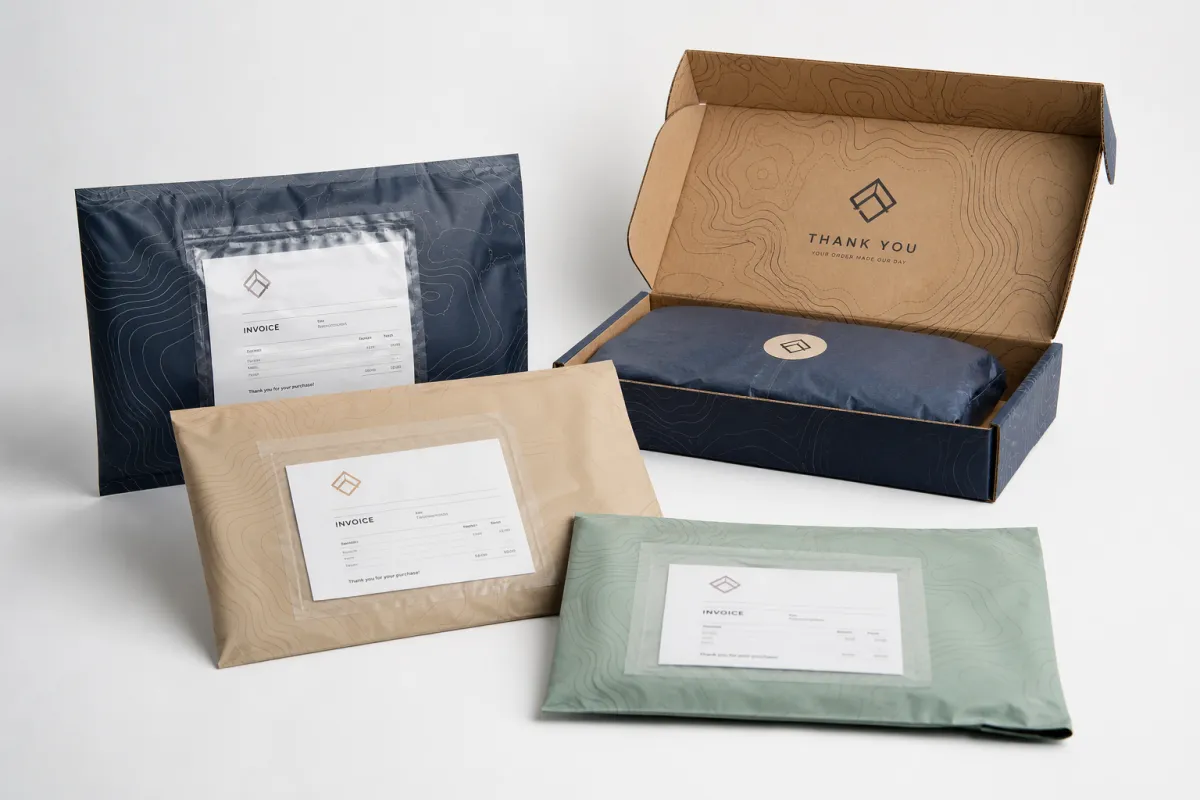
Custom mailers with invoice pouches are exactly what they sound like: a printed shipping mailer with a clear document pouch attached to the outside, usually on the front panel. The pouch holds an invoice, packing slip, return information, or any other paper that needs to travel with the order. That gives one piece of packaging three jobs at once: protect the product, carry the branding, and keep the paperwork visible and secure.
That mix makes sense in apparel, subscription boxes, cosmetics, accessories, replacement parts, and small-batch retail packaging. A T-shirt brand wants the logo to show the minute the parcel lands. A parts supplier needs an order ticket that does not get beat up in transit. A subscription company may want the insert visible without opening the mailer. The pouch handles the paperwork so the rest of the package can do its job.
There is a labor angle too. A packer loads the product, slides the paper into the attached pouch, seals the mailer, and moves on. No separate envelope. No loose slip. No last-second tape patch. That saves motion, and motion costs time. The difference matters whether the team ships 200 orders a day or 20,000.
I think buyers underestimate how much neater the shipment looks when the paperwork is built into the mailer. Nothing flashy. Just tidy. And tidy matters in packaging. The customer may never say, “Nice invoice pouch.” They still notice when the package arrives organized instead of patched together.
Custom mailers with invoice pouches also help teams that need a fast visual check at receiving. A clear pouch placed well lets staff verify the document without opening the parcel. That can help with order matching, returns handling, and warehouse workflows where speed matters. Small feature. Real effect.
A good pouch does not beg for attention. It keeps the shipment readable, protects the paperwork, and lets the pack line keep moving.
If you are comparing options, start with the full packaging system instead of fixating on the pouch alone. Some brands need Custom Packaging Products that combine mailers, cartons, and inserts. Others only need a targeted run of Custom Poly Mailers with document storage built in. The right choice usually depends on product weight, packing style, and how much printing belongs on the outside.
The real value of custom mailers with invoice pouches is simple. They combine branding and handling in one structure. The pouch is not a decorative add-on. It is part of the shipping format itself, which is why it fits so well in packaging programs that need both presentation and function.
One more thing: the best version is not always the fanciest one. For a lot of businesses, a clean, clear pouch on a well-sized mailer beats a busy design with too many graphics. It is kinda boring, and that is the point. The package should work first.
How Custom Mailers with Invoice Pouches Work on the Packing Line
To understand custom mailers with invoice pouches, picture the build from the inside out. The base mailer is usually a polyethylene film structure, often in the 2.5 mil to 4 mil range for standard e-commerce work, though heavier applications may call for more. The exterior can be printed in one color or full coverage, with branding, shipping instructions, or return messaging placed where the eye lands first. Then the clear pouch is attached to the outer face, usually with a heat seal or pressure-sensitive bond depending on the construction.
The pack-out sequence stays straightforward, which is part of the appeal. The product goes into the mailer. The paperwork is folded to the right size and inserted into the pouch. The mailer is sealed, labeled, and sent onward. If the pouch sits in the right place, the packer does not need to wrestle the document into a tight opening or stop to redo the insert. That is the standard worth aiming for.
Pouch placement matters more than most people expect. Center-front placement works for many brands because it is easy to find and easy to load. Side placement can help if the shipping label needs a clear area or if the packer’s hand naturally reaches one side first. Orientation matters too. A pouch opening that faces the workflow instead of fighting it shortens the time per order. Over thousands of packs, that difference turns into real labor savings.
Protection is the other half of the equation. Custom mailers with invoice pouches help guard paperwork from moisture, abrasion, and handling marks. A packing slip tucked into the pouch is much less likely to smear than one taped to the outside. It is also less likely to tear off if the parcel rubs against other cartons in transit. If the pouch uses clear film with decent cling and seal strength, the document stays readable for receiving teams and easy to inspect for customers.
There is still a balance to strike. A pouch that is too tight slows insertion. One that is too loose lets the paperwork shift and look sloppy. For single-sheet invoices, a snug opening usually works well. For multi-page inserts, returns instructions, or combined order documentation, a deeper pouch with more width is usually the better call.
In packaging design terms, the pouch should feel like it belongs on the mailer. The best custom mailers with invoice pouches look intentional because the logo, print block, label zone, and document carrier follow the same visual logic. That is what separates thoughtful retail packaging from something that got printed after the meeting ended.
For businesses handling mixed order types, the pouch can support different document sets without changing the outer mailer format. One SKU may need a single invoice, another may need a packing slip plus a return label, and a third may use a product care sheet. The mailer stays the same; the paperwork changes with the order. That kind of flexibility is one reason custom mailers with invoice pouches show up so often in fast-moving fulfillment environments.
The nicest part is that the pouch does not require a fancy training program. If the format is clear and the opening matches the fold, most teams get it on the first try. That is a quiet win. Packaging people love those.
Cost, Pricing, and Material Choices That Shape the Build
Price is where buyers usually slow down and compare carefully, which is fair. Custom mailers with invoice pouches are not just a printed film cost; they are a small assembly with material, print, pouch attachment, and labor all included. The biggest drivers are film thickness, print coverage, pouch size, pouch position, and order quantity. If the mailer uses a higher percentage of recycled content, special inks, or a heavier gauge film, the unit price rises with it.
For many programs, the invoice pouch adds a modest amount to the base mailer cost, often a few cents per unit at scale. That sounds tiny until you multiply it across a year of volume. Separate document envelopes, extra tape, and slower packing cost money too, just in different places. The honest comparison is total fulfillment cost, not the printed mailer price alone.
Minimum order quantities and setup charges shape the final number too. A small run with custom printing and a pouch usually costs more per unit than a large run because the setup gets spread across fewer pieces. Multi-color graphics, heavier ink coverage, or specialty finishes can raise the price further. That does not make the product overpriced. It means planning matters. If you know annual demand, larger batches often make more sense because they dilute setup and shipping overhead.
Here is a practical way to think about the cost stack:
| Option | Typical Use | Relative Cost | Operational Impact |
|---|---|---|---|
| Plain poly mailer | Simple outbound shipments with no document needs | Lowest | Fast, but paperwork must be handled separately |
| Custom poly mailer without pouch | Branded shipping with separate invoice or insert | Moderate | Strong visual branding, but extra packing steps remain |
| Custom mailers with invoice pouches | Orders needing visible paperwork and branded presentation | Moderate to higher | Cleaner pack-out, less document handling, better presentation |
That table leaves out one key point: lower unit cost does not always mean better value. A cheaper mailer that causes damaged paperwork, slower fulfillment, or more customer service questions can cost more overall. A slightly higher-priced custom mailer with an invoice pouch may reduce those friction points enough to justify the difference.
Material choice affects transit performance too. Thinner films can work for lightweight soft goods, but they may feel flimsy if the route includes rough handling or long conveyor runs. Heavier films hold shape better and usually present the branding more cleanly, which is useful in product packaging where the outer surface is part of the brand experience. Recycled-content films can fit well too, but the full construction should be tested so the pouch attachment and print quality hold up as expected.
For brands that track sustainability claims carefully, verify the sourcing story instead of guessing. FSC certification applies to paper-based components that are responsibly sourced and traceable through the supply chain; it is not a blanket label for every part of a plastic mailer. Paperboard inserts and document components may fit into that system, while the mailer film itself needs its own material specification. For transit performance testing, the ISTA standards are widely used in packaging validation, while the EPA provides useful context on waste and materials management through EPA recycling guidance. Those references will not pick the mailer for you, but they do keep the discussion tied to real criteria.
When buyers ask whether custom mailers with invoice pouches are worth it, my answer is usually this: judge them as a system. If they save labor, improve package branding, and reduce document mishaps, the price can be justified even if the line item looks a little higher than plain mailers. If the paperwork rarely matters, the pouch may be unnecessary. Context decides the value.
And yes, sometimes the cheapest option is the one that creates the most annoying problems. Anyone who has spent time on a pack line knows that already. A penny saved on the front end can become a bunch of tiny repairs on the back end.
Step-by-Step Timeline for Specifying and Ordering Your Mailers
Ordering custom mailers with invoice pouches goes better when the spec work happens before artwork starts. First step: measure the paperwork you actually use. A packing slip folded to 4 x 6 inches needs a different pouch than a two-page invoice folded to 5 x 7 inches. If the team uses more than one document type, identify the most common one and decide whether the pouch should fit the average case or the largest expected insert.
Next comes the layout decision. Where should the pouch sit? Where will the logo go? Is the shipping label applied by hand or by machine? Should the return address sit above the fold or beside the pouch? These choices affect both the look and the line speed. A thoughtful layout can reduce handling steps and keep the order readable at a glance, which is especially useful in custom mailers with invoice pouches used for high-volume fulfillment.
The proofing stage matters more than many buyers expect. Review the artwork alongside the pouch position, document size, film color, and seal structure. A digital mockup can show the concept, but a physical sample shows the truth. Fold the real paperwork, insert it, close the mailer, and see how the finished piece feels in the hand. If there is wrinkling, resistance, or awkward placement, that is the time to fix it.
Production usually follows a straightforward path: prepress, printing, pouch attachment, curing or inspection, finishing, packaging, and outbound shipping. Depending on quantity and complexity, lead times often land around 12 to 18 business days after proof approval, though larger runs or special constructions can take longer. If the job includes custom colors, heavier film, or additional document features, I would plan extra buffer time instead of assuming a quick turn.
Good ordering habits prevent delays. Finalize artwork before requesting the quote. Confirm the folded document size instead of guessing. Approve a sample with the actual paperwork that will travel in the pouch. Match the quantity to expected demand so you do not overbuy or run short right after launch. Those are simple steps, but they keep custom mailers with invoice pouches from turning into a back-and-forth project that drags longer than it should.
A real production note: if the pouch is attached after printing, the factory needs enough clear space and a stable seal area to hold it properly. If the pouch is part of the print plan, those dimensions must be built into the artwork early. That is why buyers benefit from working through the full spec sheet instead of only asking for a logo on a bag. Packaging design lives in the details.
For teams still comparing formats, it can help to look at the broader product mix, including custom printed boxes or different mailer styles for heavier items. The right answer is often a combination of formats, not one package for every SKU. Custom mailers with invoice pouches are excellent for some orders, but not every order needs the same structure.
That planning step is where a lot of good packaging programs either get sharper or get messy. Do the boring work now, and the rest gets easier later. Not glamorous. Still true.
Common Mistakes When Choosing Custom Mailers with Invoice Pouches
One of the most common mistakes with custom mailers with invoice pouches is choosing a pouch that looks fine on paper but is awkward in real use. If the opening is too narrow, staff have to bend the paper too much. If the depth is too shallow, the invoice rides high and looks unstable. Either problem slows the line and invites rework, which defeats the point of the pouch in the first place.
Another frequent miss is ignoring the folded size of the paperwork. Buyers sometimes measure the full sheet and forget that it enters the pouch folded. That leads to wrinkling, corners catching at the opening, or documents that sit halfway exposed. Custom mailers with invoice pouches only work well if the inserted document matches the fold pattern used in packing.
Testing under real conditions is the part people skip and later regret. A mailer may look perfect on a white table under bright lights, then behave differently once it faces humidity, cooler storage, a busy conveyor, or repeated sorting. The pouch adhesive may be fine in one setting and less forgiving in another. If shipments travel through long routes or variable climates, sample testing is not optional; it is the only way to know how the build behaves.
Another mistake is printing too much on the mailer and leaving nowhere sensible for labels, barcodes, or compliance text. A brand can absolutely make custom mailers with invoice pouches look polished, but the design still needs functional zones. If the pouch overlaps the shipping label area or competes with scannable information, the packing room will work around the design instead of with it. That slows the line and creates avoidable clutter.
There is also a tendency to think that a stronger-looking mailer automatically means a better one. Not always. A heavier film may improve durability, but it can also add cost and stiffness that are unnecessary for lightweight products. An oversized pouch can sound safer, yet it creates excess bulk and can make the mailer look less refined. The right choice is the one that fits the product, the document, and the workflow together.
Below are the mistakes I see most often in custom mailers with invoice pouches:
- Pouch size is chosen from guesswork instead of the real folded document.
- Pouch placement slows the packer or conflicts with the label zone.
- Sample approval happens without the actual paperwork used in fulfillment.
- Print coverage crowds out important shipping information.
- Material strength is selected by appearance alone rather than transit conditions.
Those errors sound small, but simple mistakes get expensive when they multiply across thousands of shipments. The safest way around them is to test early and be honest about the actual workflow. Custom mailers with invoice pouches are practical tools, not decorative extras, and practical tools should be measured against the work they need to do.
One more point: do not assume every line worker will insert documents the same way. If the pouch is a tight fit, even a small variation in fold direction or insertion angle can create delays. Clear instructions, a sample that matches the final spec, and a quick pack-line trial are worth more than a perfectly worded purchase order.
I have seen teams blame the pouch when the real problem was the fold instruction. That is a packaging classic. The hardware gets blamed for what is really a process issue.
Expert Tips for Better Fit, Branding, and Shipping Performance
The best custom mailers with invoice pouches do more than hold paperwork. They support the way the order leaves the building and the way it is received on the other end. That starts with fit. I would match the pouch to the most common document size first, then leave enough clearance for the packer to insert the paper without folding it like a paper crane. A little extra room helps. Too much room lets the document drift.
Placement should support the whole visual system. If the logo sits on the upper panel, the pouch should not block it. If the shipping label is applied on one side, the pouch should not crowd that zone or make it uneven. Good package branding feels deliberate because the elements are arranged for a reason. That is true for custom mailers with invoice pouches just as much as it is for retail packaging or custom printed boxes.
Requesting a physical sample is one of the smartest moves a buyer can make. Put your real paperwork in it. Run your real pack sequence. Use your real label placement. If your team tapes anything, folds anything, or adds extras, include those too. The sample should show not only what the mailer looks like, but how it behaves in daily use. That kind of test tells you more than a polished mockup ever will.
Material choices should follow shipping conditions, not just visual preference. A clear pouch with good clarity helps the invoice stay readable, but the adhesive or weld also needs to hold up in your route. If the mailer is exposed to cool docks, warm trucks, or long regional transit, the pouch bond should be tested with that in mind. If the product is a soft good, a midweight film may be enough. If the item has sharp edges or irregular corners, a stronger structure may be the safer call.
Here is a useful rule of thumb: choose clarity where visibility matters, choose film strength where transit is rough, and choose pouch depth where document handling is repetitive. That keeps the discussion grounded. It also keeps custom mailers with invoice pouches from getting overbuilt in the wrong places.
Brand teams sometimes focus only on the front graphic, but the entire shipment is part of the experience. A neat document pouch signals care. A crisp print layout signals order. A clean opening and secure closure signal that the package was built to travel, not just to sit under lights for a photo. That balance is what customers remember, even if they never say it out loud.
One final detail: if sustainability claims matter to your buyers, review every component, not just the outer film. A recycled-content mailer, a paper insert, and a documented sourcing program all need to line up. That is where standards and certifications help keep the conversation honest. For teams building a responsible package program, custom mailers with invoice pouches can fit into a broader material strategy, but only if the full construction is checked.
The strongest mailers are often the ones that disappear into the workflow. People notice the brand, not the effort. People notice the tidy paperwork, not the engineering. That is a good sign.
And if the package gets opened in a warehouse instead of at a kitchen table, that still counts. A well-designed mailer should hold up in both places.
Next Steps for Custom Mailers with Invoice Pouches
If you are considering custom mailers with invoice pouches, the next move is not to guess at a design. Audit the current process. Measure the paperwork. Watch how long it takes to pack one order. Notice where documents get bent, taped, or set aside because there is no easy place for them. That quick audit usually shows whether the pouch is a nice-to-have or a real fix for a recurring problem.
Then gather the spec details before asking for pricing. You will want the mailer dimensions, film thickness target, print requirements, pouch size, pouch position, quantity, and the production window you are aiming for. If you already know the folded size of the invoice or packing slip, include that too. The more exact the brief, the easier it is to quote custom mailers with invoice pouches accurately and avoid rework later.
A short sample run is often the smartest first order. It lets the team confirm fit, document visibility, insertion speed, and overall presentation before committing to a large run. This matters even more if you are moving from plain mailers or from another format entirely. The small test reveals what a spreadsheet cannot.
When comparing suppliers, look beyond the quoted unit price. Ask about material quality, pouch construction, lead time, and whether the vendor understands the practical side of fulfillment rather than only the print side. A lower price can look tempting, but if the pouch fails in use or the print zone is poorly planned, the bargain disappears quickly. For custom mailers with invoice pouches, the best value is usually the one that performs cleanly on the line and looks finished in the customer’s hands.
If you are still building out your packaging program, keep the wider system in view. Some brands need mailers for apparel, cartons for fragile products, and specialty inserts for regulated items. Others need only one format and a very clean document workflow. Either way, the goal is the same: a shipment that is easy to pack, easy to receive, and consistent with the brand.
My practical advice is simple. Start with the paperwork. Match the pouch to the job. Test the sample in real conditions. That approach keeps custom mailers with invoice pouches focused on function first, which is usually where the best packaging decisions begin. And if the result also sharpens package branding, lowers handling time, and gives the shipment a more polished finish, even better.
For many businesses, custom mailers with invoice pouches end up being a small packaging upgrade that touches a surprising number of touchpoints: speed, appearance, document control, and customer perception. That is why they deserve a careful spec, not a rushed one. Get the structure right, and the rest tends to follow.
The takeaway is straightforward: define the document, fold it the way it will actually ship, test the pouch with real hands on a real line, and only then lock the artwork. That is the difference between a mailer that just looks branded and one that genuinely helps fulfillment move faster.
Are custom mailers with invoice pouches worth it for small businesses?
Yes, if you want paperwork to stay visible, protected, and attached to the shipment without adding a separate document envelope. Custom mailers with invoice pouches can also make orders look more polished, which matters for brands that care about the unboxing and delivery experience. A small test run is the best way to see whether the added cost is offset by easier packing and fewer document problems.
What size invoice pouch should I choose for custom mailers with invoice pouches?
Measure the folded size of your most common packing slip or invoice, then leave enough room so staff can insert it quickly. If you use multiple pages or extra return paperwork, choose a larger pouch instead of forcing the document into a tight opening. Testing with the real paperwork is the safest way to confirm the fit.
Do custom mailers with invoice pouches cost a lot more than plain mailers?
Usually the pouch adds a modest amount to the unit price, but the final cost depends on material, print coverage, quantity, and construction. Many brands find the added cost is balanced by faster packing, fewer loose inserts, and a more polished shipment presentation. The best comparison is total fulfillment cost, not just the mailer price alone.
Can invoice pouches be used on recycled custom mailers?
Often yes, but the full construction should be checked to make sure the pouch attachment and film choice work with the recycled material. Ask for samples or technical details so you can confirm the pouch stays secure and the printed surface still performs well. If sustainability is a priority, verify both the mailer film and the pouch components before ordering custom mailers with invoice pouches.
How do I keep paperwork secure in custom mailers with invoice pouches during shipping?
Use the correct folded size, insert the document fully, and make sure the opening is not exposed to repeated snagging points. Choose a pouch with enough depth and a secure seal so the paperwork does not slide out during transit or sorting. Test the finished mailer in real shipping conditions, especially if it will face moisture, long routes, or heavy handling.
If you are evaluating custom mailers with invoice pouches now, the most useful next step is to define the paperwork, the pack-out flow, and the quantity you actually need. That will tell you whether the pouch should be small and simple or sized for a fuller document set. Once that part is clear, custom mailers with invoice pouches become much easier to specify, quote, and put to work in daily fulfillment.

