Buyer Fit Snapshot
| Best fit | Custom Mailing Bags for Boutiques projects where brand print, material claims, artwork control, MOQ, and repeat-order consistency need to be specified before quoting. |
|---|---|
| Quote inputs | Share finished size, material target, print colors, finish, packing count, annual reorder estimate, ship-to region, and any compliance wording. |
| Proofing check | Approve dieline scale, logo placement, barcode or warning zones, color tolerance, closure strength, and carton packing before bulk production. |
| Main risk | Vague material claims, crowded artwork, missing packing details, or unclear freight terms can make a low unit price expensive after revisions. |
Fast answer: Custom Mailing Bags for Boutiques: Style, Size, and Cost should be specified like a repeatable production item. The safest quote records material, print method, finish, artwork proof, packing count, and reorder notes in one written spec.
Production checks before approval
Compare the actual filled-product size with the drawing, then confirm tolerance on folds, seals, hang holes, label areas, and retail display edges. Reserve space for logos, QR codes, warning copy, and material claims before decorative graphics fill the panel.
Quote comparison points
Review material grade, print process, finish, sampling route, tooling charges, carton quantity, and freight assumptions side by side. A quote is only useful when the supplier can repeat the same color, closure quality, and packing count on the next order.
A sweater set can leave in a plain gray sleeve and arrive looking forgettable, or it can ship in Custom Mailing Bags for boutiques that signal care before the customer even tears the flap. For small retailers, that outer layer is not just protection in transit. It is the first real proof that the brand pays attention, and customers notice that fast.
If you sell apparel, accessories, giftable soft goods, or lightweight retail items, Custom Mailing Bags for boutiques pull a lot of weight without adding much weight, which is kind of the whole point. They are light, moisture-resistant, simple to store, and fast to pack. That is why many boutique owners treat them as part of their everyday branded packaging instead of another generic shipping supply. If you are comparing formats across your shipping setup, it helps to look at Custom Poly Mailers next to the rest of your Custom Packaging Products so the whole presentation stays aligned.
What surprises newer buyers is how many decisions hide behind a mailer that looks simple from the outside. Size, film thickness, print coverage, adhesive strength, storage space, and reorder timing all shape the result. Custom mailing bags for boutiques are easy to order badly and easy to order well. The difference shows up in damage rates, packing speed, and how polished the parcel feels in the customer's hands.
Why custom mailing bags for boutiques matter
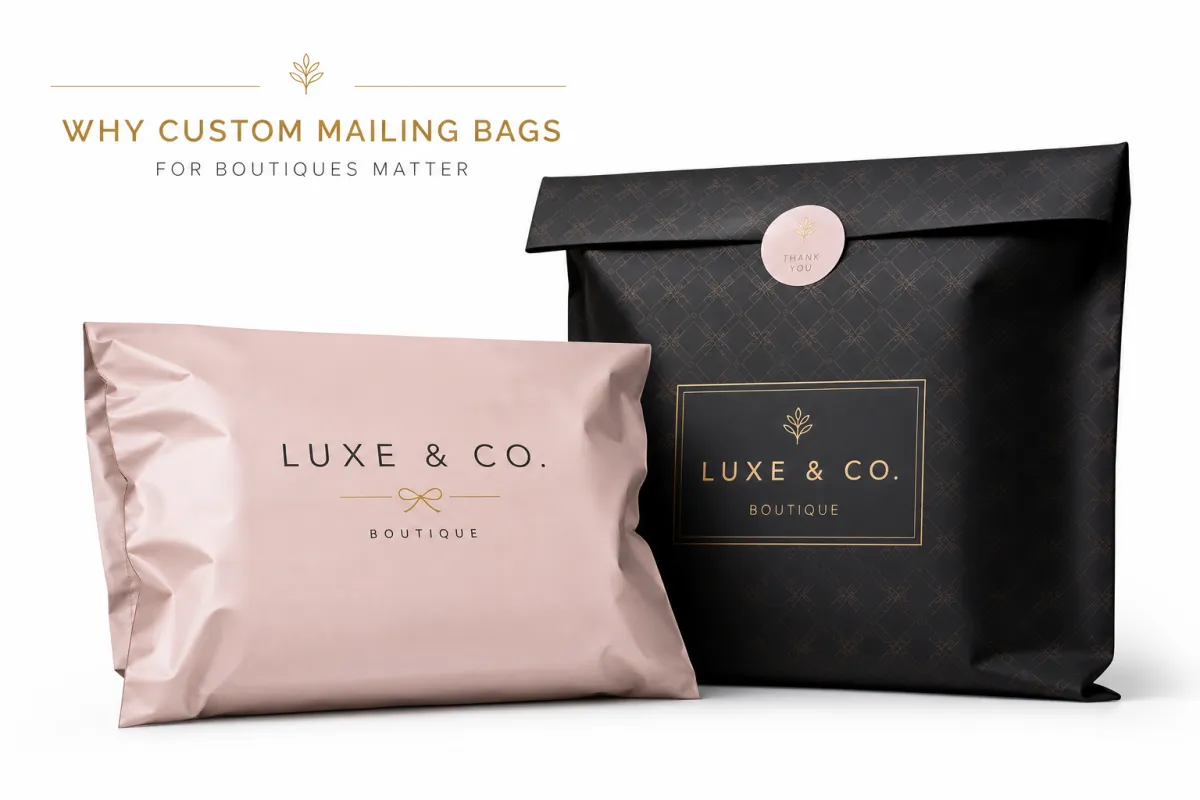
A boutique parcel often carries more emotional weight than the bag itself suggests. Someone may have spent twenty minutes choosing a scarf, a dress, or a small gift, and the outer packaging becomes part of the promise behind that purchase. That is why custom mailing bags for boutiques matter so much: they help a small order feel deliberate, not disposable.
From a practical angle, these mailers are usually made from layered polyethylene film with sealed edges and a self-adhesive flap. That construction keeps weight down while still resisting normal transit abuse, light moisture, and scuffing from sorting equipment. For boutiques shipping soft goods, custom mailing bags for boutiques often hit the sweet spot between protection and efficiency, especially when the product does not need a rigid carton.
There is also a brand reason to care. Every parcel is a mini billboard, and it is a trust signal too. A clean, well-sized mailer says the business understands product packaging and retail packaging beyond the checkout screen. A sloppy one, even if the contents are lovely, can make the whole experience feel rushed. That is one reason I like custom mailing bags for boutiques: they let smaller brands look finished without adding much complexity or weight.
Think about the economics for a second. Poly mailers are typically cheaper and lighter to ship than boxes, and that matters when postage keeps climbing. A boutique that ships a folded top or a pair of socks does not need heavy corrugated board for every order. In practice, custom mailing bags for boutiques can keep fulfillment moving because the packer is not building a carton, sourcing inserts, or stuffing empty space just to make the box feel full.
A mailer has to do three jobs at once: protect the item, move cleanly through the carrier network, and still look like it belongs to the brand.
That balance is why the rest of this topic deserves a little attention. Pick the wrong size and the parcel looks loose. Pick the wrong thickness and the seam may split. Push the artwork too far and the print turns muddy or costs more than it should. The best custom mailing bags for boutiques handle those tradeoffs quietly, so the buyer sees a neat branded package and the warehouse team sees a bag that actually works.
How custom mailing bags for boutiques work
At a basic level, custom mailing bags for boutiques are polyethylene mailers printed with a brand's logo, colors, or pattern. The film is usually coextruded, which means it is built in layers for a better mix of flexibility and strength. The edges are sealed, the back flap gets adhesive, and a release liner protects that adhesive until the packer is ready to close the bag.
The manufacturing flow is straightforward, but a few points need solid communication. The boutique sends artwork, usually as vector files or a clean high-resolution layout. The supplier reviews print placement, color count, and bag dimensions, then prepares the files for the chosen process. Once approved, the design is transferred to the film, cured or finished, and then converted into usable mailers. For custom mailing bags for boutiques, a clean file is often worth more than a flashy file because sharp logos and clear contrast survive printing and shipping abuse much better.
In daily use, the bag needs to behave predictably. A team member folds the garment or product, slips it into the bag, removes the liner, presses the flap closed, and hands the parcel off to the carrier. That sounds simple because it should be simple. Custom mailing bags for boutiques should support fast packing, not slow it down.
Most boutiques use these mailers for items that are soft, flexible, or already protected by their own inner wrap. Common examples include:
- Apparel such as tees, knitwear, leggings, and light outer layers
- Accessories like scarves, hats, belts, and small bags
- Gift sets that do not need crush protection
- Lightweight retail items that fit neatly without piling up air inside
That does not mean every order should go in a poly mailer. If the item is fragile, boxed, or sensitive to bending, the packaging choice changes. Still, for a large share of boutique shipments, custom mailing bags for boutiques are the practical answer because they combine package branding with efficient shipping weight. The right bag can make a small e-commerce operation feel organized without adding much overhead.
For teams that care about testing, a good rule is to think like a parcel engineer for a moment. Check seal integrity, evaluate tear resistance, and run a few shipment simulations before a large rollout. Many packaging teams borrow from the thinking behind ISTA parcel testing standards so the mailer is judged on transit performance, not just how it looks on a screen. That mindset is especially useful for custom mailing bags for boutiques because the bag has to survive sorting, stacking, and last-mile handling with the logo still looking decent at delivery.
Key factors when choosing custom mailing bags for boutiques
Size is the first decision most buyers should make, and it is also the one people rush through. A bag that is too small forces the packer to fight the product, while a bag that is too large wastes material and can make the parcel look loose or underfilled. With custom mailing bags for boutiques, the goal is a fit that leaves enough room for easy packing but still keeps the final parcel neat.
Film thickness matters almost as much. Lighter-gauge mailers are flexible and cost-effective, but they are not the right choice for every item. Heavier-gauge options tend to resist puncture and scuffing better, which can help on longer carrier routes or with products that have buttons, zippers, or sharp retail tags. A practical buyer usually thinks in terms of use case: a 2.5 mil or 3 mil-style bag may work for simple apparel, while a thicker build may suit higher-value shipments or rougher handling. Custom mailing bags for boutiques should be specified for the actual parcel journey, not just the product photo.
Print coverage is the next tradeoff. A one-color logo in a small placement can look crisp and restrained, especially for minimalist or luxury-leaning brands. Full-coverage printing makes a stronger statement, but it can increase setup complexity and change lead time. More colors, gradients, and edge-to-edge artwork can also affect how stable the final print looks from batch to batch. That is why custom mailing bags for boutiques often work best when the artwork is designed for the printing method instead of copied blindly from a website banner.
Closure strength deserves more attention than it usually gets. A weak seal creates returns, complaints about tampering, and parcels that look wrinkled before they even leave the dock. A good self-seal adhesive should close firmly with normal hand pressure and hold until the recipient opens it. If the bag is part of your everyday retail packaging, reliability matters more than novelty. That is especially true for custom mailing bags for boutiques that leave the fulfillment table in high volume.
Brand tone is the last big design factor. A boutique selling modern basics may want a monochrome bag with a single clean mark. A playful accessories label may want a brighter pattern. A premium shop may prefer muted tones and a lot of negative space. Either way, the packaging design should match the story the products already tell. Custom mailing bags for boutiques work best when the outer parcel feels like a natural extension of the collection, not a separate decision made in a hurry.
Operational fit matters too
It is easy to forget the warehouse side of the equation. Where will the mailers be stored? How much shelf space do they take? Can the packer grab the right size quickly? If the mailers arrive in a thick stack but the team has to sort through them by hand, order flow slows down. Good custom mailing bags for boutiques should support packing speed, not become a daily nuisance.
For many shops, the smartest move is to match mailer sizes to the top three order types rather than trying to cover every possible SKU. A boutique with a strong denim category might need one larger bag, while a jewelry-heavy shop may need a smaller size for accessories. The closer the bag fits the real order mix, the more efficient the operation becomes. That is the practical side of custom mailing bags for boutiques, and it is where the smartest savings often show up.
Custom mailing bags for boutiques: pricing and budget
Pricing usually comes down to five levers: size, material thickness, print process, color count, and quantity. Special finishes, custom shapes, or unusual artwork can also change the quote. For custom mailing bags for boutiques, the cheapest unit price is not always the best value because the right bag can reduce damage, improve brand perception, and save packing time. That matters more than people think.
To make the cost picture more concrete, here is a simple comparison using common boutique scenarios. These ranges are directional, not a quote, but they help frame the budget conversation around custom mailing bags for boutiques.
| Option | Typical Use | Approx. Unit Price at 5,000 pcs | Print Style | Best For |
|---|---|---|---|---|
| Plain poly mailer | Basic shipping | $0.08-$0.14 | No print | Lowest cost, internal packing use |
| One-color branded mailer | Apparel and accessories | $0.16-$0.26 | Logo or simple mark | Most boutique shipping programs |
| Full-color custom mailer | Strong visual branding | $0.24-$0.42 | Full coverage or multi-color art | Campaign launches, fashion-forward brands |
| Premium matte or specialty finish | Higher-end presentation | $0.32-$0.55 | Enhanced surface, richer look | Luxury collections, giftable orders |
Those numbers shift with quantity. Larger orders generally lower unit cost because setup is spread across more bags, but that only helps if the boutique can store the inventory and use it before the design or season changes. That is a real issue for custom mailing bags for boutiques, especially when styles rotate often or the brand updates its look every few months.
Minimum order quantities are another budget reality. A small boutique may want 1,000 pieces to test the idea, while a growing shop might move into 5,000 or 10,000 once it sees steady volume. The decision should balance cash flow against the risk of running out. If the mailers sit too long, the savings can disappear into storage space and stale inventory. If they run out too soon, the brand may have to ship in plain packaging, which weakens the whole presentation of custom mailing bags for boutiques.
Watch for hidden costs too. Artwork setup, file cleanup, proofing, freight, and reorder timing can all shift the true spend. A cheaper per-unit quote with expensive freight may not beat a slightly higher quote with better shipping terms. When I look at custom mailing bags for boutiques, I always suggest calculating total packaging cost per order instead of staring at the bag price alone. That means adding the packaging itself, labor, inbound freight, and any damage or rework risk.
Here is a simple way to frame the budget:
- Estimate monthly order volume by bag size.
- Map peak season volume separately, not just the average month.
- Compare 3-6 month storage cost against the savings from a larger run.
- Include setup, freight, and any sample or proof charges.
- Measure the brand value of a cleaner customer experience.
That last point is often where custom mailing bags for boutiques make sense even if they are not the absolute cheapest line item. A more polished parcel can support repeat orders, social sharing, and a more consistent package branding experience, which is hard to reduce to a single line in a spreadsheet.
For broader packaging context, the Packaging and Specialty Packaging industry resources are useful for tracking material trends, sustainability discussions, and format choices that affect retail packaging decisions. That kind of research helps a boutique compare custom mailing bags for boutiques with boxes, tissue, inserts, and other formats before locking in a buying plan.
Step-by-step ordering process and timeline
The cleanest orders usually start with the shipping problem, not the artwork. List the products you ship most often, the finished dimensions of those packed items, and whether the bag needs to support returns or only outbound shipments. That gives you a real foundation for custom mailing bags for boutiques instead of a guess based on catalog sizes.
Next comes artwork preparation. Vector files are ideal because they stay sharp at scale and give the printer cleaner edges. If the logo only exists as a JPEG from a website, it may still work for a proof, but it often needs cleanup before print. Keep text readable, leave safe margins, and avoid tiny details that disappear once they are printed on flexible film. That advice sounds basic, yet it saves a lot of trouble in custom mailing bags for boutiques runs where the bag is not huge and the logo needs to work from arm's length.
Proofing is where the plan gets real. A digital proof confirms layout, size, and color placement. A physical sample is even better because it shows the actual feel of the material, the closing action of the adhesive, and how the artwork reads on a real bag. For many custom mailing bags for boutiques orders, this is the point where the buyer catches a sizing issue before hundreds or thousands of bags are produced.
A typical production sequence looks like this:
- File review and artwork check
- Digital proof approval
- Optional physical sample review
- Printing and curing or finishing
- Quality checks on seal, print, and dimensions
- Packing, cartonization, and outbound freight
Timelines vary, but a simple run often moves faster than a highly customized one. If the design is straightforward, the bag size is standard, and the proof is approved quickly, the process can be relatively efficient. More complex artwork, special film, or a bigger quantity usually adds time. For custom mailing bags for boutiques, I would plan early enough to allow for file cleanup, proofing, and freight without rushing the final week before a launch.
A practical timeline approach
One of the easiest mistakes is treating reorders like first orders. They are not the same. A first run may need extra review, while a reorder may only need a quick check if nothing has changed. Still, it is smart to build in a buffer, especially ahead of holiday drops, influencer sends, or seasonal launches. The last thing a boutique wants is to fall back to plain packaging because the supply cupboard is empty. Strong custom mailing bags for boutiques planning keeps that from happening.
As a rough rule, make a reorder trigger based on weeks of inventory rather than absolute units. If the shop burns through bags faster in peak months, the reorder point should move sooner. That is a small operational habit, but it protects the consistency of custom mailing bags for boutiques and keeps the customer experience steady.
Common mistakes with custom mailing bags for boutiques
The most common mistake is choosing the wrong size. If the bag is too tight, the product gets wrinkled, folded poorly, or forced in against the seams. If it is too large, the parcel looks lazy and can slide around in transit. With custom mailing bags for boutiques, the fit should be deliberate, not approximate.
Another frequent problem is designing for the logo alone. A beautiful mark is useful, but the parcel also has to seal cleanly, stack well, and survive delivery handling. Sometimes the best-looking mailer online turns out to be awkward in the hands of a packer because the flap is too short or the print sits too close to the edge. That is why real-world custom mailing bags for boutiques testing matters more than mockup glamour.
Material quality and adhesive strength can also be underestimated. A weak seal or flimsy film can split under pressure, especially if the bag is overfilled or handled roughly in transit. It is not the flashiest part of the conversation, but the adhesive is what keeps the package closed. For custom mailing bags for boutiques, the seal should be treated as a performance feature, not a background detail.
Price-only buying is another trap. A cheaper quote can hide thin film, poor print clarity, or inconsistent sizing. If the bags wrinkle badly, jam during packing, or arrive with color drift from batch to batch, the true cost rises fast. The better habit is to compare value across the whole system: unit price, freight, storage, pack speed, and customer impression. That is where custom mailing bags for boutiques either save money or quietly drain it.
Here are the mistakes I see most often in small retail programs:
- Ordering before measuring the packed product dimensions
- Ignoring the feel and stiffness of the film
- Using artwork that is too detailed for the print method
- Skipping a test pack or sample review
- Buying too little inventory for peak demand
The last one is especially frustrating because it is avoidable. A boutique that switches from branded packaging back to plain stock mailers for two weeks will usually lose a little of the polished look it worked so hard to build. That is one reason I like treating custom mailing bags for boutiques as part of a planned inventory cycle instead of a one-off purchase.
Expert tips for custom mailing bags for boutiques
Design for the parcel journey, not only the product photo. A mailer that looks crisp on a flat lay can still look muddy after being stacked, sorted, and rubbed against other parcels. For custom mailing bags for boutiques, strong contrast and clean spacing usually outperform busy artwork because they stay readable after handling.
If your order volume is moderate, restraint often looks more premium than decoration. A centered logo, one or two brand colors, and a clean bag tone can create a sharper result than a crowded full-coverage pattern. I have seen plenty of boutiques do better with a confident, simple layout than with something that tries to say too much. That is one of the clearest lessons in custom mailing bags for boutiques: clarity usually beats clutter.
It also helps to match the mailer size to your top-selling items rather than designing around the oddest SKU in the catalog. A boutique with steady dress and knitwear orders may not need the same spec as one built around small accessories. Review packing data after a few months and adjust if the real product mix changes. That is how custom mailing bags for boutiques become a working part of the operation instead of a fixed guess.
Before peak season, build a reorder buffer. I would rather see a brand hold a few extra cartons in storage than scramble for rush production and pay more for freight. Emergency purchasing tends to create compromises in print, size, or lead time, and those compromises are exactly what you do not want when the brand is busiest. Well-planned custom mailing bags for boutiques reduce that stress.
There are also moments when upgrading the design makes sense. Holiday launches, premium capsule drops, influencer mailers, and giftable orders can justify a more refined finish or a stronger visual treatment. You do not need the same level of detail for every SKU. A boutique can keep one mailer for everyday shipping and another for special presentation. That layered approach works well with custom mailing bags for boutiques because it lets the packaging match the sale, not just the product type.
A few practical checks can keep the project grounded:
- Confirm the final packed size of your most common products
- Request a sample and inspect the seal, feel, and print clarity
- Check whether the mailer stacks well with your other retail packaging
- Compare unit price against total landed cost, not just the quote line
- Keep artwork simple enough to read at arm's length
Those steps sound modest, but they are exactly what make custom mailing bags for boutiques reliable. Good packaging is usually the result of a few careful decisions, not one dramatic one.
And if you are sorting through broader product packaging choices, it is useful to compare mailers against inserts, cartons, and other custom printed boxes so the shipping system stays consistent from one order type to the next. Not every item belongs in the same format, and that is fine. The point is to build a package that fits the brand and the item at the same time.
For anyone who wants to keep the whole ordering process disciplined, the best next step is simple: measure your top items, request a sample, compare size and print options, and prepare artwork before you commit to a production run. That is the practical path to custom mailing bags for boutiques that look good, pack fast, and hold up in transit.
Frequently Asked Questions
Are custom mailing bags for boutiques strong enough for apparel shipments?
Yes, they are commonly used for apparel, scarves, accessories, and other soft goods because the film is lightweight but built to resist normal shipping wear. The best result comes from matching thickness and seal quality to the item weight and the distance it needs to travel. For custom mailing bags for boutiques, the right spec matters more than chasing the thinnest possible material.
What size custom mailing bags for boutiques usually need?
Most boutiques size mailers around their best-selling items, such as folded tees, light knitwear, small accessories, or gift sets. The smartest approach is to measure the finished packed dimensions first, then choose a bag that allows a little room without excess slack. That usually produces better-looking custom mailing bags for boutiques and a smoother packing process.
How long does it take to produce custom mailing bags for boutiques?
Timing depends on artwork approval, print complexity, quantity, and freight, so simple jobs usually move faster than highly customized runs. Build enough lead time for proofing and a sample check, especially before seasonal launches or promotions. If your boutique depends on custom mailing bags for boutiques for daily fulfillment, planning the reorder early is the safest move.
What affects the price of custom mailing bags for boutiques the most?
The biggest price drivers are size, material thickness, print coverage, number of colors, order quantity, and any special finishing or setup costs. A larger order often lowers the unit price, but the best budget decision should also consider storage space and how often you will need to reorder. That is the real arithmetic behind custom mailing bags for boutiques.
Can custom mailing bags for boutiques support a luxury brand look?
Yes, especially when the design is clean, the logo placement is deliberate, and the bag color matches the boutique's visual identity. A luxury feel usually comes from restraint, crisp printing, and consistent sizing rather than busy graphics. In that setting, custom mailing bags for boutiques can feel just as polished as more expensive retail packaging formats.
Custom mailing bags for boutiques are one of those packaging choices that seem simple until you start making the tradeoffs yourself. Once size, thickness, print style, and budget are lined up correctly, the mailer stops being a supply item and starts working as part of the brand. For a boutique that cares about presentation, speed, and shipping cost all at once, that is hard to beat.
The practical takeaway is straightforward: measure your top packed item, pick the smallest mailer that fits with a little breathing room, test the seal and print Before You Buy in volume, and build a reorder buffer before peak season hits. That is the shortest path to custom mailing bags for boutiques that hold up in the real world and still make the parcel feel intentional.

