Buyer Fit Snapshot
| Best fit | Custom Mailing Bags Price projects where brand print, material claims, artwork control, MOQ, and repeat-order consistency need to be specified before quoting. |
|---|---|
| Quote inputs | Share finished size, material target, print colors, finish, packing count, annual reorder estimate, ship-to region, and any compliance wording. |
| Proofing check | Approve dieline scale, logo placement, barcode or warning zones, color tolerance, closure strength, and carton packing before bulk production. |
| Main risk | Vague material claims, crowded artwork, missing packing details, or unclear freight terms can make a low unit price expensive after revisions. |
Fast answer: Custom Mailing Bags Price: Film, Print, MOQ, and Carton Packing should be specified like a repeatable production item. The safest quote records material, print method, finish, artwork proof, packing count, and reorder notes in one written spec.
Production checks before approval
Compare the actual filled-product size with the drawing, then confirm tolerance on folds, seals, hang holes, label areas, and retail display edges. Reserve space for logos, QR codes, warning copy, and material claims before decorative graphics fill the panel.
Quote comparison points
Review material grade, print process, finish, sampling route, tooling charges, carton quantity, and freight assumptions side by side. A quote is only useful when the supplier can repeat the same color, closure quality, and packing count on the next order.
Custom Mailing Bags price can look tidy on a quote and still turn messy once you count the stuff nobody likes to count: damaged goods, repacking labor, wasted inserts, and the time your team loses fixing packaging mistakes that should never have happened. A mailer that saves two cents on paper but adds thirty seconds at the packing bench is not cheap. It just looks cheap. And if it slows apparel shipping, bumps return rates, or makes a subscription kit arrive looking tired, the bill gets bigger fast. That is the real question here. Not whether a bag is low cost. Whether the custom mailing bags price fits the full job the bag has to do.
One thing buyers miss all the time: the unit price is only one line on the page. The rest shows up in labor, waste, replacement stock, and the brand damage from a parcel that lands looking half-finished. From a packaging buyer’s point of view, that matters more than a tiny swing in material cost. If the bag is protecting lightweight apparel, cosmetics, accessories, or a curated e-commerce order, the right spec can trim hidden costs while still giving the shipment a clean branded finish. That is where the Custom Mailing Bags price stops being a surprise and starts becoming a planning tool.
Brands That Ship often should care about pricing clarity. A small DTC label sending 300 orders a week, a cosmetics line with fragile presentation standards, and an apparel business dealing with seasonal spikes all need different answers. So do teams comparing branded packaging against plain poly mailers, custom printed boxes, or mixed product packaging programs. The point is not to pay more just to say the packaging is branded. The point is to pay the right amount for a mailer that supports speed, presentation, and damage control. Once you look at it that way, custom mailing bags price becomes less about hunting the cheapest number and more about choosing the best total outcome.
That approach matters even more if your shipments are lightweight, flat-packed, and high frequency. In those cases, mailers can cut carton fill, reduce void space, and give the parcel a more consistent retail packaging look. A well-specified mailer earns its place by making operations easier, not by being flashy. And yes, it can still be economical. The trick is knowing which features actually move the custom mailing bags price and which features are just decoration.
The cheapest mailer is not the cheapest order if it creates rework on the packing line or a poor first impression at delivery.
Custom mailing bags price: why the lowest quote can cost more
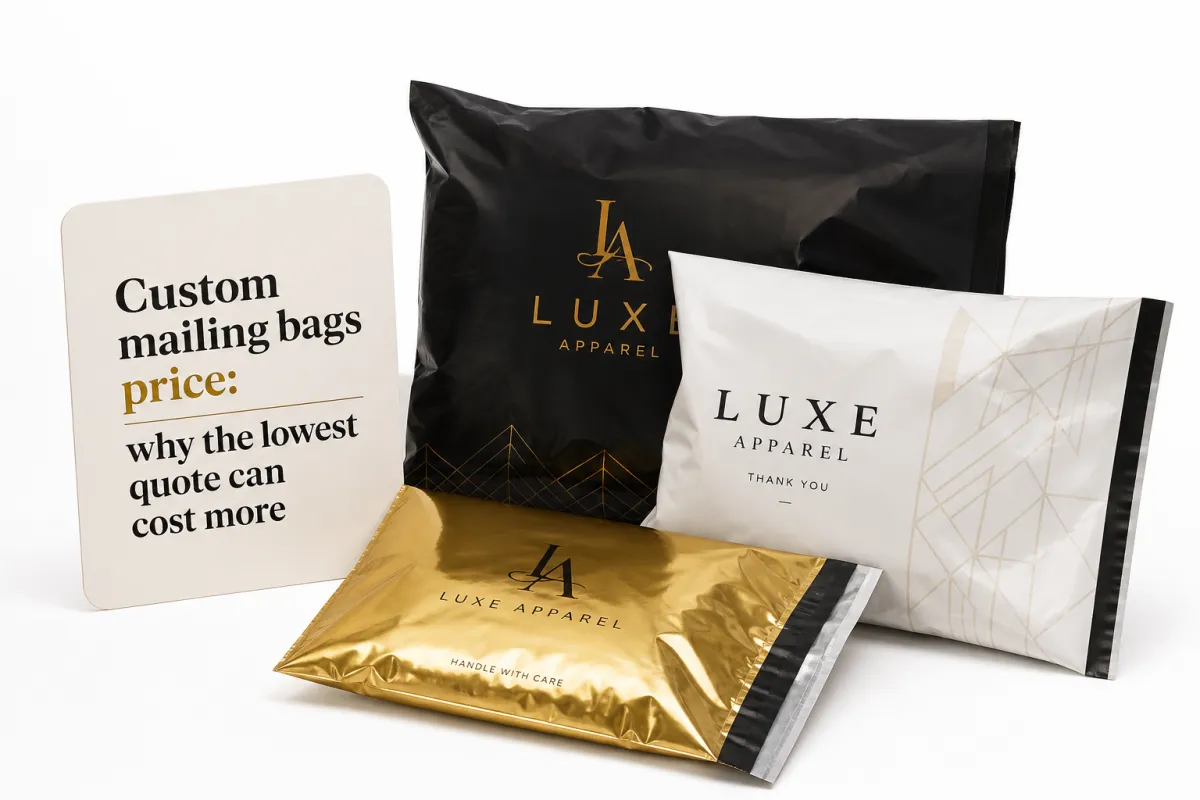
The lowest quote is not always the best quote. Packaging buying proves that over and over. A low custom mailing bags price can hide thin film, weak seals, poor opacity, or print that rubs off during transit. Any one of those failures can turn into returns, customer complaints, or a second shipment. Once that happens, the real cost of the bag jumps fast.
Think about what a mailer actually has to do. It has to hold shape, survive handling, keep the contents private, and carry your brand without slowing the packing bench. If it misses one of those jobs, the order becomes more expensive than the quote suggested. That is why I tell buyers to treat custom mailing bags price as a system cost, not a sticker price. A mailer that costs a bit more per unit but packs faster and arrives cleaner can win on total economics.
This hits hardest for brands shipping apparel, cosmetics, accessories, and lightweight e-commerce orders. Those categories depend on presentation as much as protection. A bag that looks low-grade can drag down package branding, while a better spec can make the shipment feel considered before the customer even opens it. In many cases, the right bag also cuts the need for extra inserts or outer wraps. That can offset part of the custom mailing bags price before the order leaves the warehouse.
Custom mailers also help if your team ships mixed products and needs a tighter brand experience. If your operation already uses Custom Poly Mailers for flat items, or if you need to coordinate with a broader mix of Custom Packaging Products, a clear pricing structure keeps the program manageable. Buyers often compare mailers against custom printed boxes, but the comparison should stay practical: what protects the item, what supports the brand, and what keeps packing labor predictable?
One more thing. Low quotes sometimes assume high tolerances, vague artwork rules, or a spec thinner than what your product actually needs. That is where hidden cost starts. A supplier that gives a detailed line-item quote on custom mailing bags price is helping you. You can see the bag size, thickness, print method, and delivery assumptions in one place. That makes it easier to compare offers fairly and avoid orders that only look cheap because the spec was fuzzy.
What custom mailing bags include: materials, print, and use cases
At the simplest level, a custom mailer is a lightweight shipping bag made from poly film, usually with an adhesive strip for closure and a custom print area for branding. The details are where the money moves. Film thickness changes puncture resistance. Opacity affects privacy. Tear resistance changes how the bag handles rough treatment. Security features, like tamper-evident seals, can add confidence for apparel and retail packaging orders. Every one of those choices affects custom mailing bags price.
Most buyers start with one of three material directions. Standard poly is common for routine e-commerce shipments and gives a solid balance of weight and cost. Heavier-duty film fits better when products are dense, corners are sharp, or the shipment is likely to get shoved through a busy carrier network. Recycled-content options keep showing up in branded packaging programs that want a lower material footprint. The EPA has useful guidance on recycling and material recovery if you are trying to line up your packaging plan with broader waste goals: EPA recycling guidance. One honest caveat: local recycling rules vary a lot, and not every mailer belongs in curbside bins. Check the actual disposal route before you promise sustainability points you cannot back up.
Use case matters just as much as material. Apparel usually benefits from a smooth, opaque bag with enough body to resist scuffing. Cosmetics and accessories often need a cleaner print finish because the package is part of the product packaging story. Subscription kits may need a larger format or a stronger adhesive strip to handle varied contents. Non-fragile retail goods often do well in mailers because the bag adds protection without the weight of a carton. In each of those examples, custom mailing bags price shifts according to how much material and print coverage the order needs.
Print style changes the order too. A single-color logo is usually the most economical branded option. Full-color exterior print can turn a mailer into a stronger package branding tool, but it also raises setup complexity and often increases ink coverage. Custom sizing adds another layer because the film dimensions need to be cut and produced for your exact shipment profile. If you are comparing a plain mailer to a fully branded mailer, ask whether the design is doing real work or just adding cost. That question usually leads to a better custom mailing bags price decision.
For buyers still choosing between package formats, a good test is simple: which option protects the product, packs fastest, and looks right beside the rest of your branded packaging? If the answer is mailers, the next step is to specify the film, print, and closure in a way that fits your order mix. That is where pricing gets more predictable.
Typical mailer choices and cost effects
| Spec choice | Typical unit effect | What changes in practice | Best fit |
|---|---|---|---|
| Standard 50 micron film, 1-color logo | Lower | Basic protection and simple branding | Routine apparel and accessory shipments |
| 60-70 micron film, 2-color print | Moderate | Better body, better handling, stronger visual impact | Retail packaging programs and subscription kits |
| Full-bleed print, higher ink coverage | Higher | More setup, more ink, richer appearance | Brand-led launches and premium presentation |
| Recycled-content film, custom size | Moderate to higher | Material sourcing and custom cutting add cost | Sustainability-focused orders with precise fit |
That table is illustrative, not universal, but the pattern is clear. The more the order moves away from standard dimensions and minimal print, the more the custom mailing bags price rises. For many buyers, that is still worth it because a branded mailer supports a cleaner customer experience than plain packaging. The key is knowing which upgrade buys real value and which upgrade is just aesthetic baggage.
Custom mailing bags price by specification: size, thickness, and finish
Size is one of the first numbers that moves custom mailing bags price. Bigger bags use more film, more ink in some layouts, and often larger shipping cartons for the finished pack. The cost does not rise only because the bag is physically larger. It rises because the production and logistics footprint expands. A small mailer for a folded T-shirt is a different job from a wide-format mailer for a puffer jacket or a bundled multi-item order.
Thickness is the next lever. A thinner film may work for lightweight garments, but it will not always be right if the item has edges, accessories, or higher handling risk. Increasing thickness can improve puncture resistance and seal strength, but it also pushes the custom mailing bags price upward. Most buyers can feel the difference in the hand. A slightly heavier film tends to look and behave more professionally, especially for retail packaging that has to move through carrier hubs without arriving battered.
Finish matters more than people expect. Glossy finishes make print pop and can look sharp on some brand palettes. Matte finishes can feel more restrained and premium, though they may cost more depending on the film structure and print system. Soft-touch effects, metallic inks, and heavy flood coverage can all add production steps. If your budget is tight, compare the finish against the role the bag is supposed to play. The custom mailing bags price should reflect the job, not just the style preference.
Here is a practical way to think about the trade-offs:
- Smaller dimensions reduce material use and are often the fastest route to a lower quote.
- Thicker film improves durability but tends to add to the unit price.
- Simple logo placement is usually the most cost-effective print option.
- Full-panel artwork can strengthen package branding, but it raises setup and ink costs.
- Special finishes should be chosen only when they support positioning or product protection.
If you want a clean comparison, ask suppliers to quote the same size, same thickness, same print coverage, and same delivery method. That sounds basic because it is. It is the best way to keep custom mailing bags price comparisons honest. A quote that uses a different film thickness or a different shipping assumption is not a direct comparison; it is a different product dressed up like a cheaper offer.
For buyers planning packaging design across multiple formats, the mailer should not be judged in isolation. If your brand uses custom printed boxes for some products and mailers for others, you need a consistent visual system, not identical unit costs. A mailer can be the lower-cost component while still carrying a premium look. In that sense, custom mailing bags price should be evaluated against the whole packaging mix, not a single line item.
Custom mailing bags price, MOQ, and volume breaks
MOQ, or minimum order quantity, is one of the strongest drivers of custom mailing bags price. A first run is usually more expensive per unit because the setup cost has to be spread across fewer bags. That setup can include prepress work, plate fees for certain print methods, color separation, proofing, and production calibration. None of those items are dramatic by themselves. Together, they change the economics of the order.
Think in tiers. A 1,000-piece run might be the right choice for a product launch, a seasonal test, or a smaller brand proving out a design. A 5,000-piece run often improves the unit price noticeably. At 10,000 pieces and above, the price usually becomes more efficient, especially if the spec stays simple. The important part is not just chasing volume. It is asking where the break-even point sits for your shipping profile. That is how you keep custom mailing bags price lined up with stock planning.
Illustrative pricing bands often look something like this for a common custom poly mailer format, though exact rates depend on size, print coverage, and material:
- 1,000 pieces: higher per-unit cost because setup is spread thinly.
- 5,000 pieces: noticeably better unit economics and often the sweet spot for many mid-size brands.
- 10,000 pieces: stronger pricing efficiency if storage space and cash flow can handle the run.
Buyers should also ask about repeat-order pricing. A supplier may quote a first run at one level and a reorder at a better level because the tooling and artwork are already approved. That detail matters. If you know a design will be used again, build that into your pricing comparison. A fair custom mailing bags price conversation includes the initial order and the cost of restocking.
There is also a comparison problem that shows up constantly. One supplier quotes a 60 micron bag with one-color print, another quotes a 50 micron bag with a lighter print area, and a third quotes a 70 micron bag with full coverage. The numbers are not really comparable. Before you approve any order, line up the dimensions, thickness, print method, proof format, and shipping terms. That is the only way to judge custom mailing bags price without getting fooled by a lower number hiding a weaker spec.
If you are testing demand, start with the smallest MOQ that still makes operational sense, then ask for a ladder of pricing at 2,500, 5,000, and 10,000 units. That gives you a practical view of how fast the custom mailing bags price drops as volume rises. In many businesses, the best answer is not the biggest run. It is the run that balances cash flow, storage, and the next replenishment cycle.
Process and timeline: from artwork approval to delivery
The order journey is usually straightforward, but the timeline can stretch if the artwork is not ready or the spec changes late. A clear workflow keeps custom mailing bags price tied to the right lead time. First comes the quote request. Then the supplier confirms size, film, print coverage, and quantity. After that, artwork is submitted and checked against print requirements. A proof follows. Production starts only after proof approval. Quality checks happen before shipment. That sequence is ordinary, but each step affects the final cost and schedule.
Simple repeat orders can move quickly, often in the range of 7 to 12 business days from final proof approval, depending on the supplier’s load and the order size. New custom jobs usually need more time, often 12 to 18 business days or longer if the artwork is complex or the bag size is unusual. Transit time sits on top of that. If your launch date is fixed, include all three pieces in your planning: proof approval, production, and shipping. That matters because the best custom mailing bags price is useless if the bags arrive after you need them.
Delay usually happens at proofing. The artwork file may be low resolution, the logo placement may be unclear, or the print area may not match the chosen bag size. Those problems are easy to avoid, but they do cost time. A clean art file and a quick approval process can save days. That is one reason buyers who prepare properly often get a better sense of custom mailing bags price and a better production schedule at the same time.
For shipping-critical programs, I also recommend asking how the mailers are packed and tested for transit. The International Safe Transit Association publishes well-known package testing standards used across the industry: ISTA transit testing standards. You do not need to become a testing engineer to use that reference. You only need to know that the best packaging suppliers think about how the bag performs before it hits the carrier network, not after customers complain.
Here is a practical planning rule: if the bags support a product launch, seasonal drop, or replenishment window, work backward from your ship date and leave room for proof revisions. A rushed approval can save a week and cost a month later if the artwork is wrong. That is why a clean production plan belongs in the custom mailing bags price discussion, not outside it.
A reliable packaging program is built on one habit: lock the spec before the press run, not after the first sample disappoints you.
It also helps to think about how the mailers fit into your broader packaging design. If the outer bag carries the brand message while the inside pack uses simpler product packaging, the design roles need to be coordinated. That is often more efficient than making every component expensive. A balanced mix of branded packaging elements can look polished without forcing every item to carry the same cost burden.
Why choose us for transparent custom mailing bags price quotes
Our approach is built around clarity. No vague bundles. No guessing what is included. No surprise add-ons hiding in the small print. When a buyer asks for custom mailing bags price, the goal is to return a quote that shows the spec plainly so the decision can be made quickly and with confidence. That means size, thickness, print coverage, quantity, proofing, and shipping terms should all be visible from the start.
That kind of quote matters because packaging buyers do not have time to decode a guessing game. They need to know whether a mailer is being quoted at 50 micron or 70 micron, whether the print is one color or full coverage, and whether the delivery estimate includes production only or production plus freight. Once those items are clear, the custom mailing bags price becomes much easier to compare across options. A transparent quote is not just nice to have; it lowers purchasing risk.
Operationally, responsiveness matters too. Buyers often need help with artwork cleanup, brand color matching, or reorder consistency. A line-item process makes that easier because the review happens on the real specification, not on a vague estimate. That is especially useful for teams that manage several SKU groups or want to keep package branding consistent across different product lines. If your packaging program includes mailers for one range and Custom Packaging Products for another, the support has to be organized, not improvised.
Better communication also reduces the cost of mistakes. A missing bleed line, a typo in a logo file, or a size mismatch can trigger delays that push the order back by days. Those are not abstract risks. They are common production issues, and they affect the final custom mailing bags price because extra proof rounds and schedule changes eat time. The best supplier relationship is the one that makes those problems visible early.
For businesses trying to decide between a mailer and other forms of retail packaging, the right answer is often built on evidence, not enthusiasm. If the bag meets the shipping requirement, supports the brand, and keeps the packing line moving, it is a strong choice. If not, a different format may be better. Honest pricing helps that judgment happen. That is why we focus on specification checks, proof review, and practical support instead of selling on buzzwords. The result is a custom mailing bags price conversation that is easier to trust.
From a buyer’s point of view, trust comes from seeing the trade-offs in plain language. A quote that shows what changes the unit cost gives you more control than a price that only shows the total. And control is the part that really matters when you are ordering packaging that must perform at scale.
Next steps for getting an accurate custom mailing bags price
If you want a quote that reflects reality, prepare the core spec before you ask. Start with bag size, material thickness, quantity, number of print colors, artwork files, and your target delivery date. If you can, also mention whether the bags will carry apparel, cosmetics, accessories, or a mixed kit. That context helps narrow the right build and gives a more accurate custom mailing bags price from the first reply.
It is smart to ask for three options. An economy option shows the lowest practical route. A standard option usually reflects the most balanced spec. A premium option shows what happens if you upgrade thickness, print coverage, or finish. Those three levels are useful because they show how the custom mailing bags price changes as the bag becomes more durable or more brand-led. Buyers often discover that the middle tier is the best mix of cost and presentation.
Before you approve the order, check the line-item quote against these points:
- Size: does it fit the product without excess empty space?
- Thickness: is the film strong enough for the item and carrier route?
- Print: is the logo placement clear and legible?
- Proof: does the artwork match the approved layout?
- Lead time: does production plus shipping fit your inventory plan?
If your operation is comparing mailers with cartons, inserts, or other branded packaging formats, do the same exercise across all options. That is the only honest way to compare value. A lower unit cost on paper may vanish once you account for packing labor or extra protection. A fair custom mailing bags price should sit inside a broader shipping and presentation strategy, not outside it.
One final practical step: approve the proof only after you have checked the size, color, and closure details against your actual shipment use. That single habit cuts down expensive rework. Then confirm the production schedule in writing so the order moves into manufacturing cleanly. If you are comparing quotes this week, line up the same size, thickness, print coverage, MOQ, and freight terms before you decide. That one habit usually exposes the real custom mailing bags price instead of the shiny version.
The takeaway is simple: buy the spec that matches your packing reality, not the one that only looks cheapest on paper. That is how you keep the custom mailing bags price honest, the warehouse moving, and the customer opening a parcel that looks like somebody cared.
How is custom mailing bags price calculated?
It is usually based on size, film thickness, print coverage, quantity, and setup requirements. Shipping, proofing, and any special finishes can also move the total up or down. The most accurate quote comes from matching the same specs across every supplier so the custom mailing bags price comparison is fair.
What MOQ should I expect for custom mailing bags?
MOQ depends on the print method, bag size, and whether the design is one color or full color. Smaller runs cost more per unit because setup costs are spread over fewer bags. If you are testing a new product, ask for the lowest viable MOQ and a repeat-order price break so the custom mailing bags price stays practical as you scale.
Do printed bags cost more than plain poly mailers?
Yes, printed bags usually cost more because they require artwork preparation and production setup. The premium is often offset by stronger branding and a more professional unboxing experience. If you ship often, branded mailers can reduce the need for extra inserts or stickers, which can improve the overall custom mailing bags price value.
How long does production take after approval?
Timing depends on the order size, print complexity, and current production schedule. Simple repeat runs move faster than new custom jobs that need artwork checks and proofs. Ask for both production time and shipping time so you can plan inventory accurately and keep the custom mailing bags price decision tied to your launch schedule.
Can I get a sample before placing a full order?
Many suppliers can provide samples or a pre-production proof, especially for custom runs. A sample helps confirm size, finish, opacity, seal strength, and print appearance. If time is tight, ask whether a digital proof or physical sample is the faster option, then make sure the sample matches the quoted custom mailing bags price spec.

