Buyer Fit Snapshot
| Best fit | Custom Matte Labels Manufacturer projects where brand print, material claims, artwork control, MOQ, and repeat-order consistency need to be specified before quoting. |
|---|---|
| Quote inputs | Share finished size, material target, print colors, finish, packing count, annual reorder estimate, ship-to region, and any compliance wording. |
| Proofing check | Approve dieline scale, logo placement, barcode or warning zones, color tolerance, closure strength, and carton packing before bulk production. |
| Main risk | Vague material claims, crowded artwork, missing packing details, or unclear freight terms can make a low unit price expensive after revisions. |
Fast answer: Custom Matte Labels Manufacturer: Material, Adhesive, Artwork, and MOQ should be specified like a repeatable production item. The safest quote records material, print method, finish, artwork proof, packing count, and reorder notes in one written spec.
Production checks before approval
Compare the actual filled-product size with the drawing, then confirm tolerance on folds, seals, hang holes, label areas, and retail display edges. Reserve space for logos, QR codes, warning copy, and material claims before decorative graphics fill the panel.
Quote comparison points
Review material grade, print process, finish, sampling route, tooling charges, carton quantity, and freight assumptions side by side. A quote is only useful when the supplier can repeat the same color, closure quality, and packing count on the next order.
Custom Matte Labels Manufacturer: What Buyers Need to Know
A label changes how a product feels before anyone even touches the cap. That is the whole point. A custom matte labels manufacturer matters because matte finishes cut glare, soften reflections, and make packaging feel calmer, more deliberate, and usually more premium under ugly retail lighting. Put a matte label on a jar and it can look cleaner. Put it on a bottle and it can feel more refined. Put it on a shipping insert and it stops looking like an afterthought.
Finish is the obvious part. It is not the only part. A custom matte labels manufacturer also has to turn artwork, substrate, adhesive, and application requirements into something that survives actual handling. That can mean a roll label for an automatic applicator, a sheet label for manual packing, or a pressure-sensitive format that sticks to glass, HDPE, PET, coated board, or flexible pouches without curling at the edges like it regrets its life choices.
If you are comparing suppliers, you are not just buying a look. You are buying a production method, a material system, and a path from proof to finished roll with as few surprises as possible. For readers building out Custom Labels & Tags, or pairing labels with Custom Packaging Products, that difference matters more than most first-time buyers expect. You can also read more about the company on About Custom Logo Things.
Matte, in packaging terms, means low gloss and low reflectivity. That softer surface changes how ink reads, how shadows land, and how color saturation feels from a few feet away. A red on matte stock often looks richer and less loud than the same red on gloss. Black feels quieter. White feels less harsh. Nothing mystical here. Just optics, coating, and the way shelf lighting hits the print.
Where do matte labels fit best? Beauty, wellness, artisan food, specialty beverage, cosmetics, candle lines, supplements, and private-label packaging use them for a reason. The finish supports retail packaging that wants to feel considered instead of noisy. It also works for shipping inserts and subscription programs where the label needs to support package branding without fighting the rest of the printed system.
Finish is still only one piece of the job. Material choice, adhesive type, liner construction, and print method can change the result just as much as the matte surface itself. A paper label with a matte varnish behaves differently from a matte BOPP film. A removable adhesive on a cosmetic bottle is a very different beast from a freezer-safe adhesive on a chilled food jar. A good custom matte labels manufacturer should explain those tradeoffs without hiding behind sales fluff.
What a Custom Matte Labels Manufacturer Actually Does
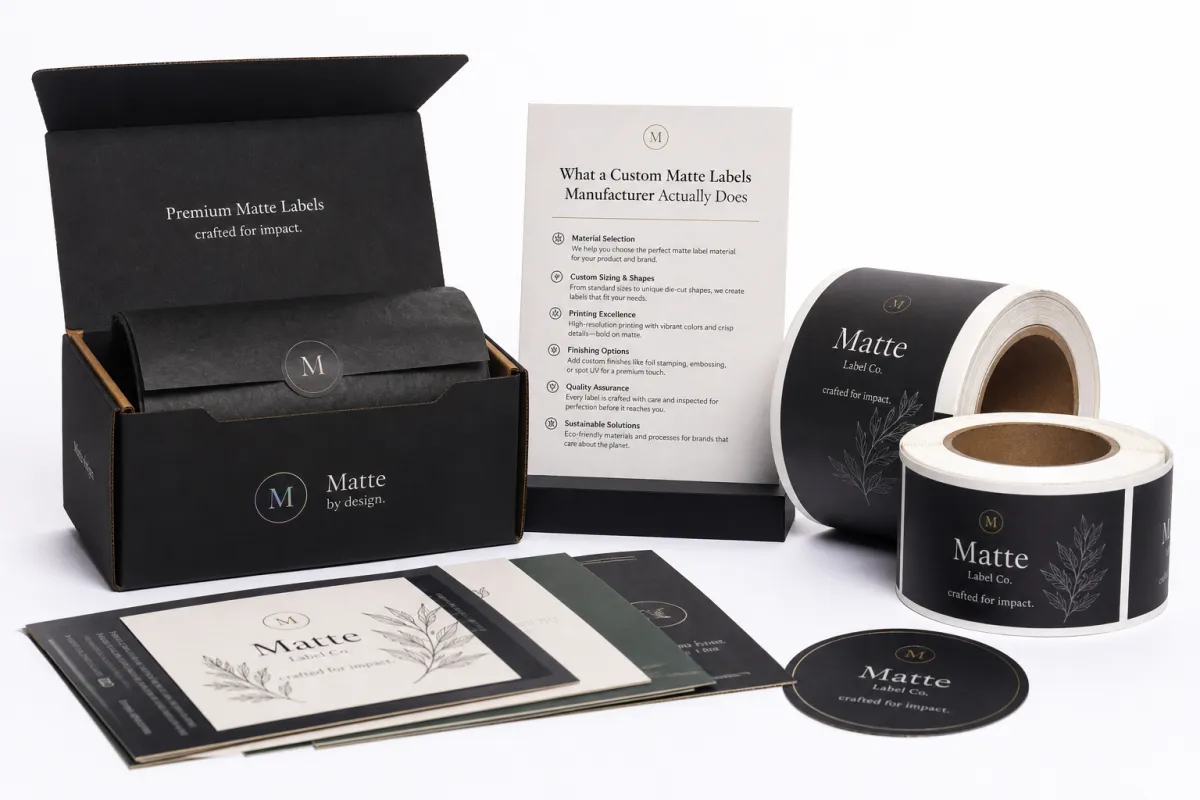
A custom matte labels manufacturer is part print shop, part material advisor, and part production planner. The work starts long before ink hits stock. First comes the brief: dimensions, container type, application method, quantity, target finish, and the environment the label will live through. Then comes the technical translation. Artwork has to fit a dieline. Adhesive has to match the surface. The finish has to support the look the brand wants without turning into a readability problem.
That translation is where many packaging programs win or lose. A design team may want a soft-touch look for premium beauty packaging, but if the label is going onto a cold bottle with condensation, the manufacturer may recommend a synthetic matte face stock instead of paper with a matte coat. That recommendation is not a style opinion. It is a performance call based on packaging conditions, shelf life, and how the label will be applied in the real world.
Matte labels also live inside a broader packaging system. They may need to coordinate with custom printed boxes, carton wraps, shipping labels, or a full branded packaging program. When the visual language stays consistent across the label, carton, and insert, the product feels more intentional. When one piece is too glossy, too thin, or too crowded, the package branding story starts to wobble.
Here is the practical part: a custom matte labels manufacturer should know how to balance appearance and function. That means checking whether small type stays legible, whether barcodes scan cleanly, whether registration stays steady across the run, and whether the finish changes color perception in a way that affects the approved artwork. In a good job, the supplier is not just printing labels. The supplier is cutting down avoidable risk.
For buyers, matte usually means a low-gloss, low-reflection face stock or coating. It can also mean a different tactile feel. Some matte papers feel dry and natural. Some matte films feel smoother and more polished. That hand-feel matters in beauty and wellness, where customers often pick up the package before they read a single claim. A custom matte labels manufacturer should be able to show samples that make that difference obvious, not just talk about it.
Another thing buyers miss: matte does not automatically mean durable. A matte paper label may look excellent on a shelf, but it may not hold up in refrigerated storage or on an oily bottle neck. A matte polypropylene or polyester label may handle moisture better, but it can cost more and feel different in hand. Good suppliers explain the tradeoff instead of pretending one perfect option exists for every job. Spoiler: it does not.
How a Custom Matte Labels Manufacturer Turns Specs Into Labels
The workflow usually starts with artwork intake and file review. A custom matte labels manufacturer checks dimensions, bleeds, safe areas, resolution, color mode, and whether the design matches the actual container shape. If a customer sends a flat file for a curved bottle without compensating for distortion, the print may look fine on screen and fail on the line. That is why proofing is not a checkbox. It is the point where production reality shows up.
From there, the supplier chooses a print path. Digital printing is often preferred for shorter runs, multiple SKUs, fast revision cycles, or variable data. Flexographic printing is usually more efficient at larger volumes and can be a strong choice when the same label repeats often. A seasoned custom matte labels manufacturer will not push one method for every order. The better question is which process fits your quantity, artwork complexity, and cost target.
Matte coatings or matte stocks come next. Some projects use a paper face stock with a matte finish because the brand wants a natural, quiet look. Others use synthetic matte film for moisture resistance, abrasion resistance, or stronger dimensional stability. On food, beverage, and wellness packaging, a matte BOPP face stock is often a practical middle ground. On premium product packaging, a textured matte paper can create a softer, more artisanal appearance.
Digital or flexographic?
Digital is usually faster to set up and better suited to short or mixed runs. It can make revisions less painful, especially when a brand is testing flavors, scents, or regional variants. Flexographic production may carry more setup work, but on volume it can bring unit cost down and support repeat ordering without drama. A custom matte labels manufacturer with both capabilities can tell you where the break-even point likely sits instead of forcing the same process on every purchase order.
Automation also matters. When the supplier has well-maintained finishing equipment, slitting consistency improves, matrix removal gets cleaner, and label rolls tend to behave better on applicators. That matters for narrow labels, fine lines, and barcodes. A few thousandths of an inch in die-cut accuracy can be the difference between a clean production run and a line full of stops and muttered complaints.
Proofing is where buyers should slow down. Review the dieline, exact dimensions, color expectations, finish choice, and adhesive callout. If the supplier sends a digital proof, use it to confirm placement, not to judge the final surface tone with perfect accuracy. If you need a physical sample, ask for one on a substrate close to the actual package. A custom matte labels manufacturer should welcome that request because it reduces the chance of expensive surprises later.
For buyers who care about shipping and distribution stress, it helps to think beyond the label itself. Resources from ISTA are useful when you want a better sense of the vibration, drop, and compression conditions that packaged goods face in transit. If your matte labels sit inside a broader paper-based system, FSC certification may matter for the face stock or carton components, depending on your sourcing goals.
"A label that looks perfect on the proof can still fail on a cold, curved, or oily container. The only real proof is the label on the actual package."
That line sounds blunt because it is blunt. Packaging buyers need blunt. A custom matte labels manufacturer who talks about failure modes instead of hand-waving around them is usually the one worth keeping on your shortlist.
Key Factors to Compare Before Choosing a Custom Matte Labels Manufacturer
Choosing a custom matte labels manufacturer is less about finding the cheapest quote and more about matching the label system to the package. If the face stock is wrong, the adhesive is wrong, or the finish is too soft for the application, the label can peel, scuff, curl, or become unreadable long before the product leaves the store.
Material choice comes first. Paper is usually the most economical and can look excellent for dry indoor use, especially on cartons, jars, and inserts. Matte polypropylene tends to be a strong choice for bottles and containers that may see condensation or handling. Polyester is often selected when higher chemical resistance or durability is required. Textured stocks can create an artisanal look, but they may not be ideal for tiny type or high-speed application.
Adhesive selection is just as important. Permanent adhesive is common, but removable, freezer-safe, oil-resistant, and moisture-resistant options each behave differently. A label on glass is not the same as a label on HDPE. A label on cardboard may need only enough tack to survive distribution, while a label on a chilled serum bottle may need a stronger bond to avoid edge lift. A reliable custom matte labels manufacturer should ask about the container surface, storage temperature, and how long the product sits before use.
Environment often decides the winner. Condensation, refrigeration, abrasion, hand oils, sunlight, and light chemical exposure can all change performance. A label that looks excellent in a studio sample tray may fail on a warehouse floor or in a refrigerated display case. That is why buyers should describe the real use case, not just the intended aesthetic. In the label business, the conditions are part of the specification.
Design compatibility matters more with matte than many brands expect. Because matte finishes reduce glare, they can also soften perceived contrast. Fine serif type, pale text on pale backgrounds, and thin barcode bars may need adjustment. If your packaging design uses a restrained palette, ask the supplier to check readability on actual stock. The finish should support the artwork, not bury it.
Quality controls deserve direct questions. Does the supplier review every file before print? Do they measure die-cut precision? Are color checks done against a standard? Do they test the label on the intended substrate? Can they help validate application conditions? A strong custom matte labels manufacturer will have a repeatable process for those answers, not a vague promise that "we inspect everything."
Buyers comparing suppliers should also ask how the label program fits the rest of the branded packaging system. If the label will sit next to custom printed boxes or ship inside a subscription kit, the visual relationship matters. A quiet matte label can lift the whole pack. A mismatched surface can make even strong packaging design feel split down the middle.
One useful way to compare suppliers is to separate appearance, durability, and operating cost. Those three are rarely optimized at the same time. A cheaper stock may save money upfront but cost more later if it fails under refrigeration. A premium synthetic may be overkill for a dry shelf product. A good custom matte labels manufacturer should help you see those tradeoffs clearly.
| Label Option | Typical Best Use | Typical 5,000-Piece Unit Range | What You Gain | What You Give Up |
|---|---|---|---|---|
| Matte paper stock | Dry products, cartons, inserts, artisan packaging | $0.08-$0.16 | Lower cost, natural feel, clean print appearance | Less moisture resistance, lower abrasion tolerance |
| Matte BOPP film | Bottles, jars, wellness and food packaging | $0.12-$0.24 | Better moisture resistance, stable look, strong all-around value | Higher price than paper, slightly more synthetic feel |
| Matte polyester | Durable labels, chemical exposure, harsher handling | $0.16-$0.32 | Higher durability, better resistance to scuffing and chemicals | Higher cost, less friendly for low-budget programs |
| Textured matte specialty stock | Premium branded packaging, boutique product lines | $0.18-$0.40+ | Distinctive tactile look, premium shelf presence | More sensitivity to legibility and application limits |
The table is only a starting point. A small label with heavy ink coverage can cost more than a larger label with limited print coverage. A custom die can add setup cost. A special adhesive can change the quote. Still, if you compare material, adhesive, and use case together, it becomes much easier to see whether a custom matte labels manufacturer is giving you a sensible recommendation or just a generic one.
Custom Matte Labels Manufacturer Pricing: What Changes the Quote
Pricing is where many buyers get annoyed, because the quote rarely moves in a straight line. A custom matte labels manufacturer may price a run based on quantity, size, colors, finish type, material, adhesive, and production path. Change one variable and the total can jump more than expected. That is normal. Print production likes repetition. It punishes complexity.
Quantity is usually the biggest driver. Lower quantities carry higher setup cost per label because the supplier still has to prep files, verify proofs, calibrate the press, and finish the run. Once volume rises, unit cost often falls. That is why short-run digital jobs and long-run flexographic jobs live in different price bands. If you only need 1,000 labels, you will not get the same unit economics as a 20,000-piece order. The machine does not care about your budget.
Size and coverage matter next. Bigger labels use more material. Heavy ink coverage uses more ink and can add drying or curing time. If the design has a lot of solid black, metallic ink, or rich color on a matte background, the quote may reflect that. A simple one-color matte label can be a very different job from a full-color photographic label, even if the dimensions are almost the same.
Material changes can move price quickly. Paper to matte BOPP is a common step up. Adding a freezer-safe or oil-resistant adhesive can increase both raw cost and handling complexity. A custom matte labels manufacturer may also charge differently for specialty liners, custom perforations, or wound rolls that need a particular orientation for an applicator. Tiny details add up in printing because each one can affect machine setup and waste.
Revision rounds can quietly raise cost too. If artwork is not print-ready, the supplier has to spend more time checking files and sometimes more time reworking the job. Rush production, multiple SKUs, variable data, or custom packaging requirements may also add fees. That does not mean the quote is padded. It means the run is more complicated than a basic label reorder.
For buyers, the smartest comparison is not just the sticker price. Compare the total landed cost, the likelihood of waste, the lead time, and the expected performance in use. A cheaper quote from a weak custom matte labels manufacturer can become expensive if the labels fail on the line or need replacement after arrival. Paying a little more for the correct material and adhesive can save time, labor, and brand damage.
There is also a hidden cost in poor fit. If a matte label does not adhere properly, staff spend time reapplying it. If the label smears or scuffs, product packaging may need to be reworked. If the finish clashes with your retail packaging or your other branded packaging assets, the visual mismatch can undercut the launch. That is not just a design issue. It is a business issue.
Buyers often ask for a quote, then compare the lowest number line by line. That is understandable, but it is not enough. Ask what stock was quoted. Ask whether the adhesive is permanent or removable. Ask how the label is shipped. Ask if proofs are included. Ask whether the supplier can match the application conditions you actually face. A serious custom matte labels manufacturer should answer those questions without hedging.
One practical habit helps more than people expect: compare two or three material options side by side before making a final decision. A matte paper sample, a matte BOPP sample, and a premium textured sample can show you where the value really sits. In many cases, the middle option is the strongest balance of price and performance. Sometimes the premium choice is worth it. Sometimes it is just a prettier line item.
Process and Timeline: From Brief to Delivery
A realistic schedule starts with a clear brief. A custom matte labels manufacturer needs label dimensions, substrate type, quantity, print colors, finish preference, container photos, and any special requirements such as refrigeration or oil exposure. When that information arrives early, the rest of the workflow gets easier. When it comes in piece by piece, the order slows down almost immediately.
A typical path looks like this: discovery brief, file submission, quote, proof review, revisions if needed, production, finishing, quality check, and shipping. That sounds simple, but each step can branch. If the dieline is wrong, the proof goes back. If the material is out of stock, the timeline shifts. If the run uses a custom die, that die has to be made and approved before print. A good custom matte labels manufacturer will show you where the timing pressure points are instead of hiding them until the last minute.
Lead times vary with process and complexity. Simple digital runs may move in a relatively short window once the proof is approved, while specialty materials, larger flexographic jobs, or labels with custom finishing can take longer. The fastest path is usually the one with the least uncertainty. Clean artwork, a clear dieline, and a complete spec sheet can shave off days because they reduce back-and-forth.
Approval milestones matter because label jobs often stall when buyers wait too long to sign off. If the proof arrives and everyone on the team is busy, the schedule stretches. That is normal, but it is also avoidable. The best way to protect launch timing is to assign one person who can review dimensions, color intent, barcode placement, and finish expectations quickly. A custom matte labels manufacturer can move fast when the approval chain is short.
Communication is part of production quality. You want status updates that are specific: proof sent, proof approved, material ordered, run in progress, finishing complete, shipped. Vague updates do not help anyone plan pack-out or inventory. Specific updates let your team coordinate labor, line scheduling, and receiving. That matters even more if labels are tied to a launch date or seasonal product packaging window.
Good communication also includes honesty about risk. If a supplier thinks a certain matte stock might scuff in transit, they should say so. If a label is likely to curl on a narrow radius bottle, they should say so. If a custom die will extend the schedule, they should say so before the purchase order is locked. That kind of transparency is one of the clearest signs that a custom matte labels manufacturer understands real production, not just sales.
If you are building a broader packaging program, align the label timeline with the rest of the print work. Custom printed boxes, inserts, and labels often have different production clocks. When they are all moving toward one launch, the label can become the bottleneck if it was ordered late. Better to put it in the schedule early, especially if the label helps define the final shelf look.
For buyers who want tighter control, sample approval is worth a little extra time. Ask for a sample on the intended substrate, apply it to the actual container, and leave it in the real environment for a few days if possible. A label that survives those conditions is far more likely to survive the field. A custom matte labels manufacturer can support that kind of test without drama, and that is usually a sign you are dealing with the right partner.
Common Mistakes When Working With a Matte Labels Supplier
The first mistake is choosing finish before function. Matte can look beautiful and still be the wrong choice if the adhesive, stock, or coating does not match the container and environment. A custom matte labels manufacturer should help you think through performance first. If the label needs to survive condensation, shipping abrasion, or repeated handling, the material decision comes before the aesthetic decision.
The second mistake is sending artwork that is not truly print-ready. Low-resolution files, missing fonts, weak contrast, and incorrect dielines create delays and increase the chance of a bad print. In some cases, the design might still print, but it will not print well. Buyers who want clean output should supply vector files, confirm the dieline, and make sure the barcode has enough quiet space. The more complete the file, the better the result from the custom matte labels manufacturer.
The third mistake is ignoring the application condition. A matte label that works on a dry sample room table may fail on a cold bottle, a curved jar, or a greasy package line. This is where many first-time buyers get caught. The sample looked great. The production line does not care. Real-world packaging cares about temperature, pressure, and surface energy.
The fourth mistake is comparing quotes without checking specs. Two suppliers may both say "matte label" and still deliver very different materials, adhesives, and finishing quality. One might quote paper. Another might quote synthetic film. One might include a better adhesive. One might not. If you only compare the total price, you can end up buying two very different products and assuming they are the same. They are not.
The fifth mistake is treating proof review as a box to rush through. Review color, margins, bleed, barcode placement, copy, and finish expectations carefully. If you approve a proof with an off-center dieline or a barcode too close to the edge, the problem can survive into the full run. A reliable custom matte labels manufacturer will want you to slow down here because catching a problem on proof is far cheaper than catching it on pallet receipt.
There is also a broader mistake that shows up in branded packaging programs: treating the label as separate from the rest of the package. It is not separate. It sits beside the bottle shape, the cap, the carton, the insert, and the shelf environment. If one piece is off, the whole package feels less intentional. That is why the best label buyers think in systems, not in isolated line items.
Practical check: if you are unsure whether your matte label will perform, test it on the actual container, fill it with the actual product, and expose it to the actual storage condition. Refrigerate it. Handle it. Ship it if you can. Then inspect for edge lift, smudging, scuffing, and readability. That small test saves more money than most people expect.
Expert Tips and Next Steps for Ordering Confidently
Start with samples that match the real job. A generic swatch book sample is useful for surface feel, but it is not enough to judge adhesion or durability. A matte sample on the actual substrate tells you much more. That is where a custom matte labels manufacturer earns trust: by helping you test the actual use case instead of making you guess.
Build a simple spec sheet before you request quotes. Include label dimensions, container material, application method, storage conditions, target quantity, and finish preference. Add whether the product will face moisture, refrigeration, sunlight, or handling abrasion. The more complete the brief, the better the quote. It also reduces the number of revisions you will need later. A good custom matte labels manufacturer can work from a clear one-page spec almost as easily as from a full brand deck.
Ask for a comparison across at least two material options. For many buyers, the best way to understand value is to see how the same design behaves on matte paper and on matte film. The cost difference may be modest, or it may be significant. The performance difference is often bigger than the price gap. If the label is doing real work on the shelf, a slightly higher unit cost may still be the smarter business move.
Use a proof checklist. Confirm artwork, dieline, barcode placement, color expectations, finish, adhesive type, and approval deadline. If your team uses specific Pantone targets or brand color tolerances, share them early. If you have a line speed requirement, say so. If the label needs to run on an applicator, say that too. The best custom matte labels manufacturer is the one that fits into your process without forcing a workflow rewrite.
One more practical move: ask how the supplier thinks about testing. Do they check adhesion on the actual package? Do they measure slitting accuracy? Do they review type size under the chosen finish? Do they know how the matte surface changes contrast? Those questions reveal whether you are speaking with a printer, a production team, or someone who only knows how to quote a job. The difference shows up later, and usually when it is inconvenient.
For companies building out a family of branded packaging pieces, coordinate labels with cartons, inserts, and shipping materials before the launch is locked. If the label is the last item ordered, it can slow the whole program. If it is planned early, it can support the visual system and keep the launch moving. That applies to subscription kits, retail packaging, and private-label food and wellness lines.
Here is the simplest path forward: gather your specs, request samples, compare at least two materials, review the proof carefully, and place a test run before scaling. That sequence is not glamorous. It works. A custom matte labels manufacturer can make the process feel easy once the job is defined clearly, and that is the point. The label should support the product, not distract from it. If the finish, adhesive, and print method are right, the matte look does exactly what buyers want: it makes the packaging feel more considered, more polished, and more credible from the first glance.
What should I send a custom matte labels manufacturer for an accurate quote?
Send label dimensions, quantity, container type, and whether the label needs to survive moisture, refrigeration, or abrasion. Include artwork files if you have them, or at least a rough layout so the custom matte labels manufacturer can estimate print complexity. Share your target application method and any deadline that could affect production scheduling.
Are custom matte labels better than gloss labels for product packaging?
Matte labels usually reduce glare and can create a more restrained, premium look, especially under bright store lighting. Gloss can boost saturation and shine, which may work better for bold, high-energy branding. The better choice depends on legibility, brand style, and the surface conditions your packaging will face. A custom matte labels manufacturer should be able to show you both options on similar stock.
How long does a custom matte labels manufacturer usually take to produce an order?
Timeline depends on proof approval speed, material availability, print method, and order size. Simple digital runs may move quickly, while specialty materials, custom dies, or large flexographic runs can take longer. Fast approval of artwork and specs is one of the easiest ways to reduce delays when working with a custom matte labels manufacturer.
What affects the price most when ordering matte labels?
Material, adhesive, quantity, and print complexity usually have the biggest impact on price. Finish choice, rush production, multiple SKUs, and special durability requirements can also raise the quote. The lowest unit price is not always the best value if the label fails during shipping or application, so compare the full cost of using the custom matte labels manufacturer rather than the quote alone.
How do I know if a matte label will hold up on my packaging?
Test samples on the actual container and expose them to the real conditions they will face. Check for peeling, smudging, edge lift, moisture damage, and readability after handling or chilling. Ask the custom matte labels manufacturer which adhesive and face stock they recommend for your specific use case, then verify it with a small production test before scaling up.

