Buyer Fit Snapshot
| Best fit | Export Shipping Boxes Manufacturer projects where brand print, material claims, artwork control, MOQ, and repeat-order consistency need to be specified before quoting. |
|---|---|
| Quote inputs | Share finished size, material target, print colors, finish, packing count, annual reorder estimate, ship-to region, and any compliance wording. |
| Proofing check | Approve dieline scale, logo placement, barcode or warning zones, color tolerance, closure strength, and carton packing before bulk production. |
| Main risk | Vague material claims, crowded artwork, missing packing details, or unclear freight terms can make a low unit price expensive after revisions. |
Fast answer: Export Shipping Boxes Manufacturer: Board, Finish, Dieline, and Unit Cost should be specified like a repeatable production item. The safest quote records material, print method, finish, artwork proof, packing count, and reorder notes in one written spec.
Production checks before approval
Compare the actual filled-product size with the drawing, then confirm tolerance on folds, seals, hang holes, label areas, and retail display edges. Reserve space for logos, QR codes, warning copy, and material claims before decorative graphics fill the panel.
Quote comparison points
Review material grade, print process, finish, sampling route, tooling charges, carton quantity, and freight assumptions side by side. A quote is only useful when the supplier can repeat the same color, closure quality, and packing count on the next order.
An Export Shipping Boxes manufacturer does a lot more than cut board to size and send it down the line. The real job is closer to risk management with corrugation and glue. A carton can survive a warehouse drop test and still fail after a few humid days in a container, where vibration, stack pressure, and rough handling do their slow damage. For exporters, fulfillment teams, and ecommerce shipping managers, that gap is where money slips out.
A serious export shipping boxes manufacturer designs for transit packaging, not retail theater. The box has to hold up through pallets, ocean containers, transshipment, port delays, and the kind of handling that turns a small spec error into a claim. Buyers who compare only board thickness or only unit price usually end up paying twice. If you are building a wider packaging program, the right mix of cartons and mailers starts with Custom Packaging Products and a clear map of how the shipment actually moves.
Domestic packaging asks a simple question: does it fit? An export shipping boxes manufacturer asks a harder one: will it still protect the product after compression, moisture exposure, and a long chain of handling events? That shift changes the whole spec. Materials, flute selection, pallet pattern, testing, and even print decisions follow from it.
What an Export Shipping Boxes Manufacturer Actually Does
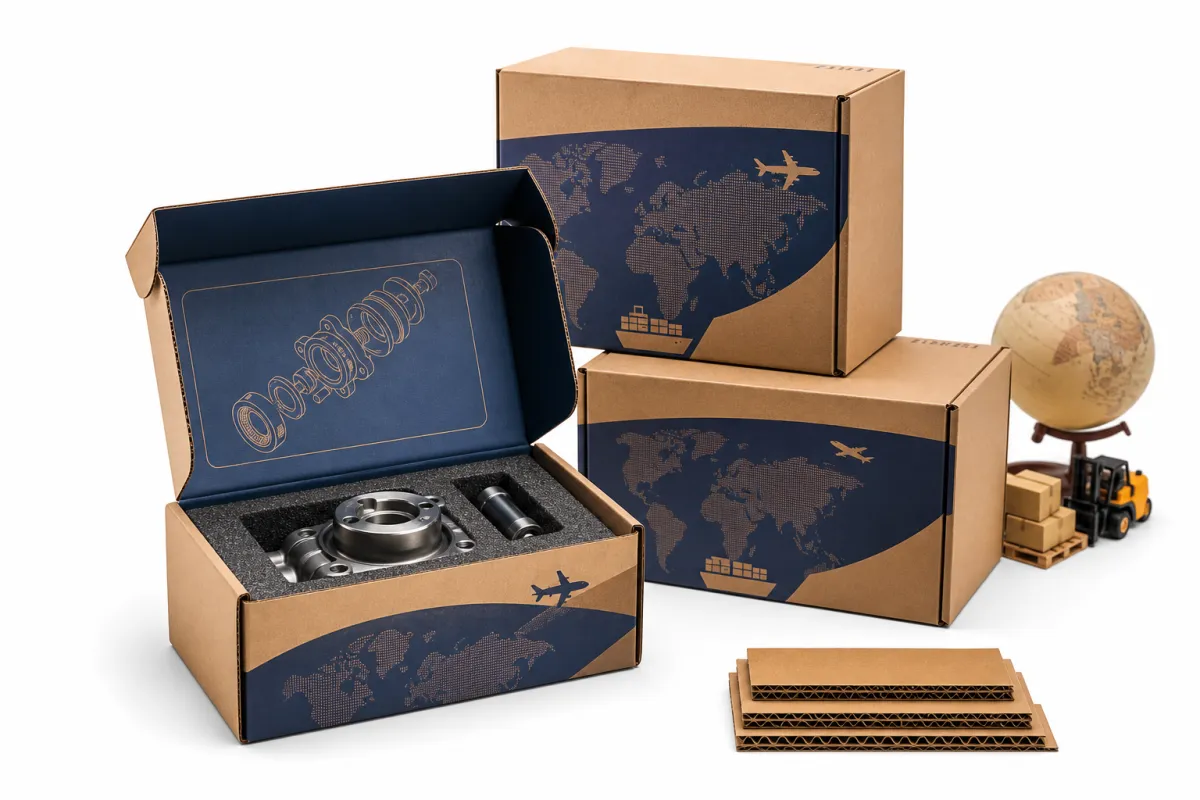
A strong export shipping boxes manufacturer starts with route risk, not artwork. Destination climate matters. Container type matters. So do stack height, storage time, forklift moves, hand-carry handling, and whether the shipment sits in a mixed distribution network before final delivery. The box is only one layer of protection; the board has to support the product while the whole stack absorbs real-world abuse.
Standard corrugated cartons are usually built to move a product from point A to point B. An export shipping boxes manufacturer builds cartons to survive a sequence of events. Think pallet compression, humidity swings, container vibration, temperature changes, and delays in order fulfillment. That is why export packaging often uses stronger board grades, tighter tolerances, and more controlled print processes.
Board strength is usually the first technical decision. A common domestic carton might use 32 ECT single-wall board, while a heavier export program may call for 44 ECT, 275# test, or double-wall construction such as BC flute. The right choice depends on weight, stack load, and route. A seasoned export shipping boxes manufacturer also looks at moisture resistance, because corrugated fibers lose strength as relative humidity rises. Buyers often ask about aqueous coating, wax alternatives, or water-resistant liner options for shipping materials for exactly that reason.
Fit and retention are not the same thing. A carton can fit a product perfectly and still be wrong for export if the product shifts around inside it. The manufacturer may recommend internal partitions, corner pads, inserts, or a tighter die-cut design to control movement. Good transit packaging is not just about the outer box; it is about how the load behaves inside the box.
Who usually needs these cartons? In most cases, the customer is one of the following:
- Exporters sending product to distributors or overseas retailers
- Contract manufacturers shipping finished goods under private label
- Industrial shippers moving parts, kits, or assemblies in bulk
- Brands with ecommerce shipping volumes that cross borders
- Operations teams trying to lower damage claims without overpacking
Honestly, the biggest mistake I see is treating the carton as a commodity. An export shipping boxes manufacturer should act like part packaging engineer, part materials adviser, and part logistics translator. If the supplier cannot explain compression strength, flute behavior, or why a pallet pattern affects dimensional weight, the buyer is not getting full value. I have watched that mistake turn into lost margin more than once, and it is never the carton alone that caused it.
“The carton looked fine on paper. The route proved otherwise.” That is the line a lot of packaging teams end up saying after the first damage spike.
Anyone comparing packaging suppliers should understand the standards behind the claims. Organizations such as ISTA publish test procedures that simulate distribution hazards, and the FSC system matters when buyers want certified fiber sourcing. A serious export shipping boxes manufacturer should be able to speak to those references without sounding scripted or salesy.
How the Export Box Manufacturing Process Works
The work usually starts with a needs assessment. A good export shipping boxes manufacturer will ask for dimensions, product weight, stack expectations, route details, destination climate, and whether the box will be used for palletized export shipping or direct-to-customer ecommerce shipping. That first conversation saves time later because it cuts down the chance of designing around the wrong assumption.
Next comes the material recommendation. The manufacturer translates the route into a spec: carton style, board grade, flute profile, wall construction, print method, pallet pattern, and any moisture-resistant treatment. This is where a supplier earns trust. A box quote that ignores the handling environment is half a quote, which is usually a polite way of saying "not enough information." A careful export shipping boxes manufacturer asks about compression limits, cube efficiency, and whether the product is fragile, dense, or top-heavy.
After that, the team usually prepares a sample or prototype. It might be a plain sample for fit, a printed sample for artwork approval, or a structural sample for load testing. The buyer should check actual product fit, closure performance, ease of packing, and how the carton behaves when filled. An export shipping boxes manufacturer that rushes samples without validation is cutting corners in the one place where shortcuts turn into claims. That is the kind of shortcut that looks cheap until it is very, very not cheap.
Testing matters more than many buyers expect. Common checks include:
- Compression testing using methods aligned with ASTM D642 or similar internal protocols
- Drop testing to see how corners, seams, and closures behave under shock
- Moisture exposure to understand how the board reacts in humid conditions
- Fit checks with the real product, not a placeholder sample
That testing mix separates a decent box from an export-ready one. In many cases, an export shipping boxes manufacturer will also suggest pallet-level testing, because a box that performs on its own may still fail once it is stacked into a full load. The container does not care about marketing language. It cares about structure.
Communication speed is not a side issue. It affects tooling, print plates, scheduling, and the production slot the job gets. When approvals drag, the best slots disappear first. A responsive export shipping boxes manufacturer keeps the process moving by giving specific feedback on board choice, art readiness, and sample revisions. Slow approvals can add a week or more to a project that looked easy at the start.
Cost and Pricing Factors You Need to Compare
The price of an export carton is not just the price of paper. A export shipping boxes manufacturer builds quotes from board grade, wall construction, flute profile, dimensions, print coverage, tooling, and order volume. A plain single-wall carton usually costs less than a double-wall export carton, but that comparison is too shallow unless you also compare damage risk and freight efficiency.
For smaller runs, setup costs matter. Die-cut tooling, flexo plates, custom sizing, and sample development can raise the effective per-unit cost when volumes are low. It is common to see low-volume custom cartons land in the roughly $0.80 to $2.50 per unit range depending on size, board grade, and print complexity, while higher-volume, simpler export shipping boxes may cost materially less. A careful export shipping boxes manufacturer should separate recurring costs from one-time costs. If they do not, the quote is kinda hiding the real number.
Freight and palletization deserve equal attention. A carton that ships well in flat packs but wastes pallet cube can increase transportation cost more than a stronger box would. Dimensional weight also matters in some distribution channels, especially for mixed ecommerce shipping programs. The real question is not "What does the carton cost?" It is "What does protected, delivered inventory cost?"
Here is a practical comparison buyers can use as a starting point. The numbers are directional, because freight, print coverage, and volume change the outcome, but they help frame the conversation with an export shipping boxes manufacturer.
| Carton Type | Typical Use | Strength Profile | Indicative Unit Cost | Notes |
|---|---|---|---|---|
| Single-wall RSC | Light to medium export cartons | Moderate, best for shorter transit chains | $0.35-$0.90 | Good for lower-risk routes and lighter goods |
| Double-wall RSC | Heavy products, tall stacks, humid routes | High compression and better edge crush | $0.85-$2.25 | Often preferred by an export shipping boxes manufacturer for ocean freight |
| Die-cut export carton | Products needing tighter fit or internal retention | Depends on design, often better product control | $1.10-$3.00 | Useful when movement inside the box is the main risk |
| Moisture-resistant carton | Humid climate, long dwell times, mixed storage | Improved performance in damp conditions | $1.00-$3.25 | Often paired with coated liners or other shipping materials |
Another hidden cost is damage replacement. If a cheaper carton increases the failure rate by even 1% or 2%, the apparent savings can disappear quickly once returns, reshipments, and customer service time are counted. That is why a disciplined export shipping boxes manufacturer will push buyers to compare landed packaging cost per protected unit, not just unit price.
There is also a sourcing angle. If the buyer wants certified fiber, recycled content targets, or environmental documentation, the supplier may need a different paper mix or chain-of-custody paperwork. That can shift pricing slightly, but not usually by a wild amount. The bigger cost jump usually comes from structural upgrades, not from labels. A knowledgeable export shipping boxes manufacturer should explain that difference clearly.
Process and Timeline: From Spec Sheet to Export Shipment
Once the buyer has the specs, the timeline moves in stages. A solid export shipping boxes manufacturer usually goes from spec gathering to sample development, then approval, then production, finishing, packing, and dispatch. It sounds neat. In real life, the process is only as smooth as the information that came in at the start.
Simple stock boxes may move quickly, sometimes in a few business days if the supplier has inventory and no special printing is required. Simple custom cartons often take around 10 to 15 business days after proof approval. More engineered export packaging, especially with print, inserts, special finishes, or testing cycles, can stretch to 2 to 4 weeks. A good export shipping boxes manufacturer will say that up front instead of hiding behind vague language.
Three things slow projects down most often: missing dimensions, unclear product weights, and artwork that is not ready when the structural approval is complete. Revisions are normal, but repeated sample changes can burn a week very quickly. In export work, that matters because packaging should never become the bottleneck for shipment. The best export shipping boxes manufacturer keeps the critical path visible and keeps the buyer honest about what is still missing.
Buyers should also build in buffer time for the things they cannot control. Port delays happen. Routes change. Forecasts slip. A rush order that looks manageable on Monday can turn ugly by Friday if export bookings move. Good planning means keeping a small safety stock of packaging or setting reorder triggers before inventory gets tight. That advice applies to shipping materials in general, but it is especially true when a carton is tied to a specific pallet pattern or product revision.
Packaging teams that manage both retail and industrial programs often find that the same discipline used in order fulfillment improves export stability: clearer specs, cleaner approvals, and fewer last-minute substitutions. An export shipping boxes manufacturer can support that rhythm, but only if the buyer shares usable data early.
How to Choose an Export Shipping Boxes Manufacturer
The smarter question is not "Can you make a box?" It is "Can you make the right box for my route?" A strong export shipping boxes manufacturer should ask about climate, container type, stacking height, pallet footprint, transit duration, and handling methods. If the supplier never asks route-specific questions, that is a warning sign.
Technical depth matters more than polished sales language. Ask how the manufacturer tests cartons, what sample policy they use, what quality checks happen before dispatch, and how they document measurements. A credible export shipping boxes manufacturer should be able to explain why a 44 ECT board is not automatically better than a double-wall structure, or why flute choice affects both compression and print quality.
Responsiveness is another useful signal. Fast answers do not guarantee good engineering, but slow answers often predict delay later. Export packaging projects involve a lot of moving parts, and a supplier that cannot keep up during quoting usually struggles during production too. For buyers managing multiple SKUs, that can ripple through order fulfillment and container scheduling.
Ask for examples of past export work, even if the names are anonymized. You are looking for pattern recognition, not name-dropping. How did the supplier solve moisture issues? Did they reduce carton failure by changing flute profile? Did they improve pallet efficiency without increasing dimensional weight too much? An experienced export shipping boxes manufacturer should have answers grounded in packaging decisions, not just outcome claims.
One practical way to compare vendors is to score them on three dimensions:
- Technical fit - board grade, compression, moisture resistance, and carton design quality
- Service fit - speed, clarity, sample support, and documentation quality
- Commercial fit - price, freight impact, and reorder consistency
If you need carton-heavy programs, consider pairing a box supplier with a broader packaging partner that also handles Custom Shipping Boxes. For brands that use mixed-format transit packaging, a supplier who understands both cartons and Custom Poly Mailers can make the overall system easier to manage. A good export shipping boxes manufacturer should fit into that broader packaging structure instead of forcing every problem into one product type.
Also ask how they handle documentation. A dependable export shipping boxes manufacturer should be able to provide specification sheets, test references, FSC paperwork if needed, and clear carton counts per pallet. That may sound administrative, but documentation becomes critical when a shipment is delayed, inspected, or disputed. Packaging quality is easier to trust when the paperwork is as disciplined as the box.
Common Mistakes Buyers Make With Export Cartons
The most expensive mistake is choosing by unit price alone. A low-cost carton can look attractive until a humid route, a long dwell time, or a poorly stacked pallet turns it into a damage problem. An export shipping boxes manufacturer should help the buyer see that the cheapest quote is not always the lowest risk once replacement goods, labor, and delays are counted.
Another common error is reusing domestic specs for export. That approach ignores the fact that international transit is usually harsher, longer, and more variable. Domestic packaging may survive short-distance ecommerce shipping, then fail after a sea leg plus warehouse storage. A competent export shipping boxes manufacturer will push back if the spec does not match the route.
Mis-measured cartons create a different kind of waste. They can squeeze products, leave excess void, or reduce pallet efficiency. Add weak pallet patterns or poor labeling, and the result is avoidable claims and lower container utilization. Those problems do not always show up in a sample room. They often appear only after a few shipments, when real handling exposes the flaw. That is why an export shipping boxes manufacturer should treat measurement discipline as seriously as board selection.
Skipping sample validation is another trap. A box that looks right in a drawing can still fail once filled, stacked, taped, and moved through the actual packaging line. The same applies to the closure method. Tape width, seam design, and flap overlap all matter. In export shipping, small errors compound. An experienced export shipping boxes manufacturer will insist on sample review before production, not after.
“We saved a few cents on the carton and spent dollars on the claim.” That trade-off is common, and it is usually avoidable.
There is one more mistake worth mentioning: assuming that all shipping materials perform the same in every lane. They do not. A carton that works well in a dry inland route may not be the right answer for a coastal lane with high humidity and longer storage. A smart export shipping boxes manufacturer designs for the worst credible condition, not the easiest one. Anything less is a gamble with someone else’s freight.
Expert Tips and Next Steps for Better Export Packaging
Start with a one-page spec sheet. Include product weight, product dimensions, destination, stacking needs, pallet pattern, handling method, and any known issues such as moisture, crushing, or carton bulging. That simple document gives an export shipping boxes manufacturer enough information to quote intelligently instead of guessing.
Order two samples if the program matters. One should be a fit sample. The other should be used for stress testing, even if the test is simple and internal. That two-sample approach costs a little more at the start, but it saves money when the product is expensive or the route is unforgiving. A disciplined export shipping boxes manufacturer will support that process without making a fuss.
Compare quotes on total protection, not just paper cost. I would rank suppliers this way: technical support first, lead-time reliability second, documentation quality third, and price fourth. That may sound backward until a shipment is delayed or damaged. Then the ranking makes sense very quickly. A trustworthy export shipping boxes manufacturer earns repeat business by preventing surprises.
For packaging teams that want to improve without overcomplicating the process, a useful checklist looks like this:
- Review the last three damage claims and identify the common failure mode
- Map the weakest route by climate, transfer points, and storage delays
- Ask the manufacturer to recommend board grade, flute profile, and wall construction
- Validate fit with the real product, not a substitute
- Confirm carton counts per pallet and how that affects dimensional weight
If you are expanding a packaging program and want more than cartons alone, the broader category pages at Custom Packaging Products can help you compare shipping formats across the line. That kind of category thinking matters because a box decision often interacts with labels, inserts, tape, and even the pallet pattern. A good export shipping boxes manufacturer should understand the system, not just the carton.
One final habit pays off again and again: set a reorder trigger before inventory gets low. Export cartons are not the place to gamble on emergency lead times. If the reorder point is too thin, packaging becomes the bottleneck. If the reorder point is sensible, the export shipping boxes manufacturer can keep you ahead of the next shipment wave without rushed changes or costly substitutions.
What does an export shipping boxes manufacturer provide beyond cartons?
They should help with sizing, board selection, print setup, sample development, and export-ready palletization guidance. The best export shipping boxes manufacturer also advises on compression, moisture resistance, and route-specific handling risks. Some can support testing and documentation so the packaging decision is backed by evidence, not just a price quote.
How do I know if my export shipping boxes need double-wall construction?
Double-wall is often worth it for heavy products, tall stacking, long ocean transit, or routes with high humidity and repeated handling. If the product deforms easily or if carton failure would stop a shipment, stronger board is usually cheaper than a claim. A export shipping boxes manufacturer should recommend it based on product weight, compression needs, and destination conditions.
What affects export shipping boxes manufacturer pricing the most?
Board grade, wall construction, dimensions, print complexity, and order volume usually drive the biggest price swings. Tooling and setup costs matter more on small orders, while freight and pallet efficiency can change the total landed cost. The cheapest quote is not always the lowest risk once damage and replacement costs are included, which is why a good export shipping boxes manufacturer focuses on total cost.
How long does it take to produce custom export shipping boxes?
Simple orders can move quickly, but custom samples, artwork approval, and tooling usually add time before production begins. Complex cartons, print requirements, and testing can extend the schedule further. Buyers should plan with buffer time so packaging does not delay the shipment itself, and a reliable export shipping boxes manufacturer should be clear about that upfront.
Can one export carton work for every destination market?
Usually not, because climate, transit duration, stacking pressure, and handling standards vary by route. A box that works for a short regional shipment may fail on a humid ocean route or in a multi-stop distribution chain. The safer approach is to design for the worst credible condition, not the easiest one, and to review that logic with an export shipping boxes manufacturer.
Buying export cartons well is less about finding the lowest quote and more about choosing the right export shipping boxes manufacturer for the route, the product, and the risk profile. If the supplier can speak clearly about board grade, compression, moisture, palletization, and testing, you are usually on the right track. If not, the box may still look fine on a dock, but that is not where export packaging gets judged. Start with the route, demand a real spec, and make the supplier prove the carton belongs there.

