Buyer Fit Snapshot
| Best fit | Custom Natural Cotton Drawstring Bags projects where brand print, material claims, artwork control, MOQ, and repeat-order consistency need to be specified before quoting. |
|---|---|
| Quote inputs | Share finished size, material target, print colors, finish, packing count, annual reorder estimate, ship-to region, and any compliance wording. |
| Proofing check | Approve dieline scale, logo placement, barcode or warning zones, color tolerance, closure strength, and carton packing before bulk production. |
| Main risk | Vague material claims, crowded artwork, missing packing details, or unclear freight terms can make a low unit price expensive after revisions. |
Fast answer: Custom Natural Cotton Drawstring Bags: Quote Scope, Sample Proof, MOQ, and Lead Time should be specified like a repeatable production item. The safest quote records material, print method, finish, artwork proof, packing count, and reorder notes in one written spec.
Production checks before approval
Compare the actual filled-product size with the drawing, then confirm tolerance on folds, seals, hang holes, label areas, and retail display edges. Reserve space for logos, QR codes, warning copy, and material claims before decorative graphics fill the panel.
Quote comparison points
Review material grade, print process, finish, sampling route, tooling charges, carton quantity, and freight assumptions side by side. A quote is only useful when the supplier can repeat the same color, closure quality, and packing count on the next order.
Custom Natural Cotton Drawstring Bags: What They Are and Why They Stand Out
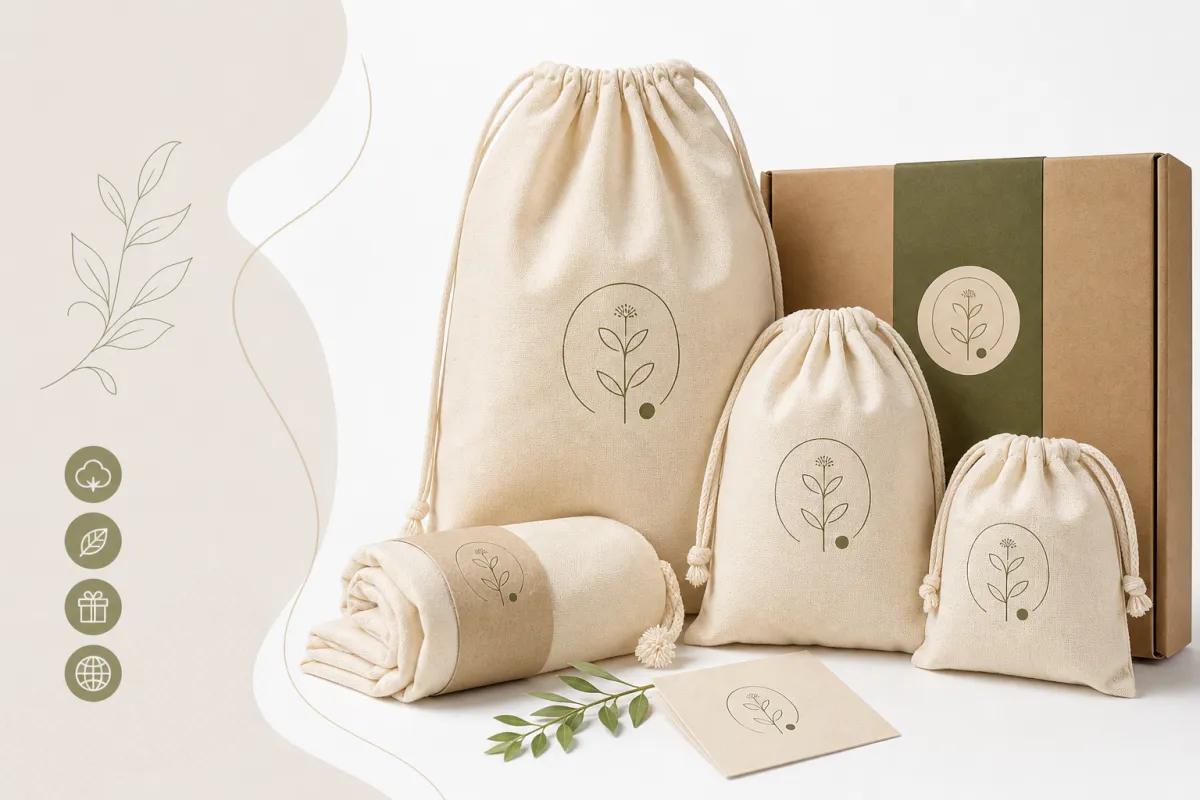
A small candle, a necklace, a tea sample, or a product kit feels more finished the moment it lands in one of the right custom natural cotton drawstring bags. Put that same item in a thin pouch with weak stitching and the experience changes fast, which is usually the point where packaging starts doing real work instead of just checking a box on a spec sheet.
In practical terms, custom natural cotton drawstring bags are unbleached or lightly processed cotton pouches with a cord closure, sized and decorated for a specific product, event, or brand presentation. The format looks simple, yet the fabric weight, seam construction, print method, and closure style all shape how the bag feels in hand, how it travels, and how likely it is to be reused after the first purchase.
That is why these bags show up in retail packaging, ecommerce inserts, hospitality kits, trade show giveaways, travel amenities, subscription boxes, and promotional sets. Cotton is breathable, easy to brand, and comfortable alongside other Custom Packaging Products such as printed cartons, mailers, and inserts when a brand wants the whole unboxing sequence to feel intentional from the first touch.
For a packaging buyer, the appeal is straightforward. A cotton drawstring pouch protects the product without making the presentation feel stiff or overly formal, and it often stays in use long after the first sale. That combination gives custom natural cotton drawstring bags an outsized role in how a customer judges value, especially for accessories, jewelry, cosmetics, teas, soaps, samples, and small gift items.
I have seen plenty of packaging programs where the bag does more than hold the product. It frames the product. It gives the customer a tactile signal that the order was prepared with care, and that signal matters more than people think, especially when the rest of the brand is quiet and material-focused.
Practical rule: if the product is delicate, small, giftable, or meant to feel thoughtful, the bag spec should support that feeling instead of working against it.
In the pages that follow, we will look at how custom natural cotton drawstring bags are made, which specs move pricing the most, how production timing usually unfolds, and the mistakes that are easiest to avoid before an order is approved. If you are comparing them with custom printed boxes or other packaging design options, that context matters more than many buyers expect.
How Custom Natural Cotton Drawstring Bags Are Made
The construction is simple on paper, but the quality lives in the details. Custom natural cotton drawstring bags usually begin with cotton fabric selected by weight and weave, then the material is cut into panels, stitched, hemmed, and finished with a cord threaded through a channel or casing. Each stage changes how the bag feels in the hand, how it closes, and how well it holds up after repeated use.
Fabric weight is one of the first decisions. Lighter cotton drapes more softly and folds small for giveaways or inserts, while heavier cotton feels sturdier and keeps its shape better for retail packaging or repeat use. Seam quality matters just as much, because a pouch that looks clean on a table can still fail along the stitch line if thread tension, seam allowance, or top hem consistency is off.
Cord style deserves attention too. Flat tape cords feel different from round cords, and both can be made from cotton or blended materials. A smoother cord usually opens and closes with less friction, while a thicker cord can feel more substantial in the hand. That may sound like a small detail, yet on custom natural cotton drawstring bags the closure is part of the user experience every time the pouch is opened.
Natural cotton is not a perfectly uniform material, and buyers should plan for that from the start. Tonal variation, tiny fiber slubs, and slight shrinkage can show up depending on the weave and finish. Those traits are not defects. They are part of what gives the bag a natural, low-gloss look that works well for handmade brands, wellness lines, and products that need a softer visual tone. The key is to account for those traits in print setup and in the way the finished bag is presented alongside the rest of the order.
Quality control is the point where a simple pouch stays simple or turns into a problem. Good suppliers check seam integrity, print placement, cord pull performance, and final count before packing. On larger runs of custom natural cotton drawstring bags, I would also expect a spot check for consistency across cartons so the shipment does not arrive with mixed shades or slightly different print alignment.
For buyers who want a broader view of transit performance, the ISTA resource library is a useful place to think about how packaging behaves in shipping, especially if the bags sit inside a larger kit. For additional industry context, the Institute of Packaging Professionals offers practical packaging references that are worth keeping close during planning.
If the pouch is part of a rigid carton, sleeve, or insert card program, it should be spec'd as part of the full packaging system rather than as an isolated item. That is how the strongest custom natural cotton drawstring bags are usually planned in real production work.
Pricing, MOQ, and Cost Drivers for Custom Natural Cotton Drawstring Bags
Pricing for custom natural cotton drawstring bags rarely comes down to one single variable. It usually reflects a mix of size, fabric weight, print colors, print locations, cord type, finishing details, and total quantity. Change two or three of those at the same time and the quote can move quickly, especially on smaller runs where setup time is spread across fewer units.
The bag size is often the first major cost driver. A small pouch uses less fabric and usually less sewing time, but once the dimensions increase, material usage rises in a way that affects both labor and supply cost. Fabric weight matters for the same reason. A lighter bag can be less expensive, while a heavier option may be the better choice if the bag needs to hold shape, survive repeated use, or support a more polished retail presentation.
Minimum order quantity, or MOQ, matters before quotes are requested for custom natural cotton drawstring bags. Smaller runs usually cost more per unit because cutting, printing, proofing, and machine setup have to be absorbed across fewer bags. A 500-piece order can make perfect sense for a launch or event, but the unit cost will generally sit higher than a 5,000-piece run with the same artwork.
A simple way to think about common cost drivers:
- Print complexity: one-color screen print is usually easier than multi-color artwork or full-coverage decoration.
- Decoration location: printing on one side is normally simpler than front-and-back or wraparound layouts.
- Construction details: gussets, reinforced seams, and custom cord treatments add labor and sometimes material cost.
- Artwork prep: vector cleanup, separations, and color matching can add time before production begins.
- Special handling: retail hangtags, barcode labels, inner packaging, and kitting all increase work per unit.
There are also costs that catch first-time buyers off guard. Sampling is one. Rush production is another. Freight can become a meaningful line item if the bags need to arrive by a firm launch date. If the artwork is not print-ready, cleanup time can be billed or built into the quote. That is why custom natural cotton drawstring bags should always be quoted with dimensions, quantity, artwork, target date, and intended use in the same brief.
For reference, lighter giveaway pouches often price differently than heavier retail bags, and the gap widens as print coverage increases. A buyer ordering custom natural cotton drawstring bags for a sample kit may care most about unit cost, while a retailer may accept a slightly higher price if the bag improves presentation and reuse. That tradeoff is normal and worth discussing early.
| Fabric Weight | Typical Feel | Best Use | Cost Impact |
|---|---|---|---|
| Light cotton | Soft, flexible, easy to fold | Giveaways, inserts, sample kits | Usually the lowest material cost |
| Midweight cotton | Balanced drape and structure | Retail packaging, gifts, accessories | Moderate cost with better perceived value |
| Heavy cotton | Stiffer, more durable, more premium | Repeat use, higher-end presentation | Higher material and sewing cost |
If the goal is to bring the price down without weakening the packaging, the cleanest levers are standard sizing, one-side printing, and a single ink color. Those choices keep custom natural cotton drawstring bags efficient to produce while still giving you a branded surface that supports the rest of the packaging system. When needed, the bag can work alongside other branded packaging options instead of trying to carry every part of the presentation on its own.
A clear spec sheet reduces quote noise. The more precise the brief, the more useful the quote, and the easier it becomes to compare custom natural cotton drawstring bags against other packaging design choices without guessing at hidden costs.
Choosing the Right Specs: Fabric, Size, Print, and Finish
Choosing the Right spec is where custom natural cotton drawstring bags either fit neatly or turn into a compromise. The best choice is not always the heaviest cotton or the largest bag; it is the one that matches the product, the brand position, and the kind of handling the item will face after production.
Fabric weight should follow use. Lighter cotton works well for small accessories, hospitality items, and short-term giveaways because it keeps the pouch flexible and economical. Midweight fabric is often the sweet spot for retail packaging and gift sets because it looks more substantial without becoming bulky. Heavy cotton is the better choice when the pouch needs to hold shape, support repeated use, or help the product feel more premium the moment it is lifted.
Size matters just as much. A bag should be large enough for the product plus enough extra room for easy loading and a clean closure, but not so large that the item moves around inside with no support. In packaging design, that extra room is sometimes called headroom, and on custom natural cotton drawstring bags it affects both presentation and function. Too tight, and the closure looks strained. Too loose, and the package feels careless.
Print method is the next decision. One-color screen print is usually the most efficient choice for crisp branding, especially when the logo is simple and the artwork has clean edges. Multi-color print can work too, but it adds complexity and often raises the price. If the goal is a more premium look, woven labels or embroidery can be strong choices, although they are not ideal for every budget or every logo shape.
Here is a practical comparison of common decoration approaches for custom natural cotton drawstring bags:
Decoration Comparison
| Decoration Method | Best For | Strengths | Watchouts |
|---|---|---|---|
| Screen print | Simple logos, one-color branding | Crisp, efficient, cost-friendly | Less ideal for highly detailed gradients |
| Multi-color print | More graphic retail presentations | Visually louder and more expressive | Higher setup complexity and cost |
| Woven label | Premium retail or handmade positioning | Elegant, durable, tactile | Needs enough space and budget |
| Embroidery | High-touch brand presentation | Raised texture and strong perceived value | Can be limited by fine detail and pricing |
Finishing details change the outcome more than many people expect. Cord length affects usability. Closure tension affects whether the bag feels secure or awkward. Seam reinforcement matters if the contents are heavy, sharp-edged, or frequently handled. The natural tone of the cotton should also be checked against the rest of the brand palette, because an off-white or warm unbleached base can support one packaging direction while fighting another.
If the brand leans earthy, artisanal, or wellness-focused, natural cotton is usually a strong fit. If the brand presentation is very clean and color-controlled, bleached or more tightly specified cotton may fit better. That is not a value judgment, just a packaging design decision, and it is one reason custom natural cotton drawstring bags should be spec'd alongside the rest of the product packaging rather than treated like a last-minute add-on.
When the specs are chosen well, the bag feels obvious. That is the goal. The customer should not be thinking about the stitching, the closure, or the print method. They should just feel that the custom natural cotton drawstring bags belong with the product.
Production Steps and Timeline for Custom Natural Cotton Drawstring Bags
The production path for custom natural cotton drawstring bags is usually orderly, but only if the project brief is clear from the start. A typical order moves through inquiry, quote, artwork preparation, proofing or sampling, approval, production, packing, and shipping. Each stage sounds short, yet any delay in artwork or specs can stretch the schedule quickly.
Good timelines start with the product brief. If the bag is intended for a retail launch, a hospitality kit, or an event giveaway, that use case should be clear before the quote is issued. The best briefs include dimensions, quantity, print method, target delivery date, and a sample of the logo or artwork. For custom natural cotton drawstring bags, that upfront detail reduces back-and-forth and helps the manufacturer tell you whether the job can move in one run or needs a staged approach.
Artwork prep comes next. If the logo is supplied as a vector file, the proofing stage is usually faster and cleaner. If the artwork is low resolution, has tiny type, or includes multiple color assumptions, more time gets spent cleaning it up. That may not sound dramatic, but for custom natural cotton drawstring bags it can be the difference between approving a proof in a day and revisiting it several times.
Sampling is useful when the bag is part of a larger launch or when the product inside has unusual dimensions. A sample lets you test the fit, closure, print placement, and overall feel before committing to production. It also helps catch issues that are easy to miss on screen, such as a logo sitting too close to a seam or a drawcord that binds more than expected. If the order is time-sensitive, a production proof may be enough, but I would still ask for one whenever the bag is doing serious branding work.
The fastest projects are usually the ones where size, artwork, and quantity are finalized before quoting. That sounds obvious, yet it is often the exact detail missing when buyers are under pressure. Once those decisions are locked, custom natural cotton drawstring bags can move through production without the stop-start rhythm that eats up calendar time.
A useful planning framework is simple:
- Reserve time for approval first, because that is the stage most likely to stall.
- Then leave room for production, which changes with quantity and print complexity.
- Finally, add freight and receiving time so the shipment is not counted as on hand before it actually arrives.
That sequence matters more than building a schedule around the event date alone. A buyer who wants custom natural cotton drawstring bags for a launch should work backward from the launch, not forward from the order date. That small shift usually prevents last-minute freight charges and awkward compromises on artwork.
In many cases, the total lead time depends on stock availability, decoration method, and whether shipping is ground, air, or consolidated with another order. If you are also ordering custom printed boxes or insert cards, it makes sense to align those timelines early so the whole packaging program lands together rather than arriving in separate pieces.
Common Mistakes When Ordering Custom Natural Cotton Drawstring Bags
The most expensive mistakes with custom natural cotton drawstring bags are usually not dramatic failures. They are small planning misses that only show up once the bags are in hand. A few millimeters off on the size, a logo placed too close to a seam, or a fabric tone that looked right online but feels too warm in person can change how the entire package reads.
The first mistake is guessing dimensions instead of measuring the actual product. A candle, bottle, device, or accessory can look simple, but the usable space inside the bag is what matters, not just the outside dimensions on paper. If the item is a tight fit, the drawstring closure can become awkward and the bag can wrinkle in a way that makes even well-made custom natural cotton drawstring bags look less refined.
The second mistake is assuming every natural cotton bag will look identical. It will not. Weave structure, batch variation, and fiber tone can shift the final appearance even when the spec name is the same. That is normal textile behavior, not a quality failure. The buyer just needs to understand it ahead of time, especially if the brand is sensitive to color consistency across custom natural cotton drawstring bags and other branded packaging items.
The third mistake is crowding the artwork. Logos and copy that sit too close to seams, top hems, or the cord channel can distort during stitching or close awkwardly under the drawcord. On a flat proof, the design may look perfect; on the finished pouch, it can feel compressed. That is one reason proofs and samples are worth the time, even when the team wants to move quickly.
The fourth mistake is skipping validation altogether. People sometimes approve custom natural cotton drawstring bags from a digital mockup and assume the rest will work out. That is a risky habit. A proof or sample is the point where scale, color, closure tension, and placement issues show up while changes are still affordable.
There is also a packaging-system mistake that comes up often. A buyer will design the bag well, then forget how it interacts with the item inside, the shipping carton, the insert card, or the retail shelf display. Strong packaging design is rarely about one component alone. The best custom natural cotton drawstring bags support the entire experience, whether they are sitting inside an ecommerce shipper or being handed across a counter with a brand message attached.
My honest advice is to treat the bag like a production item, not an accessory. Measure the product, check the artwork scale, confirm the fabric tone, and ask what the finished package is supposed to do. That sequence catches most problems before they become costly rework.
Expert Tips and Next Steps for Your Custom Natural Cotton Drawstring Bags Order
If you want custom natural cotton drawstring bags to move smoothly from idea to production, start with a one-page spec sheet. List the bag size, fabric weight, quantity, print method, delivery date, and how the bag will be used. That single page usually saves more time than a long email thread because it gives everyone the same target.
Artwork is the next place where discipline pays off. Send vector files when possible, and decide early whether the branding should feel subtle or more visible. A clean one-color mark can support understated package branding, while a bolder print can push the bag toward retail packaging territory. Neither choice is wrong, but the choice should be made on purpose for custom natural cotton drawstring bags, not left to the final hour.
Ask for a sample or production proof if the order matters to a launch, gift set, or customer-facing kit. Confirm minimums, lead time, and shipping assumptions in writing. That may sound routine, but it is the easiest way to avoid confusion once the order is in motion. When custom natural cotton drawstring bags are part of a broader packaging program, the same discipline should extend to any cartons, labels, or insert cards included in the bundle.
Here is the short version of what usually works best:
- Measure the product before you size the bag.
- Choose the fabric weight based on use, not just price.
- Keep the print simple unless the brand truly needs more color.
- Approve a proof or sample before production.
- Plan freight with the delivery date in mind, not after the fact.
That approach keeps the order grounded in the real job the bag has to do. Whether you are comparing it with Custom Packaging Products for retail packaging, pairing it with branded packaging options for an event kit, or building a product packaging system from scratch, the same principle applies: the bag should fit the item, fit the brand, and fit the budget without unnecessary surprises.
The clearest next step is to measure the product, choose the bag spec, gather the artwork, and request a quote with those details in hand. That gives custom natural cotton drawstring bags a practical path from concept to production, and it makes the final result much easier to trust because the fit, finish, and branding decisions have already been made with care.
FAQ
What fabric weight is best for custom natural cotton drawstring bags?
Lighter weights work well for giveaways, inserts, and small accessories because they stay flexible and keep the unit price lower. Heavier weights are better for retail packaging, gift sets, or products that will be reused often because they hold shape better and feel sturdier in hand. The right choice depends on the product, the brand presentation, and how much durability you need from custom natural cotton drawstring bags.
Can custom natural cotton drawstring bags be washed?
Most unlined cotton bags can be washed, but some shrinkage and softening is normal, especially with lighter fabric. Printed bags should be tested first because inks and finishes do not all react the same way. Air drying is usually the safer choice if you want to preserve the size, shape, and print quality of custom natural cotton drawstring bags.
What print method works best for custom natural cotton drawstring bags?
Screen printing is usually the most practical choice for crisp branding, especially when the design is one color or simple in shape. Multi-color artwork can work too, but it usually adds setup complexity and cost. If the goal is a more premium look, woven labels or embroidery can be strong options when the design and budget support them for custom natural cotton drawstring bags.
How can I lower the cost of custom natural cotton drawstring bags?
Keep the bag size standard, reduce the number of print colors, and print on one side when possible. Avoid rush charges and extra sample rounds by finalizing artwork and dimensions early. If storage allows, ordering a larger quantity often lowers the unit cost because setup time is spread across more custom natural cotton drawstring bags.
How long do custom natural cotton drawstring bags usually take to produce?
Lead time depends on artwork approval, quantity, print method, and whether the materials are already in stock. Sampling, proof changes, and freight time can all add days or weeks if they are not planned from the start. The safest schedule includes extra time for approval and shipping so custom natural cotton drawstring bags arrive before the event, launch, or product release.
If the order needs to move soon, keep the brief tight: exact size, fabric weight, artwork file, quantity, and delivery window. That is the cleanest way to get custom natural cotton drawstring bags quoted accurately and produced without unnecessary friction, which is really the whole point of planning them well in the first place.

