Buyer Fit Snapshot
| Best fit | Custom Offset Printed Boxes Bulk projects where brand print, material claims, artwork control, MOQ, and repeat-order consistency need to be specified before quoting. |
|---|---|
| Quote inputs | Share finished size, material target, print colors, finish, packing count, annual reorder estimate, ship-to region, and any compliance wording. |
| Proofing check | Approve dieline scale, logo placement, barcode or warning zones, color tolerance, closure strength, and carton packing before bulk production. |
| Main risk | Vague material claims, crowded artwork, missing packing details, or unclear freight terms can make a low unit price expensive after revisions. |
Fast answer: Custom Offset Printed Boxes Bulk: Structure, Print Proof, Packing, and Reorder Risk should be specified like a repeatable production item. The safest quote records material, print method, finish, artwork proof, packing count, and reorder notes in one written spec.
Production checks before approval
Compare the actual filled-product size with the drawing, then confirm tolerance on folds, seals, hang holes, label areas, and retail display edges. Reserve space for logos, QR codes, warning copy, and material claims before decorative graphics fill the panel.
Quote comparison points
Review material grade, print process, finish, sampling route, tooling charges, carton quantity, and freight assumptions side by side. A quote is only useful when the supplier can repeat the same color, closure quality, and packing count on the next order.
Custom Offset Printed Boxes bulk change the economics quickly. Once the plates are made and the press is running cleanly, the pressure shifts away from setup and toward unit cost, consistency, and how well the packaging holds up across the full shipment. That is why large-volume buyers stop asking whether offset printing is the right method and start asking how to protect color, manage inventory, and keep the same branded look from the first carton to the last.
From a packaging buyer's point of view, the value is easy to understand. If the artwork is stable, the finish is fixed, and every box needs to look identical, Custom Offset Printed boxes bulk often outperform short-run methods on consistency and price per unit. The savings matter, but so does the discipline behind them: tighter specs, cleaner proofs, and fewer late changes usually decide whether the order stays on budget. I've seen jobs go sideways because someone treated a box like a throwaway print piece instead of a product component.
Retail packaging, subscription programs, and launch kits make the case even more clearly. A run of 5,000 units may involve more setup than a digital order, yet the per-box price can fall far enough to free up room for better inserts, a premium coating, or extra inventory that protects the reorder window. That tradeoff is what many teams are really buying. It's not just a box; it's a way to keep the brand consistent while still making the numbers work.
Why Custom Offset Printed Boxes Bulk Make Sense
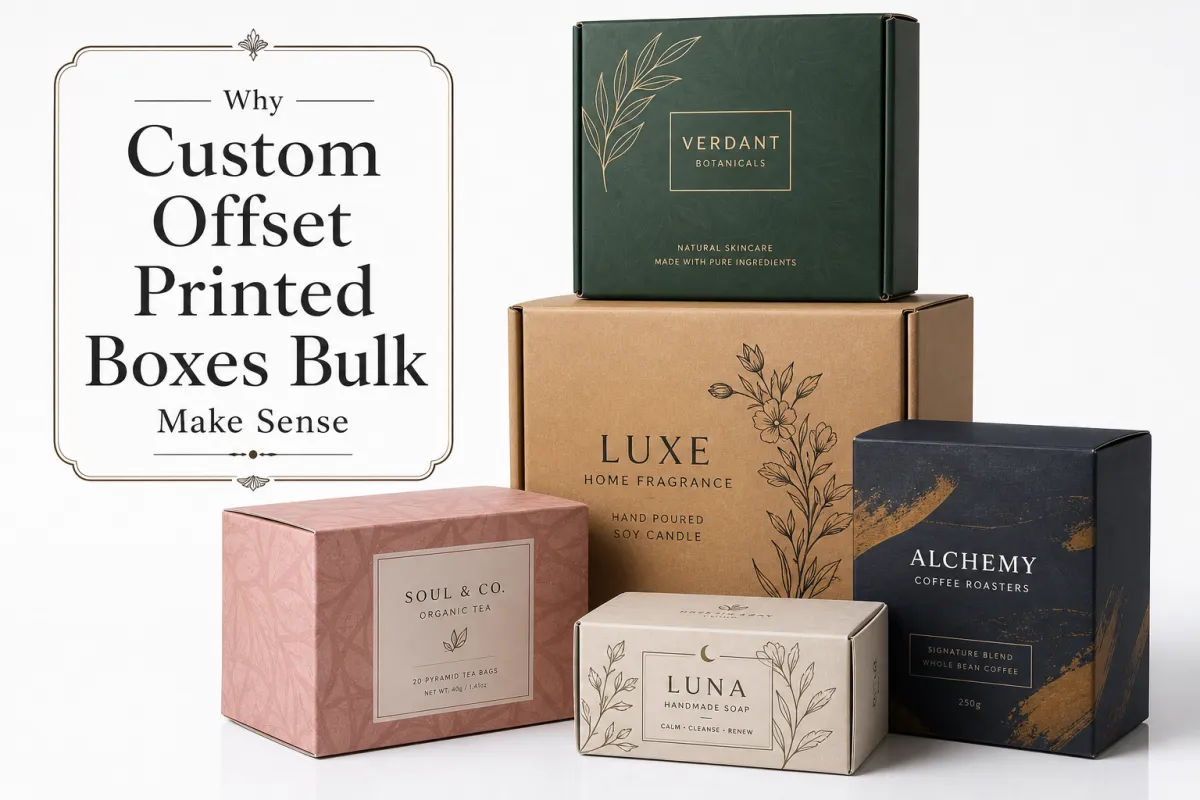
Custom Offset Printed boxes bulk make sense because offset printing spreads fixed production costs across a larger run. Plates, setup, color calibration, and press make-ready all cost money before the first finished box comes off the line. Once those costs are absorbed, each additional carton becomes cheaper to produce. That basic equation is the reason a buyer ordering 10,000 units may see a much lower unit cost than a buyer ordering 500.
Offset also gives brands tighter visual control. Small shifts in color can look minor on a spec sheet and still stand out on a shelf. A red logo that prints warmer on one carton and cooler on the next may pass casual review, but in retail it reads as inconsistency. Custom offset printed boxes bulk usually fit best when the same artwork has to repeat across every unit with close color matching.
Picture a product launch box, a subscription mailer, or a shelf-ready folding carton. The format may be familiar, yet the expectation is exacting. Buyers want crisp type, clean folds, and reliable print from one box to the next, because one weak carton can make the entire batch feel less polished than it really is. Custom offset printed boxes bulk are built for that kind of repetition.
Most teams compare the options this way:
- Short-run digital printing works well for small quantities, quick tests, and artwork that changes often.
- Offset printing makes more financial sense as quantity rises and the design stays fixed.
- Hybrid planning can work too: digital for market tests, custom offset printed boxes bulk for the repeat order after demand is proven.
Many buyers end up paying more than they need to because they treat every package like a one-off job. If the artwork is already approved and the product will stay in the same carton for months, custom offset printed boxes bulk usually deliver a stronger cost structure and a cleaner shelf presentation. The savings are not abstract. They show up line by line in the quote.
Practical note: custom offset printed boxes bulk are not the right answer if the brand is still changing the copy, the SKU assortment is unstable, or the box size is still under review. Offset rewards discipline. The more final your specifications are, the more the price and timeline work in your favor. If the spec is still moving, the quote is gonna wobble with it.
Product Details: What You Get in Bulk Offset Printing
Custom offset printed boxes bulk cover more formats than many first-time buyers expect. Common options include folding cartons, tuck-end cartons, sleeves, rigid-style presentation boxes, and product packaging with internal supports or inserts. Each format fits a different use case. Folding cartons serve high-volume retail items. Sleeves add branded impact. Rigid-style boxes support premium unboxing and higher perceived value.
The print itself can be straightforward or layered. A basic custom offset printed boxes bulk order may use full-color CMYK graphics with a single brand mark and a matte finish. A more premium run may combine CMYK imagery, spot Pantone colors, inside printing, and a soft-touch coating that changes the feel of the package the moment a customer picks it up. That tactile shift matters. It is one of the quickest ways to move a package from functional to intentional.
Common enhancements include:
- Gloss coating for sharper contrast and a more reflective retail presence.
- Matte coating for a quieter, more restrained look that often suits premium or wellness brands.
- Soft-touch lamination for a velvety feel that improves perceived value.
- Aqueous coating for protection against rub, scuffing, and light handling.
- Foil stamping for metallic highlights on logos, seals, or accents.
- Embossing or debossing for tactile detail that supports package branding without relying on more ink coverage.
- Window patches for products where visibility helps sell the item before the box is opened.
Custom offset printed boxes bulk work best when brand standards are strict and the same pack needs to look identical across a large run. That is one reason they are so common in retail packaging, cosmetics, supplements, specialty food, and consumer electronics accessories. When the package has to keep a brand line together across multiple shipments, offset provides a steadier foundation.
Board choice matters as much as print method. SBS, C1S, CCNB, and kraft all create different effects. A white-top board supports sharper color and cleaner small type. Kraft suggests a more natural position. Heavier paperboard can improve rigidity, while lighter stocks may reduce freight and material cost. In custom offset printed boxes bulk, the best board is the one that fits the product, not the one that merely sounds premium.
Authority matters here. For transport and distribution testing, the ISTA test library is a useful reference for drop, vibration, and compression methods. For fiber sourcing and chain-of-custody expectations, the FSC framework remains a common benchmark. Those references do not choose the box for you, but they do help define what good packaging performance looks like.
Custom Offset Printed Boxes Bulk Specifications to Lock In
Custom offset printed boxes bulk become much easier to quote once the spec is frozen. The most important starting point is the finished box dimension, followed by board grade, style, insert needs, and print coverage. A quote without those details is usually just a rough estimate. A quote with those details is detailed enough to compare suppliers and spot hidden cost differences early.
Start with the dieline. It defines the exact panel sizes, flap dimensions, fold lines, glue areas, and any die-cut windows. Even a small shift in depth or panel width can change material usage and press layout. That affects waste, tooling, and sometimes the way the artwork lands on the sheet. In custom offset printed boxes bulk, the dieline is part of the price, not a formality.
Color specification is another place where teams lose money if they stay vague. CMYK is the standard for process printing. Pantone matching is often the better choice when a brand color must stay consistent across different runs or substrates. If the red on the box must match the red on the display signage, say that clearly. If a color tolerance is acceptable, define that too. Otherwise, the supplier is forced to guess what close enough means.
These are the specs I would lock before final pricing on custom offset printed boxes bulk:
- Finished dimensions in length, width, and depth.
- Board type and caliper, such as 24pt SBS, 350gsm C1S artboard, or a corrugated build if the structure needs more strength.
- Printing sides, including inside print if the unboxing experience matters.
- Color system, whether CMYK, Pantone spot colors, or both.
- Finish, including matte, gloss, aqueous, soft-touch, foil, or embossing.
- Insert or retention method, such as paperboard inserts, molded pulp, or simple tuck retention.
- Barcode and legal placement, which should be checked against the final panel layout.
One detail buyers often miss is fold direction. On a simple carton, it sounds minor. On a high-volume run, it can affect folding speed, the appearance of the spine, and the way graphics land across panels. Glue areas matter too. If artwork bleeds into the glue zone, it may never be visible in the final pack, but it still affects file setup and prepress approval.
Shipping environment deserves attention as well. A carton that looks excellent in a dry showroom may not tolerate stacked pallets, humid transit, or long warehouse storage without a better coating or stronger board. Custom offset printed boxes bulk should be specified for the real route the pack will travel, not the idealized one. Product packaging has to survive the supply chain before it gets the chance to impress anybody.
For highly regulated products, confirm where the barcodes, warning statements, ingredient copy, and compliance text will sit. If the pack is scanned at retail, test the barcode against the final artwork scale. If the pack will be read under shrink wrap or a sleeve, make sure contrast and quiet zone space are still acceptable. Those small errors are expensive to fix after the press run has started.
Callout: A quote is only useful if the spec is frozen. Custom offset printed boxes bulk are priced on exact details, not rough intentions. A change in board thickness, finish, or panel size can shift the total materially, so get the dieline, color targets, and finishing plan aligned before asking for final numbers.
Pricing and MOQ for Custom Offset Printed Boxes Bulk
Custom offset printed boxes bulk are priced around a few predictable drivers: quantity, material, print complexity, finishing, tooling, and the stability of the artwork. Quantity is the biggest lever. The same box can cost far less at 10,000 units than it does at 1,000 units, even though the total spend is higher. That is the classic offset curve, and it is why bulk buyers spend so much time comparing tiers.
The MOQ, or minimum order quantity, depends on the box style and the supplier's production setup. A folding carton may have a lower barrier than a rigid presentation box. A simple one-color carton may be easier to quote than a six-color job with foil and embossing. In practice, custom offset printed boxes bulk often start to make stronger economic sense somewhere between 1,000 and 2,500 units, though the exact breakpoint changes with board choice and decoration.
Here is a simple way to compare common pricing bands for custom offset printed boxes bulk:
| Quantity | Typical Unit Price Range | Best Fit | Notes |
|---|---|---|---|
| 1,000 units | $0.42-$0.78 | Launch test or moderate reorder | Setup cost is still visible in the unit price |
| 2,500 units | $0.24-$0.46 | Growing retail or subscription line | Offset starts to separate from short-run digital |
| 5,000 units | $0.18-$0.32 | Steady seller with repeat demand | Often the sweet spot for custom offset printed boxes bulk |
| 10,000 units | $0.12-$0.24 | High-volume replenishment | Best unit economics if storage and cash flow allow it |
Those ranges are directional, not fixed. A heavy board, a custom insert, or foil on multiple panels will push the price up. A simple tuck-end carton with a single coating may stay on the lower end. The point is not to chase the lowest quote. The point is to understand what the quote actually includes. Custom offset printed boxes bulk can look inexpensive until coating, tooling, and freight are separated out line by line.
Short-run digital printing still has a place, especially for quantities under 1,000 or for products with changing SKUs. Custom offset printed boxes bulk usually outcompete digital once the artwork stabilizes and the quantity grows. That is why a buyer should compare both methods using the same spec sheet. If one quote includes thicker board, better finish, or stronger tolerances, the lower price is not really lower.
Here is a comparison that helps most teams decide:
| Method | Setup | Color Consistency | Best Quantity Range | Typical Use |
|---|---|---|---|---|
| Digital printing | Lower setup | Good, but can vary more across runs | Small to medium runs | Tests, seasonal trials, changing artwork |
| Offset printing | Higher upfront setup | Very strong for repeatability | Medium to large runs | Branded packaging and stable SKUs |
| Flexographic printing | Efficient for certain board formats | Good for simple graphics | Large corrugated programs | Shipping boxes and utility cartons |
Ask for tiered quotes every time. Custom offset printed boxes bulk should be priced at 1,000, 2,500, 5,000, and 10,000 units if the product is likely to reorder. That side-by-side view exposes where the real break point sits. It also helps you decide whether it is smarter to carry more inventory now or place a smaller run and pay more per box later.
A buyer should not judge a quote by unit price alone. In custom offset printed boxes bulk, a slightly higher rate can still win if it delivers better board, cleaner finishes, fewer defects, and a more reliable reorder path.
Custom printed boxes with more intricate finishing almost always need a tighter comparison. Soft-touch coating, foil, embossing, and custom insert work can change the total more than most teams expect. If you are comparing suppliers, use one exact file set and one exact spec sheet. Vague requests produce vague answers, and vague answers are hard to compare in a meaningful way.
Custom Offset Printed Boxes Bulk: Process and Timeline
Custom offset printed boxes bulk follow a fairly standard workflow, but the timeline can stretch or compress depending on how quickly the buyer approves files. The order usually begins with a quote, followed by file review, dieline confirmation, prepress corrections, proof approval, production, finishing, packing, and shipment. Every step matters. The fastest jobs are usually the ones where the artwork is already organized and the spec sheet is complete.
The approval stage is often the biggest variable. A packaging designer may need to adjust type size, barcode placement, legal copy, or coating expectations after the first proof. That is normal. What causes delays is not the revision itself, but the fact that the revision happens after the team assumed the job was already greenlit. Custom offset printed boxes bulk move faster when prepress sees clean files the first time.
Typical production timing depends on the build. A straightforward carton with standard coating may move through production in roughly 12-15 business days after proof approval, while a job with foil, embossing, or complex inserts can take longer. Add shipping time on top of that. If the order is tied to a launch, I would not leave timing to the last minute. The press schedule may be steady, but freight rarely waits for optimism.
Here is the usual order path for custom offset printed boxes bulk:
- Request a quote with dimensions, quantity, board preference, and finish.
- Review the dieline and confirm panel sizes, fold direction, and glue areas.
- Check files for bleeds, image resolution, legal copy, and color setup.
- Approve proofs once colors, barcode position, and typography are confirmed.
- Run production with press checks and finishing as specified.
- Pack and ship the cartons according to pallet or carton requirements.
Proofing reduces risk, and not just for color-heavy cartons. It also matters for barcode accuracy, inside printing, and panel orientation. One misplaced barcode can delay retail intake. One inverted panel can create confusion in assembly. One missed layer in the artwork can change the way a premium box opens. Custom offset printed boxes bulk deserve a proof review that looks at structure, not just the image.
Special finishes change the schedule. Aqueous and standard coatings are usually straightforward. Foil, embossing, and multi-step decoration add setup and inspection time. New tooling also adds time if the die has not already been made for the exact format. If the supplier already owns the die, great. If not, that cost and lead time need to be included before the order is approved.
Seasonal demand can create another pinch point. Large campaigns, retail resets, and holiday programs often put pressure on press capacity, coating lines, and freight. If your brand uses custom offset printed boxes bulk for a repeat SKU, it is worth planning replenishment before inventory drops to a dangerous level. Waiting until the last pallet is gone usually forces a rushed order and a weaker negotiating position.
Why Choose Us for High-Volume Offset Packaging
For high-volume projects, the best packaging partner is the one that reduces friction. Custom offset printed boxes bulk are less risky when the supplier understands dielines, print tolerances, finishing conflicts, and repeat-order planning. That is not a sales line. It is a production reality. A well-run job starts with fewer surprises and ends with fewer costly corrections.
Color consistency is one of the main reasons buyers stay with offset. If a brand needs the same red, the same black density, or the same metallic accent to appear across every box, custom offset printed boxes bulk usually provide a more controlled result than short-run alternatives. That consistency supports branded packaging and protects shelf presence. In retail, the box is not decoration. It is part of the sale.
Good support shows up before printing starts. A strong production team should catch artwork issues, layout problems, and finishing conflicts while changes are still cheap. That includes reviewing text that sits too close to a fold, graphics that bleed into a glue flap, or coatings that interfere with scannability. These are ordinary problems in packaging design, and they are much easier to fix on a screen than after plates are made.
Custom offset printed boxes bulk also benefit from disciplined material sourcing. Stable paperboard availability, predictable lead times, and clean reordering procedures matter as much as a nice mockup. If a program is repeatable, the supplier should help map the reorder path so the next run does not start from zero. That kind of operational support matters more than polished language.
For buyers managing multiple SKUs, one practical advantage is consolidation. A packaging partner that can handle custom printed boxes, inserts, sleeves, and related formats can simplify purchasing and reduce approval friction. If your line includes several box sizes or product families, compare the options in our Custom Packaging Products catalog, review our Manufacturing Capabilities, and check whether our Wholesale Programs fit your reorder rhythm.
Here is the kind of relationship that works best:
- Clear specs from the buyer.
- Fast prepress feedback from the supplier.
- Predictable production windows for repeat runs.
- Simple reorder history so the next job copies the last approved version.
Buyers sometimes overestimate how much a packaging vendor should manage on their own and underestimate how much that depends on the approval process. Custom offset printed boxes bulk are easiest to run when both sides are disciplined. The supplier catches technical issues. The buyer confirms the brand rules. That combination produces better product packaging than a vague all-purpose promise ever will.
Operationally speaking: the best high-volume packaging partner is not the one with the fanciest language. It is the one that keeps your artwork clean, your approvals organized, and your reorder path predictable. That is exactly where custom offset printed boxes bulk can turn from a cost center into a stable packaging system.
Next Steps for Ordering Custom Offset Printed Boxes Bulk
Before requesting a quote, gather the basics: box dimensions, target quantity, board preference, artwork files, finish requirements, and any insert or barcode needs. That one step saves time in a way buyers can feel immediately. Custom offset printed boxes bulk are much easier to price accurately when the supplier gets a complete picture on the first pass.
If the box will be used repeatedly, say so early. Reorder planning changes the economic picture. A brand that expects multiple replenishments may prefer a higher initial quantity, a more durable board, or a finish that protects against scuffing during storage. Custom offset printed boxes bulk can be structured around repeat use, but only if the reorder strategy is part of the first conversation.
Ask for the quote and the proof together if possible. That keeps pricing, timing, and print expectations in the same review cycle. It also reduces the chance that the project gets approved on price alone, only to stumble later on a dieline or color issue. For buyers responsible for retail packaging or launch boxes, that joined-up review is worth more than a rushed yes.
From a budget standpoint, compare the cost of holding more inventory against the cost of running smaller batches more often. There is no universal winner. It depends on storage space, sales velocity, and how often the artwork changes. Custom offset printed boxes bulk usually win when the package is stable and the SKU has proven demand. They lose ground when the market is still shifting.
Use this final checklist before ordering:
- Confirm the dieline and all critical dimensions.
- Approve the color target with CMYK or Pantone references.
- Verify the finish against shelf position and handling risk.
- Check the proof for type, barcode, and legal placement.
- Plan the reorder before stock gets tight.
Lock the specs, approve the proof, place the run, then schedule the next replenishment before stock runs low. That is the cleanest way to use custom offset printed boxes bulk without paying for avoidable rush decisions later. If the order is built correctly the first time, the next one is easier, the numbers are cleaner, and the packaging works the way it should.
How many custom offset printed boxes bulk do I need to get better pricing?
The break point usually depends on board choice, print complexity, and finishing, but offset becomes more efficient as quantity rises. If the artwork will be reused, larger runs often reduce the unit price enough to offset the higher setup cost. Ask for tiered quotes so you can compare 1,000, 2,500, 5,000, and 10,000 units side by side.
What artwork files work best for custom offset printed boxes bulk orders?
Editable vector files with outlined fonts and linked images are the safest starting point. High-resolution PDFs with bleed and crop marks usually speed up prepress review. Include brand color references and any legal copy that must appear exactly as approved so the proof stage stays focused.
Can I mix sizes or SKUs in one bulk offset printing order?
Yes, but the pricing usually changes because each size or SKU may need its own setup and proofing. Combining versions can work well when the artwork is shared and only the size, insert, or barcode changes. Ask whether the supplier can gang multiple versions on one press sheet to reduce waste.
How long do custom offset printed boxes bulk orders usually take?
Timing depends on proof approval, tooling, finish type, and production queue, but the approval stage is often the biggest variable. Simple runs move faster than jobs with foil, embossing, or multiple coatings. If the packaging is tied to a launch date, build in extra time for revisions and freight.
Which finishing options are worth adding to bulk offset printed boxes?
Choose finishes that support the product's shelf position: gloss for impact, matte for restraint, soft-touch for premium feel. Use foil or embossing when tactile detail supports brand value rather than as decoration alone. Test how the finish affects scuff resistance, barcode readability, and stacking performance before approving the run.

