Buyer Fit Snapshot
| Best fit | Custom Offset Printing Labels projects where brand print, material claims, artwork control, MOQ, and repeat-order consistency need to be specified before quoting. |
|---|---|
| Quote inputs | Share finished size, material target, print colors, finish, packing count, annual reorder estimate, ship-to region, and any compliance wording. |
| Proofing check | Approve dieline scale, logo placement, barcode or warning zones, color tolerance, closure strength, and carton packing before bulk production. |
| Main risk | Vague material claims, crowded artwork, missing packing details, or unclear freight terms can make a low unit price expensive after revisions. |
Fast answer: Custom Offset Printing Labels: How They Work and Why should be specified like a repeatable production item. The safest quote records material, print method, finish, artwork proof, packing count, and reorder notes in one written spec.
Production checks before approval
Compare the actual filled-product size with the drawing, then confirm tolerance on folds, seals, hang holes, label areas, and retail display edges. Reserve space for logos, QR codes, warning copy, and material claims before decorative graphics fill the panel.
Quote comparison points
Review material grade, print process, finish, sampling route, tooling charges, carton quantity, and freight assumptions side by side. A quote is only useful when the supplier can repeat the same color, closure quality, and packing count on the next order.
Custom offset printing labels matter most when a package has fine type, dense color fields, or brand details that need to stay sharp from the first label to the last. Once copy starts to blur or a logo loses its edge, the entire package presentation drops a level, and offset printing tends to step in right where that problem begins.
From a packaging buyer's point of view, custom offset printing labels are really about control. The image transfers from plate to blanket and then to the label stock, which helps preserve small details, even ink coverage, and repeatable color across longer runs. That is why these labels fit so well in branded packaging, retail packaging, and Premium Product Packaging where the label does a lot of the selling before anyone opens the box or bottle.
Custom offset printing labels show up on food jars, beverage bottles, cosmetic tubes, vitamin containers, and plenty of other products where color accuracy and registration have to stay tight. They also sit comfortably inside Custom Labels & Tags programs, and they often run alongside broader Custom Packaging Products orders when a brand wants the label, carton, and outer pack to feel like one system. Offset makes the most sense once the artwork is settled and the quantity is high enough to justify a setup-heavy process.
I see buyers compare print methods too casually. Offset is not automatically better than digital printing, but custom offset printing labels can be the better fit when the artwork calls for gradients, exact Pantone matches, metallic accents, or small legal copy that has to stay clean. That is the kind of packaging design decision where the print method changes the outcome, plain and simple.
Custom Offset Printing Labels: What They Are and Why They Stand Out
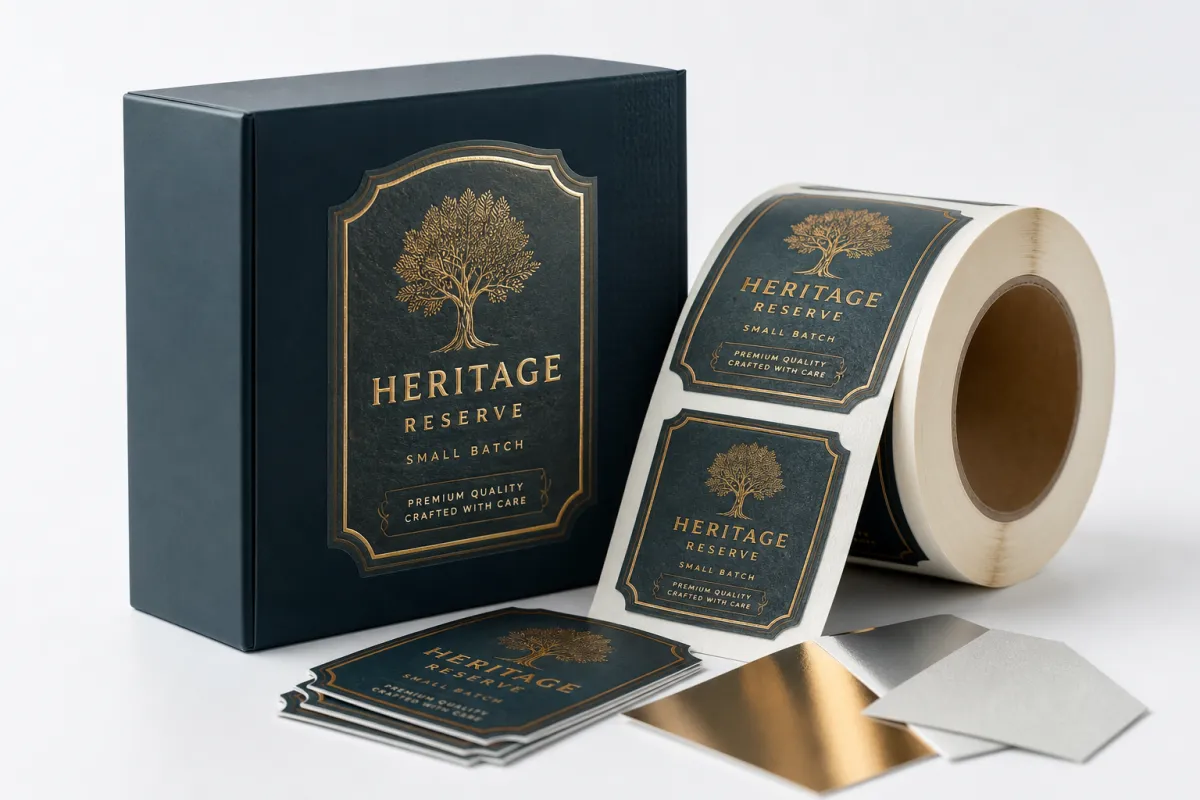
Custom offset printing labels are printed labels made with an offset press, where the inked image on a plate transfers to a rubber blanket and then onto the label stock. That indirect transfer helps the press hold detail cleanly, especially on longer runs where consistency matters more than speed alone. It is a mature process, and packaging teams still trust it for jobs that carry real brand weight.
The image quality is the first thing people notice. Fine type, hairline rules, tiny icons, and soft gradient transitions usually come out more controlled with offset printing than with lower-resolution methods. If the label is part of a packaging system that also includes custom printed boxes or a broader retail packaging rollout, that edge quality helps the whole shelf presence feel deliberate instead of tossed together at the last minute.
Custom offset printing labels are also valued because they handle color discipline well. A buyer trying to hold a precise brand red, a cool gray, or a deep black usually appreciates how tightly ink can be managed once the press is set. That matters for supplement labels, cosmetic lines, and premium foods where even a small color shift can make a whole range feel inconsistent. I've stood at press checks where a slight drift in black density made the difference between a label that looked expensive and one that looked a little off, kinda like it had been printed by two different shops.
Common uses include:
- Food and beverage labels with dense ingredient copy or compliance text
- Cosmetic labels that need a polished, retail-ready look
- Supplement labels with fine typography and multiple variants
- Specialty product packaging where brand color and detail cannot drift
A useful way to think about custom offset printing labels is simple: if the label needs to act like a miniature billboard, offset helps that billboard stay sharp. If the job changes often, runs very short, or needs frequent version updates, digital printing may be the cleaner fit. The process should follow the product and the run length, not the other way around.
For brands that care about sourcing, paper-based FSC stocks can also be part of the discussion. That does not solve every label decision, but it does matter when the packaging program needs to line up with sustainability claims and broader packaging design goals.
How Custom Offset Printing Labels Are Made: Process and Timeline
The production flow for custom offset printing labels starts long before ink touches paper or film. Artwork prep comes first, followed by plate making, press setup, printing, drying or curing, converting, finishing, and final packing. Each stage has its own small failure points, and in label work those details matter because one weak link can ripple through an entire batch.
Prepress is where a lot of problems are either prevented or created. Files need the right bleed, proper resolution, correct dieline placement, and clean color builds before the press is scheduled. If the label is misaligned on the die line, or if a barcode sits too close to a trim edge, custom offset printing labels can still print beautifully and still fail the job.
A realistic timeline usually looks like this: one to two business days for proofing if the artwork is ready, one to three business days for plates and setup, then the run itself once the press is dialed in. Straightforward custom offset printing labels jobs can move in roughly 7-12 business days from approval, while more complex work with foil, lamination, or multiple SKUs may take longer. That is not a promise, just a practical range based on normal pressroom scheduling.
Registration, ink balance, and substrate behavior all affect the final look. Paper stocks absorb ink differently than BOPP or clear film, and that changes how solids dry and how tiny text reads at the edge. If the label carries lots of screens, vignettes, or tight reverse type, the press crew has to watch balance closely so custom offset printing labels stay crisp across the full run.
Many buyers underestimate this part: setup time is where offset spends its money, but it is also where it protects the run. Once the press is running well, the output is efficient and highly repeatable. That is why custom offset printing labels often make more financial sense on longer runs than they do on a few hundred pieces.
Turnaround can stretch or shrink depending on proof approval speed, special coatings, foil stamping, die-cut complexity, and material availability. If a plant is waiting on a precise paper grade or a specialty adhesive, the schedule can slip even when the pressroom is ready. When the timeline is tight, it helps to decide early whether the job really needs custom offset printing labels or whether another print path can meet the same brand goal.
The cleanest label jobs usually come from clean files. If the artwork is not locked, custom offset printing labels are almost guaranteed to take longer, cost more, or both.
For teams that care about testing and transit, it is smart to pair label decisions with packaging performance checks that follow ISTA methods. A label that looks perfect in the proof room still has to survive warehouse handling, shipping abrasion, and temperature swings once it is on the line and out in the field.
Key Factors That Affect Quality and Performance
Custom offset printing labels only perform well if the substrate, adhesive, ink, and finish all match the container and the use case. The print is only one part of the job. Real performance comes from how the full structure behaves once it is wrapped around a bottle, applied to a carton, or exposed to the conditions the product will actually see.
Substrate choice is one of the biggest decisions. Paper labels can feel classic and economical, but they are not always the right answer for moisture, refrigeration, or scuff-heavy handling. BOPP and clear film often provide better durability and moisture resistance, while specialty stocks may support a more premium package branding look. For custom offset printing labels, that choice changes both appearance and press behavior.
Finish matters too. Gloss varnish gives a brighter shelf look and can help with rub resistance. Matte finish feels softer and more understated. Soft-touch lamination adds a velvety feel, but it can raise cost and can complicate barcode readability if the artwork is not planned carefully. On custom offset printing labels, the finish is not just decoration; it is part of the product's handling profile.
Adhesive selection is where a lot of first-time label buyers get surprised. A label can look perfect on press and still fail on a cold bottle, a dusty carton, a squeezable tube, or a curved container with lower surface energy. If the adhesive does not match the surface, the result may be edge lift, flagging, or wrinkles. That is why custom offset printing labels should be matched to the container, not chosen from appearance alone.
Design decisions also shape performance. Tiny type needs enough contrast. Barcodes need clean quiet zones. Metallic elements should be used with care, especially if there is a compliance panel nearby. The more detail the artwork includes, the more important it becomes to keep registration tight. That is one reason buyers with stronger packaging design systems often do better on offset than on loose, last-minute label jobs.
Container shape and application method matter as well. A straight-sided jar is easier than a narrow squeeze bottle. Hand application gives more tolerance than automated labelers, which can expose problems with unwind direction, release force, and adhesive tack. If a line is running fast, custom offset printing labels need to be specified with the application environment in mind, not just the artwork.
Here is a simple way to compare common choices:
| Method | Best For | Typical Strengths | Typical Tradeoffs | Approx. Quantity Fit |
|---|---|---|---|---|
| Offset printing | Longer runs, fine detail, exact color control | Sharp text, consistent solids, efficient high-volume output | More setup, less flexible for frequent art changes | Medium to large orders |
| Digital printing | Short runs, variable data, fast artwork changes | Quick setup, easier versioning, low minimums | Can be higher unit cost at scale, some detail limits | Small to medium orders |
| Hybrid approach | Programs with repeat artwork and occasional versioning | Flexibility, selective finishing, balanced planning | More planning required, not ideal for every job | Mixed SKU programs |
That comparison is why custom offset printing labels are often chosen for steady product lines rather than one-off experiments. If the item will keep selling, the label can be engineered for repeatability instead of novelty. That is how a brand keeps its retail packaging looking stable from one production cycle to the next.
Custom Offset Printing Labels Cost, Pricing, MOQ, and Quote Basics
Custom offset printing labels are priced around setup, materials, finishing, and quantity, so the quote is usually more layered than buyers expect. Plates have to be made, the press has to be adjusted, and the job has to be converted and finished. Those fixed costs are why offset often looks expensive on the first line of a quote and more attractive once the unit economics are spread across enough pieces.
The biggest pricing drivers are usually quantity, number of colors, substrate choice, finishing, and die cutting. If the job needs a coated stock, lamination, foil, or multiple versions, the quote rises. If the artwork is simple and the run is long, custom offset printing labels can become very efficient on a per-piece basis. That is why the minimum order quantity matters so much.
Most offset label programs become economical once the run is large enough to absorb setup costs. Depending on the plant and the spec, that can be a few thousand labels or more. On some jobs, custom offset printing labels may land around $0.08-$0.25 per piece at moderate quantities, while premium structures with specialty finishes can run higher. That is a ballpark, not a fixed promise, because the exact material and press plan drive the real number.
For buyers comparing options, this table is a practical starting point:
| Order Profile | Likely Better Fit | Why | Price Behavior |
|---|---|---|---|
| 500 to 2,000 labels | Digital printing | Lower setup, faster turnaround | Higher per-unit cost is common, but low total spend may win |
| 2,500 to 10,000 labels | Offset or digital depending on art | Balance between setup and run length | Pricing depends heavily on finishes and number of colors |
| 10,000+ labels | Offset printing | Setup cost spreads out, output becomes efficient | Per-unit cost usually drops noticeably |
That table is not a rulebook, but it does reflect how custom offset printing labels are often quoted. Buyers sometimes focus on the unit price and miss the hidden cost of extra proof rounds, artwork changes after plates are made, or shipping delays because the specification was not complete. Those surprises can wipe out the savings that looked so strong at first glance.
What should be included in a quote request? Size, quantity, stock choice, finish, roll or sheet format, application method, barcode needs, and the target deadline. If the label will be used on a curved container or on a line with automated application, say so early. The more specific the request, the more useful the quote for custom offset printing labels will be.
It also helps to ask whether the quote includes die cutting, proofing, shipping, and any plate-related setup. Some vendors separate those costs, and others bundle them. If you are building a wider sourcing plan that includes Manufacturing Capabilities or coordinated branded packaging materials, that level of clarity keeps the project from drifting later.
Step-by-Step Guide to Ordering Custom Offset Printing Labels
The easiest way to order custom offset printing labels is to treat the job like a production plan, not just a design file. Start with the product environment. Is the label going on a chilled bottle, a dry carton, or a cosmetic jar that will be handled often? Those details decide the stock, adhesive, and finish before the artwork is even finalized.
Next, get the artwork checklist right. Final dimensions, bleed, dieline, Pantone references, resolution, barcode requirements, and any compliance copy should all be locked before the proof stage. I have seen strong designs lose their value because a nutrition panel was too small, or because the label width did not match the container real estate. Custom offset printing labels reward precision, and they punish guesswork.
- Define the product use, surface, and storage conditions.
- Confirm label size, shape, and application method.
- Prepare print-ready artwork with correct bleed and dieline placement.
- Review the first proof for color, layout, and technical details.
- Approve plates, schedule the run, and confirm finishing specs.
- Check delivery format, unwind direction, and storage instructions before release.
The proof stage is where smart buyers slow down. The first proof is the best chance to catch color mismatches, off-brand type treatment, barcode issues, and any spacing problems around the trim line. Once custom offset printing labels move into plates and press scheduling, changes become more expensive and usually slower.
After approval, plates are made, the press is scheduled, and the job moves into printing, drying, converting, and inspection. Then the rolls or sheets are packed for shipment. If the labels are going into a controlled line, confirm roll direction, core size, and unwind requirements before the order is released. That small detail can save a production headache later, especially with automated application.
Custom offset printing labels should also be paired with smart receiving and storage instructions. Labels stored too hot, too cold, or in a humid area can cause adhesive problems later. If the run is for seasonal or future use, keep that in mind before the first pallet arrives. A label is not finished at the press; it is finished when it runs correctly on the product.
For brands that are expanding, it can be useful to map the label work against broader packaging programs. If the same line also uses Custom Packaging Products, or if a design team is building a family of cartons and labels together, the order sequence matters. The best custom offset printing labels projects usually sit inside a bigger packaging plan instead of being handled as isolated reprints.
Common Mistakes to Avoid with Custom Offset Printing Labels
One of the most common mistakes with custom offset printing labels is rushing artwork approval. A misspelled ingredient line or a barcode that fails scan quality checks can be expensive once the plates are already made. Even a small color shift can create a visible mismatch across a family of SKUs, which is a bigger problem than many teams expect.
Another mistake is choosing a substrate for appearance alone. A beautiful paper stock may photograph well, but if the product sits in refrigeration, sees condensation, or gets handled in distribution, the label may fail in the real world. For custom offset printing labels, the stock has to match the environment, not just the mood board.
Buyers also underestimate the application environment. Oil, chemicals, moisture, rough handling, and curved surfaces all change how a label performs. If the pack will go through freight, warehouse stacking, or rough retail handling, the adhesive and finish need to be planned with that abuse in mind. That is especially true for labels used in retail packaging where the product will be picked up, turned, and set down many times.
- Do not approve artwork before checking all text, barcodes, and dielines.
- Do not select stock based on appearance alone.
- Do not ignore temperature, moisture, and handling conditions.
- Do not overlook registration and trim tolerances.
- Do not compare quotes only on the lowest number.
Registration and dieline issues are another quiet problem. If the die line is off, the label may cut too close to the art or leave spacing that looks unprofessional. On custom offset printing labels, the press can be doing everything right and the job can still look wrong because the file was not built with production tolerances in mind.
Price-only comparisons can lead brands into trouble too. A low quote sometimes means thinner QA, fewer proof checks, or weaker finishing. If the label has to support a premium product, the cheapest option can become the most expensive one after a reprint. Good custom offset printing labels are an investment in fewer problems on the line and fewer complaints at the shelf.
Expert Tips and Next Steps for Custom Offset Printing Labels
My first tip is simple: build a print-ready checklist before you request pricing. If the size, quantity, substrate, finish, roll format, and application method are already defined, the quote will be much more accurate. That matters with custom offset printing labels because the press setup is where a lot of the economics live.
Second, order sample materials or a press proof if the label will face moisture, friction, or strict color expectations. A press proof catches problems early, and a material sample can tell you more about feel and durability than a mockup ever will. For custom offset printing labels, that early check is often cheaper than fixing a field failure later.
Third, think about future SKUs while the job is being planned. If the current label may need a seasonal version, language variant, or size adjustment later, it can be smart to keep the structure consistent. That does not mean every job should be overbuilt, but it does mean the brand should avoid creating a label system that is hard to repeat. Good package branding usually leaves room for that kind of growth.
Fourth, confirm storage and application details before the labels arrive. Roll direction, unwind requirements, core size, pallet storage conditions, and line speed all matter more than most people think. If the application team has to improvise, even strong custom offset printing labels can underperform on the floor.
Here is a practical sequence that usually works well:
- Gather specs and confirm use conditions.
- Request a quote with exact dimensions and quantities.
- Review the proof carefully and mark every correction.
- Approve only after the team signs off on color and layout.
- Plan receiving, storage, and application before shipment.
If you want to keep the project aligned with your larger packaging program, it helps to look at the label alongside any cartons, inserts, or outer packs. A strong Custom Labels & Tags order can support the shelf look, but the whole package still needs to work as one system. That is where custom offset printing labels become part of a smarter sourcing process rather than a stand-alone purchase.
The last thing I would say is this: do not wait until the final production run to discover whether the label behaves the way you need. Custom offset printing labels are at their best when the buyer is deliberate, technical, and a little picky. That kind of discipline usually pays back in smoother production, better shelf presence, and fewer surprises.
Choosing Custom Offset Printing Labels for the Long Run
If the goal is a label that looks refined, holds color well, and supports a stable product line, custom offset printing labels are often the right answer. They are not the fastest route for every project, and they are not the cheapest option for tiny runs, but they do deliver a level of control that matters in serious packaging work. That is especially true when the label is carrying a lot of the brand story on a crowded shelf.
The real value shows up in the details: precise type, steady registration, clean solids, and a finish that matches the product's positioning. Those details help the label work with the rest of the packaging system, whether that means a carton, a pouch, or a full suite of custom printed boxes. If the brand wants the pack to feel dependable and polished, custom offset printing labels give that message a better chance to land.
From a buyer's perspective, the smartest next step is usually to define the product environment, lock the artwork, and ask for a quote with exact specs. Once that is done, custom offset printing labels become much easier to compare against digital printing, shorter-run options, and alternate finishing paths. The answer is rarely about printing alone; it is about matching the label method to the real product, the real line, and the real shelf.
If you are deciding right now, start with three things: the container surface, the storage conditions, and whether the artwork is truly final. If those are clear, the choice between offset and another print method gets a lot easier, and you are gonna avoid the usual back-and-forth that slows packaging projects down.
Frequently Asked Questions
Are custom offset printing labels better than digital labels for large runs?
Yes, that is often the case once the quantity is high enough to absorb setup costs. Custom offset printing labels usually deliver very strong color consistency and sharp detail across long runs, while digital printing is often better for short runs or frequent artwork changes.
How long do custom offset printing labels usually take to produce?
Lead time depends on artwork readiness, proof approval, material availability, and the finishing steps involved. Straightforward custom offset printing labels jobs can move in about 7-12 business days after approval, while complex finishes or multiple SKUs can take longer.
What affects the cost of custom offset printing labels the most?
Quantity, number of colors, substrate choice, and finishing usually drive the price the most. Plate setup and die cutting also matter, and rush schedules or special coatings can raise the total for custom offset printing labels.
Can custom offset printing labels work on curved bottles or containers?
Yes, but the material and adhesive need to match the container shape and the application method. Curved surfaces may need more flexibility and testing for edge lift or wrinkling, so custom offset printing labels should be reviewed with the actual pack in mind.
What should I send when requesting a quote for custom offset printing labels?
Send the label size, quantity, stock preference, finish, format, artwork files, container details, and any special requirements like foil or lamination. The more complete the request, the more accurate the quote and timeline for custom offset printing labels will be, and the less likely you are to run into avoidable rework later.

