Buyer Fit Snapshot
| Best fit | Custom Packaging for Handmade Business Wholesale Options projects where brand print, material claims, artwork control, MOQ, and repeat-order consistency need to be specified before quoting. |
|---|---|
| Quote inputs | Share finished size, material target, print colors, finish, packing count, annual reorder estimate, ship-to region, and any compliance wording. |
| Proofing check | Approve dieline scale, logo placement, barcode or warning zones, color tolerance, closure strength, and carton packing before bulk production. |
| Main risk | Vague material claims, crowded artwork, missing packing details, or unclear freight terms can make a low unit price expensive after revisions. |
Fast answer: Custom Packaging for Handmade Business Wholesale Options should be specified like a repeatable production item. The safest quote records material, print method, finish, artwork proof, packing count, and reorder notes in one written spec.
Production checks before approval
Compare the actual filled-product size with the drawing, then confirm tolerance on folds, seals, hang holes, label areas, and retail display edges. Reserve space for logos, QR codes, warning copy, and material claims before decorative graphics fill the panel.
Quote comparison points
Review material grade, print process, finish, sampling route, tooling charges, carton quantity, and freight assumptions side by side. A quote is only useful when the supplier can repeat the same color, closure quality, and packing count on the next order.
Custom Packaging for Handmade business wholesale looks like a line item until you trace where it actually shows up: pack time, freight cube, shelf presence, breakage, and the way a buyer remembers a product after the first opening. A carton that fits tightly, a mailer that stacks without sagging, or an insert that keeps a jar from skating around can protect margin better than a heavier board ever will. Handmade brands live in that tension every day. The package has to carry the maker’s story and still survive pallets, storage racks, and repeat orders without turning into expensive theater.
The most common mistake is also the easiest to miss. Buyers ask for prettier packaging before they know the dimensions, the packout, or the reorder size. That sequence usually leads to extra spend and a redesign nobody wanted. Custom Packaging for Handmade business wholesale works better as an operations choice first and a branding choice second. Once the structure is right, the package affects cube, labor time, damage rates, and how fast a restock can move through the line. Those are the numbers that move a wholesale account.
Most makers do not need the most ornate option on the table. They need packaging that repeats cleanly, protects the product, and still feels intentional on a shelf or in a shipping bin. A package built for the exact item, the exact workflow, and the exact restock pattern does more than generic stock packaging ever can. That is the practical promise here, and it is why custom Packaging for Handmade business wholesale deserves a careful setup from the start.
Most handmade brands do not need fancier packaging; they need packaging that fits the product, the packout speed, and the carton cube.
How does custom packaging for handmade business wholesale change margins?
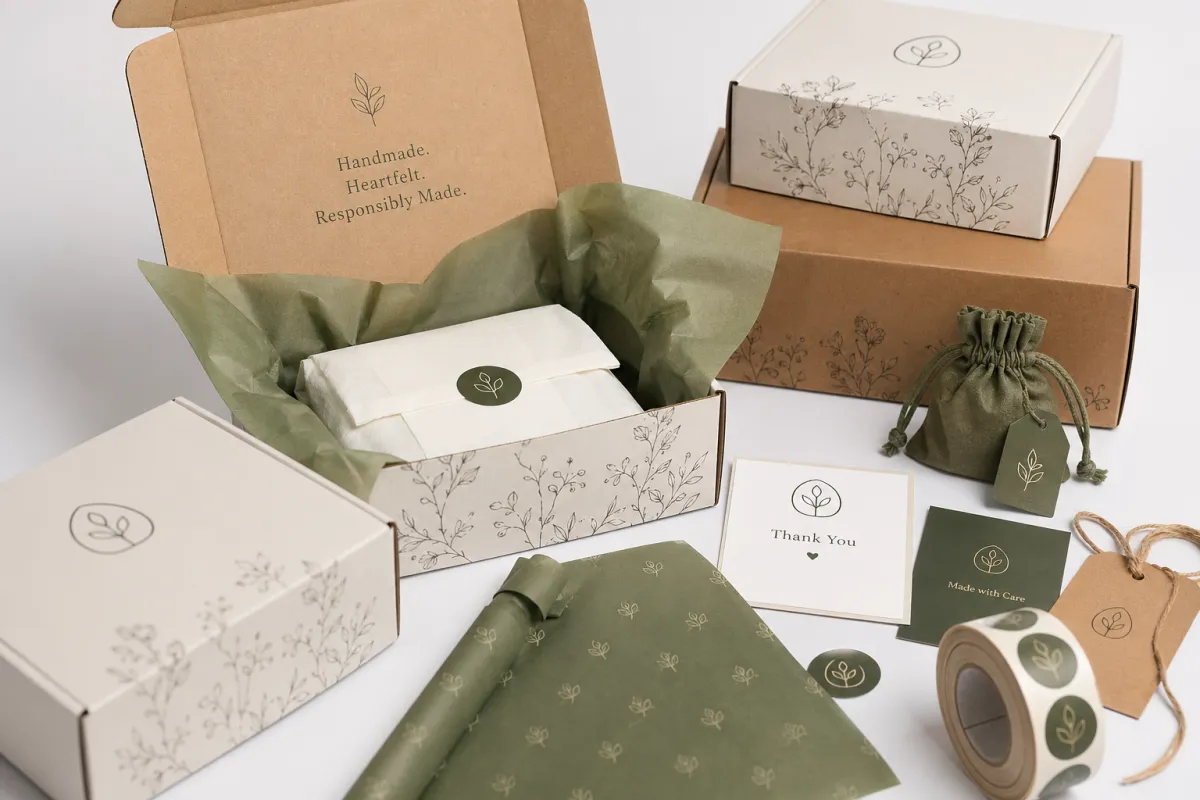
Custom Packaging for Handmade business wholesale changes margins because the package is part of the unit cost, not a wrapper around it. A soap bar that rattles, a candle that needs extra void fill, or a jewelry kit that takes 20 extra seconds to assemble all create hidden costs that never show up in the board price. The right dimensions, insert, and closure can save more money than a slightly cheaper sheet of paperboard. A lean package is often the quieter financial win.
Freight is the first place the math gets interesting. Add an inch to a small carton and the cube grows faster than many buyers expect. A box that measures 10 x 6 x 4 inches holds 240 cubic inches. Push it to 11 x 7 x 5 and it jumps to 385 cubic inches, a 60 percent increase. That difference ripples through pallet count, storage space, and shipping charges. Custom Packaging for Handmade business wholesale helps keep those dimensions honest by matching the structure to the real product plus tissue, wrap, or protective layers instead of guessing with a stock size that almost fits.
Labor is the second margin lever, and small teams feel it quickly. A box that opens cleanly, accepts the product the same way every time, and does not fight the packer can shave seconds off each unit. Those seconds become hours across a 2,000-piece order and days across a seasonal replenishment. In many handmade operations, custom packaging for handmade business wholesale pays back in speed before it pays back in branding.
Retail presentation matters too. Handmade brands often want something crafted rather than industrial, yet buyers still expect tidy shelf edges, predictable stacking, and readable product information. A package can feel artisanal without becoming fragile, awkward, or expensive to store. Strong custom packaging for handmade business wholesale balances display value with warehouse logic, which matters when the product has to move through distribution centers, retail backrooms, and direct shipping stations without damage.
Returns change the equation again. A chipped jar, a dented lid, a shifted insert, or scuffed print can turn a low-cost package into a costly problem. Replacement stock, re-shipping, and service time often dwarf the packaging line item. That is why custom packaging for handmade business wholesale should be judged on the whole run. A modest increase in structure cost can be cheaper than a higher failure rate.
Buyers get better results when they narrow six decisions early: format, material, print, finish, quantity, and timing. With those pieces fixed, custom packaging for handmade business wholesale becomes easier to quote and easier to reorder. Good specifications save more than good intentions do.
Custom packaging for handmade business wholesale: formats and materials
Custom packaging for handmade business wholesale includes more than a custom printed box. Handmade brands usually need a layered system: primary packaging, retail packaging, and shipping packaging. Each one behaves differently. Folding cartons suit lightweight products and shelf presentation. Mailer boxes carry more strength for e-commerce. Rigid boxes bring a premium feel. Sleeves, labels, belly bands, and insert cards often finish the package without pushing the budget into uncomfortable territory.
Paperboard remains the most common starting point. Coated or uncoated carton board in the 16 pt to 24 pt range works for many handmade products, depending on weight and print coverage. Kraft board suits brands that want a natural look, especially for soap, candles, bath goods, and bakery-style handmade items. Corrugated board is the practical answer for transit protection. Rigid setup structures make sense when the item is delicate, the perceived value is high, or the opening moment matters as much as packout speed. Custom packaging for handmade business wholesale should follow the product, not force the product to adapt to the package.
A simple rule helps narrow the field. Light product and strong shelf requirements usually point to a folding carton. Direct shipping pushes the choice toward a corrugated mailer. Fragile or high-value items often need a rigid box with a fitted insert. None of that means every handmade product deserves the highest-cost format. It means custom packaging for handmade business wholesale should be chosen by use case, not by habit or aesthetics alone.
| Format | Best For | Typical Wholesale Unit Range | Notes |
|---|---|---|---|
| Folding carton | Soaps, lip balms, small cosmetics, tea bags, accessories | $0.18-$0.55 | Good for retail shelves; lower setup cost; easy to store flat |
| Mailer box | Direct-to-consumer shipping, candle sets, subscription goods | $0.55-$1.40 | Better transit strength; ideal for branded packaging and unboxing |
| Rigid box | Jewelry, premium gift sets, fragile handmade items | $1.60-$4.50 | High presentation value; higher freight and storage cost |
| Sleeve or belly band | Soap bars, folded textiles, candle jars, gift bundles | $0.05-$0.22 | Low-cost branding layer; easy to refresh artwork later |
| Label set or insert card | Small runs, regulatory copy, product instructions | $0.03-$0.12 | Useful when the base package stays simple |
The ranges above are typical wholesale figures, not promises. They shift with quantity, board grade, print coverage, finish selection, inserts, and assembly requirements. A plain one-color kraft sleeve behaves very differently from a foil-stamped rigid box with a soft-touch coating. Even so, the table makes one thing clear: custom packaging for handmade business wholesale is not automatically cheaper when it looks cheaper. Freight, labor, and breakage can change the result fast.
Print and finish choices shape cost and perception at the same time. Offset printing suits longer runs and tighter color control. Digital printing opens the door to smaller custom packaging for handmade business wholesale orders because setup is lighter and minimums can be lower. Foil stamping, embossing, debossing, soft-touch coating, gloss varnish, matte varnish, and aqueous coating each create a different visual and tactile effect. Some finishes protect against scuffing and fingerprints. Others are there mainly to sharpen the visual identity. The strongest package uses the smallest number of effects needed to feel complete.
Simple often wins. A brand may want a premium rigid box, then discover that the reorders are frequent, the storage is tight, and the fulfillment team is small. A folding carton or carefully designed mailer can preserve more margin and reduce errors. In custom packaging for handmade business wholesale, simplicity is not a compromise. It is often the reason the next order can be repeated without drama.
For brands trying to grow beyond one-off craft orders, standard structures are also easier to scale across Custom Packaging Products. A package that works for one SKU but collapses on the next creates excess inventory and extra training. A supplier with practical experience can help turn one family of packaging into a platform for several product lines.
Sizing, print specs, and quality details that keep orders consistent
Custom packaging for handmade business wholesale lives or dies on fit. Outside dimensions can mislead. Internal opening size, board thickness, tuck style, and insert allowances decide whether the product truly fits. A candle jar that needs tissue wrap, or a soap bar shipped with a belly band and insert card, needs internal dimensions that account for every layer. A box that is technically large enough but still loose will shift, scuff, and feel cheap the moment it moves through the line.
The details that keep orders consistent are often the ones buyers overlook during quoting. Board caliper affects both structure and print feel. Tolerance ranges define how much variation a production run may have. Bleed and safe zones keep logos and barcodes from being trimmed away. Seam placement matters because a front-panel seam can interrupt branding in a way that flat artwork mockups never show. In custom packaging for handmade business wholesale, these are production decisions as much as design decisions.
Artwork should start with the correct dieline file, usually in editable vector format or a production-ready PDF with fonts outlined and images embedded at the required resolution. Barcodes need quiet space to scan reliably. Ingredient panels, safety copy, country-of-origin marks, and care instructions all need to sit clear of folds and seams. If the package carries compliance text, that layout has to be planned from the beginning, not patched during proofing. Complete copy sent early makes custom packaging for handmade business wholesale far easier to approve.
Material choice shapes how the package ages in the real world. Soft-touch coating feels excellent, but frequent handling can leave rub marks. Gloss varnish tends to resist scuffing better, though it can look louder than the brand wants. Aqueous coating often lands in a practical middle ground on Custom Printed Boxes because it adds protection without making the finish complicated. Handmade goods that sit in humid storage or travel through multiple hands need those choices made carefully.
Orientation matters as much as color. A box can match the dimensions and still perform badly if the opening, display panel, or seam lands in the wrong place. That is why custom packaging for handmade business wholesale should be reviewed as a full structure, not just as a flat artwork file. A design that looks balanced on screen still has to fold, glue, stack, and pack in the warehouse.
Retail standards matter as well. Transit testing can prevent unpleasant surprises after launch, especially for fragile or premium products. The International Safe Transit Association publishes useful package-testing guidance and is worth reviewing before approving a sensitive order. Sourcing matters too. A certification such as FSC can support purchasing decisions when responsibly sourced fiber is part of the brief.
One habit saves a surprising amount of work: lock one master specification before production begins, then reuse that same document for every reorder. Keep internal size, board grade, finish, print method, insert style, and pack-out instructions together. That makes custom packaging for handmade business wholesale much easier to reorder later, even if a different team member places the next purchase order.
Pricing, MOQ, and unit economics for wholesale packaging
Custom packaging for handmade business wholesale pricing begins with material and ends with setup. Board grade, print coverage, finishing, structure complexity, insert style, and production steps all shape the quote. A one-color sleeve on kraft board is a different job from a full-coverage folding carton with foil and embossing. A rigid box with a custom insert costs more again because assembly labor, nesting requirements, and freight density all rise at the same time.
MOQ, or minimum order quantity, is the smallest efficient run a supplier can produce. Simpler structures usually allow lower minimums, especially with digital print or standard board selections. Highly finished custom packaging for handmade business wholesale often needs larger quantities because plates, dies, setup adjustments, and finishing costs are spread across more units. Small brands can still start. The right question is not the catalog minimum. The right question is the lowest viable quantity for the exact size and product weight.
Good pricing decisions depend on total landed cost, not unit price alone. Sample costs, die charges, plate charges, freight, case packing, and storage belong in the same calculation. A box that appears inexpensive per unit can become costly if it ships poorly or requires hand assembly that slows the line. Custom packaging for handmade business wholesale should be judged by the real cost of a finished, packed, delivered unit.
Many handmade businesses save money without making the packaging feel plain. One box size can serve multiple SKUs. Special finishes can stay on the most visible surfaces. A structure that nests efficiently in shipping cartons reduces both inventory complexity and reorder friction. If one carton can handle a soap set, a candle pair, and a small gift kit with only the insert changing, annual spend usually drops.
It also helps to separate visible premium from hidden practicality. A branded sleeve, foil logo, or textured outer carton can make the package feel more upscale while the interior remains simple and efficient. That is a smart way to approach custom packaging for handmade business wholesale because the customer sees the finish first, while the warehouse team gets a structure that packs quickly.
Sometimes a higher first quantity is the better business move. A larger run can reduce setup impact enough to pull unit price down, which may offset the cost of carrying more inventory. That can improve margin on wholesale accounts and retail sales together. The decision deserves comparison, so it helps to model three cases: a low trial run, a mid-sized test run, and a quantity that approaches the most efficient print lane.
Brands that want a cleaner path for repeat orders often do better through a wholesale relationship instead of a one-off craft purchase. A program under Wholesale Programs gives the buyer a more direct route for planning, reorder timing, and production guidance. That matters in custom packaging for handmade business wholesale because the next order usually arrives before the first one feels old.
Budget tip: if the product is light, the shape is standard, and the branding is already strong, spend on fit and print clarity before ornate finishes. That tradeoff usually improves packaging design more than another specialty effect does.
Process and timeline from artwork to delivery
Custom packaging for handmade business wholesale follows a predictable path, and the fastest orders are the ones with clean inputs. The usual sequence starts with a product brief, moves to dieline selection, artwork setup, proof review, sample approval, production, packing, and shipping. If one of those steps is incomplete, the schedule stretches. Production rarely forgives missing information.
The first thing a buyer should prepare is not the logo file. It is the product data. Exact dimensions, weight, fragility, current packout method, whether tissue or wrap is included, and whether the package must ship or simply sit on a shelf all shape the structure. For custom packaging for handmade business wholesale, that information matters more than the color palette does.
Artwork files should arrive with all required copy in one place. Barcode data, ingredient panels, caution text, care instructions, and country-of-origin language all belong together. Missing copy slows proofing because nobody wants to approve art that later fails compliance or scanning checks. A tighter proof process also reduces surprises with fold direction, seam placement, and logo position.
Most delays come from the same few places. A buyer sends rough dimensions and later learns the product needs more clearance. A finish is approved before anyone sees how it behaves on the actual board. A late edit moves a barcode after the proof has already been tuned. A sample arrives, but the feedback is vague, so the production team has to guess. Custom packaging for handmade business wholesale works best when feedback is specific and written down.
Lead times work better when they are split into parts. Proofing may take a few business days, depending on file readiness. Physical samples can add several more days if the structure is unusual. Production time depends on quantity, material, and finish. Transit time depends on freight method and destination. A single total number hides all of that. The first order of custom packaging for handmade business wholesale usually carries more steps than a reorder, so planning should reflect that difference.
A realistic timeline for many handmade brands includes time to finalize the die, another block for artwork cleanup, a few days for sample review, and a production window that leaves room for finishing and packing. Once the first run is approved, later runs move faster because the master spec already exists. That is the real benefit of treating custom packaging for handmade business wholesale as a system instead of a one-time task.
Reorder planning deserves its own calendar entry. Waiting until the last pallet is open creates avoidable pressure. Packaging shortages slow fulfillment as quickly as product shortages do. A better habit is to reorder while inventory is still comfortable, especially if the material or finish needs a longer production window. That buffer keeps the brand shipping product instead of improvising temporary packaging.
Why choose us for custom packaging for handmade business wholesale
Custom packaging for handmade business wholesale works best with a supplier that understands production realities, not just polished mockups. The right team narrows choices instead of flooding the buyer with options that do not fit the product, the budget, or the restock plan. That kind of guidance matters because handmade brands need Packaging That Feels crafted yet still behaves like a dependable wholesale item.
Strong support shows up in the details. Artwork review should catch bleed problems, barcode placement issues, and seam conflicts before production begins. Samples should be checked against the actual product, not only against a flat drawing. Print consistency, fold accuracy, glue-line control, and case-packing discipline all shape the final result. In custom packaging for handmade business wholesale, those checks protect the brand from avoidable reprints and awkward last-minute fixes.
Communication matters more than many buyers expect. If the size is off by even a small amount, fit changes the whole feel of the packout. If a color runs too dark or a finish feels too slick for the product, the package may still function, but it will weaken the brand story. Good suppliers flag those issues early so the buyer can correct them before the order is locked.
For brands building a larger assortment, the best suppliers also think in families. One carton style may work for three SKUs with different inserts, or one mailer format may support a series of gift sets with different internal layouts. That kind of planning makes custom packaging for handmade business wholesale easier to manage because the brand does not need a separate solution for every item.
If you are comparing options, review Custom Packaging Products alongside the available Wholesale Programs so the structure, quantity, and print method match the way the business actually sells. That is often the fastest route away from overbuilt packaging. It is also the cleanest way to keep branded packaging aligned with real order volume.
Manufacturing should support the brand story rather than fight it. A handmade product can still look polished, premium, and deliberate while using a structure that is efficient to produce and easy to pack. That point gets missed often. Packaging is not only appearance. It is how the box behaves in carton, on shelf, and in transit.
Quality checkpoint: the safest order is the one where every detail is confirmed before full production, including size, finish, artwork placement, and how the product sits inside the box. That simple discipline avoids the most expensive mistake: a full run that looks good in concept and fails in use.
Next steps to place a wholesale packaging order
Custom packaging for handmade business wholesale becomes easier once the buyer has a clean spec sheet. Start with product dimensions, product weight, fragility level, and the exact packaging format you want quoted. Add quantity, finish preference, artwork files, barcode data, and the target delivery window. A clear brief reduces back-and-forth and helps the supplier quote the right structure the first time.
The smartest way to start is with one approved structure and one color direction. That keeps the first order focused and makes the proof process easier to validate. Once the box fits well, the print reads cleanly, and the finish holds up in handling, the brand can expand into alternate colors, seasonal runs, or other product families. That is a practical path for custom packaging for handmade business wholesale because confidence grows before complexity does.
Speed from quote to proof depends on response time. Review artwork quickly, mark changes clearly, and confirm sample feedback in writing. If a dieline needs adjustment, identify the exact problem instead of saying the package feels off. If a barcode or ingredient panel needs repositioning, note the measurement and the preferred location. Specific feedback shortens the correction cycle and keeps packaging design moving.
Before approving production, verify three things: fit, print, and packout. The fit should hold the product without excess movement. The print should match the brand and remain legible at the expected viewing distance. The packout should be easy for the team to repeat without special handling. That is the working standard that keeps custom packaging for handmade business wholesale profitable over time.
One last discipline helps more than people expect: schedule replenishment before inventory gets thin. Packaging lead times are easier to manage when buffer stock exists, and buffer stock is easier to justify once the package already performs well. The strongest custom packaging for handmade business wholesale order is the one that matches the product, the budget, and the replenishment plan.
What is the minimum order for custom packaging for handmade business wholesale?
MOQ depends on the structure, print method, and material, so simpler formats usually support smaller runs than rigid or highly finished boxes. Digital print and standard shapes often keep entry quantities lower, while custom tooling, foil, or specialty finishing usually raises the minimum. If you are unsure, ask for the lowest viable quantity for your exact size and product weight rather than the generic catalog minimum.
Which custom packaging for handmade business wholesale works best for fragile items?
Fragile products usually do best in a snug folding carton, corrugated mailer, or rigid box with a fitted insert that blocks movement during transit. The right structure depends on both breakage risk and presentation needs, since a cosmetic jar, candle, or ceramic item may need different support. Fit matters as much as board thickness, because movement inside the package is often what causes damage.
How do I keep wholesale packaging costs under control without looking cheap?
Standardize one or two sizes across multiple SKUs so tooling stays simpler, inventory stays leaner, and order quantities become more efficient. Keep special finishes on the most visible surfaces and limit print effects to the details that do the most work for the brand. Start with a practical structure, then add premium elements only where they improve shelf appeal or protection.
How long does custom packaging for handmade business wholesale usually take?
Timing depends on whether the order needs a new dieline, printed proof, physical sample, or special finishing, so the first run usually takes longer than a reorder. Production and transit should be treated as separate timelines, because freight can add days or weeks depending on destination and shipping method. The fastest orders are the ones with complete artwork, confirmed dimensions, and quick approval.
Can I include my logo and barcode on wholesale handmade packaging?
Yes, if the artwork is set up correctly and the barcode has enough quiet space for reliable scanning. Keep logos, compliance text, and barcodes inside the proper safe zones so folds, seams, or inserts do not interfere with print or function. If needed, the layout can be adjusted so branding stays prominent while scan-critical information remains clear.
If the goal is a package that looks intentional, ships cleanly, and reorders without friction, custom packaging for handmade business wholesale is the right place to focus. Lock the size, choose the structure that fits the product and fulfillment method, and confirm print, packout, and reorder terms before the first run is approved. That single checklist protects margin, reduces damage, and keeps the next order from becoming a scramble.

