Buyer Fit Snapshot
| Best fit | Custom Packaging Labels Wholesale projects where brand print, material claims, artwork control, MOQ, and repeat-order consistency need to be specified before quoting. |
|---|---|
| Quote inputs | Share finished size, material target, print colors, finish, packing count, annual reorder estimate, ship-to region, and any compliance wording. |
| Proofing check | Approve dieline scale, logo placement, barcode or warning zones, color tolerance, closure strength, and carton packing before bulk production. |
| Main risk | Vague material claims, crowded artwork, missing packing details, or unclear freight terms can make a low unit price expensive after revisions. |
Fast answer: Custom Packaging Labels Wholesale: Pricing, Specs, Process should be specified like a repeatable production item. The safest quote records material, print method, finish, artwork proof, packing count, and reorder notes in one written spec.
Production checks before approval
Compare the actual filled-product size with the drawing, then confirm tolerance on folds, seals, hang holes, label areas, and retail display edges. Reserve space for logos, QR codes, warning copy, and material claims before decorative graphics fill the panel.
Quote comparison points
Review material grade, print process, finish, sampling route, tooling charges, carton quantity, and freight assumptions side by side. A quote is only useful when the supplier can repeat the same color, closure quality, and packing count on the next order.
Custom Packaging Labels Wholesale: Pricing, Specs, Process
Why custom packaging labels wholesale makes sense fast
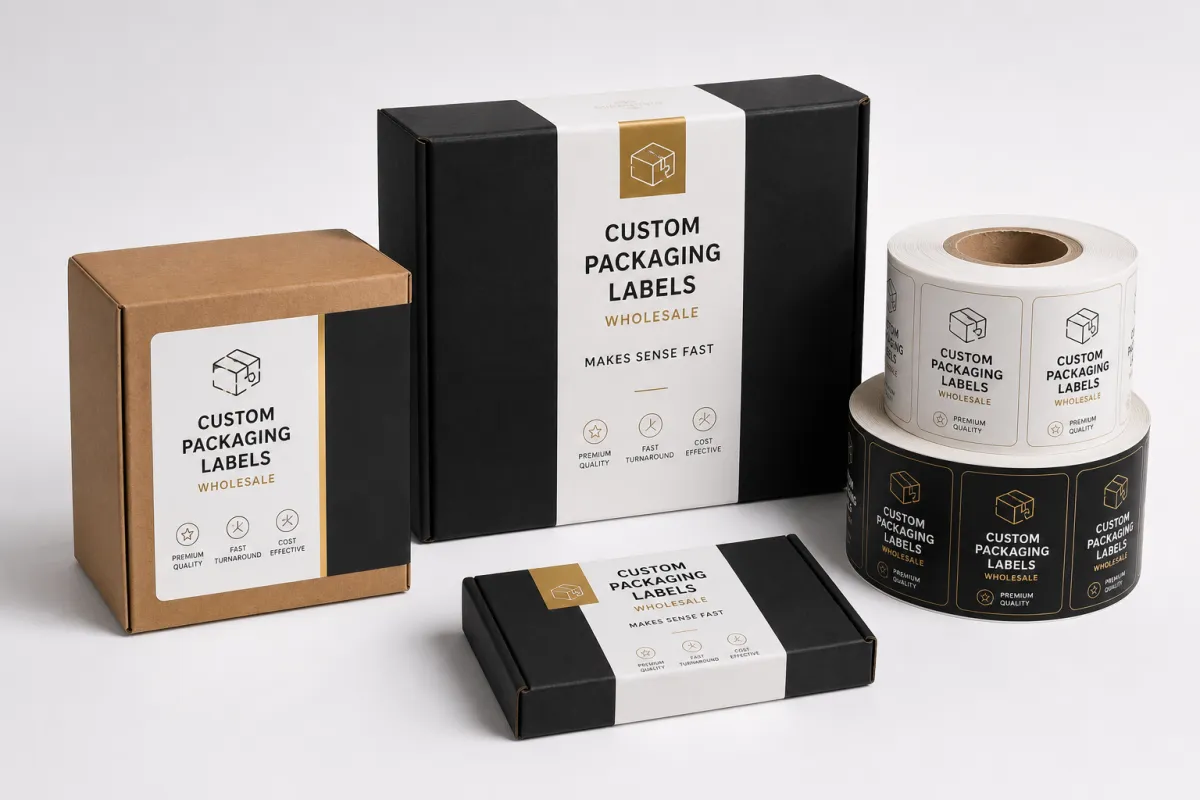
If the label looks weak, the package looks weak. That is the ugly truth, and it shows up everywhere. Custom packaging labels wholesale gives brands a faster way to tighten up product packaging without paying for a new printed carton every time a flavor, scent, size, or promo changes.
Lower unit cost matters, sure. So does the ability to swap artwork without rebuilding the whole package system. That is why custom packaging labels wholesale is often the first sane move for launches, private label runs, seasonal drops, subscription products, and multi-SKU lines. One container can carry a lot of variation if the label does the heavy lifting.
A decent jar, pouch, or mailer can still look cheap if the label is crooked, the finish is flat, or the adhesive starts peeling at the edge. Customers notice that stuff immediately. They do not separate the label from the product experience. They just see whether the packaging feels intentional or thrown together five minutes before ship time.
There is also the production side, which people love to ignore until it gets expensive. Ingredients change. Compliance text shifts. Promo codes expire. If every update forces a full box rerun, the brand pays for waste it never needed. Labels keep the base package stable and move the changes into a printed layer that is easier to update, easier to store, and easier to reorder.
Wholesale does not mean generic. It means volume pricing with repeatable quality. That distinction matters. The value is not just a lower price per label. It is the ability to reorder the same spec without watching color drift, adhesive inconsistency, or sloppy trimming creep into the run. For branded packaging, consistency is not a bonus. It is the job.
A label takes the beating first. It gets handled, scraped, refrigerated, shipped, and judged in one glance. If it fails, the product feels cheaper than it is.
I have seen brands spend thousands perfecting the box structure, then slap on a label that peels during transit. That kind of mismatch is painful because it is avoidable. Custom packaging labels wholesale works best when the buyer thinks past sticker price and looks at the full packaging job: fewer repacks, faster reorders, cleaner inventory, less waste.
Custom packaging labels wholesale product options and use cases
Custom packaging labels wholesale comes in a few standard formats, and the right one depends on surface, environment, and handling. Pressure-sensitive labels are the most common choice because they apply quickly and work well on glass, plastic, coated board, and many pouches. Roll labels fit machine application or faster hand application. Sheet labels make more sense for small runs, office use, or packaging that gets labeled in batches. Specialty labels cover the awkward jobs: curved jars, cold surfaces, oil-heavy containers, or boxes that need a premium branded packaging look without extra drama.
For bottles and jars, BOPP and vinyl are usually the safest starting points because they handle moisture and scuffing better than plain paper. For dry goods, cartons, and some mailers, coated paper can do the job at a lower cost. Clear labels work when the container color should show through. Matte labels feel quieter and more restrained. Gloss labels catch light and pop on retail shelves. Soft-touch finishes add texture, although they are not the answer for every product. Sometimes a plain, clean label wins because it reads fast and does not try too hard.
The practical mapping is simple. Candle tins often need a label that can handle oils and a little heat. Cosmetic tubes usually need a flexible material that survives squeezing. Food containers may need freezer-safe adhesive or moisture resistance. Shipping boxes and mailers can use simpler stock, but the label still needs to stick well and stay readable through transit. That is the part people underestimate. A label that looks fine on a flat proof can fail on a curved bottle or chilled container. Then everybody gets surprised, which is kind of funny until the reprint invoice lands.
Custom packaging labels wholesale is especially useful for seasonal drops and multi-SKU programs. If you sell five flavors or twelve scents, full printed boxes for every version can turn into a storage problem fast. Labels let you keep the core package consistent while changing the copy, color, or flavor callout. That means tighter product packaging control and fewer dead SKUs sitting in a corner pretending to be inventory.
Shape matters too. A round label can soften a product. A square label can feel more direct and structured. A die-cut shape can add emphasis, but only if the artwork supports it. I have seen brands waste money on extra finish tricks when the real issue was contrast. Better type hierarchy, better white space, and a cleaner color break often do more for shelf visibility than another shiny coating ever will.
For buyers comparing custom packaging labels wholesale options, the decision usually comes down to three things:
- Durability - Does the label need to survive moisture, refrigeration, shipping abrasion, or repeated handling?
- Application - Is the label applied by hand, by machine, or in a semi-automated line?
- Presentation - Does the product need a clean retail finish, a premium texture, or a simple utility look?
Do not overbuild the label just because it sounds premium. A soft-touch finish on a shipping-first product is often wasted money. A simple paper label on a refrigerated bottle is a bad idea. The point is to match the material to the job, not to chase a catalog fantasy.
For broader packaging needs, brands often pair labels with Custom Packaging Products or use Custom Labels & Tags as the flexible layer across multiple SKUs. If the program is recurring, the Wholesale Programs page is worth a look because repeat volume is where the pricing starts to make sense.
Custom packaging labels wholesale specifications that matter
Specs are where custom packaging labels wholesale gets clean or gets messy. If the size is off by even a small amount, the label can wrinkle, sit crooked, or cover the wrong part of the package. If the file setup is weak, the print result will look off no matter how good the material is. Buyers should confirm the basics before asking for pricing: label size, shape, bleed, color mode, file format, print side, core size, roll direction, and order quantity.
The common file setup is straightforward. Vector artwork is preferred. Adobe Illustrator files, EPS, and print-ready PDF files are the safest options. Fonts should be outlined or embedded. Color should be set correctly, usually CMYK for process work, with Pantone references only when spot color control is needed. Keep at least 0.125 inch bleed and a safe text margin so the edge trim does not clip copy or barcodes. Those details are boring until they wreck a production run.
One more thing: RGB files are not a print plan. They are a screen plan. Screens lie a little. Ink is less polite. If the brand color matters, send Pantone references or approved samples and say so up front. That avoids the classic "it looked fine on my monitor" argument, which helps nobody.
Adhesive selection matters just as much. Permanent adhesive is the standard for most product packaging because it stays put on glass, plastic, and coated board. Removable adhesive is useful for temporary promotions or reusable containers. High-tack adhesive is better for textured surfaces, cold surfaces, or packages that go through harsher handling. Freezable adhesive is the one people forget to ask for until labels start peeling in cold storage. That is an expensive mistake, and it is avoidable.
Finishing options change both appearance and durability. Lamination helps resist moisture, scuffing, and scratches. UV resistance matters if the product sits in bright retail displays or ships through sunny environments. Some labels need oil resistance for cosmetic and candle packaging. Some need moisture tolerance for chilled beverages or refrigerated food. If a label must survive condensation, plain paper stock is usually the wrong answer no matter how cheap it looks on the quote.
Custom packaging labels wholesale also benefits from understanding roll specs. Core size is commonly 1 inch or 3 inches, and the roll direction needs to match the applicator or hand-peel process. Labels per roll affect handling speed and warehouse flow. A buyer with a semi-automatic line should confirm unwind direction, roll outer diameter, and gap spacing before approving anything. Those little production details are exactly where delays show up if they were ignored up front.
Here is a useful checklist for specification review:
- Size and shape - exact width, height, and any rounded corners or die cuts
- Adhesive type - permanent, removable, high-tack, or freezable
- Material - paper, BOPP, vinyl, clear stock, or specialty substrate
- Finish - matte, gloss, soft-touch, foil accent, or laminate
- Application - hand-applied, machine-applied, or mixed
- Artwork setup - bleed, margins, barcode placement, and color references
For brands that care about eco-minded packaging design, material selection can also reflect sourcing goals. Paper options can fit FSC-certified supply chains, while some programs prioritize recyclability or reduced plastic use. If sustainability is part of the brief, review the standard carefully and make sure it does not clash with the product environment. The FSC site is a useful reference point when paper sourcing matters, and it keeps the conversation practical instead of vague.
The cleanest custom packaging labels wholesale orders usually come from buyers who lock specs before they ask for a quote. Not after. Not halfway through proofing. Before. Changing one dimension or swapping stock can shift cost, print time, and application behavior. That is not a sales trick. It is how print production works.
Custom packaging labels wholesale pricing, MOQ, and unit economics
Custom packaging labels wholesale pricing is driven by five things that actually matter: size, material, finish, adhesive, and quantity. Color count can matter too, but most modern label runs are priced more by substrate and setup than by whether the art uses four colors or five. Custom cutting, specialty coatings, and unusual handling requirements also push pricing up. If the quote ignores those factors, the quote is not real yet.
MOQ is where a lot of buyers make emotional decisions instead of practical ones. A low minimum is useful if you are testing a new product line, a new container, or a new market. That said, the per-label cost usually drops quickly as volume rises. For many programs, the best savings show up once the order moves from a few hundred units into the low thousands. That is why it is smart to request pricing at multiple tiers instead of asking for one number and pretending that number tells the whole story.
Here is a realistic way to think about the unit economics. A simple paper label at 500 pieces might sit around $0.18-$0.35 each depending on size and print coverage. At 5,000 pieces, that same label may move closer to $0.05-$0.12 each. A waterproof BOPP label with laminate might land around $0.10-$0.28 each at mid-volume, while premium specialty finishes can climb well above that. These are not promises. They are the kind of ranges a buyer can actually use to make decisions.
Custom packaging labels wholesale becomes inefficient when a brand keeps reordering tiny quantities because nobody wants to commit. That is a common mistake. The setup cost comes back again. Then again. Then someone wonders why the label budget is weirdly high. The answer is usually that the company is paying for repeated setup, repeated proofing, and repeated shipping on orders that were too small to matter.
The other trap is over-specifying premium finishes for a product that ships in a box and disappears into the warehouse. A soft-touch laminate, foil accent, and custom die-cut shape can look great, but if the container is hidden inside a sleeve or corrugated shipper, most of that spend is decorative noise. On the flip side, saving a few cents by choosing a weak label is false economy if the label peels, scuffs, or forces customer service replacements. Cheap labels are expensive when they fail.
The cleanest way to evaluate custom packaging labels wholesale is to ask for a quote at two or three quantities. For example:
| Order Size | Typical Use | Price Behavior | Buyer Takeaway |
|---|---|---|---|
| 250-500 | Testing, limited launch, one-off promo | Higher unit cost because setup is spread thin | Good for proofing a design before committing |
| 1,000-2,500 | Small wholesale run or single SKU launch | Usually a better balance of cost and flexibility | Often the sweet spot for first production |
| 5,000+ | Repeat programs, multi-SKU rollouts, retail volume | Unit price drops more sharply | Best value if artwork and inventory are stable |
That table is the real conversation. Not vague talk about being affordable. If a buyer needs a quick launch, the low MOQ may be worth the premium. If the label is part of a stable product line, the larger tier usually wins. That is the tradeoff. No drama. Just math.
For brands comparing label spend against broader packaging programs, the question is usually whether to spend more on packaging design now or hold that money for inventory. My answer is simple: spend enough to avoid failure, then buy volume where the economics make sense. A label that performs well often saves more in complaints and repacks than it costs upfront.
Custom packaging labels wholesale process and timeline
The order flow for custom packaging labels wholesale is simple when the buyer is organized and annoying when they are not. It usually goes like this: inquiry, spec review, artwork check, digital proof, approval, production, quality check, packing, and shipment. That is the normal path. Delays usually come from missing sizes, incomplete artwork, or people trying to change the design after the proof has already been built.
For a clean project, the timeline is usually reasonable. A repeat order with locked specs can move faster because the proof and setup already exist. New artwork, specialty finishing, or a new substrate adds time. As a general range, proofing may take 1-3 business days, production may take 7-15 business days after approval, and shipping adds whatever the route requires. If the order needs a custom die or unusual material, add more time. Not a little more. More.
Speed improves when the buyer brings complete information. Final dimensions. Print-ready files. Clear quantity targets. Adhesive requirements. Surface type. Application method. One decision-maker. That last one matters more than people admit. A project slows down the minute three departments start voting on a label that should have been signed off two calls ago.
Custom packaging labels wholesale also moves faster when the product use is clearly described. Saying "for bottles" is not enough. Saying "for 12 oz PET bottles that will be chilled in display coolers and hand-applied in small batches" is useful. That one sentence tells production what the adhesive, finish, and handling needs probably are. Good specs are not paperwork theater. They save time.
Shipping time is not part of print time, which sounds obvious until a launch date is suddenly in trouble. Build in transit time, especially if the labels are tied to a retail drop, influencer campaign, or fulfillment deadline. If the project depends on cold-chain handling, review the transit path and consider packaging tests that mirror the actual journey. The ISTA transit testing standards are a useful benchmark when a label or package needs to survive more than a light trip across town.
Here is what slows orders down most often:
- Artwork submitted in a low-resolution format that cannot hold fine type or barcodes.
- Late changes to label size after the proof has already been generated.
- Unclear surface conditions, such as condensation, powder coating, or textured board.
- Quantity shifts after pricing has already been quoted at another tier.
- Approval by committee, which is a polite way to say nobody wants to own the decision.
Those are the same mistakes I see across packaging buyers, whether they are ordering labels, Custom Packaging Products, or full branded packaging systems. The companies that move fastest are not always the biggest. They are usually the ones that lock the spec early and stop treating production like a moving target.
From a buyer's perspective, it helps to think in stages. First confirm structure. Then confirm artwork. Then confirm proof. Then release the order. If the order is urgent, do not bury questions about adhesive or material in the final proof round. Ask early. Production can handle a lot of things. Surprise is not one of them.
Why choose us for custom packaging labels wholesale
Good label suppliers do not just print. They translate packaging problems into usable specs. That is the real difference with custom packaging labels wholesale. The value is not a flashy pitch. It is packaging-specific guidance, reliable material sourcing, and a quoting process that explains tradeoffs instead of hiding them under vague language.
Consistency matters even more on repeat orders. A buyer does not want the second shipment to look slightly different from the first because the finish changed or the adhesive was swapped. Repeatability is part of the product. If the label size, color, finish, and stick behavior do not match across reorders, the packaging system stops feeling controlled. It starts feeling improvised, which is not a good look for branded packaging.
Quality control should not be a mystery either. A solid program checks the proof carefully, verifies the material before production, and inspects the finished order before packing. That matters on any wholesale run, but especially when the label needs to fit a new container or a product that moves between room temperature and refrigeration. There is no prize for shipping labels that fail in the field.
Custom packaging labels wholesale should also help buyers avoid expensive mistakes before they happen. If a product is oily, cold, flexible, or heavily handled, the label spec should reflect that. If the artwork contains a barcode, the file should be checked for contrast and quiet zone spacing. If the package uses an odd shape, the label dimensions should be tested against the actual container, not just a mockup on screen. The best support saves a buyer from a bad reorder.
That is why the comparison should not be "cheapest label versus most expensive label." That is a lazy comparison and usually the wrong one. The real question is which option delivers the lowest total cost for labels that look right, stay put, and do not create rework. Sometimes that is a simple paper label. Sometimes it is a waterproof BOPP label with laminate. Sometimes it is a custom cut with a stronger adhesive. The right answer depends on the product.
For buyers building a wider system, the label program should fit the rest of the package without fighting it. A clean label can support Custom Labels & Tags, coordinated cartons, or a broader packaging design system without forcing every SKU into the same visual box. That is useful for fast-moving launches, especially if multiple retail packaging formats are running at once.
A few reasons brands stick with a well-run wholesale label program:
- Lower total waste because artwork changes do not require a full carton rerun.
- Better SKU flexibility when flavors, scents, or promo versions need quick swaps.
- Cleaner repeat orders because the spec stays fixed and production is predictable.
- Stronger shelf presentation because the finish and format are chosen for the actual container.
That is also where a structured Wholesale Programs workflow helps. Volume pricing only works if the order details are tracked cleanly enough to reorder without confusion. Once a brand gets that right, custom packaging labels wholesale stops being a one-off purchase and becomes part of the packaging system itself.
Next steps for custom packaging labels wholesale orders
If you want the cleanest result from custom packaging labels wholesale, start with a short checklist instead of starting with a design debate. Measure the package. Choose the material. Confirm the adhesive. Gather the artwork. Estimate the first run quantity. That sequence sounds basic because it is basic, and basic is what keeps print jobs from turning into rescue operations.
Then request quotes at two or three volume levels. For example, ask for pricing at 500, 1,000, and 5,000 pieces if the product is new. That shows where the unit price actually drops and helps the buyer decide whether to test small or commit to volume. A single quote tells you almost nothing. A tiered quote tells you where the economics turn in your favor.
If the label will touch a new container, a refrigerated product, or a surface with unusual texture, order a small test run first. That is not caution for its own sake. That is avoiding the very predictable moment when a pretty proof fails in real use. In packaging, a $200 test is often cheaper than a bad launch and a warehouse full of unusable stock.
Custom packaging labels wholesale should also be planned around reorder timing. Do not wait until the last pallet is gone to place the next order. Build a reorder point based on lead time, shipping time, and your average consumption. The brands that run out of labels usually did not misjudge demand. They just ignored the time it takes to buy more.
Once the proof is approved, confirm shipment timing and make sure the receiving side is ready. That is especially true for brands working with fulfillment centers, seasonal launches, or retail deadlines. A great label is not useful if it sits in transit while inventory sells through.
Here is the simplest path forward:
- Lock the package dimensions and label placement.
- Choose the right stock, finish, and adhesive for the environment.
- Send print-ready artwork with clear specs and barcode placement.
- Review the proof carefully and approve only when the details match.
- Schedule production, shipping, and the reorder point before the run gets tight.
If you are comparing branded packaging options, remember the point is not to buy the fanciest thing in the room. It is to buy the version that protects the product, supports the brand, and keeps the unit cost sensible. That is why custom packaging labels wholesale keeps winning for launches, private label programs, subscription boxes, and multi-SKU retail packaging. It gives you control without locking you into a costly full-box change every time the market shifts.
Lock the specs, compare pricing at the right volume levels, and move the order into production. Custom packaging labels wholesale works best when the first order is treated like the start of a repeatable system, not a one-time fix.
What is the minimum order for custom packaging labels wholesale?
MOQ usually depends on size, material, and print method, but custom packaging labels wholesale orders often start at a few hundred pieces and scale up by volume tier. Ask for pricing at multiple quantities so you can see where the per-label cost drops enough to justify a larger run.
Which material works best for custom packaging labels wholesale on bottles and jars?
BOPP or vinyl is usually the safest starting point for moisture, handling, and curved surfaces, while paper works better for dry, low-abuse applications. For refrigerated or wet environments, choose waterproof stock with the right adhesive instead of trying to force standard paper to behave.
How much do custom packaging labels wholesale orders usually cost?
Pricing is driven by size, quantity, material, finish, and adhesive, so two visually similar labels can still land at very different unit costs. The fastest way to get a real number is to quote the same design at several quantities; that shows the breakpoints instead of one useless average.
How long does production take for custom packaging labels wholesale?
Simple repeat orders move faster than new designs because proofing and setup are already done, while specialty finishes or new materials add time. Build in extra time for shipping, especially if the labels are tied to a product launch or fulfillment date with no room for drama.
Can I order multiple SKUs in one custom packaging labels wholesale run?
Yes. That is usually smarter than separate tiny orders, as long as the specs are organized clearly by size, artwork, and quantity. Keep a clean SKU list so production does not mix up roll directions, sizes, or finish options across versions.

