Buyer Fit Snapshot
| Best fit | Custom Boxes Wholesale projects where brand print, material claims, artwork control, MOQ, and repeat-order consistency need to be specified before quoting. |
|---|---|
| Quote inputs | Share finished size, material target, print colors, finish, packing count, annual reorder estimate, ship-to region, and any compliance wording. |
| Proofing check | Approve dieline scale, logo placement, barcode or warning zones, color tolerance, closure strength, and carton packing before bulk production. |
| Main risk | Vague material claims, crowded artwork, missing packing details, or unclear freight terms can make a low unit price expensive after revisions. |
Fast answer: Custom Boxes Wholesale: Pricing, Specs, and Process should be specified like a repeatable production item. The safest quote records material, print method, finish, artwork proof, packing count, and reorder notes in one written spec.
Production checks before approval
Compare the actual filled-product size with the drawing, then confirm tolerance on folds, seals, hang holes, label areas, and retail display edges. Reserve space for logos, QR codes, warning copy, and material claims before decorative graphics fill the panel.
Quote comparison points
Review material grade, print process, finish, sampling route, tooling charges, carton quantity, and freight assumptions side by side. A quote is only useful when the supplier can repeat the same color, closure quality, and packing count on the next order.
Custom Boxes Wholesale: Pricing, Specs, and Process
A box that is only 5 mm too large can raise freight, let products shift around, and waste shelf space. That is why custom boxes wholesale starts as a cost decision, not a branding stunt. The pretty part matters. The math matters more. Packaging buyers usually find out the hard way that the box is not just a container; it is part of shipping, storage, damage control, and reorder planning.
Custom Logo Things works in the part of packaging where small details carry real weight. A clean dieline, a tight spec, and a quantity plan that matches reality can cut waste faster than any fancy finish. Get the numbers right and custom boxes wholesale becomes a useful system for product packaging, retail packaging, and branded packaging that holds up past the first run. I have seen brands spend months polishing artwork, then blow the whole budget because the box was oversized by a sliver. That kind of thing is annoying, and expensive.
Buyers comparing custom printed boxes usually get the best results by starting with five basics: dimensions, board grade, print coverage, finishing, and order quantity. Those five choices shape the quote more than anything else. The rest is just consequences.
“A box that looks cheap but ships damaged is not cheap. It is a bill with a delay attached.”
Custom Boxes Wholesale: Why Bulk Orders Pay Off
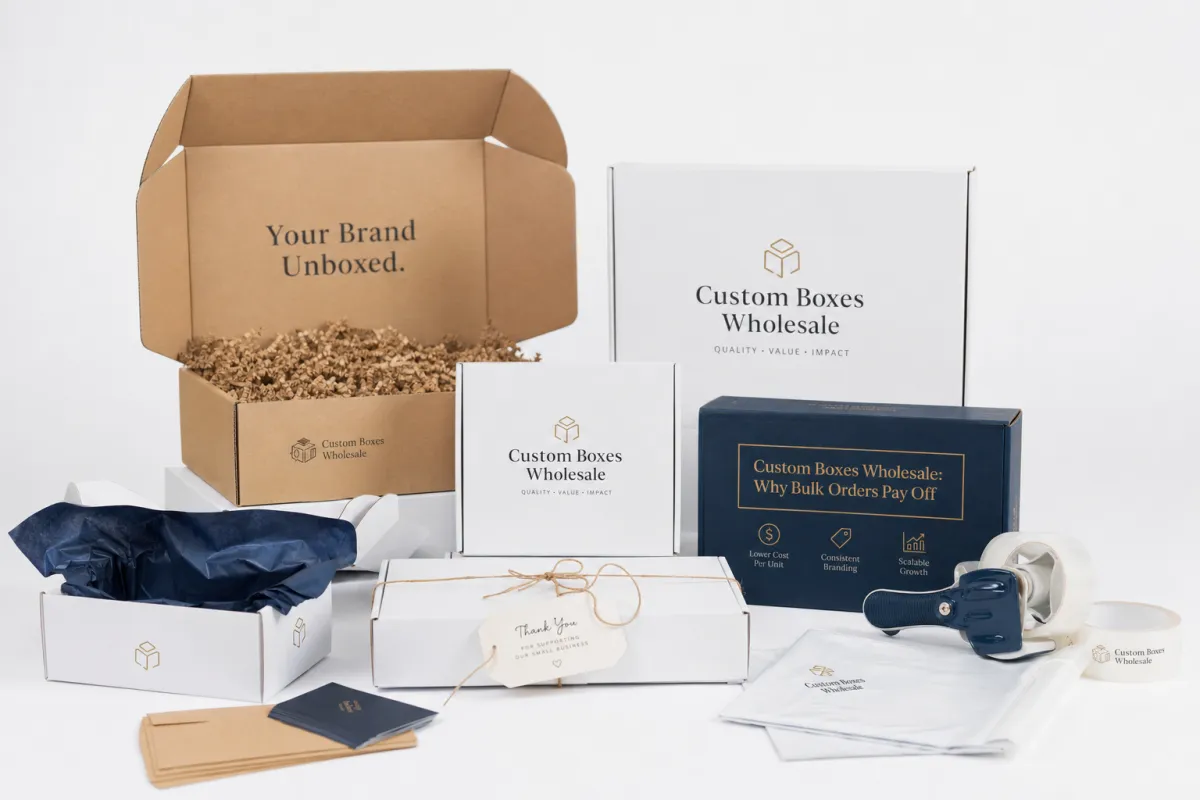
Custom boxes wholesale lowers unit cost because setup work gets spread across more boxes. That sounds obvious because it is. Die-cut tooling, print setup, prepress review, and color control all take time. Once the setup is done, the per-box cost drops as quantity rises. Brands with steady demand can use that to protect margin instead of watching packaging eat it one order at a time.
Bulk ordering also makes planning less messy. Wholesale runs let buyers standardize specs, keep predictable stock on hand, and skip emergency buys that always cost more than they should. A company shipping 300 to 800 parcels a week can usually forecast box usage with decent accuracy. That means fewer rushed reorders, fewer odd substitutions, and fewer compromises on size or finish. In real life, custom boxes wholesale works best when the product line is stable, the fulfillment volume is known, or the launch calendar is already set.
The use cases are easy to spot. E-commerce brands use custom mailers and shipping cartons to reduce dimensional weight and cut filler. Subscription kits need repeatable specs because the contents have to sit the same way every cycle. Retail packaging buyers want shelf-ready presentation, crisp print, and panel placement that does not wander. Seasonal replenishment orders benefit because the structure and artwork stay fixed while the quantity rises ahead of peak sales. Each case uses custom boxes wholesale differently, but the logic stays the same: fewer surprises, less waste, and a box that matches how the product actually moves.
Wholesale is not always the right first move. Products still in development may need dieline changes after the first sample run. Unpredictable demand can turn a big order into dead stock. A smarter call is to compare total system cost: box size, freight, inventory carrying cost, and reorder cadence. A smaller buy can still win if the design is unstable. A larger buy can still lose if the spec is wrong. Custom boxes wholesale pays when the packaging spec is mature enough to repeat without drama.
The useful question is not “How low can the box price go?” It is “What construction lowers the total cost without creating damage or extra labor?” That is the better packaging conversation. It also keeps the brand honest. If the box needs more void fill, more tape, or more repacking, the design was too loose from the start. A well-built custom boxes wholesale program fixes that by matching the box to the product instead of making the product suffer through a generic carton.
Brands building package branding around a consistent customer experience get another benefit from the wholesale model: visual control. A repeatable carton size keeps artwork placement steady. Repeatable finishing keeps color and surface feel predictable. That matters for unboxing, sure. It also matters in the warehouse. A box that stacks cleanly moves faster through fulfillment and gives transit less chance to chew it up.
Product Details: Box Styles, Materials, and Print Options
Picking the right structure is where custom boxes wholesale stops being a vague idea and turns into a real packaging spec. The box style should match the product weight, the shipping method, and the presentation goal. A rigid box can make sense for premium retail packaging, but it is usually too much box for a lightweight skincare jar. A corrugated mailer may be perfect for direct-to-consumer shipping and still look too plain for shelf-facing display. The value lives in fit, not in using the fanciest thing on the menu.
Below is a practical way to compare the common options buyers request through Custom Packaging Products and related Wholesale Programs.
| Box Style | Typical Material | Best Use | Common Wholesale Price Range |
|---|---|---|---|
| Mailer box | Corrugated E flute or B flute | E-commerce shipments, subscription kits | $0.45-$1.20 per unit |
| Folding carton | 18pt-24pt SBS or cardstock | Retail shelves, lightweight consumer goods | $0.18-$0.55 per unit |
| Rigid box | 800gsm-1500gsm rigid board | Premium presentation, gift sets | $2.50-$6.50 per unit |
| Shipping box | 32 ECT or 200# test corrugated | Transit protection, heavier products | $0.70-$2.25 per unit |
| Tuck-end carton | SBS, kraft paperboard, cardstock | Cosmetics, supplements, small retail items | $0.16-$0.48 per unit |
Kraft usually wins when a brand wants an uncoated, natural look that signals recyclability and a grounded style. Corrugated board is the better call for shipping strength because the flute structure absorbs impact and stacks better. SBS and high-grade cardstock give a smoother face for sharp graphics and polished retail packaging. Rigid board adds structure and weight, which fits gift sets, luxury cosmetics, and products where the box itself is part of the price justification. None of these materials wins across the board. The right one depends on product weight, shelf expectations, and how hard the box gets pushed during shipping.
Print choices matter just as much. A one-color run is usually cheaper and can look sharp, especially on kraft or natural board. Full CMYK opens the door for photography, gradients, and bright custom printed boxes. PMS spot colors help brands hold exact color control, which matters if package branding depends on one signature shade. Inside printing adds surprise and works well for subscription packaging. Outside printing carries the main branding. Full-wrap artwork uses more ink and more press coverage, so it often costs more, but strong design can make that spend earn its keep.
Finishing changes both feel and durability. Matte lamination gives a softer, quieter look. Gloss adds reflectivity and makes color hit harder. Soft-touch gives a velvety finish that signals premium product packaging, though it can show scuffs if the boxes get handled a lot. Aqueous coating sits in a practical middle zone because it protects the print while keeping cost under control. Foil stamping, embossing, and spot UV add contrast and tactile detail, but each one brings extra setup time and cost. Custom boxes wholesale buyers should treat those options as tools, not default upgrades.
Custom boxes wholesale usually gives the best value when the box style and the product story actually belong together. A minimal tuck-end carton works well for a supplement line that needs efficient shelf display. A corrugated mailer fits a fragile candle or apparel bundle moving through parcel networks. A rigid box makes sense when the product price can absorb the packaging cost and the unboxing moment helps justify that spend. Smart buyers do not ask for every finish. Smart buyers ask which finish improves the sale, the shipment, or the margin.
If the brand is still deciding between structures, order samples or compare dielines before production starts. That matters even more for custom boxes wholesale orders with inserts, windows, or unusual closures. A folding carton that looks fine on a screen can collapse under product weight. A mailer that seems roomy can waste three inches of empty space. The sample is where the truth shows up.
Specifications That Affect Fit, Protection, and Presentation
The most common mistake in custom boxes wholesale is treating outside dimensions as the only dimensions that matter. They are not. Internal dimensions control fit, insert sizing, and product movement. External dimensions affect freight, shelf fit, and carton stacking. If the inside measurement misses by even a few millimeters, the product can rattle, lean, or crush corner seams during transit. That is why the spec sheet should always separate internal and external size.
Board thickness and flute type come next. A 14pt or 18pt carton may work for a lightweight item, but a product with sharp corners or more weight usually needs a heavier board or a corrugated structure. Common corrugated specs such as E flute, B flute, or 32 ECT each change the balance of print quality and protection. A lower flute profile gives a cleaner retail look. A stronger flute gives better shipper performance. For buyers comparing custom boxes wholesale options, the real question is whether the structure can survive the actual route, not the nice sample on the table.
Dielines matter because they lock in the geometry. Once a dieline is approved, the panel placement, fold lines, tuck flaps, and glue areas should stay consistent from run to run. That consistency helps print alignment and makes repeat orders easier to manage. Tolerance is part of the same conversation. A small tolerance range is normal in manufacturing, but too much drift can affect stacking, sealing, and the way inserts sit inside the box. Reliable custom boxes wholesale suppliers will tell you where the acceptable variance sits and what that means for your product.
Protection requirements should be spelled out early. Some products need cushioning through inserts, paperboard partitions, molded pulp, or corrugated dividers. Others need tamper evidence or a closure that shows whether the pack has been opened. Moisture resistance can matter for food, bath, and cold-chain-adjacent items. Ventilation can matter for produce or anything that should not trap condensation. The box is not just a graphic surface. It is a protective system. That is the packaging buyer’s job, whether they like the title or not.
Compliance buyers should keep a standards mindset. The ISTA test protocols are a useful reference for distribution risk, especially if the box ships through parcel networks or mixed logistics. For sustainability claims and recycled fiber choices, the FSC framework can support responsible sourcing language when the paperboard qualifies. If you need a broader industry reference on packaging practices, groups such as packaging.org also publish useful guidance. Buyers do not need to become certification nerds, but they should know which claims can be backed up and which ones are just marketing trying to dress up as facts.
Labeling requirements are easy to miss until proof stage. Barcodes need a quiet zone and strong contrast. Ingredient panels need enough room for readable type. Warning text should not get shoved into a corner just to keep the front panel clean. Shipping marks must stay visible if the box moves through a warehouse. Recycled-content claims, where applicable, need to match the actual material spec. In a wholesale environment, the box has several jobs at once. Custom boxes wholesale works best when those jobs are mapped before artwork starts.
One simple rule saves a lot of pain: approve the product fit with the actual insert, not with a guessed measurement. A box that looks right on paper can behave differently once a bottle, jar, device, or folded garment is inside. If the product moves after the closure is sealed, the spec needs another look. That is true for premium retail packaging, and it is even more true for e-commerce packs that have to survive courier handling without complaint.
Custom Boxes Wholesale Pricing, MOQ, and Volume Breaks
Custom boxes wholesale pricing comes down to a handful of variables buyers can actually influence. Size is the first one. Bigger boxes use more board, more ink, and more freight space. Material is next, because rigid board, thicker corrugate, and coated stocks each carry different costs. Print coverage matters too; a full-wrap design with multiple colors will usually cost more than a one-color logo on kraft. Add finishing, inserts, and special closures, and the unit price can move fast.
MOQ changes with construction. Many folding carton runs can start in the low hundreds, while rigid structures and complex multi-part boxes usually require more. That does not mean smaller quantities are off the table. It means the per-box price climbs because setup is being shared across fewer units. In practical terms, custom boxes wholesale is most efficient when the order is large enough to spread the prep work without clogging storage with extras. The sweet spot depends on sales speed and warehouse space.
Here is a simple volume view buyers often ask for during quote review:
| Quantity | Typical Price Behavior | Best For |
|---|---|---|
| 250-500 units | Higher per-unit cost because setup is spread thin | Testing a design, early launches |
| 1,000 units | Better balance between cost and inventory risk | Growing brands, controlled reorders |
| 2,500 units | Often the first meaningful price break | Stable demand, repeat sales |
| 5,000 units and up | Lower unit price, but more storage and cash tied up | High-volume product packaging, seasonal demand |
A quote is only useful if it shows more than one number. Ask for tiered pricing at several quantities so you can see where the real break starts. A single quantity can hide the actual economics. Good wholesale pricing should include unit cost, tooling or die charges if applicable, sample or proof cost, freight, and any rush fees. If those lines are missing, the quote is incomplete. Custom boxes wholesale buyers need landed cost, not a headline number that looks pretty until the freight bill shows up.
Landed cost is where many packaging decisions get clarified. Freight can be modest on a compact run and painful on a bulky one. Rework gets expensive if the proof was rushed. A lower unit price can lose its edge if the boxes need reprinting or if they do not fit the product correctly. That is why the cheapest quote is not always the best buy. The best buy is the one that supports fulfillment, protects the goods, and keeps the margin where it belongs.
Order quantity should also reflect storage and reorder frequency. A warehouse with limited rack space may be better off taking 1,000 to 2,500 boxes at a time instead of stacking cartons across the floor like a bad game of Tetris. A subscription brand with reliable monthly shipments can justify a larger run. A startup with shifting artwork should probably stay smaller until the spec is locked. That is how custom boxes wholesale becomes a working procurement strategy instead of a one-time guess.
Price comparisons should feel like a packaging audit. Are the dimensions identical? Is the board grade the same? Does the quote include print on the interior, exterior, or both? Is coating included? Are inserts counted? If two suppliers quote different prices for what looks like the same box, the spec is probably not the same. Clear comparison points keep false savings from sneaking in wearing a nice suit.
Brands under pressure to cut cost usually have three fast wins: reduce unused space, simplify the print plan, and align order quantity with actual demand. Those moves can lower spend without making the box look cheap. That is the practical side of custom boxes wholesale. It is not about cutting corners. It is about cutting waste.
Production Process and Timeline for Custom Boxes Wholesale
The workflow for custom boxes wholesale is usually straightforward, but the details still matter. First comes the quote, which should confirm size, style, material, finish, quantity, and shipping destination. Then comes artwork and dieline review. After that, prepress checks catch bleed issues, font problems, color mismatches, and panel alignment errors. Once the proof is approved, the order moves into production. That sequence is normal, and each step protects the buyer from expensive mistakes later.
Most delays happen before the press ever starts. Missing artwork files slow prepress. Unclear dimensions trigger dieline revisions. Late proof approval pushes the schedule. Complex finishes such as foil, embossing, or multi-stage coating can add setup time because each operation has to line up. When buyers ask why a quote includes a longer lead time, the answer usually sits inside one of those variables. Custom boxes wholesale moves faster when the spec is stable and the artwork is ready.
The production stages usually look like this:
- Specification confirmation and quote approval
- Dieline creation or dieline review
- Artwork upload and prepress check
- Digital proof or physical sample approval
- Printing and color control
- Die-cutting, folding, gluing, or rigid assembly
- Quality inspection and packing
- Freight booking and shipment
Lead time depends on complexity, quantity, and approval speed. Simple custom printed boxes can move faster than rigid structures with inserts, specialty coating, or full-wrap artwork. Buyers who expect one fixed number usually end up annoyed because production does not work like a stopwatch. A better way to plan is by range. For standard runs, many buyers should think in terms of proof approval plus several business days for production, then transit on top of that. Seasonal buyers should start even earlier because carriers get crowded and artwork changes always take longer than anyone wants.
Sampling is one of the smartest checkpoints in custom boxes wholesale. A sample can reveal fit issues, closure problems, print color drift, or panel distortion that a digital mockup will not catch. It can also confirm how the box handles inserts, whether the product sits square, and whether the opening experience feels intentional instead of accidental. For product packaging teams, that is cheap insurance. A sample costs far less than a full reprint and a stack of excuses.
Quality control should not stay vague. Ask how the supplier checks print alignment, glue lines, corner squareness, and board defects. Ask what happens if a box fails inspection. Ask whether the supplier keeps a production reference for reorders. A consistent custom boxes wholesale partner should have direct answers for all of that. If the answer turns foggy, the process probably is too.
Transit planning matters as well. Even a well-made box can arrive late if freight is booked too close to deadline. That is why launch orders need buffer time. If a new SKU goes live on the first of the month, the packaging should not ship that same week unless you enjoy stress for breakfast. Build room for artwork approval, production, and carrier variability. That is not pessimism. That is a sane purchase plan.
Why Choose Us for Custom Boxes Wholesale Orders
For buyers comparing suppliers, consistency usually decides the deal. Custom boxes wholesale should give you repeatable color, repeatable fit, and repeatable lead-time expectations. That matters more than a flashy sales pitch. A packaging vendor can promise everything under the sun, but if the second order does not match the first, the real cost shows up in customer complaints and warehouse labor.
Custom Logo Things is built around practical support for packaging buyers who want custom boxes wholesale without guesswork. That means helping you Choose the Right structure, right-size the box, and avoid paying for material you do not need. A 10 x 8 x 4 mailer and a 12 x 10 x 5 mailer may look close on a quote, but the larger one can change freight cost and void fill use in a way that shows up fast. Good guidance catches that before the order is locked.
Transparency matters too. Buyers need to compare options cleanly, which means the quote should separate spec, finish, quantity, and shipping. Hidden charges make procurement harder. Clear quotes make it easier to see whether a thicker board, a different coating, or a lower MOQ actually improves the result. That helps brands balance branded packaging against margin pressure. The cheapest package is not always the smartest one.
The operational gain is easy to measure. Better custom boxes wholesale planning can reduce packaging errors, simplify forecasts, and lower emergency replenishment costs. It can also make fulfillment smoother because boxes stack better, seal better, and move through packing lines more predictably. For brands shipping enough volume to notice the difference, a good box spec is not a cosmetic upgrade. It is a process upgrade.
That is why the best wholesale relationships are built around consistency, not one-off transactions. If a box performs well, the next run should match it. If the product changes, the spec should change with it. If the brand wants a new print effect, the supplier should explain what it does to budget and lead time. Buyers who manage custom boxes wholesale that way usually get better outcomes over time because the packaging turns into a repeatable asset instead of a recurring surprise.
Use the product and wholesale pages to narrow the options before you request a quote. Start with the most relevant structure from Custom Packaging Products, then compare how different order sizes fit your replenishment plan through Wholesale Programs. A little prep makes the quote sharper and usually makes the final decision less annoying.
Next Steps: How to Quote and Order Faster
If you want a cleaner quote for custom boxes wholesale, bring the right information the first time. Product dimensions should include length, width, and height, plus the product weight if the box has to travel by parcel. Artwork files should be editable when possible. If the design is still being refined, send the draft anyway so the technical side can be checked early. Finish preference, insert needs, and target quantity should also be on the table from the start.
A quote gets much more useful when it includes tiered pricing. Ask for pricing at two or three quantities so you can see where the real break starts. One run may be cheap enough for testing, while another quantity may be better for unit economics. That comparison is far more useful than a single headline number. It also helps you make a better procurement decision for custom boxes wholesale without ordering way more than you need.
Before approving production, request a sample or proof review. That step catches panel placement mistakes, color issues, and fit problems before they become full-run waste. If the box needs to protect glass, electronics, cosmetics, or food-adjacent items, test the closure and insert fit with the actual product. A few minutes of checking can save a full reprint. That matters even more for launch packaging and seasonal replenishment.
Delivery details matter too. Confirm the ship-to address, the deadline, and the storage plan. An order that arrives on time but has nowhere to go can create a warehouse headache. An order sized to your real fulfillment rhythm avoids that. In a strong custom boxes wholesale workflow, the box count is not random; it matches sales velocity, shelf space, and replenishment timing.
Submit the specs, review the quote, approve the proof, and move forward only when the numbers fit the budget and the timeline. That is the simplest path to buying custom boxes wholesale with fewer surprises and a better return on packaging spend.
What is the MOQ for custom boxes wholesale?
MOQ varies by style, material, and print setup, but many programs start in the low hundreds rather than the tens. Rigid boxes, multi-part structures, and heavier finishing usually push the minimum higher. If you are comparing options, ask for several tiers so you can see where the best unit-price break begins.
How much do custom boxes wholesale cost per unit?
Unit cost depends on dimensions, board choice, print coverage, finishing, and total quantity. A small run with full-wrap artwork will cost more than a larger run with simpler graphics. The real comparison is landed cost, so ask for freight and setup charges too.
How long does custom boxes wholesale production usually take?
Timeline depends on proof approval speed, box complexity, order size, and finishing requirements. Straightforward runs usually move faster than rigid packaging or orders with specialty coatings. If the boxes support a launch or seasonal shipment, build extra time for revisions and transit.
Can I order samples before placing a wholesale box run?
Yes, and it is the safest way to confirm fit, closure style, print quality, and overall presentation. A sample can expose issues that are hard to see on a screen, including color shift and weak structural support. Use it to verify the product, insert, and packing workflow before production starts.
What files do you need for custom boxes wholesale artwork?
Editable vector artwork is preferred, plus font files, logo files, and brand color references. A dieline helps confirm panel placement, folds, and bleed areas before printing begins. If the artwork is not final, send a draft anyway so technical issues can be flagged early. That is the fastest way to keep custom boxes wholesale on schedule and aligned with your budget.
What should I lock before I place the order?
Lock the internal dimensions, material grade, print method, finish, quantity tier, and delivery window. If any of those are still floating around, the quote can drift too. Get the sample right, verify the landed cost, then order. That simple sequence saves more headaches than any fancy packaging trick ever will.

