Buyer Fit Snapshot
| Best fit | Custom Packaging Minimum Order projects where brand print, material claims, artwork control, MOQ, and repeat-order consistency need to be specified before quoting. |
|---|---|
| Quote inputs | Share finished size, material target, print colors, finish, packing count, annual reorder estimate, ship-to region, and any compliance wording. |
| Proofing check | Approve dieline scale, logo placement, barcode or warning zones, color tolerance, closure strength, and carton packing before bulk production. |
| Main risk | Vague material claims, crowded artwork, missing packing details, or unclear freight terms can make a low unit price expensive after revisions. |
Fast answer: Custom Packaging Minimum Order: Material, Print, Proofing, and Reorder Risk should be specified like a repeatable production item. The safest quote records material, print method, finish, artwork proof, packing count, and reorder notes in one written spec.
Production checks before approval
Compare the actual filled-product size with the drawing, then confirm tolerance on folds, seals, hang holes, label areas, and retail display edges. Reserve space for logos, QR codes, warning copy, and material claims before decorative graphics fill the panel.
Quote comparison points
Review material grade, print process, finish, sampling route, tooling charges, carton quantity, and freight assumptions side by side. A quote is only useful when the supplier can repeat the same color, closure quality, and packing count on the next order.
Custom Packaging Minimum Order: What Buyers Need to Know
For most buyers, the hard part of a packaging project is not the artwork, the color match, or even the box structure. It is the custom packaging minimum order that sets the budget, the production method, and the launch speed from day one. Get that number right early, and the rest of the project gets a lot less annoying. Get it wrong, and you end up redesigning around inventory you never needed.
I have seen teams fall in love with a package before they have checked the quantity floor. That is usually where things get weird. A pretty mockup does not pay for tooling, setup, or wasted board.
Custom Packaging Minimum Order: The Real Starting Point
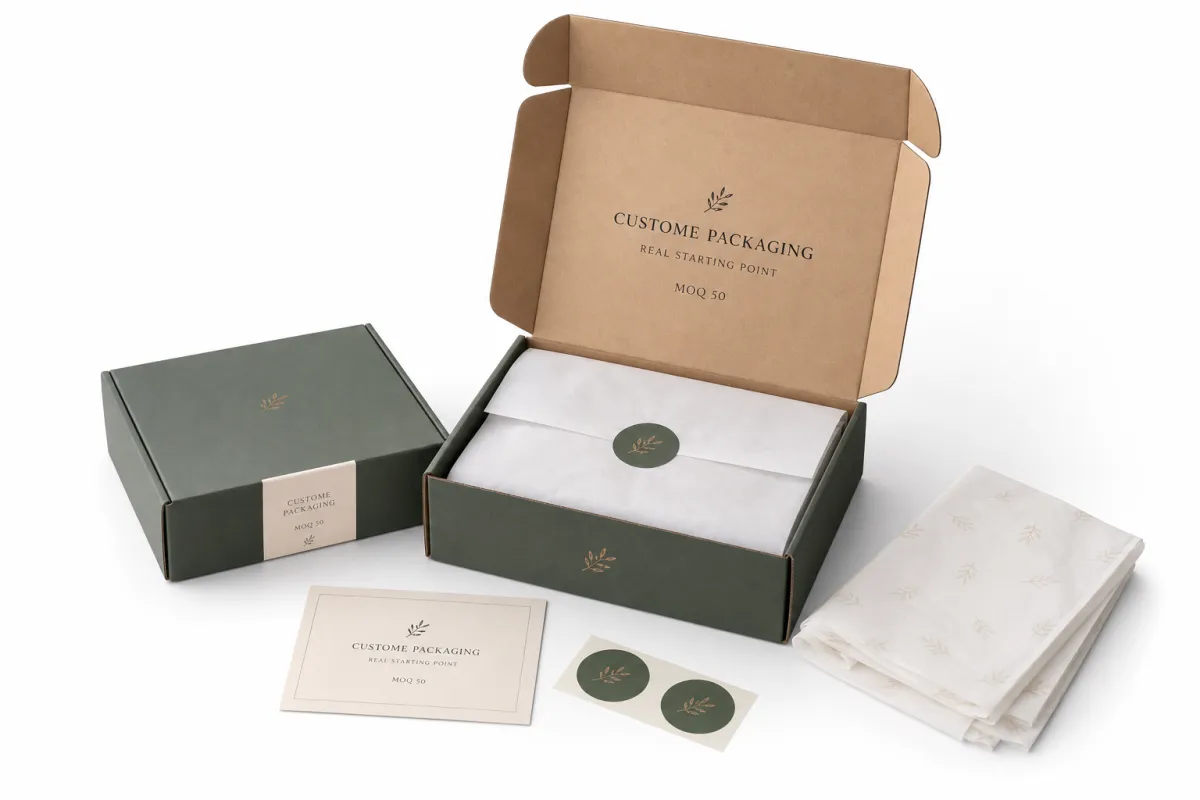
The custom packaging minimum order exists for plain manufacturing reasons. A printer or converter has to spend time on setup, alignment, ink control, die cutting, folding, gluing, packing, and inspection before the first finished unit goes out the door. Whether the job is a folding carton, a mailer, or a rigid gift box, those fixed steps do not disappear just because the run is small. Spread across too few units, the cost per piece jumps. Simple math. No mystery. Just manufacturing refusing to care about your deadline.
That is why the custom packaging minimum order is rarely about being difficult. It is about running equipment efficiently and making a job economical enough to produce cleanly. Press operators need enough sheets to stabilize color. Die makers need enough quantity to justify tooling. Converters need enough volume to account for spoilage, sample pulls, and the waste that comes with setup. In practical terms, the minimum order is the point where the job becomes commercially sensible for both sides.
From a buyer's point of view, the right custom packaging minimum order protects cash flow and keeps storage under control. A brand that launches with 5,000 printed cartons when it only needs 900 for first sell-through is tying up money in inventory that may sit for months. A tiny order can go the other direction and get expensive fast, especially if the package is part of retail packaging or ecommerce packaging where appearance and consistency matter.
It also helps to separate true custom work from stock packaging with a custom label. A stock mailer with a branded sticker, a pre-made bag with a printed insert, or a plain carton with a sleeve can hit the marketing goal at a lower threshold than fully custom printed boxes. That difference matters because the custom packaging minimum order for a true printed structure is usually higher than the order level for label-based branded packaging. One is a manufacturing job. The other is often closer to finishing.
If you are sorting through your first quote set, think about three questions: How much product do I need to ship or display? How much cash can I commit right now? And what level of package branding actually supports the sale? Those questions are more useful than chasing the lowest possible custom packaging minimum order, because the cheapest entry point is not always the smartest packaging decision.
The cheapest quote is rarely the cheapest package once freight, spoilage, storage, and rework are counted.
For a broader industry view, the basics of package construction, materials, and print methods are covered well by the packaging industry resources at packaging.org. Those fundamentals explain why the custom packaging minimum order varies so much from one format to another.
Product Types That Fit a Lower Custom Packaging Minimum Order
Buyers often assume that every package has the same threshold. It does not. The custom packaging minimum order changes with structure, assembly, material thickness, and finishing. Some products can be made in small quantities without much tooling pain. Others need a larger run to keep the price from getting ridiculous.
Here is the practical version. A simple sleeve, label, or insert can usually support a lower custom packaging minimum order than a fully assembled rigid box. A folded carton sits in the middle for many programs, especially if the artwork is straightforward and the board stock is standard. A custom printed pouch can be efficient too, but the threshold depends on print technology, barrier requirements, and whether the pouch is for food, cosmetics, or a general consumer product. The more specialized the build, the more the order size tends to climb.
These are the packaging formats buyers ask about most often:
- Folding cartons - good for retail packaging, lightweight consumer goods, and shelf display, often one of the more manageable routes for a lower custom packaging minimum order.
- Mailer boxes - popular for ecommerce shipping and subscription kits, with a minimum order that can stay friendly if the design is simple and the board is standard.
- Rigid boxes - premium presentation pieces that usually require more hand assembly and a higher custom packaging minimum order.
- Pouches - useful for dry goods, samples, and lightweight product packaging, with thresholds that depend on structure and sealing requirements.
- Hang tags and sleeves - efficient branded packaging tools when you want impact without committing to a full structural redesign.
- Tissue, inserts, and wraps - lower-cost brand touchpoints that can improve the unboxing experience while keeping the custom packaging minimum order under control.
The easiest way to think about it is this: if the box itself must be engineered, printed, folded, glued, and packed as a finished item, the minimum order tends to rise. If branding can be added to an existing format, the custom packaging minimum order usually becomes more manageable. A premium look does not always require a premium structural build. Sometimes a printed sleeve over a stock carton, paired with a matching insert, gives the same shelf presence without pushing the project into a much larger run.
That approach works especially well for launches where the team wants branded packaging without locking into too much inventory. For a pop-up retail program, a new cosmetic line, a gift set, or a subscription box, the goal is usually to create a clear product story while keeping the initial order realistic. If the package protects the item and communicates the brand, the exact structure can usually be adjusted to fit the custom packaging minimum order instead of the other way around.
To compare options before you request pricing, you can also browse Custom Packaging Products and narrow the field by format, product type, and display needs. That step alone can keep the custom packaging minimum order from ballooning because it forces the project into the right category early.
Materials, Sizes, and Print Specs That Change MOQ
The custom packaging minimum order is shaped by more than the product format. Material choice, box size, print coverage, and finishing all affect how the job is priced and how many units make sense to run. Two cartons that look similar on paper can land at very different quantities if one uses a heavier board, a more complex finish, or a tighter structural fit.
Substrate selection is usually the first lever. A standard SBS or CCNB board is generally easier to source and run than a specialty paperboard with a textured face, metallic base, or unusual coating. Heavier board can be useful for presentation and protection, but it may also increase the custom packaging minimum order because the converter needs to account for sourcing, waste, and machine handling. The same logic applies to pouches, labels, and inserts: the simpler the material build, the easier it is to keep the minimum order in range.
Size matters just as much. Dielines that nest efficiently on a press sheet reduce waste and improve output, which can bring the custom packaging minimum order down. An awkward footprint, by contrast, can leave too much unused sheet area and push the economics in the wrong direction. That is why a small change in dimensions, like trimming 3 mm from the width or adjusting the depth to match a standard board layout, can sometimes improve pricing more than a cosmetic artwork revision ever could.
Print and finish choices also play a major role. Full coverage ink, multiple spot colors, foil stamping, embossing, debossing, spot UV, soft-touch lamination, clear windows, and custom inserts all add handling steps. Every extra step makes the line slower or more specialized, and that often raises the custom packaging minimum order. If you need a premium feel but the run has to stay lean, it is usually smarter to choose one well-executed finish instead of stacking several.
Here is a simple way to think about the spec stack:
- Lower complexity: one or two colors, standard board, matte or gloss varnish, no special insert.
- Mid complexity: full color print, custom dieline, one finish, tuck closure, or a simple insert.
- Higher complexity: foil, embossing, soft-touch lamination, window patching, specialty inserts, or multi-part assembly.
Clearer specifications usually produce a better quote. If you know your dimensions, target product weight, finish preference, and shipping environment, the printer can price the job around real production needs instead of guessing. That is one of the easiest ways to keep the custom packaging minimum order honest and avoid a surprise later. A vague request can look cheap at first and turn expensive after revisions, while a precise request often leads to a cleaner manufacturing path.
If the package must survive parcel distribution, ask whether the design should be checked against ISTA test methods or similar transport testing practices. If fiber sourcing matters to your buyer or retail partner, confirm whether the board and paper components support an FSC claim. Those questions do not change the custom packaging minimum order by themselves, but they can prevent a package redesign after the job is already in motion. ASTM D4169 is another useful reference point when the package has to survive handling, vibration, and distribution stress.
Custom Packaging Minimum Order Pricing: How Costs Are Built
The best way to understand the custom packaging minimum order is to look at the cost stack. A quote is not just paper and ink. It usually includes prepress work, plate or tooling setup, material procurement, printing, converting, finishing, inspection, packing, and freight. If any one of those steps is expensive relative to the run size, the custom packaging minimum order rises or the per-unit price climbs.
That is why a lower custom packaging minimum order often carries a higher unit cost. The total invoice may be smaller, but each piece has to absorb more of the fixed setup expense. A 500-piece job can look efficient from a cash standpoint and still be expensive per box. A 5,000-piece job can cost more overall while landing at a much better piece price. The right choice depends on sell-through, storage, and how quickly the product is expected to move.
Here is a straightforward comparison that buyers can use as a planning tool. These numbers are typical planning ranges, not promises, because materials, print coverage, and finishing all change the outcome.
| Packaging format | Common MOQ range | Typical unit price range | Best use case | Cost driver to watch |
|---|---|---|---|---|
| Folding carton | 250 to 1,000 units | $0.45 to $1.10 | Retail packaging, cosmetics, small electronics, supplements | Board grade, print coverage, and die complexity |
| Mailer box | 100 to 500 units | $1.20 to $3.50 | Ecommerce shipping, subscriptions, branded unboxing | Board strength, size, and interior print |
| Rigid box | 300 to 1,000 units | $2.80 to $7.50 | Gift sets, premium launches, high perceived value | Hand assembly, wrap material, and inserts |
| Pouch | 500 to 2,000 units | $0.22 to $0.68 | Dry goods, samples, lightweight product packaging | Barrier film, zipper, seal type, and print method |
| Sleeve or label | 100 to 500 units | $0.05 to $0.40 | Branding on stock packaging or short-run promotions | Copy coverage, adhesive, and finishing |
The table makes one thing obvious: the custom packaging minimum order is only part of the financial picture. A lower quantity may fit the budget in terms of total spend, but it might not be the best value if the project includes expensive finishing or a lot of handwork. Buyers should ask for the total landed cost, not only the unit price, because freight, proofing, overages, and special finishing can change the final number more than many teams expect.
There are also different quote structures to watch. Some suppliers present a clean unit price with setup baked in. Others separate tooling, plates, samples, and shipping so the custom packaging minimum order looks lower up front but the true total is higher. Neither approach is wrong, but you need to compare them on the same basis. If one supplier includes a printed proof and another charges extra for it, the quotes are not equivalent even if the piece price appears close.
A practical budgeting rule helps here: if a quote feels too low for a complex build, ask what has not been included. That question can expose hidden assumptions about color matching, extra proof cycles, or freight distance. Honest pricing should make the custom packaging minimum order easy to understand, not harder. If you can identify the setup line, the unit line, the finishing line, and the ship line, you are much less likely to get blindsided later.
Custom Packaging Order Process and Timeline
A clean order process matters just as much as the quote. The custom packaging minimum order influences how a project moves through the schedule because smaller jobs may fit into gaps in production, while larger jobs may be planned around longer press runs and more complex converting calendars. If the buyer understands the steps ahead of time, the launch is less likely to stall over avoidable paperwork or artwork issues.
The path usually starts with discovery: product dimensions, target quantity, shipping destination, and the level of finish needed. Then comes specification review, which is where the supplier confirms whether the custom packaging minimum order matches the requested structure. After that, artwork prep begins. Good dielines, correct bleeds, and properly outlined fonts save real time because they cut down on proof corrections and avoid rework in prepress.
A realistic production flow often looks like this:
- Request and spec review - 1 to 2 business days if the product details are complete.
- Artwork check and proof prep - 1 to 3 business days, sometimes longer for complex print builds.
- Sampling or prototype approval - can add 5 to 10 business days if a physical sample is needed.
- Production and finishing - often 10 to 20 business days after approval, depending on the custom packaging minimum order and the print method.
- Freight and delivery - varies by destination, carton count, and service level.
What slows things down most? Missing dielines, low-resolution art, unapproved color references, and last-minute size changes. A buyer may think the custom packaging minimum order is the only variable that matters, but the order can sit idle if the file is not ready. In practice, a well-prepared 300-piece job often moves faster than a messy 3,000-piece one because the production team can approve it without repeated back-and-forth.
Sampling deserves special attention. A physical sample can be worth the extra time if the product has tight tolerances or if the package needs to protect fragile contents. That is especially true for custom printed boxes, inserts, and mailers where fit matters as much as appearance. A sample may add a few days to the schedule, but it can save a full production run from a fit issue that would otherwise cost much more than the custom packaging minimum order itself.
When the timeline is tight, keep the structure simple. A straightforward carton, a standard board, and one finish often give you the best chance of meeting the launch date. If the design team insists on foil, embossing, and a custom insert, make sure everyone understands that the custom packaging minimum order and the lead time may both rise. Good packaging design is not only visual; it is operational.
If you want to narrow the options before requesting pricing, the FAQ covers the most common order questions, and the more prepared your files are, the faster the custom packaging minimum order can move from estimate to approved production.
Why Buyers Choose Custom Logo Things for MOQ Projects
For MOQ-driven projects, buyers usually want the same thing: clear guidance, realistic pricing, and packaging that fits the product without forcing excess inventory. That is where Custom Logo Things can add value. The goal is not to push every project into the biggest run possible. The goal is to match the custom packaging minimum order to the actual need so the package supports the launch, the replenishment cycle, or the retail rollout instead of straining it.
Transparent quoting matters a lot in this space. A good supplier should make it obvious what is included in the custom packaging minimum order, what changes the price, and which specification choices are driving the estimate. If one box style comes in lower because it uses standard board and a simpler cut, while another rises because of foil and a custom insert, the difference should be easy to see. Buyers make better decisions when the tradeoffs are clear.
Just as important is format guidance. Many teams assume they need a fully custom box when a sleeve, label, or mailer would do the job more efficiently. Others assume a low custom packaging minimum order means they must accept a plain package with no brand presence. Neither assumption is always true. The smarter move is to compare the product against several packaging paths and choose the one that delivers the right mix of protection, shelf appeal, and cost control.
That is where a practical product range helps. A brand can review Custom Packaging Products to compare cartons, mailers, inserts, and branded packaging accessories side by side, then decide whether the best route is a lower-run printed sleeve, a mid-volume folding carton, or a more premium custom build. If a company buys in volume or supports multiple locations, it can also review Wholesale Programs to see how the custom packaging minimum order fits broader purchasing needs.
Here is the real benefit for buyers: fewer surprises. A supplier that understands packaging design, print constraints, and production economics can help prevent overbuying, over-specifying, or choosing a format that looks impressive but does not fit the budget. For many businesses, that is worth more than a quote that appears low on the surface but hides complexity later.
Good packaging advice should make the next decision easier, not just make the quote look smaller.
From a customer-service standpoint, that means explaining where a custom printed box makes sense, where a mailer does the same job more efficiently, and where the custom packaging minimum order can be reduced by changing a finish or switching to a stock format with custom print. That kind of guidance is practical, and it is often what buyers remember after the order is complete.
I've also seen brands save themselves from a bad launch by choosing the boring option on purpose. Not glamorous, sure. But if the package gets the product out the door and leaves room for a second run, that is a win.
Next Steps to Get an Accurate Quote
If you want a quote that is actually useful, send the right details the first time. The custom packaging minimum order can only be estimated properly when the supplier knows the product size, the packaging type, the quantity target, and the finish level you have in mind. A vague inquiry creates a vague quote, and vague quotes are the fastest way to lose time.
Before you request pricing, gather these basics:
- Product dimensions - length, width, depth, and product weight.
- Target quantity - the real number you need for the first run, not the wish list.
- Packaging style - folding carton, mailer, pouch, sleeve, label, insert, or rigid box.
- Print requirements - colors, coverage, inside print, and any brand standards.
- Finish preferences - matte, gloss, soft-touch, foil, embossing, spot UV, or none.
- Shipping destination - warehouse, distribution center, or direct business address.
If you already have artwork, send it. If you have sample references, send those too. If the dieline is not ready, say so. The more complete the request, the better the supplier can estimate the custom packaging minimum order and the less likely the job is to change after the proof stage. Good files shorten the project, and clear files reduce rework.
It also helps to compare total landed cost instead of just the unit rate. Freight, sampling, tooling, finishing, and overages can shift the final price in a way that changes the best choice for the custom packaging minimum order. A slightly higher unit price with lower freight or simpler setup can easily win on total cost. That is why serious buyers look at the whole project, not only the per-piece number.
A practical path forward is usually simple: choose one or two packaging formats, confirm the custom packaging minimum order, request a sample or proof, and then move into production with everyone aligned on size, color, and finish. That sequence avoids most of the delay points that slow packaging launches. If you are still sorting out the finer details, the FAQ is a useful place to start before you submit the request.
When the numbers are clear, the custom packaging minimum order stops feeling like a roadblock and starts acting like a planning tool. That is the right way to approach packaging: not as a guessing game, but as a manufacturing decision that should protect cash, support the product, and keep the launch moving.
What is a typical custom packaging minimum order?
The typical custom packaging minimum order depends on the package type, print method, and finishing, but many projects start in the low hundreds rather than at a single carton. Simple folding cartons, sleeves, or labels can often stay at a smaller quantity, while rigid boxes, specialty inserts, and premium finishes usually need more units to make the setup cost reasonable.
Can I lower my custom packaging minimum order by changing materials?
Yes, material choice can reduce the custom packaging minimum order. Lighter board, simpler coatings, and fewer embellishments usually make the job easier to run in smaller batches. In some cases, swapping to a stock mailer with a custom label or a printed sleeve over an existing container gives you the branded look you want without forcing a larger order.
Does the custom packaging minimum order include setup and printing costs?
Usually the custom packaging minimum order is tied to the production economics that include setup, print time, and converting, so those costs are built into the quote. Ask whether the estimate also includes tooling, proofing, freight, and finishing so you can compare suppliers on the same basis and avoid a mismatch between the unit price and the actual total.
How long does a custom packaging order take after I approve the minimum order?
Lead time depends on artwork readiness, sampling needs, material availability, and the production queue, but approvals and file quality have the biggest effect on speed. Projects move faster when the dieline is approved early, the print specs are finalized before production starts, and the custom packaging minimum order does not require extra revision cycles.
What should I prepare before requesting a custom packaging quote?
Have your product dimensions, target quantity, packaging style, brand colors, finish preferences, and shipping destination ready. Send any artwork, reference images, and sample requirements so the supplier can quote the actual build instead of a rough placeholder. The clearer your request, the more accurate the custom packaging minimum order estimate will be.
If you are planning a new product, a refill run, or a retail refresh, treat the custom packaging minimum order as a design constraint and not just a number on a quote. The right order level can protect margin, reduce clutter in the warehouse, and keep the packaging working hard for the product from the first shipment through the replenishment cycle.
The cleanest takeaway is simple: pick the format that fits the product, keep the spec stack honest, and size the custom packaging minimum order to real demand rather than wishful thinking. That saves money, cuts storage headaches, and gives the launch a much better shot at actually staying on schedule.

