Buyer Fit Snapshot
| Best fit | Custom Pouch Packaging MOQ projects where brand print, material claims, artwork control, MOQ, and repeat-order consistency need to be specified before quoting. |
|---|---|
| Quote inputs | Share finished size, material target, print colors, finish, packing count, annual reorder estimate, ship-to region, and any compliance wording. |
| Proofing check | Approve dieline scale, logo placement, barcode or warning zones, color tolerance, closure strength, and carton packing before bulk production. |
| Main risk | Vague material claims, crowded artwork, missing packing details, or unclear freight terms can make a low unit price expensive after revisions. |
Fast answer: Custom Pouch Packaging MOQ: Film, Print, MOQ, and Carton Packing should be specified like a repeatable production item. The safest quote records material, print method, finish, artwork proof, packing count, and reorder notes in one written spec.
Production checks before approval
Compare the actual filled-product size with the drawing, then confirm tolerance on folds, seals, hang holes, label areas, and retail display edges. Reserve space for logos, QR codes, warning copy, and material claims before decorative graphics fill the panel.
Quote comparison points
Review material grade, print process, finish, sampling route, tooling charges, carton quantity, and freight assumptions side by side. A quote is only useful when the supplier can repeat the same color, closure quality, and packing count on the next order.
Custom Pouch Packaging MOQ: What Buyers Need to Know
Custom Pouch Packaging MOQ is rarely the real headache. The headache is ordering the wrong pouch, then finding out the correction costs more than the original mistake. I have seen brands get seduced by a low minimum, only to discover the pouch wrinkles badly, seals inconsistently, or lands on shelf looking nothing like the mockup. That is not a packaging win. That is a procurement bruise.
MOQ sits at the intersection of budget and production reality. A lower Custom Pouch Packaging MOQ can protect cash and give a brand room to test. A higher MOQ can lower the unit price, but it also asks for more certainty up front. The right call depends on launch stage, sell-through speed, storage space, and how much risk the team can actually live with. Not the fantasy version. The real one.
If you are comparing pouch styles, materials, or print methods, start with the launch plan, not the render. If you need a broader look at packaging options, see our Custom Packaging Products and keep the FAQ nearby for quick answers.
Custom Pouch Packaging MOQ: Why Buyers Care
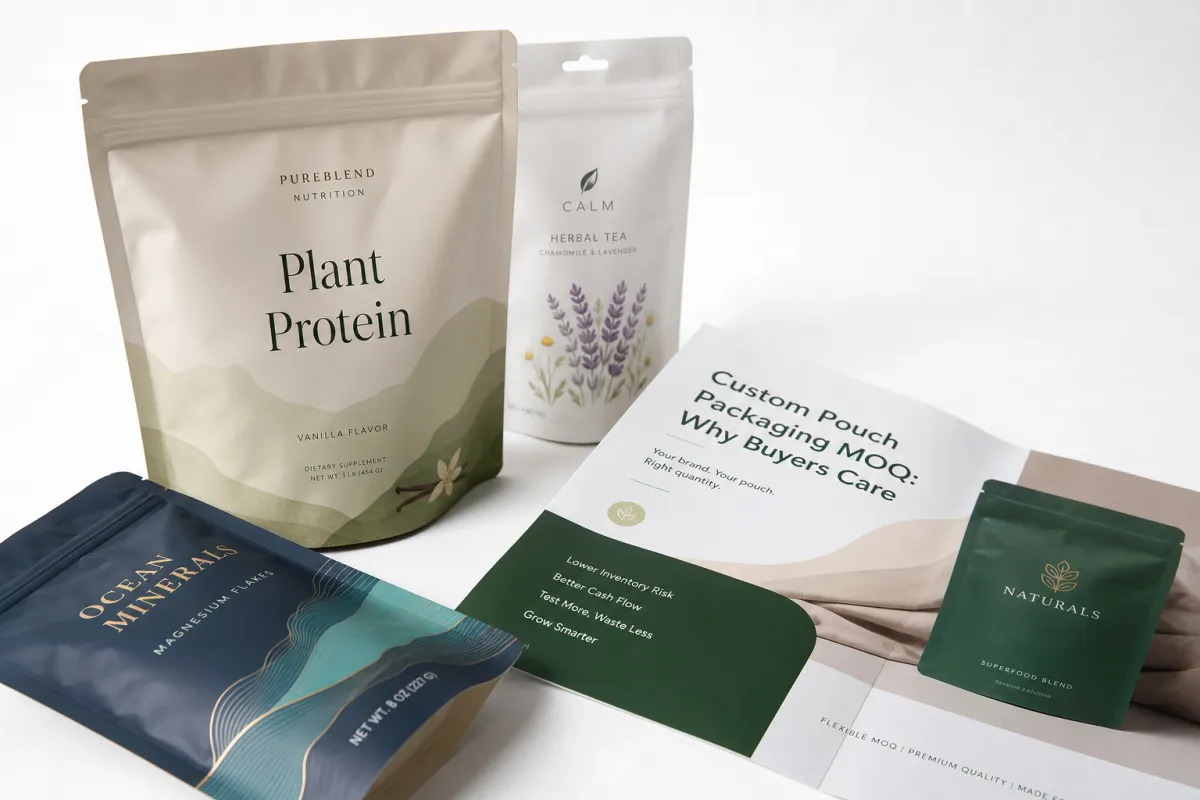
Buyers care about custom pouch packaging MOQ because it sets the floor for the order. A minimum of 1,000 pieces and a minimum of 10,000 pieces are not the same problem dressed in different fonts. The first leaves room for testing, pivots, and the occasional “well, that did not go as planned.” The second assumes demand is already behaving itself. That assumption can get expensive fast.
MOQ matters because packaging is not just artwork on a bag. It is a production item with setup, tooling, material choice, print method, sealing performance, freight, and shelf behavior all baked in. If the custom pouch packaging MOQ is too high for the product stage, cash gets trapped in inventory. If the MOQ is too low and the spec is weak, the first run turns into a patch job. Nobody gets bragging rights for either outcome.
The smartest launches match order size to the stage of the business. Lower custom pouch packaging MOQ works well for regional tests, seasonal products, limited flavors, and pilot retail runs. Higher MOQ makes sense for stable items with predictable demand and a clearer reorder pattern. A supplement brand testing one blend can usually keep the order tighter. A beverage powder line with three flavors, a warehouse partner, and retail deadlines usually cannot. The package should follow the pace of learning, not the pace of wishful thinking.
Lower MOQ does not mean magic pricing. It usually means one of three things: digital printing, a standard pouch size, or fewer custom features. That is why custom pouch packaging MOQ should be treated like a structure decision, not just a quote number. If a supplier offers a lower floor, ask what changed to make that possible. The answer is usually simpler construction, less setup, or a higher unit cost hiding in plain sight.
“The best MOQ is the one that lets you launch without stocking a warehouse full of regret.”
That sounds blunt because it is. Packaging buyers do not need a pep talk. They need a pouch that fills cleanly, seals correctly, survives freight, and still looks decent after the box line, the distributor, and the warehouse have had their way with it. Custom pouch packaging MOQ is just the first number in that chain.
Think in total cost, not just unit price. A lower MOQ may protect cash this month, but a more efficient run at a higher quantity can cut the unit cost enough to matter on every case sold afterward. The right answer depends on velocity. If a product moves 300 units a month, a huge opening order is just inventory cosplay. If it moves 5,000 units a month, a tiny custom pouch packaging MOQ becomes a habit you will regret.
Custom Pouch Packaging MOQ and Pouch Types
Not every pouch style behaves the same way under custom pouch packaging MOQ pressure. Some formats are straightforward. Others bring extra materials, extra steps, and extra setup, which usually pushes the minimum upward. For a practical launch, the pouch type should follow the product. That sounds obvious until someone picks a shape because it looked cool in a deck.
Stand-up pouches do a lot of the heavy lifting in food, coffee, snacks, supplements, and pet products because they hold shape on shelf and offer strong front-panel branding space. A standard stand-up pouch often works better with a lower custom pouch packaging MOQ than a heavily modified format. Add a zipper, tear notch, and matte finish, and the spec still stays manageable. Add a valve, spout, or high-barrier structure, and the minimum usually climbs.
Flat pouches are usually the simplest route. They fit single-serve products, samples, wipes, powders, and small consumer goods. They help buyers keep custom pouch packaging MOQ under control because they use less material and fewer conversion steps. They are not right for everything, though. If the item needs shelf presence, rigidity, or resealability, flat may not cut it.
Gusset bags work well for products that need volume and vertical presence, like coffee, pet treats, dry goods, and some hardware items. They can be efficient, but they are not always the easiest choice for very small custom pouch packaging MOQ orders. The shape, fill behavior, and sealing requirements need a careful look. A plain-looking gusset bag is not automatically cheap just because it looks simple.
Spouted pouches are useful for liquids, sauces, concentrates, and refill applications. They also bring more production complexity. Once a spout enters the build, the pouch becomes more specialized, and that usually affects custom pouch packaging MOQ. Same story with child-resistant features. Useful? Absolutely. Simple? Not even close.
Zipper pouches show up everywhere because customers like resealability. The closure helps freshness and adds perceived value. The tradeoff is obvious: the zipper is another component, another assembly step, and another line in the quote. It does not have to wreck the project, but it can push custom pouch packaging MOQ higher than a plain heat-seal pouch.
Here is the practical version. Match the product to the pouch first, then fit the custom pouch packaging MOQ around the best structure. Coffee often needs a valve and a zipper. Supplements often need a barrier film and a clean front panel. Cosmetics may need a higher-end finish, stronger graphics, or a spout. Small consumer goods may need hang holes, clear windows, or anti-static behavior. One pouch type is not best across the board. That is a marketing myth with a production bill attached.
The more features you stack onto a pouch, the less forgiving it gets. Tear notches sound minor until a line operator fights inconsistent tearing. Clear windows sound simple until they interfere with barrier performance. Hang holes sound cheap until the artwork shifts and the pouch looks crooked. Every add-on should earn its place. That is how you keep custom pouch packaging MOQ realistic.
For packaging design, restraint usually wins. A clean structure with the right barrier, a usable closure, and solid print quality often outsells a busy pouch stuffed with gimmicks. Retail packaging succeeds because it works first and looks good second. Not the other way around.
Specifications That Change Your MOQ
Custom pouch packaging MOQ changes the moment specifications start stacking up. Size is the first variable. A custom dimension often costs more than a standard size because it changes tooling and production setup. Film structure comes next. A simple two-layer laminate is easier to run than a multi-layer high-barrier build made for oxygen, moisture, or aroma protection. If the product is sensitive, the pouch needs to do more work, and that usually raises the minimum.
Print colors matter too. A 1- or 2-color design is usually easier to manage than a full-coverage graphic with gradients, metallic effects, or multiple spot colors. The more detailed the artwork, the more attention the press setup needs. That affects unit cost, and it also affects how much material a supplier needs to justify the run. That is one reason custom pouch packaging MOQ can shift based on artwork alone.
Finish matters as well. Matte, gloss, soft-touch, metallic, and custom texture effects are not free extras. They may require different film, different lamination, or different handling during conversion. A buyer can absolutely choose a premium finish, but it should be a deliberate choice. Otherwise the quote starts looking fancy for no operational reason.
Closures and accessories are another real driver. Zippers, sliders, spouts, degassing valves, and hang holes all add complexity. If the product needs a zip top for consumer convenience, fine. If it needs a valve for freshly roasted coffee, also fine. Just do not pretend these items are cosmetic. They change production and they change custom pouch packaging MOQ.
Compliance is where things get serious. Food contact requirements, child resistance, and product protection standards are not places to cut corners. Depending on the product, you may need material declarations, migration compliance, or testing against performance expectations tied to ASTM methods or similar industry requirements. For shipping and distribution stress tests, organizations like ISTA set useful benchmarks for transport packaging. For sustainability claims and certified sourcing, the FSC system matters when paper-based components are part of the build.
The practical rule is simple: the more the pouch has to do, the more units you usually need to make it efficiently. That does not mean every feature is expensive or that every MOQ rises in the same way. It means the buyer should think in layers:
- What does the product need to stay stable?
- What does the customer need to use the pouch easily?
- What does the shelf need to make the brand look credible?
Once those questions are answered, custom pouch packaging MOQ becomes much easier to control. Leave them unanswered, and the quote turns into a guessing game. Guessing is a lousy procurement strategy.
Custom Pouch Packaging MOQ Pricing Breakdown
Custom pouch packaging MOQ pricing only makes sense when unit price and total project cost are separated. A quote can look cheap per pouch and still be expensive overall if setup, printing, tooling, freight, and packaging materials pile up. That is why a buyer should never stop at the first number on the page. The unit price matters. It just does not tell the whole story.
The biggest pricing drivers are predictable: material thickness, barrier level, print method, number of colors, special finishes, and closure add-ons. Shipping matters too, especially if the project moves by ocean freight, air freight, or domestic trucking. A buyer who compares only per-unit price without asking about landed cost is doing retail math with a procurement problem. Cute. Not useful.
| Option | Typical MOQ | Best For | Usual Unit Cost Range | Notes |
|---|---|---|---|---|
| Digital print stand-up pouch | 500-1,000 units | Launches, short runs, SKU testing | $0.18-$0.42 | Fast to approve; better for smaller custom pouch packaging MOQ orders |
| Standard printed pouch with zipper | 3,000-5,000 units | Stable products, basic branded packaging | $0.08-$0.22 | More efficient at scale; setup and lead time are usually higher |
| High-barrier pouch with valve or spout | 5,000-10,000 units | Coffee, liquids, sensitive products | $0.20-$0.55 | More parts, more testing, more chance for custom pouch packaging MOQ to rise |
Those ranges are not fixed quotes. They are the kind of numbers buyers should expect before they ask for exact artwork, size, and feature details. A plain flat pouch can sit near the bottom of the range. A premium stand-up pouch with a soft-touch finish and complex graphics can land much higher. Quantity, structure, and the amount of customization all push the number around.
Digital print is often the smartest choice for smaller orders. It can make custom pouch packaging MOQ easier to work with because it removes some of the heavy setup tied to longer-run print methods. That said, digital is not always the cheapest route. Once quantities grow, traditional print methods often bring the unit cost down enough to matter. If you are moving 10,000 units and saving only a penny or two per pouch at a higher MOQ, the larger run may still win.
Here is the real buying framework:
- Compare the total landed cost, not just the quote per pouch.
- Check whether the MOQ fits your sales forecast for the next 90 to 180 days.
- Ask what feature change would lower or raise the custom pouch packaging MOQ.
- Make sure the spec supports filling, shipping, and shelf use before chasing a lower number.
Packaging.org has useful industry context on packaging trends and materials if you want to see how the market treats structure and sustainability across categories: packaging industry resources. That kind of reference helps because custom pouch packaging MOQ is rarely just a factory issue. It is sourcing, logistics, and brand direction all at once.
For brands building product packaging alongside other formats, the same logic applies across custom printed boxes, labels, and retail packaging systems. The cheapest-looking quote can become expensive if the structure is wrong or the package branding does not fit the product line. A lower MOQ can save cash on day one, but a larger run may cut unit cost enough to strengthen margin for the whole launch cycle. That is the tradeoff. No mystery. Just numbers.
One more thing buyers should watch: sample costs and proofing charges. Some projects need printed samples, color proofs, or structure testing before full production. That can add a few hundred dollars to the project, sometimes more depending on complexity. It is still cheaper than discovering the wrong barrier level after launch. I have never seen a retailer reward a brand for saving $300 on proofing and losing thousands in damaged product.
Process and Timeline for Custom Pouch Packaging MOQ Orders
Custom pouch packaging MOQ orders move faster when the buyer shows up prepared. That sounds obvious, but it is where a lot of delays begin. The usual process looks like this: quote request, specs review, artwork setup, proof approval, sampling if needed, production, and shipping. Each step depends on the one before it. If the dimensions are unclear, the quote is fuzzy. If the artwork is not final, the proof cycle drags. If the proof is delayed, the lead time stretches. Simple enough.
The fastest buyers usually have five things ready before they ask for pricing:
- Product type and fill weight
- Target pouch dimensions or at least a rough size range
- Closure needs like zipper, spout, or tear notch
- Print quantity and preferred MOQ target
- Launch date or retailer deadline
With those details in hand, custom pouch packaging MOQ becomes a conversation instead of a scavenger hunt. A supplier can narrow the structure faster, which means the buyer sees better pricing and fewer revision rounds. That matters if you are trying to get branded packaging approved across sales, operations, and procurement without burning half the month.
Lead time depends heavily on print method and complexity. Simple digital orders can sometimes move in about 10 to 15 business days after proof approval, assuming the files are ready and no structural changes show up midstream. Standard printed orders often take 15 to 25 business days or more, especially if the design has multiple colors, special finishes, or a high-barrier build. Add shipping time, and the actual calendar gets bigger than the optimistic version on the quote.
Delays usually come from the same handful of mistakes:
- Artwork arrives without dielines or bleeds.
- The buyer changes the size after proof approval.
- The pouch needs a feature that was not discussed early.
- Someone asks for a lower custom pouch packaging MOQ after the quote is already built.
That last one comes up a lot. A buyer asks for pricing on 5,000 units, then decides 1,500 feels safer, then wonders why the per-unit number jumps. The answer is production math. Shorter runs are less efficient, and the line still has to be set up. Packaging design decisions do not disappear just because the order size got smaller.
Think of the timeline in stages. Confirm the structure. Approve the artwork. Lock the quantity. Leave room for production and freight. Brands that respect that order usually avoid panic. Brands that treat custom pouch packaging MOQ like a guess usually create their own delays. It is not mysterious. It is just avoidable.
For teams managing multiple launches, coordination matters. Product packaging, retail packaging, and package branding all need to match. If the pouch is one style, the carton is another, and the label direction changes every week, everybody wastes time. A cleaner approval path is usually better than a flashy concept that nobody can produce on schedule.
Why Choose Us for Custom Pouch Packaging MOQ
Good packaging suppliers do not just send a number. They help you make the number make sense. That is the difference. For custom pouch packaging MOQ, the value sits in clarity: transparent quotes, realistic guidance on structure, and fewer surprises after approval. Buyers do not need a speech about premium solutions. They need an answer that survives the filling line and fits the budget.
Our approach stays practical. If a simpler structure will do the job, we will say so. If a lower custom pouch packaging MOQ is possible by changing the print method or standardizing the size, we will say that too. If the project needs a better barrier, a stronger closure, or a finish that holds up under retail handling, we will say that before the order is locked. That saves everyone time.
That last point matters more than most brands admit. A supplier who says yes to every feature often creates a prettier quote and a worse project. Real support means helping you Choose the Right pouch spec instead of upselling every option on the shelf. It is not glamorous. It is just how good packaging gets made.
Quality control belongs in the value conversation too. A pouch that looks fine on screen but leaks, wrinkles, or prints inconsistently is a bad buy. Consistent print matching, proper sealing, and clean conversion matter because the product has to survive filling, transport, and shelf handling. That is true for food, supplements, cosmetics, and most consumer goods. If the pouch cannot make the trip, the design never had a chance.
Responsive quoting is another practical advantage. Fast answers during the quote stage help buyers avoid bad specs before the order starts. That is especially useful when a launch date is fixed and the brand is deciding between branded packaging options, a temporary test run, or a full production order. Sometimes the gap between moving forward and stalling is a clear answer on MOQ within a day or two.
Here is the blunt version: custom pouch packaging MOQ should not be a mystery you need three phone calls and a spreadsheet to decode. It should be clear enough that you can compare structures, compare costs, and pick the option that fits the product. The best supplier relationship feels practical, not theatrical.
If you need help comparing pouch options against other custom printed boxes or packaging formats, start with the product requirements and work backward. That is usually the cleanest route. Fancy packaging that fails the product is just expensive decoration.
Next Steps to Lock In Your MOQ and Launch
Start with the basics. Have your product type, pouch size, closure needs, print quantity, and target launch date ready before you request a quote. That one step shortens the whole custom pouch packaging MOQ process because it gives the supplier something concrete to work with. Vague requests produce vague answers. Concrete requests get better numbers.
Ask for two or three options if you can. A standard zipper pouch, a higher-barrier version, and a lower-MOQ digital option can make the tradeoffs obvious. That is often the fastest way to compare custom pouch packaging MOQ against unit cost, shelf appearance, and production risk side by side. You do not need twenty variations. You need a few meaningful ones.
Before production starts, approve the artwork, confirm the structure, and lock the timeline. Do not let last-minute changes creep in unless the change truly matters. A new color tweak sounds harmless until the proof cycle resets and the launch date slips. Packaging teams hear that story all the time. It is not charming.
Planning the reorder point early is smart too. The first custom pouch packaging MOQ order should not turn into an emergency restock. If the product starts moving well, you want enough lead time to reorder before inventory gets thin. That usually means watching sell-through data, not guessing. A brand that tracks actual usage can decide whether the next order should stay at the same MOQ, step up to a more efficient volume, or shift to a different print method.
Use the quote as a decision tool, not a trophy. Compare the price, the structure, the lead time, and the real unit cost against your sales plan. If the numbers work, move. If they do not, simplify the spec before you force the budget. That is how buyers keep control of custom pouch packaging MOQ without wrecking margin.
Yes, this applies whether you are launching snacks, supplements, coffee, pet products, or another consumer item. The details change, but the logic stays the same. Clear specs, realistic quantities, and a supplier who gives straight answers beat pretty packaging fantasies every time.
Bottom line: custom pouch packaging MOQ is easiest to control when the product goals are clear, the files are ready, and the order volume matches what you can actually sell. Get those three things right and you stop paying for mistakes you could have avoided. That is the job.
FAQ
What is a typical custom pouch packaging MOQ?
Digital print jobs often start around 500 to 1,000 pouches, depending on size and structure. Traditional printed runs usually start much higher, often 5,000 units or more. The exact custom pouch packaging MOQ depends on pouch style, print method, and whether the bag needs special features.
Can custom pouch packaging MOQ be lowered for a new product launch?
Yes, usually by choosing a simpler structure and a print method built for smaller runs. Keeping the size standard and limiting add-ons can reduce the minimum order requirement. Lower MOQ is often possible, but the per-unit price will usually be higher.
What drives the price of custom pouch packaging MOQ orders?
Material type, barrier level, print method, and pouch features have the biggest impact. More colors, custom finishes, zippers, spouts, and windows usually increase the cost. Shipping and packaging setup can also change the final landed price.
How long does a custom pouch packaging MOQ order take?
Timing depends on artwork approval, sample needs, and print method. Simple digital orders can move faster than larger traditional print runs. The best way to keep lead time short is to send final specs and files upfront.
What do I need before requesting a custom pouch packaging MOQ quote?
Have your product type, pouch dimensions, and target quantity ready. Know whether you need a zipper, spout, window, matte finish, or other feature. Send print-ready files if you have them, or at least a clear logo and packaging direction.
If you are ready to compare options, send the product details, quantity target, and artwork direction. A clean custom pouch packaging MOQ quote should tell you what works, what costs more, and where you can save without making the pouch weaker. That is how buyers protect margin and still get packaging that does the job.

