Buyer Fit Snapshot
| Best fit | custom packaging sleeves for ecommerce design for packaging buyers comparing material specs, print proof, MOQ, unit cost, freight, and repeat-order risk where brand print, material, artwork control, and repeat-order consistency matter. |
|---|---|
| Quote inputs | Share finished size, material target, print colors, finish, packing count, annual reorder estimate, and delivery region. |
| Proofing check | Approve dieline scale, logo placement, barcode or warning zones, color tolerance, and any recyclable or compostable wording before bulk production. |
| Main risk | Vague material claims, crowded artwork, or missing packing details can create delays even when the unit price looks attractive. |
Fast answer: Custom Packaging Sleeves for Ecommerce Design: Claims, Protection, MOQ, and Cost should be specified like a repeatable production item. The safest quote includes material, print method, finish, artwork proof, carton packing, and reorder notes in one written spec.
What to confirm before approving the packaging proof
Check the product dimensions against the actual filled item, not only the sales mockup. Ask for tolerance on folds, seals, hang holes, label areas, and retail display edges. If the package carries a logo, QR code, warning copy, or legal claim, reserve that space before decorative graphics fill the panel.
How to compare quotes without losing quality
Compare board or film grade, print process, finish, sampling route, tooling charges, carton quantity, and freight assumptions side by side. A lower quote is only useful if the supplier can repeat the same color, closure quality, and packing count on the next order.
Custom Packaging Sleeves for Ecommerce: Design That Sells
A plain mailer says, "We shipped it." A printed sleeve says, "Someone cared enough to make this look right." That shift happens fast, and Custom Packaging Sleeves for ecommerce are one of the cheapest ways to make a product feel worth more without rebuilding the whole pack.
That is the real reason brands keep coming back to sleeves. Custom packaging sleeves for ecommerce will not rescue a weak product or fix bad photography. They will not do your positioning work for you either. They do improve perceived value, sharpen branding, and make a box or mailer feel deliberate instead of borrowed from a warehouse aisle. For launches, bundles, influencer kits, seasonal promos, and subscription boxes, that matters more than people like to admit.
Custom Packaging Sleeves for Ecommerce: What They Are
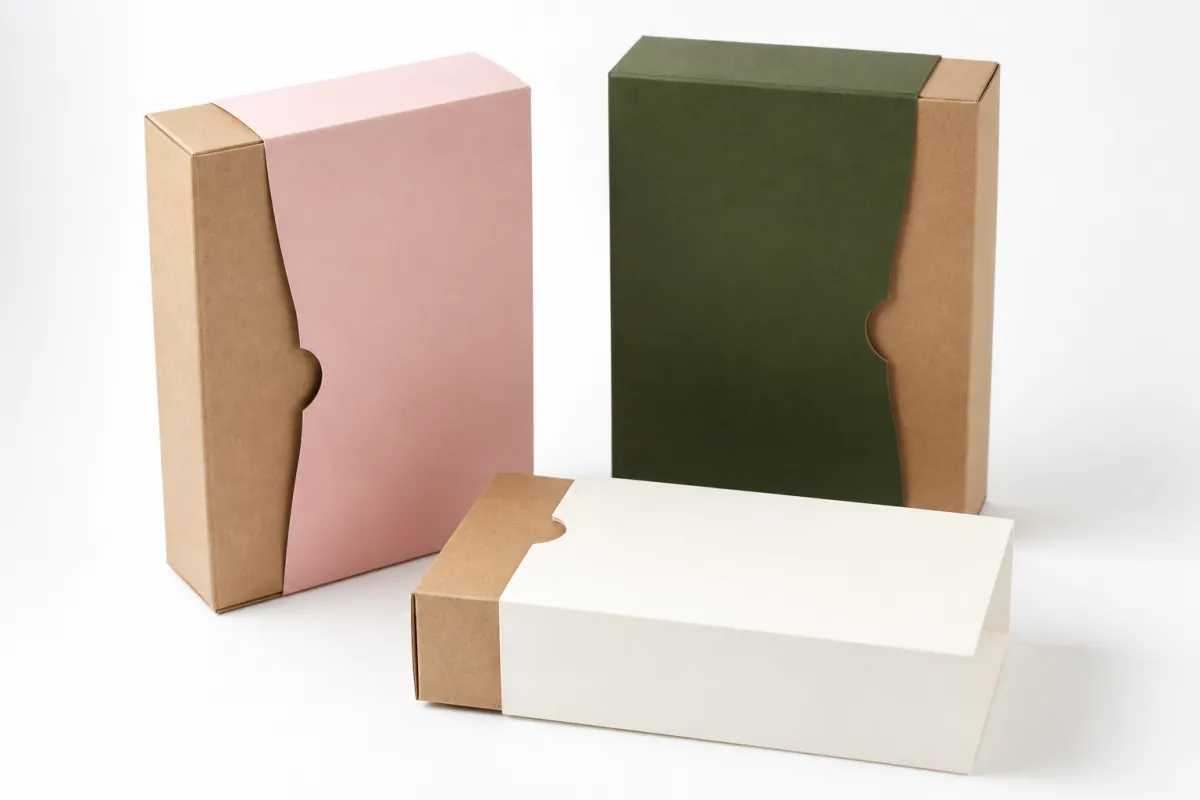
Custom packaging sleeves for ecommerce are printed paper bands or wraparound pieces that sit around a base pack such as a box, mailer, or bundle. Think of them as a branding layer, not the structure itself. They are there to frame the product, carry the message, and make the first impression count before anyone opens the package.
A sleeve can be dead simple or surprisingly technical. Some are just a strip that wraps the carton. Others use a die-cut shape, tuck-in tab, adhesive strip, or a friction fit that holds tighter on the pack. That range is why custom packaging sleeves for ecommerce work so well for brands that want a stronger presentation without a full packaging overhaul. Keep the base pack. Upgrade the face it shows the customer.
These are the situations where sleeves earn their keep:
- New product drops that need quick visual impact
- Seasonal promos that change often
- Bundles and sets that need a clearer offer
- Subscription boxes that need repeatable branding
- Influencer kits and PR mailers that need to photograph well
- Early brand tests before paying for custom printed boxes
If you are still deciding how far to go, start small. Custom packaging sleeves for ecommerce let you test customer response without paying for a full packaging redesign. That is especially useful when your base pack already does the job mechanically and only needs a stronger branded layer on top.
Here is the part buyers sometimes miss: a sleeve is not "just paper." It is package branding with a lower entry cost. When the product, the message, and the timing line up, a sleeve can make a plain box feel much closer to retail packaging. No drama. Just a better use of print budget.
How Custom Packaging Sleeves for Ecommerce Work
The structure usually starts with a dieline. That is the flat template that shows folds, cuts, glue zones, and safe areas. For custom packaging sleeves for ecommerce, the dieline decides whether the sleeve wraps cleanly, stays aligned, and goes together without wasting time on the packing line. If the dieline is sloppy, the sleeve will look sloppy. Packaging is not subtle about that.
There are a few common structure types. A wrap band runs around the pack and overlaps at the back. A tuck-in sleeve uses a tab or slot to hold the shape. A friction-fit sleeve relies on sizing and paper tension. An adhesive strip gives a more fixed closure and works well for automation or repeatable hand assembly. The right choice depends on how fast your team packs orders and how much handling the sleeve needs to survive.
Custom packaging sleeves for ecommerce also need to work with the base pack. Corrugated boxes are usually the easiest because they hold shape. Rigid mailers can work well when the sleeve is sized correctly. Poly mailers are trickier because they flex, so the sleeve needs enough control to stay presentable. Subscription kits often sit in the middle, which means the sleeve has to look good and behave during stacking, storage, and shipping.
Print method and finish matter too. Digital printing is practical for shorter runs and versioned artwork. Offset printing usually makes sense for larger orders and tighter color control. Foil stamping, spot UV, soft-touch coating, matte lamination, and gloss all change the feel in different ways. I would not pay for every finish just because it exists. Pay for the effect that supports the product and the price point. For custom packaging sleeves for ecommerce, the finish should do a job, not decorate the invoice.
Shipping tests matter more than most people think. Sleeves need to survive warehouse stacking, friction from transit, and the occasional box drop nobody wants to talk about. If the pack is going through stricter transport expectations, ask about ISTA testing standards and how the sleeve behaves under handling, vibration, and compression. A pretty sleeve that scuffs immediately is still a problem.
Assembly time matters just as much. If the sleeve adds ten or twelve seconds per unit, that is not a tiny detail. Multiply it by 2,000 units and the "cheap" option starts eating labor. Good custom packaging sleeves for ecommerce should be easy to orient, easy to slide on, and forgiving enough that the warehouse team does not have to babysit every piece.
What Makes a Sleeve Work: Design, Materials, and Brand Fit
The best custom packaging sleeves for ecommerce are not crowded. They use hierarchy. Logo placement comes first, then the product name or offer, then one strong support message. That is usually enough. When a sleeve tries to shout five things at once, the result is visual noise. The customer should understand the offer in a glance, not work for it.
Material choice is where perception starts to shift. Uncoated paper gives a natural, tactile feel and works well for earthy, handmade, or sustainability-led brands. Coated stock usually delivers sharper color and cleaner contrast, which is useful for brighter branding or more polished product packaging. Heavier stock, often in the 16pt to 18pt range or around 250gsm to 350gsm depending on the construction, tends to feel more premium and less flimsy in hand.
Recycled paper can be a solid fit if the brand story supports it. That said, recycled does not automatically mean better. A weak recycled stock that wrinkles badly is still weak. If sustainability is part of the pitch, look at FSC-certified paper options and compare them against tactile performance. A sleeve that feels thin and bends at the corners will not help branded packaging, no matter how good the claim sounds.
Custom packaging sleeves for ecommerce also need the right sizing. A sleeve that rides high, shifts off-center, or blocks a flap will look careless in photos and worse in the warehouse. If the sleeve is meant to stay straight on camera, the die-line needs to account for fold pressure, adhesive placement, and any curvature in the underlying box. Small sizing errors show up fast. Customers may not know the word "dieline," but they know when something looks crooked.
Brand fit matters just as much as material. Minimalist brands usually work best with restrained type, generous white space, and one high-contrast accent. Playful brands can use bold color blocking, icons, and a more energetic layout. Luxury brands need discipline: fewer words, cleaner edges, better stock, and finishes used sparingly. Earthy brands can lean into texture, recycled stock, and quieter print. High-contrast designs can work too, but only if the product, audience, and offer support that tone.
A sleeve that looks polished on a proof but takes too long to align in fulfillment is not "premium." It is just expensive friction.
If you are building out a wider system, it helps to think of sleeves as part of the same family as Custom Packaging Products, not a random add-on. The sleeve should sit comfortably beside inserts, labels, mailers, and custom printed boxes. When the pieces match, the whole pack feels intentional instead of cobbled together. That is what strong custom packaging sleeves for ecommerce do best: they make the kit feel like one decision.
For brands that want more than a flat band, the sleeve can also carry campaign messaging. A launch date, a bundle offer, or a seasonal graphic can live on the sleeve without forcing you to redesign the base box. That gives you more flexibility in packaging design and less waste when the campaign changes. It is one of the few moves in packaging that can improve both presentation and operational flexibility.
Social sharing matters too. If the sleeve is going to show up in unboxing clips, make sure it stays aligned, the logo is not buried in the fold, and the camera-facing side has the strongest visual contrast. Custom packaging sleeves for ecommerce should work in hand, on shelf, and on screen. If they only work on screen, they are too theatrical. If they only work in the warehouse, they are too dull.
Custom Packaging Sleeves for Ecommerce: Cost and Pricing
Cost is where people get honest. Custom packaging sleeves for ecommerce are often cheaper than full custom printed boxes, but the savings depend on quantity, stock, print coverage, finishing, and assembly. Small runs cost more per unit because setup gets spread across fewer pieces. Larger runs drop fast once press setup and die costs are absorbed. That is not a trick. It is just print economics.
Here is a realistic comparison of common sleeve options. Prices vary by size, coverage, and region, but these ranges are a useful starting point when budgeting custom packaging sleeves for ecommerce:
| Sleeve Type | Best For | Typical Setup Complexity | Approx. Unit Price at 5,000 pcs | Notes |
|---|---|---|---|---|
| Simple wrap band | Light branding, promo campaigns | Low | $0.08-$0.16 | Fast to produce; minimal finishing |
| Tuck-in sleeve | Subscription kits, bundles | Medium | $0.12-$0.22 | Good balance of presentation and assembly speed |
| Friction-fit sleeve | Boxes that need a tighter fit | Medium | $0.14-$0.26 | Requires tighter sizing and better sample checks |
| Adhesive-closure sleeve | High-volume fulfillment lines | Higher | $0.18-$0.35 | Can speed pack-out, but setup and materials cost more |
The numbers above are only part of the story. For custom packaging sleeves for ecommerce, the real budget question is what you want the sleeve to do. If it only needs to add a branding layer, a simple wrap band may be enough. If it needs to behave more like retail packaging, carry a stronger message, and feel premium in hand, the stock and finish will need to move up. Cheap sleeves that do nothing are just paper. Useful sleeves cost more because they actually solve something.
Watch the hidden costs. Sampling, setup, freight, and storage can quietly add up. If you need multiple versions for different SKUs or campaign messages, versioning increases management overhead too. Add labor if the sleeve is hand-applied and not easy to place consistently. A sleeve that seems like a $0.14 line item can turn into a more expensive packaging decision once assembly time is included. That is why I always recommend comparing unit price against total landed cost, not against a hopeful spreadsheet row.
Finishes can change pricing fast. Soft-touch, foil, and spot UV are not free little upgrades. They increase press work, sometimes require extra proofing, and may demand more care during packing so the finish does not scuff. If the packaging only needs a clean, sharp look, matte or gloss on a heavier stock can deliver a lot without pushing the budget too hard. For custom packaging sleeves for ecommerce, the smartest spend is usually the one the customer can feel.
Budget with a purpose. If the goal is a low-cost brand lift for a flash sale or launch kit, keep the sleeve simple and precise. If the goal is a premium retail-style presentation, spend for better stock and tighter finishing. Those are not the same projects. Mixing them up is how buyers end up disappointed and suppliers end up answering awkward emails.
For brands comparing sleeves against broader branded packaging sleeves and mailers, the tradeoff is usually simple: sleeves are lighter on setup and easier to change, while custom printed boxes can deliver stronger structural branding at a higher total cost. If the budget is limited, sleeves often win on flexibility. If the box itself needs to carry the brand story, that is when the extra spend on box printing starts to make sense.
Process and Timeline: From Brief to Delivery
The process for custom packaging sleeves for ecommerce is straightforward if you feed it good information. It usually runs like this: brief, dimensions, dieline, artwork, proofing, sample, production, and shipping. Skip any of those steps or rush them, and the schedule starts slipping. Packaging projects rarely fail because one giant thing went wrong. They fail because several small things were left vague.
- Brief the project - define the product, order quantity, target finish, and how the sleeve will be used in fulfillment.
- Confirm dimensions - measure the base box or mailer in finished form, not "roughly around this size."
- Build the dieline - mark folds, safe zones, bleeds, and any adhesive or tuck-in areas.
- Review artwork - check logo scale, barcode placement, type size, and color consistency.
- Approve proofing - catch alignment or layout issues before print.
- Run a sample - test fit, assembly time, and appearance in hand.
- Produce and ship - final print, finishing, packing, and freight to your site or 3PL.
Where do delays usually happen? Missing dimensions. Late approvals. Color changes after proofing. Overly ambitious finishes that need extra sampling. Those are the usual suspects. Custom packaging sleeves for ecommerce move faster when the artwork is ready, the box measurements are final, and the decision makers are actually available to approve the proof. Revolutionary concept, I know: decisions help schedules.
Timelines vary, but here is a practical range. Simple sleeve jobs can often move in about 7-12 business days after proof approval if the artwork is clean and the structure is basic. Standard custom work with a new dieline or moderate finishing often sits closer to 12-15 business days. If you add special coatings, multiple versions, or a sampling loop, plan for 15-25 business days or more. For custom packaging sleeves for ecommerce, speed is possible, but only if the project is boring in the right ways.
Buffer time matters. Build it before a product launch, influencer drop, or seasonal push. If the sleeves are tied to a campaign date, do not schedule production so tightly that freight or proofing becomes the bottleneck. I have seen more good packaging plans get embarrassed by shipping delays than by bad design. It is a familiar waste of effort.
Standards can help keep the process honest. If your sleeve is part of a shipper that needs protection, ask whether the pack design aligns with FSC-certified paper options for the paper portion and whether the shipping configuration is reasonable for the distribution method. For tougher transit conditions, ask about ISTA-style testing and whether the assembled sleeve is still readable and intact after handling. Good custom packaging sleeves for ecommerce should not only look correct on a desk; they should still look correct after shipping.
A useful rule: the more custom the structure, the more important the sample. If the sleeve needs to stay aligned on a premium box, test it. If the artwork uses tight type on a dark background, test it. If the assembly is supposed to happen at speed, test that too. A small sample run is cheap compared with reprinting 3,000 sleeves because the first version looked fine on screen and wrong in hand. Screen pixels are liars. Paper is not.
If the sleeve needs two people and a prayer to align, it is not ready for production.
Common Mistakes With Ecommerce Sleeves
The first mistake is sizing. Custom packaging sleeves for ecommerce fail quickly when they are too loose, too tight, or centered badly on the pack. A sleeve that slides around looks cheap. A sleeve that buckles across a fold looks worse. If it blocks a flap or interferes with opening, the customer will notice immediately and probably blame the brand, not the file.
The second mistake is writing too much. A sleeve is not a brochure. If the customer has to read the panel twice, the design is already overloaded. Use one main message, one supporting point, and a clear logo system. That is enough for most product packaging. When brands try to stuff a sleeve with the entire company history, three offers, and a social handle parade, the result is visual clutter. Less text usually means more impact.
The third mistake is ignoring print behavior. Color drift can ruin a carefully chosen palette. Thin stock can make a premium brand feel cheap. Barcode placement can interfere with scanning or get hidden by the fold. Bleed and safe zones matter whether the job is small or large. For custom packaging sleeves for ecommerce, the artwork has to respect the structure, not fight it.
Fulfillment mistakes show up just as often. A sleeve that takes too long to place will annoy the warehouse team before it impresses the shopper. If the sleeve requires exact rotation, extra adhesive, or constant manual correction, pack-out slows down. In a high-volume environment, even five extra seconds per unit becomes a cost line. That is why the best sleeves are usually the ones that make assembly feel obvious. No guessing. No fiddling. No drama.
Another problem is designing for a photo instead of designing for the real box. The proof might look great on a flat monitor. The actual pack might curve, flex, or reflect light differently. If the package is going through retail packaging photography, social content, and real-world shipping, the sleeve has to survive all three. Strong custom packaging sleeves for ecommerce do not collapse under that kind of pressure. They are built for it.
Finally, do not let the sleeve outrun the brand. A luxury finish on a low-price product can feel mismatched. A playful sleeve on a highly technical product can feel unserious. The point is not to make the sleeve "fancier." The point is to make the presentation believable. Buyers can smell overcompensation from a mile away.
Expert Tips and Next Steps for Custom Packaging Sleeves for Ecommerce
If you are starting from zero, begin with one SKU or one campaign. Custom packaging sleeves for ecommerce work best when you test them in a controlled way. Pick the product that ships often, sells well, or needs a stronger presentation. Run that first. Once you know the sleeve fits, you can decide whether the same structure should roll across the rest of the catalog.
Test two or three combinations before locking the order: one material, one finish, one structural approach. Compare them on three things only: appearance, cost, and packing speed. That keeps the decision grounded. A lot of bad packaging choices happen because someone liked a sample but did not check how it handled on the line. Pretty is not enough. For custom packaging sleeves for ecommerce, the right sample is the one that still makes sense after assembly.
Ask for three things before you approve anything: the dieline, a physical sample, and a quote that separates unit price from setup, finishing, and freight. That breakdown matters. It lets you see whether the cheap quote is actually cheap or just hiding the messy parts in the fine print. If a supplier cannot explain the total cost clearly, that tells you something useful.
If the sleeve is going to live alongside other packaging pieces, make sure the system stays coherent. It should match your labels, inserts, and Custom Packaging Products without looking copied and pasted. That is how branded packaging starts to feel credible. The customer should see one design language, not a pile of unrelated parts.
My practical advice: lock dimensions first, choose stock second, confirm finish third, and only then finalize artwork. Reversing that order is how people end up redesigning the file three times because the sleeve was measured loosely. For custom packaging sleeves for ecommerce, dimensions are the anchor. Everything else hangs off them.
Keep the goal visible. If the sleeve is supposed to raise perceived value, make sure the print, stock, and structure support that. If it is supposed to help a promotion move faster, keep the assembly simple. If it is supposed to improve package branding, keep the message clear and the layout disciplined. That is how custom packaging sleeves for ecommerce do real work instead of just sitting there looking expensive.
Done right, custom packaging sleeves for ecommerce give you a practical middle ground between plain mailers and fully custom printed boxes. They change the first impression, improve product packaging, and control cost better than most people expect. Done badly, they become fiddly little bits of paper that annoy fulfillment and disappoint customers. Choose the first version.
How much do custom packaging sleeves for ecommerce usually cost?
Pricing depends on size, quantity, stock, print coverage, and finishing. Small runs usually cost more per sleeve because setup is spread across fewer pieces, while larger runs bring the unit price down fast. For custom packaging sleeves for ecommerce, it is smart to budget for sampling, setup, and freight too, not just the printed sleeve price.
What material is best for custom packaging sleeves for ecommerce?
Uncoated stock works well for a natural, tactile look, while coated stock usually gives sharper color and a cleaner premium finish. Heavier recycled paper can support sustainability messaging without feeling flimsy. The best choice for custom packaging sleeves for ecommerce depends on the brand tone, the base pack, and how much handling the sleeve will see.
How long does production take for custom packaging sleeves for ecommerce?
Simple jobs can move quickly if the dieline and artwork are ready, but sampling, special finishes, or revisions add time. A basic run may be done in about 7-12 business days after approval, while more complex projects often need 12-15 business days or longer. Build in buffer time so custom packaging sleeves for ecommerce do not become the launch bottleneck.
Do custom packaging sleeves for ecommerce work on mailers and boxes?
Yes, sleeves can wrap corrugated boxes, rigid mailers, subscription kits, and even some flexible mailers if the size and closure are planned correctly. The key is matching the sleeve structure to the base pack so it stays aligned during shipping and unboxing. That is what makes custom packaging sleeves for ecommerce more useful than a random paper band slapped on at the last minute.
What should I send a printer before ordering custom packaging sleeves for ecommerce?
Send exact dimensions, artwork, brand colors, quantity, target finish, and how the sleeve will be assembled in fulfillment. If possible, request a sample and a quote that separates printing, setup, and shipping so there are no surprises. The cleaner the brief, the better the result for custom packaging sleeves for ecommerce.

