Buyer Fit Snapshot
| Best fit | Custom Packaging with Cmyk Printing projects where brand print, material claims, artwork control, MOQ, and repeat-order consistency need to be specified before quoting. |
|---|---|
| Quote inputs | Share finished size, material target, print colors, finish, packing count, annual reorder estimate, ship-to region, and any compliance wording. |
| Proofing check | Approve dieline scale, logo placement, barcode or warning zones, color tolerance, closure strength, and carton packing before bulk production. |
| Main risk | Vague material claims, crowded artwork, missing packing details, or unclear freight terms can make a low unit price expensive after revisions. |
Fast answer: Custom Packaging with Cmyk Printing: Material, Print, Proofing, and Reorder Risk should be specified like a repeatable production item. The safest quote records material, print method, finish, artwork proof, packing count, and reorder notes in one written spec.
Production checks before approval
Compare the actual filled-product size with the drawing, then confirm tolerance on folds, seals, hang holes, label areas, and retail display edges. Reserve space for logos, QR codes, warning copy, and material claims before decorative graphics fill the panel.
Quote comparison points
Review material grade, print process, finish, sampling route, tooling charges, carton quantity, and freight assumptions side by side. A quote is only useful when the supplier can repeat the same color, closure quality, and packing count on the next order.
custom packaging with cmyk printing can make a plain mailer, folding carton, or rigid box feel deliberate the second someone picks it up. The artwork matters, sure. But so do board choice, coating, ink density, die lines, and file prep. Miss one of those, and the nice design starts looking kinda average in a hurry.
I have seen custom printed boxes pick up real shelf presence with a sharp CMYK illustration, the right substrate, and a finish that stayed out of the way. I have also seen the same concept fall flat on kraft board because the file was built like it would live on a backlit screen instead of absorb ink on fiber. That gap is why custom packaging with cmyk printing needs a plan before anyone starts calling a proof final.
If you are comparing formats, start with the range of Custom Packaging Products and then check the shop's Manufacturing Capabilities so structure, print method, and finish all make sense together before the artwork gets too far along. Early coordination is not glamorous, but it usually beats paying for a late color fix. And yes, people do end up paying for that sort of thing all the time.
What custom packaging with cmyk printing really means
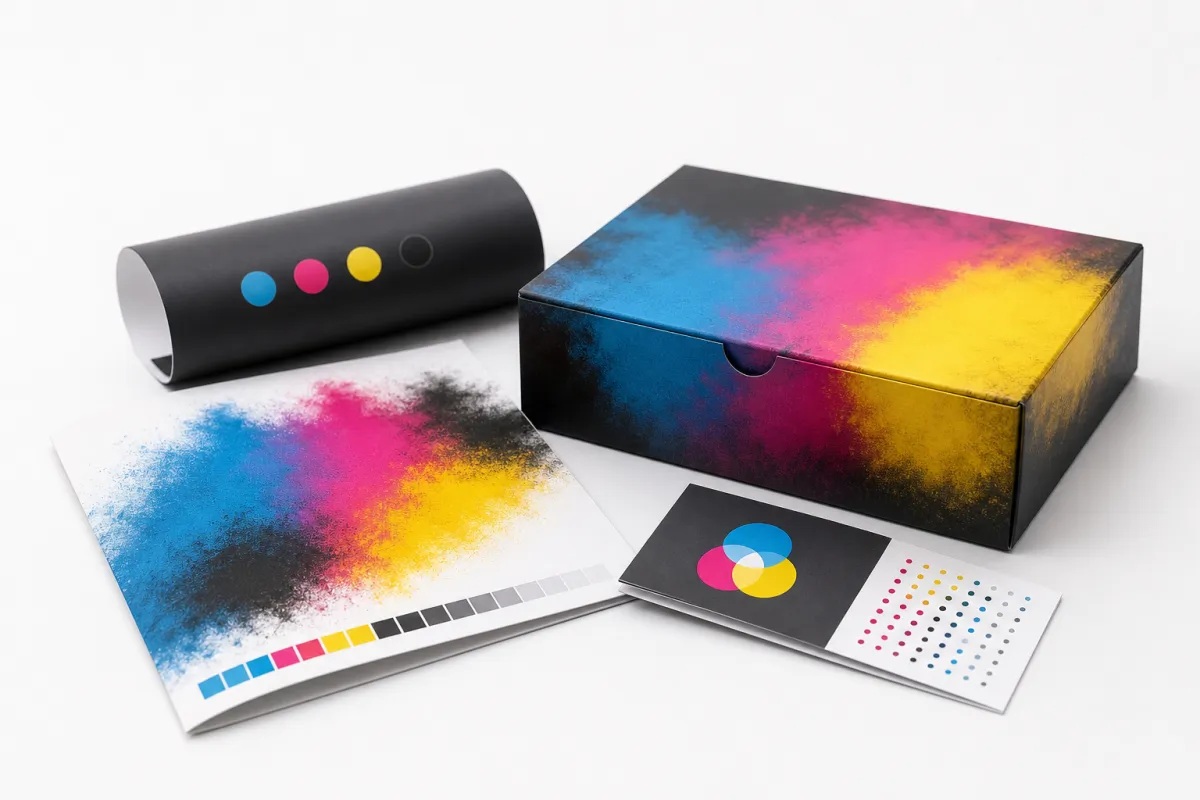
At its core, custom packaging with cmyk printing means the design is built from four process inks: cyan, magenta, yellow, and black. Those inks are laid down in tiny dots at different percentages, and the eye blends them into photos, gradients, shadows, and mixed brand tones. That is why custom packaging with cmyk printing shows up everywhere for packaging that needs depth without assigning a separate ink to every color in the palette.
The method works especially well for product photography, soft fades, layered illustrations, and retail packaging with several secondary colors. A gradient sky, a food image, or a subtle tone-on-tone pattern can print beautifully because CMYK can build a broad palette from one press setup. For custom packaging with cmyk printing, that flexibility is often the whole reason to use it in the first place.
CMYK is not a promise of exact color matching. A vivid orange on your monitor may land a little duller on coated board, and a pale pastel may shift warmer on kraft. From a packaging buyer's point of view, that is the tradeoff: custom packaging with cmyk printing gives you range and visual variety, but the substrate still controls how the box reads in hand.
I think a lot of disappointment starts when people expect the print method to do all the work. A strong brand file, a sensible finish, and a substrate that suits the artwork matter just as much as the four process inks. That is why custom packaging with cmyk printing should be treated as a system, not a decoration step.
Color on a screen is light. Color on a box is ink, fiber, and finish all arguing with each other. If one changes, the result changes too.
For brands that need repeated consistency across product packaging, inserts, and outer cartons, the smarter move is to decide early whether CMYK alone is enough or whether a spot color, a proofed match, or a different structure is needed. In other words, custom packaging with cmyk printing is excellent, but it is not magic.
How custom packaging with cmyk printing works
Every clean print job starts with the file. A print-ready layout should be in CMYK color mode, built on the correct dieline, and set with bleed that usually lands around 0.125 inch or 3 mm unless the supplier asks for something else. Safe zones matter too, because text and logos placed too close to a fold or trim edge can wander once the board is die-cut and folded. For custom packaging with cmyk printing, those details are not extras; they are the difference between a clean proof and a stack of corrections.
Resolution matters in the same blunt way. Raster images should generally sit at 300 dpi at final size, while thin type needs enough weight to survive ink spread and folding pressure. Rich black builds can help large dark panels look deeper, but small black text usually stays cleaner at 100% K. That is the kind of detail that separates a finished box from a merely printed one, and it is one reason custom packaging with cmyk printing works best when the artwork was made with production in mind.
Artwork prep that prevents rework
Before a press ever starts, prepress checks the file for overprints, image links, font issues, bleed, and dieline alignment. Hidden RGB elements, embedded spot colors, and low-resolution graphics can all sneak through if nobody catches them early. For custom packaging with cmyk printing, a careful prepress review usually saves a painful correction later, especially on larger runs of custom printed boxes.
I also like to see a note for any finish that changes color perception, such as gloss varnish, matte lamination, or soft-touch film. Matte can mute saturation a little, while gloss can make color feel stronger and more reflective under retail lighting. That is why custom packaging with cmyk printing should never be reviewed as artwork alone. The finish is part of the color story.
From press to finished carton
Once the file is approved, the production flow usually moves from printing to drying or curing, then to die-cutting, stripping, folding, gluing, and packing. Digital printing can be a strong fit for shorter runs, versioned artwork, or launch-stage retail packaging because setup is lighter and proofing is faster. Offset printing often becomes the better fit for larger volumes and tighter control over solid areas, though it brings plate or make-ready costs that only make sense when the run is big enough.
The substrate changes everything at this stage. A 350gsm C1S artboard accepts ink differently than E-flute corrugated, and both behave differently again from rigid chipboard wrapped in printed paper. If you are sourcing custom packaging with cmyk printing for shipping cartons, the same file may need a different ink strategy than it would for shelf-facing packaging. That is normal, not a defect.
For a quick reference on packaging formats and production thinking, the industry references at packaging.org can help frame material choices and packaging design basics, especially for teams comparing custom packaging with cmyk printing against other print methods.
One more practical point: proof types answer different questions. A digital proof shows artwork placement and color direction on a screen or on calibrated output, a press proof shows how inks behave on a specific sheet or board, and a substrate mockup shows how the structure feels in hand. For custom packaging with cmyk printing, you want to know which proof is being offered before you treat it like final color truth.
Key factors that affect color, quality, and cost
Material choice is the first big cost and color driver. SBS board, kraft board, corrugated, and rigid chipboard all absorb ink differently and reflect light in their own way. A file that looks vivid on white SBS may look softer and warmer on kraft, and a design with fine gray type may feel crisp on one stock and slightly rough on another. That is why custom packaging with cmyk printing always needs a substrate-specific conversation, not a generic promise.
Finish is the second major variable. Gloss lamination can make packaging feel bright and retail-ready, matte can pull the look toward a quieter premium style, soft-touch can add a velvety surface that customers notice immediately, and aqueous or varnish can change sheen without the full cost of film lamination. For branded packaging, that finish choice changes how customers read color under store lights, on camera, and in hand. Custom packaging with cmyk printing can look very different with the same artwork simply because the light hits a different surface.
Quantity changes the price curve in a predictable way. Setup, make-ready, die tooling, and proofing are fixed or semi-fixed costs, so those dollars get spread out as the run grows. A short run of 250 folding cartons may cost several times more per unit than 5,000 cartons, even if the artwork stays identical. That is not pricing trickery; it is production math, and it is one reason custom packaging with cmyk printing gets more efficient when you plan quantities realistically.
Design complexity affects both quality and cost. Heavy ink coverage can increase drying time, large solid fields can scuff more easily, reverse type can fill in if it is too small, and gradients can reveal banding on some digital systems if the file is not prepared well. Fine line art, metallic effects, and tight registration between elements all add pressure on the press and on the operator. In practice, custom packaging with cmyk printing rewards clean, disciplined artwork far more than crowded layouts stuffed with tiny details.
There is still a place for spot colors, especially if a brand needs a signature tone to match across product packaging, inserts, or a wider retail packaging system. CMYK can recreate a lot of color well, but some brand hues are easier to control with a dedicated ink or a proofed target. That choice does not mean abandoning custom packaging with cmyk printing; it means deciding where process color is the right tool and where a spot ink earns its keep.
If sustainability language matters to the brand, fiber sourcing enters the conversation too. A board can print beautifully and still be the wrong fit if the sourcing story is weak, so many buyers ask whether FSC-certified board is available and whether the finishing system fits the environmental brief. That is a packaging decision as much as a print decision, and it belongs in the same planning meeting as custom packaging with cmyk printing.
Custom packaging with cmyk printing: pricing and budget basics
Pricing starts with structure, not just artwork. A simple mailer with a single-panel print and a standard tuck closure will usually cost less than a rigid two-piece box with inserts, foil accents, and a complex wrap. Die tooling, print setup, finishing passes, and the number of unique SKUs all shape the quote, and custom packaging with cmyk printing sits inside that broader build cost instead of replacing it. That is why two boxes with similar graphics can still carry very different price tags.
As a rough planning range, short-run digital mailers or folding cartons can sometimes land around $0.60 to $1.50 per unit depending on size, board, and finish, while larger offset-printed runs may fall much lower once setup costs are spread out. Rigid boxes can climb into the $1.80 to $4.50 range or more, especially when wrapped chipboard, inserts, or specialty finishes are involved. Those numbers are broad on purpose because custom packaging with cmyk printing varies a lot, but they are still useful when a buyer needs a starting point before requesting a quote.
Proofing should be treated as budget protection, not a luxury. A physical proof or a true substrate mockup can catch color drift, dieline mistakes, copy errors, and closure issues before a full run is printed and assembled. If the project has multiple brand stakeholders, custom packaging with cmyk printing usually benefits from one carefully reviewed proof rather than three rounds of people guessing at a screen. I have watched that kind of guessing burn a week, and nobody enjoys explaining the delay after the fact.
For teams trying to decide whether a project should lean toward digital printing or offset printing, a simple comparison helps:
| Packaging type | Best fit | Typical cost pattern | Main strength | Main tradeoff |
|---|---|---|---|---|
| Digital mailers | Short runs, test launches, versioned artwork | Lower setup, higher unit cost at scale | Fast turnaround and flexible artwork changes | Can be less efficient on large volumes |
| Offset folding cartons | Medium to high volume retail packaging | Higher setup, better unit price as quantity rises | Strong solids and repeatable color control | Plates and make-ready raise upfront cost |
| Rigid boxes | Premium product packaging and gift sets | Higher labor and material cost | Premium feel and strong shelf presence | More construction steps and longer lead time |
That table is simplified, but it reflects what usually happens on the floor. A short run may look inexpensive on paper until the setup work gets counted, while a larger order may seem expensive at first and then become efficient once the press is running steadily. For custom packaging with cmyk printing, the cleanest budgeting conversation is the one that includes quantity, structure, finish, and proof plan all at once.
Another practical tip is to spend where the customer actually sees value. If the box protects the product and ships well, that is the first win. After that, invest in the panels that carry the strongest visual impact, then decide whether a premium finish is worth the added cost. That order of priorities keeps custom packaging with cmyk printing honest, because the design should support the product, not compete with it.
For sustainability-minded buyers, sourcing and test expectations can also affect budget. If a package has to survive parcel shipment, you may be asked to think about ISTA transit testing, especially on heavier e-commerce packs. The standards at ista.org are a useful reference point when custom packaging with cmyk printing needs both visual appeal and shipping durability.
Step-by-step timeline for custom packaging with cmyk printing
A typical project starts with the brief. Before art files move, the team should know the product dimensions, product weight, packaging type, quantity, target finish, and any shipping or display requirements. That is the point where custom packaging with cmyk printing begins to become a production job instead of an idea. Without those details, even a strong design can drift into rework because the structure itself was never locked down.
After the brief, the supplier usually confirms the dieline and structural spec. Then the artwork gets placed, the prepress team checks the file, and a proof comes back for review. Depending on complexity, that first proof can arrive quickly for a simple digital run or take longer for an offset job with spot finishing. If the design is already clean, custom packaging with cmyk printing can move from file submission to approval without much friction. If the art needs fixing, the calendar can stretch fast.
Approval is the most common schedule maker or breaker. A late change to copy, an updated barcode, a revision to the logo, or a last-minute finish request can force a new proof, a new setup step, or a revised production sequence. I have seen projects lose several business days to a small wording change that should have been settled earlier. With custom packaging with cmyk printing, the fastest projects are the ones where the proof stage is treated as a real decision point, not a casual preview.
Once the proof is signed off, the run moves into production and then quality control. Good shops check registration, color consistency, glue-line strength, dieline alignment, panel orientation, and box assembly before the order ships. If the package is going to survive fulfillment, the team may also check a compression target or shipping test profile, sometimes with reference to ASTM or ISTA expectations. That kind of discipline matters because custom packaging with cmyk printing is only useful if the box survives both the printer and the warehouse.
Here is the most realistic timeline pattern I see: a straightforward project with final artwork and a basic finish may take 10 to 15 business days after proof approval, while a more complex run with special lamination, inserts, or rigid construction can easily take longer. Late artwork changes and unclear specs are the biggest causes of delay. If a team wants custom packaging with cmyk printing to stay on schedule, the cure is simple: finalize the file before production starts and avoid using production as the place to make design decisions.
If the proof is still open, the schedule is still open. A box cannot be built faster than the decisions behind it.
Common mistakes with custom packaging with cmyk printing
The first mistake is building the file in RGB and hoping the printer will sort it out. RGB is made for light on a screen, while CMYK is made for ink on a substrate, and that mismatch often creates color shifts that show up the moment the box is printed. A bright blue on screen may turn darker and less saturated in production, and a soft pink may lose the warmth the brand expected. For custom packaging with cmyk printing, the file needs to start in the right color space or the project begins on the wrong foot.
The second mistake is weak file prep. Low-resolution images, type set too close to trim, missing bleed, and thin lines that are too delicate for the chosen stock invite production problems. On folding cartons, even a tiny shift can create a visible edge issue once the board is cut and folded. That is why custom packaging with cmyk printing works best when the artwork is built with press tolerances in mind, not just with visual appeal on a monitor.
The third mistake is assuming the same brand color will behave the same way on every material. A bright white SBS carton, a natural kraft mailer, and a textured corrugated shipper will each change how the ink reads. Light shades disappear more easily on brown board, while darker colors can look slightly duller on absorbent surfaces. For Packaging Design That needs a very exact hue, custom packaging with cmyk printing may need a proof on the actual board rather than a proof on a generic white sheet.
The fourth mistake is ignoring ink coverage. Heavy solids on absorbent stock can look uneven if the print process is not tuned well, and deep blacks can lose richness if the build is not balanced. Fine details and reverse type can also suffer if the coating or paper grain works against them. A well-planned custom packaging with cmyk printing file usually keeps some breathing room in the layout so the press can do its job cleanly instead of fighting the design.
The fifth mistake is approving from a screen alone. A monitor can help with layout and color direction, but it cannot show how a coating changes reflectivity or how a carton folds at the seam. A physical proof or an actual mockup catches the problems that digital review misses. If a team is serious about custom packaging with cmyk printing, the final approval should involve a real sample whenever the budget and schedule allow it.
It also helps to remember that package branding is not the same as decoration. A box should communicate the product, support shipping, and reflect the brand with enough discipline that the print method does not become the story. Custom packaging with cmyk printing works best when the design choices are simple, purposeful, and realistic about how ink behaves on the chosen stock.
Next steps for custom packaging with cmyk printing
The fastest way to move a packaging project forward is to gather the facts before asking for a quote. Dimensions, product weight, quantity, dieline, target finish, brand files, and any shipping requirement should all sit in the same brief. Once that is in place, custom packaging with cmyk printing becomes a much easier conversation because the printer can recommend a structure instead of guessing at one.
Choose the material for the job the box actually needs to do. If the package is shelf-facing and needs strong visual impact, a coated board with a clear finish may be the right move. If the product will ship in bulk, corrugated strength may matter more than a glossy look. If the brand wants a premium unboxing feel, rigid construction or a specialty wrap might be worth the added cost. Each of those choices changes custom packaging with cmyk printing in a real, measurable way.
Decide what matters most in the print itself. Is the priority photographic realism, broad color range, or a closer brand-color match? Answering that question early lets the production team steer the job toward digital printing, offset printing, or a hybrid approach that suits the run size. That same clarity also helps with custom packaging with cmyk printing because the art can be prepared around the actual production path instead of a vague idea of "high quality."
Before approval, run through a simple checklist: bleed included, safe area respected, copy checked, barcode tested, finish confirmed, and box assembly understood. That kind of review sounds basic, but it catches the problems that cost time and money later. It also keeps custom packaging with cmyk printing grounded in the real details that matter to a buyer, a fulfillment team, and the end customer.
For brands trying to build stronger product packaging, the smartest move is usually not the most complicated one. Start with the right board, choose a finish that suits the product, confirm the proof on the right substrate, and keep the production plan clear enough that there are no surprises on press. That is how custom packaging with cmyk printing stays controlled from the first file to the final box.
If you want the cleanest result, make one decision first: decide what the packaging has to do before you decide how it should look. That sounds obvious, but it saves a lot of bad calls. Once the function is locked, custom packaging with cmyk printing can do what it does best - turn a decent structure into packaging that feels intentional, prints well, and holds up in the real world.
Frequently asked questions
Is custom packaging with cmyk printing good for brand colors?
Yes, it can be very good for many brand colors, especially when the design includes gradients, photos, or layered graphics. Exact Pantone matching is not guaranteed, though, so a highly specific hue may need a spot color or a proofed match plan. For custom packaging with cmyk printing, the most reliable check is a substrate-specific proof on the actual board you plan to use.
What file should I send for custom packaging with cmyk printing?
A print-ready PDF is usually the safest starting point, ideally paired with the correct dieline and final dimensions. Set the file in CMYK color mode, include bleed, and make sure fonts and images are embedded or outlined correctly. If a finish or color target matters, add notes so custom packaging with cmyk printing can be reviewed before the press run starts.
Does CMYK printing work on kraft packaging?
Yes, but kraft changes how the ink reads because the board itself has a warm brown tone. Light shades, skin tones, and soft neutrals usually look warmer and less saturated than they would on bright white stock. If that appearance matters to the brand, ask for a proof on the actual substrate before approving custom packaging with cmyk printing.
How does CMYK printing affect packaging cost?
Cost is shaped by setup, quantity, ink coverage, finishing, tooling, and whether proofing or revisions are needed. Shorter runs often cost more per unit because fixed setup work is spread across fewer boxes, while larger orders usually become more efficient. In custom packaging with cmyk printing, the smartest budget move is to focus spending on the surfaces customers see first.
How long does a custom packaging with cmyk printing project take?
The timeline depends on artwork readiness, proof approval speed, print method, quantity, and finishing complexity. Projects move fastest when the dieline, copy, quantity, and design are finalized before production begins, while late revisions are the most common cause of delay. If you want custom packaging with cmyk printing to stay on track, plan for one careful proof review and treat that approval as the final production gate.

