Buyer Fit Snapshot
| Best fit | custom packaging workflow automation tools for faster runs for packaging buyers comparing material specs, print proof, MOQ, unit cost, freight, and repeat-order risk where brand print, material, artwork control, and repeat-order consistency matter. |
|---|---|
| Quote inputs | Share finished size, material target, print colors, finish, packing count, annual reorder estimate, and delivery region. |
| Proofing check | Approve dieline scale, logo placement, barcode or warning zones, color tolerance, and any recyclable or compostable wording before bulk production. |
| Main risk | Vague material claims, crowded artwork, or missing packing details can create delays even when the unit price looks attractive. |
Fast answer: Custom Packaging Workflow Automation Tools for Faster Runs should be specified like a repeatable production item. The safest quote includes material, print method, finish, artwork proof, carton packing, and reorder notes in one written spec.
What to confirm before approving the packaging proof
Check the product dimensions against the actual filled item, not only the sales mockup. Ask for tolerance on folds, seals, hang holes, label areas, and retail display edges. If the package carries a logo, QR code, warning copy, or legal claim, reserve that space before decorative graphics fill the panel.
How to compare quotes without losing quality
Compare board or film grade, print process, finish, sampling route, tooling charges, carton quantity, and freight assumptions side by side. A lower quote is only useful if the supplier can repeat the same color, closure quality, and packing count on the next order.
Custom Packaging Workflow Automation Tools for Faster Runs
The slowest step on a packaging job is rarely the press. It is usually the approval chain, and the numbers tend to prove it. I still remember one cosmetics carton in Shenzhen that stalled through 38 emails, 11 file renames, and 3 proof versions before anyone signed off on the final board copy. Thirty-eight. I counted them, then regretted counting them. That kind of delay is exactly why custom packaging workflow automation tools matter: they recover days from launch schedules by cutting the churn around artwork, claims, and sign-off, not by squeezing another minute out of a Heidelberg or Koenig & Bauer press.
Brand teams, procurement, and plant planners usually see the same problem from different angles. A designer thinks the artwork is done. Legal is still checking a 14-word claims line. Production is waiting on a clean release for a 350gsm C1S artboard folder with a soft-touch laminate. One folding-carton line I visited in Dongguan sat idle for 19 hours because a sign-off lived in a manager's inbox in Chicago. The work was ready. The decision was not. Honestly, I think that is the real packaging bottleneck in most companies, even the ones that say everything is under control. Custom packaging workflow automation tools are built to close that gap, and they do it with packaging workflow management, artwork approval automation, and tighter version control.
What Custom Packaging Workflow Automation Tools Actually Do
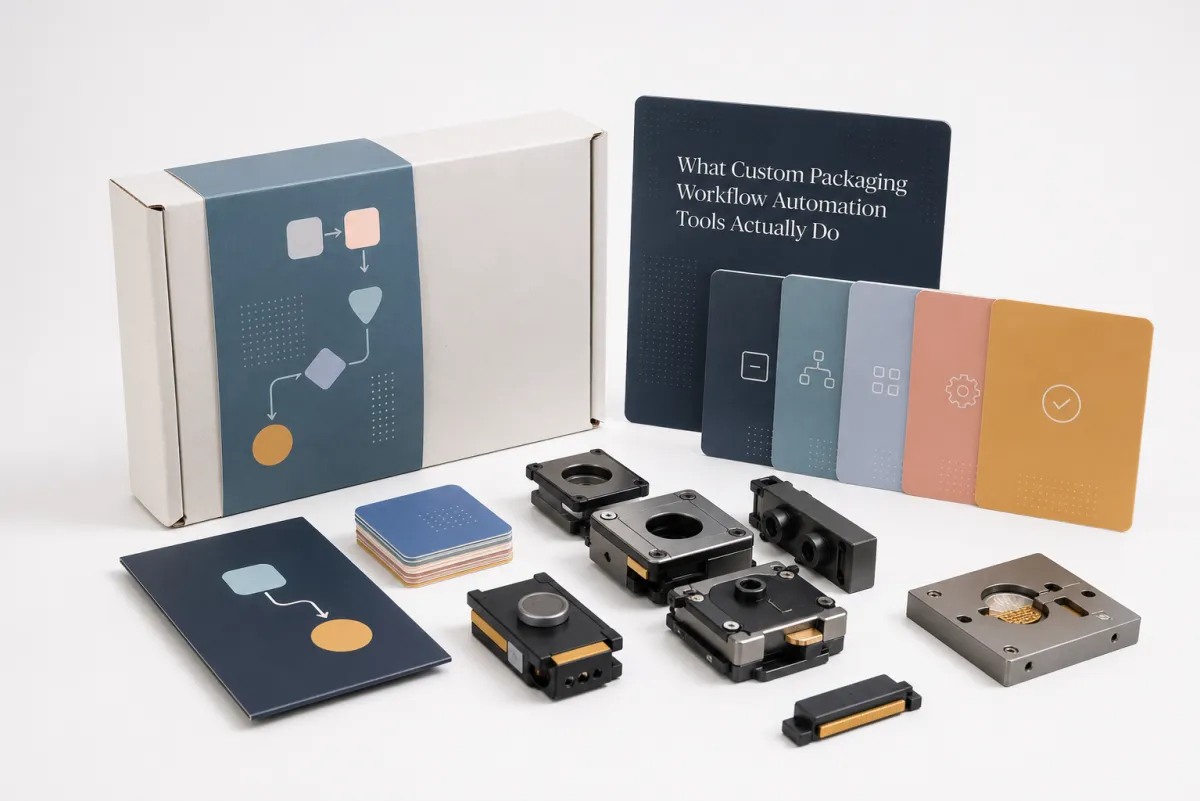
Custom packaging workflow automation tools connect the pieces of packaging work inside one tracked system. Artwork requests, dielines, specs, purchase orders, proof comments, and production release notes stop drifting across inboxes and shared drives. Packaging is never just one document. It is a chain of decisions, and each decision carries a version history that can make or break a launch. I have seen a one-line copy change create a week of chaos because the line lived on a shipper carton, a retail sleeve, and a regulatory label in three different markets: California, Ontario, and Queensland.
Task software and custom packaging workflow automation tools are not the same thing, even if vendors like to blur the line. A task list shows the next action. Automation routes the job, assigns the right reviewer, nudges the right person, escalates overdue steps, and records who approved what and when. That difference sounds minor until a brand manager says, "I assumed legal approved that panel copy," and the plant has already booked the run for Thursday morning. A tracked system gives the team a trail instead of a pile of assumptions. That trail matters more than people admit, especially after a launch goes sideways and everyone starts speaking in half-remembered sentences.
The teams that feel the strongest pressure are usually packaging managers, procurement leads, prepress groups, brand owners, and manufacturers handling 40, 80, or even 200 active SKUs with revision cycles that never quite settle. Seasonal packaging is especially brutal. So is Custom Printed Boxes work with regional copy changes in the US, Canada, and Germany, where a single ingredients line can trigger three separate approvals. One small edit can ripple into artwork, inventory, warehouse timing, and transport. I once watched a holiday carton revision knock out a shipping plan because the FSC statement moved by 4 millimeters and the barcode quiet zone shrank below spec. Custom packaging workflow automation tools exist for that kind of complexity, not for a clean demo on a sales call.
"We did not need faster printing; we needed one source of truth." A supply chain director said that to me after lunch in Chicago, and I still think about it whenever a packaging job stalls on the same file for the fourth time.
The time drain is easy to underestimate. A job with four approvers can generate 12 or 15 handoffs before release, especially if legal, prepress, and procurement each send comments separately. Each handoff adds a chance for a mismatch in dieline, copy, barcode placement, or artwork. Custom packaging workflow automation tools lower that risk by keeping the whole path visible. A dashboard helps. A clean audit trail helps more. For teams managing package branding across a cosmetics line in Milan, a snack line in Texas, and a beverage carton in Monterrey, that visibility is often worth more than a polished interface.
How Do Custom Packaging Workflow Automation Tools Work?
Most custom packaging workflow automation tools follow the same basic sequence, even if the screens look different. Request intake comes first. A brand lead or procurement manager submits the job with the SKU name, carton size, board grade, target launch date, and print method. Asset collection follows. The system asks for logos, regulatory copy, images, barcodes, and any existing dielines. From there the job moves into design routing, proofing, approval, prepress checks, and production release. Every stage leaves a timestamp. That timestamp is boring in the best possible way. It lets people stop arguing over memory and start looking at a record that says 9:14 a.m., 9:47 a.m., and 2:06 p.m.
Rules-based routing is the part that saves the most time. Instead of someone manually forwarding a file, custom packaging workflow automation tools send the proof to the correct reviewer based on preset rules. A cosmetics carton with multilingual claims pulls in legal automatically. A simple shipper box may only need a packaging engineer in Guangzhou and a plant planner in Louisville. When a step sits untouched for 24 hours, the system can nudge the reviewer. At 48 hours, it can escalate. None of that is flashy. It is practical, and practical is what keeps launch dates intact. I know that sounds unglamorous. It is. It also keeps people from working on a Friday night in a plant break room with fluorescent lights and bad coffee.
The data layer matters just as much as the routing. Version history, approval timestamps, change logs, dielines, specs, and supplier notes stay attached to the job. That means prepress can see that the last revision did more than shift a color; it changed the panel count from six to eight and moved the QR code 6 millimeters to the left. I once sat with a converter in Ho Chi Minh City who lost half a shift because an old dieline was reused on a shelf-ready tray. One line of metadata would have prevented that. Custom packaging workflow automation tools are meant to keep those details from wandering off into some forgotten folder called "final_final_USE_THIS."
A manual packaging workflow can turn a single revision into a scavenger hunt. Email starts the job, a designer edits a file on a desktop, a PDF gets reviewed in a thread, and a phone call adds one more note that nobody writes down. Final version? No one is certain until five attachments are opened and one person mutters, "Wait, that is not the one with the corrected claims." In custom packaging workflow automation tools, the revision sits in one queue, with comments attached to the exact page and the exact step. That kind of dullness is useful. Dull is good when the next stop is press approval for a 6-color carton run scheduled in 12 business days.
Compliance sits inside the same picture. For shipping tests, I still check whether a pack should follow ISTA procedures, especially when parcels or mixed freight are involved. If the board or paper needs certified sourcing, FSC chain-of-custody records may need to travel with the job. Custom packaging workflow automation tools do not replace those standards. They keep the paperwork tied to the right run instead of buried in somebody's downloads folder. That alone can save an auditor in Rotterdam or Toronto from asking the kind of question that makes the whole room stare at the table.
Key Factors That Shape Cost and Pricing
Pricing for Custom packaging workflow automation tools almost never lands on one neat number. Vendors charge per user, per workflow, per brand, per facility, or under enterprise licensing that bundles support and integrations. A 10-person packaging group in Atlanta does not need the same setup as a multinational with six plants and 200 active carton codes in Mexico, Poland, and Vietnam. The pricing model matters because the wrong one can make a small team overpay or a large team underbuy and hit a wall six months later. That is the sort of decision that looks harmless in procurement and then becomes everyone else's problem after launch.
A lean team that only needs artwork approval may do fine with a per-user subscription. A company managing multiple brands and retail packaging lines may do better with pricing tied to workflows or facilities. In one proposal I reviewed last quarter, a 12-user team was quoted $19 per user per month plus a $3,500 setup fee for template building and a 2-hour admin training session. Another plant group, running 80 to 100 jobs a month, was looking at a $24,000 annual contract with onboarding included and a 15-business-day implementation window. Those are not universal rates, but they match the range I keep seeing in the market. The spread is wide enough that you should always ask what is included, because "setup" can mean anything from a quick template tune-up to a full week of head-banging meetings.
| Option | Example Price Shape | Best Fit | Main Tradeoff |
|---|---|---|---|
| Spreadsheet + email | $0 software fee, but 6-12 staff hours a week in admin | Very small teams with low SKU volume | High rework risk and weak audit trail |
| Per-user workflow tool | $15-$45 per user per month, plus $1,500-$5,000 setup | Teams that need structured proofing and approval routing | Can get expensive as headcount grows |
| Per-workflow or per-brand platform | $2,500-$8,000 per workflow annually | Companies with repeating carton families and stable packaging design rules | Less flexible if workflows change often |
| Enterprise licensing | $18,000-$60,000 a year, sometimes more with integrations | Multi-site packaging operations with ERP, asset, and prepress connections | Longer rollout and more governance work |
Setup costs often matter as much as the subscription. Template building, change control rules, file storage connections, ERP links, data migration, and training can add $2,000 to $15,000 before the first live job moves through the system. That is why custom packaging workflow automation tools should be judged like process infrastructure, not just software. If the tool saves 20 minutes per approval loop and you run 300 jobs a year, the math starts to shift fast. I have watched teams dismiss a tool because the monthly fee felt annoying, then spend far more on overtime and rework in Shenzhen, Chicago, and Cincinnati. That is not a clever savings strategy. It is just deferred pain.
The cost of not automating shows up more clearly on the plant floor than in a budget sheet. Missed launch dates lead to air freight from Hong Kong or Frankfurt. Duplicate artwork work consumes prepress hours. Approval delays hold up raw material orders for 350gsm SBS board, PET sleeves, or kraft mailers. Reprints are the most expensive mess because they combine waste, labor, and embarrassment in one line item. I have seen a client spend more to fix one incorrect nutrition panel than they spent on a quarter's worth of custom packaging workflow automation tools. That is not unusual. Packaging has a sneaky way of turning small errors into expensive drama.
ROI tends to come from four places: fewer revision loops, faster sign-off, better traceability, and less production waste. The cheapest option is not always the least expensive once rework gets counted. If a $9,000 annual platform cuts two late-stage reprints and saves a week of packaging coordinator time each month, payback can arrive quickly. I like asking teams to put a dollar value on one hour of delay. Once they do, custom packaging workflow automation tools stop looking like overhead and start looking like protection against waste. That shift in language matters more than the spreadsheet color scheme.
Step-by-Step Rollout and Timeline
Any rollout should begin with a map of the current process. Every step matters, not just the official ones. Who requests the job? Who creates the brief? Who owns the dieline? Who signs off on claims? Who releases the purchase order? Custom packaging workflow automation tools work best when they mirror the real process instead of the ideal version someone sketched on a whiteboard in a meeting room in Singapore six months ago. If the map is wrong, the tool will be wrong in a more expensive way. I have seen that movie. It ends with a lot of meetings and a very expensive "reset" conversation.
Starting with one narrow workflow usually works better than trying to rebuild everything at once. A single carton line, one high-volume SKU family, or one repeat package redesign is enough to prove value without creating a governance headache. At a folding-carton plant I visited in Dongguan, the team piloted one coffee sleeve family with 3 proof stages and 5 reviewers. It was boring, which was exactly why it worked. They found the proofing bottleneck within 11 days, and the first fixed template saved them from three repeated file checks on the next run. Custom packaging workflow automation tools do not need companywide scope to matter. In fact, they usually behave better when they are not asked to solve every mess by Tuesday.
- Configure templates for one job type, such as a 350gsm C1S artboard carton with soft-touch lamination and spot UV.
- Assign permissions so brand, legal, procurement, and prepress each see only the steps they need.
- Connect file storage, DAM, or ERP tools so job data does not have to be typed twice.
- Test proof routing, reminder logic, and escalation rules with a live-but-low-risk SKU.
- Train users on the exact approval path and define who owns each exception.
The sequence is simple. The execution is not always simple. A narrow pilot can often be live in 2 to 4 weeks if the workflow is clean and the team is ready. A multi-brand rollout may take 8 to 14 weeks, especially if packaging data lives in separate systems and decision rights are fuzzy. That delay is normal. I would rather see a slower launch with clean rules than a quick launch that gets abandoned two months later. Custom packaging workflow automation tools only work if people trust the path the software creates. If people do not trust it, they route around it, which is the software equivalent of a lock with a missing door.
One supplier negotiation sticks with me. A plant manager in San Jose told me he could promise 12-15 business days from proof approval to production, but only if art was frozen and the change log stayed clean. That kind of number is useful because it turns a vague promise into an operating rule. Custom packaging workflow automation tools help teams make that promise with more confidence, because the status of each approval is visible in real time instead of buried in a mailbox. And when the status is visible, people ask better questions. That alone can save hours.
If your operation handles custom printed boxes, printed sleeves, or multi-language retail packaging, bring prepress checks into the rollout early. Small issues like barcode quiet zones, panel shifts, and bleeds can sink a release if nobody catches them before sign-off. I also like to keep a sample of current package branding rules next to the workflow map, including the latest color targets for Pantone 186 C or matte black ink on white board. The software should reflect the brand's actual guardrails, not a generic checklist that only looks good in a demo. If the brand loves tiny legal copy and oddly placed icons, the workflow has to know that. Reality wins, every time.
Common Mistakes in Packaging Automation Projects
The biggest mistake is automating a broken process. If nobody knows who owns approval, custom packaging workflow automation tools will not fix the confusion. They will make it faster and more visible. I have watched teams install a polished platform, then discover that three people believed they were the final approver for the same label printed on 250,000 units in three different facilities. The software did its job. The process was the problem. That is not a software failure so much as a company holding up a mirror and then being surprised by the reflection.
Overcomplication is the second trap. Teams sometimes load a workflow with 47 fields, nine mandatory gates, and every exception they can imagine on day one. Adoption dies there. A prepress coordinator in Leeds told me in one meeting that she spent more time filling out metadata than reviewing the proof for a 6-panel carton. That is a warning sign. The Best Custom Packaging workflow automation tools are strict about the steps that matter and light on everything else. If a field does not change a decision, it probably should not be mandatory. I know that sounds obvious. I also know how often obvious things get buried under committee logic.
The integration trap comes next. If the tool does not connect cleanly with artwork libraries, asset management, or ERP systems, people create side channels and duplicate records. Then the team starts asking which record is real. I have seen that happen with version control, supplier notes, and PO numbers at plants in Ohio and Penang. Custom packaging workflow automation tools should cut duplicate typing, not create a second spreadsheet nobody trusts. If users have to keep a shadow system just in case, the rollout is already leaking value.
Training is the final weak point, and it is more serious than many vendors admit. Even strong custom packaging workflow automation tools fail when users do not understand what the new process expects from them. I learned that the hard way years ago on a corrugated project where the plant kept bypassing the system because nobody had explained the difference between "review" and "release." One hour of training would have saved three weeks of friction. The tool was fine. The onboarding was not. I was annoyed then; I am still annoyed now, which probably tells you the lesson stuck.
Standards can also trip teams up. If the job involves transit testing, I like to keep the relevant ISTA procedure visible from the start. If the product needs certified fiber documentation, the FSC chain should be built into the job path, not bolted on after approval. Those details sound small until an auditor asks for the trail. Custom packaging workflow automation tools are strongest when compliance is part of the route, not an afterthought. Otherwise, the process ends up feeling like a treasure hunt, except the prize is a corrective action form and a long afternoon in a conference room.
"We did not fail because the software was weak. We failed because the process was half-baked." That was a candid line from a procurement lead after a rollout review, and it was accurate.
Expert Tips for Better Adoption and ROI
Start with one pain point, not the whole supply chain. If the biggest drag is artwork approval, fix artwork approval first. If the real delay is the handoff to the factory, focus there. Custom packaging workflow automation tools earn trust when they solve a visible problem quickly. Once a team sees one cycle drop from nine days to four, the conversation changes. People stop asking whether the system works and start asking where else it can help. That is the moment you want. It is also the moment people start volunteering opinions they did not have five minutes earlier.
Pick metrics before launch. I like four numbers: cycle time, revision count, late approvals, and rework cost. Those tell a stronger story than a generic satisfaction score. If the team says the tool feels easier but cycle time has not moved, something is off. If cycle time drops but revision count rises, the workflow may be too loose. Custom packaging workflow automation tools should be measured by what they remove from the process, not just what they add. I have seen teams celebrate a prettier interface while the actual bottleneck sat untouched. That is the corporate equivalent of repainting a bridge with potholes.
Templates are doing more work than many teams realize. Strong use of templates for job types, approval paths, artwork naming, and prepress checks cuts friction fast. For branded packaging and product packaging lines that repeat month after month, a template can remove most of the setup noise. I have seen a mid-sized snack brand in Minneapolis cut three duplicate status meetings a week after it standardized job templates for two carton families and one shrink-sleeve line. That was not a software miracle. It was disciplined packaging design governance. The software simply stopped the team from improvising the same decision six different ways.
Assign a process owner. Not a software admin, a process owner. There is a difference. The owner should review edge cases, clean up exceptions, and keep the workflow aligned to how the business actually runs. Custom packaging workflow automation tools need that human layer because real packaging work is messy. Sales wants urgency, legal wants certainty, production wants stable artwork, and procurement wants purchase order visibility. Someone has to keep those voices from breaking the path. If nobody owns the process, the process owns everyone else, and that gets old fast.
The first 90 days deserve a learning mindset. A few rough edges are normal. The goal is not perfection; it is visibility. Once the team can see where proofing stalls, which approvers miss deadlines, and how often files bounce back to prepress, the conversation gets sharper. At that point, custom packaging workflow automation tools feel less like software and more like a management habit. I think that is the real payoff: fewer surprises, fewer excuses, and fewer mysterious delays that somehow always land on a Friday.
One more thing. If your organization also buys packaging through an existing channel, keep the buying path simple. Pair workflow discipline with a clean catalog of Custom Packaging Products, and the team spends less time hunting for the right structure or insert. I have seen that pairing work especially well for companies with multiple box styles and a few repeat order patterns in the US Midwest and southern Ontario. It gives brand, procurement, and production one place to start. That sounds mundane, but mundane is underrated when three departments are trying to agree on a box insert before noon.
When I walk a factory floor, I notice what people print out and tape to monitors. Three different job lists usually point to a process problem. One live queue and one approval path usually mean the team is close to scale. Custom packaging workflow automation tools help teams get to that second state, where the job is visible, the decision is owned, and the press is not waiting around for a PDF to be found. If the monitor wall looks calmer, that is usually a good sign, though I still trust the floor more than the dashboard.
Next Steps for Custom Packaging Workflow Automation Tools
Start with a short audit. Pick one packaging workflow and write down every approval step, every file handoff, and every moment where someone asks, "Which version is current?" Measure how long each step takes, down to the minute if you can. That gives you a baseline before you shop for software, and it tells you whether the real delay is in proofing, handoff, or sign-off. Custom packaging workflow automation tools work best when they are matched to an actual bottleneck, not a theoretical one. People love theoretical bottlenecks because they sound strategic. The real ones usually look messier and are much easier to fix.
After that, compare two or three platforms against your real process. Skip the perfect demo scenario. Use one live carton revision, one real approver chain, and one current SKU with actual constraints, such as a 3-panel sleeve, a 1,000-piece run, or a 4-color kraft mailer. If the platform can handle your job with real fields, real deadlines, and real exceptions, you will learn more in one afternoon than in three sales calls. I have seen teams discover in a pilot that the software was fine, but their internal approval ownership was not. That is useful information, even if it stings a bit.
Then run a small pilot on one product family. Review cycle time, error rates, and user feedback after the first full run. If the team can cut revision loops by two and shave three days off approval, that is a credible win. If not, inspect the template and the routing logic before you expand. Custom packaging workflow automation tools reward clarity. They do not reward wishful thinking, and they definitely do not reward "we'll figure it out later" as a project plan.
If you are still on the fence, write down the three delays that hurt you most this month. Maybe it is artwork approval. Maybe it is the late copy change that pushes a print date. Maybe it is the confusion over who owns the final release. Once those are visible, the buying decision gets easier. The most successful teams do not Buy Custom Packaging workflow automation tools because they love software. They buy them because they are tired of watching good packaging work get stuck in avoidable loops. That exhaustion is a signal, not a flaw.
My closing advice is simple: document one process this week, then measure it. That one act will tell you more than a glossy demo ever will. Build from there, and custom packaging workflow automation tools can do what they are supposed to do: shorten the path from request to release, reduce waste, and keep the next run moving.
Frequently Asked Questions
How do custom packaging workflow automation tools reduce approval delays?
They replace scattered email threads with one tracked review queue, which keeps everyone looking at the same job record. They also route files to the correct approver automatically and send reminders when a step stalls after 24 or 48 hours. Because version history stays attached, teams stop wasting time checking which proof is current. That is a small change on paper and a huge relief in practice, especially on jobs with 6 or more stakeholders.
What should a packaging team automate first?
Start with the highest-friction step, which is often artwork approval or proof routing. Pick a workflow that repeats often enough to show value quickly, such as one carton family or one label family. I would avoid trying to automate every exception on day one, because that slows adoption and muddies the results. A narrow win is better than a sprawling half-success, especially if the first pilot can close in 2 to 4 weeks.
How much do custom packaging workflow automation tools cost?
Pricing usually depends on users, workflows, brands, or facilities rather than one flat number. Budget for setup, integration, and training in addition to the subscription fee. The cheapest option is not always the least expensive once rework, late approvals, and duplicate artwork work are counted. In other words, the sticker price is only the first invoice, and on a 300-job annual volume that difference can be sizable.
How long does implementation usually take?
A narrow pilot can often be configured faster than a companywide rollout. The timeline depends on template building, integrations, approvals, and training. Complex packaging operations need more time because the workflow has to reflect the real production rules, not just the ideal ones. If someone says it will be done in a week, I would ask a few more questions, then ask for the current number of reviewers and the number of active SKUs.
Which metrics prove the tools are working?
Measure approval cycle time before and after launch. Track revision count, rework volume, and late-stage changes. I also like to review whether production handoff becomes cleaner and easier to audit, because that is where the operational lift usually shows up. If the numbers improve and the team complains less, that is usually a decent sign, especially on a line producing 50,000 units a week.
After the first pilot, keep the focus on the numbers and the users. If custom packaging workflow automation tools cut delay, reduce confusion, and make the handoff easier to trust, you have a process worth expanding. If they do not, tighten the workflow before you scale, then document one more process and test it again.

