Buyer Fit Snapshot
| Best fit | Custom Paper Bags Without Handles Bulk projects where brand print, material claims, artwork control, MOQ, and repeat-order consistency need to be specified before quoting. |
|---|---|
| Quote inputs | Share finished size, material target, print colors, finish, packing count, annual reorder estimate, ship-to region, and any compliance wording. |
| Proofing check | Approve dieline scale, logo placement, barcode or warning zones, color tolerance, closure strength, and carton packing before bulk production. |
| Main risk | Vague material claims, crowded artwork, missing packing details, or unclear freight terms can make a low unit price expensive after revisions. |
Fast answer: Custom Paper Bags Without Handles Bulk: Pricing & Specs should be specified like a repeatable production item. The safest quote records material, print method, finish, artwork proof, packing count, and reorder notes in one written spec.
Production checks before approval
Compare the actual filled-product size with the drawing, then confirm tolerance on folds, seals, hang holes, label areas, and retail display edges. Reserve space for logos, QR codes, warning copy, and material claims before decorative graphics fill the panel.
Quote comparison points
Review material grade, print process, finish, sampling route, tooling charges, carton quantity, and freight assumptions side by side. A quote is only useful when the supplier can repeat the same color, closure quality, and packing count on the next order.
Custom Paper Bags Without Handles Bulk: Pricing & Specs
Order Custom Paper Bags without handles bulk and the tradeoff shows up fast: fewer parts, fewer headaches, less to go wrong. Remove the handle and you remove a small chain of glue steps, fold points, and timing traps. For retail counters, event fulfillment, and direct-to-consumer runs, that simplification helps production move with less drama and more predictability. In practical terms, less motion per bag usually means cleaner throughput and fewer disruptions when volume spikes.
This is a buying reference, not a mood board. It stays close to what converters and printers actually build, with specs, pricing bands, and timeline notes you can use to write a short RFQ, compare suppliers, and place a first PO without improvising at 4:47 p.m. on a Friday. If you run bulk paper bags with a team that is already juggling inbound volume, this is the kind of document you want nearby.
Custom Paper Bags Without Handles Bulk: Why They Often Win
The operational reason buyers miss at first glance
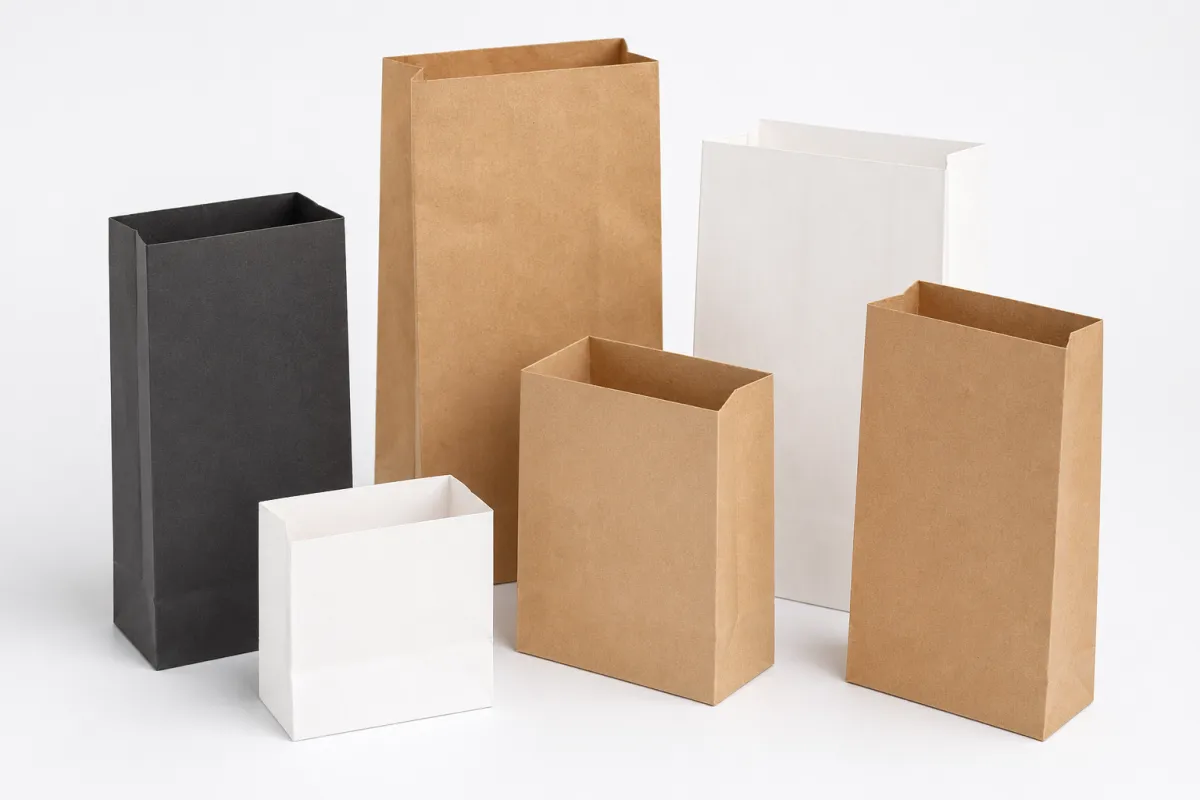
A handle sounds like a feature. In production, it often behaves like an extra checkpoint. In practice, Custom Paper Bags without handles bulk usually move smoother through print-to-pack because there is one less component to babysit. No handle fold. No handle attachment alignment. No awkward bulk in the carton profile. The bag shape stays flatter and easier to stage, especially when orders have to be packed fast and then moved.
At speed, every extra cycle counts. A handled bag adds another fold action, another check for misalignment, and another point where a line operator can flag a flaw. Switch to flat-ply Custom Paper Bags without handles bulk and you usually see lower handling friction earlier in the shift. For lightweight products, teams often notice an 8 to 15 percent speed gain. That is not a magic number, just a practical range from jobs where the line spends less time fussing with the bag and more time packing it.
The benefit is not only speed. It is also consistency. If your team runs multiple SKUs, a no-handle format can simplify transitions between jobs because operators keep the same handling cues and do not have to recalibrate their motions. A small operational gain repeats across shifts. Repetition is where the margin sits.
Where the format performs best
In real use, Custom Paper Bags Without Handles bulk fit cleanly into:
- Folded apparel and light garment inserts
- Bakery inserts and pastry carries where contents stay compact
- Event handouts, sponsorship packets, and promotional gift sets
- Takeout accompaniments, meal kit inserts, and small pantry components
- Subscription boxes and accessory bundles where the bag supports the unboxing moment
- Lightweight retail packaging for home goods, stationery, and samples
This format is still a paper shopping bag by function if the product is light and stable. It is less suitable for soft, wet, or dense items that punish thin walls. That is where people get into trouble: forcing a premium look onto the wrong structure. If the load is wrong for the format, the bag becomes a problem, not a solution. Change the stock, change the format, or change the material.
That is where custom paper bags without handles bulk earns its place. The bag has to match actual use, not mockup aesthetics. For quick distribution, the flat stack and predictable geometry help everyone from packing to replenishment. For premium gifting, heavier paper and smarter finishing still work with no handle and keep the same crisp hand feel. I have seen buyers spend twice as long arguing over a prettier mockup when the better fix was a sturdier sheet and a simpler fold. Kind of funny, until it is your receiving team dealing with the mess.
Flat, nestable, and easier to hold as inventory
Handled bags, especially ones with glued loops or reinforced handles, sit differently in cartons and force higher stack height before the first unit is packed. A custom paper bags without handles bulk configuration stays cleaner in stack profile, especially when you move into pallet quantities. That matters in cramped storage zones, busy dispatch areas, and stores that are trying to avoid “where did this inventory go?” situations.
Flat nesting cuts down on touches. Counting and scanning is easier. Pallet build times tighten. Shelf restocks become less chaotic. That matters less to a spreadsheet and more to the people living with it at 7 a.m. in the back room. Less handling typically means fewer dents, fewer tears, and fewer quick temper tantrums over “bad stock.”
Why bulk is not just "bigger order," it is a control tool
Ordering custom paper bags without handles bulk is often about control, not chase-the-savings. A larger coordinated run can lock print consistency, stabilize paper sourcing, and reduce the noise around urgent reorders when demand is reliable. If you can predict sell-through better, volume helps you control variance, not just unit cost.
There are two savings streams: unit economics and process stability. The first is obvious. The second is bigger but easier to ignore: steadier freight planning, less urgency in approvals, and less back-and-forth across merchandising and operations. Matching shade, stock, and fold behavior is easier when each wave follows a known recipe.
If you are using custom paper tote bags as part of a larger fulfillment stack, this approach is about predictability first and savings second. It usually saves both.
Product Details: Stocks, Printing, and Finishes
Now the real question: what should it be made of? For many brands, the right stock does more for perception than any finish layer. That is why custom paper bags without handles bulk usually start with paper choice, then move to graphics and color.
Paper stock options and what they really do
- Kraft (70-120 GSM): natural, earthy, and familiar. Good for straightforward branding, medium graphics, and buyers who want the bag to look honest rather than over-styled.
- White SBS / coated white stock (90-150 GSM): better ink holdout, sharper logos, stronger contrast, cleaner text for multi-color and marketing-heavy runs.
- Heavier SBS or uncoated board (120-200 GSM): more body, more stiffness, a stronger premium feel, and less side-wall collapse at higher dimensions.
- Recycled or FSC-claims stock (varies): useful for sustainability-driven programs, but inspect fiber content, print behavior, and supplier consistency before locking anything in.
Simple rule: if it has to carry a heavy structured item, structure comes first. If it carries soft, light goods, lighter paper can work. Pick the stock from the product side first, not the logo size. A pretty front panel does not rescue weak paper.
When teams choose a custom paper bag style for bulk paper packaging, the best call is usually “what can this hold, then what can it sell.” If the result performs in handling, packaging design usually follows.
A strong stock-to-content match beats the first rendering. Buyers forgive a simpler look when they know the pack survives transport, stacking, and the short, rough moments between warehouse doors.
Print systems and practical control points
Printing approaches for custom paper bags without handles bulk usually come in practical tiers:
- One-color: fast, cost-focused, and effective for symbol-driven branding.
- Two-color: efficient for a bold mark plus one accent.
- Four-color process (CMYK): needed for photos, gradients, and campaign images.
- One- or two-side coverage options: front-only, back-only, or front plus back depending on fold and print logic.
In retail use, the outside panel usually carries most value. Inside print is great for handling notes, care instructions, or serial checks. Multi-side print works best if fold lines are mapped clearly and type remains legible across the seam transitions.
If the graphic has tiny type, dry paper and matte surfaces can hide detail quickly. Keep body copy at 7-8 pt minimum at the likely viewing distance. Keep fine marks away from fold lines, glue zones, and stress points where compression is highest. If the artwork is busy, simplify it. A bag is not a billboard, no matter how badly someone in marketing wants it to be one.
Finish selection: more than "feel good"
Finish affects brand appearance and production behavior:
- Matte: natural look, reduced glare, better readability in most aisle lighting, and fewer visual distractions.
- Gloss: sharper contrast, stronger punch, but higher surface reflection in bright retail zones.
- Soft-touch lamination: premium tactile feel, common for gifting and subscriptions.
- Uncoated: true paper style with minimal processing, better for sustainability-led stories but less reflective contrast.
Custom paper bags without handles bulk with gloss can scuff faster in rough operations. Matte helps mask wear marks and reads cleaner for text-heavy layouts. Soft-touch lifts perceived value, but it generally adds cost and may alter fold behavior slightly. For light goods, matte often gives you enough visual quality without extra risk.
Coatings can also change fold memory. They lower absorbency and can affect how the bag softens with humidity and handling. If scanners, conveyors, and repeated opening are part of usage, request a short sample run before committing to 10,000-plus pieces. Otherwise you are guessing, and guessing is a bad procurement strategy.
Some teams compare this route with custom printed boxes or rigid alternatives, and that is a reasonable cross-check. If protection and shelf integrity dominate, boxes may win. If speed, lower waste, and lower line labor matter more, this no-handle format stays highly competitive.
Product packaging context
Custom paper bags without handles bulk sit inside a wider packaging system with packaging design, fulfillment flow, and shelf behavior. If the rollout covers more than one campaign, align panel proportions and tones with shelf tags, labels, and in-store graphics. That is where package branding becomes visible at the point of touch, not just in the design file.
Specifications to Confirm Before Ordering
Clear specs reduce rework. Good definitions early on lower the probability of surprise changes. Skip them and you invite late proofs, cost escalation, and quality debates at the worst possible time.
Dimensions first: width, height, gusset, and bottom
For custom paper bags without handles bulk, these measurements shape the outcome:
- Width: usually 90-320 mm for compact goods, up to 400 mm+ for larger bundles.
- Height: commonly 180-350 mm, with taller bags for layered apparel or grouped small SKUs.
- Gusset depth: 50-100 mm and above for higher-volume but light items.
- Bottom construction: flat bottom, pleated bottom, or fitted base based on stand-up need and stack behavior.
Buyers often overestimate usable panel area when they forget tabs, folds, and glue zones. A bag measured as “10x12 inches” can lose real printing space once all fold allowances are mapped. Confirm the final flat layout before artwork is locked, and keep margins around seams and top lock areas.
For custom paper bags without handles bulk in pre-defined carton sizes, ask whether the folded bag stack fits your carton height profile. A neat drawing helps; a real stack reveals weak seams, poor airflow, and crush points around corners. I have watched more than one program get delayed because the finished stack was just a little too tall for the warehouse carton plan. Not glamorous. Very expensive.
Why paper weight and caliper are production-critical
Paper weight is one variable. Caliper is another and it impacts fold quality and stiffness when packed in volume. Light content can work in 80-100 GSM. Products needing structure usually land in 120-150 GSM. Above 170 GSM is possible for premium builds, but this raises both material and conversion cost.
Thickness consistency matters more than average weight. A stable 100 GSM run with clean caliper can outperform a higher nominal weight that bounces from sheet to sheet. If thickness is uneven, you will chase split edges, curl, and misfold behavior through the line. That is the kind of issue that looks small in a sample and annoying in a pallet, then turns into a headache in receiving.
Artwork standards and print limits
For clean prepress on custom paper bags without handles bulk, send:
- Vector files (AI, EPS, or PDF/X-1a when possible)
- 3-5 mm bleed on all printable edges
- Safe margins around 6-8 mm from edges, folds, and glue zones
- CMYK-separated files for four-color work
- Approved colors or Pantone references when color consistency is critical
Fine lines below 0.5 pt can disappear depending on grain and press conditions. Reverse type can work on dark grounds, but only if contrast is proven at proof stage. If the initial sample looks fragile, request a scaled-up proof before final sign-off.
Practical check: if your logo has a 1 mm border in the first mockup, assume a 0.3-0.7 mm production loss can happen during trimming on some runs. Leave room now, not after the first pallet lands.
Tolerance and quality expectations
Before confirming, lock acceptable variation for custom paper bags without handles bulk on paper:
- Dimensional tolerance: about +/-1.5-2.0 mm on width/height in high-volume runs
- Color consistency: normal batch-to-batch variation is expected in different ink density conditions
- Edge alignment: minor panel drift usually acceptable unless branding requires strict visual straightness
What should fail automatically? Tears. Delamination. Severe color streaking. Barcode rejection issues. Structural collapse before fill. Keep tolerance notes with every batch and enforce a visible incoming inspection routine.
For teams with QA systems, map these checks to internal receiving standards. Even where external certification is not mandatory, alignment with industry expectations and your internal rules keeps reorder cycles cleaner and reduces variance in custom paper bag packaging.
Also confirm whether the specification is intended for front-of-store retail packaging or protected secondary-only packing. A custom paper bags without handles bulk build performs differently if goods are palletized first versus handed directly at a counter.
How Much Do Custom Paper Bags Without Handles Bulk Cost in Real-World Production?
Now for the obvious question: how much? There is never a single fixed number. Cost shifts with paper grade, print level, quantity range, finishing, and plant load at the time the job starts. Anyone pretending otherwise is probably selling smoke, not bags.
Main cost drivers you can control
Price does improve as order volume increases, but these are the main levers:
- Bag size and geometry: larger footprints raise material usage and waste potential.
- Paper stock: coated and heavier options usually increase unit cost.
- Print coverage: one-color remains simpler than full-bleed CMYK.
- Finishing: lamination, varnish, and special effects usually add both cost and handling time.
- Quantity and repetition: setup work spreads across more pieces when quantities are larger.
The keyword matters here because custom paper bags without handles bulk tends to save money through repeatability and line stability, not through expensive-looking design cues. You keep margin by removing friction, not by removing personality from the product.
MOQ as planning logic, not a hard gate
Custom paper bags without handles bulk MOQ is often read as fixed thresholds like 1,000, 2,000, or 5,000. In practice, it follows setup efficiency and production complexity. A small one-color run can make sense at lower runs. A four-color front-and-back campaign often needs a larger threshold before costs settle.
Think of MOQ as the smallest efficient setup point that yields stable quality and non-chaotic waste levels. Seasonal programs usually perform best with one planned base run and a smaller controlled top-up once demand becomes real.
| Bag setup | Stock & finish | 5,000 units | 10,000 units | 25,000 units | |
|---|---|---|---|---|---|
| 9 x 10 x 3.5 in | 90 GSM kraft, matte | 1-color front | $0.18 - $0.23 | $0.15 - $0.19 | $0.11 - $0.14 |
| 10 x 12 x 4 in | 120 GSM kraft, uncoated | 2-color, front only | $0.23 - $0.30 | $0.20 - $0.26 | $0.16 - $0.21 |
| 11 x 13 x 4.5 in | 120 GSM SBS, matte + clear | 4-color front + back | $0.34 - $0.42 | $0.28 - $0.37 | $0.23 - $0.31 |
| 12 x 14 x 5 in | 150 GSM SBS, soft-touch | 2-color + trim/outline effect | $0.56 - $0.68 | $0.47 - $0.60 | $0.39 - $0.50 |
The table is directional, not a final quote. Ink market, supplier location, and machine capacity can move numbers. It is still a practical baseline when comparing custom paper bags without handles bulk routes across suppliers.
What should be in your quote
Most supplier disputes start where scope gets fuzzy. A complete proposal for custom paper bags without handles bulk should include:
- Prepress and file support
- Proofing method (digital, press proof, or physical sample)
- Plates or screens if press setup requires them
- Bag format, dieline revision, and fold instructions
- Packaging format and bags per outer carton
- Freight method and landed-cost assumptions
- Delivery windows and reprint terms by batch
Ask for freight and reprint details in writing. High-volume buyers quickly find that these lines can outweigh tiny differences in unit price.
Also remember the wider use case. Custom paper bags without handles bulk can improve lifecycle economics because they reduce handling-related issues in replenishment and distribution. Even a modest per-unit advantage compounds when returns and touch labor rise.
Value comparison beyond unit price
Price per piece is only one line in the decision sheet. For retail packaging teams, this category also depends on:
- Reorder consistency and lead-time reliability
- First-run waste and visible defect rates
- Storage compatibility with current rack and pallet systems
- Ease of incremental campaign updates without redoing everything
If this feels strict, it should. You are not buying a decorative insert. You are buying part of your fulfillment machine. Stable packaging design across repeats lowers variation in operations and lowers avoidable conversations later.
And when your line includes more than one custom paper bag style, make sure your procurement language compares total ownership cost, not just visible unit spend.
Custom Paper Bags Without Handles Bulk Process and Timeline
Clear process architecture keeps bulk buying predictable. In this space, timeline clarity is not marketing language, it is operations discipline.
Order flow from inquiry to shipment
- Inquiry: send dimensions, quantity, stock preference, print count, and destination.
- Quote: supplier confirms pricing bands, estimated lead time, and any file constraints.
- Artwork review: approve dieline, bleed, and fold-safe placement.
- Proof approval: digital or physical check before production lock.
- Production scheduling: machine setup, proof confirmation, and run build.
- Packing: count and cartonize using counts that fit your warehouse flow.
- Shipment: final dispatch date, transit mode, and receiving instructions.
Teams that treat this flow as a checklist often save 3 to 6 business days on custom paper bags without handles bulk timelines for first-time orders. No magic. Just fewer rework loops.
Why first orders take longer
New projects carry unknowns: stock qualification, setup tuning, and approval rounds. Repeat jobs tend to be faster because structure and workflow are already validated. In many plants, first runs can take 20 to 40 percent longer than repeat runs, depending on print complexity.
Common windows look like:
- Simple one-color job: typically 12-15 business days after final art approval.
- Multi-color or full-bleed: usually 16-22 business days.
- Special finish or stock delays: potentially 24+ business days.
These ranges are directional and shift with capacity, holidays, and approval speed.
Common timeline risks
Three issues usually delay custom paper bags without handles bulk jobs:
- Artwork ambiguity: missing bleed, inconsistent logos, or unstable color references.
- Material constraints: specialty stock can face allocation or import delays.
- Approval lag: internal review misalignment and unclear sign-off ownership.
If this order supports a launch, festival, or seasonal push, schedule proof complete at least a week before shipping for product packaging windows. Compressed windows are where avoidable risk hides.
Quality checks during production
Ask for lot samples and written acceptance rules. If your team references ASTM or internal inspection protocols, map those checks directly to production checkpoints and define defect thresholds early. Include any tear-strength or durability test you care about, even if no external certification is required. If sustainability is part of your sourcing logic, use FSC requirements as a screening standard, not just marketing language.
Guidance from ISTA handling guidance helps when custom paper bags without handles bulk move into wider distribution channels. It is easier to fix pack logic before launch than to replace stock after an entire cycle has already shipped.
If you have a tight launch, ask whether the format tolerates extra picker and conveyor handling. If not, a small reserve batch is usually the safer route. It is less elegant in planning terms and more reliable in real terms.
Why Choose Custom Logo Things for Bulk Paper Bags
When sourcing custom paper bags without handles bulk, communication quality and repeatability usually outweigh a flashy quote. Low price plus low clarity still creates hidden cost. The dependable path is usually the boring one: shared standards, clear revisions, and stable execution.
Clear material and print guidance
Buyers often overpay for expertise they never quite receive. The value is in pre-order guidance: bag size, stock behavior, print placement, and fold memory. If a supplier can explain caliper, grain, and fold response before PO confirmation, risk often drops for the next 12 months.
A single misunderstood line can stall an entire production cycle. A good team should flag whether your design fits dry, lightweight goods or whether a different retail packaging route is safer long before proof approval.
Reorders and consistency
For repeat programs, consistency matters. When product families use shared visuals and shared materials, one controlled partner prevents tone drift across quarters. Use one approved print reference and one tone-to-tone plan across runs, then keep the output aligned.
There is no shortcut here. Big promises are cheap. Reliable execution with organized files, stable specs, and predictable timing is what protects both budget and reputation.
How this supports operations
At pack-out, the right partner for custom paper bags without handles bulk should answer practical questions quickly: can this run on the same lane as last cycle? Does a 3 mm gusset change insert fit? These are the questions that keep a line moving.
Also check whether the supplier can advise on related lines from Custom Packaging Products if your portfolio expands into sleeves, mailers, or point-of-sale materials. It is worth reviewing Wholesale Programs before dividing volume between too many vendors and creating timing drift.
Next Steps for Ordering Custom Paper Bags Without Handles Bulk
Before you request pricing, build a clean brief. You do not need a deck. You need clear inputs, in the same format every time, so suppliers can score your requirements fast.
What to gather before requesting pricing
Start with:
- Finished bag dimensions (width, height, gusset, bottom style).
- Target quantity by campaign or quarter.
- Paper preference (kraft, white SBS, or heavier stock).
- Print count and placement (front-only, back-only, full wrap, front plus inside messaging).
- Destination and freight details including lead constraints.
Then ask for rough pricing at three levels, such as 5,000, 10,000, and 25,000 units. That keeps supplier comparison quick and avoids burning time on oversized exploratory asks for custom paper bags without handles bulk.
Artwork and approval sequence
Send logo and artwork files as vectors when possible. Include CMYK output requirements, color references, and whether sides share the same artwork or vary per run. For detailed or complex programs, ask for both digital proof and a physical sample. If this format supports an existing line, provide a live sample so package branding stays consistent from one batch to the next.
Decision points before commit
For custom paper bags without handles bulk, confirm these final checks:
- Is the print area safe from folds, seams, and seal zones?
- Is tolerance policy clearly defined per run?
- Does the quote include packing format and freight structure?
- Is there a clear reproof or reprint policy for acceptable defects?
Then compare bids on three things: unit price, lead time, and reordering simplicity. If your cadence is reliable, a slightly higher unit price can still win when lead time is significantly safer. Fit pricing to your flow, not the other way around.
At this stage, you are not just buying a printable surface. You are building a repeatable item of branded packaging that must work through sales timing, warehouse handling, and QA expectations through multiple cycles. Getting timing, specs, and tolerances right before approval prevents budget leaks later.
Start with dimensions, confirm production assumptions, and finalize the timeline before locking artwork. If the logic works, custom paper bags without handles bulk can become a dependable line in medium- to high-volume packaging programs.
FAQs on Custom Paper Bags Without Handles Bulk
Are custom paper bags without handles bulk cheaper than handled bags?
Usually yes. You are often removing material and handle attachment operations, which usually lowers per-unit cost. Actual savings still depend on stock, print coverage, and order size. In many operations, the bigger win is faster packing and simpler handling, not only invoice cost.
What paper stock is best for custom paper bags without handles bulk orders?
Kraft is a strong base choice when the project needs a natural, sturdy look with straightforward branding. White SBS is usually better for sharp marks, photos, and richer color. Heavier papers help when the format needs more structure and a more premium tactile presence.
What do I need to get an accurate quote for custom paper bags without handles bulk?
Share final dimensions, quantity band, paper type, print count, finish preference, and destination logistics. Include artwork files so the supplier can verify margins, print limits, and folding behavior before quoting.
How long does production usually take for bulk paper bags without handles?
Lead times are driven by proof cycles, stock availability, print complexity, and batch size. First runs are commonly slower because setup and approvals take longer than repeats. For launch windows, always add proof and shipping buffer.
Can I print on both sides of custom paper bags without handles bulk?
Yes, many jobs support front and back printing. The real limit is usually die layout, fold positions, and safe margins near seams and glue zones. Cleaner spacing and simpler registration usually reduce proof risks and rejections.
Can no-handle paper bag packaging work for gift bundles and premium stores?
Yes. If the product is stable and the stock selection is correct, no-handle packaging still delivers a premium cue with less assembly complexity. Heavier builds and controlled finishing can support premium positioning without sacrificing operability.

