Buyer Fit Snapshot
| Best fit | Custom Paper Shreds for Packaging projects where brand print, material claims, artwork control, MOQ, and repeat-order consistency need to be specified before quoting. |
|---|---|
| Quote inputs | Share finished size, material target, print colors, finish, packing count, annual reorder estimate, ship-to region, and any compliance wording. |
| Proofing check | Approve dieline scale, logo placement, barcode or warning zones, color tolerance, closure strength, and carton packing before bulk production. |
| Main risk | Vague material claims, crowded artwork, missing packing details, or unclear freight terms can make a low unit price expensive after revisions. |
Fast answer: Custom Paper Shreds for Packaging: Material, Print, Proofing, and Reorder Risk should be specified like a repeatable production item. The safest quote records material, print method, finish, artwork proof, packing count, and reorder notes in one written spec.
Production checks before approval
Compare the actual filled-product size with the drawing, then confirm tolerance on folds, seals, hang holes, label areas, and retail display edges. Reserve space for logos, QR codes, warning copy, and material claims before decorative graphics fill the panel.
Quote comparison points
Review material grade, print process, finish, sampling route, tooling charges, carton quantity, and freight assumptions side by side. A quote is only useful when the supplier can repeat the same color, closure quality, and packing count on the next order.
Custom paper shreds for packaging are one of those small details that make an order feel deliberate before the customer even gets to the product. Small detail, big signal. The filler is often the first thing they touch, lift, and judge. In practice, custom paper shreds for packaging do three jobs at once: they fill empty space, cushion the contents, and tell the buyer that the brand actually paid attention.
That matters across ecommerce, gift sets, cosmetics, seasonal boxes, and subscription kits. A plain carton with generic void fill can do the job. So can a box with no personality and a prayer. But custom paper shreds for packaging usually do the job with better presentation, better brand alignment, and a cleaner pack-out rhythm. For a business trying to improve branded packaging without rebuilding the entire box system, this is one of the easiest places to start. It is also one of the few packaging upgrades that customers notice immediately, which is kinda the whole point.
I have watched brands spend months arguing over box art and then toss in whatever filler was cheapest that quarter. The box looked sharp. The inside looked like a rush job. Customers notice that split right away, even if they never say it out loud.
Custom Paper Shreds for Packaging: What They Are and Why They Work
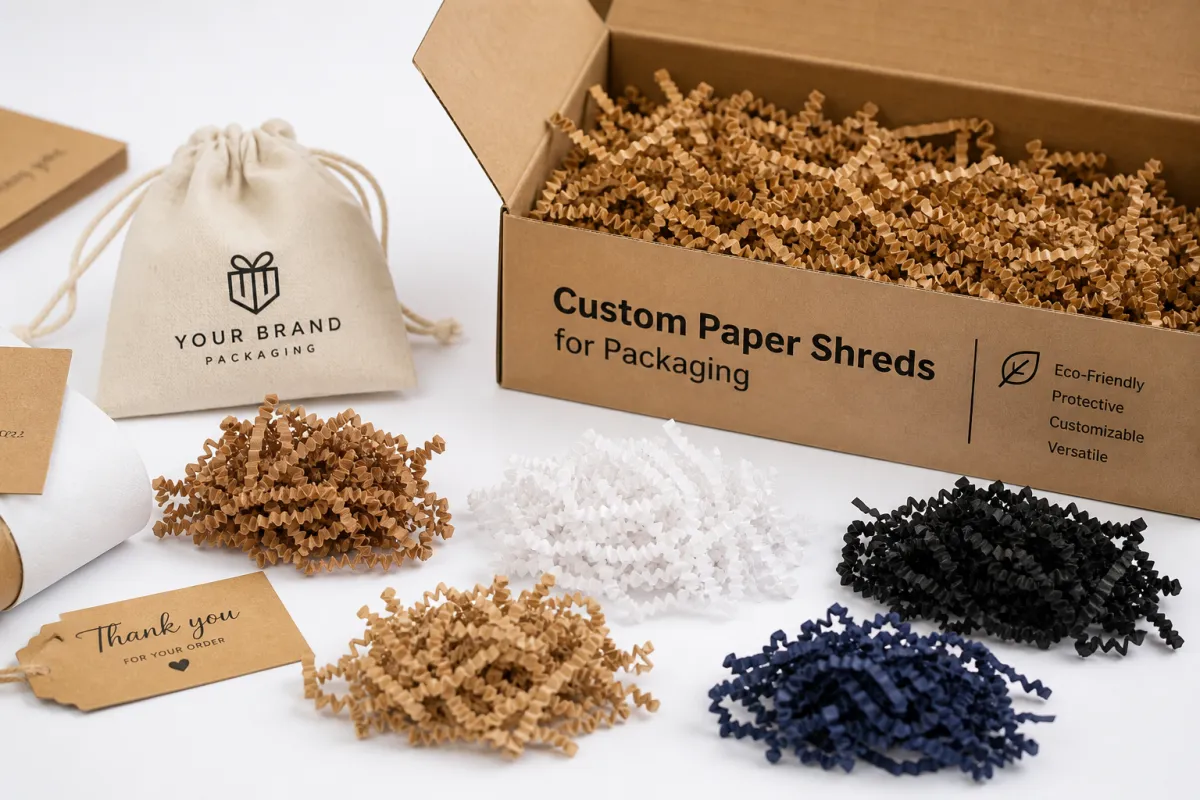
At the simplest level, custom paper shreds for packaging are shredded paper used as void fill, cushioning, and presentation inside boxes and mailers. The job is not just to hide empty space. The job is to keep products from sliding, protect them from rubbing against hard box walls, and make the unboxing look intentional instead of rushed.
The filler customers touch first often shapes how premium the whole order feels. That is why custom paper shreds for packaging show up so often in gift sets, retail packaging, cosmetics, fragile items, and branded subscription kits. They are especially common where packaging design matters almost as much as the product itself. A customer may forgive a plain shipper for a replacement part. They are a lot less forgiving when a premium candle or skincare set arrives rattling around in a box like spare hardware.
Generic filler and custom options are not the same thing. Generic shred is usually chosen for cost and volume. custom paper shreds for packaging add control over color, texture, cut consistency, and density. That changes the look of the pack-out and the way the material behaves under weight. A tight, consistent shred pattern gives a cleaner nest. A loose or uneven fill can make the box look cheap even if the product inside is high-end.
There is also a structural reality here. custom paper shreds for packaging are great for stabilizing light to medium-weight goods, but they are not magic armor. They Work Best as part of a package system that may also include inserts, trays, dividers, tissue, or custom printed boxes. A good pack-out does not rely on one material to solve every problem. It uses the right material in the right place and stops pretending otherwise.
Practical rule: if the filler looks good but the product still shifts after a basic drop test, the pack-out is not finished. Pretty is not the same thing as protected.
If you are comparing filler to other branded packaging pieces, think in terms of package branding, not just protection. A box, insert, label, and filler all tell the same story or they fight each other. Custom Packaging Products should work together, not like four departments that never spoke to each other.
On a packaging line, that mismatch shows up faster than people expect. I have seen a premium rigid box lose half its effect because the filler was the wrong color or had too much spring. The product still shipped safely. It just did not feel finished.
How Custom Paper Shreds for Packaging Move Through Packing Lines
The packing process is straightforward, which is exactly why it gets messed up so often. With custom paper shreds for packaging, the usual workflow is bottom fill, product placement, side stabilization, then top fill to lock the item in place. If the box has voids, the contents move. If the contents move, the customer notices. If the customer notices movement before they notice the brand card or product insert, the experience has already started on the wrong foot.
Shred shape changes performance more than people expect. Longer strands tend to cushion better because they interlock and spring back a bit after compression. Shorter cuts stack more evenly and can improve presentation in shallow boxes. Flatter cuts often make pack-outs look tidier, but they do not always hold a heavy object as well. That is why custom paper shreds for packaging need to match the item, not just the color palette.
Machine packing and hand packing are different animals. In hand pack-out, workers can fluff and place custom paper shreds for packaging quickly if the fill recipe is standardized. In a machine-assisted line, consistency matters more because the product, box size, and speed have to stay aligned. A line doing 100 to 300 orders a day can usually tolerate a bit of manual judgment. Once volume rises, labor time and consistency become real costs, not a theory in a meeting.
For fragile or irregular items, the best fill pattern is usually not "more." It is "better placed." I would rather see a box with a measured bottom cushion, a centered product, and a tidy top cap than a carton stuffed full of random paper just to make it feel heavy. custom paper shreds for packaging should create restraint, not chaos.
That point matters for ecommerce operations that ship mixed SKUs. A subscription kit with five small components may need a different fill recipe than a single bottle in a mailer. Good pack-out teams often standardize by SKU group:
- Light cosmetic kits: a thinner base layer and modest top cap.
- Glass or ceramic products: deeper cradle, side walls, and tighter top fill.
- Gift sets: fuller presentation with enough compression to keep the display neat.
- Seasonal boxes: more visual emphasis, but still enough hold to survive transit.
If you want the pack-out to hold up in real shipping conditions, test against actual distribution stress, not a gentle desk drop. ISTA procedures and ASTM distribution tests exist for a reason. For transport test references, the ISTA site is a useful starting point. That does not mean every brand needs a full lab setup, but it does mean nobody should guess their way through packaging design and hope freight carriers are feeling kind. I have seen too many "it looked fine on the bench" decisions turn into dented corners and returns.
Choosing the Right Paper, Color, and Cut for Your Brand
Paper choice is where custom paper shreds for packaging stop being generic filler and start acting like part of the brand. Softer paper stock compresses more easily, which helps in tighter cartons or smaller mailers. Stiffer stock holds volume better, which can create a fuller, more premium-looking nest. Recycled content can add a textured, natural feel that works well for handmade goods, artisan food packaging, and earth-toned branded packaging.
Paper weight matters too. Many suppliers build shred from roughly 50 to 80 gsm paper, though the exact range depends on the product and the machine setup. Lighter stock tends to fold and settle more. Heavier stock feels crisp and can look cleaner in display boxes. The wrong weight can make custom paper shreds for packaging either too airy or too dense, which is why sample testing beats staring at a swatch sheet and making optimistic guesses.
Color is not a vanity detail. It is part of package branding. A charcoal shred in a black or silver box can feel sharp and controlled. Kraft or natural brown can read as rustic, eco-minded, or handmade. Bright colors work for seasonal retail packaging, but they can fight with the product if the rest of the box is understated. The point is not to match everything perfectly. The point is to avoid visual noise and keep the eye on the product.
For brands using custom printed boxes, the filler should support the print system, not compete with it. A loud lid graphic paired with an equally loud filler can feel messy. A restrained filler inside strong packaging design can make the whole set look more expensive. That is one reason custom paper shreds for packaging are so popular with premium ecommerce brands. They are flexible enough to play backup singer instead of trying to steal the show.
Cut size and density deserve more attention than they get. Longer strands can create better cushioning around glass or ceramics. Shorter, tighter cuts can improve presentation in shallow trays and gift boxes. Denser fill means more material per carton, which raises cost and storage needs. Looser fill means less material, but it may not lock the product in place. The tradeoff is usually between visual volume and functional restraint, and that tradeoff should be intentional.
Here is a practical way to choose:
| Shred Option | Best Use | Typical Price Range | What It Does Well |
|---|---|---|---|
| Standard recycled shred | Everyday ecommerce and gift boxes | $14-$28 per 10-lb case | Low cost, decent volume, easy to stock |
| Color-matched custom shred | Branded packaging and retail packaging | $22-$42 per 10-lb case | Better visual alignment with the box and product |
| Specialty cut or blend | Luxury sets, fragile goods, launch kits | $35-$65 per 10-lb case | More controlled look, sometimes better hold |
Those ranges are planning numbers, not a promise. Still, they are useful because they show the real pattern: custom paper shreds for packaging cost more when the paper is more specific, the cut is more controlled, or the color match is tighter. If the product is expensive, the filler should look and behave like it belongs in that environment. If the product is not expensive, the filler should not fake a luxury story it cannot support.
For sustainability-minded sourcing, FSC certification can matter. It does not make every decision easy, but it gives buyers a clearer paper chain to evaluate. The FSC site is a good reference point if your packaging program includes recycled content, certified fiber, or claims that need to hold up under scrutiny.
One detail people skip: finish. A matte natural shred and a bright white high-whiteness shred can read very differently under warehouse lighting versus studio lighting. If your team approves a sample by looking at it in a bright office, then ships it in a dim fulfillment center, you may get a surprise. Not a fun one.
Custom Paper Shreds for Packaging Cost: What Actually Drives Price
Price is where people often get lazy and then act shocked later. custom paper shreds for packaging are influenced by paper grade, color matching, order size, packaging format, and whether the run needs a special blend or cut. If you ask for a specific brand color on a specialty paper stock, of course it costs more. That is not a surprise. That is manufacturing.
The biggest lever is order size. Small runs almost always cost more per unit because setup, cutting, and handling do not shrink just because the order is tiny. Bulk buying lowers unit cost, but it also increases inventory risk. If the shade is slightly off or the pack-out recipe changes, you can end up sitting on a lot of filler nobody wants to use. A lot of buyers treat fill material like an infinite commodity when it is really a managed inventory item with actual consequences.
Another hidden cost is labor. custom paper shreds for packaging that look beautiful but slow down pack-out can cost more than a cheaper filler that ships faster. If a team spends an extra 10 to 15 seconds per box fluffing or adjusting the shred, that adds up fast over a thousand orders. Labor is not glamorous, but it is usually the line item people feel first when the month closes.
Freight and storage matter too. A case of filler takes up more room than many first-time buyers expect. If your warehouse already stores carton sizes, inserts, labels, and protective materials, adding bulk filler can be a real space problem. That is especially true for seasonal launches, where the business wants six weeks of material on hand and suddenly the back room looks like a paper warehouse with a branding department attached.
Cheaper filler is not always cheaper overall. If the material crushes easily, shifts in transit, or makes the box hard to close, the cost shows up later in damage claims, re-packs, or lower customer perception. I would rather see a buyer spend a bit more on custom paper shreds for packaging that actually protect the product and support the brand than save pennies and lose margin on replacements. I have had that exact conversation with operations teams more than once, and the math usually gets boring in a good way once the full picture is on the table.
Here is the practical tradeoff table most teams need:
| Buying Choice | Upfront Cost | Operational Impact | Best For |
|---|---|---|---|
| Small custom run | Higher per unit | Lower inventory risk, easier to test | New launches, limited editions |
| Bulk custom run | Lower per unit | More storage and cash tied up | Steady SKUs, repeat packing |
| Generic filler | Lowest per unit | Less brand alignment, may need more labor | Commodity shipping, internal use |
| Custom matched shred | Mid to high | Stronger brand presentation | Gift sets, retail packaging, premium ecommerce |
The smartest buyers do not ask, "What is the cheapest shred?" They ask, "What is the total landed cost once freight, labor, storage, and damage risk are included?" That is where custom paper shreds for packaging can justify themselves. A slightly higher material price can still lower total pack-out cost if it reduces rework and protects the product better.
And if a supplier cannot explain the setup cost, minimum order quantity, or sample policy in plain English, that is a warning sign. Packaging is already full of hidden variables. The vendor should not be one of them.
Custom Paper Shreds for Packaging Process and Timeline
The order process should be simple enough that nobody has to decode it with three calls and a spreadsheet. A clean custom paper shreds for packaging process usually starts with specs: box size, product weight, target color, approximate fill volume, and any sustainability requirements. Then the supplier shows paper options or a physical sample. After that comes approval, production, and shipping.
Sampling is not a courtesy step. It is a money-saving step. One bad sample is cheaper than one bad pallet. If the color is off, the cut looks sloppy, or the density is wrong, catch it before production. I have seen brands skip approval because they were in a hurry, then spend more time and budget fixing the result than they would have spent waiting for a proper sample. Fast is not fast if it creates a second job.
Timeline depends on how specific the order is. Stock materials move faster. Custom color matching, special cuts, or unusual blends add time. A basic run might be ready in about 1 to 2 weeks after approval, while more customized custom paper shreds for packaging can take longer if paper sourcing or color matching is involved. If the shipment also needs staged deliveries for multiple warehouse locations, add more buffer. Anyone promising a launch-day miracle without seeing the spec sheet is selling confidence, not manufacturing capacity.
There is also a difference between production time and real-world readiness. A batch may be finished in the plant, but that does not mean it is in your building, counted, and ready for the team. Shipping, receiving, and put-away can add several more days. Seasonal launches get squeezed here all the time. The box design is approved, the inserts are in, and then someone remembers the filler needs to arrive before the warehouse starts pack-out. That is how schedules get annoying.
For rush orders, be practical. A faster turnaround is possible in some cases, but it often narrows your options. You may get less color flexibility, less room for special cuts, or a higher freight bill. If your launch date is fixed, build in buffer time instead of betting the whole schedule on emergency production. custom paper shreds for packaging are not complicated, but they are still a manufactured material with setup and lead time.
Here is the sequence I would use for a low-risk order:
- Confirm box dimensions, product weight, and target look.
- Request paper, color, and cut samples.
- Pack 5 to 10 real units and inspect the hold.
- Ship a test carton through normal transit.
- Approve the final spec only after transit feedback looks good.
That process sounds slow only if you ignore the cost of getting it wrong. In packaging, every correction moves through product damage, labor, and customer perception. custom paper shreds for packaging are cheap enough to test properly, which is exactly why you should.
If you are planning a launch, the ugly truth is that the filler timeline should sit on the same schedule as the box and label timeline. A lot of teams treat it like a minor accessory. Then the pallet shows up late and the launch team starts improvising. That is never cute.
Common Mistakes With Custom Paper Shreds for Packaging
The most common mistake is underfilling. People think the box looks neat until the product moves in transit. Then the filler has done nothing except cost money. custom paper shreds for packaging only work if they actually hold the item in place. A premium look with bad stabilization is just expensive disappointment.
Overfilling is the other extreme. Too much shred wastes material, slows pack-out, and makes the box difficult to close cleanly. It can also crush the presentation so much that the product gets buried instead of displayed. There is a sweet spot, and it changes by carton size and product shape. The fill recipe should be documented, not guessed every morning by whoever happens to be on shift.
Color mismatch is a branding mistake that gets ignored too often. If your brand uses controlled neutrals, a filler that drifts green, gray, or yellow can cheapen the whole presentation. This is especially noticeable in product packaging for beauty, wellness, candles, and jewelry. The buyer may not say, "The shade is off." They just feel that something is not right. That is the problem with package branding details. Bad ones are felt before they are named.
Poor storage planning is another quiet failure. custom paper shreds for packaging can occupy a surprising amount of space at scale. A few cases look harmless. Fifty cases look like an operational problem. If your warehouse is already tight, plan storage before the material lands. Nothing improves team morale like a pallet of filler blocking the pick path.
There is also a test mistake people make: they evaluate filler by sight alone. Visual inspection matters, but shipping performance matters more. A neat pack-out that loses shape after one leg of transit is not a win. That is why a real pilot should include product movement, carton closure, and a basic transit test. If you are shipping fragile goods, align your test with a method like ISTA 3A or a comparable ASTM distribution test. Fancy language aside, the carton has to survive the same bumps your carrier will deliver.
A few mistakes are worth listing plainly:
- Using the same fill amount for every SKU.
- Choosing color from a screen instead of a physical sample.
- Ignoring how fast the team can actually pack with the chosen shred style.
- Buying too much before the recipe is proven.
- Expecting custom paper shreds for packaging to replace structural protection for heavy or fragile goods.
None of these errors are dramatic. That is exactly why they show up so often. They are small process failures that create bigger downstream costs. Fix the process, and custom paper shreds for packaging become a useful packaging tool instead of a decorative headache.
One more mistake deserves a separate callout: treating sample approval as a design-only exercise. A shred can look perfect in a photo and still break down under compression or shed too much dust in handling. That is not something a mood board can catch.
Expert Tips and Next Steps for Better Pack-Outs
The fastest way to improve a pack-out is to test it on real shipments. Pack a few actual orders with custom paper shreds for packaging, ship them through normal transit, and inspect what happens on arrival. Did the product stay centered? Did the fill compress too much? Did the presentation hold up? That feedback is more useful than ten opinions from people standing around an empty sample box.
Standardize by SKU wherever possible. A simple fill recipe by carton size cuts guesswork and reduces waste. For example, a small cosmetic box might use a light base layer plus a top cap, while a gift set might need side support and a fuller display bed. Once the team stops improvising, pack-out speed improves and material usage becomes predictable. That predictability matters more than people think.
Always compare two or three shred styles side by side. Not on a desk. In the actual product, inside the actual box, with the actual closure method. custom paper shreds for packaging can look similar in a sample bag and behave very differently once compressed. One option may look nicer but cost more labor. Another may pack faster but lose shape. Tradeoffs are normal. Pretending they do not exist is how buyers end up reordering in a panic.
Here is the short version of what usually works best:
- Use a matched color when the box is part of the brand experience.
- Use a denser cut when the product needs more hold.
- Use recycled or FSC-sourced stock when sustainability claims matter.
- Use a controlled fill recipe instead of hand-waving at the box.
- Use custom paper shreds for packaging as part of the system, not the whole system.
If you are comparing filler options with other branded packaging pieces, start by looking at the whole presentation. Labels, inserts, tape, tissue, and exterior cartons all affect the same customer experience. That is where Custom Packaging Products can help you compare materials without treating every component like an isolated purchase.
One more practical note: ask for a quote with the exact box dimensions, expected monthly volume, desired color, and target ship date. That short list saves time on both sides. It also makes it easier to judge whether a standard fill, a custom blend, or a tighter brand match is worth the extra spend. For a lot of brands, custom paper shreds for packaging are a smart middle ground between plain void fill and expensive full custom inserts.
My advice is simple. Test the fill. Measure the labor. Check the transit result. Then scale the spec with confidence. That is how custom paper shreds for packaging earn their place in a packaging program instead of becoming another pretty mistake. If the product stays put, the box looks intentional, and the team can pack it without slowing down, you have the right setup. If not, tweak the recipe and keep going. Packaging is supposed to work, not merely look busy.
Are custom paper shreds for packaging recyclable?
Usually yes, if the stock is plain paper and does not include heavy coating, lamination, or mixed materials. Ask for the exact paper spec before assuming curbside recyclability. If sustainability matters, match the shred with the rest of the box system so disposal stays straightforward. That also keeps the customer from guessing what goes in the bin.
How many custom paper shreds for packaging do I need per box?
It depends on box size, product weight, and how much void space you need to lock down. A small cosmetic box may only need a light bottom layer, while a larger mailer may need side and top support. Test one packed sample, measure the fill depth, then standardize that recipe for the SKU. Guessing by feel is how teams end up with both waste and movement.
What affects the price of custom paper shreds for packaging?
Paper grade, color matching, order volume, and cut style are the biggest drivers. Freight, storage, and pack-out labor can matter just as much as the material price itself. Small orders usually cost more per unit, so the cheapest-looking option can get expensive fast. The invoice is only part of the bill.
Can custom paper shreds for packaging be matched to my brand color?
Yes, but exact matching depends on the supplier's paper options and production method. Pantone-style precision is possible in some cases, but recycled or specialty stocks may shift the shade slightly. Always approve a physical sample before placing a larger order. A screen is not a color standard. It is a suggestion.
How long do custom paper shreds for packaging take to produce?
Stock materials are usually faster than fully custom color or cut requests. Sampling, approval, production, and shipping all affect the final timeline. If you need a launch date, build in buffer time instead of assuming the rush option will save you. Production schedules have a way of ignoring wishful thinking.
custom paper shreds for packaging work best when they are chosen like a real packaging component, not an afterthought. Get the paper right, match the color to the brand, test the cut against the product, and confirm the pack-out speed before you scale. Start with one SKU, one sample, and one real transit test. That is the cleanest way to find out whether the shred is doing its job or just taking up space. It also keeps the shipment looking like somebody cared.

