Buyer Fit Snapshot
| Best fit | Custom Paperboard Display Boxes Supplier projects where brand print, material claims, artwork control, MOQ, and repeat-order consistency need to be specified before quoting. |
|---|---|
| Quote inputs | Share finished size, material target, print colors, finish, packing count, annual reorder estimate, ship-to region, and any compliance wording. |
| Proofing check | Approve dieline scale, logo placement, barcode or warning zones, color tolerance, closure strength, and carton packing before bulk production. |
| Main risk | Vague material claims, crowded artwork, missing packing details, or unclear freight terms can make a low unit price expensive after revisions. |
Fast answer: Custom Paperboard Display Boxes Supplier: Board, Finish, Dieline, and Unit Cost should be specified like a repeatable production item. The safest quote records material, print method, finish, artwork proof, packing count, and reorder notes in one written spec.
Production checks before approval
Compare the actual filled-product size with the drawing, then confirm tolerance on folds, seals, hang holes, label areas, and retail display edges. Reserve space for logos, QR codes, warning copy, and material claims before decorative graphics fill the panel.
Quote comparison points
Review material grade, print process, finish, sampling route, tooling charges, carton quantity, and freight assumptions side by side. A quote is only useful when the supplier can repeat the same color, closure quality, and packing count on the next order.
Custom Paperboard Display Boxes Supplier Buying Guide
If a launch has to look premium, ship cleanly, and survive the retail floor, the choice of custom paperboard display boxes supplier can decide whether the project feels controlled or turns into cleanup duty. From a packaging buyer's point of view, that supplier is not just printing graphics. They are translating product weight, store conditions, and brand standards into a display that has to hold up under pressure. Retail packaging tends to fail quietly first, then loudly later. That pattern never gets old.
Paperboard displays sit in a useful but unforgiving spot. They support branded packaging goals, cut freight weight, and often fit recycling streams more cleanly than mixed-material alternatives. They also expose sloppy planning fast. If the board is too light, the face bows. If the structure is overbuilt, costs rise and the display gets annoying to ship. A good custom paperboard display boxes supplier keeps those trade-offs under control instead of handing you a pile of expensive guesses.
The smartest way to evaluate a custom paperboard display boxes supplier is to treat the project like a system, not a single box. Structure, print quality, assembly, delivery timing, and sustainability proof all need to line up. Miss one piece and the display may still arrive, but it will not necessarily do its job. The real buying question is simple: can this partner protect the product, the budget, and the launch date at the same time?
What a Custom Paperboard Display Boxes Supplier Actually Does
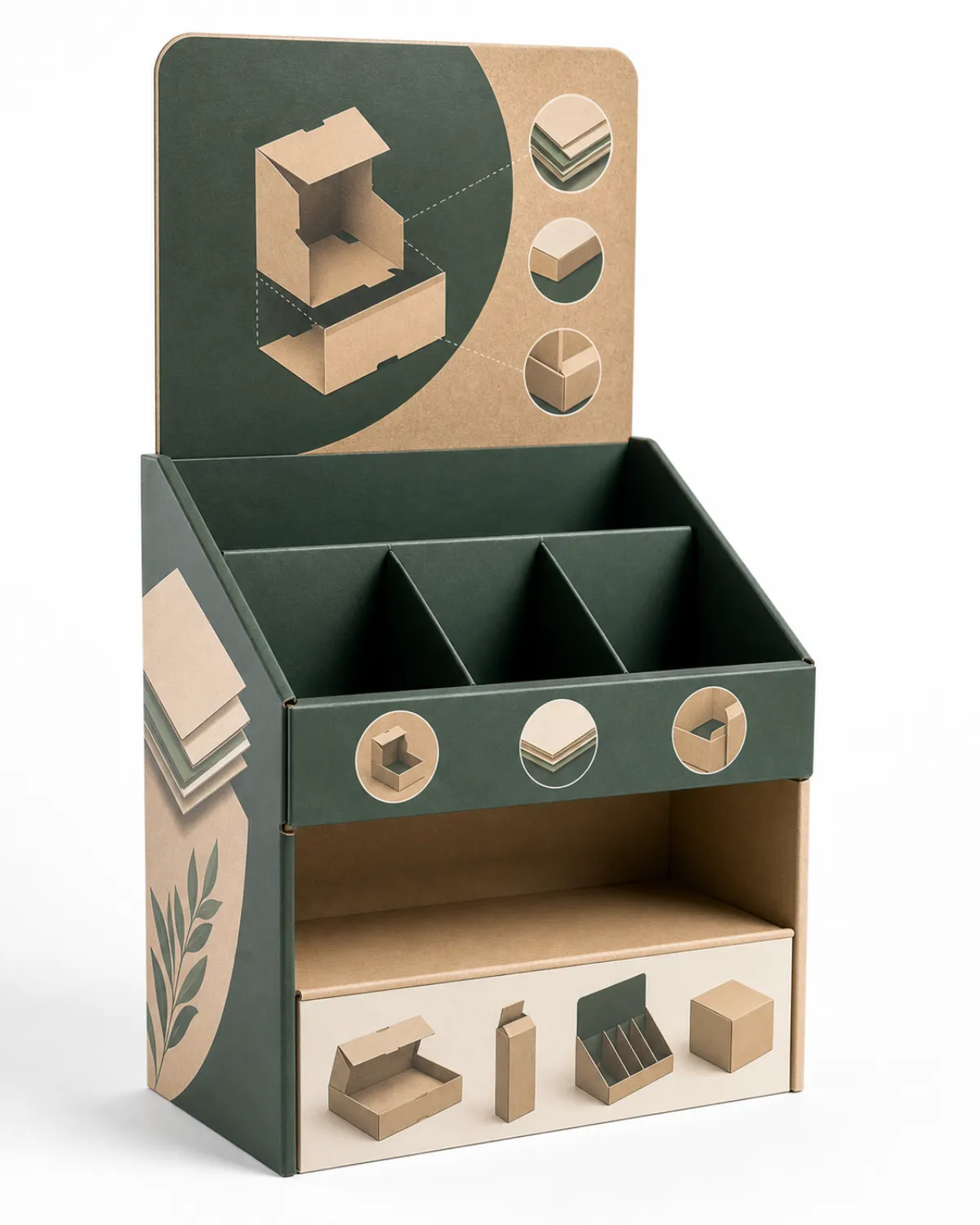
A custom paperboard display boxes supplier does a lot more than produce custom printed boxes. The job starts with understanding the product and ends with a display that holds shape, communicates value, and fits the store environment. For a buyer, that means the supplier should translate a brief into a working piece of retail packaging, not just a polished sample that looks nice under studio lights.
In practice, the supplier is solving several problems at once. How heavy is the product? Will shoppers pick it up over and over? Does the retailer allow pegged hooks, shelf-ready trays, or floor stands? Is the display meant to move product quickly or mostly support package branding at the Point of Sale? A capable custom paperboard display boxes supplier asks those questions before a dieline gets locked.
It helps to separate three roles. A printer focuses on graphics. A converter turns board into shape. A full-service custom paperboard display boxes supplier can do both and usually adds structural engineering, mockups, and shipping support. That difference matters. A vendor that only prints can still deliver beautiful panels that fail the first time a store associate loads them badly. A supplier that understands engineering designs for abuse, not just appearance.
Paperboard displays are often a smarter retail packaging choice than buyers expect. They use less material than many mixed-format structures, can be flat-packed for freight efficiency, and may fit standard recycling pathways more easily. The strongest custom paperboard display boxes supplier will explain those benefits in practical terms, not marketing language. Less material only matters if the structure still carries the load.
I see the same mistake over and over: treating the supplier like a print shop with a different name. A strong custom paperboard display boxes supplier should help with structural thinking, product packaging constraints, and store-level realities. If a display is supposed to sit in a high-traffic aisle, that is not a cosmetic detail. It is a design requirement.
For brands building a launch program or a seasonal retail campaign, the right partner can also reduce complexity elsewhere. If a display is engineered well, store setup gets easier, fill rates improve, and replacement orders behave more predictably. That is why many teams pair display buying with a broader look at Custom Packaging Products instead of chasing one-off solutions for every SKU.
One thing I learned the hard way: a display that looks perfect on a render can still be a pain in the store. The sample room never has a tired associate trying to restock three flavors in under two minutes. Real life does. A supplier that understands that gap is worth more than a glossy presentation deck.
How a Custom Paperboard Display Boxes Supplier Runs the Process
A solid custom paperboard display boxes supplier usually follows a sequence, even if different vendors describe it in slightly different ways. The sequence matters because each step cuts risk. Discovery comes first. Then structural concept, dieline development, artwork setup, sampling, approval, production, finishing, and shipment. When that chain is respected, the project feels controlled. When it gets compressed too hard, surprise costs show up later.
The discovery stage should produce a usable brief. At minimum, the custom paperboard display boxes supplier should know product dimensions, unit weight, carton count, target retailer, display location, and the kind of traffic the unit will face. A countertop display for a 50-gram cosmetic item has a very different structure from a floor display carrying several pounds of bottled product. Better input saves redesign time.
After that comes structure. This is where a good supplier earns its fee. A thoughtful custom paperboard display boxes supplier will recommend board grade, score lines, locking tabs, and load-bearing features that suit the product instead of forcing one standard format onto everything. If the format is a PDQ tray, the fill method matters. If it is a floor display, the base footprint matters even more. If it ships to multiple stores, knockdown construction may save freight and labor.
Sampling is the moment the project gets honest. A flat proof can hide problems that a physical sample exposes immediately: weak corners, awkward refill access, poor product visibility, or a front panel that blocks the price card. A careful custom paperboard display boxes supplier should provide a prototype or structural sample early enough to fix those issues without pushing production off the rails. If the sample stage feels rushed, you're gonna pay for it later.
Timelines usually expand in a few predictable places. Late artwork changes are a classic. Complex folds and specialty finishes add time too. Seasonal capacity can stretch lead times in a way many teams underestimate, especially if multiple stores need staggered delivery. A dependable custom paperboard display boxes supplier should spell out the bottlenecks instead of tossing out one blanket turnaround number and hoping nobody asks questions.
Lead time is a sequence, not a single number. Sampling may take a few business days, proof approval may take another round, production may require 10-15 business days, and shipping adds its own window depending on distance and delivery method. A supplier who gives you one date without explaining the steps may still be competent, but they are not helping you manage risk.
Process visibility matters too. A good custom paperboard display boxes supplier should define milestones: brief confirmed, dieline approved, sample signed off, production started, and finished goods shipped. Those checkpoints reduce rework and make it easier to spot problems before they turn into rush freight charges or missed shelf dates. Retail launches are expensive enough without paying for preventable confusion.
Key Factors That Shape Pricing, Durability, and Sustainability
Price is rarely just price. A custom paperboard display boxes supplier may quote a unit cost that looks attractive, but the real decision depends on board grade, die-cut complexity, coating choice, print coverage, assembly labor, and freight. Two quotes can differ by a few cents per unit and still end up hundreds of dollars apart once setup fees and shipping are added.
Material selection drives a big chunk of that gap. A lightweight SBS or C1S board works well for smaller retail display packaging, while heavier loads may need a more engineered paperboard specification or reinforcement at stress points. The custom paperboard display boxes supplier should explain why a 300gsm board is enough for one promotion and why 18pt or a reinforced structure is safer for another. That is the level of specificity buyers should ask for.
Comparisons get easier if you look at total landed cost instead of unit price alone. A cheaper quote may hide tooling, proofing, or freight that appears after approval. A pricier quote may include structure optimization, cleaner graphics alignment, and lower assembly labor. The right custom paperboard display boxes supplier will separate those numbers clearly. If they do not, the spreadsheet will lie to you.
| Display Type | Typical Unit Range | Common Lead Time | Best Use | Main Trade-Off |
|---|---|---|---|---|
| Counter display | $0.18-$0.42 at 5,000 units | 10-14 business days after approval | Lightweight items near checkout | Less capacity and less shelf presence |
| Retail-ready tray | $0.24-$0.58 at 5,000 units | 12-15 business days after approval | Fast replenishment and club-style merchandising | Limited structure for heavier products |
| Floor-standing display | $1.10-$2.75 depending on print and assembly | 15-20 business days after approval | Seasonal launches and high-visibility promos | More freight volume and more assembly complexity |
| Custom engineered display system | $2.00-$4.50+ for complex builds | 18-25 business days after approval | Heavy or high-value product families | Highest setup cost and longest approval cycle |
Durability depends on more than board thickness. A display that gets moved once from warehouse to store has different needs than a unit touched by staff every day for a month. Humidity matters too. So does the number of products resting on the base panel. A skilled custom paperboard display boxes supplier should talk about those conditions honestly, because a structure that performs well in a dry sample room may behave differently on a humid sales floor.
One practical test I like to ask about is handling. If the display will be lifted, restocked, or shifted by store teams, ask the custom paperboard display boxes supplier how it performs after repeated touches. Ask whether edge crush resistance matters. Ask whether the design has been checked against common handling patterns. In many cases, a small reinforcement near the bottom panel prevents a much larger failure later.
Sustainability needs a careful read. Recycled content is useful, but not every recycled-content display is automatically easy to recycle after use. FSC certification can support responsible fiber sourcing, while water-based inks and efficient nesting reduce environmental load in quieter ways. A credible custom paperboard display boxes supplier should be able to explain those distinctions without hiding behind green language. For reference, ISTA testing guidance helps buyers understand transit stress, and FSC certification information helps with fiber sourcing decisions.
The EPA also publishes useful material recovery guidance through its sustainability resources, which can help buyers think more clearly about end-of-life pathways. That does not mean every display is curbside-recyclable everywhere. It means the custom paperboard display boxes supplier should be able to show how the structure, inks, and adhesives fit a practical recovery story instead of relying on vague eco claims.
Value is not the same as the cheapest line item. The strongest custom paperboard display boxes supplier is the one that helps you spend where it matters: board strength, print quality, and structural design that prevents waste. If a display survives the launch, restocking, and store handling without drama, the true cost is often lower than the bargain version that needed replacement halfway through the campaign.
Step-by-Step Guide to Vetting a Supplier Before You Order
Before you send a request for quote, build an internal brief that is more specific than a product name and a quantity. A serious custom paperboard display boxes supplier will need unit dimensions, pack-out method, target shelf or floor placement, product weight, required quantity, and delivery deadline. If your team already knows the retailer's merchandising rules, include those too. Better input leads to a cleaner quote.
Ask for a structural sample or at least a dieline early. This is where many teams save themselves from avoidable trouble. A good custom paperboard display boxes supplier should be able to show how the product sits, how the display folds, and where the weak points are likely to appear. If the sample does not let you test fill, visibility, and stability, it is not enough to approve full production.
Ask for an apples-to-apples quote. That means you want material, printing, coating, tooling, assembly, sampling, freight, and rush charges separated. If the custom paperboard display boxes supplier gives you only one blended number, it becomes hard to tell whether the price is competitive or just incomplete. A transparent quote also makes it easier to compare suppliers who use different production models.
Production capability deserves a hard look. Ask how the supplier handles color consistency across a run, what they do when board variation appears, and whether they inspect die-cut accuracy before packing. A reliable custom paperboard display boxes supplier should be able to describe its quality checkpoints in plain language. If the answer stays vague, the risk usually grows with order size.
It is worth asking about test methods too. For transit-related concerns, suppliers may reference ISTA procedures; for rough handling or drop resistance, they may use internally developed checks or ASTM-based methods such as drop or compression testing. A thoughtful custom paperboard display boxes supplier does not need to drown you in jargon. They just need to show that the design has been checked against realistic use.
Lock down the timeline in writing. That should include the sampling window, artwork approval deadline, production start date, and delivery date. A professional custom paperboard display boxes supplier will treat the schedule as a chain of commitments, not a guess. If one step slips, you should know immediately whether the launch date is still safe or whether the team needs to adjust.
If your team buys display packaging regularly, keep the process repeatable. Save the final dieline, artwork files, material spec, and approved sample photos. Then use the next round to improve the brief. A good custom paperboard display boxes supplier will welcome that discipline because it shortens future quoting cycles and cuts down on rework. The best supplier relationships are built on shared data, not hope.
Quick supplier check: if the vendor cannot explain how the display performs under normal store handling, how the board is specified, and how the quote breaks down, keep looking. A custom paperboard display boxes supplier should make the decision easier, not foggier.
Common Mistakes Buyers Make When Choosing a Supplier
The first mistake is chasing the lowest quote without checking the fine print. A custom paperboard display boxes supplier may offer a sharp unit price, then add proofing, tooling, freight, or change-order charges later. That can turn a bargain into a headache. A lower number only matters if it reflects the full scope of the job.
The second mistake is approving artwork before testing the structure. Graphics can look great and still land badly if the display tips, bows, or hides the product. A better custom paperboard display boxes supplier will insist on the structural side first because packaging design has to work physically before it works visually. Good package branding depends on both.
Store conditions are easy to underestimate. Humidity, rough handling, imperfect shelves, and repeated restocking all affect performance. A display that behaves well in a clean sample room may fail in a discount chain or a high-traffic supermarket aisle. A serious custom paperboard display boxes supplier should ask about those conditions instead of pretending every store looks the same. Retail packaging lives or dies in the store, not in the render.
Communication failures create another layer of risk. If the supplier does not clearly own the artwork files, the dieline version, and the approval trail, a simple reorder can turn into a scavenger hunt. The right custom paperboard display boxes supplier should leave a paper trail that lets your team reorder with confidence. That matters more when campaigns run in waves, because one missed detail can delay an entire refresh.
There is a subtle trap around sustainability claims too. Recycled fiber, recyclable board, FSC sourcing, and compostable language are not interchangeable. A display can contain recycled content and still have adhesives or coatings that complicate recovery. A trustworthy custom paperboard display boxes supplier should provide actual specs, not just green adjectives. If the claims sound broad and unverified, ask for documentation.
Another mistake is underestimating assembly labor. Some displays are cheap to produce but expensive to finish by hand. Others ship flat and assemble quickly, which can reduce total cost across multiple stores. A knowledgeable custom paperboard display boxes supplier will help you compare those options instead of hiding assembly inside a vague quote. That level of detail often changes the final decision.
Reorder speed gets ignored too often. Many launches succeed because the first run arrives on time, but the real value shows up when inventory needs refreshing. A custom paperboard display boxes supplier that can hold your art, specs, and history makes the second order much easier. That kind of continuity supports both branded packaging consistency and better cost control over time.
I have watched a buyer save five cents a unit and spend three weeks undoing the damage later. Cheap is not a strategy. It is just a number on a spreadsheet until the stores start calling.
Expert Tips for Better Retail Performance and Lower Waste
Start with shopper behavior, not decoration. A custom paperboard display boxes supplier can produce elaborate structures, but the display should first make the product easy to see, easy to reach, and easy to restock. If the graphic panel is fighting the merchandised item for attention, the design may be too busy. Clear hierarchy usually sells better than visual clutter.
Modular thinking pays off. If the same structure can scale across multiple footprints, the brand avoids reinventing the wheel for every retailer. A smart custom paperboard display boxes supplier can build a family of related display formats that share board dimensions, print templates, or assembly logic. That reduces future packaging design work and makes the product packaging program easier to manage across regions or chains.
Flat-pack and knockdown formats deserve more attention than they usually get. They often lower shipping volume, reduce warehouse congestion, and make store setup easier. For many brands, that means a custom paperboard display boxes supplier can help cut freight cost and handling waste at the same time. The environmental benefit is real, and so is the operational one. Fewer cartons in transit usually means fewer problems on the receiving dock.
Keep the sustainability message simple and believable. A modest recycled-content claim, a clear FSC note, or a concise statement about right-sized packaging usually lands better than oversized green storytelling. A seasoned custom paperboard display boxes supplier will know that shoppers trust specific facts more than vague promises. The retail floor is not the place for overstatement.
There is a direct link between weight and waste that buyers sometimes miss. Lighter, right-sized displays can reduce transportation fuel use, lower damage risk, and simplify disposal. That does not make every lightweight design better, because flimsy structures create their own waste. A thoughtful custom paperboard display boxes supplier can usually find the middle ground: enough board to perform, not so much that the display becomes overbuilt.
From an operations point of view, consistency is an environmental strategy too. Displays that are easy to assemble correctly the first time create less scrap, fewer replacements, and fewer emergency shipments. That is one reason the best custom paperboard display boxes supplier relationships feel boring in a good way. No surprises. No rework. No last-minute panic before a product launch.
Practical tip: ask your custom paperboard display boxes supplier to design for the worst reasonable store condition, not the best sample-room condition. That one shift in mindset often improves durability without pushing the budget out of range.
Buyers who want to extend a retail display program should also ask about component reuse. Sometimes the base structure can stay fixed while the header card or side panel changes for each promotion. That kind of thinking allows a custom paperboard display boxes supplier to support package branding updates without forcing a full rebuild every time. It is a small adjustment with an outsized impact on cost and waste.
In practice, the strongest programs often look less glamorous on paper and more reliable in stores. A display that holds shape, ships flat, and uses standard materials can outperform a flashier piece that creates assembly confusion. A disciplined custom paperboard display boxes supplier will usually push you toward the Design That Sells product and cuts waste, not the one that merely photographs well.
Actionable Next Steps for Choosing the Right Supplier
The best way to choose a custom paperboard display boxes supplier is to stop comparing promises and start comparing evidence. Shortlist two or three vendors. Send each one the same brief. Ask for the same sample, the same quote structure, and the same delivery expectations. That way you are comparing capability, not sales style.
Build a simple scorecard. Rate each custom paperboard display boxes supplier on structure quality, communication, sample speed, total cost, sustainability documentation, and ability to meet the launch window without shortcuts. A weighted score helps teams avoid being swayed by a polished email or a low first number. The supplier that scores well across the board is usually the safer partner.
Review the sample with the people who will actually touch the display. That includes packaging, marketing, operations, and, if possible, whoever handles store replenishment. A strong custom paperboard display boxes supplier will welcome practical feedback because it improves the final product. If the sample is hard to fill, hard to fold, or hard to read, that feedback is worth more than a prettier mockup.
Ask one final round of questions before you commit. What happens if replenishment is needed fast? How long does reorder lead time take? Who owns the artwork files? Can they adjust the display for a second retail program without retooling everything? A dependable custom paperboard display boxes supplier should answer those questions directly. If they cannot, the risk will show up later.
This is also the point to think beyond a single order. A supplier that can support custom printed boxes, retail packaging, and display programs consistently becomes more valuable over time because the learning curve gets shorter with every run. That continuity is one reason many brands prefer a partner who can handle both display structures and broader Custom Packaging Products needs within the same system.
If you want a practical rule for the final decision, use this: choose the custom paperboard display boxes supplier that protects the product, protects the schedule, and protects the budget in that order. The right partner makes the process calmer, not louder. That is the real test of a custom paperboard display boxes supplier: not who talks nicest, but who makes the launch safer, cheaper to move, and easier to restock.
What should I ask a custom paperboard display boxes supplier before getting a quote?
Ask what information they need on size, product weight, quantity, retail environment, and delivery deadline so the quote reflects real production conditions. A good custom paperboard display boxes supplier should also tell you whether they need a sample product for fit checks. Request a line-item estimate that separates structure, printing, finishing, assembly, tooling, and freight. Confirm whether they can provide a sample, dieline, or prototype before full production starts.
How long does a custom paperboard display boxes supplier usually need?
Lead time depends on artwork readiness, sample approval, structural complexity, and order size. A custom paperboard display boxes supplier may need a few days for sampling, then 10-20 business days for production depending on the build. Ask for separate timeframes for sampling, production, and shipping so there are no surprises. Fast turnarounds are possible, but they usually require simple structures and quick approvals.
What affects the price the most when working with a custom paperboard display boxes supplier?
Board grade, print coverage, coatings, custom inserts, and die-cut complexity usually have the biggest impact. A custom paperboard display boxes supplier will also factor in quantity because setup costs are spread across fewer units in smaller runs. Order quantity matters, and freight and assembly can change the total cost as much as the printed box itself. Ask for a clear split so you can see what drives the number.
How do I know a custom paperboard display boxes supplier is truly sustainable?
Ask for documentation on recycled content, forestry certification, inks, and adhesives. A custom paperboard display boxes supplier that is serious about sustainability should also explain how the structure supports efficient shipping and standard recycling paths. Check whether the design uses right-sized packaging and avoids unnecessary mixed materials. Be cautious of vague eco claims that are not backed by material specs or third-party evidence.
Can a custom paperboard display boxes supplier help with retail-ready design?
Yes, if they offer structural engineering, mockups, and testing before production. Share product dimensions, shelf constraints, and retailer requirements so the custom paperboard display boxes supplier can design for real store conditions. The best suppliers help balance visual impact, ease of stocking, and durability. They should also be able to suggest changes that improve fill speed or reduce damage risk.
Takeaway: shortlist two or three custom paperboard display boxes supplier options, give them the same brief, and compare their structural sample, line-item quote, and proof of performance side by side. Choose the one that can show how the display holds up in real store handling, not just how it looks in a mockup. That is the cleanest way to avoid a pretty failure.

