Buyer Fit Snapshot
| Best fit | Custom Partition Inserts for Boxes projects where brand print, material claims, artwork control, MOQ, and repeat-order consistency need to be specified before quoting. |
|---|---|
| Quote inputs | Share finished size, material target, print colors, finish, packing count, annual reorder estimate, ship-to region, and any compliance wording. |
| Proofing check | Approve dieline scale, logo placement, barcode or warning zones, color tolerance, closure strength, and carton packing before bulk production. |
| Main risk | Vague material claims, crowded artwork, missing packing details, or unclear freight terms can make a low unit price expensive after revisions. |
Fast answer: Custom Partition Inserts for Boxes: Fit, Cost, Value should be specified like a repeatable production item. The safest quote records material, print method, finish, artwork proof, packing count, and reorder notes in one written spec.
Production checks before approval
Compare the actual filled-product size with the drawing, then confirm tolerance on folds, seals, hang holes, label areas, and retail display edges. Reserve space for logos, QR codes, warning copy, and material claims before decorative graphics fill the panel.
Quote comparison points
Review material grade, print process, finish, sampling route, tooling charges, carton quantity, and freight assumptions side by side. A quote is only useful when the supplier can repeat the same color, closure quality, and packing count on the next order.
Custom Partition Inserts for Boxes: Fit, Cost, Value
custom partition inserts for boxes solve a problem that looks small right up until a shipment starts shaking itself apart. A carton can pass a nice tidy spec sheet and still fail in transit because the contents slam into each other, tilt, or settle into weird positions after a few miles of vibration. That is the whole job of custom partition inserts for boxes: they turn empty space into controlled space. Less breakage. Less mess. Better presentation. Fewer late-night complaints from the packing room.
The first question buyers ask is usually the wrong one. They ask, "Will it protect the product?" Fair enough. The better question is, "Will it protect the product, pack quickly, fit the box correctly, and still make sense once labor, damage, and returns show up on the ledger?" That is the real test. custom partition inserts for boxes may look like a minor component, but they shape the whole shipping system. They influence product packaging, retail packaging, and even package branding the second the customer opens the lid.
This piece stays practical. Fit. Materials. Price drivers. Timeline. The mistakes that waste money. The decisions that make an insert useful instead of decorative. If you need a wider look at packaging formats while you plan, our Custom Packaging Products page covers related structures and box styles.
Custom Partition Inserts for Boxes: what they are and why they matter
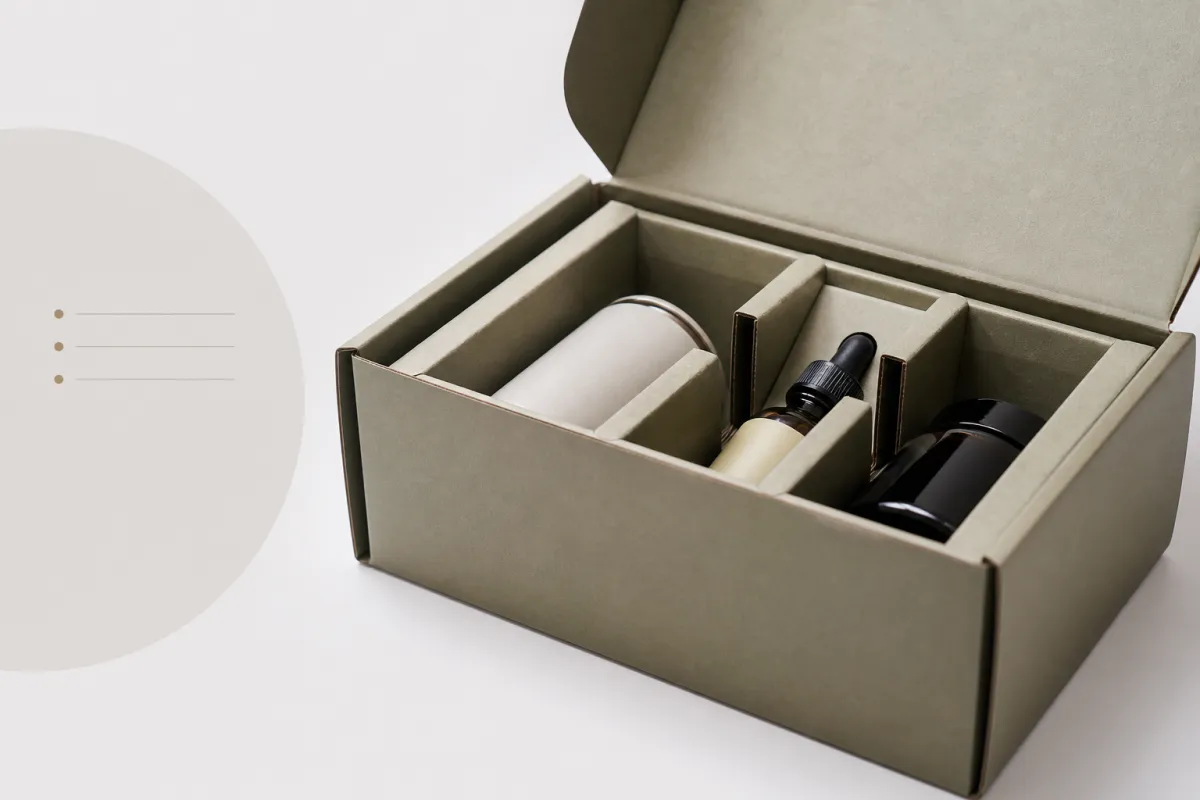
custom partition inserts for boxes are dividers, grids, trays, or fitted liners that split a carton into separate cells. Each cell holds one item or a small group of items. The idea is plain: keep everything upright, stop it from drifting around, and keep products away from each other during transit. In practice, that means less side-to-side movement, fewer impacts, and less dependence on loose paper or oversized void fill that somebody jammed in at the last minute.
There is a real business case behind that simplicity. Fewer breaks cut replacement cost and reduce customer complaints. Cleaner unboxing supports brand perception. Faster packing lowers labor. If an operator can place four jars into a partitioned packout in 20 seconds instead of building a makeshift cushion for 45 seconds, the math gets ugly in a hurry. custom partition inserts for boxes are often the quiet reason a shipping operation feels controlled instead of chaotic.
The same logic shows up across categories. Glassware sellers use them to separate tumblers and stemware. Cosmetic brands use them for bottles, jars, and sample kits. Candle makers want them to keep wax vessels from rubbing. Electronics teams use them for accessories, cables, and small devices. Food brands rely on them for jars, bottles, and tasting sets. Subscription kits use them to lock each item into place so the box opens neatly instead of looking like it lost a fight with a forklift.
Most strong use cases have the same core problem. A product can look stable on a shelf and still become fragile once it starts moving through the distribution chain. That is where custom partition inserts for boxes earn their keep. They do more than "fill space." They control what happens inside the carton.
Think of it this way: the outer box protects against the shipping environment. The insert protects the products from each other. Those jobs are related, not identical. When teams blur them together, they usually overspend on the carton and underbuild the interior. Predictably, that gets expensive.
How custom partition inserts for boxes work inside packaging
The mechanics are simple and unforgiving. custom partition inserts for boxes divide one carton into multiple compartments so each item is held from several sides at once. That reduces movement in the x, y, and z axes. Less motion means less collision energy when a shipment is dropped, tipped, vibrated, or compressed.
Shape matters as much as material. Cross partitions work well when the product set is symmetrical and easy to grid. Full grids add more cells and more separation, which helps when there are many pieces or the breakage risk is higher. Sleeve-style dividers work when the carton needs a simpler wall structure. Insert trays can support premium custom printed boxes or presentation-led kits because they hold contents in a clean, visible layout.
Cell size is not a tiny detail. Too much room and the products rattle. Too little room and packing slows down, or the product gets scuffed during insertion because nobody bothered to account for real tolerances. Wall thickness changes fit as well, especially when moving between paperboard, corrugated board, or molded pulp. Headspace matters too. A divider that supports the product body but leaves the top exposed can still allow bounce under vibration. That is why custom partition inserts for boxes should be designed with the box and product together, not tacked on afterward like an apology.
The outer carton still matters. A strong insert inside a weak outer box is not a complete solution. For parcel shipments, teams often pair the insert with a mailer, tuck-top carton, or RSC outer box depending on handling and product weight. For long-haul freight or palletized distribution, compression resistance matters more. A good packout usually combines the right board strength with an insert that keeps the load centered instead of wandering around like it owns the place.
Picture a six-bottle shipment. The outer carton may be built for stacking strength, but the bottles still need a partition that prevents shoulder contact and bottom sway. If the bottles vary slightly in diameter because suppliers are not magic, the insert needs a narrow tolerance band instead of a fantasy-perfect fit. That is the difference between a nice mockup and a design that survives a busy shipping day.
Testing is part of the job. Many teams use ISTA-style parcel methods or compare against ASTM D4169 profiles. That is not overkill. It is how you find out whether the divider survives real handling, not just a polished render. For sustainability decisions, the EPA recycling guidance helps when you are deciding how the insert should be handled after use. If the goal is recyclable fiber-based packaging, the structure needs to support that goal from the start.
Key factors that shape the right insert design
Product dimensions come first. Length, width, height, weight, wall thickness, and fragile protrusions all affect the layout. If a jar has a narrow neck, the cell may need a relief area. If a bottle has an uneven shoulder, the opening may need to flare slightly at the top. custom partition inserts for boxes work best when they are built around real product variation, not the idealized CAD version someone wishes they sold.
Material choice is the next big lever. Corrugated board is popular because it balances strength and cost. Paperboard and chipboard work well for lighter items or premium presentation. Molded pulp adds cushioning and often fits brands that want a clearer sustainability story. Specialty options exist too, including coated or water-resistant structures for products that may face condensation. The best choice depends on product weight, shipping distance, and how polished you want the finished branded packaging to feel.
Product mix changes the equation. One SKU is easy. Five SKUs with slight shape differences create tolerance stacking, which is packaging shorthand for "small differences start to matter fast." If your line includes a bottle, a dropper, a jar, and an accessory, custom partition inserts for boxes may need to hold several item profiles without turning the pack line into a puzzle nobody asked for.
Shipping conditions deserve more attention than they usually get. Parcel shipments see more drops and vibration than pallet loads. Local delivery can mean fewer miles but more stops and starts. Long-haul freight adds compression, temperature swings, and repeated handling. A divider that works for local courier routes may fail once the shipment enters a cross-country network. Route matters. Testing should match the route, not just the product.
Brand and retail goals matter too. Some inserts stay hidden, so the focus stays on utility and cost. Others are visible the second the customer opens the box, which means the insert becomes part of the presentation. In those cases, custom partition inserts for boxes are not just a protective layer. They are part of the unboxing experience and part of the brand story too. A box can do that much. Sometimes more than the marketing deck.
If you are comparing structures, write down the actual purpose before you commit to one. Is the insert there to stop breakage? Speed packing? Improve display value? Cut down on void fill? The answer often points to a different structure, and sometimes to a different carton. Good packaging design starts with use, not with aesthetics pretending to be strategy.
Custom Partition Inserts for Boxes: cost, pricing, and value
Pricing is where many buyers get tripped up. custom partition inserts for boxes are not priced like a commodity liner because too many variables move at once: material, partition count, cut complexity, print coverage, finishing, quantity, and whether the job needs sampling or tooling. Two inserts that look similar at a glance can land in different price bands once the die structure and board usage are counted.
As a rough planning range, a simple corrugated divider at volume may land around $0.12-$0.30 per unit, while a tighter-fit multi-cell design or a more presentation-focused insert may run $0.25-$0.60 or more depending on order size and material. Those numbers are not universal. Board prices move. Labor moves. Freight moves. Reality, annoyingly, does too. Still, the range helps with planning. custom partition inserts for boxes reward clear specs. Better brief, better quote.
The honest way to think about cost is total cost of ownership. A divider that costs a few cents more can still win if it reduces breakage, limits returns, and speeds packout. If an insert saves 8 seconds per order on a line that ships 2,000 orders a week, the labor savings alone can cover a modest unit-price increase. That math matters more than piece price, though piece price tends to get the loudest voice in the room.
Here is a practical comparison of common structures. The ranges are illustrative, not absolute, but they are useful when you are narrowing the field.
| Insert type | Best for | Typical relative cost | Main advantage | Main trade-off |
|---|---|---|---|---|
| Cross divider | Simple bottle or jar sets | Low | Fast to assemble and easy to store | Limited flexibility for mixed SKU packs |
| Full grid partition | Multiple fragile items in one carton | Low to medium | Strong separation and orderly packout | More parts, more assembly time |
| Fitted tray insert | Premium kits and visible unboxing | Medium | Clean presentation and product control | Higher design sensitivity to tolerance |
| Molded pulp partition | Brands emphasizing recycled content | Medium to high | Cushioning plus sustainability appeal | Tooling and lead time can be heavier |
| Precision chipboard divider | Lighter retail assortments | Medium | Tidy appearance and crisp cell definition | Not ideal for heavy or high-impact loads |
Hidden costs matter too. A poor insert design can force a larger outer carton, which increases freight and storage costs. A late redesign can delay launch and create rework. Multiple insert sizes can clutter inventory if product dimensions shift often. custom partition inserts for boxes should be judged with the full operation in view, not just the invoice line. Cheap on paper is not the same thing as cheap in practice.
If you are comparing product lines, use a simple scorecard. Unit cost. Assembly time. Breakage risk. Storage footprint. Put them side by side. That gives a more realistic picture than price alone, especially for Custom Packaging Products that need to serve both production and brand goals.
Step-by-step process and timeline for custom partition inserts for boxes
The process usually starts with a product audit. Measure each item. Note fragile points. Collect photos. Identify the shipping method. Then move into structure concept, prototype, review, approval, production, and delivery. custom partition inserts for boxes move much faster when the brief is specific. Vague dimensions create vague samples. Vague samples create delays. That pattern never gets old, mostly because it keeps happening.
Accurate inputs save the most time. Product samples beat guesses. Real inner carton dimensions beat outer box measurements. A shipping profile beats a generic "needs to be strong" note. If the insert has to survive parcel vibration, say that. If packout must happen in under 30 seconds, say that too. The more the supplier understands the use case, the less likely you are to burn time on revisions that should have been obvious on day one.
Timing depends on complexity. A straightforward structure may go from concept to prototype in a few business days. Tight-tolerance projects take longer because each adjustment changes the fit. Production then depends on quantity, material availability, and whether the job needs a custom cut pattern. For many buyers, custom partition inserts for boxes are not slow because manufacturing is impossible. They are slow because the approvals were incomplete.
Delays usually come from three places: unclear measurements, late design changes after sampling, and waiting for sign-off from too many departments. Packaging, operations, quality, and brand teams may all want input. That is normal. Someone still needs final approval, or the prototype turns into a moving target with a coffee budget.
Work backward from launch and leave room for at least one revision cycle. If the insert ships with a new product or seasonal release, do not wait until the artwork is final. Structural decisions affect the carton size, the board spec, and sometimes the outer box branding too. In that sense, custom partition inserts for boxes are part of the launch schedule, not a late-stage accessory that can be tossed in after everything else is settled.
For brands launching premium custom printed boxes, the insert approval should happen early enough for the internal layout and the outside graphics to work together. That keeps the packout coherent and avoids ugly compromises at the end.
Common mistakes with custom partition inserts for boxes
The biggest mistake is designing the outer box first and the insert later. That order often leaves too much movement, awkward voids, or a packout that slows production because the insert is fighting the carton instead of fitting it. custom partition inserts for boxes work best when the carton and the interior are developed together.
Another common miss is measuring only the product. The usable inside box space is what matters, and it changes with board thickness, fold lines, glue flaps, and closure allowances. Ignore those details and the insert may look right on a screen while being wrong in the real carton. That mistake leads to scuffed labels, crushed caps, and operators forcing a fit that should have been obvious from the start.
Overcomplication causes its own problems. Too many partitions can slow packing, raise cost, and make the insert harder to store or assemble. A neat grid is not automatically a better grid. Sometimes the best custom partition inserts for boxes use fewer parts and fewer motions so the operator can keep moving without thinking too hard about a box. Packaging should help people, not make them earn a diploma.
Under-testing is expensive too. A divider can look perfect in a prototype and still fail under vibration, compression, or carrier handling. A carton drop from 24 to 30 inches is not the same as setting a box on a desk and giving it a stern look. If the shipment is going through a parcel network, test it that way. That is why many teams compare prototype results against ISTA procedures or similar internal standards before release.
There is also a sustainability trap. A material can look eco-friendly and still make recycling harder because of the wrong coating, adhesive, or contamination risk. custom partition inserts for boxes should be judged by how they behave after use, not by a label alone. If the goal is recyclable fiber-based packaging, the full structure needs to support that outcome.
If the packout slows down on a Monday morning, the design is not finished yet. Protection matters, but repeatability is what turns a decent prototype into a useful packaging system.
Expert tips for better custom partition inserts for boxes
Design for tolerance, not perfection. Products vary a little. Cartons vary a little. Human packing speed varies a lot. The best custom partition inserts for boxes leave just enough room for normal variation without letting the packout go sloppy. That small buffer can be the difference between an insert that works on day one and one that keeps working after 10,000 packs.
Test with real workers, not only with designers. A packout that looks elegant in a drawing may be awkward on the line if it needs too many folds, too many flips, or too much force. Operators notice things CAD misses: whether the divider is easy to orient, whether the cells collapse, and whether the product can be inserted with one hand. That feedback is especially useful for custom partition inserts for boxes used in high-volume shipping.
Sample shipments are worth the effort. Send a few test packs through the same carrier or route you use in production. Then compare breakage, appearance, and customer handling. A divider that arrives intact but creates a messy unboxing may still need revision. For branded packaging, that final impression matters just as much as the protection score.
Simplify when you can. One versatile insert size can beat three highly specific versions if the product line changes often. Fewer SKUs mean less inventory clutter, fewer picking errors, and less storage pressure. That matters for seasonal businesses and subscription programs where the assortment changes constantly. It also makes custom partition inserts for boxes easier to standardize across operations.
Standardize labels, fold direction, and assembly instructions. If the insert needs a specific sequence, mark it clearly. If a certain cell must face a certain direction, make that obvious. Small cues reduce operator variation and keep the packout faster and more repeatable. Packaging teams do not always brag about that stuff, but they absolutely feel the difference.
For businesses balancing presentation and shipping performance, compare the insert against other pieces in the Custom Packaging Products lineup. Sometimes a modest change to the carton style or closure reduces stress on the insert and improves the whole system. Fixing one weak link can clean up three problems at once. Rare, I know.
What to do next with custom partition inserts for boxes
The next step is a short, honest audit. List the products you ship, the damage points you see most often, the current carton dimensions, and the shipping method. Then measure the usable inside space, not just the outside box size. That is the starting point for custom partition inserts for boxes that fit the real job instead of an idealized version of it.
Build a brief that includes product count, weight, fragility, ship distance, monthly volume, and any branding or sustainability requirements. If the insert needs to support retail packaging display, say so. If it must stay recyclable, note that too. If the packout needs to work with package branding or a premium opening experience, describe the visual standard as clearly as the protective one. Vague goals create vague outcomes.
Ask for at least one prototype or sample layout. Then test fit, packing speed, and protection before ordering full production. A side-by-side comparison is usually enough: unit cost, packout time, breakage risk, and storage footprint. That gives you a more useful decision framework than price alone, especially for custom partition inserts for boxes that will affect labor and returns.
If you are not sure where to begin, start with the product that causes the most damage or burns the most packing time. Fixing the worst problem first usually produces the fastest return. That is why many teams treat custom partition inserts for boxes as an operational improvement, not just a packaging purchase. The right insert can cut waste, tighten workflow, and make the unboxing feel deliberate instead of improvised.
When the goal is a cleaner, more controlled shipping system, custom partition inserts for boxes work best when they are measured carefully, tested under real conditions, and matched to the carton, the product, and the route. Get those three pieces aligned, then lock the spec and keep it consistent. That is the move.
How do I measure custom partition inserts for boxes correctly?
Measure the product first, then measure the usable inside dimensions of the box, including board thickness and closure allowance. Record width, depth, height, weight, and any fragile protrusions that need extra clearance. If the product varies, base the design on the largest safe dimension and test with the smallest unit too. That gives custom partition inserts for boxes enough tolerance to pack quickly without turning loose.
What material is best for custom partition inserts for boxes?
Corrugated board is common because it balances strength and affordability. Molded pulp can be a strong choice when cushioning and sustainability matter. Paperboard and chipboard work well for lighter items or premium presentation, but they may not suit heavy or fragile products. The right material depends on weight, shipping distance, unboxing goals, and budget. In plain English, custom partition inserts for boxes should match the job, not the habit.
How much do custom partition inserts for boxes usually cost?
Pricing depends on material, partition count, dimensions, print requirements, and order quantity. Simple standard-sized dividers are usually cheaper than precision-fitted multi-cell inserts. As a planning guide, lower-volume orders often sit higher per unit, while larger runs usually reduce the price. The better question is total cost: breakage reduction and faster packing can offset a more expensive custom partition inserts for boxes spec.
How long does it take to make custom partition inserts for boxes?
Timing depends on how quickly the design is approved and whether a prototype is needed. Simple layouts move faster than complex inserts with tight tolerances or multiple sample rounds. To avoid delays, send accurate measurements, product samples, and a clear launch deadline at the start. That gives suppliers enough information to keep custom partition inserts for boxes moving without unnecessary revisions.
Can custom partition inserts for boxes be reused or recycled?
Reusability depends on the material strength and how often the box is opened, closed, and shipped again. Many paper-based inserts can be recycled if they are clean and free from coatings or contamination. If reuse matters, ask for a structure that stays rigid after multiple packouts and returns. That way, custom partition inserts for boxes support both logistics and disposal goals.

