Buyer Fit Snapshot
| Best fit | Custom Cardboard Inserts for Boxes projects where brand print, material claims, artwork control, MOQ, and repeat-order consistency need to be specified before quoting. |
|---|---|
| Quote inputs | Share finished size, material target, print colors, finish, packing count, annual reorder estimate, ship-to region, and any compliance wording. |
| Proofing check | Approve dieline scale, logo placement, barcode or warning zones, color tolerance, closure strength, and carton packing before bulk production. |
| Main risk | Vague material claims, crowded artwork, missing packing details, or unclear freight terms can make a low unit price expensive after revisions. |
Fast answer: Custom Cardboard Inserts for Boxes: Board, Finish, Dieline, and Unit Cost should be specified like a repeatable production item. The safest quote records material, print method, finish, artwork proof, packing count, and reorder notes in one written spec.
Production checks before approval
Compare the actual filled-product size with the drawing, then confirm tolerance on folds, seals, hang holes, label areas, and retail display edges. Reserve space for logos, QR codes, warning copy, and material claims before decorative graphics fill the panel.
Quote comparison points
Review material grade, print process, finish, sampling route, tooling charges, carton quantity, and freight assumptions side by side. A quote is only useful when the supplier can repeat the same color, closure quality, and packing count on the next order.
Custom Cardboard Inserts for boxes do more than keep a product from rattling around like spare change in a glove box. They control movement, protect surfaces, organize components, and shape the first moment a customer opens the package. If the outer carton is the shell, the insert is the part doing the actual work inside.
That matters because a strong box alone does not stop damage. A product can survive the carton and still get scuffed, tipped, crushed, or knocked out of position on the way to the customer. I have seen that happen plenty of times in sample testing: the box looks fine, the insert looks fine, and then the product shows up with a dented corner or a label rubbed raw. Not a great look.
For product packaging teams, the real question is not whether an insert is needed. It is how to build Custom Cardboard Inserts for boxes that protect the product, keep the pack-out efficient, and still look sharp in retail packaging or custom printed boxes. Start with the job the insert has to do, then work through structure, materials, cost, testing, and the mistakes that waste time.
What Custom Cardboard Inserts for Boxes Really Solve
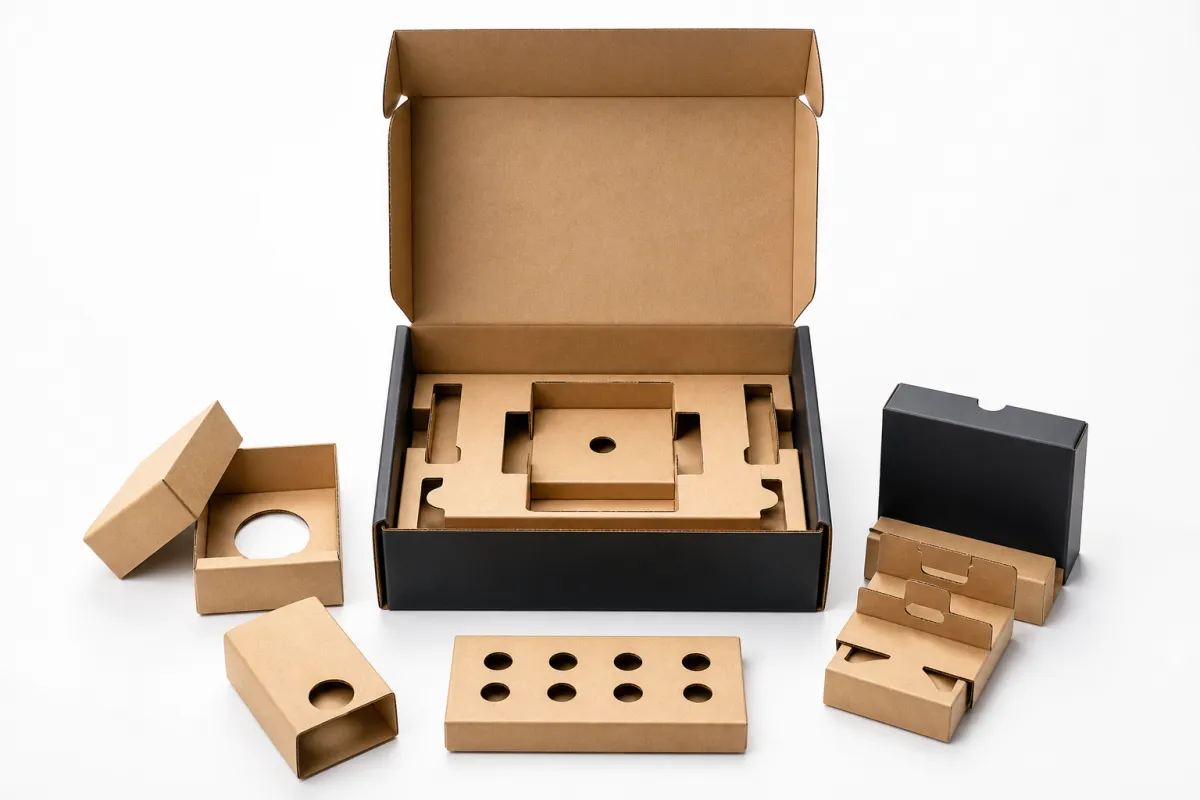
A product can survive a solid outer carton and still arrive damaged because it shifted, rubbed, tipped, or stacked into something else inside the box. That is the exact problem custom cardboard inserts for boxes are meant to fix. The carton handles the shipping environment. The insert handles the product's internal movement. Those are not the same thing, even if people treat them like they are.
Think about a glass bottle, a candle set, a skincare kit, or a small electronics bundle. The box may be strong enough for parcel transit, but the product can still move just enough to scuff a printed label, crush an edge, or snap a corner. Custom cardboard inserts for boxes hold the product in a defined position, separate fragile parts, and give packers a repeatable loading path instead of a guess-and-hope routine.
There is also the presentation side. In branded packaging, the insert is often the first thing a customer sees after opening the box. A tidy insert frames the product and makes the whole package feel deliberate. A loose bundle feels cheap. That difference matters in ecommerce, subscription kits, and retail packaging where the unboxing moment is part of the product experience.
It helps to separate three ideas that often get lumped together:
- Void-fill is loose material such as paper, air pillows, or crumpled dunnage used to occupy empty space.
- Generic dividers create basic separation, but they are not always tuned to a specific product's geometry.
- Custom cardboard inserts for boxes are engineered to restrain, cradle, separate, or display specific products inside a specific carton.
That difference matters because a true insert can do several jobs at once. It can stop one item from moving, hold a multi-piece kit in sequence, and protect delicate surfaces from abrasion. It can also help a packaging team standardize assembly. Nobody is gonna thank you for a pretty insert that slows the line to a crawl. It needs to fit the product and the operation.
There is a sustainability angle too. When the design is right, custom cardboard inserts for boxes can replace foam blocks, plastic trays, and oversized dunnage with fiber-based components that are easier to sort and recycle in many curbside streams. That does not mean paper is always the answer. Some products need serious shock control, and some finishes are sensitive to board rub. Still, for a large share of shipping and retail applications, paper-based inserts are a smart starting point.
For teams comparing options, the useful view is the whole package system, not one part in isolation. A better insert can allow a lighter outer carton, a smaller shipper, or fewer returns. That is where these inserts start paying for themselves.
If the insert can move, the product can pay for it later.
That line sounds blunt because it is. A few millimeters of free play can turn into edge wear, label damage, or broken corners after vibration and compression. Good insert design closes that gap before the box ever leaves the dock.
How Custom Cardboard Inserts for Boxes Are Built
Custom cardboard inserts for boxes start with geometry, not artwork. First you measure the product at its widest, tallest, and deepest points, then compare those numbers to the usable inside dimensions of the carton or mailer. From there, the designer sets clearances for loading, unloading, and manufacturing tolerance. A dieline turns those measurements into cuts, scores, folds, and locking features that can be produced at scale.
The simplest versions are flat die-cut pieces that slot around a product or create a cradle. More advanced versions use tabs, folds, nested layers, or partition walls to build compartments for multiple components. A cosmetic kit may need one cavity for a bottle, one for an applicator, and one for a leaflet. An electronics accessory kit may need a cable channel, a battery-safe compartment, and a tray that keeps everything centered. Custom cardboard inserts for boxes can handle that if the structure is planned correctly.
There are several common construction methods:
- Die-cut corrugated inserts for stronger restraint and more impact resistance.
- Folding board inserts for a cleaner presentation and a smoother printed finish.
- Partitions and separators for multi-item sets that need individual cells.
- Layered or laminated structures for heavier products or deeper cavities.
- Locking tabs and self-retaining folds that reduce glue use and speed up assembly.
Material choice is where a lot of teams either overspend or under-protect. Single-wall corrugated board is common for lighter goods and moderate shipping exposure. Heavier flute profiles or multi-layer constructions fit larger loads, deeper boxes, or products with a high center of gravity. Folding carton board gives a tighter visual finish and often works well for retail packaging where display matters as much as protection. The best custom cardboard inserts for boxes are not the thickest ones. They are the ones that match the product's risk profile.
Prototyping saves headaches. A structure that looks perfect on a screen can behave very differently once the product is loaded, the carton is closed, and the assembly line starts moving. Corrugated has memory, fold lines take pressure differently, and real-world tolerances show up fast. That is why a sample should be built, handled, and checked with the actual product before anyone approves a full run of custom cardboard inserts for boxes.
For more on packaging formats and carton structures, the Custom Packaging Products catalog is a useful place to compare options, especially if the insert and the outer box need to be developed together. If the carton itself is still being selected, Custom Shipping Boxes can help you think through how the insert and shipper dimensions should work as one system.
At the design stage, ask a few plain questions: Can the insert be loaded quickly? Does it hold the product upright without pinching labels or corners? Will it survive a drop without letting the item escape its cavity? Those details separate a concept from production-ready custom cardboard inserts for boxes.
Key Factors That Shape Fit, Strength, and Sustainability
The fit question sounds simple, but it has a lot of moving parts. Product weight, surface finish, balance point, and fragility all influence how much restraint custom cardboard inserts for boxes need to provide. A lightweight bottle with a tall profile may need more side support than a heavier but shorter item. A matte-coated cosmetic carton may tolerate contact better than a glossy printed label that scuffs easily. A glass component may need edge isolation, while a metal part may need scratch prevention and orientation control.
Carton size and internal tolerance matter just as much. If a packaging line uses mixed production lots, or if the product includes caps, handles, cords, or seasonal accessories, a design that is only barely large enough can turn into a problem. Buyers should think beyond nominal dimensions. Real packaging design needs a little breathing room, but not so much that the product shifts. The sweet spot is usually measured in millimeters, not in vague comfort language.
Shipping conditions shape the structure too. Parcel transit is rougher than many people assume, with repeated drops, vibration, and compression from other packages. Retail distribution may create more shelf-ready presentation pressure. Long-haul freight can add stacking loads and temperature swings that affect board performance. High-vibration routes or mixed handling environments often justify stronger custom cardboard inserts for boxes than a local delivery route would need. For transit testing, ISTA's methods are a strong reference point, and the published guidance at ISTA is worth reviewing if you want to understand how packaged products are evaluated under repeatable conditions.
Sustainability is not just a matter of saying "paper-based." The material still has to be right-sized and designed for recovery after use. Recycled content matters, but so does how much board gets consumed. Mixed materials can complicate recycling, and heavy coatings may reduce fiber recovery in some streams. If the design can eliminate plastic clips, foam corners, or unnecessary laminated layers, the package often becomes easier to recover and simpler to explain to buyers who care about end-of-life disposal.
That said, sustainability should never turn into a slogan that ignores product risk. If a lighter insert leads to a higher damage rate, the net waste may actually be worse. A broken item, a reshipment, and a customer complaint all add material and transport burden. The most responsible custom cardboard inserts for boxes are the ones that protect the product with the least total material needed to do the job.
Branding belongs in the design brief too. In premium product packaging, the insert can reinforce package branding through color, print, texture, and layout. A simple kraft interior can signal natural, minimal positioning. A white SBS or clay-coated board can feel cleaner and more retail-ready. Some brands use printed instruction panels or QR callouts on the insert itself. That can be useful, but only if it does not interfere with strength or recycling goals. The best branded packaging supports the product without pretending the insert is a billboard.
For paper sourcing and fiber-chain credibility, the FSC program is a useful benchmark when the project calls for responsibly sourced board. FSC certification does not solve every packaging question, but it gives procurement teams a clearer way to talk about material origin.
Custom Cardboard Inserts for Boxes: Cost and Pricing Factors
Price for custom cardboard inserts for boxes is shaped by more than board thickness. Buyers often focus on unit price first, but the real cost includes engineering, tooling, sample rounds, assembly time, pack-out speed, damage risk, and the effect of the insert on carton size. A design that seems slightly more expensive per piece can still be the better purchase if it stops product movement and cuts returns.
The main cost drivers are usually straightforward:
- Board grade and caliper: heavier or higher-performance materials cost more.
- Cut complexity: more intricate geometry means more setup and more die detail.
- Number of cavities: multi-compartment designs add engineering and slow packing.
- Print and finish: branded interiors, coatings, or specialty textures raise price.
- Assembly method: glued, folded, or multi-part inserts can change labor cost a lot.
Tooling is another real line item. If the insert needs a custom die, sample set, or special scoring pattern, there is an upfront engineering cost that has to be recovered across the order. That is why short runs usually carry a higher per-unit number. As volume increases, setup gets spread across more units and the price per insert tends to come down. A simple single-cavity corrugated insert might land around $0.18-$0.28 per unit at 5,000 pieces, while a more complex multi-compartment design can move into the $0.35-$0.80 range depending on board, print coverage, and assembly effort. Those are working ranges, not promises, because every line item changes with size and complexity.
| Insert Type | Typical Use | Approx. Unit Cost at 5,000 | Assembly Notes | Best Fit |
|---|---|---|---|---|
| Single-wall corrugated cradle | Light to medium products | $0.18-$0.28 | Fast to load, usually flat-packed | Shipping, ecommerce, basic retail packaging |
| Folding carton board insert | Premium presentation | $0.22-$0.40 | Cleaner print surface, moderate assembly | Branded packaging, gift sets, custom printed boxes |
| Multi-compartment corrugated system | Kits and multi-SKU bundles | $0.35-$0.80 | More folds and slower pack-out | Fragile sets, mixed components, heavier loads |
Labor deserves attention because it can hide inside the process. A cheap insert that takes 20 extra seconds to assemble can get expensive very quickly in a high-volume line. If the insert ships flat but needs careful folding, hand gluing, or frequent alignment corrections, the line cost may outweigh the material savings. With custom cardboard inserts for boxes, the cheapest board is not always the cheapest package.
Packaging teams should also look at the secondary savings. A well-fit insert can reduce shipping damage, which lowers replacement costs and customer service burden. It can also permit a tighter carton, which may reduce dimensional weight charges. In some programs, that alone pays back the difference between a generic filler approach and purpose-built custom cardboard inserts for boxes.
From a buyer's point of view, the smartest question is not "What does the insert cost?" It is "What does the total pack-out cost?" That includes board, tooling, labor, shipping efficiency, and the cost of failure. If a slightly higher-priced insert cuts damage by even a few points, the math can turn quickly in its favor.
Custom Cardboard Inserts for Boxes: Process and Timeline
The development process for custom cardboard inserts for boxes usually moves through a predictable sequence, even when the product is unusual. It starts with a brief, then moves into measurement, structural concepts, prototyping, revision, testing, and final approval. The better the information you provide at the start, the less time gets burned fixing avoidable errors later.
A strong brief usually includes product samples, finished dimensions, target carton size, pack quantities, and any handling concerns. If the product has fragile edges, polished faces, leaking risk, or accessories that must stay together, those facts need to be in the conversation immediately. Photos of the current packaging, drop points, and fulfillment setup help too, because the insert needs to fit the operation as well as the product.
Here is a practical sequence many teams follow:
- Review the product and define the protection goals.
- Confirm internal carton measurements and clearance targets.
- Create a structural concept or dieline.
- Build a prototype and load the real product.
- Check fit, load speed, and surface contact points.
- Revise the structure if needed.
- Approve production and prepare the packing line.
Simple custom cardboard inserts for boxes can move quickly once the product is confirmed. A straightforward single-cavity concept may be ready for sample review in a short window if all dimensions are final. More complex projects take longer, especially if the insert must hold several SKUs, accommodate multiple box sizes, or pass shipping tests before release. It is common for a multi-component project to need at least one revision cycle, and sometimes more if the product shifts in a way the first prototype did not reveal.
Delays usually come from the same places. Final product dimensions are not ready. The outer carton is still changing. The product sample in hand is not the final version. Or the team has not agreed on whether the insert should prioritize speed, display, or maximum protection. None of that is unusual, but it does slow development. The fastest projects are the ones where structural, packaging, and operations teams agree on the goal before any die is made.
Testing matters because packaging behavior can surprise people. A paperboard solution that feels snug by hand can still fail under vibration, compression, or repeated drops. That is where test methods such as ASTM D4169 or ISTA procedures help keep everyone honest. Even a basic shake-and-drop review can reveal whether custom cardboard inserts for boxes are actually restraining the product or just surrounding it.
Hand-off is the final piece. Production should know how the insert is folded, where glue is used, what order components go into the box, and what the acceptable fit range is. If the line team has to guess, consistency drops. When the handoff is clean, custom cardboard inserts for boxes support both quality and throughput, which is exactly what a good packaging design should do.
Common Mistakes When Specifying Cardboard Inserts
One of the most common mistakes is measuring only the product and forgetting the real assembly conditions. Glue thickness, wall thickness, fold memory, and carton variation all affect the final fit. A design that is tight on paper may be too tight on the line, especially after a few sample adjustments or a change in board source. With custom cardboard inserts for boxes, small dimensional misses show up fast.
Another issue is overengineering. Some teams keep adding layers, folds, or dense board because they assume more material always means more protection. That is not always true. Too much board can create a bulky feel, raise material cost, slow packing, and even introduce new failure points where the product gets forced into an awkward angle. A well-planned insert protects the product without turning into a carton inside a carton.
Ignoring shipping tests is another expensive habit. A package can look perfect on the bench and still fail under repeated vibration or corner drops. That is especially true for tall products, loose caps, stacked sets, and items with a lot of empty headspace. The best time to discover a problem is during prototyping, not after a full production run of custom cardboard inserts for boxes is already sitting in inventory.
Workflow mistakes matter just as much as structural ones. If the insert is hard to load, packers will find ways to speed it up, and those shortcuts can damage the product or create inconsistent placement. If the insert requires awkward twisting, hidden alignment, or excessive force to close, the line will feel it immediately. Packaging design needs to work for the people assembling the box, not just for the render file.
A good insert should guide the product, not fight the packer.
Sustainability mistakes show up too. Mixing unnecessary materials, adding decorative layers that do not improve function, or choosing a heavier board than the product needs can all undermine the point of paper-based packaging. In some cases, the greener choice is not the thinnest possible insert, but the one that uses enough material to prevent breakage while staying easy to recover. That balance is where custom cardboard inserts for boxes make the most sense.
There is also a branding trap. Some teams want the inside of the box to do too much. A little print can help with instructions or brand reinforcement, but too much ink coverage, foil, or coating may complicate recycling and increase cost. The insert should support the package branding story, not overpower the product itself.
Here are a few quick checks that catch many of the problems early:
- Does the product move when the carton is shaken gently?
- Can the insert be loaded in one clean motion?
- Does any surface contact create scuffing or pressure marks?
- Can the same structure handle normal product variation?
- Will the insert still work after the carton is closed and stacked?
If the answer is no on any of those, the design probably needs another pass. It is much cheaper to revise custom cardboard inserts for boxes on a prototype than to repair a broken launch later.
Expert Tips and Next Steps for Better Inserts
The best insert projects usually start with a protection map. List the surfaces that must never touch, the parts that can tolerate light contact, and the areas where movement is acceptable. That one exercise makes the structural brief far clearer. It also helps the packaging engineer decide whether custom cardboard inserts for boxes should cradle, separate, suspend, or simply lock a product in place.
After that, prototype early and test honestly. Load the actual product, not a dummy shape that only approximates it. Shake the carton. Rotate it. Drop it from practical heights that match the shipping risk. Then check for rub marks, displacement, and compression damage. A design that survives paper review but fails in handling is not ready, no matter how nice it looks in CAD.
Standardization can save time and simplify inventory. If your product family shares a similar footprint, one insert platform may work across multiple SKUs with only small adjustments. That can reduce changeover complexity and make forecasting easier. Many packaging teams forget how much operational value comes from reusing a stable insert architecture instead of redesigning every box from scratch. In a busy fulfillment environment, that kind of consistency matters.
It is also smart to review recyclability, carton efficiency, and line speed together. A design that looks sustainable but slows pack-out may create its own operational waste. A design that is easy to assemble but uses too much board may push shipping costs higher than needed. The best custom cardboard inserts for boxes balance those pressures instead of favoring one at the expense of the others.
For brands building a larger packaging system, connect the insert project to the rest of the package architecture. Make sure the outer carton, the print system, and the insert all support the same retail packaging or ecommerce goal. If the shipping box is too large, the insert ends up carrying a burden it should not have to carry. If the branding is too busy, the product may lose the clean presentation the insert was meant to create. Good package branding feels coordinated, not crowded.
Here is the short version of the next steps:
- Gather final product dimensions and samples.
- Confirm the inside dimensions of the carton.
- State the shipping method and damage risks.
- Define whether the insert must display, separate, or cushion.
- Request a prototype and test it before full production.
That process keeps the project grounded in real use, which is where custom cardboard inserts for boxes either succeed or fail. If you treat them as part of the packaging system instead of disposable filler, you get better protection, better presentation, and usually a cleaner cost structure over time.
Once the measurements, carton specs, and pack quantities are ready, the next move is straightforward: ask for a prototype, test the fit, and refine the structure until the product stays put with no unnecessary material. Done well, custom cardboard inserts for boxes support product packaging, reduce damage, and make the whole box feel more deliberate from the first lift to the final unboxing.
FAQ
How do I measure custom cardboard inserts for boxes correctly?
Measure the product at its widest, tallest, and deepest points, then add only the clearance needed for safe loading and removal. Use the actual carton interior dimensions, not the outside box size, because wall thickness changes the usable space. If the product has handles, caps, or irregular edges, include those features in the measurement set so the insert does not bind during packing. That extra step prevents a lot of rework on custom cardboard inserts for boxes.
Are cardboard inserts better than foam for fragile products?
Cardboard inserts are often the better sustainable choice when the product needs positioning, separation, or light-to-moderate protection rather than heavy shock absorption. Foam may still be useful for extreme impact control, but paper-based inserts are usually easier to recycle and often better suited to retail presentation. The right answer depends on product weight, transit risk, and the type of damage you are trying to prevent, so custom cardboard inserts for boxes should always be matched to the real shipping profile.
What affects the price of custom cardboard inserts for boxes?
Main cost drivers include material grade, insert complexity, tooling, sample revisions, and total order quantity. Assembly time also matters, especially if the insert has multiple folds, locks, or compartments that slow pack-out. A design that reduces product damage can be more economical overall even if the unit price is slightly higher, which is why buyers should look at total packaging cost, not just the board cost of custom cardboard inserts for boxes.
How long does it take to develop a prototype insert?
Simple insert concepts can move quickly once dimensions and product samples are confirmed. More complex projects take longer when they need revisions, shipping tests, or multiple product variants. The fastest way to keep the timeline moving is to provide final carton specs, product samples, and clear performance goals at the start. That gives the design team a clean basis for custom cardboard inserts for boxes that can be tested without guesswork.
Can custom cardboard inserts for boxes be recycled after use?
In most cases, yes, especially when the insert is made from paper-based board without unnecessary mixed materials. Recyclability improves when the design avoids plastic laminations, excessive adhesives, and hard-to-separate components. Always match the material choice to the local recycling stream and the product's protection requirements, because the most practical custom cardboard inserts for boxes are the ones that protect the product and still fit the recovery path in your market.

