Buyer Fit Snapshot
| Best fit | Custom Pattern Poly Mailers projects where brand print, material claims, artwork control, MOQ, and repeat-order consistency need to be specified before quoting. |
|---|---|
| Quote inputs | Share finished size, material target, print colors, finish, packing count, annual reorder estimate, ship-to region, and any compliance wording. |
| Proofing check | Approve dieline scale, logo placement, barcode or warning zones, color tolerance, closure strength, and carton packing before bulk production. |
| Main risk | Vague material claims, crowded artwork, missing packing details, or unclear freight terms can make a low unit price expensive after revisions. |
Fast answer: Custom Pattern Poly Mailers: Design, Cost, and Process should be specified like a repeatable production item. The safest quote records material, print method, finish, artwork proof, packing count, and reorder notes in one written spec.
Production checks before approval
Compare the actual filled-product size with the drawing, then confirm tolerance on folds, seals, hang holes, label areas, and retail display edges. Reserve space for logos, QR codes, warning copy, and material claims before decorative graphics fill the panel.
Quote comparison points
Review material grade, print process, finish, sampling route, tooling charges, carton quantity, and freight assumptions side by side. A quote is only useful when the supplier can repeat the same color, closure quality, and packing count on the next order.
Custom pattern poly mailers do more than move a product from warehouse shelf to front door. They are the first surface a customer touches, the first visual cue a porch delivery gives away, and often the first clue that a brand paid attention to details. That is why custom pattern poly mailers have become a practical branding tool for apparel, beauty, accessories, and lightweight ecommerce orders that need visible identity without the expense of heavy Custom Printed Boxes.
For a packaging buyer, the attraction is easy to explain: package branding in a low-cost shipping format. Production complicates that picture. Custom pattern poly mailers are never just a matter of printing artwork and calling it finished. Film thickness, print coverage, adhesive strength, repeat alignment, and bag dimensions all change the look and the invoice. Miss those variables and you can end up with a bag that looks polished in a mockup and awkward in a fulfillment center.
A good mailer is not just a wrapper. It is a moving billboard, a handling surface, and a first impression that gets judged in seconds.
Custom Pattern Poly Mailers: Why They Stand Out
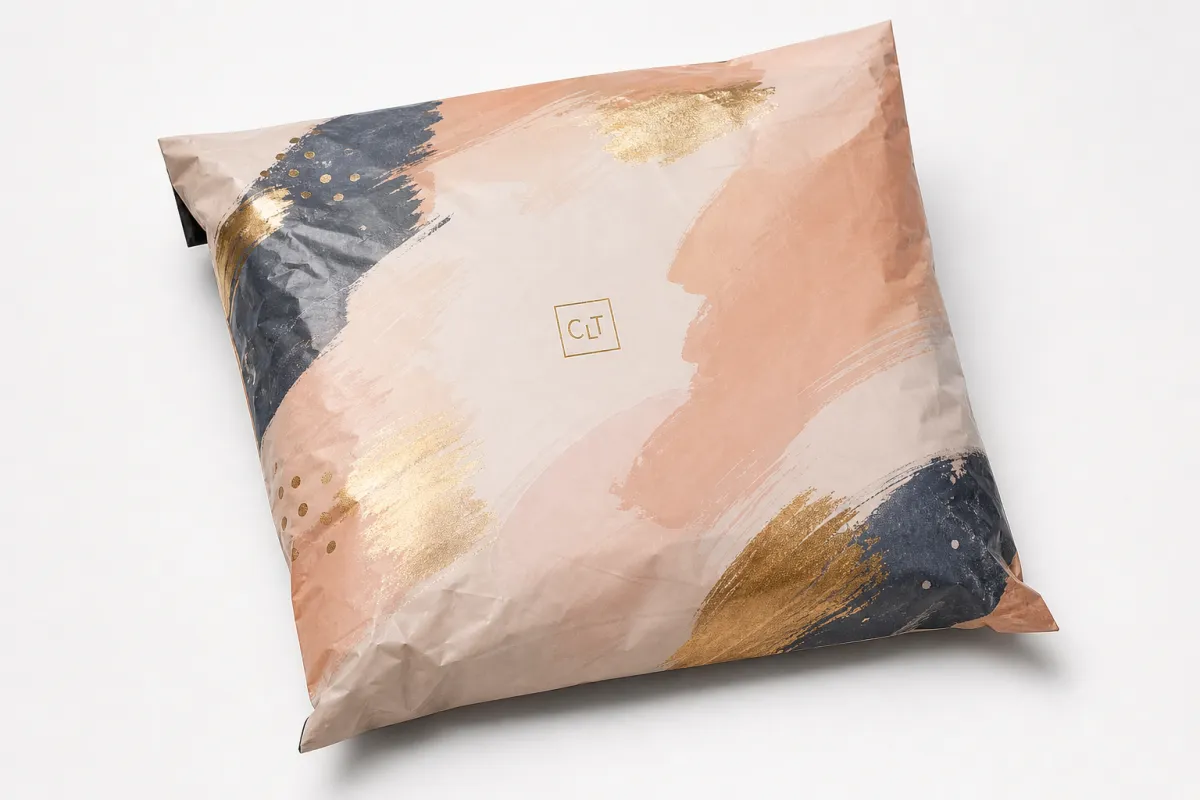
Custom pattern poly mailers stand out because the outside does the branding work before the package is opened. That sounds simple, yet many buyers still treat shipping supplies like invisible infrastructure. A pattern changes the frame. It can make a plain black tee, a skincare set, or a small accessory order feel like branded packaging instead of anonymous fulfillment. In a stack of deliveries, the one with a strong repeat pattern gets noticed first.
The format is straightforward. Custom pattern poly mailers are printed shipping mailers made from polyethylene film, usually with repeat graphics, logos, icons, or full-surface artwork on the outer layer. The pattern may cover the whole bag, sit along the edges, or repeat across a cleaner background. The goal stays constant: make the package recognizable at a glance without turning it into a fragile art object.
Here is the part that surprises some buyers. A modest product inside a striking branded mailer can feel more premium than a better product shipped in a plain bag. That is not smoke and mirrors. It is package branding doing real work. People notice effort. They notice continuity. They notice when a shipment feels like it belongs to a brand rather than a warehouse aisle. I have seen small ecommerce labels get more customer photos from the mailer than from the product itself, which is a little absurd, but also very real.
They fit best where the product is light, flexible, and shipped in volume: apparel, beauty samples, subscription inserts, lightweight accessories, and soft goods that do not need rigid protection. If the item can handle a mailer without crushing, custom pattern poly mailers are usually one of the least expensive ways to add visual impact. More pattern coverage, more colors, and special finishes all raise the cost. Packaging still answers to material science, even when the artwork looks elegant.
There is also a practical side. Custom pattern poly mailers are compact, easy to store, and fast to pack. A warehouse team can move quickly with them, and a buyer can still get a branded look without jumping straight to custom printed boxes or secondary packaging that eats labor time. That combination is a major reason custom pattern poly mailers keep showing up in ecommerce programs that care about both speed and presentation.
In plain terms, they do three jobs at once: they ship, they brand, and they signal care. That is why the category keeps growing even as brands get more selective about packaging spend. The bag has to earn its place, and a strong pattern helps it do exactly that.
How Custom Pattern Poly Mailers Are Printed and Sealed
Most custom pattern poly mailers begin with a film structure that balances printability, strength, and moisture resistance. The outer surface carries the artwork, the inner layer helps with seal performance, and the adhesive closure finishes the shipping format. Some bags use a simple mono-layer construction, while others rely on co-extruded layers for better tear resistance and opacity. Thin film and heavy artwork rarely get along. The film has to support the design, not fight it.
Printing is often handled with flexographic printing for larger runs, since flexo is efficient for repeat patterns and consistent color on long production lots. Smaller runs may use digital methods, depending on the supplier and the artwork. The choice matters. Flexo usually fits best when the design is locked and the quantity is high enough to absorb plate or setup costs. Digital can make sense for smaller orders, color-heavy tests, or a first run where a buyer does not want to commit to thousands of bags before the design proves itself. That is one reason buyers compare custom pattern poly mailers so carefully: the print method changes unit cost and the room to adjust later.
Repeat patterns are not only a design preference. They are a production decision. The artwork must tile cleanly across the bag so the repeat looks intentional instead of broken up. A seam through a logo, a logo too close to the edge, or a pattern that drifts over the length of the bag makes the run feel off. On custom pattern poly mailers, repeat alignment is one of those details that separates polished branded packaging from a bag that feels rushed.
Printing also affects performance. A dense pattern with strong contrast can hide scuffs during transit better than a pale design, but heavy ink coverage may add cost and can show more variation if the process is not tightly controlled. Film thickness matters too. Common mailer films often fall in the 2.0 to 3.0 mil range for lighter ecommerce use, while heavier shipments may need thicker film or a stronger seam structure. If the adhesive closure is weak, none of the print quality matters, because the parcel fails before the customer ever notices the pattern.
That is where testing matters. Shipping performance should not be guessed. A supplier who understands transport abuse should talk about seal strength, tear resistance, and how the mailer behaves under compression and moisture. For teams that want a formal reference point, transport testing standards like ISTA are worth reviewing, especially if the product is delicate or travels far. Custom pattern poly mailers do not need overengineering, but they do need enough structure to survive normal handling without splitting at the seam.
Key Factors That Affect Custom Pattern Poly Mailers
If a buyer asks why custom pattern poly mailers cost what they cost, the answer usually starts with size. Larger bags use more film, more ink coverage, and more material handling. The right size should come from the folded product, not a guess or a rough memory of what worked last season. A small apparel order may fit cleanly in a 10 x 13 inch bag, while a bulkier hoodie or bundled accessory set may need something wider or longer. Oversize mailers quietly drain budget. Extra film, extra print area, and extra shipping weight add up fast.
Material choice comes next. Standard polyethylene remains the most common option because it is cost-effective and durable enough for routine ecommerce shipping. Recycled-content blends can make sense for brands trying to reduce virgin plastic use, but not every recycled claim carries the same meaning, and not every shipment needs that spec. Compostable alternatives exist, though they are not the automatic answer for every program. In packaging design, the best material is the one that matches the product, the shipping environment, and the brand promise without pretending to solve three problems at once. That holds true for custom pattern poly mailers and for custom printed boxes alike.
Print coverage and color count matter more than many first-time buyers expect. A one-color repeat on a simple background is easier to run than a full-coverage, multi-color design with fine detail and edge-to-edge artwork. The more the design covers the bag, the more control the print process usually needs. Pattern density also shapes the visual result. A bold, sparse pattern can feel crisp and modern. A busy pattern can feel playful, but if the contrast is too low, it can look muddy on the shelf and on camera. That matters in retail packaging, because custom pattern poly mailers often appear in unboxing videos and porch delivery photos before they ever reach a merch buyer.
Adhesive strength and overall durability are easy to ignore until they fail. A mailer that opens in transit is wasted money and a customer service headache. Heavier products, humid routes, and rough delivery networks all push seal performance harder. Buyers should also think about opacity. Some custom pattern poly mailers are fully opaque, which helps protect the contents and keep the look clean. Others are more translucent. That may work for some products, but it is a poor fit if the goal is privacy or a more premium package branding effect.
Compliance and sustainability claims should be checked, not assumed. If a supplier says a mailer is recyclable, ask what resin it uses, what local collection rules apply, and whether the claim is specific or generic. The EPA has public recycling guidance at epa.gov/recycle, and that is a better reference point than a glossy sales sheet. If the mailer supports broader sustainability messaging, the claim has to match the actual material. Buyers who align the message with the product tend to avoid awkward customer complaints later. Funny how often that is the part that gets skipped.
One more practical factor: print registration tolerance. A design can look gorgeous on a monitor and still disappoint if the artwork shifts a little during print. On a small repeat, that shift might be invisible. On a bold geometric pattern, it can be obvious enough to nag at the eye. That is why experienced buyers usually ask for a proof and a sample instead of trusting the mockup alone.
Cost, Pricing, MOQ, and Quote Basics
Pricing for custom pattern poly mailers is driven by a few plain inputs: quantity, size, print complexity, material, and setup steps. That is the short version. The longer version is that each input changes the production path. A large run with a simple repeat pattern is easier to price than a small run with full-coverage graphics, a special finish, and strict color matching. Buyers who ask for a quote without exact dimensions usually get vague pricing in return. Vague request, vague answer. The exchange is almost fair.
MOQ, or minimum order quantity, is where the economics become real. Lower MOQs help when a brand is testing designs or checking market response. Higher MOQs usually bring down the unit cost, but they also tie up cash and storage space. For many suppliers, a small branded run may sit in the thousands of units, while larger production can move into much better per-bag pricing. If a program is still changing sizes, artwork, or fulfillment flow, ordering too many custom pattern poly mailers too early is a classic mistake. It costs less to learn on 1,000 bags than to uncover a print issue on 20,000.
Here is a practical way to think about cost. At a mid-volume order, a simple one- or two-color repeat pattern on standard film may land in a lower unit-cost range, while a full-coverage, premium-finish version can cost noticeably more. The difference is not just ink. It is setup, waste, print control, and the extra handling needed to keep the bag looking right. For budget planning, think in ranges rather than guesses. A plain repeat pattern may sit roughly in the lower cents-per-unit zone at scale, while complex custom pattern poly mailers with heavy coverage or premium film can climb well beyond that. The real number depends on the exact spec sheet.
The cleanest quote comparison is the one that puts every assumption on the table. Ask whether art setup, plates, proofing, packaging, and freight are included. Ask whether the quote is ex-works, FOB, or landed to your warehouse. A low bag price with high shipping charges is not a bargain. It is a distraction. Also ask about storage and split shipments if you do not plan to receive everything at once. Good suppliers will quote the same custom pattern poly mailers in a way that lets you compare apples to apples. Poor ones make the unit price look attractive and add the annoying parts later.
| Option | Best For | Typical MOQ | Rough Unit Cost at 5,000 Units | Notes |
|---|---|---|---|---|
| Simple repeat pattern | Apparel basics, inserts, low-complexity branded packaging | 1,000-3,000 | $0.18-$0.30 | Usually the easiest path for custom pattern poly mailers |
| Multi-color repeat | Beauty, lifestyle, stronger package branding | 3,000-5,000 | $0.24-$0.40 | More setup and color control, but stronger shelf presence |
| Full-coverage premium bag | High-visibility ecommerce, influencer orders, premium retail packaging | 5,000+ | $0.35-$0.70+ | Higher cost, especially with thicker film or special finish |
If you are comparing related packaging formats, it helps to look at the broader mix instead of treating custom pattern poly mailers as the only option. A brand may need mailers for soft goods and boxes for gift sets or fragile products. Browsing Custom Packaging Products can help map the broader packaging system, while Custom Poly Mailers is useful for seeing the range of mailer styles side by side. That is usually smarter than ordering from a random internet mood board.
One detail that tends to get missed: freight class and carton packing. A supplier can quote a very attractive unit price, then pack the bags in a way that raises the landed cost or creates receiving headaches. The real number is the one that lands in your warehouse ready to use, not the one that looks tidy in an email.
Process and Timeline: From Artwork to Delivery
The production process for custom pattern poly mailers usually follows a clear sequence: gather specs, confirm artwork, issue a proof, approve samples if needed, print, finish, pack, and ship. That sounds orderly because it is. Trouble starts when one step is rushed or skipped. A missing dieline, an incorrect bleed area, or a file with the wrong colors can slow the whole order. The machine does not care that the launch date is tomorrow. It prints what you approve, not what you meant.
Artwork approval is usually where the most time disappears. Designers may send a beautiful pattern that does not tile correctly on a mailer, or a logo may sit too close to the fold area. Good custom pattern poly mailers need a repeat that holds up across the full bag, not just on a polished mockup. If the color matters, ask about proof standards. Screen colors can drift from printed colors, especially if the design uses saturated tones or very fine line work. A digital proof tells you placement; it does not always reveal ink behavior. That is why large orders sometimes justify a physical sample.
Timeline should be planned in layers. Artwork revisions can take a few days, proof approval may require another round, and manufacturing itself runs on its own clock. For many custom pattern poly mailers, a realistic production window after approval might be about 12-20 business days, depending on quantity, print method, and factory schedule. Freight can add more time, especially if the shipment is moving across countries or through a tight receiving calendar. Rush orders do happen, but only if the design is clean, the spec is locked, and the supplier has production space available. A rush order with unfinished artwork is not really a rush order. It is a problem with extra fees attached.
Pre-production checks are worth the extra day. Check edge safety, repeat alignment, adhesive placement, bag opening direction, and whether the design still looks good at actual bag scale. If your brand is serious about product packaging, this is the point where the decision should feel controlled rather than hopeful. Teams that test a small lot first usually catch the ugly surprises early. That is also where transport testing language becomes useful. Not every order needs a formal lab program, but if the shipment is valuable or fragile, asking about compression or distribution testing based on ISTA methods is practical, not dramatic. It is simply a more accurate view of how packages are handled.
Leave buffer time. Always. Custom pattern poly mailers are not a same-week product unless the run is tiny and the artwork is already clean. If a launch depends on the bags arriving on time, set the schedule backward from the delivery date and leave room for proof changes, freight delays, and warehouse receiving. Nobody gets praised for cutting it close on packaging.
I have watched a brand miss a seasonal launch because the factory needed one more proof cycle and nobody had padded the timeline. That kind of delay hurts more than the cost difference between two suppliers. You can usually recover a few cents per bag. You do not always recover a lost launch window.
Common Mistakes With Custom Pattern Poly Mailers
The most common mistake is choosing the pattern before the bag size. That sounds harmless until the first proof comes back with stretched logos, awkward repeats, or a design that looks good on a computer and wrong on the actual bag. Custom pattern poly mailers should be designed around the finished dimensions, because the repeat changes as the bag width and length change. If the artwork is not built for the format, the bag will announce that mistake to every customer who touches it.
Another bad move is approving artwork on screen and never checking contrast, edge safety, or repeat alignment in the real print layout. A pattern with too little contrast may disappear under warehouse lighting. A logo too close to the edge can get cut off or feel cramped. A repeat that drifts even a little can make the whole run feel off. This is where packaging design becomes less about taste and more about control. On custom pattern poly mailers, control is what keeps the package from looking cheap.
Buyers also get burned by ignoring adhesive quality. A weak seal can open on a hot route, in humid conditions, or after a rough delivery sequence. If the product is heavier than expected, the closure needs to match that reality. The same goes for seam strength. A bag that looks fine in a sample but splits under normal use is not a bargain. It is a return label waiting to happen. And yes, the customer will blame the brand, not the mailer.
Focusing only on the cheapest quote is another common way to create extra work. A low unit price can hide weak print quality, thin film, bad freight terms, or a supplier that is slow to respond when the proof needs changes. Custom pattern poly mailers are not the place to buy blind. If the quote does not show setup, shipping, and proofing clearly, compare the total landed cost instead. Cheap is not a strategy if the bags arrive late or fail in transit.
The last mistake is ordering too many bags before testing them on real products and real packing lines. A mailer that feels right in the hand may be too small for folded inventory, too slick for fast packing, or too opaque for the product visibility your team needs. Small sample runs catch those issues without wrecking the budget. A short trial also gives the warehouse team a say, which is smart, because the people actually packing the orders tend to know where the friction is. Operational feedback usually beats a mood board.
There is also a quieter mistake: treating sustainability language like decoration. If a supplier says a mailer is recyclable or made with recycled content, the claim should match the material spec and the recovery rules in the regions where it ships. Otherwise the message is just noise, and customers can smell that kind of thing a mile away.
Expert Tips and Actionable Next Steps for Your First Order
Start with a sample run or a small production lot. That sounds cautious because it is. It is also practical. Before you commit to a larger order of custom pattern poly mailers, test the bag size, seal strength, print clarity, and pack speed on the actual product. If the bag loads slowly, if the pattern lands awkwardly once folded, or if the closure is annoying for the team, fix it before you scale. That is cheaper than discovering the problem after the pallets are parked in a warehouse corner.
Build a spec sheet that removes guesswork. At minimum, include exact dimensions, product weight, material preference, print colors, finish, quantity, shipping destination, and whether the order needs samples. Add notes about the product shape if it folds oddly or if there is a header card, tissue, or insert. The cleaner the spec sheet, the easier it is to compare custom pattern poly mailers from different suppliers. Good quotes come from good input. Weak input produces pretty estimates that fall apart the moment someone asks a real question.
Ask for a digital proof and, for larger orders, a physical sample. The digital version checks layout, type placement, and repeat logic. The physical sample checks color feel, film hand feel, and whether the bag behaves the way the warehouse team expects. If your brand is trying to build stronger branded packaging, this is where you separate what looks good from what works well. The best-looking custom pattern poly mailers are the ones that survive real use and still make the shipment feel intentional.
Compare at least two or three suppliers using the same spec sheet. If one quote is much lower, there is usually a reason. Maybe the print coverage is different. Maybe the film is thinner. Maybe freight is excluded. Maybe the supplier is quoting a different MOQ than the one you actually need. Do not compare a loose idea against a finished quote and pretend that is research. That is how buyers end up paying twice, once for the order and once for the correction. Custom pattern poly mailers are simple enough to quote well if the inputs are clear.
If you are building a broader packaging lineup, keep the mailer decision connected to the rest of the brand system. Custom pattern poly mailers should support the same visual story as custom printed boxes, tissue, inserts, labels, and any retail packaging the customer sees later. Consistency matters because customers notice it, even if they cannot name the exact reason the package feels more polished. The goal is not just a bag with a logo. The goal is packaging that ships safely, looks sharp, and earns its keep every time it leaves the dock.
The most useful first step is also the least glamorous: lock the bag size, lock the artwork repeat, and lock the shipping target before you talk price. Do that, and the rest gets a lot easier. Skip it, and you will be kinda guessing while pretending to compare quotes.
FAQ
What are custom pattern poly mailers made of?
Most custom pattern poly mailers are made from polyethylene film, usually with one or more layers for print quality, moisture resistance, and tear strength. Some suppliers offer recycled-content or specialty film options, but the best material depends on product weight, shipping conditions, and your brand goals. Ask about the adhesive and seam design too, because weak sealing on cheap film is the kind of savings that turns into a headache fast.
How much do custom pattern poly mailers usually cost?
Pricing usually moves with quantity, size, print coverage, color count, and finish. A simple repeat pattern costs less than full-coverage artwork or special effects, and larger orders usually lower the unit price. For real planning, compare the total landed cost, not just the bag price, because freight, setup, and proofing can change the final number quickly. That is especially true with custom pattern poly mailers, where the artwork and film specs can swing the quote more than people expect.
How long do custom pattern poly mailers take to produce?
The timeline usually includes artwork setup, proof approval, production, and shipping. Simple jobs can move fairly quickly, but complex patterns, larger quantities, or sample revisions add time. A realistic plan often leaves room for proof changes and freight, especially if the bags need to arrive before a launch. If you need a rush order, ask about production slots before you assume the deadline is realistic.
What is the minimum order for custom pattern poly mailers?
MOQ varies by supplier, print method, and material, so there is no single standard number. Lower MOQs are useful for testing a design, but higher volumes usually deliver better unit pricing. The smart move is to order the smallest quantity that still gives you enough bags to test packing speed, shipping performance, and customer response. That approach keeps custom pattern poly mailers from turning into an expensive guessing game.
How do I get an accurate quote for custom pattern poly mailers?
Send exact bag dimensions, estimated quantity, artwork files, color count, and any material or finish preferences. Include your shipping destination and whether you want samples, because freight and proofing affect the total. The cleaner the spec sheet, the fewer surprises later. Vague requests usually produce vague pricing, and vague pricing usually turns into awkward emails once the order is already in motion.
Custom pattern poly mailers are worth the effort when the spec is right, the artwork is built for the bag, and the quote reflects the real job instead of a pretty guess. Lock those three pieces first, then place the order. That is how you get packaging that looks branded and still works in the messier parts of fulfillment.

