Buyer Fit Snapshot
| Best fit | Custom Perforated Boxes Wholesale for Faster Packing projects where brand print, material claims, artwork control, MOQ, and repeat-order consistency need to be specified before quoting. |
|---|---|
| Quote inputs | Share finished size, material target, print colors, finish, packing count, annual reorder estimate, ship-to region, and any compliance wording. |
| Proofing check | Approve dieline scale, logo placement, barcode or warning zones, color tolerance, closure strength, and carton packing before bulk production. |
| Main risk | Vague material claims, crowded artwork, missing packing details, or unclear freight terms can make a low unit price expensive after revisions. |
Fast answer: Custom Perforated Boxes Wholesale for Faster Packing should be specified like a repeatable production item. The safest quote records material, print method, finish, artwork proof, packing count, and reorder notes in one written spec.
Production checks before approval
Compare the actual filled-product size with the drawing, then confirm tolerance on folds, seals, hang holes, label areas, and retail display edges. Reserve space for logos, QR codes, warning copy, and material claims before decorative graphics fill the panel.
Quote comparison points
Review material grade, print process, finish, sampling route, tooling charges, carton quantity, and freight assumptions side by side. A quote is only useful when the supplier can repeat the same color, closure quality, and packing count on the next order.
Custom Perforated Boxes Wholesale for Faster Packing
custom perforated boxes wholesale is one of those packaging choices that looks small on paper and feels big on the floor. A clean tear line can save a worker from fighting a flap, grabbing a knife, or tearing the carton in some weird off-brand way that ruins the presentation. That stuff adds up fast. I have seen one bad opening design turn a simple pack-out into a daily headache.
The appeal is not just speed, either. Buyers look at custom perforated boxes wholesale because they want control over how a package opens, how it holds up, and how it looks after the first pull. The carton can be built around the product, the packing step, and the end user instead of being forced to act like a generic shipping box. Generic boxes can survive. They rarely cooperate.
There is also a labor angle that people undercount. Once the tear line is consistent, the motion is consistent. That means fewer surprises for the crew, fewer damaged cartons, and fewer little delays that chip away at throughput. A well-made perforated carton does not just save a few seconds. It makes the whole packing step feel less stubborn.
Why custom perforated boxes wholesale can speed up packing
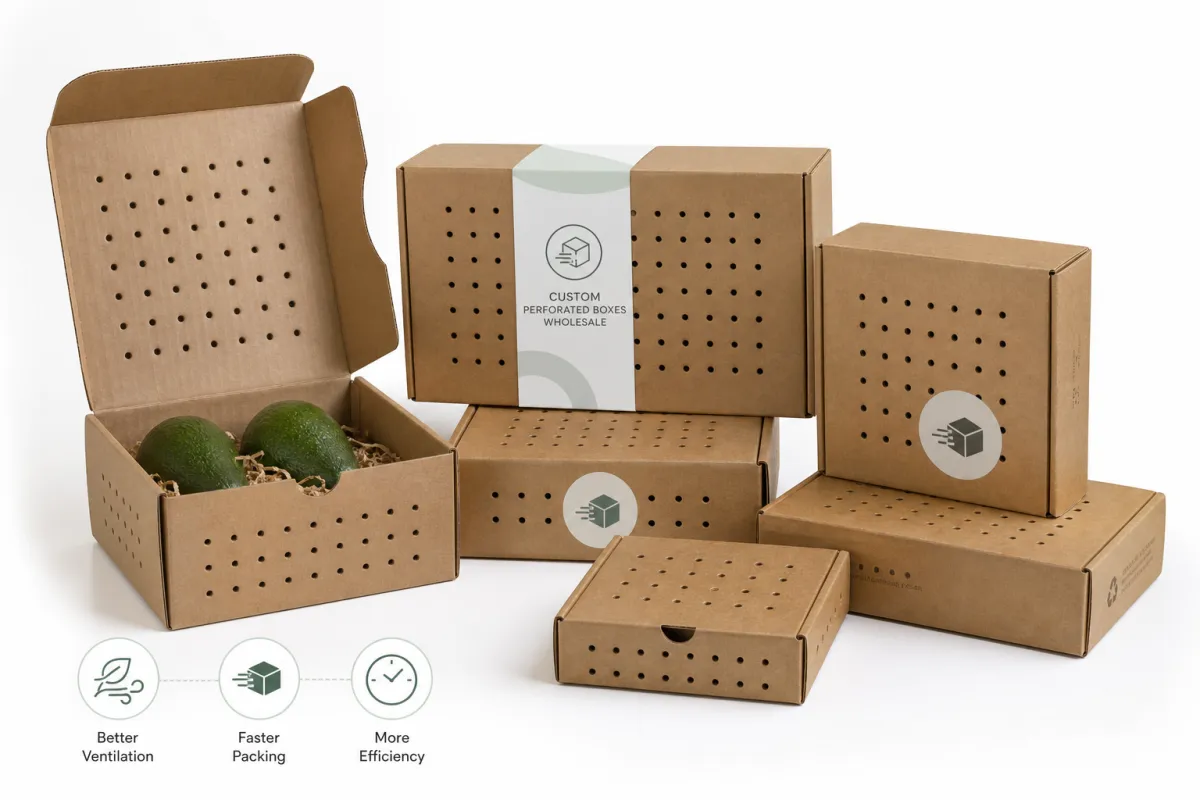
Walk through a busy fulfillment area and the friction is easy to spot. Someone is trying to open a carton with one hand while the other hand holds a label, a scan gun, or a product that should not touch the floor. That is where time leaks out. Custom perforated boxes wholesale gives the packer a built-in opening path, so the box opens the way the process expected it to open instead of forcing improvisation.
Speed is only part of the story. A good perforation can reduce knife use, which helps with safety and keeps the bench cleaner. It also cuts down on rework. Fewer torn flaps mean fewer cartons tossed aside because the front panel got mangled before the product even went in. The difference feels minor until it is repeated a few thousand times. Then it is not minor at all.
From an operations point of view, predictable tear behavior matters a lot. If the board grade, score depth, and perforation spacing stay consistent, the opening action stays consistent too. That makes training easier and keeps supervisors from having to explain three different workarounds for the same carton. Nobody needs that kind of circus.
A clean tear line is not a fancy extra. It is a practical decision that can save labor, protect the product, and make the package look like somebody meant it.
The best perforation is the one matched to the next step in the process. If the carton becomes a shelf-ready tray, the tear should preserve the face that customers see first. If the box is used for kitting, the opening needs to expose the contents without collapsing the structure. If it is a returnable mailer, the opening path needs to work without wrecking the reclose function. That last one gets ignored a lot, and then everyone acts surprised when the box turns into a one-time-only event.
Wholesale buying helps because the same structure can be repeated across sites, shifts, and reorder cycles without redesigning the carton every time. A fixed opening style, fixed size, and fixed print layout are easier to manage. That is where custom perforated boxes wholesale really earns its place. The packaging stops being a moving target.
What custom perforated boxes wholesale are made to do
At the simplest level, custom perforated boxes wholesale means cartons with controlled tear lines, removable panels, or easy-open sections built into the board. The perforation is part of the dieline, not a last-minute add-on. That matters because the cut pattern, score strength, and tear behavior all need to work together. If one piece is off, the opening gets messy fast.
There are a few common formats. A full panel release works well for shelf-ready packaging or display cartons that need to expose the product quickly. A top-strip opening gives access while keeping most of the structure intact. A side-access panel can work when the contents should stay partially enclosed. Hang-tab styles can also include perforated release points, especially when retail presentation matters as much as shipping performance.
custom perforated boxes wholesale shows up in retail display, sample kits, subscription shipments, store transfers, and e-commerce returns. It also fits promotional packaging where the printed surface needs to stay strong after the opening step. Nobody wants a carton that looks great until the first tear turns it into something that belongs in the break room recycling bin.
The opening style changes the user experience more than people admit. A carton that opens from the wrong edge can feel awkward even if the board is strong. A tear strip that cuts through a barcode or legal copy can create real problems for the retailer. I have seen that happen, and it is never the kind of mistake anyone wants to explain twice. That is why custom perforated boxes wholesale should follow the use case, not just the shipping dimensions.
There is always a trade-off between access and protection. A carton that opens too easily can fail under stacking pressure. A carton that is too stiff can frustrate the person opening it and leave ugly ragged edges behind. The goal is simple: open cleanly, then keep doing the rest of the job during transit, storage, and display. Sounds basic. It still gets missed.
For buyers comparing options, I usually think about function first:
- Retail packaging: needs a clean front face, readable graphics, and a controlled opening.
- Product packaging: needs a balance of access and protection.
- Branded packaging: needs the tear path to avoid logos, taglines, and barcodes.
- Custom printed boxes: need artwork placed with the die line in mind, not added after the fact.
For sustainability questions, many buyers ask about fiber sourcing. FSC-certified stock is a common option when responsible material sourcing matters, and the broader packaging industry has useful references through packaging.org. If the carton needs to survive a rougher shipping lane, testing references from groups like ista.org can help frame durability without guessing.
custom perforated boxes wholesale works best when the product defines the box, not the other way around. Tear path, front panel height, score strength, and opening direction should all be chosen with the unpacking step in mind. Everything else is decoration pretending to be strategy.
Material and structural specifications for custom perforated boxes wholesale
Board choice decides more than most buyers expect. A light carton can open beautifully and still fail under load. A heavy carton can survive stacking and still feel stubborn at the tear line. Custom perforated boxes wholesale only works well when the board matches the product weight, the shipping lane, and the way the carton gets handled after it arrives.
Single-wall corrugated is often enough for lighter loads, especially when the box is not stacked high and the opening panel is not carrying much stress. E-flute and B-flute are common in retail packaging because they print cleanly and keep the exterior neat. C-flute gives more cushion and compression strength, which matters for wider cartons or tougher transit conditions. Double-wall construction is worth a serious look when the load is heavier or the pallet pattern gets aggressive.
custom perforated boxes wholesale also depends on tear geometry. Hole spacing, notch depth, corner relief, and distance from folds all affect how the line behaves. Put the perforation too close to a score and the panel can split farther than intended. Set it too near a seam and the opening force may run the wrong direction. That is why the dieline should be checked against the artwork, not just reviewed as a flat blank on a screen.
Three things should guide perforation placement:
- Opening control: the line should start and stop where the user naturally pulls.
- Load path: the tear should avoid corners and major compression zones.
- Graphic placement: logos, instructions, and barcodes should stay readable after opening.
Finish choices change how custom perforated boxes wholesale holds up in the real world. A kraft look suits a natural brand image and hides handling marks better. A white face stock gives cleaner print and stronger contrast. Aqueous coating adds scuff resistance without making the board feel plasticky. Litho-labeled corrugated makes sense when the project needs sharp graphics on the outside and corrugated performance underneath.
Size specs need to be settled early. Internal dimensions, product clearance, fill weight, glue area, and shipping method all need to be decided before artwork gets locked. A carton that ships flat can save space and freight. A pre-assembled style can reduce labor at the destination. Either can work, but the structure has to match the packing process the business actually runs, not the one someone dreamed up in a meeting after lunch.
For stronger transit programs, ask for testing that matches the lane. Compression targets and stacking expectations are not the same as retail display needs, and an opening carton still has to survive the trip before it ever gets opened. If the pack is going through vibration, drop, or compression exposure, custom perforated boxes wholesale should be checked against the handling the carton will really face.
A good supplier should ask more than just size and quantity. They should ask whether the carton is standing upright, laid flat, palletized, or opened right away after receipt. Small changes in board grade or tear line location can decide whether the carton opens on cue or splits in the wrong spot like it has a grudge.
Pricing, MOQ, and unit economics for custom perforated boxes wholesale
Pricing for custom perforated boxes wholesale comes down to a handful of inputs: board grade, print coverage, perforation complexity, tooling, finishing, and whether the order needs inserts or partitions. A plain brown corrugated mailer with a basic tear strip will cost far less than a highly printed retail carton with a precise opening panel and artwork matched to the die line.
MOQ matters because setup work has to be spread across the run. Once a line is configured, a dieline is approved, and plates or tooling are set, larger quantities usually bring the per-unit cost down. That is why custom perforated boxes wholesale often makes the most sense for repeat programs, subscription kits, and retail rollouts that will reorder on a schedule instead of treating packaging like a one-off experiment.
Short runs can still work, but they behave differently from true wholesale production. Setup charge carries more weight, and the unit price can look high compared with a larger run. Reorders are where the economics start to improve. When the structure stays the same, the buyer pays more for material and less for repeated engineering work. That is the part wholesale buyers actually want.
Here is a practical comparison of common buying paths:
| Option | Typical MOQ | Approx. unit cost range | Best use | Notes |
|---|---|---|---|---|
| Simple perforated mailer | 250 to 1,000 | $0.95 to $2.10 | Sampling, smaller launches, test packs | Lower tooling burden, but less efficient on cost |
| Printed retail-ready carton | 1,000 to 5,000 | $0.42 to $1.25 | Retail packaging, display shipments, branded packaging | Good balance of print quality and throughput |
| High-volume wholesale run | 5,000+ | $0.18 to $0.55 | Repeat programs, warehouse transfers, national rollouts | Best value when specs stay stable across reorders |
| Complex perforated structure with inserts | 1,000 to 3,000 | $0.80 to $1.80 | Kits, premium product packaging, curated sets | Extra die-cut work and assembly raise cost |
Those ranges are working numbers, not promises. A carton with heavy print coverage, specialty coating, or multiple tear points will land higher. A straightforward brown shipper with a clean opening strip may come in lower. That is why a quote for custom perforated boxes wholesale only helps when the details are actually complete.
If you want a cleaner quote, send these items first:
- Exact box dimensions, preferably internal measurements
- Product weight and how the load sits inside the carton
- Desired perforation style, if known
- Artwork file or print expectation
- Order quantity and reorder expectation
- Target ship date and destination
- Any retail, compliance, or pallet requirements
That information lets the manufacturer separate material cost from structural work. It also cuts down on back-and-forth, which matters on custom perforated boxes wholesale orders where one small change to the tear line can affect the whole dieline.
Order process and timeline for custom perforated boxes wholesale
A clean order process protects the buyer and the production team. For custom perforated boxes wholesale, the workflow usually starts with spec review, then moves to structural recommendation, dieline creation, artwork proofing, sample approval, and production. Each step matters because the tear line, print areas, and final fold behavior all need to line up before the run starts.
Most delays show up where the perforation runs into other design elements. A barcode too close to the tear path can become unreadable. Legal copy can get cut by the opening panel. A logo can land in a zone that looks fine on the proof but gets split as soon as the carton is opened. That is why custom perforated boxes wholesale should be proofed against the real opening motion, not only against a flat layout on screen.
For standard builds, a practical timeline often looks like this:
- Spec review: 1 to 2 business days
- Dieline and structural confirmation: 2 to 4 business days
- Artwork proofing: 2 to 5 business days depending on revision count
- Sample approval: 3 to 7 business days if a physical sample is needed
- Production: often 12 to 15 business days after final approval for straightforward runs
Complex builds take longer. Extra perforations, inserts, unusual coatings, or tight print registration can add days. If the carton is tied to a launch, the smarter move is to approve the structural sample early and leave room for one more review cycle than feels necessary. That is especially true with custom perforated boxes wholesale because a tiny change near the tear line can ripple through the dieline and artwork in ways nobody wants to discover late in the game.
Communication milestones should be set from the start. Quantities need to be confirmed before plates or tooling are committed. Shipping method needs to be decided before cartons are packed for freight. Pallet requirements should be agreed on before the order moves to staging. Those checkpoints sound basic because they are basic, and skipping them is how wholesale programs drift into avoidable delays.
In practice, the best orders are the ones where the buyer and supplier agree on what success looks like before production begins. Does the box need to stack for two weeks in a warehouse? Does the customer open it from the front or the top? Will the display panel stay on shelf after opening? The answers shape the structure, and custom perforated boxes wholesale performs better when those answers are settled early.
Why choose us for custom perforated boxes wholesale
For buyers comparing vendors, the biggest advantage is not some flashy promise. It is clear spec work, responsive quoting, and cartons that behave the way they should on the packing line. That is the practical value Custom Logo Things should bring to custom perforated boxes wholesale: honest structure recommendations, useful print guidance, and a straight read on how the carton will behave in real handling conditions.
Decision support matters more than hype. If a carton needs heavier board to survive stacking, that should be said directly. If the opening strip needs to move away from a score line, that should be adjusted before the proof gets signed off. The point of custom perforated boxes wholesale is not to make the box look clever in a mockup. It is to make it work in the warehouse, in transit, and at the point of use.
Quality control for perforated structures should focus on the details that actually affect performance:
- Tear consistency: the opening should follow the intended line without wandering.
- Score alignment: folds and perforations should sit where the die line planned them.
- Adhesive integrity: glue seams should stay secure under stacking and handling.
- Carton squareness: the box should assemble cleanly and load evenly.
- Graphic placement: branding should stay intact after opening.
Those checks matter most on repeat orders, because the first run becomes the baseline for every reorder that follows. A stable spec is easier to forecast, easier to store, and easier to deploy across multiple locations. For wholesale buyers, that kind of consistency is a quiet advantage. It keeps the program from drifting every time the order is repeated, and that is exactly why custom perforated boxes wholesale can save more than it looks like on paper.
I also like suppliers who admit when a structure needs a test run. No carton is magic. If the product is heavy, the board is light, or the shipping lane is rough, the right answer is usually a sample and a real check, not blind optimism. That honesty saves everyone from a late-night reprint panic, which is never fun and never cheap.
The box should make the job easier, not ask the crew to work around it. That is usually the clearest test of whether a perforated carton has been designed well.
If you are building a broader packaging program, it also helps to see where these cartons fit alongside other formats. A perforated carton may be one piece of a larger mix of Custom Packaging Products, including mailers, retail trays, and custom printed boxes. For buyers managing multiple locations or repeat replenishment, Wholesale Programs can simplify ordering and keep specs aligned from one run to the next.
custom perforated boxes wholesale should also fit the brand story. The carton is not just a transport shell. It is part of product packaging and package branding. When the opening step looks intentional, the whole experience feels more controlled, which is what buyers want whether the carton is headed to a store, a distributor, or a direct customer.
Next steps for custom perforated boxes wholesale orders
If you are ready to move, start with the minimum facts that let a supplier build the right recommendation: box size, product weight, perforation style, print needs, quantity, and shipping destination. Those details are enough to begin a meaningful quote for custom perforated boxes wholesale without wasting time on a generic estimate that will change later.
If the opening style is not finalized, ask for a structural recommendation first. That is often the smartest move, because the right tear path depends on how the product sits inside the carton and what happens after the box is opened. A display-ready tray needs a different approach from a returnable mailer or a transfer carton. Same keyword, different job.
From there, the path is straightforward: quote, proof, sample, approval, production. Keep sign-off at each stage, and do not rush the structural review. Most late changes cost more than the original adjustment would have cost at the beginning, especially on custom perforated boxes wholesale where the perforation line is tied closely to the die and the artwork.
One practical note: if you plan to reorder, say that early. Wholesale programs get better when the spec stays stable, the carton size remains fixed, and the print layout does not change every cycle. That is how custom perforated boxes wholesale turns into a repeatable part of operations instead of a one-off packaging experiment nobody wants to revisit.
Send the box size, the product weight, and the opening style you want first. If you already know you need custom perforated boxes wholesale, that information is enough to start the conversation, narrow the structure, and move toward a carton that packs faster, opens cleaner, and supports the way your products actually move.
Frequently Asked Questions
What products work best with custom perforated boxes wholesale?
They work well for products that need fast, clean opening without knives, including retail kits, mailer returns, sample packs, and display-ready goods. They also make sense when the customer should open the box without damaging the contents or the outer presentation.
How do custom perforated boxes wholesale stay strong after adding a tear line?
Strength comes from placing the perforation away from load-bearing corners and Choosing the Right board grade for the finished package weight. A good design is tested for stacked compression and tear consistency so the box opens predictably without splitting where it should not.
What MOQ is typical for custom perforated boxes wholesale orders?
MOQ depends on board type, print coverage, and tooling, but wholesale runs usually make the most sense once the order reaches a few hundred units or more. Higher quantities generally lower the unit price because setup costs are spread across more cartons.
Can custom perforated boxes wholesale be printed with branding?
Yes, branding is common, but artwork should stay clear of the tear path so the opening panel does not cut through logos, copy, or barcodes. It helps to proof the dieline against the artwork early so print placement, perforation, and final use all line up cleanly.
How long do custom perforated boxes wholesale orders take?
Timing depends on proof approval, sample needs, and the complexity of the structure, but the biggest schedule step is usually final sign-off. Simple repeat runs move faster than fully custom printed structures, and shipping time should be added based on destination and pallet needs.

