Buyer Fit Snapshot
| Best fit | Custom Product Labels Wholesale for Fast Brand Launches projects where brand print, material claims, artwork control, MOQ, and repeat-order consistency need to be specified before quoting. |
|---|---|
| Quote inputs | Share finished size, material target, print colors, finish, packing count, annual reorder estimate, ship-to region, and any compliance wording. |
| Proofing check | Approve dieline scale, logo placement, barcode or warning zones, color tolerance, closure strength, and carton packing before bulk production. |
| Main risk | Vague material claims, crowded artwork, missing packing details, or unclear freight terms can make a low unit price expensive after revisions. |
Fast answer: Custom Product Labels Wholesale for Fast Brand Launches should be specified like a repeatable production item. The safest quote records material, print method, finish, artwork proof, packing count, and reorder notes in one written spec.
Production checks before approval
Compare the actual filled-product size with the drawing, then confirm tolerance on folds, seals, hang holes, label areas, and retail display edges. Reserve space for logos, QR codes, warning copy, and material claims before decorative graphics fill the panel.
Quote comparison points
Review material grade, print process, finish, sampling route, tooling charges, carton quantity, and freight assumptions side by side. A quote is only useful when the supplier can repeat the same color, closure quality, and packing count on the next order.
Custom Product Labels Wholesale for Faster Brand Launches
Custom Product Labels wholesale can be the difference between a launch that moves cleanly through production and one that gets tangled in reprints, adhesive failures, and artwork corrections that should have been caught earlier. I have watched brands spend more time fixing a label than choosing it, which is a strange place to end up given how small the component looks on a mockup. A mislabeled run rarely causes only one problem. It usually spreads into labor, shipping delays, inventory holds, and the kind of quiet frustration that comes from touching the same box twice.
Once volume starts climbing, labels stop behaving like a tiny accessory and start acting like part of the packaging system. They need to bond to glass, plastic, coated cartons, and pouches. They need to survive cold storage, moisture, oil, abrasion, and repeated handling. They also need to sit visually beside Custom Printed Boxes, inserts, and the rest of the brand system without looking like a last-minute add-on. That is where custom product labels wholesale earns attention: the buyer gets better cost control, a steadier replenishment cycle, and a spec that supports package branding instead of fighting it. Bulk labels become less like a purchase and more like planning.
Used well, custom product labels wholesale becomes more than a buying decision. It becomes a process decision. The right construction reduces surprises, makes reorder planning easier, and gives the brand a label structure that can be repeated without reinventing the job every time inventory turns. A 2% reprint rate on a 25,000-unit run is not a rounding error. It is 500 labels, plus the labor attached to them. That kind of math gets attention fast.
Why custom product labels wholesale can cut costs fast
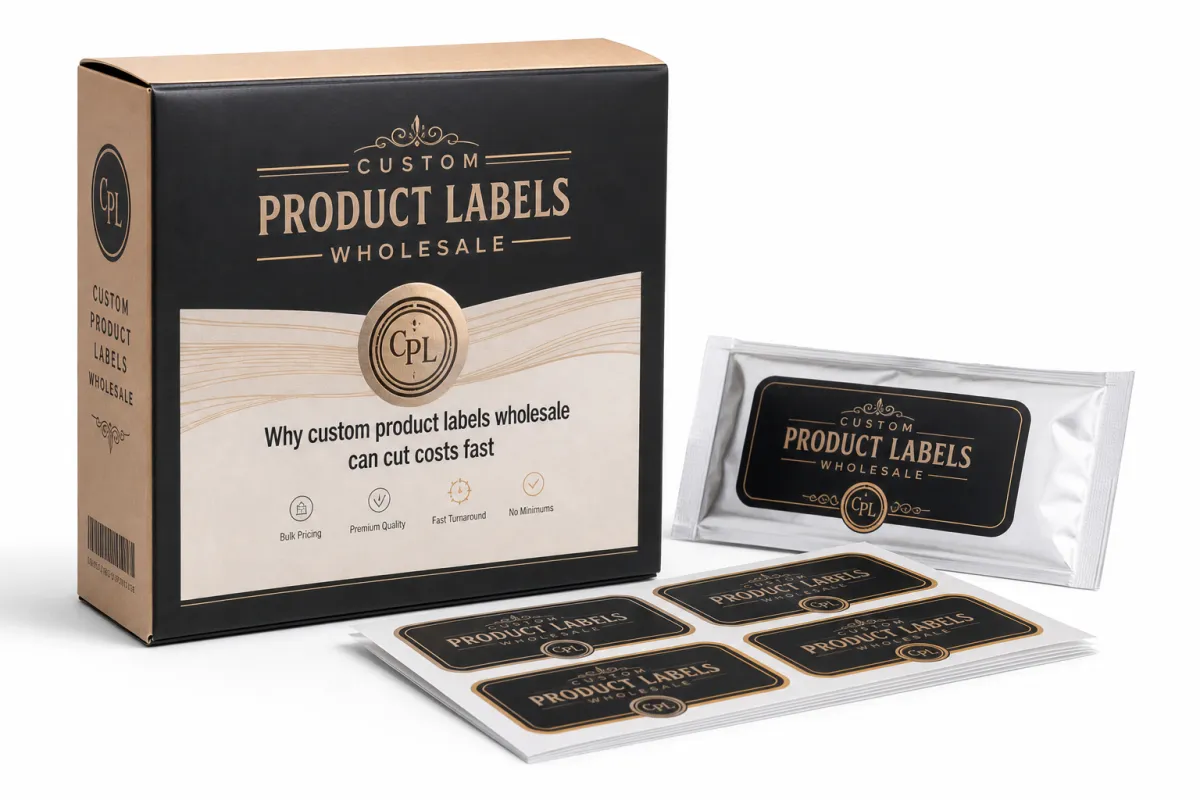
Many teams treat labels as a minor line item until the cost of poor fit shows up in packing labor and rejected stock. A label that lifts at the corners on a chilled jar, smears under oil, or jams on the applicator can cost more than a better construction would have cost upfront. I have seen a supplement line lose half a shift because labels were cut for the artwork, not for the applicator. That sounds small on paper. It is not small in a warehouse.
A food, health, or beauty launch makes the point quickly. The first run may be small enough that almost any label works. Once the product starts moving, the package faces more shipping miles, more warehouse time, and more hands. At that point, custom product labels wholesale protects margin because the buyer can specify the right adhesive, finish, and material before problems start showing up in the warehouse.
Consistency across product packaging matters too. If the label is part of a broader branding system, the same color target, finish, and die shape can appear on the label, the carton, and related inserts. Shoppers notice when those pieces agree with one another. They also notice when one piece looks like it came from a different brand entirely. That is a small visual detail with a large commercial effect, which is kinda the whole point of packaging design.
Ask a practical question before approving any label spec: what does the label have to survive after it leaves the press? Moisture, cold, oil, repeated handling, and long shelf life all point to a performance-first decision. Custom product labels wholesale works best when the spec is built around the actual use environment instead of a generic idea of "premium." Premium is not a material. It is a result.
Brands that plan to grow into broader Custom Packaging Products benefit from thinking in systems. A label that matches the carton design, bottle shape, and shipping format keeps the launch easier to manage. That makes custom product labels wholesale part of the larger packaging design conversation rather than a last-minute add-on.
"A label that looks right but fails in the packing room is the wrong label. The best wholesale order is the one that behaves the same on day one and on reorder day."
Clearer expectations also save time. Instead of asking for a vague premium label, define the package surface, environment, application method, and finish. Once those pieces are on the table, custom product labels wholesale becomes easier to quote, easier to compare, and much easier to reorder without guesswork.
Custom product labels wholesale: materials, adhesives, and finishes
The material decision starts with a blunt question: what conditions will the label face? Paper stocks work well for dry goods, shelf-stable cartons, and short-run retail packaging where the label only needs to stay clean and legible under normal handling. BOPP or polypropylene is a stronger fit for jars, bottles, and products that may be chilled or wiped down because it resists moisture better. Vinyl serves tougher use cases. Specialty stocks can give launch sets or higher-end package branding a more distinctive look.
In custom product labels wholesale, material choice is tied directly to the product environment. A jar in a refrigerator has different needs from a carton on a dry shelf. A lotion bottle may encounter condensation and oils. A supplement bottle may need a cleaner, more clinical presentation. A shipping label on a display kit may need durability first and visual drama second. Good sourcing starts with that level of practical match, not with a generic stock name.
Adhesive choice matters just as much. Permanent acrylic adhesives are a common default because they work well on many smooth surfaces, including glass, plastic, and coated paperboard. Removable adhesives make sense when the label has to come off cleanly later, though they are not right for every package. Freezer-grade adhesives are built for low temperatures, and high-tack adhesives help on rougher or harder-to-bond surfaces. In custom product labels wholesale, the adhesive is often the hidden reason one quote performs better than another.
Finish changes both appearance and function. Matte creates a softer, quieter look and can improve readability on text-heavy labels. Gloss adds visual punch and helps color blocks feel denser. Soft-touch feels premium in hand, although it raises cost and is not the best fit for every application. Clear film can produce a no-label look on transparent containers, while metallic stocks or metallic effects can make a launch feel more upscale. Protective varnish or lamination can improve scuff resistance and moisture protection, which is why those finishes come up often in custom product labels wholesale orders meant for transit or refrigerated storage.
Format affects the economics too. Roll labels are common for automatic or semi-automatic application and can reduce labor when the line is built for roll-fed dispensing. Sheet labels are easier for hand application or very small runs. Kiss-cut shapes allow easy peel-and-apply handling, while fully die-cut labels can support custom outlines and more distinct branding. The strongest custom product labels wholesale quote usually matches the format to the application method instead of forcing one style onto every package.
If paper sourcing matters to the brand, check whether the stock can align with documented forestry standards. The Forest Stewardship Council is a useful reference point for buyers looking at responsible fiber sourcing: FSC. That does not mean every paper label needs a certification claim, but it does mean the buyer can ask sharper questions before approving the spec.
For brands comparing common constructions, the table below is a practical starting point. Exact pricing still depends on size, coverage, quantity, and finishing, but the tradeoffs stay consistent across many custom product labels wholesale orders.
| Material / Format | Best Fit | Typical Strength | Relative Wholesale Cost |
|---|---|---|---|
| Paper label | Dry retail packaging, cartons, short shelf life products | Clean print quality, easy to convert, economical for volume | Lowest |
| BOPP / polypropylene | Bottles, jars, refrigerated goods, moisture exposure | Water resistance, good durability, strong everyday performance | Moderate |
| Vinyl | Tougher use cases, heavier handling, rougher surfaces | More rugged feel and longer service life | Higher |
| Specialty stock | Premium package branding, launch kits, gift sets | Distinctive look and feel, more visual impact | Highest |
What should you check before ordering custom product labels wholesale?
Precise specs are what turn a quote into something useful. Start with label size, then go further. Confirm bleed, corner radius, core size, unwind direction, and application orientation. Those details sound small until the labels arrive and the applicator is set up for the wrong roll direction or the trim leaves too little room for clean edge handling. For custom product labels wholesale, the spec sheet is not paperwork; it is production insurance.
Durability needs plain language. Will the label sit in a fridge? Travel through a cold chain? Touch oil, sanitizer, or condensation? Need UV resistance for window display or outdoor storage? If the product is handled often, the surface should be tested for abrasion resistance and ink adhesion. Some teams also reference ASTM methods for consistency checks, such as peel or tack testing, when the application is sensitive and a label failure would be expensive. That level of testing is not necessary for every order, but it can help on custom product labels wholesale runs where the product environment is unforgiving.
Printing details affect legibility and compliance. CMYK works well for many artwork-heavy jobs, while spot colors help with brand-critical color matching. White ink on clear film can make type and logos stand out, but it adds complexity and can change cost. Barcodes need strong contrast and enough quiet zone around them to scan properly. Small ingredient or warning text should be checked at actual size, not just on a zoomed-in screen, because a label that looks fine in proof can feel cramped once trimmed.
For brands selling food, personal care, supplements, or household products, the label has to support whatever regulatory copy belongs on the package. That means the art file needs space for ingredient panels, net weight, recycling marks, or caution statements if those apply. The faster the buyer confirms that space before ordering custom product labels wholesale, the less likely the job will stall in proof review.
A clean proofing checklist saves time and money:
- Confirm the final label dimensions against the actual package surface.
- Check bleed, trim, and safe area so text does not drift too close to the edge.
- Review the dieline for corner radius, cut shape, and any special notches.
- Verify barcode size, contrast, and placement at actual print scale.
- Read all ingredient, warning, or compliance copy line by line.
- Confirm the finish, adhesive, and stock against the real use environment.
If the labels will be used in shipping or repeated warehouse handling, package testing matters too. The ISTA test methods are widely used in the industry to simulate transit stress, vibration, and drop conditions. That matters because a label that survives the press is not automatically the label that survives the journey. The most dependable custom product labels wholesale orders are the ones where the packaging team thinks through the whole route, not just the art file.
One more practical point: do not let the design file hide a material problem. If the label is meant for a clear bottle, make sure transparency works with the printed text. If the product is stored cold, ask whether the adhesive can handle condensation during application. If the package is oily, test the actual product surface. These are the details that separate a smooth custom product labels wholesale order from a frustrating one.
Pricing, MOQ, and custom product labels wholesale value
Pricing for custom product labels wholesale comes down to a few variables buyers can actually control. Material choice is the biggest one, followed by label size, ink coverage, finish, die complexity, quantity, and whether the job is run digitally or on a longer production press. A small, simple paper label with modest ink coverage will usually cost much less than a large BOPP label with white ink, lamination, and a custom contour cut.
For planning purposes, a standard 2 x 3 inch label with ordinary four-color print might land around $0.04-$0.09 per unit at 5,000 pieces on paper, $0.06-$0.14 on BOPP, and $0.10-$0.22 or more on vinyl or specialty constructions, depending on coverage and finishing. Those are not promises; they are working ranges that help buyers budget before the quote comes back. With custom product labels wholesale, the point is not to chase the cheapest number. The point is to understand what the number includes.
MOQ changes the cost story. Higher quantities usually spread setup and press time over more units, which lowers unit cost. Lower MOQ orders can help with cash flow, SKU testing, or early-stage launches, but they often carry a higher per-label price. That tradeoff is normal. The right order size for custom product labels wholesale depends on how fast the labels move through the warehouse and how much storage the team can hold comfortably.
Hidden costs deserve attention early. Proofs may be included or billed separately. Setup charges can appear on specialty jobs. Rush production may add a fee. Revision charges can show up if artwork changes after proof approval. Shipping can become a major variable if the order needs to arrive on a tight window. When comparing custom product labels wholesale quotes, ask for an apples-to-apples comparison with the same size, material, finish, adhesive, quantity, and delivery date.
The table below breaks down the most common buying choices and how they influence value.
| Cost Driver | What It Changes | Buyer Impact | What to Ask |
|---|---|---|---|
| Material | Durability, appearance, moisture resistance | Can raise or lower unit price quickly | Is paper enough, or does the package need BOPP or vinyl? |
| Quantity | Setup cost spread, per-label price | Higher runs usually lower unit cost | What quantity hits the best working price? |
| Finish | Visual effect and protection | Lamination and specialty coatings add cost | Is matte, gloss, or laminate actually needed? |
| Die complexity | Cutting time and tooling | Fancy shapes may cost more | Will a simpler shape work just as well? |
| Print coverage | Ink usage and press time | Heavy backgrounds usually cost more | Can the design reduce flood coverage without hurting the look? |
If the same launch also needs case packs or companion cartons, it can be smart to review the broader Wholesale Programs page and align the label budget with other branded packaging items. That way the numbers for custom product labels wholesale do not get set in isolation while the rest of the package system is still changing.
The cheapest quote is not always the best value. A label that requires hand rework, extra inspection, or a second run because the adhesive was wrong will erase savings very quickly. Good custom product labels wholesale buying means looking at the whole cost of ownership, not only the per-piece price on the estimate.
Process and timeline for custom product labels wholesale orders
The order flow should be simple enough that both sides know what happens next. It usually starts with a quote request, then moves into artwork review, proof approval, production, quality check, packaging, and shipping. That sequence sounds standard, but it is exactly where strong custom product labels wholesale buyers save time. When the artwork is clean and the spec is clear, the process moves predictably. When either one is vague, every step slows down.
Simple orders can move quickly, especially if the artwork is final and the stock is common. A straightforward digital run may ship within roughly 5-10 business days after proof approval, while more specialized jobs with custom dies, metallic effects, or lamination often need 10-15 business days or more. Large quantities, complex finishes, and variable data can extend the schedule further. For custom product labels wholesale, the smart move is to build in time for proof review rather than assuming the fastest possible turnaround.
Most delays come from the same few issues: missing artwork files, unclear dielines, late proof changes, or compliance copy that has to be corrected after the fact. That is why good prepress communication matters. If the order needs a barcode, a serial number, a batch code, or an ingredient block, those elements should be settled before production begins. Every extra revision slows down custom product labels wholesale orders and can create avoidable costs.
"The schedule almost always slips at the proof stage, not the press stage. A careful proof saves more time than a rushed production slot."
Planning reorder points is just as important as the first run. If the brand waits until the last carton of labels is on the shelf, the team loses negotiating room and invites rush charges. A better approach is to set a reorder threshold based on lead time, average weekly use, and safety stock. For many custom product labels wholesale buyers, that means ordering again while there is still enough inventory to absorb a normal production window plus shipping.
It also helps to think about how the label will be stored before use. Humidity, heat, dust, and direct sunlight can all affect label performance over time. Rolls should stay clean and flat. Sheet labels should be kept from curling or bending. If the label is printed for a refrigerated product, the team should confirm how the stock behaves when it moves from warehouse conditions to cold storage. Those small operational questions keep custom product labels wholesale inventory useful instead of stale.
Here is a practical timeline framework many buyers can work from:
- Day 1 to 2: submit specs, artwork, and quantity target.
- Day 2 to 4: receive quote and proof.
- Day 4 to 6: review and approve proof, or request one round of corrections.
- Day 6 to 15: production, inspection, and packing.
- Final step: ship, receive, and verify the order against the purchase spec.
For launch teams, this timeline is easier to protect when the label spec is not changing every few days. The same discipline that helps with labels also helps with cartons, inserts, and other product packaging components. That is especially true when the brand wants the printed carton, the bottle label, and the outer package to look like one coherent system.
Why choose us for custom product labels wholesale
Wholesale buyers rarely need a flashy pitch. They need a partner who can match the label structure to the package, the environment, and the application method without creating extra back-and-forth. That practical support is the core value behind custom product labels wholesale at Custom Logo Things. The goal is to help buyers choose a label that fits the job instead of paying for a spec that sounds good but does not hold up in production.
Consistency is a major reason wholesale customers return. Once a label works, it should keep working the same way on reorder. That means repeatable cut size, stable color output, and dependable adhesive behavior from one run to the next. When a launch grows, the buyer should not have to relearn the label spec every time inventory cycles. Strong custom product labels wholesale support protects that consistency and keeps package branding from drifting.
Clear communication matters as much as production quality. Buyers Should Know which specs are final, which items are still open for approval, and what the expected delivery window looks like. That kind of transparency reduces stress, especially when a launch depends on coordinated arrival of labels, cartons, and other branded packaging components. If the team is also building custom printed boxes or a broader retail packaging system, the label work can be aligned to the same color targets and finish choices so the whole package feels deliberate.
There is also value in not overbuilding the spec. Some buyers assume a better label must be thicker, shinier, or more complicated. That is not always true. A well-chosen material and adhesive often performs better than a fancy label that is simply too much for the package. The right custom product labels wholesale recommendation can reduce waste, simplify application, and keep the launch budget focused where it actually matters.
Our internal product pages make that easier to sort through. If you are comparing label styles with other packaging needs, the Custom Labels & Tags page is a practical place to review form factors, while the Custom Packaging Products page can help when the label is only one part of the package system. For broader buying questions, the Wholesale Programs page is useful for planning repeat orders and coordinating volume.
From a packaging buyer’s point of view, the best supplier relationship is one that reduces uncertainty. A clear spec, a clear proof, and a label that performs the same way on each reorder are worth more than a glamorous pitch. That is the standard we aim for with custom product labels wholesale, because that is what actually helps a brand launch faster and stay organized afterward.
Next steps for custom product labels wholesale buyers
The fastest way to get a useful quote is to gather the right inputs before asking for one. A good starting packet includes package photos, label dimensions, estimated quantity, material preference, surface type, and how the label will be applied. If the product will face cold storage, oil, condensation, or heavy handling, include that detail in the request. Those facts help turn custom product labels wholesale into a practical recommendation instead of a guess.
Request samples or a small test run when the application is difficult. A label that will be exposed to moisture, refrigeration, or frequent handling should be tested on the real surface before a full production order is approved. The same advice applies to new artwork with small text, fine lines, or barcode placement. A short test can prevent a much larger problem later, which is one reason experienced teams treat custom product labels wholesale as a controlled production decision rather than a casual purchase.
Plan reorder thresholds before the first shipment lands. If the team knows the average monthly label use and the production lead time, they can avoid emergency ordering and keep inventory at a healthy level. Storage matters too. Labels should stay clean, dry, and protected from heat or sunlight. That kind of housekeeping keeps custom product labels wholesale stock ready when the line needs it.
Here is a simple action list to keep the next order on track:
- Gather package photos and exact label measurements.
- Decide whether the label must resist moisture, oil, cold, or UV exposure.
- Choose the expected quantity so pricing and MOQ can be compared properly.
- Share artwork files in a production-ready format such as PDF, AI, or EPS.
- Ask for proof review before production starts.
- Set a reorder point based on lead time and inventory usage.
That planning discipline pays off in the finished product packaging. Labels that fit the package, the surface, and the environment support better line speed, fewer reprints, and a more consistent customer-facing result. For brands that want reliable replenishment and cleaner brand execution, custom product labels wholesale is often the most straightforward path.
What is the best material for custom product labels wholesale orders?
Paper works well for dry products and short-run packaging where moisture is not a concern. BOPP or polypropylene is a stronger fit for bottles, jars, and packages that may face condensation, oils, or frequent handling. The right choice for custom product labels wholesale depends on the surface, the environment, and how long the label needs to stay clean and legible.
How does MOQ affect custom product labels wholesale pricing?
Higher quantities usually lower the cost per label because setup and production costs are spread across more units. Lower MOQs can help with cash flow and storage, but the unit price is often higher. For custom product labels wholesale, the right order size depends on how fast the labels move and how much inventory the team can store comfortably.
Can custom product labels wholesale be waterproof?
Yes, but waterproof performance depends on the label stock, adhesive, and finish working together. BOPP, vinyl, and protective lamination or coating are common choices for wet or refrigerated environments. Always test the finished label on the actual package surface before approving a full production run, especially on custom product labels wholesale orders that will face moisture or cold.
How long do custom product labels wholesale orders usually take?
Turnaround depends on artwork readiness, material selection, finishing, and production method. Simple orders with approved art move faster than jobs that need special inks, die-cuts, or compliance corrections. Build in time for proof review so the schedule does not slip at the last minute on custom product labels wholesale jobs.
What file types should I send for custom product labels wholesale artwork?
Vector files such as PDF, AI, or EPS are preferred because they hold sharp detail at production size. Include bleed, outlined fonts, and any barcode or variable-data requirements so prepress can check the layout correctly. If the label includes small legal or ingredient text, review it at actual size before approving the proof for custom product labels wholesale.
For brands that want repeatable colors, dependable adhesion, and cleaner replenishment, custom product labels wholesale is often the most practical way to keep packaging moving without making the line more complicated than it needs to be. The smartest move is simple: define the real use environment, test the label on the real surface, and reorder before inventory gets tight.

