Buyer Fit Snapshot
| Best fit | Custom Pharmaceutical Packaging Boxes projects where brand print, material claims, artwork control, MOQ, and repeat-order consistency need to be specified before quoting. |
|---|---|
| Quote inputs | Share finished size, material target, print colors, finish, packing count, annual reorder estimate, ship-to region, and any compliance wording. |
| Proofing check | Approve dieline scale, logo placement, barcode or warning zones, color tolerance, closure strength, and carton packing before bulk production. |
| Main risk | Vague material claims, crowded artwork, missing packing details, or unclear freight terms can make a low unit price expensive after revisions. |
Fast answer: Custom Pharmaceutical Packaging Boxes: Specs, Cost, Timeline should be specified like a repeatable production item. The safest quote records material, print method, finish, artwork proof, packing count, and reorder notes in one written spec.
Production checks before approval
Compare the actual filled-product size with the drawing, then confirm tolerance on folds, seals, hang holes, label areas, and retail display edges. Reserve space for logos, QR codes, warning copy, and material claims before decorative graphics fill the panel.
Quote comparison points
Review material grade, print process, finish, sampling route, tooling charges, carton quantity, and freight assumptions side by side. A quote is only useful when the supplier can repeat the same color, closure quality, and packing count on the next order.
A medicine can be chemically correct and still feel a little uncertain if the carton looks thin, crowded, or slightly off-center. That is the part people sometimes miss about custom pharmaceutical packaging boxes: the package starts doing trust work before anyone opens it, scans a barcode, or reads a dosage line.
For a packaging buyer, the carton is never just a shell. It is secondary packaging, a shelf signal, a shipping buffer, and a compliance surface all in the same piece of board. Treat it like branding alone and the bill usually shows up later in rework, confusion, or a reprint nobody planned for.
If the carton is hard to read or looks inexpensive, the brand has already lost credibility it probably did not budget to lose.
Custom pharmaceutical packaging boxes need a practical brief, not a vague pile of reference images. The best results usually come from a clean dieline, a disciplined information hierarchy, and a realistic view of what the box has to survive between approval and warehouse shelf. That part is not glamorous, but it is the part that saves headaches.
What Are Custom Pharmaceutical Packaging Boxes?
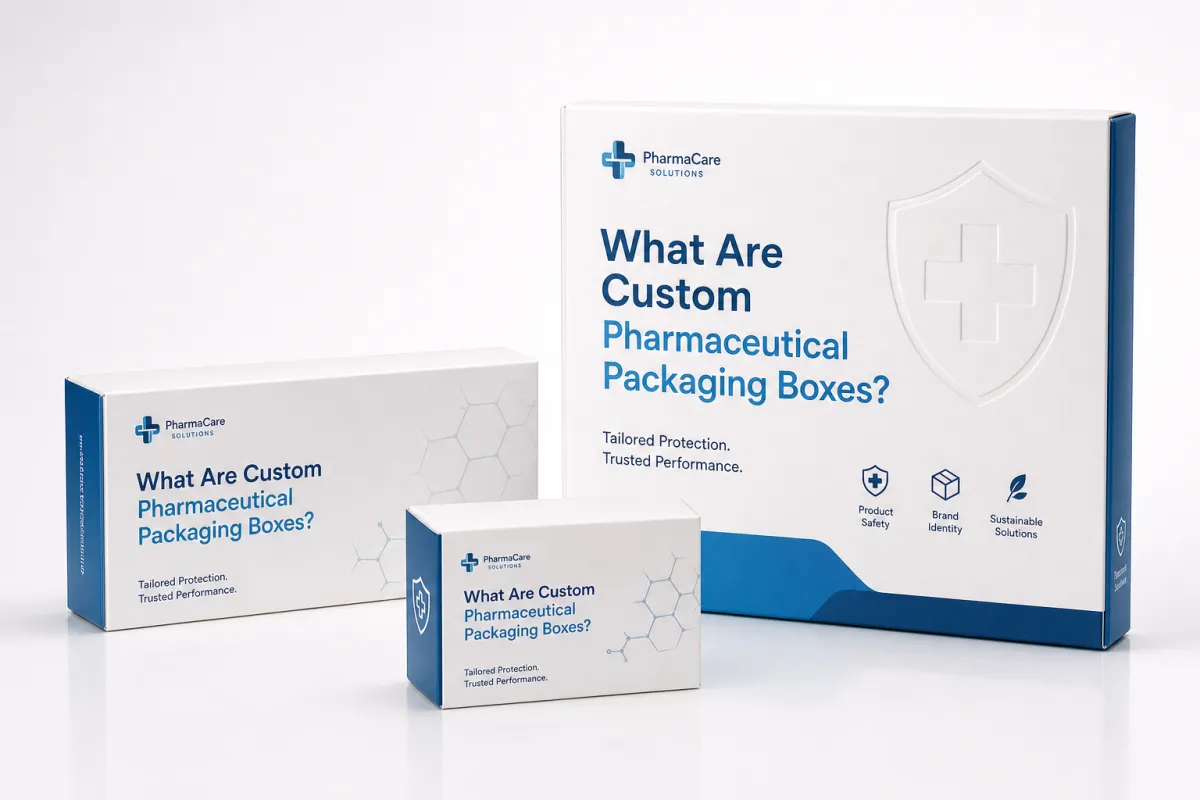
Custom pharmaceutical packaging boxes are printed secondary packages made for tablets, capsules, syrups, sample kits, OTC products, and institutional supplies. In plain terms, they are the cartons that sit around the primary pack and carry the brand, the regulated copy, and the practical details people actually need. SBS board, C1S artboard, inserts, tamper-evident features, barcode zones, and fold structures all show up here because the carton has to do more than look tidy in a mockup.
They matter because pharmaceutical packaging has a split personality. It has to look orderly enough to build confidence, while staying disciplined enough to keep warnings, strength, lot coding, and expiration data easy to find. A box can be beautifully printed and still fail if the critical information gets buried under visual noise. Custom pharmaceutical packaging boxes earn their place by making the important information obvious.
One size rarely works. A 30-count blister pack, a carton for unit-dose sachets, and a sample-size box all call for different proportions, closure styles, and panel priorities. Force those three into one generic structure and the result is usually wasted board, weak shelf presence, or copy that reads like it was crammed in at the last minute. Custom pharmaceutical packaging boxes solve that by matching the structure to the product instead of making the product adapt to the carton.
They also shape how the product is seen in retail packaging, in clinic distribution, and in warehouse storage. Clean typography, sharp registration, and a clear hierarchy tell the buyer the company pays attention to details. That kind of package branding is not flashy, but it works. People do notice the difference, even if they do not always say it out loud.
In practice, the carton is part of the safety system too. The box can support dosage clarity, patient instructions, anti-counterfeit perception, and basic shipping protection. Custom pharmaceutical packaging boxes are not decoration. They are part of the product experience, and in plenty of cases they belong in the risk control plan as well.
I have seen projects where the formulation was approved, the insert was right, and the launch still stumbled because the packaging hierarchy hid the lot code or made the dosage line too easy to miss. That kind of miss is annoying because it is preventable. A carton has one job before it has ten jobs: communicate clearly.
Process and Timeline
The production flow for custom pharmaceutical packaging boxes looks straightforward on paper, then gets much less charming once files start moving between teams. It usually begins with discovery, where the packager confirms product dimensions, carton count, board preference, print coverage, and the required copy. From there comes dieline selection or structural design, artwork setup, proofing, sample review, prepress checks, printing, finishing, die-cutting, folding, and final packing. One small regulatory edit can ripple through the whole chain.
The longest delays rarely come from the press run itself. Missing copy, late barcode placement, unresolved warning text, incorrect measurements, and slow signoff from marketing, regulatory, or operations teams cause more pain than the printer usually does. A request for “just a tiny text change” can still trigger a new proof, a fresh check against the dieline, and a delay that pushes the clean part of the schedule out of reach. That is one of those things that sounds minor until it eats two days and a weekend.
For a simple repeat order with no structural change, custom pharmaceutical packaging boxes can move quickly once files are approved. A fully custom carton with new artwork, inserts, and compliance review usually takes longer. A practical range is often 7-12 business days after proof approval for a straightforward reprint, 12-18 business days for a new carton with standard print and finishing, and 15-25 business days if the job includes inserts, security elements, or multiple review rounds. Rush jobs exist, though they usually cost more and narrow the finish options.
Before asking for a quote, have the boring details ready. Final product dimensions, quantity, board preference, print colors, barcode data, warning text, target launch date, and shipping destination all belong in the first request. The more exact the input, the less vague the answer. Custom pharmaceutical packaging boxes are not the place for “close enough.”
Quality checks should happen before anyone signs off. Check the dieline for panel size and flap fit. Read every line of copy. Verify barcode placement and scannability. Review the color proof under neutral light. Test the folded sample for closure tension and glue performance. If the distribution route is rough, ask whether the shipper should be tested against ISTA methods or an ASTM-style distribution profile. That is not overcautious. It is ordinary discipline.
One more thing: the sample stage is where real packaging knowledge shows up. A fold that feels fine on screen can feel too tight once you run it by hand. A shade that looks balanced under office light can read muddy on the shelf. The only honest way to catch that is to put your hands on the sample and check it like a person who has to live with the result.
Safety, Branding, and Compliance
Materials come first. The board grade affects stiffness, print clarity, score quality, and how well custom pharmaceutical packaging boxes hold their shape inside a shipper. For lighter contents, 14pt SBS or a comparable coated board can be enough. For heavier packs or cartons that get handled often, 16pt to 18pt stock is usually more comfortable. A flimsy carton saves pennies and costs trust. That trade never ages well.
Compliance is where many designs slip. The carton needs to make the essential information easy to find: product name, dosage strength, quantity, lot code, expiration date, warning statements, and any region-specific copy. If the buyer has to hunt for the basics, the packaging failed the actual assignment. Custom pharmaceutical packaging boxes are not supposed to act like a puzzle.
Branding still matters, though it should stay controlled. Strong contrast, clear typography, and a disciplined hierarchy do more for confidence than decorative effects ever will. A carton can look refined and still fail if the finish throws glare across the dosage line under store lighting. Pretty is fine. Readable is better. That balance is where the work happens.
Supply chain realities matter just as much as the file on screen. Temperature swings, humidity, pallet stacking, and bulk shipping all change how a carton behaves. A structure that looks polished in a render can still scuff, warp, or crush in transit. Custom pharmaceutical packaging boxes need to be designed for real handling, not just a presentation deck.
Sustainability helps when it stays honest. Recyclable board, lean ink coverage, and minimal coating can support a cleaner material story, especially when FSC-certified stock is part of the brief. A practical environmental choice beats a loud green claim that falls apart under inspection. The Environmental Protection Agency offers useful general guidance on waste and materials, but the box still has to protect the product, stay legible, and survive the route. Common sense costs less than a reprint.
Custom pharmaceutical packaging boxes often sit at the edge of product packaging and retail packaging, which means the carton has to work in two environments at once. On a shelf, it must communicate in seconds. In a warehouse, it must stay readable after stacking and handling. Those are different problems, and pretending they are the same usually leads to an expensive lesson.
There is also the unglamorous issue of tampering and verification. Depending on the market and product category, a carton may need visible evidence that it has not been opened or altered. Security printing, serialized labels, and controlled barcode placement do not make a box more exciting, but they do make it more trustworthy. In pharmaceuticals, trust is the whole ballgame.
Cost and Pricing
Price depends on a handful of very unromantic variables: board thickness, carton size, print colors, coating, foil, embossing, inserts, window patches, and anti-counterfeit features. Every extra step adds labor, setup, or both. Nothing about custom pharmaceutical packaging boxes gets cheaper just because the carton is small. Small cartons can still be fussy, and fussy jobs still cost money.
Quantity changes the math quickly. Lower quantities almost always raise unit price because setup costs get spread across fewer pieces. Higher runs reduce the per-box cost, but only if storage space, shelf life, and demand forecasts make that volume sensible. A buyer who overorders to save money can quietly turn a good quote into dead inventory. I have watched more than one team realize that too late, and it is never a fun conversation.
Here is a practical way to think about custom pharmaceutical packaging boxes pricing for a run around 5,000 units. These are ballpark figures, not a quote, and the final price shifts with artwork coverage and finish complexity.
| Option | Typical Build | Best For | Rough Unit Price at 5,000 | Lead-Time Impact |
|---|---|---|---|---|
| Basic carton | 1-2 colors, standard SBS board, no special finish | Simple OTC or sample packs | $0.14-$0.24 | Lowest |
| Standard carton | Full-color print, aqueous or matte coating, clean dieline | Most branded packaging programs | $0.22-$0.45 | Moderate |
| Premium carton | Foil, embossing, soft-touch, insert, or security feature | Launches, hero SKUs, or security-sensitive lines | $0.48-$1.10 | Highest |
That table matters because it shows why the cheapest quote is not always the best one. A bargain number can hide weak board, poor color control, hidden setup fees, or a reprint if the first run misses a compliance detail. Custom pharmaceutical packaging boxes only stay cost-effective if they arrive on time, pass inspection, and avoid a second production run.
If you want a quote that can actually be compared, provide exact dimensions, quantity tiers, artwork count, shipping destination, finish requirements, and compliance notes. Otherwise vendors are not quoting the same job. They are quoting different jobs with similar names, which is a common way to confuse procurement and call it shopping. Custom pharmaceutical packaging boxes deserve cleaner math than that.
For buyers juggling multiple SKUs, the smarter comparison is total landed cost. Include freight, samples, setup, scrap risk, and any extra regulatory review time. The unit price looks tidy in an email. The full bill tells the truth. That is the number that matters when the cartons land and the receiving team starts checking pallets.
One practical tip from the production side: always ask whether special finishes will require a separate make-ready or additional curing time. That little detail can shift the schedule and the budget, and it is one of those things people only remember after the purchase order is already signed.
How to Order the Right Box
Ordering custom pharmaceutical packaging boxes gets much easier once the carton is treated like a spec sheet instead of a design mood board. The process below keeps the order clean and cuts down on back-and-forth that usually eats time for no good reason.
- Define the product. Measure the contents, confirm the count per carton, decide whether inserts are needed, and list every required line of regulated copy. If the product spec is fuzzy, the carton spec will be worse. That is how surprises are born.
- Choose the structure. Select the box style, opening direction, closure, and display needs based on how the product will be stored, shipped, and shelved. Straight tuck, reverse tuck, and auto-lock bottoms each solve different problems. The best structure for custom pharmaceutical packaging boxes is the one that fits the workflow, not the mockup.
- Build the artwork around the dieline. Place the product name, dosage strength, and warning hierarchy first, then let the branding sit around that framework. This keeps the layout tidy and reduces last-minute reshuffling when compliance asks for a text change. Clean packaging design usually comes from restraint.
- Review proofs like a skeptic. Check every number, barcode, date field, and line break. Verify color expectations too. A proof is not a pretty preview. It is the last chance to stop a mistake that would otherwise be printed in bulk across custom pharmaceutical packaging boxes.
- Approve a sample, then launch production. Test the fit, folding, print quality, and carton durability before giving the final go-ahead. Then plan receiving, storage, and SKU labeling so the finished boxes do not sit in a pallet maze for a week. That sort of delay is avoidable, and it is usually self-inflicted.
If a line needs multiple carton styles, the broader Custom Packaging Products catalog can help keep the sourcing mess in one place. It is usually easier to manage one vendor relationship than to scatter custom printed boxes across a dozen nearly identical orders.
The other practical habit is standardization. If two or three SKUs can share a width, insert style, or closure type, inventory gets cleaner and the chance of a future spec mismatch drops. Custom pharmaceutical packaging boxes do not need to be exotic to be effective. They need to be consistent.
It also helps to create a simple approval chain before anyone starts layout work. Decide who signs off on copy, who signs off on structural samples, and who owns the final production approval. That may sound boring, but it prevents the classic situation where three departments all think the other one already checked the barcode.
Mistakes to Avoid with Pharma Packaging
The first mistake is designing before the dimensions are locked. That usually creates text collisions, oversized logos, or a carton that wastes board and looks awkward on shelf. Measure first. Pretty second. Custom pharmaceutical packaging boxes are a lot less forgiving than a design file on a monitor.
The second mistake is cramming too much copy onto one panel. Pharmaceutical packaging needs clarity, not wall-to-wall paragraphs. If the warnings, dosage instructions, and identification copy are unreadable, the design failed its job. There is no prize for squeezing the most text into a square inch.
The third mistake is ignoring material behavior. Some coatings scuff, some inks dull down, and some boards crack on tight folds. A carton that looks perfect on a screen can still arrive looking tired and cheap. That gets especially annoying in retail packaging because the customer sees the flaw before anyone from the brand does.
The fourth mistake is chasing finishes without thinking through the workflow. Foil and embossing can raise the look of custom pharmaceutical packaging boxes, but they also add lead time, Cost, and Production risk. Fancy is fine. Bad timing is not. A finish that pushes a launch date is just an expensive way to feel sophisticated.
The fifth mistake is buying on unit price alone. That is how brands end up with higher scrap rates, slower delivery, and reprint headaches. The real comparison is total landed cost, not the number in the quote email. Cheap custom pharmaceutical packaging boxes are only cheap if they ship correctly and stay in spec.
A box that saves a cent and costs a week is not a savings. It is a delay with a polished spreadsheet.
Most of these problems are boring, which is exactly why they keep happening. The fix is boring too: tighter specs, clearer copy approval, better proof review, and a realistic conversation about what the carton has to do after it leaves the press. That is where good packaging gets made.
Expert Tips and Next Steps for a Better Order
Here is the short version: custom pharmaceutical packaging boxes work best when the buyer thinks like a production person, not a graphic dreamer. The goal is not to create the loudest carton in the aisle. The goal is to make the box readable, stable, and easy to reorder without drama.
Tip one: ask for a plain white sample or unprinted mockup before approving the full run. Fit problems are much easier to catch on a blank carton than after the artwork is already approved. If the structure is wrong, no amount of pretty print will rescue it.
Tip two: standardize wherever possible. If several SKUs can share a common width or insert style, the brand saves time, reduces tooling variation, and keeps inventory cleaner. Repetition is not boring here. It is efficient. For custom pharmaceutical packaging boxes, consistency usually beats novelty.
Tip three: simplify the visual system. Use a strong hierarchy, fewer type sizes, and clear spacing around the critical data. That makes the box easier to read and usually lowers production risk. Branded packaging should support the message, not fight it.
Tip four: build a clean spec sheet before requesting quotes. Include dimensions, quantity tiers, board preference, finishes, regulatory copy, target launch date, and shipping destination. Better inputs mean better pricing and fewer surprises. If the scope is clean, custom pharmaceutical packaging boxes become a purchasing job instead of a fire drill.
If you are comparing options across a wider product line, keep the vendor list tight and use one source for related custom printed boxes, inserts, and other product packaging components. That is one reason buyers lean on Custom Packaging Products instead of piecing the order together from random suppliers.
The next steps are straightforward. Collect the measurements. Write the required copy. Request two or three quotes. Compare unit cost and lead time on the same spec. Review a sample. Lock the files. That is how custom pharmaceutical packaging boxes get ordered without gambling on a reprint or pretending the first proof was close enough.
If the launch schedule is tight, work backward from the desired ship date and add time for proof review, sample approval, and one round of corrections. That buffer is not waste. It is insurance against the kind of last-minute change that always seems tiny until it lands on a production desk.
FAQ
What materials work best for custom pharmaceutical packaging boxes?
SBS board is a common choice because it prints cleanly and handles fine detail well. Kraft or recycled board can work for eco-focused programs if the contrast stays strong and the copy remains readable. For custom pharmaceutical packaging boxes, thickness should match the product weight, shipping stress, and whether the carton needs extra stiffness. In most cases, the board choice should be driven by function first and appearance second.
How much do custom pharmaceutical packaging boxes usually cost?
Pricing depends on quantity, board grade, print complexity, and finishing options. Simple custom pharmaceutical packaging boxes with fewer colors and no special finish usually sit in the lower-cost tier, while foil, embossing, inserts, and security features push the unit cost up fast. The fastest way to get a misleading number is to ask for “a box price” without a full spec. If the quote is vague, the comparison will be too.
What is the typical lead time for custom pharmaceutical packaging boxes?
Lead time usually includes proofing, approval, production, finishing, and shipping. Simple repeat orders for custom pharmaceutical packaging boxes can move faster than fully custom cartons with new structural or regulatory review. Late copy changes and missing files are still the fastest way to stretch the schedule. A clean file set and a quick approval chain go a long way.
Do custom pharmaceutical packaging boxes need special compliance details?
Yes. They should clearly show product name, dosage strength, quantity, lot code, expiration date, and warnings where required. Barcode placement and readability matter because custom pharmaceutical packaging boxes have to work in retail, warehouse, and institutional settings. Final text should always be checked against the market’s rules before production starts. If a local regulation conflicts with the design, the regulation wins every time.
How can I lower the MOQ and unit cost for custom pharmaceutical packaging boxes?
Use a standard carton size and avoid structural changes where possible. Limit print complexity by reducing special finishes and extra ink coverage. If the product line can support it, order several SKUs in a shared format. That is the simplest way to keep custom pharmaceutical packaging boxes from getting expensive for no useful reason. A little standardization goes further than most teams expect.
How do I know if the box is actually ready for production?
You want three things: a verified dieline, a proof with final copy checked line by line, and a physical sample that folds correctly and fits the product without force. If any one of those is off, the job is not ready. It is better to spend one more round in review than to discover a sizing mistake after 5,000 cartons are printed.
Custom pharmaceutical packaging boxes work best when every decision supports clarity, fit, and traceability. If the structure is measured correctly, the copy is approved carefully, and the materials match the product’s real handling needs, the box stops being a liability and starts doing its job. That is the actual goal, and it is a practical one: build the carton around the product, then verify the details before press time.

