Buyer Fit Snapshot
| Best fit | Custom Poly Bags Design for Better Packaging Results projects where brand print, material claims, artwork control, MOQ, and repeat-order consistency need to be specified before quoting. |
|---|---|
| Quote inputs | Share finished size, material target, print colors, finish, packing count, annual reorder estimate, ship-to region, and any compliance wording. |
| Proofing check | Approve dieline scale, logo placement, barcode or warning zones, color tolerance, closure strength, and carton packing before bulk production. |
| Main risk | Vague material claims, crowded artwork, missing packing details, or unclear freight terms can make a low unit price expensive after revisions. |
Fast answer: Custom Poly Bags Design for Better Packaging Results: Film, Print, MOQ, and Carton Packing should be specified like a repeatable production item. The safest quote records material, print method, finish, artwork proof, packing count, and reorder notes in one written spec.
Production checks before approval
Compare the actual filled-product size with the drawing, then confirm tolerance on folds, seals, hang holes, label areas, and retail display edges. Reserve space for logos, QR codes, warning copy, and material claims before decorative graphics fill the panel.
Quote comparison points
Review material grade, print process, finish, sampling route, tooling charges, carton quantity, and freight assumptions side by side. A quote is only useful when the supplier can repeat the same color, closure quality, and packing count on the next order.
Custom Poly Bags Design Tips for Better Packaging Results
Custom Poly Bags design tips sound simple until a logo lands on a seal line and the whole run comes back wrong by a quarter inch. That tiny miss can turn a clean packaging plan into a remake, a delay, and a stack of wasted film that nobody wanted. I have seen that happen more than once, and it usually starts with one assumption: that a poly bag behaves like a flat page. It does not.
Custom poly bags are lightweight plastic packages made to a specific size, thickness, print layout, and closure style for shipping, storage, or retail display. The visual side matters, but structure matters just as much. A bag that looks sharp on a screen can still wrinkle, tear, scuff, or bury the branding once it is filled and sealed.
Custom poly bags design tips need to connect brand goals with manufacturing limits. The strongest bags protect the product, keep shipping efficient, and make the package readable in the first few seconds. If your packaging mix also includes Custom Packaging Products, Custom Poly Mailers, or other custom printed packaging, the same logic applies: fit, material, print method, and closure shape the final result.
I keep coming back to one pattern. Packaging teams often treat the bag as a decoration layer, then act surprised when the finished piece does not behave like the mockup. The bag is not a sticker. It is a working object with seams, folds, pressure points, and stretch. Once that clicks, custom poly bags design tips stop looking like a graphic exercise and start looking like production planning.
Custom Poly Bags Design Tips: Why Small Choices Matter
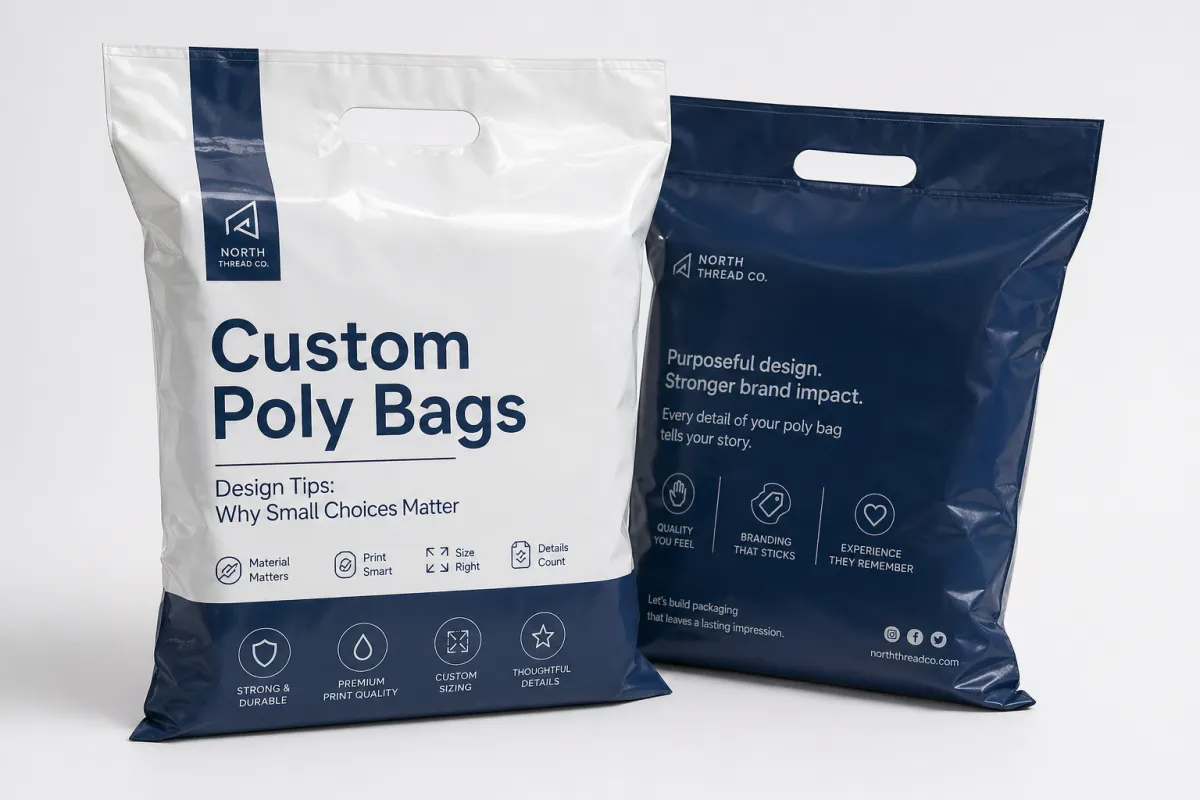
The smallest choices carry the biggest consequences. A bag can look polished in a presentation, then fail in production because the logo sits too close to a gusset, the seal compresses text, or a transparent film makes the color appear lighter than expected. Good custom poly bags design tips begin with that reality, not with the artwork file.
From a buyer's point of view, a bag has four jobs at once. It needs to hold the product, present the brand, survive handling, and pack efficiently into cartons or mailers. Miss any one of those, and the whole package feels off. That is why custom poly bags design tips are as practical as they are visual.
Here is the decision stack I see most often: size, film thickness, print method, closure style, and order quantity. Change one variable and the quote changes. Change two, and the production plan may change too. Custom poly bags design tips help you see those tradeoffs before proof approval, not after.
Keep the seal area boring. If a fold, seam, or closure can touch it, do not place critical art there. A clean bag is usually a simpler bag.
Packaging design is not only a branding exercise. It affects shelf presence, shipping efficiency, and the way buyers judge quality in seconds. A plain-looking bag can still be the right choice if it reduces clutter, protects the product, and keeps the branding sharp. The same lesson shows up in retail packaging and e-commerce packaging alike.
- Size: too much empty space looks sloppy and wastes film.
- Thickness: heavier film adds strength, but also adds material cost.
- Print placement: seams and seals can interrupt artwork.
- Closure: zipper, heat seal, adhesive flap, or open-top changes the layout.
Custom poly bags design tips are not about making the bag busy. They are about making the bag work. That is a different skill, and it usually pays back faster than chasing extra decoration.
How Do Custom Poly Bags Move From Artwork to Finished Pack?
Most custom poly bags design tips need one piece of process thinking up front: the bag is not printed as a flat rectangle without constraints. The design has to map to a physical object with panels, seams, gussets, and closure zones. The artwork brief should lead the job, not just the logo.
The production flow usually starts with concept or request, moves into bag spec selection, then artwork setup, proofing, printing, converting, and final inspection. Simple enough in theory. In practice, each stage can add time if the dimensions are unclear or the artwork is not built for the exact construction. Custom poly bags design tips work better when they include a production sequence, not only a design checklist.
Artwork mapping is where many first-time buyers underestimate the complexity. A front panel may carry a perfect logo, while the back panel is interrupted by a fin seal, and a side gusset may wrap text in a way no mockup showed. If the bag closes with a heat seal, the top margin is not decorative space. It is functional space. That distinction matters.
Print method changes the equation too. Digital print can be practical for lower quantities, variable artwork, or faster setup. Flexographic printing usually becomes more attractive at higher volumes and with simpler color counts. There are other methods in the market, but those two are the ones buyers hear about most often. Strong custom poly bags design tips should account for how each method handles detail, speed, and cost.
Timeline pressure usually shows up in the same three places: approval delays, color matching, and shipping. A team may approve a file quickly, but if the proof reveals that the barcode is too close to a seam, the schedule slips. Transit testing and distribution planning matter too; if a bag has to survive parcel movement, many teams borrow thinking from ISTA transit testing to stress the package before launch.
That habit pays off. The best custom poly bags design tips do not stop at the art file. They travel all the way through to the finished pack, because that is where the buyer sees the result and decides whether the packaging looks intentional or improvised.
Custom Poly Bags Design Tips for Size, Material, and Cost
Size shapes more than appearance. Oversized bags waste film, create loose product movement, and make branding look undersized. Undersized bags wrinkle, stretch artwork, and can make sealing difficult. If you want practical custom poly bags design tips, start by measuring the product with enough clearance for loading and closure, not by guessing the smallest possible footprint.
Film thickness is the next cost lever. A lightweight 1.5-2 mil bag may work for low-abuse retail or internal packaging, while 3-4 mil usually gives a more substantial feel for shipping or heavier items. Go thicker and you gain puncture resistance, but you also add material cost and, sometimes, shipping weight. That tradeoff is exactly why custom poly bags design tips need a numbers mindset, not just a design mood board.
Material and finish decisions shape the look too. Clear film shows the product and supports a clean, transparent retail presentation. Opaque or white film gives more print contrast and can hide inconsistent product color. Gloss tends to feel brighter and sharper, while matte can read softer and more premium, though not every substrate handles matte the same way. These are the kinds of custom poly bags Design Tips That save a buyer from being surprised by the final sheen.
Pricing usually moves with artwork complexity, number of colors, order volume, special finishing, and custom features. More colors are not always a problem, but each added layer can raise the quote, especially on shorter runs. If budget matters, simplify the design rather than asking for a visually dense bag and hoping the supplier can absorb the cost. That is rarely how quoting works.
| Bag Choice | Best Use | Typical Thickness | Print Style | Approx. Unit Range | Design Note |
|---|---|---|---|---|---|
| Clear flat poly bag | Simple product visibility, inner packaging | 1.5-2 mil | 1-color or minimal print | $0.10-$0.18 at 5,000 units | Keep copy short so the product stays visible. |
| White opaque poly bag | Retail packaging, stronger branding | 2.5-3 mil | 1-2 colors or spot colors | $0.16-$0.28 at 5,000 units | Higher contrast helps logos read faster. |
| Gusseted retail bag | Bulkier items, better shelf presentation | 3-4 mil | 2-4 colors | $0.22-$0.40 at 5,000 units | Plan safe zones carefully near folds. |
| Heavy-duty shipping bag | E-commerce, returns, transit protection | 4-6 mil | Simple branding or monochrome print | $0.20-$0.38 at 5,000 units | Strength matters more than decorative detail. |
These ranges are not fixed. Film resin, print coverage, bag size, and source market all change the number. Still, they are useful reference points. If one quote comes in far below the rest, ask what changed: thickness, ink coverage, closure, or quality standard. Strong custom poly bags design tips always include a price sanity check.
There is also an environmental side to this. If your company tracks waste reduction, ask about downgauged film, post-consumer recycled content, and how the bag fits your recycling guidance. For broader context on packaging and waste, the EPA packaging and waste guidance is a useful baseline. It does not replace supplier advice, but it helps teams ask better questions.
One more split matters: a bag for shipping has a different logic than a bag for display. E-commerce teams care about puncture strength, carton counts, and label visibility. Retail teams care more about shelf appeal, fit, and how the package branding reads from three feet away. The same custom poly bags design tips will not produce the same bag for both jobs, and that is exactly how it should be.
Step-by-Step Custom Poly Bags Design Tips for Better Artwork
Start with the product dimensions and then add real-world clearance. That means space for loading, a little movement inside the bag, and enough room for sealing without crowding the design. If you begin with art before the size is final, the rest of the file is already compromised. This is one of the most overlooked custom poly bags design tips, and it creates avoidable rework.
Next, build the layout around safe zones, bleed, and seal margins. Logos, barcodes, legal copy, and any QR code need to stay clear of the areas where the bag folds or seals. A safe zone of roughly 1/4 inch to 1/2 inch is common on many projects, but the actual number depends on the bag construction and print method. That is why custom poly bags design tips should always tie back to the exact spec sheet, not a generic template.
Build the file the way production sees it
Use vector art for logos and line work whenever possible. It keeps edges sharp and reduces the chance of soft or jagged printing. If you use images, supply them at print-quality resolution and name the files clearly. Fonts should be outlined if your supplier requests it, and spot colors or CMYK values should be labeled in a way that someone in prepress can understand without guessing. Good custom poly bags design tips often come down to reducing ambiguity.
Typography deserves more attention than it usually gets. Small text that looks fine on a monitor can disappear once it lands on film, especially if the film has sheen or a tint. Avoid hairline strokes. Keep contrast strong. A brand name may survive at 7 points in a brochure, but a poly bag is not a brochure. It bends, reflects light, and gets handled. That changes everything.
If your packaging program also includes custom printed boxes, borrow the same discipline across all formats. The core idea is identical: align artwork with the physical package, not with a digital ideal. Consistency across product packaging and retail packaging builds trust faster than flashy graphics that do not survive production.
Review the proof like a buyer, not a designer
Proof review should be methodical. Check dimensions first, then layout, then copy, then color expectations. Do not approve a file just because the logo looks right. Ask whether the barcode has enough quiet space, whether legal copy is readable, and whether the design still works if the product shifts a little inside the bag. Those are practical custom poly bags design tips, not design theory.
- Confirm the bag size against the actual product sample.
- Check where seams, folds, and seals fall on the artwork.
- Verify minimum text size, barcode placement, and contrast.
- Compare the proof to the intended use: shipping, storage, or retail display.
- Approve only after the proof reflects the real construction.
A proof that ignores the seam is not a proof. It is a guess with a logo on it.
That is the part many buyers learn the hard way. The more disciplined the artwork review, the fewer surprises later. If a supplier sends a flat proof, ask for a version that shows the actual bag construction. It takes a little longer upfront, but it protects the run. In my experience, that is the heart of useful custom poly bags design tips: catch the cheap fix early and avoid the expensive one later.
Common Mistakes in Custom Poly Bags Design
The first mistake is designing before confirming the exact bag dimensions. Once that happens, the artwork may be cropped, stretched, or pushed into a seam. A bag that is even slightly off-size can make a brand look careless. Custom poly bags design tips are supposed to prevent that, yet this is still one of the most common errors.
The second mistake is overdesigning the front panel. Too much copy, too many logos, and too many decorative elements can turn a bag into visual clutter. Clean package branding usually works better because it gives the product room to breathe. If a shopper cannot understand the message in two seconds, the design is doing too much. That lesson applies to retail packaging across the board.
The third mistake is ignoring how the film changes the image. Clear film, glossy film, matte film, and tinted film all shift perception in different ways. A blue logo on a screen can look muted on translucent resin. Black can read strong on one substrate and washed out on another. Good custom poly bags design tips force you to think about contrast in real materials, not just in software.
- Skipping the proof: this is the fastest path to preventable errors.
- Using tiny legal text: it becomes unreadable after sealing or handling.
- Placing critical art near folds: the design can get interrupted by the build.
- Ordering too many units too soon: the inventory risk grows if the design changes later.
The fourth mistake is treating the bag like a one-off instead of part of a larger packaging system. If your brand already uses custom printed boxes or other coordinated packaging, the bag should feel aligned with that family. Not identical, but related. That kind of consistency matters because buyers read it as professionalism, not decoration.
Another common problem is assuming a cheaper quote means a better deal. Sometimes the lower number comes from a thinner film, fewer print colors, or a simplified seal that is not right for the product. Sometimes it comes from a shorter approval path that leaves less room to fix mistakes. Good custom poly bags design tips always compare value, not just unit price.
Inventory risk is real too. A bag design can look excellent in theory, then become awkward if the product size changes or the compliance language gets updated. That is why the best teams build in enough flexibility to avoid overcommitting to one locked-in version too early. I’m kinda wary of any bag program that leaves no room for a size tweak or copy change, because those revisions happen more often than people expect.
What Are the Best Custom Poly Bags Design Tips for Faster Approvals?
Fast approvals start with a clean brief. If you want useful custom poly bags design tips, send the supplier the bag size, product dimensions, intended use, print count, target quantity, and any closure preference in one place. A quote request that reads like a complete spec sheet gets better answers than a note that says, "Need a bag with our logo." Suppliers can work from detail. They cannot work from a hunch.
The next move is to package the artwork cleanly. Include fonts if they are not outlined, keep linked images in one folder, and attach a reference mockup that shows the intended front and back layout. If the design depends on a particular shade or contrast level, say that directly. One of the most practical custom poly bags design tips is also one of the least glamorous: make the file easy for prepress to review.
Ask for a proof that reflects the actual construction, not just a flat art file. That means seam placement, bag width, and closure details should be visible early. A proof should answer the question, "Will this work on the actual bag?" If it cannot answer that, it is not the right proof. In larger packaging programs, this same logic applies to Custom Packaging Products and even to Custom Poly Mailers, because structure shapes the final print result.
Timeline buffer matters too. Build in time for revisions, color matching, production setup, and delivery. Rush schedules cost more and reduce room for correction. I have seen teams save a little time at the quoting stage and lose a lot of time in final approval because nobody left space for a second proof. That tradeoff rarely pays off.
If you are deciding where to spend and where to trim, use a simple matrix. If brand impact matters most, keep the print quality high and simplify elsewhere. If margin matters most, reduce color count and avoid special features that do not change the buyer's experience. If transit durability matters most, spend on thickness and seal quality before you spend on extra ink. That is a practical version of custom poly bags Design Tips That works in real purchasing meetings.
There is also a standards mindset worth borrowing. For shipping performance, teams often lean on ISTA transit testing to think through drops, vibration, and handling. For material discussions, suppliers may mention ASTM methods for seal strength or film evaluation. You do not need to quote the standard in every conversation, but knowing these frameworks exist helps you ask sharper questions and compare suppliers more fairly.
One more judgment call: do not let the approval process get buried under aesthetics. A good proof is about fit, readability, and manufacturability. If you keep those three priorities clear, approvals move faster and the final bag usually looks more expensive than it was.
Next Steps for Custom Poly Bags Design and Production
The simplest way to move forward is to create a one-page spec sheet. Include the size, material, thickness, print method, closure type, quantity, and target use. Add a short note on whether the bag is for shipping, storage, or retail display. That one page often does more for custom poly bags design tips than a long back-and-forth thread ever will.
Then audit the current artwork. Look for seams, safety margins, minimum text size, barcode space, and contrast. If the file was built for another package shape, assume it needs revision. This is also the moment to check whether the branding system is consistent across related formats. A bag should not feel disconnected from other product packaging, especially if the brand already uses custom printed boxes or other coordinated materials.
Request a sample or proof process that lets you compare placement, readability, and finish against the actual product. If possible, compare the bag next to the item it will hold, not just on a screen. That simple step catches more problems than people expect. It is one of the quietest custom poly bags design tips, and also one of the most effective.
From there, set a realistic production calendar. Count proofing, revisions, manufacturing, and delivery before you set a launch date. Work backward. Build a buffer. A packaging schedule that ignores setup time usually becomes a stressful schedule later. Buyers who respect the calendar usually get better results and fewer surprises.
For brands deciding between different formats, keep the choice simple: use the version that protects the product, supports the budget, and fits the timeline without forcing awkward compromises. That may be a bag, a mailer, or a box. The point is not to force every brand touchpoint into one format. The point is to make each one earn its place.
Use these custom poly bags design tips to choose the simplest version that still supports the brand, the product, and the order flow. Done well, the bag stops being just a container and becomes part of the buying experience.
What are the most important custom poly bags design tips for first-time buyers?
Start with exact product dimensions and a clear use case so the bag fits, seals, and ships the way you need. Keep the artwork simple enough to survive seams, folds, and print limits. Ask for a proof before approving production. Those three steps cover most of the risk in custom poly bags design tips.
How do custom poly bags design tips help control pricing?
They reduce waste by matching the bag size to the product instead of overbuying material. They also help you Choose the Right print method and color count for the budget, which is often where costs move fastest. Most important, they lower revision costs by catching artwork problems early. That is where custom poly bags design tips pay for themselves.
What file format works best for custom poly bags design?
Vector files are usually best for logos and line art because they stay sharp at production size. High-resolution raster images can work for photos or detailed graphics if they are supplied correctly. Always include fonts, linked assets, and any spot color notes requested by the supplier. Clean files make custom poly bags design tips easier to apply.
How long does the custom poly bags design and approval process usually take?
Simple jobs can move quickly if artwork is ready and no structural changes are needed. Extra time is often needed for proofs, color matching, and revisions. Rush timelines usually cost more and leave less room to fix mistakes, so even solid custom poly bags design tips need a realistic calendar behind them.
What is the biggest mistake to avoid when applying custom poly bags design tips?
Approving artwork before checking seams, margins, and final bag dimensions is the biggest one. A design that looks great on a computer can fail when it meets the physical bag layout. A careful proof review prevents the most expensive production errors, which is why custom poly bags design tips always circle back to the proof.
Custom poly bags design tips work best when they are treated like a production discipline, not a design trend. The more carefully you match artwork to structure, thickness, closure, and use case, the more likely the finished bag will look intentional in the hand and on the shelf. My practical takeaway is simple: measure the product, map the seam and seal zones, and approve the proof against the real construction before you commit to a full run. That is the shortest path to a bag that does its job without making a fuss.


