Buyer Fit Snapshot
| Best fit | Custom Poly Film Printing Wholesale Supplier for Brands projects where brand print, material claims, artwork control, MOQ, and repeat-order consistency need to be specified before quoting. |
|---|---|
| Quote inputs | Share finished size, material target, print colors, finish, packing count, annual reorder estimate, ship-to region, and any compliance wording. |
| Proofing check | Approve dieline scale, logo placement, barcode or warning zones, color tolerance, closure strength, and carton packing before bulk production. |
| Main risk | Vague material claims, crowded artwork, missing packing details, or unclear freight terms can make a low unit price expensive after revisions. |
Fast answer: Custom Poly Film Printing Wholesale Supplier for Brands should be specified like a repeatable production item. The safest quote records material, print method, finish, artwork proof, packing count, and reorder notes in one written spec.
Production checks before approval
Compare the actual filled-product size with the drawing, then confirm tolerance on folds, seals, hang holes, label areas, and retail display edges. Reserve space for logos, QR codes, warning copy, and material claims before decorative graphics fill the panel.
Quote comparison points
Review material grade, print process, finish, sampling route, tooling charges, carton quantity, and freight assumptions side by side. A quote is only useful when the supplier can repeat the same color, closure quality, and packing count on the next order.
A custom poly film printing wholesale supplier can save money in places most buyers miss. The film itself is rarely the expensive part. The real costs show up when the gauge is off, the seal window is too tight, or the print setup does not match the line. That is where waste, rework, and launch delays are gonna start stacking up.
Poly film is not doing one job. It is protecting the product, carrying the artwork, running through equipment, and staying consistent from the first order to the fifteenth. If your team already buys branded packaging, Custom Printed Boxes, or retail packaging, the film side should not be the weak link. A strong custom poly film printing wholesale supplier keeps the printed film aligned with the rest of the package, not just with the lowest quote.
Wholesale sourcing changes the commercial model in a good way. Instead of splitting film, printing, and converting across different vendors, the buyer asks one supplier to own the specs, the color control, and the delivery schedule. That usually cuts hidden costs. It also reduces the number of places a reorder can drift. For high-volume product packaging, that kind of control matters. I have seen teams save a few cents on the roll and lose it three times over in scrap because the film never really matched the machine.
Poly film has different strengths from paperboard, labels, and cartons. It is lighter. It handles moisture better. It can be formed, wrapped, or overwrapped in ways rigid packaging cannot. It also keeps freight weight down, which sounds boring until you see the shipping bill. Compared with many rigid formats, a custom poly film printing wholesale supplier gives brands more print space and less bulk in transit.
The buying rule is simple. If the brand cares about throughput, repeatability, and predictable pricing, wholesale supply is the right model. A custom poly film printing wholesale supplier is not just selling material. The supplier is selling process control. That is where the margin usually survives.
Why a Custom Poly Film Printing Wholesale Supplier Matters
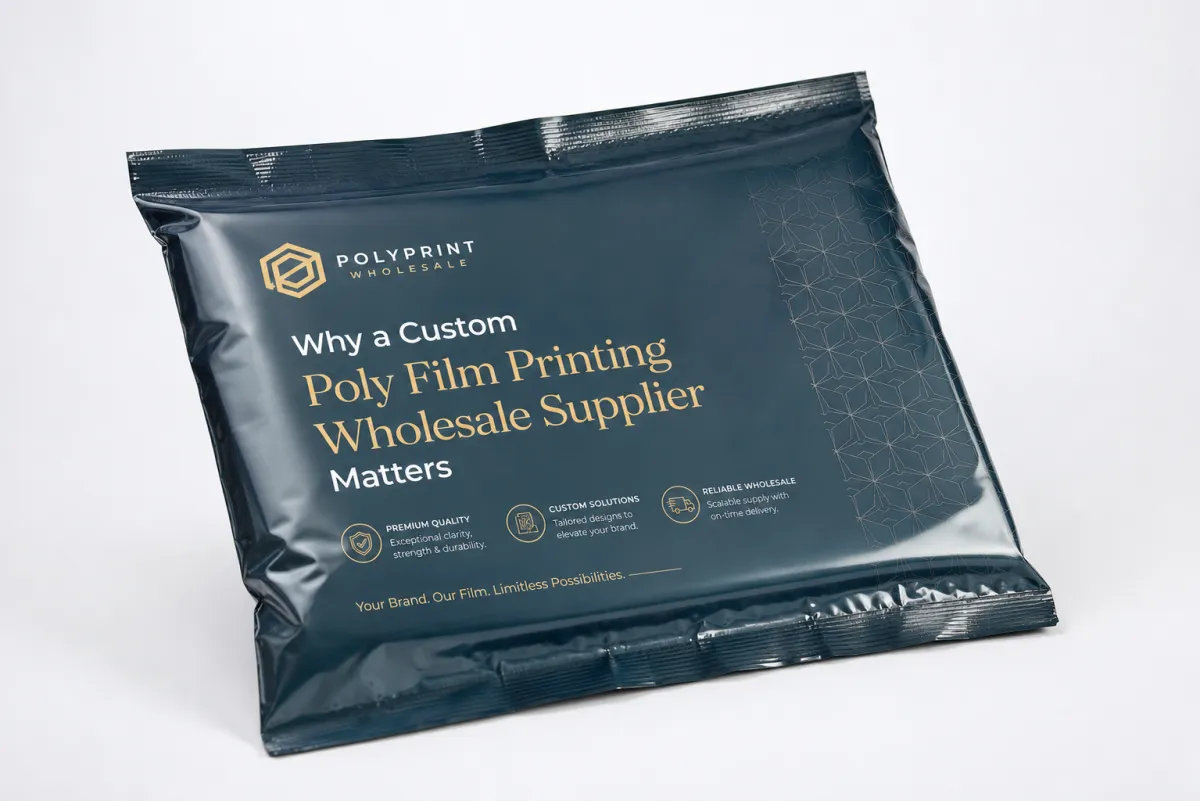
Most packaging headaches show up after the purchase order is already sent. A film that looks cheap on paper can turn expensive the moment it hits a fast line and starts slipping, wrinkling, or sealing badly. A custom poly film printing wholesale supplier cuts that risk by matching the film gauge, resin family, and print setup to the application instead of forcing the buyer to fix problems later.
The hidden cost is usually a spec mismatch. Add one mil of thickness and puncture resistance may improve, but stiffness and machine behavior can change with it. Push the seal window too narrow and leaks creep in. Load the print too heavily and production slows while scrap climbs. A custom poly film printing wholesale supplier should spot those trade-offs before production starts. That is cheaper than learning them during a launch run.
Wholesale matters even more on reorder. The first run may look fine. The second run has to match it. The third run needs to land on time. If the film width, winding direction, or color target drifts, production crews notice fast. A good custom poly film printing wholesale supplier keeps roll dimensions, print alignment, and sealing behavior steady across runs. That is what consistency actually means.
There is also the brand side. Buyers who source custom printed boxes, labels, and other product packaging from different vendors often end up with a package that feels stitched together. Film is part of the system. When the art direction, color targets, and finish are coordinated, the whole package looks deliberate. That matters in retail packaging, direct-to-consumer fulfillment, and industrial channels alike.
The better question is not "Can this film be printed?" It is "Can this custom poly film printing wholesale supplier keep the job stable for six months of reorders?" That question forces the conversation toward repeatability, waste rate, and line efficiency instead of headline price.
- Lower waste: fewer mismatches between film gauge, seal jaws, and line speed.
- Better continuity: the same color, roll size, and run behavior on reorders.
- Cleaner buying: one quote covers printing, converting, and logistics instead of three handoffs.
- Stronger brand control: artwork and finish stay aligned across product packaging programs.
A custom poly film printing wholesale supplier matters most when the buyer has volume, repeat SKUs, or a tight launch window. That is when small defects become operational problems. The difference between a decent quote and a useful one usually comes down to whether the supplier understands the line as well as the artwork.
Custom Poly Film Printing Wholesale Supplier Options: Film, Ink, and Finish
The first decision is the film structure. A custom poly film printing wholesale supplier will usually lay out several choices, and each one changes strength, clarity, seal behavior, and price. The common options are LDPE, HDPE, LLDPE, and co-extruded blends. None of them wins every job. The right one depends on weight, puncture risk, storage conditions, and whether the film is being used as a pouch, liner, wrap, or overwrap.
LDPE, HDPE, and LLDPE
LDPE is flexible and forgiving. Buyers use it when easy sealing and general handling matter more than stiffness. HDPE is stiffer and works well when the application needs a thinner feel with more tensile strength. LLDPE usually brings better puncture resistance and stretch performance, which makes it useful for tougher industrial jobs and load containment. A custom poly film printing wholesale supplier should explain how those choices affect the machine, not just the catalog spec.
Co-extruded structures deserve attention because they let different layers do different work. One layer can support print clarity. Another can improve seal performance. Another can add toughness. That is a practical advantage when the film has to survive transit, stacking, or rough handling. For buyers comparing branded packaging formats, this is where film becomes more flexible than people expect.
Flexographic, rotogravure, and digital printing
Printing method changes the economics and the image quality. Flexographic printing is often the most balanced choice for a custom poly film printing wholesale supplier because it handles many wholesale programs well and keeps setup costs more manageable than some alternatives. Rotogravure can produce excellent solids and fine detail at very high volume, but the tooling expectations are higher. Digital printing can fit short runs, seasonal SKUs, or artwork that changes often.
The practical view is simple. If the artwork is basic, the run is steady, and the volume is high, flexo usually makes sense. If the graphics are rich and the program is massive, rotogravure deserves a look. If the order is small or speed matters more than anything else, digital printing may be the least painful path. A good custom poly film printing wholesale supplier will not push the fanciest method. The right method is the one that fits the run length and the reorder plan.
| Print Method | Best Fit | Setup Profile | Typical MOQ | Relative Unit Cost | Notes |
|---|---|---|---|---|---|
| Digital printing | Short runs, fast changes, seasonal graphics | Low setup, minimal tooling | 1,000-5,000 units | Higher | Good for proof-to-production speed and smaller inventory risk |
| Flexographic printing | Repeat SKUs, medium to high volume | Moderate setup, plate-based | 5,000-25,000 units | Medium | Often the most flexible wholesale option for a custom poly film printing wholesale supplier |
| Rotogravure printing | Very high-volume programs, rich solids | High setup, cylinder-based | 25,000+ units | Lower at scale | Strong image quality, but higher front-end commitment |
Gloss, matte, and performance finishes
Finish is not just a visual choice. Gloss can sharpen color and give the package more shelf pop. Matte can reduce reflections and make premium designs feel calmer. Anti-slip finishes matter when bags or rolls are stacked on pallets. Anti-static treatment matters when the film moves through automated equipment or picks up dust in dry environments. A thoughtful custom poly film printing wholesale supplier should talk about finish in terms of handling and presentation, not only style.
Clear and opaque constructions solve different problems. Clear film can show product texture or fill level. Opaque film can hide variability and strengthen package branding. For brands already using offset printing on cartons or digital printing on labels, the finish on the film should support the same design language. That is how a product family feels connected instead of assembled from separate vendors.
The best choice is not the flashiest one. It is the one that matches product weight, storage conditions, and retail packaging requirements. A custom poly film printing wholesale supplier should be able to explain those trade-offs in plain language, because the buyer's job is not to admire the spec sheet. The job is to keep the line moving and the brand looking consistent.
If you are comparing adjacent formats, the same logic applies to Custom Poly Mailers and other flexible formats. Film, mailers, and overwraps all live in the same decision tree: protect the product, reduce waste, and keep the artwork aligned with the broader packaging design system.
Core Specifications Buyers Must Lock In Before Ordering
Quotes go sideways when buyers send incomplete specs. A custom poly film printing wholesale supplier can only price accurately if the order details are locked before the artwork is approved. The basic inputs are width, thickness, core size, roll diameter, winding direction, and whether perforation is required. Miss one of those, and the quote starts drifting.
The technical details matter just as much as the basic dimensions. Film that runs on automated equipment needs the right slip coefficient, puncture resistance, and seal strength. If the packaging line is aggressive, the supplier should know the operating conditions. If the film is feeding a form-fill-seal machine, jaw temperature range and seal dwell time matter. A custom poly film printing wholesale supplier that asks these questions is not slowing the order down. It is preventing a reprint.
For buyers who want a practical standard, build the spec sheet around measurable properties. ASTM D882 is commonly used for tensile behavior, ASTM F88 is often used for seal strength, and ASTM D1894 is a useful reference for coefficient of friction. Those standards do not replace application testing, but they give the buyer and the supplier a common language. The ISTA standards library is also useful if the film will face parcel drops, vibration, or distribution stress rather than simple shelf storage. A spec sheet is not a magic wand, but it does cut through a lot of guesswork.
Artwork needs the same discipline. A custom poly film printing wholesale supplier should receive a clean file with bleed, dielines, Pantone targets, barcode placement, and minimum type sizes. Small reversed type below about 5 pt can get hard to read on film, especially if the print area stretches during conversion. Barcodes should stay clear of seams, folds, and places likely to wrinkle. If the buyer changes art after proof approval, the delay should not be a surprise.
Compliance should be defined before production begins, not after. Food-contact applications need the right resin declarations and, where relevant, migration support. Chemical packaging may need compatibility checks or safety documentation. Regulated goods may require traceability or additional handling notes. A custom poly film printing wholesale supplier that handles those questions early is protecting the launch schedule.
One of the easiest ways to improve quote accuracy is to send a one-page spec sheet. That sheet should include:
- Film construction: LDPE, LLDPE, HDPE, or co-ex blend.
- Dimensions: width, thickness, roll diameter, core size, and winding direction.
- Print details: number of colors, Pantone targets, and print coverage level.
- Application: food, retail packaging, industrial wrapping, liner, or pouch use.
- Operational needs: seal strength target, puncture resistance, anti-static, or anti-slip treatment.
- Artwork files: editable source files, outline fonts, and barcode placement.
That one sheet saves days of back-and-forth. It also helps the custom poly film printing wholesale supplier match the order against the right production path, which is usually what buyers actually want from the first call.
Custom Poly Film Printing Wholesale Supplier Pricing, MOQ, and Volume Breaks
Price is the headline, but it is not the full story. A custom poly film printing wholesale supplier prices work based on resin choice, gauge, print colors, order volume, roll width, and whether the order needs custom converting or special finishing. A thicker gauge, more print coverage, or a higher color count can move the number fast. So can a narrower width if the line needs a special slitting setup.
MOQ is usually tied to setup effort. Digital jobs can support lower thresholds because tooling is lighter. Flexographic orders often need a higher floor because plates, setup, and color registration all take time. Rotogravure usually sits at the highest commitment level because cylinders and press preparation are more intensive. A custom poly film printing wholesale supplier should explain why the minimum exists, not just state it. If they cannot explain it, the number is probably doing too much work on its own.
Volume breaks create another trap. The cheapest unit price can still be the wrong buy if inventory piles up or the design is likely to change. A lower first run may cost more per unit, but it can reduce obsolescence and warehouse pressure. Buyers should look at landed cost, shelf life, and forecast certainty together. That is the commercial reality of wholesale film buying.
Here is a cleaner comparison that buyers can use when evaluating a custom poly film printing wholesale supplier quote:
"A quote should make the trade-offs visible: gauge, print coverage, setup, freight, and reorder behavior. If those pieces are hidden, the real price is hidden too."
| Cost Factor | Why It Moves Price | What To Ask |
|---|---|---|
| Resin choice | Different polymers change clarity, strength, and seal behavior | Which film family best fits the application and line speed? |
| Gauge / thickness | More material usually means more cost and different machine behavior | What is the minimum gauge that still protects the product? |
| Print colors | Each color can add setup time, plates, or registration complexity | Can the art be simplified without hurting package branding? |
| Order volume | Setup costs spread out over more units at higher volumes | What is the best break point for the next 2-3 reorders? |
| Freight and packing | Heavy pallets, long routes, and special packing can change landed cost | What is the delivered price to my dock? |
When buyers compare quotes fairly, they compare like with like. Same film gauge. Same width. Same print method. Same roll size. Same core. Same proofing assumptions. A custom poly film printing wholesale supplier cannot be judged on unit price alone if another bidder quietly changed the spec.
There is also room to negotiate value instead of only cutting the line item. Standardize widths across multiple SKUs. Bundle repeat runs. Approve a longer supply plan if the forecast is stable. Ask whether plate charges can be spread over a rolling program. Those moves often save more than arguing over the smallest quote difference.
For buyers who also work with Wholesale Programs in other packaging categories, the same lesson applies: the best commercial deal usually comes from repeatability, not a one-time discount. A custom poly film printing wholesale supplier should be part of that strategy, not a one-off purchase.
From Quote to Delivery: Process and Timeline
A smooth order is usually a disciplined order. A custom poly film printing wholesale supplier will move through the same basic steps every time: spec review, artwork file check, quote, proof approval, production, quality inspection, packing, and freight. The buyer's job is to keep the process clean so each step finishes once.
Delays often start with missing information. Artwork arrives without bleeds. Color targets are described verbally instead of with Pantone references. The buyer changes the width after the quote arrives. Someone new gets pulled into the approval chain and asks to see a different proof. Each change can reset the clock. A reliable custom poly film printing wholesale supplier will warn about that early, because they have seen the same mess more than once.
Sampling matters, but not every job needs the same proofing depth. A digital proof is often enough when the art is straightforward and the risk is low. A physical sample is worth the extra step when the film has a complex finish, a demanding seal window, or a new machine interface. That extra loop can save a lot of time if the film is tied to launch inventory. The point is to test the right thing, not to test everything.
Lead time is a mix of production and freight. A simple reorder with locked artwork often lands in the 12-15 business day range after proof approval, while a more complex first run can take longer, especially if tooling or special converting is involved. Shipping method adds another layer. Air moves faster and costs more. Ground or ocean can make sense for larger wholesale programs, but only if the buyer has enough inventory buffer. A custom poly film printing wholesale supplier should be honest about where the time is actually spent.
Peak season capacity also changes the picture. If the supplier's press schedule is tight, the same job can take longer without any change in specs. That is normal. What matters is communication. Buyers should ask for a realistic window, not the most optimistic one. They should also keep one person responsible for approvals so the process does not stall in a group thread.
Three practical moves shorten the cycle:
- Send one clean spec sheet with the first inquiry.
- Use one approval owner for artwork, proof, and schedule sign-off.
- Keep a backup version of the artwork in case a line detail needs adjustment.
That kind of discipline is boring. It is also effective. A custom poly film printing wholesale supplier works best when the buyer treats the order like a controlled manufacturing step instead of a design request.
If the job is tied to broader manufacturing support, it helps to understand the supplier's Manufacturing Capabilities before the quote is signed. The buyer wants confidence in print control, converting tolerance, and shipping accuracy. Those are operational facts, not marketing claims.
Why Choose Us as Your Custom Poly Film Printing Wholesale Supplier
The strongest reason to choose a custom poly film printing wholesale supplier is not a flashy promise. It is fewer surprises. Buyers need stable quality control, responsive quoting, and print consistency that holds from one production run to the next. That matters more than any slogan because packaging is judged under load, on a line, and in front of customers.
In practice, the value comes from coordination. Printing, converting, and logistics should work as one chain. If those steps are isolated, the buyer ends up managing the handoffs. If they are aligned, the supplier can protect deadlines and keep reorders matched to the original spec. A dependable custom poly film printing wholesale supplier understands that the job is not done when the press stops. It is done when the pallet arrives in spec.
Transparent communication matters just as much. If a thickness change will affect seal performance, say so. If a color count will push the quote into a different setup tier, say so. If the lead time is realistic only with a certain freight method, say so. Buyers do not need hype. They need honest trade-offs. That is especially true for branded packaging programs where packaging design and package branding must stay consistent across channels.
Quality control should be measurable. Ask about dimensional tolerance, roll uniformity, color control, and issue resolution after delivery. A custom poly film printing wholesale supplier should be able to discuss how it checks roll width, core fit, print registration, and edge condition before shipment. That is the kind of detail that protects the line from avoidable downtime.
There is a broader commercial value too. A supplier that understands retail packaging, custom printed boxes, and other adjacent formats can help the buyer keep the whole package family aligned. That makes seasonal programs easier. It also makes private label expansion less messy. For buyers who need flexibility, a single partner can keep the film side and the other packaging pieces speaking the same visual language.
We also understand that not every buyer needs the same service level. Some orders are high-visibility launches. Others are repeat industrial runs where consistency matters more than presentation. A custom poly film printing wholesale supplier should know the difference. The right recommendation for a premium consumer item is not always the right recommendation for a warehouse line or a contract packer's operation.
That is why buyers often stay with a supplier who is clear, responsive, and predictable. The relationship gets easier with every reorder. A custom poly film printing wholesale supplier earns that trust by keeping documentation clean, keeping specs stable, and keeping the conversation about facts.
Next Steps for Buyers Ready to Request a Quote
If you are ready to quote a custom poly film printing wholesale supplier, start with the application, not the artwork. Food packaging, industrial wrapping, retail packaging, and mailing applications can all use poly film, but they do not use the same structure or finish. The same film spec is rarely ideal for every job. A better first question is simple: what does the film need to do on the line and in the field?
Then gather the basic purchase data. The faster the supplier sees the real job, the faster the quote becomes useful. A strong custom poly film printing wholesale supplier will usually price faster when the request includes these items:
- Width, thickness, and roll length or target roll diameter
- Film type and preferred finish
- Print colors, Pantone targets, and print coverage
- Core size and winding direction
- Artwork files and barcode placement
- Target quantity and reorder forecast
- Compliance or application notes
- Needed delivery date and ship-to location
Review two or three quotes on total landed cost, not only unit price. Include tooling, freight, proofing, and any special finishing. Then check whether the comparisons are truly equivalent. A custom poly film printing wholesale supplier quote is only useful if the specs match. Otherwise the lower price may just reflect a weaker film, a smaller color count, or a different production method.
Keep the same spec sheet for every reorder. That simple habit protects consistency from run to run. It also helps the supplier maintain color, tolerance, and material behavior over time. For buyers building a repeat program, that is where the value compounds. A dependable custom poly film printing wholesale supplier does not just sell a roll of film. The supplier helps keep the whole packaging system stable.
For brands that want to move beyond one-off buying, the next step is practical: collect the specs, compare the landed cost, and request a quote that can support repeat production. If the supplier can keep the numbers, the film, and the timeline aligned, the relationship is worth building. The smartest move is usually the least dramatic one: lock the spec, choose the film that runs clean, and set up the next reorder before the first one ships.
What should I send a custom poly film printing wholesale supplier for an accurate quote?
Send width, thickness, roll length or target roll diameter, core size, print colors, artwork files, and the application type. Include your target quantity, preferred delivery date, and any compliance requirements so pricing reflects the real job. A custom poly film printing wholesale supplier can only quote well when the spec sheet is complete.
How do custom poly film printing wholesale supplier MOQs usually work?
MOQ is usually tied to setup effort, print method, and film type, so more complex jobs need higher minimums. If you expect repeat orders, ask whether a larger first run lowers future unit pricing and plate or tooling amortization. A custom poly film printing wholesale supplier should explain where the break point sits and why.
How long does production take with a custom poly film printing wholesale supplier?
Timeline depends on proof approval, artwork readiness, tooling needs, and current production load. Clean files and locked specs shorten the process; late changes are the most common cause of delay. A reliable custom poly film printing wholesale supplier will give you a realistic window, not a best-case guess.
What is the difference between flexographic and rotogravure printing for poly film?
Flexographic printing is typically more flexible for many wholesale orders and can be cost-effective across a wide range of runs. Rotogravure can support very high-volume programs and strong image quality, but it usually carries higher setup expectations. The right custom poly film printing wholesale supplier will match the method to the volume, not the other way around.
How can I compare two custom poly film printing wholesale supplier quotes fairly?
Compare total landed cost, not only unit price, by including tooling, freight, proofing, and any special finishing charges. Check whether the quotes use the same film gauge, print method, roll size, and MOQ so the comparison is truly equivalent. The best custom poly film printing wholesale supplier quote is the one That Holds Up after the spec sheet is matched line by line.

